
Introduction: Language—Where the Revelation Was Entrusted
The Book of God Almighty and the Sunnah of His Prophet ﷺ represent the pure spring of Islamic legislation and the foundation of the Ummah’s creed and practice. Since divine guidance was revealed within a precise linguistic framework—Classical Arabic—this language itself became, as scholars have described it, “the vessel of the Sharia.”
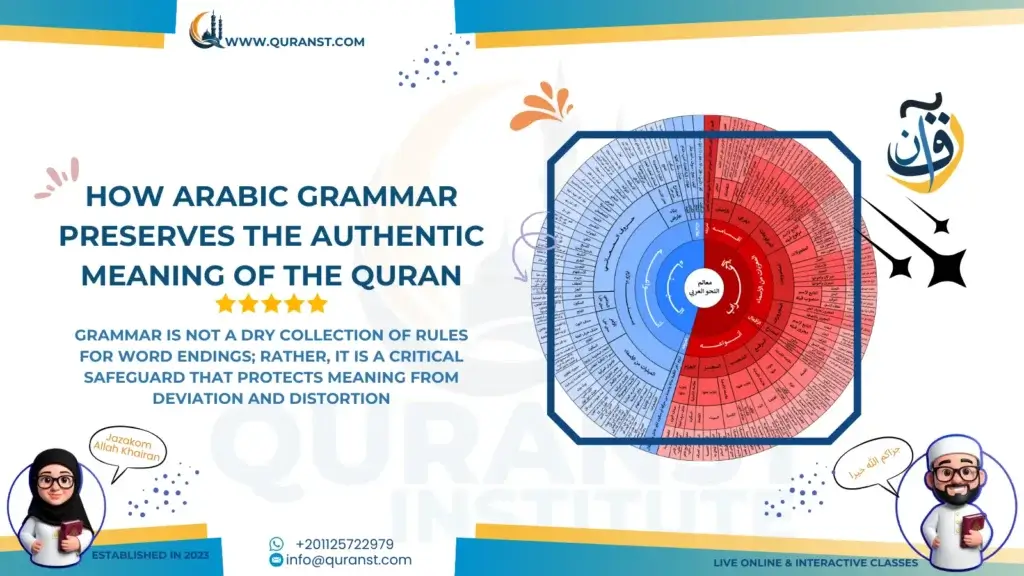
Understanding the intent of God Most High and grasping the exact meanings of Qur’anic verses and prophetic traditions cannot be achieved in full without a firm command of Arabic—foremost among its sciences is Arabic grammar (naḥw). Grammar is not a dry collection of rules for word endings; rather, it is a critical safeguard that protects meaning from deviation and distortion—distortions that may radically alter doctrinal understanding. A single grammatical vowel, if misplaced, can redirect meaning entirely, as will be demonstrated.
This article explores, with depth and reflection, the importance of grammar as an essential instrumental science. It examines its ultimate purpose, traces its historical emergence from natural linguistic instinct to codified rules, and clarifies its core foundations—such as the distinction between grammar and morphology, and the fundamental categories of speech.
First Axis: The Supreme Purpose of Studying Grammar—Preserving the Divine Meaning
1. Arabic as the Vessel of Sharia
Scholars agree that Arabic is not merely a means of communication, but the exclusive medium through which revelation is understood. Imām al-Shāṭibī states:
“The Qur’an was revealed according to the conventions of Arab speech.”
(al-Muwāfaqāt, vol. 2, p. 78)
Grammatical inflection (iʿrāb) is not ornamental—it defines relationships between words and reveals the speaker’s intent. Without it, meanings blur and divine guidance becomes vulnerable to misinterpretation.
2. The Danger of Grammatical Error and Its Doctrinal Impact
The seriousness of grammar becomes evident in verses whose meanings hinge upon a single vowel. Among the clearest examples is the verse:
“Indeed, Allah is free from obligation to the polytheists, and so is His Messenger.”
(Qur’an 9:3)
The correct reading—“wa rasūluhu” (with nominative case)—affirms that both God and His Messenger ﷺ are disavowed from the polytheists.
A mistaken reading—“wa rasūlihi” (genitive case)—would produce a gravely corrupt meaning that contradicts the foundations of faith.
Ibn Taymiyyah emphasized this reality:
“Grammatical inflection follows meaning, and its corruption leads to corruption of meaning.”
(Majmūʿ al-Fatāwā, vol. 10, p. 512)
Can a science with such consequences be treated lightly?
3. Grammar and Morphology as Instrumental Sciences
Grammar and morphology are classified among the sciences of means (ʿulūm al-ālah)—studied not for their own sake, but as indispensable tools for understanding higher sciences such as tafsīr and fiqh. Al-Zarkashī explicitly notes this classification in al-Burhān (vol. 1, p. 13).
Second Axis: The Emergence of Grammar—From Linguistic Instinct to Codification
1. Arabic Before Codification
In pre-Islamic Arabia and the early Islamic period, Arabs spoke with natural linguistic instinct. Errors were rare, and grammar existed implicitly within fluent speech.
2. Linguistic Mixing and the Rise of Error
With the rapid expansion of the Islamic state and the entrance of non-Arabs into Islam, grammatical mistakes (laḥn) began to spread—even in Qur’anic recitation. Scholars recognized that safeguarding the text required safeguarding the language itself.
3. The Foundational Role of Imām ʿAlī and Abū al-Aswad al-Duʾalī
Historical sources agree that the earliest systematic foundations of grammar trace back to Imām ʿAlī ibn Abī Ṭālib رضي الله عنه, who instructed Abū al-Aswad al-Duʾalī to codify linguistic principles after noticing widespread errors. He famously said:
“Follow this method (unḥu hādhā al-naḥw).”
(Ibn ʿAbd al-Barr, al-Inbāh, vol. 1, p. 46)
From this directive emerged the science of naḥw, beginning with the classification of speech and the marking of inflection.
4. Scholarly Development and Grammatical Schools
Grammar flourished through giants such as al-Khalīl ibn Aḥmad al-Farāhīdī, and his student Sībawayh, author of al-Kitāb, described by scholars as the most comprehensive grammatical work ever written:
“Whoever seeks mastery of grammar must rely on the Book of Sībawayh.”
(Siyar Aʿlām al-Nubalāʾ, vol. 7, p. 9)
The Basran and Kufan schools later emerged—differing in methodology, yet united in purpose: protecting Arabic to serve the Qur’an.
Third Axis: Grammar, Morphology, and Parts of Speech—Keys to Structure and Meaning
1. Grammar vs. Morphology
- Grammar (Naḥw): Studies word endings and syntactic relationships within sentences.
- Morphology (Ṣarf): Studies the internal structure and formation of words.
Ibn Jinnī summarized this distinction succinctly:
“Morphology concerns the form of the word itself, grammar concerns its state.”
(al-Khaṣāʾiṣ, vol. 1, p. 34)
2. The Three Parts of Speech
Arabic speech is confined to three categories:
- Noun: Denotes a meaning not tied to time.
- Verb: Denotes an action tied to time.
- Particle: Conveys meaning only in relation to other words.
This foundational division appears in Sībawayh’s al-Kitāb (vol. 1, p. 12).
Fourth Axis: Classical Arabic and Dialects—Why Grammar Remains Essential
1. Early Dialects and Linguistic Integrity
The dialects present during the Qur’an’s revelation were all grammatically sound and fell within the bounds of correct Arabic—hence the concept of the seven modes (aḥruf), as explained by Ibn al-Jazarī (al-Nashr, vol. 1, p. 32).
2. Modern Colloquial Arabic and Semantic Loss
Modern colloquial dialects, however, have largely abandoned grammatical inflection, altered word structures, and absorbed foreign linguistic patterns—rendering them unfit to carry the precise meanings of revelation.
Grammar thus becomes the intellectual bridge that reconnects the contemporary learner—raised in colloquial speech—to the eloquent Arabic of the Qur’an and Sunnah.
Conclusion: Grammar—The Key to Reflection and Understanding 🗝️
Arabic grammar is not a peripheral discipline; it is a gateway to Qur’anic reflection and a pillar of sound religious understanding. Mastery of grammar affirms that revelation cannot be understood through conjecture, but through its own linguistic tools.
Ibn al-Qayyim stated:
“Neither the mufti nor the exegete can function without understanding the Arabic language.”
(Iʿlām al-Muwaqqiʿīn, vol. 4, p. 120)
✨ A Gentle Invitation from Quranst Institute
At معهد قرآنست, we believe that returning to the Qur’an begins with returning to its language—and that grammar is not an obstacle, but a key that unlocks clarity and certainty.
If you seek deeper understanding, conscious reflection, and a solid linguistic foundation to accompany your scholarly journey, then begin from the roots.
📘 Start your journey with Arabic grammar today—and let language lead you to meaning.

