

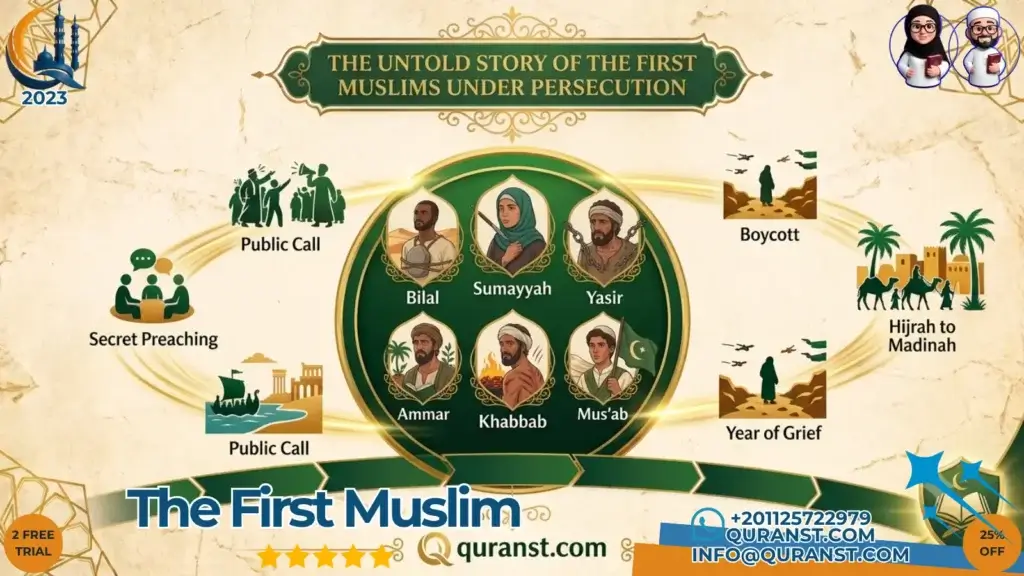
Introduction: The Price of Saying “There Is No God But Allah”
She was an elderly woman.
A freed slave with no tribe to protect her, no wealth to shield her, no political connections to appeal to. She had nothing — except a conviction so deep that no amount of physical torture could extract it from her chest.
When Abu Jahl — the most powerful enforcer in Mecca — drove his spear through her body because she refused to renounce Islam, she became something he had not intended to create.
The first martyr in the history of Islam.
Her name was Sumayyah bint Khayyat. And her story — alongside those of her husband Yasir, her son Ammar, and dozens of others — forms one of the most important and least understood chapters in Islamic history: the thirteen years between the public call to Islam and the migration to Madinah.
These were the years in which Islam was tested before it was triumphant. The years in which a small group of men and women decided that the truth was worth more than their comfort, their money, their social standing, and in some cases their lives.
For Muslim families living in the West today — raising children in a world that often makes faith feel costly — this history is not merely academic. It is a living mirror. It is the answer to the question every Muslim parent eventually faces when their child asks: “Why does being Muslim have to be so hard sometimes?”
This guide walks through those thirteen years — documented from the Quran, authentic Sunnah, and the great scholars of Ahl al-Sunnah wal-Jama’ah — with the stories, the lessons, and the spiritual framework that make this history not just informative, but transformative.
Structured Curriculum Framework
The Seerah — the prophetic biography — is one of the four core modules in quranst’s Islamic Studies track. It is taught as a living curriculum, not memorized history.
Book your free 2-session trial →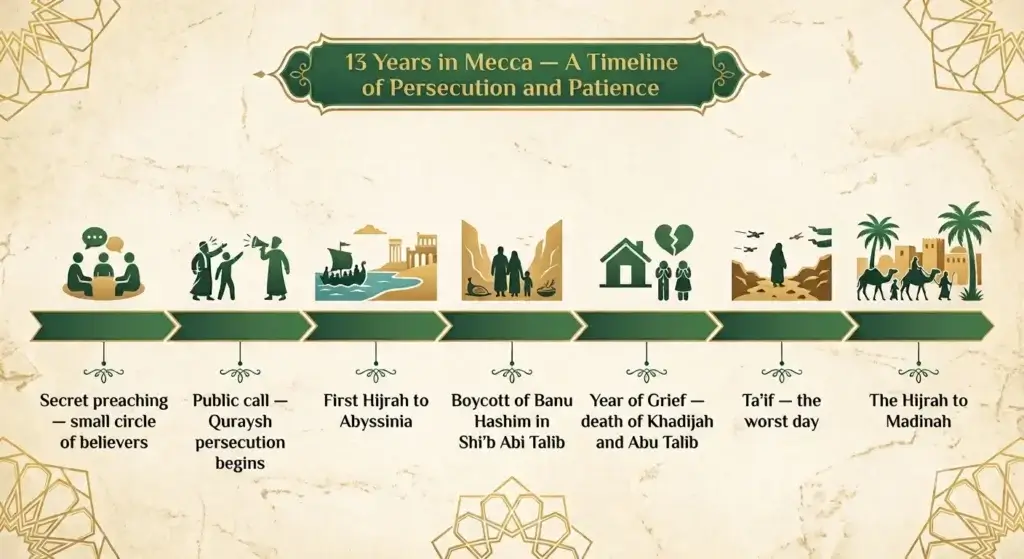
Section 1: The Moment Everything Changed — The Public Call
From Secrecy to Declaration
For approximately three years after the first revelation in the Cave of Hira, the Islamic call was private. A tight circle of believers met quietly, prayed in secret, and learned from the Prophet ﷺ away from the eyes of Quraysh. This was not cowardice. It was the wisdom of a building phase — establishing depth before breadth, roots before branches.
Then came the divine command that changed everything:
فَاصْدَعْ بِمَا تُؤْمَرُ وَأَعْرِضْ عَنِ الْمُشْرِكِينَ
“Proclaim openly what you have been commanded, and turn away from those who associate partners with Allah.”
— Quran 15:94
Ibn Ishaq narrates in his Sirah — recorded by Ibn Hisham — that the Prophet ﷺ climbed Mount Safa and called out to the tribes of Quraysh by name: “O Banu Fihr! O Banu Adi!” until they gathered. Then he asked: “If I told you that there was a cavalry in the valley about to attack you, would you believe me?” They said: “Yes — we have never known you to lie.” He said: “Then I am a warner to you before a severe punishment.”
(Ibn Hisham, Al-Sirah al-Nabawiyyah, 1/280; the hadith is recorded in Sahih al-Bukhari, Hadith 4770)
This was the point of no return. From this moment, the confrontation was open.
Why Quraysh Could Not Simply Ignore Islam
Quraysh was not an ordinary tribe. They were the guardians of the Kaaba, the economic center of the Arabian Peninsula, and the political hub of an entire civilization built on idol worship and tribal hierarchy. Islam threatened not one of these systems — it threatened all three simultaneously:
- Their religion, which brought thousands of pilgrims and their spending to Mecca annually
- Their economy, built entirely on the pilgrimage trade tied to the idols
- Their social order, which placed tribal lineage above all — a system that Islam’s declaration of human equality before Allah dismantled entirely
As the classical scholar Ibn Khaldun observed in Al-Muqaddimah (Chapter 2), the resistance of Quraysh was not primarily theological doubt — it was the reaction of an elite class watching the ideological foundation of its power being dismantled brick by brick.
Their response moved through three escalating phases:
Phase 1 — Mockery and Defamation: They called the Prophet ﷺ a sorcerer, a poet, a soothsayer, a madman. They sent delegations to warn surrounding tribes against listening to “the magician of Mecca.” Allah responded:
وَقَالُوا يَا أَيُّهَا الَّذِي نُزِّلَ عَلَيْهِ الذِّكْرُ إِنَّكَ لَمَجْنُونٌ
“And they said: O you upon whom the Reminder has been sent down — you are surely a madman.”
— Quran 15:6
Phase 2 — Targeted Economic Pressure: They began denying Muslims their wages, their trades, and their rights — using economic strangulation against those too weak to resist.
Phase 3 — Direct Physical Torture: This was the phase that produced the stories that must never be forgotten.
Section 2: How Quraysh Fought Back — A Calculated War on the Weak
The Logic of Selective Targeting
Quraysh was strategically deliberate in choosing its targets. Those with powerful tribal backing — like Abu Bakr — were relatively protected by the social code that made harming them costly. Those without tribal protection — slaves, foreigners, the poor, recent converts with no family standing — were left entirely exposed.
Ibn Mas’ud (may Allah be pleased with him) described the situation with painful precision:
“The first to declare their Islam openly were seven: The Messenger of Allah ﷺ, Abu Bakr, Ammar and his mother Sumayyah, Suhayb, Bilal, and Miqdad. As for the Messenger of Allah ﷺ, Allah protected him through his uncle Abu Talib. As for Abu Bakr, Allah protected him through his people. As for the rest — the polytheists seized them, forced them into iron armor, and left them to bake in the scorching sun.”
— Musnad Ahmad, Hadith 3599; Ibn al-Athir, Usd al-Ghabah, 1/131
The methods of torture documented in the earliest biographical sources include:
Exposure to the Burning Desert: Victims were thrown onto the scorching sands of Mecca at midday — when the ground temperature made the Arabian desert a natural furnace — with heavy rocks placed on their chests to prevent movement.
Burning with Iron: The torturer would heat iron implements until red-hot and press them against the skin of their victims. Khabbab ibn al-Aratt (may Allah be pleased with him) bore the scars of iron burns on his back until the day he died. (Sahih al-Bukhari, Hadith 3855; Ibn al-Athir, Usd al-Ghabah)
Strangulation, Choking, and Dragging: Documented in multiple biographical narrations, including the case of Yasir who was dragged through the streets.
Economic Strangulation: Refusing payment for completed work unless the Muslim renounced their faith — a particular form of cruelty directed at craftsmen and laborers who had no alternative income.
The Prophet ﷺ addressed the full historical weight of this suffering when Khabbab came to him in desperation. He was resting against his cloak in the shade of the Kaaba. Khabbab said: “Will you not supplicate to Allah for us?” The Prophet ﷺ sat up, his face flushed, and said:
“Among those before you, a man would be seized and placed in a hole dug for him in the ground. A saw would be placed on the parting of his head and he would be cut in two. His flesh would be scraped from his bones with iron combs — and yet none of this turned him away from his religion. By Allah, Allah will perfect this matter until a rider will travel from San’a to Hadramawt fearing nothing but Allah, or a wolf attacking his sheep. But you are in too much of a hurry.”
— Sahih al-Bukhari, Hadith 3612
This hadith — known in scholarship as the Hadith of Khabbab — is one of the most important statements the Prophet ﷺ ever made about the nature and purpose of tribulation. It contextualizes suffering within a larger arc of divine purpose, and it ends with a promise so specific and so audacious that only a genuine prophet could make it.
Section 3: The Stories That Must Not Be Forgotten
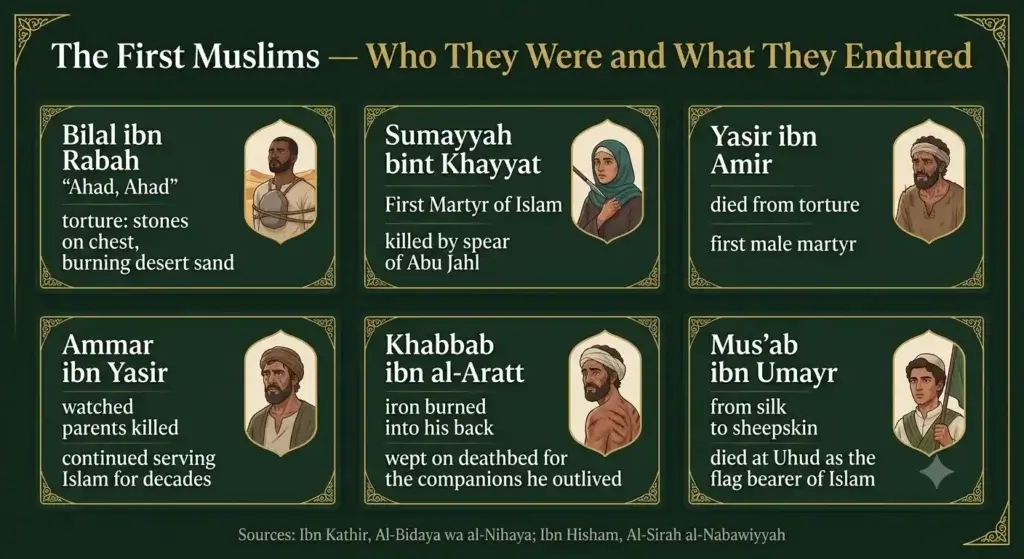
Bilal ibn Rabah: “Ahad. Ahad.”
Bilal ibn Rabah (may Allah be pleased with him) was an Abyssinian slave owned by Umayyah ibn Khalaf — a man who, as Ibn Kathir notes in Al-Bidaya wa al-Nihaya (3/62), seemed to take personal pleasure in the torture of this particular believer.
The method was designed for maximum suffering and maximum public visibility: in the middle of the day — when the Arabian sun turns the ground to a griddle — Umayyah would drag Bilal to the open desert, throw him face-up on the burning sand, and place the largest stone he could find on Bilal’s chest. Then he would demand: “Renounce Muhammad. Worship Al-Lat and Al-Uzza. And I will let you go.”
<cite index=”3-1″>Ibn Kathir records that Bilal would refuse with nothing but two words: “Ahad. Ahad.” — “One. One.” A declaration of divine unity, spoken through cracked lips, from a chest that could barely breathe under the weight of stone and sun. And he added: “By Allah, if I knew a word more annoying to you than this, I would say it.”</cite>
This was not merely endurance. This was theological defiance articulated at the molecular level. Every time he said “Ahad,” he was declaring what the entire apparatus of Quraysh was trying to make him deny.
When Abu Bakr al-Siddiq (may Allah be pleased with him) saw Bilal in that condition, he went to Umayyah and purchased him for seven ounces of gold — an amount Umayyah accepted only because he assumed Bilal would eventually break anyway. Abu Bakr then freed him.
The Prophet ﷺ said to Abu Bakr: “You have freed him, Abu Bakr.” And Abu Bakr replied: “Yes.”
(Ibn Hisham, Al-Sirah al-Nabawiyyah, 1/318–319; Al-Bidaya wa al-Nihaya, 3/62)
Years later — when Mecca fell to the Muslims and the Kaaba was purified of every idol — Bilal stood on its roof and called the adhan. The same voice that had said “Ahad, Ahad” under a crushing stone now filled the sky of a city that had tried to silence it.
The Family of Yasir: Islam’s First Martyrs
Yasir ibn Amir (may Allah be pleased with him) was a Yemeni man who had come to Mecca without tribal protection — making him, in the brutal social calculus of Quraysh, untouchable. He had married a freed slave woman named Sumayyah bint Khayyat, and they had a son named Ammar.
When the entire family embraced Islam, Abu Jahl saw an opportunity.
<cite index=”5-1″>He would bind all three of them and leave them in the sun for days. The Prophet ﷺ would pass by them and his eyes would fill with tears. He could not yet fight — the command to fight had not yet been given. So he said: “Be patient, O family of Yasir! Your appointed place is Paradise.” Abu Bakr offered to purchase them. Abu Jahl refused. And when Sumayyah screamed at Abu Jahl that she would never renounce her faith — no matter what he did — Abu Jahl drove his spear through her body and killed her.</cite>
Sumayyah bint Khayyat became the first martyr in the history of Islam.
Yasir died from the severity of his torture — some narrations say he was dragged by horses, others that he was simply beaten to death. Either way, he was gone.
And Ammar — the son — watched both his parents murdered before his eyes.
He continued living. Continued fighting. Continued serving Islam.
But when the torture became unbearable, Ammar was forced under extreme duress to utter words of disbelief. He came to the Prophet ﷺ in tears. And Allah revealed:
مَن كَفَرَ بِاللَّهِ مِن بَعْدِ إِيمَانِهِ إِلَّا مَنْ أُكْرِهَ وَقَلْبُهُ مُطْمَئِنٌّ بِالْإِيمَانِ
“Whoever disbelieves in Allah after their belief — except for one who is compelled while their heart is at rest with faith.”
— Quran 16:106
The Prophet ﷺ asked him: “How do you find your heart?” Ammar said: “At rest with faith.” The Prophet ﷺ said: “If they do it again, do what you must.”
(Tafsir al-Tabari, 14/282; Al-Bidaya wa al-Nihaya, 3/68)
Khabbab ibn al-Aratt: The Blacksmith Whose Scars Outlived His Suffering
Khabbab ibn al-Aratt (may Allah be pleased with him) was an Arab slave who worked as a blacksmith — forging the very swords that would later be used against Islam. He was among the first six to accept the faith. His mistress, Umm Anmar, used the heated metal of his own forge to burn his head and back when she discovered his conversion.
<cite index=”10-1″>Years later, when Umar ibn al-Khattab (may Allah be pleased with him) — by then the Caliph — asked Khabbab to show him what had been done to him, Khabbab uncovered his back. Umar wept. He said he had never seen a back like it. The burns from the iron had left permanent tracks across his skin — scars that never healed because they had been inflicted too many times.</cite>
And yet at the end of his life, Khabbab wept — not from pain, but from a different kind of grief altogether. His family asked him: “Why do you cry? You have suffered so much. You will meet the Prophet ﷺ and be honored by Allah.” He replied:
“I am not crying from fear of death or of meeting Allah. I am crying because I see this house around me — this comfort — and I fear that my companions who went before me received all their reward in the next life, while I have received some of mine here. I watched companions who were tortured as I was, and they left this world without tasting any of its sweetness. But I have been left — and I fear this means my portion in the next life is diminished.”
(Sahih al-Bukhari, Hadith 3852; Al-Bidaya wa al-Nihaya, 3/169)
This is the man who had iron burned into his back. And his concern — on his deathbed — was that he had been given too much comfort in this life.
Mus’ab ibn Umayr: From Silk to Sheepskin
Mus’ab ibn Umayr (may Allah be pleased with him) was described by those who knew him as the most refined and well-dressed young man in Mecca — a son of wealth who wore imported silk and Persian perfumes. When he embraced Islam, his mother locked him in his room to try to prevent him from practicing. When that failed, she cut off his allowance entirely. When that failed, she disowned him.
Ibn Sa’d records in Al-Tabaqat al-Kubra (3/87):
“The Messenger of Allah ﷺ passed by Mus’ab ibn Umayr who was wearing a patched sheepskin. The Prophet ﷺ said: ‘Look at this man whose heart Allah has illuminated. I saw him between his parents, who would feed him the finest food and the finest drink. Then his love for Allah and His Messenger brought him to what you see.'”
The man who wore silk now wore sheepskin. And he was — by every internal measure — richer than he had ever been.
Suhayb al-Rumi: A Fortune Well Spent
Suhayb ibn Sinan al-Rumi (may Allah be pleased with him) had spent years building wealth in Mecca. When he decided to emigrate to Madinah, Quraysh stopped him at the city’s edge. “You came to us with nothing,” they said, “and now you want to leave with everything you’ve earned?”
He said: “What if I leave you my wealth — all of it. Will you let me pass?”
They agreed. He handed over everything — and walked into Madinah with nothing but the clothes on his back.
When the Prophet ﷺ heard what Suhayb had done, he said:
“Rabih Suhayb. Rabih Suhayb.” “Suhayb has profited. Suhayb has profited.”
And Allah revealed:
وَمِنَ النَّاسِ مَن يَشْرِي نَفْسَهُ ابْتِغَاءَ مَرْضَاتِ اللَّهِ
“And among the people is one who sells himself in pursuit of the pleasure of Allah.”
— Quran 2:207
(Al-Bidaya wa al-Nihaya, Ibn Kathir, 3/173; Al-Isti’ab, Ibn Abd al-Barr, 2/710)
Structured Curriculum Framework
These stories — Bilal, Ammar, Khabbab, Mus’ab, Suhayb — are taught in depth in quranst’s Seerah module. Not as a list of names to memorize, but as a living curriculum that connects the first Muslims’ experience to the challenges Muslim families face today in Western schools and communities.
Explore the Islamic Studies track →Section 4: The Migration to Abyssinia — When Mecca Became Unbearable
The First Escape Route
In the fifth year of the prophethood, when the torture had reached a pitch that the weakest believers could no longer survive, the Prophet ﷺ gave the first permission for migration:
“If you were to go to the land of Abyssinia — for there is a king there in whose presence no one is wronged, and it is a land of truthfulness — until Allah provides relief from what you are suffering.”
— Ibn Ishaq, Sirah; recorded in Ibn Hisham, Al-Sirah al-Nabawiyyah, 1/321; Ibn Kathir, Al-Bidaya wa al-Nihaya, 3/74
The first migration carried twelve men and four women. The second — when the first returned briefly and then conditions worsened again — carried eighty-three men.
The Hearing Before the Negus
Quraysh sent Amr ibn al-As and Abdullah ibn Abi Rabi’ah to the Negus (Najashi) — the Christian King of Abyssinia — with gifts and a demand to extradite the Muslims. The king refused to act without hearing from both sides.
Ja’far ibn Abi Talib (may Allah be pleased with him) spoke for the Muslims. He described the state of pre-Islamic Arabia, the transformation Islam had brought, and then recited the opening verses of Surah Maryam — the chapter about Mary and the birth of Jesus.
The Negus wept until his beard was wet. His bishops wept. He said:
“By God, what Jesus son of Mary brought and what this man has brought come from the same niche of light.”
Then he turned to the Quraysh delegation and said:
“Go. By God, I will never surrender them to you.”
(Ibn Hisham, Al-Sirah al-Nabawiyyah, 1/362; Al-Bidaya wa al-Nihaya, 3/80)
Ibn al-Qayyim, reflecting on the Abyssinian migration in Zad al-Ma’ad (1/51), wrote:
“This migration was wisdom from Allah — preserving the seed of the believing community from extinction during its most vulnerable phase. It also demonstrated to history that Islam’s message was powerful enough to move the hearts of kings who had never met the Prophet ﷺ.”
Section 5: The Boycott of Banu Hashim — Three Years of Starvation
A Document Written to Starve a Community
In the seventh year of the prophethood, having failed to break individual Muslims through targeted torture, Quraysh adopted a strategy of collective punishment. The tribal leaders gathered and wrote a formal document — which they hung on the wall of the Kaaba — containing three total prohibitions against the clan of Banu Hashim:
- No trade or commerce of any kind
- No marriage contracts — no Qurayshi could marry into Banu Hashim or give their daughters to Banu Hashim
- No social interaction of any kind — no speaking, no visiting, no assistance
The entire clan — Muslim and non-Muslim alike, except Abu Lahab who sided with Quraysh — was forced into a narrow valley outside Mecca known as Shi’b Abi Talib.
For three years, they did not leave.
What Three Years of Siege Actually Looked Like
Sa’d ibn Abi Waqqas (may Allah be pleased with him) described the conditions:
“We would survive on the leaves of trees. Our lips cracked like camel skin. Once I found a dry hide, soaked it, roasted it, crushed it, mixed it with water, and ate it.”
<cite index=”24-1″>The boycott was not limited to Muslims — even non-Muslim members of Banu Hashim were included. The entire fortune of Khadijah (may Allah be pleased with her), built over decades of successful commerce, was consumed in feeding the besieged families. The wealth of Abu Talib, which had once been the pride of his clan, was exhausted. Children cried from hunger. Their voices could be heard by those who passed outside the valley.</cite>
Abu Lahab — the Prophet’s own uncle who had sided with Quraysh — would station himself at the gates of Mecca’s markets whenever traders arrived and outbid the besieged Muslims on all food supplies, driving prices beyond what the starving clan could pay.
The End of the Boycott: When Termites Did What Conscience Could Not
After three years, the Prophet ﷺ informed his uncle Abu Talib that Allah had revealed to him that termites had eaten the document on the Kaaba — leaving only the words “In Your Name, O Allah.”
Abu Talib went to the Quraysh elders. He said: “If what my nephew says is true, lift your injustice. If it is false, I will deliver him to you.”
They went to the Kaaba. They found the document exactly as described — consumed, except for the name of Allah.
The boycott ended.
(Ibn Hisham, Al-Sirah al-Nabawiyyah, 1/375; Al-Bidaya wa al-Nihaya, 3/86; Al-Rahiq al-Makhtum, al-Mubarakfuri, p. 122)
Section 6: The Year of Grief — When Both Shields Were Gone
The Death of Khadijah: More Than a Wife
Weeks after the end of the boycott — in the tenth year of prophethood — Khadijah bint Khuwaylid (may Allah be pleased with her) died.
She was not simply the Prophet’s wife. She was the first person on earth to believe in him — before any man, before any companion, before the world knew what Islam was. She was the one who had held him when he came trembling from the Cave of Hira and said words that changed everything: “By Allah, Allah will never disgrace you. You maintain family ties, you carry the burdens of others, you help the destitute, you serve your guests generously, and you assist in times of genuine calamity.”
She had spent every dirham of her considerable fortune — one of the largest in Mecca — feeding the believers during the three-year boycott. She died with nothing left to spend.
The Prophet ﷺ described her years after her death:
“Allah did not give me better than her. She believed in me when people disbelieved. She affirmed my truth when people rejected me. She comforted me with her wealth when people deprived me. And Allah blessed me with children through her.”
— Musnad Ahmad, 25/42, Hadith 16668; rated Sahih by its chains of narration
The Death of Abu Talib: The Tribal Shield
In the same year — within weeks of Khadijah’s death — Abu Talib, the Prophet’s uncle and the chief of Banu Hashim, died.
Abu Talib had never embraced Islam. But he had protected the Prophet ﷺ for ten years with the full force of tribal custom — making it socially and politically catastrophic for anyone in Mecca to physically harm his nephew. His protection was the reason the Prophet ﷺ could stand on Safa and preach. It was the reason he could walk Mecca’s streets without being killed.
With Abu Talib gone, the tribal shield evaporated overnight.
Within days, people who had never dared touch the Prophet ﷺ began throwing dirt on his head in the street. One man poured soil on him as he walked. The Prophet ﷺ entered his house and one of his daughters came to wash it away, weeping. He said to her: “Do not weep, my daughter. Allah will protect your father.”
(Ibn Hisham, Al-Sirah al-Nabawiyyah, 1/416)
The Prophet ﷺ called this period — the death of Khadijah and the death of Abu Talib in the same year — Aam al-Huzn: The Year of Grief.
Ibn al-Qayyim wrote in Zad al-Ma’ad (1/53):
“In this single year, the Prophet ﷺ lost his spiritual anchor and his worldly protector simultaneously. The wisdom of this divine timing was to demonstrate, with absolute clarity, that the victory of Islam could not rest on any human support — neither the wealth of a wife nor the authority of an uncle. It rested on Allah alone.”
Islamic Studies for Children & Teens
The quranst Islamic Studies track is available for children aged 5–18, in flexible scheduling across all time zones.
Explore the curriculum and enroll →Section 7: Ta’if — The Day That Broke Every Human Expectation
A Prophet Walks Alone to a Hostile City
After the Year of Grief — with Mecca’s doors effectively closed against him — the Prophet ﷺ made a decision that combined strategic calculation with an openness to divine possibility: he would walk to Ta’if, the second city of the Hijaz, and present Islam to the chiefs of the Thaqif tribe.
He went primarily on foot — accompanied only by his adopted son Zayd ibn Harithah — covering roughly sixty miles of Arabian terrain. He spent ten days presenting his message to the three chiefs of Thaqif — the sons of Amr.
Their responses ranged from dismissive to contemptuous. One said: “If Allah sent you as a Prophet, you are too great to need my response.” Another said: “Couldn’t Allah find anyone better than you?” The third said: “I won’t ever speak to you.”
Then, as the Prophet ﷺ began to leave the city, the chiefs sent their servants and street children to follow him — jeering, throwing stones, driving him out.
Zayd ibn Harithah positioned himself between the rocks and the Prophet ﷺ — using his own hands, arms, and face as a shield. He was wounded multiple times. The Prophet ﷺ bled from his heels and ankles until his sandals were soaked.
He took refuge in a garden owned by two men from Mecca. He sat against a wall, raised his hands, and made one of the most documented supplications in Islamic history:
“O Allah, to You I complain of my weakness, my lack of resources, and my humiliation before these people. O Most Merciful, You are the Lord of the weak, and You are my Lord. To whom would You entrust me — to a distant person who would receive me with hostility? Or to an enemy you have given control over my affair? If You are not angry with me, I do not care what I face. But Your well-being is of greater width for me. I seek refuge in the light of Your face — by which all darkness is illuminated — from letting Your anger or displeasure descend upon me.”
— Narrated by Abdullah ibn Ja’far; recorded in Al-Tabarani, Al-Mu’jam al-Kabir, and authenticated by Ibn Hajar in Al-Isabah
<cite index=”29-1″>When the Prophet ﷺ had traveled as far as Qarn al-Manazil on his return, the sky clouded over and Jibril appeared, accompanied by the Angel of the Mountains. Jibril said: “Allah has heard what your people have said to you, and He has sent the Angel of the Mountains to do with them as you command.” The Angel of the Mountains greeted the Prophet ﷺ and said: “Command me as you wish. If you wish, I will crush them between the two mountains of Mecca.” The Prophet ﷺ replied: “No. I hope that Allah will bring forth from their descendants people who will worship Allah alone, associating nothing with Him.”</cite>
(Sahih al-Bukhari, Hadith 3231; Sahih Muslim, Hadith 1795)
He was bleeding. He had been driven out of two cities. He had lost his wife and his protector in the same year. And his response to the offer of divine retribution was a prayer for the children of his persecutors.
This moment — more than almost any other in the Seerah — reveals the character that made him the seal of the prophets.
Section 8: What This History Means for Muslim Families Today
Lesson 1: Suffering Is Not Evidence of Divine Abandonment
The Quran addresses this directly — and with striking precision. It does not merely promise that things will improve. It reframes the entire meaning of hardship:
أَمْ حَسِبْتُمْ أَن تَدْخُلُوا الْجَنَّةَ وَلَمَّا يَأْتِكُم مَّثَلُ الَّذِينَ خَلَوْا مِن قَبْلِكُم ۖ مَّسَّتْهُمُ الْبَأْسَاءُ وَالضَّرَّاءُ وَزُلْزِلُوا حَتَّىٰ يَقُولَ الرَّسُولُ وَالَّذِينَ آمَنُوا مَعَهُ مَتَىٰ نَصْرُ اللَّهِ ۗ أَلَا إِنَّ نَصْرَ اللَّهِ قَرِيبٌ
“Or do you think that you will enter Paradise while there has not come to you what came to those who passed on before you? They were touched by poverty and hardship and were shaken until the Messenger and those who believed with him said: ‘When is the help of Allah?’ — Unquestionably, the help of Allah is near.”
— Quran 2:214
Ibn al-Qayyim wrote in Madarij al-Salikin (3/207):
“Tribulation for the believer is like fire for gold — it does not destroy, it purifies. No prophet was ever tested without the trial being a herald of imminent relief.”
Lesson 2: The Weak Were Chosen First — for a Reason
The first martyr was a woman with no tribe. The most famous survivor of torture was a black slave. The one who surrendered his entire fortune for freedom was a foreign craftsman.
The divine wisdom here is deliberate: Islam did not prove itself through power. It proved itself through the choices of people who had nothing to gain and everything to lose — and chose it anyway.
For Muslim children growing up in Western schools who sometimes feel that their faith makes them “different” in ways that are costly — this history is essential. It says: being in the minority is not a mistake. It is sometimes the precise position from which the most lasting testimonies are given.
Lesson 3: Patience Is Not Passivity — It Is Strategic Mastery
The Prophet ﷺ did not command patience as a counsel of defeat. He commanded it as a strategic imperative — because the community being built in those thirteen years was being built on foundations of conviction, not compulsion. Every person who stayed Muslim under torture in Mecca made a free choice. And it was precisely that freely-chosen faith that made the community that emerged from it unbreakable.
Ibn Taymiyyah wrote in Majmu’ al-Fatawa (10/305):
“Patience in the Islamic framework is not surrender to injustice — it is transcendence over injustice. When the believer is patient, they are not saying the oppressor is right. They are saying: ‘Allah is greater than your ability to shake my purpose.'”
Lesson 4: The Quran Descended Alongside the Suffering
One of the most extraordinary features of the Meccan period is that the Quran did not simply document the Muslims’ suffering from a distance. It descended into it — comforting, explaining, promising, and contextualizing, verse by verse.
Surah al-Duha was revealed when revelation had paused temporarily and the polytheists said: “His Lord has abandoned him.” Allah responded:
وَالضُّحَىٰ ﴿١﴾ وَاللَّيْلِ إِذَا سَجَىٰ ﴿٢﴾ مَا وَدَّعَكَ رَبُّكَ وَمَا قَلَىٰ ﴿٣﴾ وَلَلْآخِرَةُ خَيْرٌ لَّكَ مِنَ الْأُولَىٰ
“By the morning brightness. And by the night when it covers with darkness. Your Lord has not taken leave of you, nor has He detested you. And the Hereafter is better for you than the first life.”
— Quran 93:1–4
Not a theological argument. Not a legal ruling. A direct, personal address to a Prophet in pain — from the One who knew exactly what that pain cost.
Conclusion: The Ending the Tortured Never Saw Coming
When Sumayyah was killed by Abu Jahl’s spear — she did not know that her son Ammar would one day fight in the armies of Islam alongside men who had conquered the greatest empires of the ancient world.
When Bilal said “Ahad, Ahad” under the weight of the stone — he did not know that he would one day stand on the roof of the Kaaba — purified of every idol — and fill the sky of Mecca with the adhan.
When the Prophet ﷺ walked back from Ta’if with bloodied feet and no ally in sight — he did not know that within ten years he would return to that same city of Mecca at the head of ten thousand believers, and that its people would come to him one by one to say: “There is no God but Allah.”
This is the pattern. This is what the Quran calls the Sunnah of Allah — the unchanging divine pattern in how He deals with those who carry His message:
لَقَدْ كَانَ فِي قَصَصِهِمْ عِبْرَةٌ لِّأُوْلِي الأَلْبَابِ
“Indeed in their stories is a lesson for those of understanding.”
— Quran 12:111
And the Prophet ﷺ — summarizing the entire arc of this history in a single prophetic statement — said:
“Know that victory comes with patience, that relief comes with distress, and that with hardship comes ease.”
— Musnad Ahmad, Hadith 2769; authenticated by al-Hakim in Al-Mustadrak, Hadith 6303
For Muslim families in the West — raising children in environments that sometimes make faith feel costly, or inconvenient, or isolating — this history is not a museum exhibit. It is oxygen.
It says: the people who came before you paid more. They had less. They knew less about how the story would end. And they held on.
The story always ends. And it always ends with the truth standing.
رَبِّ هَبْ لِي مِنَ الصَّالِحِينَ
“My Lord, grant me from among the righteous.”
— Quran 37:100 — the supplication of Ibrahim ﷺ
🟢 Learn the Seerah the Way It Was Meant to Be Taught
The stories in this article are not supplementary reading. They are the foundation of Islamic identity.
A Muslim child who knows the story of Bilal will not feel alone when they are the only Muslim in their class. A Muslim teenager who knows the story of Mus’ab ibn Umayr will understand that wealth is a tool, not a goal. A Muslim adult who truly understands the Year of Grief will carry a different quality of trust in Allah when their own griefs arrive.
This is what the Seerah does — when it is taught well.
quranst’s Islamic Studies track delivers the complete Seerah — not as a list of dates and battles, but as a living curriculum of character, resilience, and faith. Taught by certified scholars. Customized to the child’s age and level. Designed for Muslim families growing up in the West.
What Your Child Gets in the Seerah Module
- The Meccan period — from the first revelation to the Hijrah — taught as a narrative of faith under pressure
- The Madinan period — the building of a community and a civilization
- Character lessons extracted from specific incidents: What does the Prophet’s response at Ta’if teach us about how to handle rejection?
- Connection to current challenges: How does Bilal’s story speak to a Muslim kid being mocked at school?
- Authentic hadith sources — every story cross-referenced with its primary documentation
Two Ways to Begin
“When Allah intends good for someone, He gives him understanding of the religion.”
— Sahih al-Bukhari, Hadith 71
Begin the understanding. Today.
بِسْمِ اللَّهِ — Begin.
References and Sources
Quranic References
- Quran 2:207 — Suhayb selling himself for the pleasure of Allah
- Quran 2:214 — Testing with hardship as the path to Paradise
- Quran 12:111 — Lessons in the stories of those who came before
- Quran 15:6 — Quraysh calling the Prophet a madman
- Quran 15:94 — Command to proclaim Islam publicly
- Quran 16:106 — Permissibility of words spoken under compulsion
- Quran 37:100 — Supplication of Ibrahim for righteous offspring
- Quran 93:1–4 — Surah al-Duha: “Your Lord has not abandoned you”
Hadith References
- Sahih al-Bukhari, Hadith 71 — Understanding of religion as Allah’s gift
- Sahih al-Bukhari, Hadith 3231 — The incident of Ta’if and the Angel of the Mountains (also Sahih Muslim, Hadith 1795)
- Sahih al-Bukhari, Hadith 3612 — “Hadith of Khabbab”: the Prophet’s response to complaints of torture
- Sahih al-Bukhari, Hadith 3852 — Khabbab’s deathbed weeping
- Sahih al-Bukhari, Hadith 3855 — Khabbab burned with hot coals
- Sahih al-Bukhari, Hadith 4770 — The Prophet’s public call on Mount Safa
- Musnad Ahmad, Hadith 2769 — “Victory comes with patience” (authenticated by al-Hakim, Mustadrak 6303)
- Musnad Ahmad, Hadith 16668 (25/42) — The Prophet’s praise of Khadijah
Classical Seerah and History Sources
- Ibn Hisham: Al-Sirah al-Nabawiyyah (based on Ibn Ishaq). Dar al-Jil, Beirut. Vol. 1: pp. 280, 318–319, 321, 362, 375, 416
- Ibn Kathir: Al-Bidaya wa al-Nihaya. Dar al-Fikr, Beirut. Vol. 3: pp. 62, 68, 74, 80, 82, 86, 169, 173
- Ibn Sa’d: Al-Tabaqat al-Kubra. Dar Sadir, Beirut. Vol. 3: p. 87 (Mus’ab ibn Umayr)
- Al-Mubarakfuri, Safi al-Rahman: Al-Rahiq al-Makhtum (The Sealed Nectar). Winner of the World Muslim League prize. p. 122 (Boycott of Banu Hashim)
Scholarly Theological Works
- Ibn al-Qayyim al-Jawziyyah: Zad al-Ma’ad fi Hady Khayr al-Ibad. Mu’assasat al-Risalah. Vol. 1: pp. 51, 53
- Ibn al-Qayyim al-Jawziyyah: Madarij al-Salikin. Dar al-Kitab al-Arabi, Beirut. Vol. 3: p. 207
- Ibn Taymiyyah: Majmu’ al-Fatawa. Majma’ al-Malik Fahd. Vol. 10: p. 305
- Al-Tabari: Tafsir al-Tabari (Jami’ al-Bayan). Dar al-Turath. Vol. 14: p. 282 (commentary on Quran 16:106)
- Ibn Khaldun: Al-Muqaddimah. Dar al-Fikr, Beirut. Chapter 2 (on tribal power and religious movements)
Biographical Companions References
- Ibn al-Athir: Usd al-Ghabah fi Ma’rifat al-Sahabah. Dar al-Fikr. Vol. 1: p. 131 (Ibn Mas’ud’s account of the first public Muslims); Vol. 2: pp. 147–150 (Bilal and Khabbab)
- Ibn Abd al-Barr: Al-Isti’ab fi Ma’rifat al-Ashab. Dar al-Jil, Beirut. Vol. 2: p. 710 (Suhayb al-Rumi)
- Al-Dhahabi: Siyar A’lam al-Nubala’. Mu’assasat al-Risalah. Vol. 2: pp. 323–325 (Khabbab ibn al-Aratt)
