

Introduction: The Blank Page
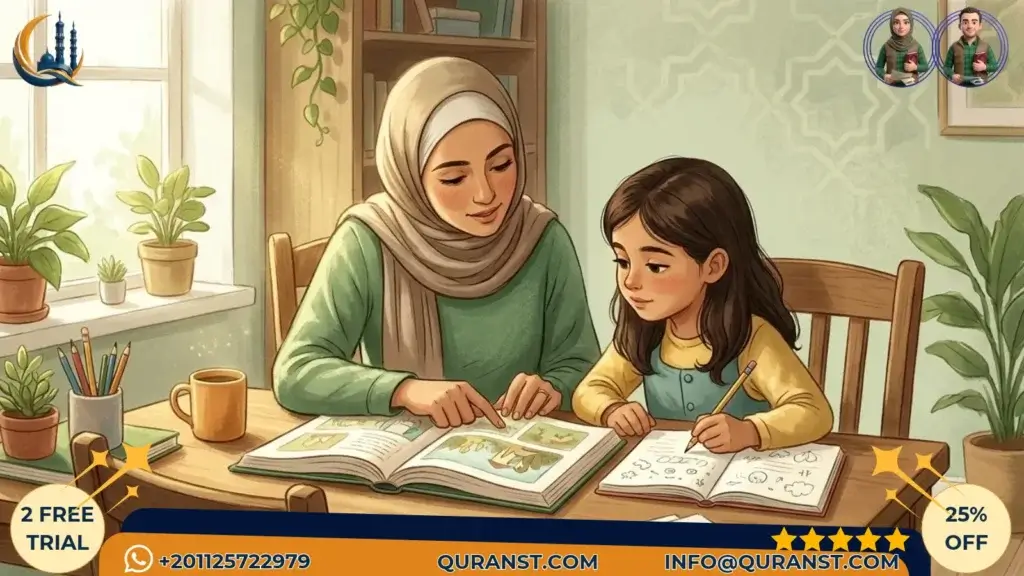
Your nine-year-old reads Arabic well. She sounds out a page of her storybook and recites her surah with Tajweed. Tonight you hand her a pencil and say, “Write me a story.”
She writes كان يا ما كان. Then she stops. “What do I write, Mama?”
This is common, and it is not failure. Reading Arabic and composing in Arabic are different skills, and the second does not arrive automatically from the first. A child can decode every word on a page and still have no words of her own for the next one.
The gap is crossable. Children become authors in a sequence: they listen, read, retell, imitate, and then invent. A parent needs a ladder, a routine, and a few rules for feedback.
designed for Muslim families in the West
quranst’s Learn Arabic track moves children from letters to reading to writing through live one-on-one sessions that fit around the school day.
Book your free 2-session trial →The Islamic Foundation
The first revelation joins reading and the pen
اقْرَأْ بِاسْمِ رَبِّكَ الَّذِي خَلَقَ … اقْرَأْ وَرَبُّكَ الْأَكْرَمُ الَّذِي عَلَّمَ بِالْقَلَمِ عَلَّمَ الْإِنسَانَ مَا لَمْ يَعْلَمْ
“Recite in the name of your Lord who created… Recite, and your Lord is the most Generous, Who taught by the pen, taught man that which he knew not.” (Quran 96:1–5, Sahih International)
The Quran models the story with a lesson
نَحْنُ نَقُصُّ عَلَيْكَ أَحْسَنَ الْقَصَصِ
“We relate to you, [O Muhammad], the best of stories.” (Quran 12:3)
لَقَدْ كَانَ فِي قَصَصِهِمْ عِبْرَةٌ لِّأُولِي الْأَلْبَابِ
“There was certainly in their stories a lesson for those of understanding.” (Quran 12:111)
A story that ends in a lesson (‘ibrah) is a form the Quran itself uses, and we will ask our children to write in it.
The Prophet ﷺ and the Companions valued writing
- Abu Hurayrah said that none of the Companions narrated more hadith than he did, except Abdullah ibn Amr, who used to write them down while he did not (Sahih al-Bukhari 113; also Jami at-Tirmidhi 2668).
- The Prophet ﷺ said to Abdullah ibn Amr: “Write, for by Him in Whose hand is my soul, nothing comes out of it except the truth” (Sunan Abi Dawud 3646, graded sahih by al-Albani).
- Zayd ibn Thabit reported that the Prophet ﷺ ordered him to learn the writing of the Jews, so that he could write for him and read what was written to him, and that he mastered it in about a fortnight (Sunan Abi Dawud 3645, graded hasan sahih by al-Albani).
- Ibn Abbas reported that some Badr captives who could not pay were ransomed by teaching the children of the Ansar to write (Musnad Ahmad 2216; graded hasan in Darussalam’s edition, which notes a weak narrator supported by other reports).
Purpose drives writing: Zayd learned quickly because a real reader was waiting.
Section 1: What the Research Shows
Reading supplies the material, and its effect compounds
Mol and Bus’s 2011 meta-analysis of print exposure from infancy to early adulthood found moderate to strong links between how much children read and their language, comprehension, and spelling, in an upward spiral: children who read well read more. Print exposure explained about 12% of the variance in oral language skills in preschool and kindergarten, 13% in primary school, 19% in middle school, and 30% in high school. This is correlational evidence.
Writing improves reading, and teaching it matters
Graham and Hebert’s 2011 meta-analysis (“Writing to Read”) found that writing about material read improves comprehension of it, that teaching writing improves reading comprehension, fluency, and word reading, and that more writing improves comprehension. The accompanying Carnegie report notes that infrequent writing and a lack of explicit instruction minimize the effect. Reading and writing feed each other, and both need deliberate practice.
How you read matters
A meta-analysis of dialogic parent–child reading (Mol, Bus, de Jong, and Smeets, 2008; 16 studies) found added vocabulary gains when the adult asks questions, responds to the child’s answers, and expands them.
Arabic adds a challenge: two varieties in one language
Arabic is diglossic: children acquire a colloquial variety first and meet Standard Arabic (Fusha) as the language of print, formal speech, and the Quran.
- Saiegh-Haddad (2003, Applied Psycholinguistics 24, 431–451) studied how the distance between the spoken and standard varieties affects initial reading acquisition.
- Riham Shendy’s 2022 article in Creative Education, presenting new survey data, confirms a weak culture of reading to young children in Standard Arabic, which limits early exposure to the language of print.
- A 2025 study in the Journal of Speech, Language, and Hearing Research (“Speech Is Golden”) tested 110 Saudi Arabic-speaking children in Grades 2–4. Their spoken Colloquial Arabic skills (sentence comprehension, sentence completion, pragmatic knowledge) and word decoding each contributed uniquely to reading comprehension. The authors suggest that interventions boosting narrative language in Colloquial Arabic could help build a foundation for literacy. The study measured associations; it did not test an intervention.
For your home: telling stories counts in any variety, so do not wait for perfect Fusha before inviting them; but Fusha needs deliberate, enjoyable exposure through read-alouds, recitation, audio stories, and writing. Most of this research involves children in Arabic-speaking countries; heritage learners in the West often start from English, so treat it as guidance, not prediction.
designed for Muslim families in the West
quranst’s Learn Arabic and Learn Quran sessions build the Fusha ear and vocabulary that story writing draws on.
Book your free 2-session trial →Section 2: The Five-Step Ladder
Move up only when the current rung feels comfortable.
Rung 1: Listen (اِسْتَمِعْ). Read aloud in Fusha for 10 to 15 minutes a day, even to children who read alone. Choose stories with clear characters and a problem. Ask before, during, and after: “What do you see? What will happen? Why did she do that?”
Rung 2: Read (اِقْرَأْ). The child reads stories at a level where she understands most words. Keep a word-bank notebook: three new words a day, each with a picture or one-line meaning. These become her writing vocabulary.
Rung 3: Retell (أَعِدِ الْحِكَايَة). After a story, she retells it aloud (“Tell it to Baba as if he missed it”), then in three to five written sentences. Use the two-column technique: fold a page; on the left she writes or dictates the retelling as she would say it at home; on the right she rebuilds each sentence in Fusha with your help. Over time the right column grows.
Rung 4: Imitate (قَلِّدْ). Keep the skeleton of a known story and change the details: a girl who loses her scarf on the way to the masjid instead of a boy who loses his bag on the way to school. This removes the paralysis of the blank page.
Rung 5: Author (أَلِّفْ). Give her one idea, not an empty page, and let her choose from three prompts:
- “ماذا لو وَجَدَتْ سَلْمَى بَابًا صَغِيرًا في جِدَارِ المَكْتَبَة؟” (What if Salma found a small door in the library wall?)
- “فِي صَبَاحِ يَوْمِ العِيدِ اخْتَفَتِ الحَلْوَى!” (On the morning of Eid, the sweets disappeared!)
- “قِطَّةٌ تَتَعَلَّمُ أَنْ تَقُولَ الصِّدْقَ.” (A cat who learns to tell the truth.)
Finish with the Quranic habit: “What is the ‘ibrah of your story?”
Section 3: Story Skeleton and 12-Week Plan
The skeleton card
| Part | Arabic | Question for the child |
|---|---|---|
| Characters | الشَّخْصِيَّات | Who is in the story? What are they like? |
| Place and time | المَكَان وَالزَّمَان | Where and when? |
| Problem | المُشْكِلَة | What goes wrong? |
| Attempts | المُحَاوَلَات | What does the hero try? |
| Solution | الحَلّ | How is it solved? |
| Lesson | العِبْرَة | What did we learn? |
Openers: كَانَ يَا مَا كَانَ · ذَاتَ يَوْمٍ · فِي صَبَاحِ يَوْمٍ جَمِيل. Connectors: ثُمَّ · وَفَجْأَةً · لَكِنَّ · لِذَلِكَ · وَفِي النِّهَايَةِ.
One sentence per part is a complete first story. A short story that is finished teaches more than a long one abandoned.
The 12-week plan (15 minutes, four days a week)
| Weeks | Focus | Rhythm |
|---|---|---|
| 1–2 | Listen and talk | Daily Fusha read-aloud with questions; start the word bank |
| 3–4 | Read and retell | Child reads a short story; oral retelling; three written sentences |
| 5–6 | Skeleton | Fill the card for a known story; five-sentence retelling |
| 7–8 | Imitate | Same skeleton, new character and place; seven sentences; two connectors |
| 9–10 | Author | Choose one of three prompts; plan on the card; draft over two days |
| 11–12 | Revise and publish | Read aloud; improve one thing; illustrate, bind, add a title page with her name, and read it to a grandparent or friend |
Make the reader real. Zayd ibn Thabit’s story shows that a real reader drives learning. Send the finished book to a relative, read it at family dinner, or give it as an Eid gift.
Section 4: Feedback That Builds Writers
- Respond to the story first. “I did not expect the cat to find the key!”
- Correct one thing at a time. Choose the error that matters most for her level (a missing connector, the ta marbutah, the hamzah) and leave the rest for another day. A page covered in red teaches a child that writing is dangerous.
- Teach the pattern, briefly. Graham and Hebert found that teaching spelling and sentence-construction skills improves reading fluency, and that teaching spelling improves word reading. Two minutes on the pattern behind a mistake beats a long lecture.
- Let her read it aloud. Many errors correct themselves when she hears her own sentence.
- Keep a “my patterns” card with three patterns at a time; replace one when it is mastered.
- Protect the habit. Four imperfect sentences a day beat one perfect sentence a week; the research above links more writing to better reading.
When she is stuck, ask a question rather than give an order: “Who is in the room? What does she hear?” When she is discouraged, go back one rung for a week.
Section 5: Age-by-Age Framework and the Parent’s Role
| Age | Focus | Sample activity |
|---|---|---|
| 4–6 | Listening, talking, letters | Read-alouds; draw it, then tell it; she dictates one sentence and you write it down |
| 7–9 | Fluent reading, retelling, the skeleton | Word bank; five-sentence stories; her first small book |
| 10–12 | Imitation and invention; dialogue | Two-column technique; stories with a lesson; a family anthology |
| 13–15 | Voice and variety | Diary, letters, short stories; reading Arabic literature with a teacher |
| 16+ | Purpose and audience | Essays and reflections on Islamic themes; a community newsletter in Arabic |
The parent as the living curriculum. Let her see you read and write; if your own Arabic is limited, copy a verse or write a note beside her. Hold a weekly story night. Praise effort and ideas. Protect fifteen minutes in the same slot each day, and ask a teacher for help when you need it.
Conclusion
Return to the nine-year-old and the blank page. You do not hand her the empty page again. Tonight you read her a story. Tomorrow she retells it. Next week she changes the hero’s name and the place. In three months she hands you a stapled booklet with her name on the cover and a lesson at the end.
That is the whole method: listen, read, retell, imitate, author. It needs a routine, a real reader, and a gentle way of responding, not perfect Arabic from the parent.
🟢 Build Arabic Readers and Writers with quranst
- Learn Arabic: letters, reading, vocabulary, and writing in Standard Arabic through live one-on-one sessions that adapt to your child’s level.
- Learn Quran: Tajweed and recitation that build the sound of Standard Arabic and a lifelong bond with the Book.
- Islamic Studies and Smart Parenting: Seerah and Quran stories your child can retell, plus Islamic parenting guidance for Muslim families in the West.
👇 Begin with Two Free Sessions
بِسْمِ اللَّهِ — Begin.
Build the Child Who Inherits Both the Quran and the Scientific Tradition
The Islamic education that produces scientifically curious, intellectually confident Muslim children is the education that connects the Quran to the civilization it produced — including its extraordinary scientific tradition.
Your child is next. Begin. بِسْمِ اللَّهِ
References and Sources
Quran (Sahih International; checked on Quran.com / legacy.quran.com)
- 96:1–5 · 12:3 · 12:111
Hadith (checked on Sunnah.com unless noted)
- Sahih al-Bukhari 113; Jami at-Tirmidhi 2668: Abdullah ibn Amr “used to write”
- Sunan Abi Dawud 3646: “Write, for by Him in Whose hand is my soul…” (sahih per al-Albani)
- Sunan Abi Dawud 3645: Zayd ibn Thabit and the writing of the Jews (hasan sahih per al-Albani)
- Musnad Ahmad 2216: ransom of Badr captives by teaching the Ansar’s children to write (hasan per Darussalam’s grading on the Musnad; one narrator weak but supported). Checked via Tohed.com and hadithunlocked.com, not Sunnah.com.
Research
- Graham, S., & Hebert, M. (2011). “Writing to read: A meta-analysis of the impact of writing and writing instruction on reading.” Harvard Educational Review, 81(4), 710–744. (see also the Carnegie Corporation report Writing to Read, 2010)
- Mol, S. E., & Bus, A. G. (2011). “To read or not to read: A meta-analysis of print exposure from infancy to early adulthood.” Psychological Bulletin, 137(2), 267–296.
- Mol, S. E., Bus, A. G., de Jong, M. T., & Smeets, D. J. H. (2008). “Added value of dialogic parent–child book readings: A meta-analysis.” Early Education and Development, 19, 7–26. (via the Leiden thesis above)
- Saiegh-Haddad, E. (2003). “Linguistic distance and initial reading acquisition: The case of Arabic diglossia.” Applied Psycholinguistics, 24(3), 431–451. (bibliographic details as cited in later studies; the original article was not opened)
- “‘Speech Is Golden’: The importance of Colloquial Arabic for reading Standard Arabic for beginning readers.” Journal of Speech, Language, and Hearing Research, 68(3S), 1441–1467 (2025). Abstract read on the publisher’s page; authors not recorded; full text not accessed.
- Shendy, R. (2022). “Learning to read in an ‘estranged’ language: Arabic diglossia, child literacy, and the case for mother tongue–based education.” Creative Education, 13(4), 1247–1301. (read via a copy of the paper)
Limits of the evidence
- Mol and Bus’s findings are correlational.
- Graham and Hebert’s meta-analysis concerns English-language students; its logic is applied to Arabic by analogy.
- Most diglossia research involves Arabic-speaking children in Arabic-speaking countries; heritage learners in the West may differ. The 2025 study’s narrative-intervention idea is a suggestion, not a tested result.
- The ladder, skeleton card, 12-week plan, feedback rules, and age table are editorial parenting guidance built on the sources above. The Arabic examples are the author’s own.
- Ahmad 2216 is used for its general point only, given the noted weakness in one narrator.
Frequently Asked Questions
Why can a child read Arabic well and still struggle to write a story?
How does Arabic diglossia affect a child’s creative writing?
What is the Five-Step Ladder from reading to authorship?
- 1. Listen: Daily Fusha read-alouds with open questions before, during, and after the story.
- 2. Read: Level-appropriate reading paired with a small word-bank notebook.
- 3. Retell: Oral retelling first, followed by short written summaries.
- 4. Imitate: Keeping a familiar story skeleton while changing characters, setting, or details.
- 5. Author: Writing an original story from a focused prompt and ending with a clear lesson (‘ibrah).
