

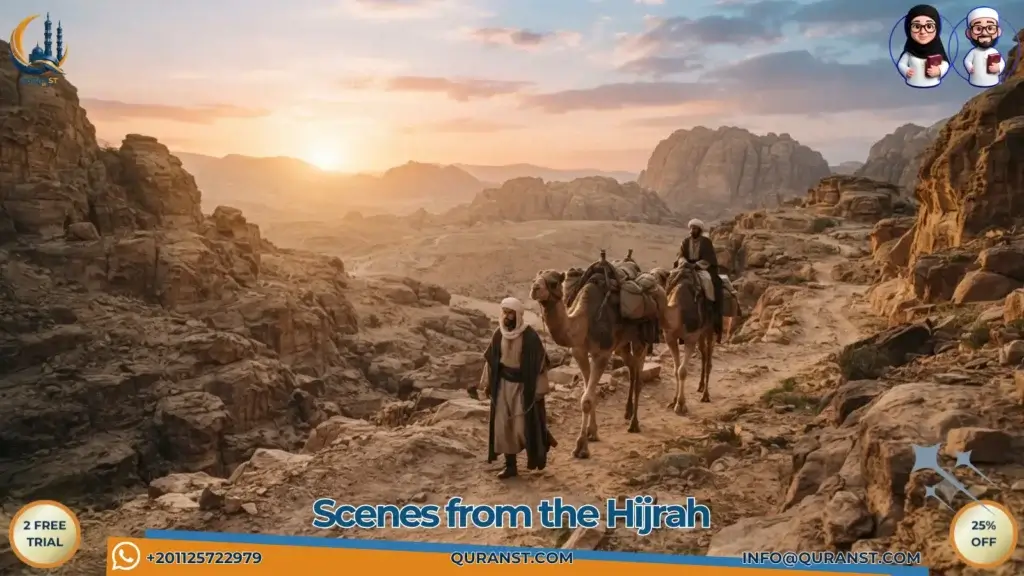
Introduction: The Journey That Divided History
There is a reason the Islamic calendar does not begin with the birth of the Prophet ﷺ.
It does not begin with the first revelation. It does not begin with the conversion of Khadijah, or Abu Bakr, or Ali. It begins with an eight-day journey through the Arabian desert — a journey made by three men, a guide, a servant, and a goat — in which no battle was fought, no conquest was made, and no treaty was signed.
The Hijrah.
The migration of the Prophet Muhammad ﷺ from Makkah to Madinah in the thirteenth year of the prophethood — 622 CE — is the event by which Muslims have marked the passage of time for fourteen centuries. And it is not merely historical convention. It reflects a profound theological truth: the most important moments in the divine plan are often not the dramatic ones. They are the quietly faithful ones.
The Hijrah was not the moment Islam became powerful. It was the moment it became rooted.
What makes the Hijrah uniquely suited to educational engagement — for children, for families, for the Muslim navigating a life that often feels like its own kind of migration — is that it contains within its eight days a series of concentrated scenes that are at once historically documented, spiritually profound, and practically instructive.
This guide walks through seven of those scenes — in the order they occurred, grounded in authentic hadith and the classical Seerah literature, and interpreted through the lens of the scholars of Ahl al-Sunnah wal-Jama’ah — with the educational dimension of each drawn out explicitly for Muslim families raising children in the modern West.
Structured Curriculum Framework
The Hijrah is taught as a living curriculum in quranst’s Seerah module — not as a list of events to memorize, but as a series of scenes to inhabit and learn from.
Book your free 2-session trial →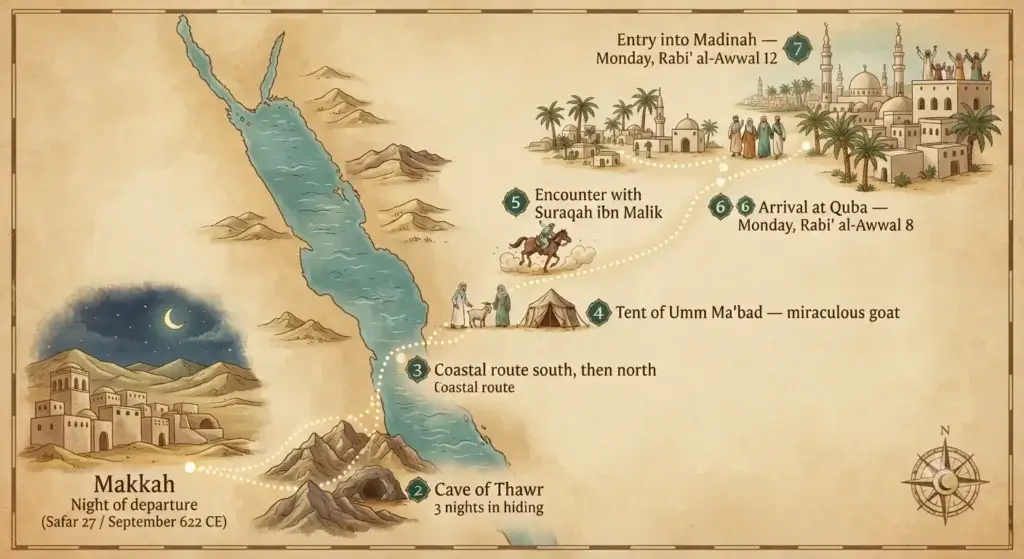
Scene 1: The Night of the Departure — When the Enemy Surrounded the House
What Happened
The night was Safar 27, in the thirteenth year of the prophethood — equivalent to the night of September 13, 622 CE. The leaders of Quraysh had gathered in Dar al-Nadwah — their council house — and reached a decision they believed was elegant in its brutality: they would send one young man from each major tribe of Quraysh to kill the Prophet ﷺ simultaneously. That way, the bloodguilt would be distributed across all tribes, and Banu Hashim — the Prophet’s clan — could not retaliate against any single family.
They surrounded the house of the Prophet ﷺ that night, waiting for dawn.
Allah revealed to His Prophet that this night would come and commanded him to leave:
وَإِذْ يَمْكُرُ بِكَ الَّذِينَ كَفَرُوا لِيُثْبِتُوكَ أَوْ يَقْتُلُوكَ أَوْ يُخْرِجُوكَ ۚ وَيَمْكُرُونَ وَيَمْكُرُ اللَّهُ ۖ وَاللَّهُ خَيْرُ الْمَاكِرِينَ
“And [remember] when those who disbelieved plotted against you to restrain you or kill you or evict you [from Makkah]. But they plan, and Allah plans. And Allah is the best of planners.”
— Quran 8:30
The Prophet ﷺ asked Ali ibn Abi Talib (may Allah be pleased with him) to sleep in his bed, wrapped in the Prophet’s own green cloak — the Hadhrami mantle — so that those watching would believe the Prophet was still inside.
He then walked out of his house.
The armed men of Quraysh were waiting at every window. And the Prophet ﷺ walked through them — reciting the opening verses of Surah Yaseen:
يس ﴿١﴾ وَالْقُرْآنِ الْحَكِيمِ ﴿٢﴾… وَجَعَلْنَا مِن بَيْنِ أَيْدِيهِمْ سَدًّا وَمِنْ خَلْفِهِمْ سَدًّا فَأَغْشَيْنَاهُمْ فَهُمْ لَا يُبْصِرُونَ
“…And We have put before them a barrier and behind them a barrier and covered them, so they do not see.”
— Quran 36:1–2, 9
He scattered dust on their heads as he passed — and they did not stir.
(Ibn Hisham, Al-Sirah al-Nabawiyyah, 1/480–482; Ibn Kathir, Al-Bidaya wa al-Nihaya, 3/174; Sahih al-Bukhari, Hadith 3905)
The Educational Dimension
Lesson: When you have done everything in your power, trust Allah to do what is beyond your power.
The Prophet ﷺ did not sit inside and wait for divine protection without taking precautions. He made a plan: Ali in the bed, departure at the right hour, movement under cover of night. He took every human precaution available to him.
And then Allah made those precautions irrelevant — by making armed men with open eyes unable to see a man walking through them.
For Muslim families raising children who sometimes ask “Why should I try if Allah controls everything?” — this scene is the answer. The Prophet ﷺ tried. Then Allah acted. The effort was the Muslim’s responsibility. The outcome was Allah’s domain.
Ibn al-Qayyim, in Zad al-Ma’ad (3/55), writes:
“The Prophet ﷺ modeled perfect tawakkul in this moment — and tawakkul is not the abandonment of means, but the use of all available means with the heart detached from them. He used every means and then placed the outcome entirely with Allah.”
Scene 2: The Cave of Thawr — When a Spider Web Was Stronger Than an Army
What Happened
The Prophet ﷺ and Abu Bakr (may Allah be pleased with him) did not take the direct road north to Madinah. They went south — to a mountain called Thawr, roughly five kilometers from Makkah — and hid in a cave for three nights.
<cite index=”9-1″>Quraysh sent out search parties in every direction, offering a reward equivalent to the blood money of two men — one hundred camels each — for whoever could bring back the Prophet ﷺ or Abu Bakr, alive or dead.</cite>
The search parties reached the very mouth of the cave.
Abu Bakr (may Allah be pleased with him) looked out and could see the feet of the searchers. He whispered to the Prophet ﷺ — not from cowardice, but from the sheer weight of what he was witnessing:
“O Messenger of Allah — if one of them were to look down at his feet, he would see us.”
And the Prophet ﷺ replied with words that became one of the most quoted statements in Islamic history:
لَا تَحْزَنْ إِنَّ اللَّهَ مَعَنَا
“Do not grieve — indeed Allah is with us.”
— Quran 9:40; narrated in Sahih al-Bukhari, Hadith 3653; Sahih Muslim, Hadith 2381
Allah then sent His tranquility (sakinah) upon them, and supported them with soldiers they could not see:
فَأَنزَلَ اللَّهُ سَكِينَتَهُ عَلَيْهِ وَأَيَّدَهُ بِجُنُودٍ لَّمْ تَرَوْهَا
“And Allah sent down His tranquility upon him and supported him with soldiers you did not see.”
— Quran 9:40
What were those soldiers? Classical scholars, including Ibn Kathir and al-Suyuti, mention two things found at the mouth of the cave when the searchers arrived: a spider had woven its web across the entrance, and two doves had built a nest and laid eggs there. The natural conclusion — that no one had entered the cave recently — caused the search party to turn away.
(Ibn Kathir, Al-Bidaya wa al-Nihaya, 3/179; Al-Mubarakfuri, Al-Rahiq al-Makhtum, p. 179)
The Educational Dimension
Lesson: Divine protection does not always look like what we expect.
A spider web is, in human terms, one of the most fragile things in existence. It breaks under a finger. And yet Allah used precisely this to stop an armed search party of the Arabian Peninsula’s most feared tribe.
For Muslim children who grow up in environments where they feel vulnerable — where their faith makes them small in the eyes of their peers, where the forces arrayed against Muslim identity seem overwhelming — the cave of Thawr carries a message that no motivational speech can replicate:
The fragility of your defenses is not the measure of your protection.
Al-Nawawi, commenting on the verse “Allah is with us” in his Sharh Sahih Muslim, writes:
“The ‘being with’ (ma’iyyah) referenced here is the specific companionship of divine support, assistance, and protection — not merely the general omnipresence of Allah that encompasses all creation. It is the ma’iyyah of the one who is singled out for divine care.”
A child who carries this concept — that when Allah is with you in this specific sense, no force on earth is sufficient against you — carries a spiritual armor that thirteen years of Quraysh persecution tried and failed to remove.
Scene 3: Abu Bakr’s Tears — The Man Who Wept from Love, Not Fear {#scene-3}
What Happened
Among the most tender and least-discussed scenes of the Hijrah is the moment, just before departure from Makkah, when the Prophet ﷺ came to the house of Abu Bakr in the middle of the day — an unusual hour for a visit, which immediately signaled to Abu Bakr that something extraordinary was about to happen.
Abu Bakr had been waiting. For months, he had asked permission to migrate, and the Prophet ﷺ had told him each time: “Do not be hasty — perhaps Allah will give you a companion.” Abu Bakr had understood this to mean the Prophet himself.
When the Prophet ﷺ arrived and told him they would leave that night, Abu Bakr wept.
Aisha (may Allah be pleased with her) reported:
“I had never seen anyone weep out of joy before that day — but Abu Bakr wept when the Prophet ﷺ said: ‘I have been given permission to migrate.’ And I knew then that he wept not from sadness but from the joy of being chosen as the Prophet’s companion.”
— Sahih al-Bukhari, Hadith 3905 (narrated through Aisha; the full account in Ibn Hisham, Al-Sirah al-Nabawiyyah, 1/486)
Abu Bakr then offered to the Prophet ﷺ two camels he had been preparing — feeding and fattening them for this exact journey — for months in advance.
The Educational Dimension
Lesson: True love prepares in advance for the needs of the beloved.
Abu Bakr did not wait to be asked. He did not scramble to help when the moment arrived. He had been fattening two camels for months — in anticipation of a moment he did not know the exact timing of, for a companion whose need he had simply foreseen.
This is the portrait of the highest form of love and loyalty in Islam: not reactive, but anticipatory. Not what I can do now that you need me, but what I have already done so that when you need me, I am ready.
For Muslim parents: this scene speaks directly to the nature of Islamic education. The parent who prepares their child with knowledge, character, and spiritual roots before the tests arrive — not scrambling to address faith crises as they happen, but building the foundation in advance — is doing what Abu Bakr did with those two camels.
Ibn al-Qayyim writes in Bada’i al-Fawa’id (3/117):
“Abu Bakr’s preparation of the camels is one of the most remarkable expressions of sincere love in the entire Seerah. He did not say ‘I will do what I can when the time comes.’ He said, with his actions months in advance: ‘The time will come, and when it does, I will already have done my part.'”
Scene 4: Suraqah ibn Malik — The Hunter Who Became the Hunted
What Happened
<cite index=”9-1″>The messengers of Quraysh had distributed themselves widely, declaring a reward of one hundred camels — an immense fortune — for whoever could bring back the Prophet ﷺ or Abu Bakr, alive or dead. Suraqah ibn Malik ibn Ju’shum, the chief of Banu Mudlij, was sitting in a gathering of his tribe when a man arrived saying he had seen three riders in the distance that matched the description.</cite>
Suraqah, narrating his own story after he later embraced Islam:
“I realized immediately that it must be them. But I told the man it was not — I named two other people he must have seen. I stayed in the gathering a while so as not to draw suspicion, then went home, armed myself, mounted my horse, and set out toward them — intending to earn the one hundred camels.”
He rode hard and caught up with the Prophet ﷺ and his companions on the coastal route. As he drew near for the first time — his horse’s legs sank into the sand up to its knees and threw him.
He freed the horse, mounted again, and rode toward them a second time. The horse’s legs sank again — deeper this time — and he was thrown again.
He freed the horse, mounted a third time. The horse’s legs sank a third time, and this time a column of dust rose from the ground like smoke.
Suraqah knew. He called out: “O Muhammad! Call your Lord to free my horse, and I give you my covenant that I will not reveal where you are to anyone.”
The Prophet ﷺ prayed, and the horse’s legs came free.
Suraqah reached for his quiver to draw his divination arrows — a pre-Islamic custom for decision-making — and each time they came up negative. He put them away.
He approached the Prophet ﷺ and asked for a written guarantee of his safety. The Prophet ﷺ instructed Abu Bakr to write it, and Suraqah rode away with a piece of bone or leather bearing the Prophet’s guarantee.
Then the Prophet ﷺ said to him something that stopped him in his tracks:
“O Suraqah — how will you feel when you wear the bracelets of Kisra?”
Suraqah — a Bedouin tracker from the desert, wearing the rough garments of a tribesman — heard the Prophet ﷺ promise him that he would one day wear the ceremonial gold bracelets of the Emperor of Persia, the most powerful monarch on earth.
He went back to his tribe and told no one where the Prophet ﷺ was. More than that — he turned away every subsequent search party that asked him, telling them he had already searched that route and found nothing.
<cite index=”2-1″>The man who had set out to claim the reward for capturing the Prophet ﷺ had become, within the space of one encounter, his protector.</cite>
(Sahih al-Bukhari, Hadith 3906; Ibn Hisham, Al-Sirah al-Nabawiyyah, 1/490–492; Ibn Kathir, Al-Bidaya wa al-Nihaya, 3/183)
The promise about the bracelets of Kisra was fulfilled — literally — during the caliphate of Umar ibn al-Khattab (may Allah be pleased with him), when the Persian Empire fell to the Muslim armies and Umar placed the ceremonial bracelets of the Persian Emperor on the wrists of Suraqah ibn Malik, fulfilling the word of the Prophet ﷺ spoken in the desert twenty years earlier.
(Narrated in Sunan al-Tirmidhi, Hadith 2918; Ibn Kathir, Al-Bidaya wa al-Nihaya, 4/4)
The Educational Dimension
Lesson 1: The world’s most powerful forces cannot override a divine guarantee.
One hundred camels could not buy what the sinking sand accomplished in minutes. The entire apparatus of Quraysh’s manhunt was undone not by a Muslim army but by the ground itself. For Muslim children who feel that the forces against their faith are overwhelming — this scene says: the arithmetic of power is not what you think it is.
Lesson 2: Prophecy is not poetry — it is precision.
The bracelets of Kisra. A desert tribesman. A moment of divine promise spoken on a coastal path in 622 CE. And twenty years later, in a city the Prophet ﷺ had never visited, on the wrists of a man who had set out to kill him — the words came true, word for word.
This is the kind of specific, verifiable prophetic fulfillment that Imam al-Nawawi described in Al-Minhaj as among the most compelling evidences of prophethood — not vague predictions but precise ones, fulfilled in documented historical events.
Lesson 3: Enemies can become allies when they encounter the truth.
Suraqah went out as a bounty hunter. He came back as a protector. The same man, the same day, completely different orientation — because he encountered something his divination arrows could not override: the evidence of the miraculous that his own eyes witnessed.
For Muslim families worried about raising children in environments hostile to Islam — this scene says: the most powerful da’wah is sometimes not words, but the unmistakable presence of divine support. Suraqah was not argued into protecting the Prophet ﷺ. He was witnessed into it.
Scene 5: Umm Ma’bad — The Tent in the Desert Where a Miracle Happened
What Happened
On the journey between the coastal route and Madinah, the Prophet ﷺ and his companions passed a tent at the edge of the desert. An elderly Bedouin woman sat outside it — her name was Atikah bint Khalid, known as Umm Ma’bad al-Khuza’iyyah.
She was known throughout the region for her generosity to travelers. Her custom was to feed anyone who passed, to offer what she had. But that day, she had nothing. Her goat was too weak to produce milk. Her provisions were exhausted. Her husband was away.
<cite index=”6-1″>The Prophet ﷺ asked if she had anything to offer. She said: “If I had, you would not have to ask.”</cite>
The Prophet ﷺ saw a thin, weak goat standing to one side — separated from the flock because it was too weak to graze. He asked: “May I try?” She said: “If you think there is anything there, try.”
He placed his hand on the goat’s udder, recited the name of Allah, and milk began to flow.
It did not trickle. It poured — filling a large vessel first for Umm Ma’bad, then for Abu Bakr, then for the entire group of travelers, then filling the vessel again to leave behind for her. The goat that had not produced a drop of milk in days was milked until everyone was full and the vessel was still flowing.
<cite index=”4-1″>When Umm Ma’bad’s husband returned that evening and found the full vessel and the goat standing quietly, he said: “Where did this milk come from? The goat has not given milk for days and the flock has not come near.” She told him what had happened, and described the man who had passed.</cite>
Her description of the Prophet ﷺ — preserved in the Seerah literature through multiple chains of narration — is one of the most detailed and moving physical and characterological portraits in the entire Islamic biographical tradition. She described him without knowing who he was, and every detail she gave matched the descriptions narrated by the Companions.
She said, in part:
“I saw a man whose face was radiant with light, neither sunken nor fleshy in the face, handsome of face, with wide dark eyes and long lashes, with a gentle voice and no harshness — what you see from afar is beautiful, and what you see up close is even more beautiful. He spoke little and was never silent without reason; his speech was like a string of perfect pearls. He was neither too tall nor too short. He was a branch between two branches — he was the most splendid of the three in appearance and the most imposing in the eye.”
— Ibn Hisham, Al-Sirah al-Nabawiyyah, 1/494; Al-Hakim, Al-Mustadrak, 3/9 (authenticated by al-Hakim and al-Dhahabi); Al-Tabari, Tarikh al-Rusul wa al-Muluk, 2/370
Umm Ma’bad and her husband embraced Islam.
The Educational Dimension
Lesson 1: Generosity is recognized and honored — even in impossibility.
Umm Ma’bad had nothing to give. And yet she offered what she had — her permission, her goat, her hospitality. She did not say “I cannot help you, move on.” She said “I have nothing — but if you think there is anything there, try.”
That disposition — the instinct toward giving even from emptiness — was rewarded with a miracle that turned her home into a station of blessing on the most important journey in Islamic history.
For Muslim children learning about charity and hospitality: this scene makes the principle visceral rather than abstract. Generosity is not contingent on having enough. It is the quality of orientation — toward giving rather than withholding — that matters.
Lesson 2: The Prophet ﷺ is best understood by those who encounter him directly.
Umm Ma’bad had never heard of Muhammad ibn Abdillah. She had no prior framework through which to filter what she saw. And her description — spontaneous, unprompted, from a woman of no particular religious or educational background — is among the most treasured portraits in Islamic literature.
This teaches something important about how we present the Prophet ﷺ to children who have grown up only with abstract descriptions: the most powerful introduction to the Prophet ﷺ is narrative encounter, not doctrinal summary.
Ibn al-Qayyim, in Zad al-Ma’ad (1/165), writes about this narration:
“The description of Umm Ma’bad is among the most significant in the Seerah literature — not because of its beauty alone, but because it comes from an outside witness with no prior exposure to Islamic teaching, making it among the most objective portraits we have of the Prophet’s ﷺ person and presence.”
Scene 6: The Arrival at Quba — The First Friday and the First Mosque
What Happened
On Monday, the 8th of Rabi’ al-Awwal — after eight days of travel — the Prophet ﷺ arrived at Quba, a settlement approximately five kilometers south of Madinah.
He was met by the Ansar — the Muslims of Madinah who had been waiting, going out each morning to the edge of the city and returning at midday when the heat became unbearable, doing this day after day until he arrived.
He stayed at Quba for four days. And in those four days, he laid the foundation of the first mosque in Islam — Masjid Quba — with his own hands. The Quran later honored it:
لَّمَسْجِدٌ أُسِّسَ عَلَى التَّقْوَىٰ مِنْ أَوَّلِ يَوْمٍ أَحَقُّ أَن تَقُومَ فِيهِ
“A mosque founded on righteousness from the first day is more worthy for you to stand in.”
— Quran 9:108
The Prophet ﷺ said about this mosque:
“Whoever purifies himself in his home and then comes to Masjid Quba and prays in it will have the reward of Umrah.”
— Sunan Ibn Majah, Hadith 1412; authenticated by al-Albani
On Friday — the first Friday of his residence near Madinah — the Prophet ﷺ prayed Jumu’ah in the valley of the Banu Salim ibn Awf. This was the first Friday prayer in the history of Islam.
(Ibn Hisham, Al-Sirah al-Nabawiyyah, 1/495; Ibn Kathir, Al-Bidaya wa al-Nihaya, 3/192)
The Educational Dimension
Lesson: The first act of the arrival was building — not celebrating.
The Prophet ﷺ had just completed one of the most dangerous journeys in history. He had escaped assassination, hidden in a cave, crossed a desert, and arrived in a city that had been waiting for him with tears of joy. The entire community wanted to celebrate.
His first act was to build a mosque.
Before he accepted the keys of hospitality, before he settled into the home of a host, before he organized the community politically — he established the house of Allah.
This priority — that the spiritual infrastructure of a community comes before its social or political infrastructure — is the message of Quba. Ibn Rajab al-Hanbali, in Lata’if al-Ma’arif, notes:
“The Prophet ﷺ arrived in Madinah with nothing but the clothes on his back and the message in his heart. His first act was to build a place where that message could be received, processed, and transmitted. Everything else — homes, markets, governance — followed from that foundation.”
For Muslim families building Islamic identity for their children in Western communities: the lesson is direct. Before everything else — before extracurricular activities, before social networks, before academic ambitions — establish the spiritual foundation.
Scene 7: Madinah Receives Its Prophet — A City That Sang
What Happened
The day the Prophet ﷺ entered Madinah proper — Monday, the 12th of Rabi’ al-Awwal — is described in the Seerah literature with an emotional density that no other event in Islamic history quite matches.
<cite index=”10-1″>The Muslims of Madinah had been going out every morning to the edge of the city, waiting for the Prophet ﷺ. When the heat of the midday sun became too intense, they would return to their homes. On the day he actually arrived, they had just gone back inside when a Jewish man from a high position saw the approaching caravan and called out to the people. They rushed out in their numbers.</cite>
The women of Madinah went up to their rooftops and sang — and what they sang has echoed through Islamic civilization ever since:
“Tala’a al-badru alayna, min thaniyyat al-wada’…”
“The full moon has risen upon us, from the valley of Wada’. We must give thanks for as long as a caller calls to Allah. O you who were sent among us — you have brought a command to be obeyed.”
(Ibn Kathir, Al-Bidaya wa al-Nihaya, 3/196; Sunan al-Tirmidhi reports a related version; the narration is transmitted through multiple Seerah chains)
The men of the Ansar competed with one another to host the Prophet ﷺ — every tribe, every family, every household reaching for the honor of receiving him. The Prophet ﷺ resolved the competition with characteristic wisdom: he let his camel walk freely and said he would stay where it chose to sit.
The camel walked through the crowds, passed the hands reaching for it, and knelt in an open lot belonging to two young orphan boys — Sahl and Suhayl ibn Amr — used for drying dates. The Prophet ﷺ asked to buy it from them. They tried to give it as a gift. He insisted on paying.
That lot became the site of Masjid al-Nabawi — the Prophet’s Mosque.
(Ibn Hisham, Al-Sirah al-Nabawiyyah, 1/497–499; Sahih al-Bukhari, Hadith 3906)
The Educational Dimension
Lesson 1: The highest honor goes to the place chosen by divine will, not human politics.
Every great family of Madinah wanted to host the Prophet ﷺ. And he chose — deliberately — to let a camel decide. The camel knelt on an empty lot belonging to two orphan boys.
Not the chief of the Ansar. Not the wealthiest household. Two orphans and an empty lot.
This detail — small in the telling, enormous in its implication — communicates something about the nature of divine selection that no theological lecture could convey. Allah honors whom He wills. And the markers of divine honor are not always the ones human society recognizes.
Lesson 2: When truth arrives, the appropriate response is joy — expressed fully.
The women of Madinah went to the rooftops and sang. The men ran from their homes. The children joined the procession. There was no dignity-management, no restrained official welcome. There was unrestrained, rooftop, full-voice joy.
Islam does not ask its adherents to be emotionally flat in the face of divine blessing. The arrival of the Prophet ﷺ produced one of the most documented expressions of communal joy in Islamic history — and the Seerah preserves it without embarrassment or qualification.
For Muslim families: joy in the religion is not a concession to sentimentality. It is the appropriate response to what Islam actually is — and the women of Madinah modeled it better than almost anyone in Islamic history.
The Educational Dimensions — A Consolidated Framework
Across all seven scenes, three overarching educational frameworks emerge:
Framework 1: The Relationship Between Effort and Trust
Every scene of the Hijrah contains this dynamic. The Prophet ﷺ plans the departure meticulously — and Allah makes armed men blind. Abu Bakr prepares camels for months — and then weeps from joy when the moment arrives. Suraqah tries three times to claim his reward — and three times the earth itself resists him.
The Hijrah teaches that tawakkul (trust in Allah) is not the opposite of action — it is what action looks like when the heart is properly oriented. You use every means. You exhaust every resource. And then you place the outcome with the One who controls outcomes.
وَعَلَى اللَّهِ فَلْيَتَوَكَّلِ الْمُتَوَكِّلُونَ
“And upon Allah let the trusting rely.”
— Quran 14:12
Framework 2: The Geography of Divine Support
In the Hijrah, divine support does not arrive in the form of armies or angels visible to the naked eye. It arrives in the form of a spider web. A sinking sand. A thin goat with milk. A camel’s knee.
This teaches children — and adults — to look for divine support in the ordinary and unexpected. The tendency to wait for dramatic divine intervention is gently corrected by the Hijrah’s pattern of quiet, precise, unexpected divine management.
Ibn Taymiyyah, in Majmu’ al-Fatawa (18/291), writes:
“Allah’s support for His believing servants does not always come in the form that human expectation constructs. It comes in the form that divine wisdom selects — and that form is often so ordinary that only those with eyes to see recognize it as divine.”
Framework 3: The Character of the Leader Under Pressure
The Prophet ﷺ walks through a circle of armed men — calmly. He sits in a cave while a search party stands at its mouth — composedly. He makes promises about bracelets of Kisra to a desert tribesman who tried to kill him — serenely. He lets a camel choose his home — graciously.
At no point in the entire Hijrah is the Prophet ﷺ described as panicked, angry, bitter, or resentful. At no point does he dehumanize his pursuers — he grants Suraqah’s request, he pays the orphans for their land.
This is the character portrait that every Muslim child should carry: that the measure of a person’s faith is not how they behave when things are easy, but how they behave when everything is at stake — and the model for that behavior is walking calmly through a circle of men who want to kill you, reciting the words of Allah.
Structured Curriculum Framework
The Hijrah — taught as these living, breathing scenes — is part of quranst’s Seerah module. Each scene is explored for its historical context, its Quranic connection, and its practical lesson for Muslim children navigating the challenges of life in the West.
Book your free 2-session trial →Conclusion: The Journey Is Not Over
The Prophet ﷺ said:
“I was born on a Monday, revelation came to me on a Monday, and I emigrated on a Monday.”
— Sahih Muslim, Hadith 1162; narrated by Abu Qatadah al-Ansari
Every event of the Hijrah happened on a Monday. In the Islamic tradition, Mondays carry the memory of this journey — and the Prophet ﷺ would fast on Mondays in honor of the day that three of the most important events of his life occurred.
This is not merely biographical detail. It is an invitation.
Every Muslim who fasts on a Monday is, in some small way, inhabiting the memory of those eight days. Every Muslim who says “Allah is with us” in a moment of fear is standing in the cave of Thawr with Abu Bakr. Every Muslim who prepares in advance for the needs of those they love is fattening the camels with Abu Bakr. Every Muslim who encounters unexpected divine help in an ordinary form is seeing Suraqah’s horse sink into the sand.
The Hijrah is not a historical event that ended in 622 CE. It is a living template for what it looks like to move through a world that is often hostile to your faith — with planning, with trust, with patience, with generosity, and with the unshakeable certainty that Allah is with the one who is truly with Him.
For Muslim families raising children in the West — where every school year brings its version of the cave, the desert, the bounty hunter, and the empty tent — this is the Seerah they need. Not a list of dates and battles, but a series of scenes they can carry into every hard moment and say:
I have seen this before. I know how this story ends.
إِن تَنصُرُوا اللَّهَ يَنصُرْكُمْ وَيُثَبِّتْ أَقْدَامَكُمْ
“If you support Allah, He will support you and plant your feet firmly.”
— Quran 47:7
🟢 Learn the Seerah as a Living Curriculum
The Hijrah is eight days of documented history.
It is also a complete manual for how to live as a Muslim when the world is not on your side.
quranst’s Seerah module teaches this history the way it deserves to be taught — not as a timeline of events to memorize for an exam, but as a series of scenes to inhabit, understand, and carry into daily life.
What the Seerah Module Covers
- The Meccan period — thirteen years of persecution and patience, from the first revelation to the departure
- The Hijrah — all seven scenes in this article, plus others, taught with full historical documentation and practical application
- The Madinan period — the building of a community, the challenges of governance, the battles, and the final years
- Character lessons — what specific moments in the Seerah teach us about courage, patience, generosity, leadership, and trust in Allah
- Connection to today — explicit, age-appropriate bridges between the Seerah’s events and the challenges Muslim children face in Western schools and communities
👇 Begin the Seerah Journey — Two Ways
Two Ways to Begin
“I was born on a Monday, revelation came to me on a Monday, and I emigrated on a Monday.”
— Sahih Muslim, Hadith 1162
Begin on any day. Begin today.
بِسْمِ اللَّهِ — Begin.
References and Sources
Quranic References
- Quran 8:30 — “They plan, and Allah plans — and Allah is the best of planners”
- Quran 9:40 — “Do not grieve — indeed Allah is with us” / sakinah sent upon them
- Quran 9:108 — Masjid Quba founded on righteousness
- Quran 14:12 — “Upon Allah let the trusting rely”
- Quran 36:1–2, 9 — Prophet recited as he passed through the armed circle
- Quran 47:7 — “If you support Allah, He will support you”
Hadith References — Primary Sources
- Sahih al-Bukhari, Hadith 3653 — “Do not grieve, Allah is with us” (also Sahih Muslim, Hadith 2381)
- Sahih al-Bukhari, Hadith 3905 — Abu Bakr’s tears upon receiving permission to migrate; full Hijrah account
- Sahih al-Bukhari, Hadith 3906 — Suraqah’s pursuit of the Prophet ﷺ; camel in Madinah
- Sahih Muslim, Hadith 1162 — Prophet born, received revelation, and emigrated on a Monday
- Sunan al-Tirmidhi, Hadith 2918 — The bracelets of Kisra placed on Suraqah
- Sunan Ibn Majah, Hadith 1412 — Reward of Umrah for praying at Masjid Quba (authenticated by al-Albani)
Classical Seerah and History Sources
- Ibn Hisham: Al-Sirah al-Nabawiyyah (based on Ibn Ishaq). Dar al-Jil, Beirut. Vol. 1: pp. 480–499 (Night of departure through arrival in Madinah)
- Ibn Kathir: Al-Bidaya wa al-Nihaya. Dar al-Fikr, Beirut. Vol. 3: pp. 174–196 (Complete Hijrah account)
- Al-Mubarakfuri, Safi al-Rahman: Al-Rahiq al-Makhtum (The Sealed Nectar). Rabitat al-‘Alam al-Islami prize winner. pp. 172–198
- Al-Hakim: Al-Mustadrak ala al-Sahihayn. Vol. 3: p. 9 (Umm Ma’bad narration — authenticated by al-Hakim and al-Dhahabi)
- Al-Tabari: Tarikh al-Rusul wa al-Muluk. Dar al-Turath, Beirut. Vol. 2: p. 370 (Umm Ma’bad account)
Scholarly Theological Works
- Ibn al-Qayyim al-Jawziyyah: Zad al-Ma’ad fi Hady Khayr al-Ibad. Mu’assasat al-Risalah. Vol. 1: p. 165 (Umm Ma’bad); Vol. 3: p. 55 (tawakkul and means-taking during the Hijrah)
- Ibn al-Qayyim al-Jawziyyah: Bada’i al-Fawa’id. Dar al-Kitab al-‘Arabi. Vol. 3: p. 117 (Abu Bakr’s preparation)
- Ibn Rajab al-Hanbali: Lata’if al-Ma’arif. Dar Ibn Hazm, Beirut. (First acts of the Prophet ﷺ in Madinah)
- Ibn Taymiyyah: Majmu’ al-Fatawa. Majma’ al-Malik Fahd. Vol. 18: p. 291 (nature of divine support)
- Al-Nawawi: Al-Minhaj Sharh Sahih Muslim ibn al-Hajjaj. Dar Ihya’ al-Turath. Commentary on Hadith 2381 (the specific ma’iyyah)
- Al-Nawawi: Al-Adhkar. Dar al-Fayha. (commentary on Cave of Thawr narrations)
