


Introduction: The Moment Arabic Grammar Changes Everything
Something happens the first time you understand an Arabic sentence you have recited a thousand times.
It is not dramatic. There is no flash of light. But something quietly shifts — like a room you have been walking through in the dark, and someone hands you a candle. The room was always there. The furniture was always arranged. But now you can see it.
This is what Arabic grammar does to the Quran.
Most Muslims who pray have recited Al-Rasikhuna fi al-‘ilm (those firmly grounded in knowledge) hundreds of times in their lives — in Surah Al-Nisa, at the tail end of a verse about the people of true understanding. But how many have stopped to notice the waw at the end of Rasikhun — and understood that this single letter is doing the grammatical work of declaring the entire phrase as the subject of a sentence? That this same waw appears on Mu’minun (the believers) in the same verse — making them joint subjects, joint carriers of the same elevated status?
Grammar is not a cage the Arabic language imprisons itself in. It is the architecture that allows meaning to stand upright — the invisible skeleton that holds every Quranic sentence in its precise, divinely intended posture.
This lesson — taught by Sheikh Mohammed El-gedawy, quranst’s lead Arabic and Quran instructor — opens the door to that architecture. Specifically, it addresses one of the most practically important topics in foundational Arabic grammar: the substitute signs of Raf’ (the grammatical state of the subject/nominative case) — the signs that replace the standard marker when the structure of a word requires a different signal.
study with Sheikh Mohammed El-gedawy
Sheikh Mohammed El-gedawy teaches live, one-on-one Arabic grammar sessions at quranst — designed for Muslim families in the West who want to understand the Quran in the language it was revealed in.
Book your free 2-session trial →A Word from Sheikh Mohammed El-gedawy
Sheikh Muhammad al-Jadawi is quranst’s principal Arabic Language and Quran instructor — a scholar whose teaching combines deep classical linguistic training with the rare ability to make grammatical concepts accessible, alive, and directly connected to the student’s experience of the Quran.
His approach to Arabic grammar is rooted in a simple but powerful conviction:
Every grammatical rule in Arabic is a window into a Quranic meaning that a non-reader cannot access.
The lesson documented in this article is part of a structured sequence in which students master the complete system of Arabic grammatical signs — moving from the foundational Dhammah (the original sign of Raf’) to the three substitute signs that replace it in specific structures. This is not merely academic grammar. It is Quranic literacy.
Review: The Original Sign of Raf’ — The Dhammah
Before understanding what replaces the Dhammah, we need to be clear about what the Dhammah is and where it appears.
In Arabic grammar, Raf’ is the nominative grammatical state — the state of the subject of a sentence (the mubtada’ and khabar, the name of kana and its sisters, and the fa’il or doer of a verb). The standard, original sign of Raf’ is the Dhammah (ـُ) — the small u-vowel marker placed above a word.
The Dhammah appears in four specific positions:
| Position | Arabic Term | Example |
|---|---|---|
| The singular noun | Al-Ism al-Mufrad | الكتابُ (the book) |
| The broken plural | Jama’ al-Taksir | الكتبُ (books) |
| The sound feminine plural | Jama’ al-Mu’annath al-Salim | المؤمناتُ (the believing women) |
| The present tense verb (unattached) | Al-Fi’l al-Mudhari’ | يكتبُ (he writes) |
In all four cases, the Dhammah is visible, regular, and predictable.
But Arabic contains certain structures — the sound masculine plural, the five nouns, the dual, and the five present-tense verbs — in which the Dhammah cannot appear, and a substitute sign must take its place.
This is the subject of Sheikh al-Jadawi’s lesson.
What Are Substitute Signs and Why Do They Exist?
The concept of substitute signs (‘Alamat al-Raf’ al-Na’ibah) reflects something elegant about the Arabic language: its commitment to clarity and function over uniformity.
In standard grammar, the Dhammah signals Raf’. But in certain word structures, attaching a Dhammah would either create ambiguity or violate the natural phonetic and structural patterns of the Arabic language. So Arabic developed three substitute signs — each appearing in specific positions — that carry the same grammatical information as the Dhammah while respecting the unique demands of each word structure.
The three substitute signs of Raf’ are:
- The Waw (و) — appearing in two positions
- The Alif (ا) — appearing in one position (covered in the next lesson)
- Thabut al-Nun (ثبوت النون — the retention of the Nun) — appearing in two positions (covered in the next lesson)
This lesson focuses on the Waw — its two positions, its conditions, and its Quranic applications.
Substitute Sign 1: The Waw (و) — Two Positions
The Waw serves as a substitute for the Dhammah in Raf’ in exactly two positions:
- Jama’ al-Mudhakar al-Salim (the sound masculine plural)
- Al-Asma’ al-Khamsah (the five/six nouns)
These two positions share a common feature: both involve a Waw that is structurally part of the word’s form — not an added case marker, but a letter whose presence signals the grammatical state.
Position 1A: The Waw in Jama’ al-Mudhakar al-Salim
What Is Jama’ al-Mudhakar al-Salim?
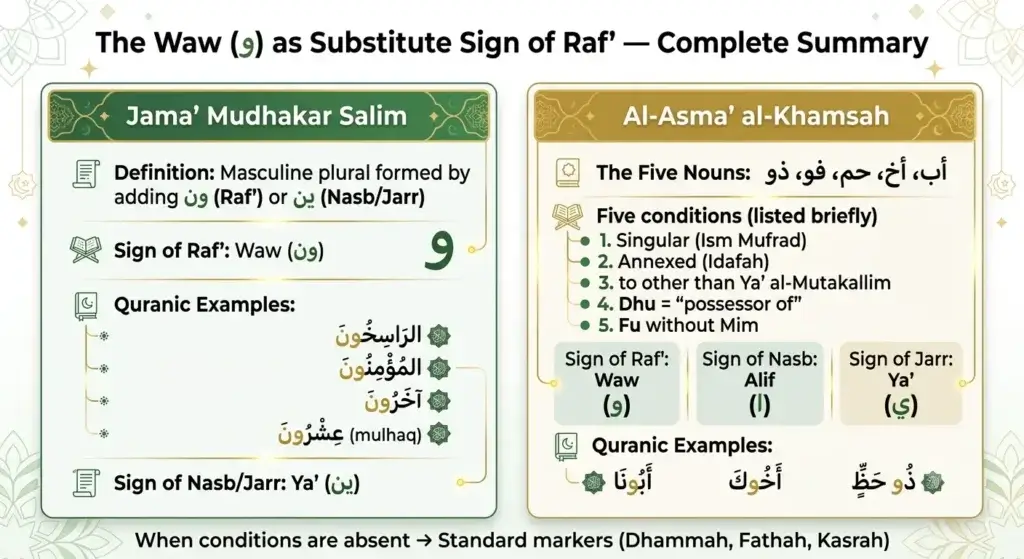
Jama’ al-Mudhakar al-Salim (the sound masculine plural) is a plural form that refers to more than two entities — male or applicable to males — formed by adding Waw and Nun (ون) in the state of Raf’, or Ya’ and Nun (ين) in the states of Nasb (accusative) and Jarr (genitive).
The word Salim (sound/intact) in its name refers to the fact that the singular form of the word remains unchanged — it is preserved intact, with the plural suffix simply added to it. This contrasts with the broken plural (Jama’ al-Taksir) in which the singular form is internally restructured.
Key rule: In Raf’, the Waw and Nun (ون) replace the Dhammah.
Islamic Studies & Smart Parenting Support
quranst provides Muslim parents in the USA, Canada, UK, Australia, and the Gulf with a structured Islamic Studies curriculum delivered by certified teachers — alongside Smart Parenting coaching to help parents reinforce learning at home.
Book your free 2-session trial for your child →Quranic Application 1: Al-Rasikhuna fi al-‘Ilm
لَٰكِنِ الرَّاسِخُونَ فِي الْعِلْمِ مِنْهُمْ وَالْمُؤْمِنُونَ يُؤْمِنُونَ بِمَا أُنزِلَ إِلَيْكَ
“But those firm in knowledge among them and the believers believe in what has been revealed to you.”
— Quran 4:162
Complete I’rab (Parsing):
| Word | Grammatical Term | Sign | Reason |
|---|---|---|---|
| لَٰكِنِ | Particle of exception (Harf Istidrak) — light form, no effect on following words | — | Not Lakinna (with shadda) which governs nouns |
| الرَّاسِخُونَ | Mubtada’ (subject) — Marfu’ (in Raf’) | Waw (و) | Jama’ Mudhakar Salim |
| فِي الْعِلْمِ | Jar wa Majrur (preposition + genitive noun) | Kasrah on العِلم | — |
| وَالْمُؤْمِنُونَ | ‘Atf (conjunction) — Marfu’ | Waw (و) | Jama’ Mudhakar Salim |
| يُؤْمِنُونَ | Fi’l Mudhari’ Marfu’ — Khabar (predicate) | Thabut al-Nun | Connected to Waw al-Jama’ah |
Sheikh al-Jadawi’s Classroom Note: A student asked: “Is Lakini here the same as Lakinna — the sister of Inna that governs what follows it?” The answer is crucial. Lakinna (لكنَّ) — with a doubled Nun and vowelled appropriately — is indeed a governing particle that puts the following noun into Nasb. But Lakini (لَٰكِنِ) here is the light form — the Nun is unvowelled, and this version is simply a particle of contrast with no grammatical effect on what follows. This is why Al-Rasikhun remains in Raf’ as the subject of the sentence, not in Nasb.
Quranic Application 2: ‘Ishrun Sabirun
إِن يَكُن مِّنكُمْ عِشْرُونَ صَابِرُونَ يَغْلِبُوا مِائَتَيْنِ
“If there are among you twenty who are steadfast, they will overcome two hundred.”
— Quran 8:65
Complete I’rab:
| Word | Grammatical Term | Sign | Reason |
|---|---|---|---|
| إِن | Harf Shart (conditional particle) | — | Particle, no case |
| يَكُن | Fi’l Mudhari’ Majzum (jussive) — verb of Kana | Sukun (حذف الواو) | The original yakunu loses its Waw before the Sukun to prevent two consecutive silent letters |
| عِشْرُونَ | Ism Yakun — Marfu’ | Waw (و) | Mulhaq (annexed) to Jama’ Mudhakar Salim |
| صَابِرُونَ | Na’t (adjective/descriptor) — Marfu’ | Waw (و) | Jama’ Mudhakar Salim |
Critical grammatical note on ‘Ishrun: ‘Ishrun (twenty) has no singular form derived from the same root — its singular is not used in standard Arabic. For this reason, it is classified as Mulhaq bi-Jama’ al-Mudhakar al-Salim — annexed to or treated like the sound masculine plural — rather than being a true sound masculine plural itself. Nevertheless, it follows exactly the same grammatical rules: Waw and Nun in Raf’, Ya’ and Nun in Nasb and Jarr.
Quranic Application 3: Wa-Akharuna
وَآخَرُونَ اعْتَرَفُوا بِذُنُوبِهِمْ
“And [there are] others who have acknowledged their sins.”
— Quran 9:102
Complete I’rab:
| Word | Grammatical Term | Sign | Reason |
|---|---|---|---|
| آخَرُونَ | Mubtada’ — Marfu’ | Waw (و) | Jama’ Mudhakar Salim (singular: آخَر) |
| اعْتَرَفُوا | Fi’l Madi (past tense) — Mabni ‘ala al-Damm | Damm | Connected to Waw al-Jama’ah |
| الواو | Fa’il (subject of the past verb) — Marfu’ | — | Pronoun in the position of Raf’ |
| بِذُنُوبِهِمْ | Ba’ harf jarr + Majrur | Kasrah | — |
| الجملة (اعترفوا بذنوبهم) | Khabar al-Mubtada’ (predicate of the subject) — Marfu’ in position | — | Verbal sentence in the position of Raf’ |
Position 1B: The Waw in Al-Asma’ al-Khamsah
What Are Al-Asma’ al-Khamsah?
Al-Asma’ al-Khamsah (the Five Nouns — sometimes six, with the inclusion of Hanu) are a specific set of Arabic nouns that follow a unique declension pattern: they are declined not with short vowel markers (Dhammah, Fathah, Kasrah) but with long vowels (letters):
- Raf’: Waw (و)
- Nasb: Alif (ا)
- Jarr: Ya’ (ي)
The five nouns are:
| Noun | Meaning |
|---|---|
| أَبٌ | Father |
| أَخٌ | Brother |
| حَمٌ | Father-in-law / husband’s male relative |
| فُوهٌ / فَم | Mouth (when without the Mim) |
| ذُو | Owner of / possessor of |
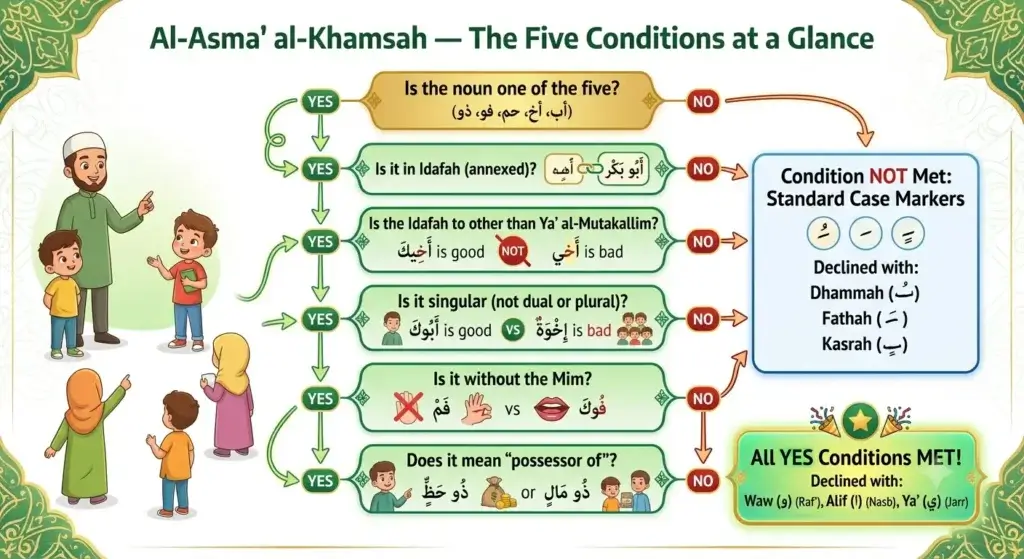
The Five Conditions of Al-Asma’ al-Khamsah
These five nouns follow the Waw/Alif/Ya’ declension pattern only when five specific conditions are met. If any condition is absent, the noun reverts to standard short-vowel declension.
Condition 1: The noun must be in the Idafah (genitive construction — i.e., it must be annexed to something)
If the noun appears alone, without being annexed to anything after it, it takes standard case markers.
Example of condition met: Ja’a akhuka (جاء أَخُوكَ) — “Your brother came.” Here akh is annexed to ka (you), so it takes the Waw in Raf’.
Example of condition absent: Ja’a akhun (جاء أخٌ) — “A brother came.” Here akh is unannexed, indefinite, so it takes the standard Dhammah Tanwin.
https://youtu.be/Azu59Dbbkac?si=zM3PAEEKixXDx6eB
Condition 2: The annexation must NOT be to the first-person pronoun Ya’ al-Mutakallim (my)
When the five nouns are annexed to the Ya’ of the first person (meaning “my father,” “my brother”), they take estimated/implied case markers — because the Ya’ after them forces a Kasrah on the preceding letter, making it impossible to display the case marker.
Example: Ja’a abi (جاء أبي) — “My father came.” The case marker of Raf’ is implied/estimated on the Ya’, not visibly shown.
Condition 3: The noun must be singular (not dual or plural)
If any of the five nouns appears in the dual form, it is parsed as a dual noun — with Alif in Raf’ and Ya’ in Nasb and Jarr.
If it appears as a broken plural (like Ikhwah — brothers), it is parsed as a broken plural — with Dhammah in Raf’.
Quranic examples of this condition being absent:
وَرَفَعَ أَبَوَيْهِ عَلَى الْعَرْشِ
“And he raised his parents upon the throne.”
— Quran 12:100
Abawayhi (أَبَوَيْهِ) is the dual form of Ab (father) — here meaning “both parents.” Because it is dual (not singular), it is parsed as a dual noun, with Ya’ in the position of Nasb (it is the object of rafa’a). It does NOT follow the Asma’ al-Khamsah declension.
إِنَّمَا الْمُؤْمِنُونَ إِخْوَةٌ
“The believers are but brothers.”
— Quran 49:10
Ikhwah (إِخْوَةٌ) is the broken plural of Akh (brother). Because it is a broken plural (not singular), it is parsed as Jama’ al-Taksir, with Dhammah Tanwin in Raf’. It does NOT follow the Asma’ al-Khamsah declension.
Condition 4: Dhu must mean “possessor of” / “owner of”
The word Dhu (ذُو) only follows the Asma’ al-Khamsah pattern when it carries the meaning of “possessing” or “owning” something. It must also be annexed to an explicit noun (not a pronoun).
Quranic example:
وَإِنَّهُ لَذُو حَظٍّ عَظِيمٍ
“And indeed, he is of great fortune.”
— Quran 28:79
Dhu here means “owner of / possessing” great fortune. It is in the state of Raf’ (as the predicate of inna) and takes the Waw.
Condition 5: Fu (the mouth) must be without the Mim
The word for “mouth” appears in two forms in Arabic: Fum (فَم) with a Mim, and Fu (فُو) without a Mim. Only the form without the Mim follows the Asma’ al-Khamsah declension.
When the Mim is present (Fam), it takes standard case markers: Dhammah in Raf’, Fathah in Nasb, Kasrah in Jarr.
Full Quranic Parsing — Applied Examples
Example 1: Wa-Abuna Shaykh Kabir
وَأَبُونَا شَيْخٌ كَبِيرٌ
“And our father is an old man.”
— Quran 12:78 (the daughters of Shu’ayb, speaking of their elderly father)
Complete I’rab:
| Word | Grammatical Term | Sign | Reason |
|---|---|---|---|
| وَ | ‘Atf or Ibtida’iyyah | — | Particle |
| أَبُونَا | Mubtada’ — Marfu’ | Waw (و) | From Al-Asma’ al-Khamsah; annexed to na (us) which is not Ya’ al-Mutakallim |
| نَا | Dhamir (pronoun) — in position of Jarr | — | Muttasil in position of Mudaf Ilayh |
| شَيْخٌ | Khabar — Marfu’ | Dhammah Tanwin | Singular noun — standard declension |
| كَبِيرٌ | Na’t (adjective) — Marfu’ | Dhammah Tanwin | Singular noun — follows its described noun |
Example 2: Inni Ana Akhuuka
إِنِّي أَنَا أَخُوكَ
“Indeed, I am your brother.”
— Quran 12:69 (Yusuf revealing himself to his brother Binyamin)
Complete I’rab:
| Word | Grammatical Term | Sign | Reason |
|---|---|---|---|
| إِنِّي | Inna — governing particle + Ya’ al-Mutakallim as its Ism | — | Ya’ in position of Nasb |
| أَنَا | Dhamir of separation (Dhamir Fasl) — no grammatical position | — | For emphasis |
| أَخُوكَ | Khabar Inna — Marfu’ | Waw (و) | From Al-Asma’ al-Khamsah; akh annexed to Ka (you — not Ya’ al-Mutakallim) |
| كَ | Dhamir — in position of Jarr | — | Mudaf Ilayh |
Example 3: Fa-Aslihú Bayna Akhawayqum
فَأَصْلِحُوا بَيْنَ أَخَوَيْكُمْ
“So make peace between your brothers.”
— Quran 49:10
Complete I’rab:
| Word | Grammatical Term | Sign | Reason |
|---|---|---|---|
| فَ | Fa’ al-Fa’ihiyyah | — | Particle |
| أَصْلِحُوا | Fi’l Amr (imperative) — Mabni ‘ala Hadhf al-Nun | — | Connected to Waw al-Jama’ah; Waw = Fa’il |
| بَيْنَ | Zarf Makan (adverb of place) — Mansub | Fathah | Annexed (Mudaf) |
| أَخَوَيْكُمْ | Mudaf Ilayh — Majrur | Ya’ (ي) | Because it is dual (Muthanna) — not singular, therefore NOT Asma’ al-Khamsah |
| كُمْ | Dhamir — in position of Jarr | — | Mudaf Ilayh |
Why Ya’ and not Waw? Akhawayqum is the dual of Akh (brother) — meaning “your two brothers.” Because the noun is dual (not singular), Condition 3 of Al-Asma’ al-Khamsah is absent. Therefore it follows the declension of the dual — Ya’ in the position of Jarr (and would take Alif in Raf’).
Example 4: Innama al-Mu’minun Ikhwah
إِنَّمَا الْمُؤْمِنُونَ إِخْوَةٌ
“The believers are but brothers.”
— Quran 49:10
This verse contains two critical parsing points that test understanding of both main topics of this lesson:
Complete I’rab:
| Word | Grammatical Term | Sign | Reason |
|---|---|---|---|
| إِنَّمَا | Kaffah wa Makfufah — Inna + Ma that neutralizes its governing effect | — | Inna cannot govern what follows it |
| الْمُؤْمِنُونَ | Mubtada’ — Marfu’ | Waw (و) | Jama’ Mudhakar Salim |
| إِخْوَةٌ | Khabar — Marfu’ | Dhammah Tanwin | Jama’ Taksir (broken plural of أخ) — NOT Asma’ al-Khamsah |
Sheikh al-Jadawi’s pedagogical question to the class: “Why is Ikhwah marked with Dhammah and not Waw, if it comes from Akh which is one of the five nouns?”
The answer tests whether students have internalized Condition 3: singularity. Ikhwah is the broken plural of Akh. Because it is a plural (and a broken one at that), it exits the category of Al-Asma’ al-Khamsah entirely and follows the standard declension of broken plurals — Dhammah in Raf’.
Why This Grammar Matters for Your Quran Recitation
At this point, a student might reasonably ask: why does this matter for someone whose primary goal is to understand the Quran, not to become an Arabic grammarian?
The answer has three dimensions.
Dimension 1: Grammatical Case Changes Recitation
In Arabic — and specifically in Quranic recitation with Tajweed — the case endings are recited, not merely written. When you recite Al-Rasikhuna fi al-‘ilm, you recite the Waw at the end of Rasikhun. When you recite Ikhwah, you recite the Dhammah Tanwin. These are not silent markers — they are sounded, and sounding them incorrectly changes the meaning of the recitation.
The Prophet ﷺ said:
“The most skilled among you in Quran is the one who is most skilled in (its recitation).”
— Sunan al-Tirmidhi, Hadith 2906; related narrations in Sahih al-Bukhari, Hadith 5027
Understanding grammar allows you to recite case endings correctly — not from memory of each individual word, but from understanding why each word carries the marker it does.
Dimension 2: Grammar Reveals Meaning That Translation Cannot
Consider the verse Innama al-Mu’minuna Ikhwah (49:10). A translation renders it: “The believers are but brothers.” Simple and beautiful.
But the grammar says more. Al-Mu’minuna is the Mubtada’ (subject) — they are the ones about whom the statement is being made. Ikhwah is the Khabar (predicate) — the quality being assigned to them. The sentence structure, in Arabic, carries an emphasis that the grammar makes explicit: it is the believers, specifically, who are defined by this quality. The Waw at the end of Mu’minuna is not just a phonetic feature — it is a grammatical declaration that places the believers at the center of the sentence.
Dimension 3: Grammar Is the Science of Allah’s Intended Meaning
Classical scholars, including Imam al-Shafi’i, held that knowledge of Arabic grammar was fard (obligatory) on the level of communal responsibility — because without it, the Quran cannot be properly understood, and the Sharia cannot be properly derived.
Imam al-Shafi’i wrote in Al-Risalah:
“It is obligatory upon every Muslim to learn of the Arabic tongue what enables him to fulfill his religious obligations: reciting the Book of Allah, making the declarations of Islamic testimony, the Takbir, the Tasbih, the Tashahhud, and what is required of him in prayer. The duty expands from this minimum the more the Muslim is able to expand it.”
— Al-Shafi’i, Al-Risalah, edited by Ahmad Muhammad Shakir, p. 48
Ibn Taymiyyah echoed this in Iqtida’ al-Sirat al-Mustaqim:
“The Arabic language is part of the religion. Knowledge of it is obligatory — for understanding the Quran and the Sunnah is obligatory, and they cannot be understood except through Arabic.”
— Ibn Taymiyyah, Iqtida’ al-Sirat al-Mustaqim, 1/527
A Summary Table: The Waw as a Substitute Sign of Raf’
Conclusion: Grammar Is Not a Cage — It Is a Key
When a student sits in Sheikh al-Jadawi’s class and parses Al-Rasikhuna fi al-‘ilm for the first time — realizing that the Waw at the end of Rasikhun is doing the grammatical work of declaring these people as the subject of the sentence, as the ones about whom a statement is being made — something changes.
The verse they have recited since childhood now has a different weight. The Rasikhun — the ones firmly grounded in knowledge — are not background characters in the verse. They are, grammatically, the stars of the sentence. The Waw puts them there.
This is what Quranic Arabic grammar gives you: the ability to hear what the Arabic is doing at a level that translation cannot reach. The ability to recite not just accurately but knowingly — with the understanding that every letter, every vowel marker, every structural feature of Arabic is carrying meaning that Allah intended.
The Prophet ﷺ described the Quran as:
“The feast of Allah upon the earth — so eat from His feast as much as you are able.”
— Al-Hakim, Al-Mustadrak, 1/742; authenticated by al-Hakim and al-Dhahabi
Arabic grammar is not the food itself. It is the knowledge of how to use the utensils. And the difference between a guest who sits at a feast without utensils and one who has them is the difference between appreciating what is in front of you — and being able to fully partake of it.
The next lesson covers the remaining substitute signs of Raf’: the Alif and Thabut al-Nun — completing the full picture of when and why Arabic moves beyond the standard Dhammah to signal the nominative case.
أَفَلَا يَتَدَبَّرُونَ الْقُرْآنَ وَلَوْ كَانَ مِنْ عِندِ غَيْرِ اللَّهِ لَوَجَدُوا فِيهِ اخْتِلَافًا كَثِيرًا
“Then do they not reflect upon the Quran? If it had been from other than Allah, they would have found within it much contradiction.”
— Quran 4:82
The grammar does not produce contradiction. It resolves it — word by word, sign by sign, into precise, divinely intended meaning.
🟢 Learn Quranic Arabic with Sheikh Mohammed El-gedawy
This lesson is part of a structured Arabic grammar curriculum taught live, one-on-one, at quranst — designed specifically for Muslim families in the USA, Canada, UK, Australia, and the Gulf who want to understand the Quran in the language it was revealed in.
Sheikh Muhammad al-Jadawi — quranst’s lead Arabic Language and Quran instructor — brings together:
- Deep classical linguistic training in Arabic grammar, Tajweed, and Quranic sciences
- Years of experience teaching students from English-speaking backgrounds and diaspora communities
- A teaching methodology that connects every grammatical rule to a Quranic verse — so students never learn grammar in the abstract, but always in the context of the Book of Allah
What the Arabic Language Track Covers
Foundational Level:
- The Arabic alphabet with correct phonetic values
- The three grammatical states (Raf’, Nasb, Jarr) and their signs
- The original signs (Dhammah, Fathah, Kasrah, Sukun)
- The substitute signs — this lesson and its continuation
Intermediate Level:
- The verbs of Kana and Inna and their effect on case
- Sentence types: nominal (jumlah ismiyyah) and verbal (jumlah fi’liyyah)
- The system of attached and detached pronouns
- Idafah (genitive construction) and its rules
Applied Quranic Level:
- Full I’rab of Quranic verses
- Understanding why specific words carry specific case markers
- How grammar changes the meaning and emphasis of Quranic statements
- Preparation for reading classical Tafsir in Arabic
👇 Begin Today — Two Ways
Two Ways to Begin
“The best of you are those who learn the Quran and teach it.”
— Sahih al-Bukhari, Hadith 5027
Learn it. Understand it. Live it.
بِسْمِ اللَّهِ — Begin.
References and Sources
Quranic References
- Quran 4:82 — “Do they not reflect upon the Quran?”
- Quran 4:162 — Al-Rasikhuna fi al-‘ilm (those firm in knowledge)
- Quran 8:65 — ‘Ishrun Sabirun (twenty steadfast believers)
- Quran 9:102 — Wa-Akharuna i’tarafa (others who acknowledged)
- Quran 12:69 — Inni ana akhuuk (I am your brother — Yusuf to Binyamin)
- Quran 12:78 — Wa-abuna shaykh kabir (our father is an old man)
- Quran 12:100 — Wa-rafa’a abawayhi (he raised his parents)
- Quran 28:79 — Wa-innahu la-dhu hazzin ‘azim (he is of great fortune)
- Quran 49:10 — Innama al-mu’minuna ikhwah (the believers are but brothers)
- Quran 49:10 — Fa-aslihú bayna akhawayqum (make peace between your brothers)
Classical Grammar Sources
- Al-Jurjumiyyah (Al-Muqaddimah al-Ajurrumiyyah): Ibn Ajurrum al-Sinhaji (672–723 AH). The foundational text on which this lesson is based — the most widely studied primer in Arabic grammar in the Islamic world.
- Sharh Ibn ‘Aqil ‘ala Alfiyyat Ibn Malik: Ibn ‘Aqil al-Hamdhani (698–769 AH). Dar al-Turath, Cairo. Standard reference for Asma’ al-Khamsah conditions.
- Al-Nahw al-Wadih: Ali al-Jarim and Mustafa Amin. Dar al-Ma’arif, Cairo. Standard pedagogical reference for modern Arabic grammar instruction.
- Sharh al-Ashmouni ‘ala Alfiyyat Ibn Malik: Al-Ashmouni (838–900 AH). Dar al-Kutub al-Ilmiyyah, Beirut. Detailed treatment of substitute signs.
Hadith References
- Sahih al-Bukhari, Hadith 5027 — “The best of you are those who learn the Quran and teach it”
- Sunan al-Tirmidhi, Hadith 2906 — skill in Quran recitation
- Al-Hakim, Al-Mustadrak, 1/742 — the Quran as Allah’s feast on earth (authenticated by al-Hakim and al-Dhahabi)
Scholarly References
- Al-Shafi’i, Muhammad ibn Idris: Al-Risalah. Edited by Ahmad Muhammad Shakir. Maktabat al-Halabi, Cairo. p. 48 (on the obligation of learning Arabic)
- Ibn Taymiyyah, Ahmad ibn Abd al-Halim: Iqtida’ al-Sirat al-Mustaqim Mukhalafat Ashab al-Jahim. Maktabat al-Rushd, Riyadh. Vol. 1: p. 527 (Arabic as part of the religion)
