


Introduction: The Thing We All Say We Don’t Have
Ask any Muslim parent in Dearborn, Dubai, or Dhaka what their biggest struggle is, and somewhere in the answer you will find the same word: time.
Not enough time. Time that moves too fast. Time that disappears between school runs and work deadlines and dinner and the endless scroll of a phone screen that was picked up for thirty seconds and put down forty-five minutes later.
And yet, if you asked those same parents to account for yesterday — to trace where each hour actually went — most would find something uncomfortable: that time did not disappear. They gave it away. To the smartphone. To the streaming service. To the email that could wait. To the conversation that went nowhere. To the minutes that seemed like nothing individually but accumulated into something that, in retrospect, could have been a relationship rebuilt, a Quran portion memorized, a prayer extended, a child truly seen.
This is the paradox of the age of speed: we have never had more efficiency tools, more time-saving devices, more instant access to everything — and we have never felt more drained, more behind, more like we are losing a race we did not sign up for.
Islam has something to say about this. Not as a productivity hack, not as a self-help framework, but as a comprehensive theological and practical tradition that has been thinking about time — its value, its purpose, its dangers — since the Quran was first revealed.
This guide is that conversation.
Structured Curriculum Framework
quranst’s Islamic Studies and Smart Parenting tracks help Muslim families build a structured, purposeful relationship with time — grounded in Quranic values and prophetic wisdom.
Book your free 2-session trial →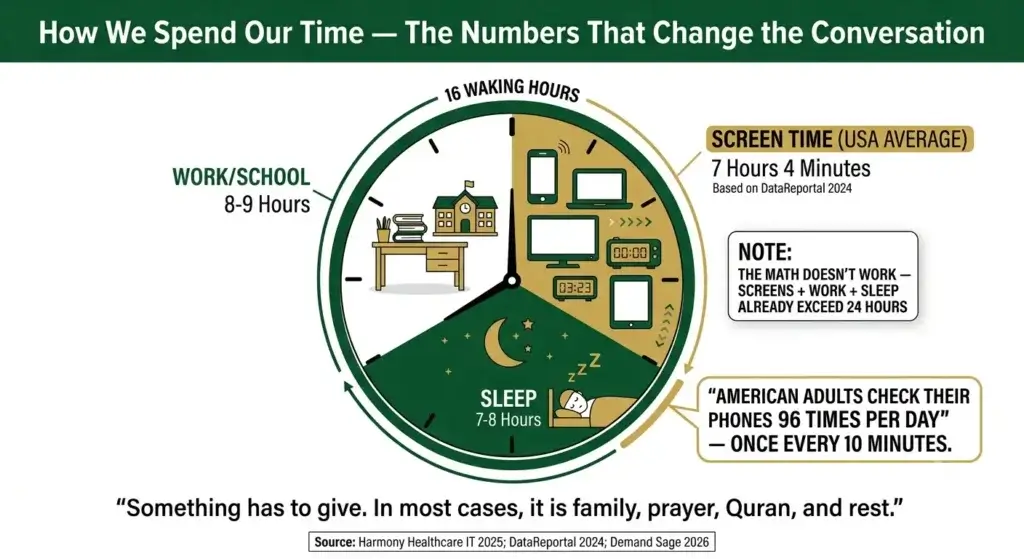
Section 1: Allah Swears by Time — The Theological Weight of Al-Asr
There are things in the Quran that, if you slow down long enough to truly notice them, stop you in your tracks.
One of them is the very first word of Surah Al-Asr:
وَالْعَصْرِ ﴿١﴾ إِنَّ الْإِنسَانَ لَفِي خُسْرٍ ﴿٢﴾
“By time — indeed, mankind is in loss.”
— Quran 103:1–2
Two words. And Allah swears by them.
In Arabic rhetoric, an oath (qasam) is used to draw attention to something of supreme importance — to make the listener lean in, to signal that what follows demands the deepest level of seriousness. And here, Allah swears not by the mountains, not by the heavens, not by the angels — but by time itself.
The word Al-‘Asr carries multiple layers: it refers to the epoch of human history, the afternoon period of the day, and by extension the passage of time in its entirety. The scholars of Quranic commentary are in broad agreement that the oath encompasses all of these dimensions — Allah is swearing by the flow of time itself as the context in which the human being will either gain or lose everything.
And the verdict that follows is stark: Inna al-insana la-fi khusr — mankind, without qualification, is in loss.
Loss of what? The scholars note that khusr in Arabic is the language of trade — of a merchant who made an investment and came back with less than they started with. And the investment here is the gift of life itself: the years, the days, the hours, the minutes that Allah allocated to each soul upon sending it into the world.
Imam al-Shafi’i — reflecting on this surah — said:
“If people reflected only upon this surah, it would be sufficient for them.”
— Cited by Ibn Kathir in Tafsir al-Quran al-Azim, commentary on Surah Al-Asr
That statement is not hyperbole. It is the assessment of the greatest jurist of his generation, who spent his life in the deepest engagement with the Quran. The three-verse surah — the Quran’s most compressed encapsulation of the human condition — says everything that needs to be said about time: that we are losing it, that loss is the default, and that the only escape is faith combined with righteous action, mutual commitment to truth, and mutual commitment to patience.
The Exception: Four Conditions for Not Being in Loss
The surah does not leave us without a way out. The third verse provides the conditions:
إِلَّا الَّذِينَ آمَنُوا وَعَمِلُوا الصَّالِحَاتِ وَتَوَاصَوْا بِالْحَقِّ وَتَوَاصَوْا بِالصَّبْرِ ﴿٣﴾
“Except those who have believed and done righteous deeds and advised each other to truth and advised each other to patience.”
— Quran 103:3
Four conditions — not one. And notably, conditions three and four are communal: tawassaw bil-haqq (advising each other toward truth) and tawassaw bil-sabr (advising each other toward patience). The surah does not locate the solution to time’s loss solely in individual piety. It locates it in the community of believers who hold each other accountable — who tell each other the truth about how time is being used, and who encourage each other to persist even when the right use of time is difficult.
For Muslim families: this surah is not just personal counsel. It is a community mandate.
Section 2: The Numbers That Should Alarm Every Muslim
Before we turn to the prophetic guidance on time, it is worth sitting with the contemporary reality of what is actually happening to our time — because the numbers are sobering, and they apply equally to Muslims and non-Muslims in the modern West.
<cite index=”13-1″>The average person spends 6 hours and 51 minutes on screens daily — totaling nearly 48 hours per week, almost the equivalent of a full work week spent staring at digital devices.</cite>
<cite index=”16-1″>Americans specifically spend an average of 5 hours and 16 minutes per day on their phones alone — a 14% increase from the previous year.</cite>
<cite index=”13-1″>The average American checks their phone 96 times every day — once approximately every ten minutes of waking life.</cite>
<cite index=”20-1″>For teenagers aged 13–18, the numbers are more alarming: American teenagers average 8 hours and 39 minutes of entertainment screen time daily, with 41% spending 8 or more hours per day on screens. The US Surgeon General, Dr. Vivek Murthy, stated in June 2024: “The mental health crisis among young people is an emergency, and social media has emerged as an important contributor.”</cite>
Now run the mathematics of the prophetic hadith against these numbers.
The Fajr prayer requires approximately 10 minutes. The Quran — if one committed to reading just one page a day — requires 3–5 minutes. A meaningful family conversation at dinner requires 20 minutes. The daily adhkar taught in the authentic Sunnah — SubhanAllah, Alhamdulillah, Allahu Akbar, the morning and evening remembrances — require fewer than 15 minutes total.
In other words: the core daily Islamic practices that sustain a believer’s spiritual life require, at most, 45 minutes to one hour of intentional time.
Against an average of 5–7 hours of screen consumption daily.
The Islamic question is not: do I have time for my religion? The Islamic question is: what am I doing with the time I have already committed to something else?
Section 3: What the Prophet ﷺ Said About Time — Seven Foundational Hadith
The Prophetic tradition on time is not a peripheral collection of sayings. It is a sustained, multi-dimensional engagement with one of the most important realities of human life.
Hadith 1: The Two Blessings Most People Squander
نِعْمَتَانِ مَغْبُونٌ فِيهِمَا كَثِيرٌ مِنَ النَّاسِ: الصِّحَّةُ وَالْفَرَاغُ
“There are two blessings which many people lose: health and free time.”
— Sahih al-Bukhari, Hadith 6412
The word magbun (مغبون) is the language of someone cheated in a transaction — the one who did not recognize the value of what they had until it was gone. The Prophet ﷺ is saying that most people are swindled out of their health and their free time — not by an enemy, but by their own failure to recognize these gifts as gifts.
For the Muslim in the West: free time is exactly what the digital entertainment industry is designed to consume. The scrolling, the streaming, the browsing — these are not accidents. They are the product of billion-dollar engagement optimization teams whose entire purpose is to convert your faragh (free time) into their revenue. Knowing this is not paranoia. It is the Prophetic framework applied to a modern reality.
Hadith 2: Take Advantage of Five Before Five
“Take advantage of five matters before five others: your youth before your old age; your health before your illness; your wealth before your poverty; your free time before you become occupied; and your life before your death.”
— Musnad Ahmad, Hadith 458; authenticated by al-Albani in Sahih al-Jami’, Hadith 1077
This hadith — one of the most comprehensive time-management statements in the Islamic tradition — identifies five windows of opportunity that are available to the believer now but will not be available forever.
Notice the pairing:
- Youth pairs with old age — not sickness or death, but old age: the gradual narrowing of capacity
- Health pairs with illness — the ability to act is not permanent
- Wealth pairs with poverty — material resource is contingent
- Free time pairs with being occupied — this pairing is deliberately specific: not with death, but with the ordinary busyness of life
- Life pairs with death — the ultimate deadline
The inclusion of “free time before you become occupied” in a list alongside life and death tells us something important about the weight the Prophet ﷺ gave to idle or wasted time. It is placed alongside existential categories — not because time is more important than life, but because the use of free time is one of the defining factors in what kind of life a person actually lives.
Hadith 3: The Questioning on the Day of Judgment
“The feet of the son of Adam shall not move on the Day of Judgment until he is questioned about five: his life — how he spent it; his youth — how he used it; his wealth — where he acquired it and how he spent it; and what he did with what he knew.”
— Sunan al-Tirmidhi, Hadith 2416; classified as Hasan by al-Tirmidhi
Of the five questions on the Day of Judgment, two specifically concern time: how the entirety of one’s life was spent, and how specifically the period of youth was used. Wealth gets one question. Knowledge gets one question. But time gets two.
This weighting is deliberate and significant. Time is the container in which everything else happens. What you did with your wealth is a time question. What you did with your knowledge is a time question. The Judgment is, among other things, an accounting of time.
Hadith 4: Allah Is Time
“Allah said: ‘The son of Adam wrongs Me by cursing Ad-Dahr (Time), but I am Ad-Dahr (Time). In My hand is the affair, and I alternate the night and the day.'”
— Sahih al-Bukhari, Hadith 4826; Sahih Muslim, Hadith 2246
This hadith contains a profound theological statement. In pre-Islamic Arab culture, people would curse Time when misfortunes befell them — blaming Time as an impersonal, hostile force. The Prophet ﷺ narrates that Allah rejects this: I am Ad-Dahr — meaning that Allah is the controller of time, the One in whose hand all of time’s events reside.
The theological implication: time is not a neutral backdrop against which human life plays out. Time is under divine governance. Every moment is authored. To waste time is, in a real sense, to waste a divine gift whose Author is Allah.
Hadith 5: The Seven Calamities That Steal Your Time
“Lose no time in doing good deeds before you are caught by one of seven calamities: a famine that may impair your mind; a prosperity that may mislead you; an illness that may damage your health; old age that may harm your senses; a sudden death; the Dajjal; or Doomsday — which is the hardest and most bitter.”
— Sunan al-Tirmidhi, Hadith 2306; authenticated by al-Albani
The Prophet ﷺ is naming the specific life circumstances that will interrupt your ability to use time well — ranging from the external (famine, pandemic, societal collapse) to the deeply personal (illness, cognitive decline, sudden death). The warning is urgency-based: do not wait for the ideal moment to start being intentional with your time, because the list of circumstances that can prevent the ideal moment is long.
Hadith 6: Every Day Is a Seller
“Do not wish for death, for the terror of the standing-place is severe. And from your goodness: that you live long enough, so that you might repent.”
— Sahih al-Bukhari, Hadith 7235; related narration
And elsewhere, the Prophet ﷺ said:
“Whoever among you wakes up in the morning secured in his home, healthy in his body, and having his daily provisions — it is as if he owns the entire world.”
— Sunan al-Tirmidhi, Hadith 2346; authenticated by al-Albani
The morning — with security, health, and provision — is described as equivalent to possessing the world. Not the afternoon. Not the evening. This morning. The moment of waking, with these three blessings intact, is a complete gift of divine generosity. The question the hadith asks implicitly: what have you done with it?
Hadith 7: The Regret of the One Who Wasted Time
“A servant will not move from his standing place on the Day of Judgment until he has been asked about his age: how he spent it; and his knowledge: what he did with it; and his wealth: how he earned it and how he spent it; and his body: in what he wore it out.”
— Sunan al-Tirmidhi, Hadith 2416
The final item — the body, and how it was exhausted — is the physical counterpart to the time question. Time and bodily energy are given together. They are depleted together. And they are accounted for together.
Section 4: What the Classical Scholars Said — Time as a Trust and a Sword
The classical scholars of Islam did not approach time as an abstract theological concept. They engaged with it as a practical emergency — and their statements on the subject carry an urgency that sounds less like medieval scholarship and more like a warning designed for exactly the moment we are living in.
Imam al-Shafi’i: The Sword That Cuts Both Ways
Perhaps the most quoted Islamic statement on time comes from Imam al-Shafi’i (150–204 AH), who said:
“Time is like a sword: if you do not cut it, it will cut you. And your self — if you do not keep it busy with truth, it will keep you busy with falsehood.”
— Cited in Productive Muslim and widely attributed in classical scholarship
The metaphor is surgical: a sword held still does not stay neutral. If it is not in your hand doing purposeful work, gravity and circumstance will eventually turn it against you. The self (nafs), left unoccupied with purposeful activity, does not rest in neutral — it drifts toward distraction, appetite, and the slow erosion of everything that matters.
Ibn al-Qayyim: Time Is Your Life Itself
Ibn al-Qayyim al-Jawziyyah (1292–1350 CE), in Al-Fawa’id — his collection of reflections written during a period of personal seclusion — wrote what may be the most precise definition of time’s value in the entire Islamic scholarly tradition:
“Time is your life — and your life is the capital from which you conduct the business of the next world. Whoever wastes his time has wasted his life; and whoever wastes his life has lost the merchandise that will be resold to him at the highest price: the pleasure of Allah and eternal Paradise.”
— Ibn al-Qayyim, Al-Fawa’id (Dar Ibn al-Jawzi), p. 95
This framing — time as capital, life as a business, the next world as the market — is not metaphor for metaphor’s sake. It is a complete re-orientation of how the believer should relate to every unit of time they are given. The question is not: am I enjoying this hour? The question is: what is this hour generating?
Hasan al-Basri: The Day Speaks to You
Hasan al-Basri (642–728 CE) — one of the greatest Tabi’in scholars of the early Muslim generation — was known for statements about time that reduced his students to tears. He said:
“O son of Adam — you are nothing but a collection of days. When a day goes, a part of you goes with it.”
— Cited in Hilyat al-Awliya’, Abu Nu’aym al-Asfahani, 2/131
And in another recorded statement:
“I have never seen anything more certain than death and more doubtful than the appointed hour — and yet you live as though both are distant.”
— Ibid.
Ibn Mas’ud: The Regret of the Believer
Ibn Mas’ud (may Allah be pleased with him) said:
“I do not grieve over anything as much as I grieve over a day that passed in which I did not increase in my provisions for the next world.”
— Cited in Ibn Rajab al-Hanbali, Lata’if al-Ma’arif, p. 168
This statement from one of the Prophet’s closest companions recalibrates the standard of what counts as a “good day.” Not a productive day professionally. Not a pleasant day personally. A day in which the provisions for the next world increased.
Imam al-Ghazali: The Hour That Passes Can Never Return
Imam al-Ghazali, in Ihya’ Ulum al-Din (Vol. 4, Chapter on Self-Examination), writes:
“Know that time is your most precious asset — and it is the most easily wasted. Every hour that passes without purpose is a loss that cannot be recovered. Time is a trust given to you for investment — not for consumption.”
Section 5: The Islamic Architecture of Time — How the Five Prayers Structure a Day
One of the most overlooked dimensions of the Islamic concept of time is structural: Allah did not merely command the five daily prayers — He scheduled them at specific points in the day, creating an architecture of intentionality that divides every waking period into segments of purpose.
إِنَّ الصَّلَاةَ كَانَتْ عَلَى الْمُؤْمِنِينَ كِتَابًا مَّوْقُوتًا
“Indeed, prayer has been decreed upon the believers at specified times.”
— Quran 4:103
The phrase kitaban mawquta (كِتَابًا مَّوْقُوتًا) means “a decreed obligation with fixed times.” The mawqut (time-fixed) nature of prayer is not incidental. It is the mechanism by which Islam structures the day.
The five prayers create five natural checkpoints across the twenty-four hour cycle:
| Prayer | Approximate Time | What It Begins |
|---|---|---|
| Fajr | Pre-dawn | The day — before distraction begins |
| Dhuhr | Midday | The afternoon — a reset at the day’s hinge |
| Asr | Late afternoon | The final productive hours — a checkpoint before evening |
| Maghrib | Sunset | The transition from day to night |
| Isha | Night | The close — the daily account before sleep |
The practical effect of maintaining the five prayers at their proper times is that the believer never has more than a few hours without a moment of deliberate return to Allah. The day is not a continuous undifferentiated stream of time available for consumption by whoever or whatever can claim it first — it is a series of segments, each with a divine appointment at its boundary.
This is, from an Islamic perspective, the most fundamental time-management system ever designed. The Muslim who keeps all five prayers, on time, has built into their day five moments in which the phone is put down, the scroll is stopped, the meeting is paused, and the soul returns to its most essential orientation.
The Prophet ﷺ described the effect:
“The five daily prayers are like a great river running by the door of one of you, into which he plunges five times a day — do you think any filth would remain on him?”
— Sahih Muslim, Hadith 667
The filth in this hadith is not only moral — it is attentional. The person who prays five times a day is someone whose attention is cleansed five times a day of the accumulated sediment of distraction, anxiety, and the world’s noise.
Section 6: The Four Thieves of Time in the Digital Age
Understanding Islam’s view of time is one thing. Understanding what specifically steals time from the contemporary Muslim is another. There are four primary thieves in the digital age that demand honest naming:
Thief 1: The Infinite Scroll
<cite index=”13-1″>The average person spends 2 hours and 21 minutes daily on social media.</cite> But this number obscures the real mechanism: the scroll is designed to be endless. There is no natural stopping point — no last page, no “the end,” no signal that the content has been exhausted. The same engineers who designed these systems have testified in US Congressional hearings that they were explicitly designed to maximize time-on-platform — not to serve the user’s wellbeing, but to extend the session.
The Islamic concept of wara’ (scrupulous avoidance of the doubtful) applies here not only to content but to mechanism. A believer who understands that a system is designed to steal their time should treat it with the same caution they would any other known danger.
Thief 2: Passive Entertainment Without Boundary
Streaming services are designed for binge — the next episode autoplays before the credits finish. <cite index=”14-1″>Americans spend approximately 3 hours per day streaming TV, with social media browsing adding nearly 2 hours and 43 minutes daily.</cite> Together, this means the average American adult spends nearly 6 hours daily in passive, algorithmically directed entertainment.
The Islamic tradition does not prohibit entertainment — the Prophet ﷺ himself raced with Aisha, joked with companions, and allowed poetry and permissible play. What it prohibits is israf — excess, waste, the crossing of boundaries that lead to the neglect of what matters. Six hours of passive daily entertainment, by any Islamic standard of time as a divine trust, constitutes israf.
Thief 3: Reactive Living
Many people today live in what psychologists call a state of continuous partial attention — never fully present, never fully away, always half-attending to the phone even while in conversation, prayer, or family time. <cite index=”13-1″>The average American checks their phone 96 times per day — once every ten minutes of waking life.</cite>
The Prophet ﷺ described the ideal quality of prayer as khushu’ — presence, submersion, full attention of the heart. This quality of presence is not only a prayer virtue — it is the Islamic relational standard in general. The person who is half-present with their child while checking their phone is neither fully praying nor fully parenting. They are living in the cracks between things, belonging entirely to nothing.
Thief 4: The Illusion of “I’ll Do It Later”
The prophetic warning about the seven calamities that can steal your good intentions addresses exactly this thief. Later is the most dangerous word in the believer’s vocabulary — because it assumes a certainty about the future that no human being possesses.
“Procrastination is of the Shaytan.”
— Ibn Rajab al-Hanbali, Jami’ al-Ulum wa al-Hikam, related in discussion of wasting time; the principle is widely cited in classical scholarship
The Shaytan does not need you to abandon your good intentions. He only needs you to delay them long enough that circumstances make them impossible.
Section 7: A Quranic and Prophetic Framework for Reclaiming Your Time
The Islamic tradition does not merely diagnose the problem of wasted time — it provides a complete prescriptive framework for reclaiming it. Here are six practical principles drawn directly from the Quran and Sunnah:
Principle 1: Niyyah Before Action — Set Your Intention Before Each Hour
“Actions are judged by intentions, and every person will have what they intended.”
— Sahih al-Bukhari, Hadith 1; Sahih Muslim, Hadith 1907
The first hadith in Sahih al-Bukhari establishes intention as the primary differentiator of value. The same hour spent in the same activity can be worship or waste depending on the intention with which it was approached. A parent who decides, before picking up their child from school, that this car ride will be a deliberate connection — not a scrolling session — has already transformed the hour through niyyah alone.
Practical application: before each major segment of your day — morning, work, family time, evening — spend thirty seconds asking: what is this time for? Name the intention. Say it aloud if possible. This is not productivity management. It is Islamic intentionality.
Principle 2: Muhasabah — Daily Accountability Before Sleep
“O you who have believed, fear Allah. And let every soul look to what it has put forward for tomorrow — and fear Allah.”
— Quran 59:18
The phrase wa-ltanzur nafsun ma qaddamat li-ghad (let every soul look to what it has put forward for tomorrow) is the Quranic instruction for muhasabah — daily self-examination. The great early scholar Umar ibn al-Khattab (may Allah be pleased with him) said:
“Hold yourself accountable before you are held accountable.”
The practical form: each night before sleep, take five minutes to review the day. Not to judge harshly, but to observe honestly. Where did the time go? What was built? What was wasted? What will tomorrow look like?
Principle 3: Maqasid-Oriented Time — Ask What Your Time Is Serving
Classical Islamic jurisprudence organizes all human activity around five protected necessities (al-daruriyyat al-khamsa): religion, life, intellect, lineage, and wealth. Everything a Muslim does with their time should, in some way, serve one of these five — directly or indirectly.
The practical question, applied to any given activity: which of these five does this serve? Watching a show that improves your craft serves livelihood. A walk that maintains your health serves life. Prayer serves religion. Time with your family serves lineage. Study serves intellect.
An activity that serves none of them is, by this Islamic framework, either neutral mubah (permitted, but generating no reward) or wasteful.
Principle 4: Tawbah Immediately — The Day That Is Lost Can Still Produce Repentance
“Allah spreads out His hand at night to accept the repentance of those who sinned during the day, and He spreads out His hand during the day to accept the repentance of those who sinned during the night.”
— Sahih Muslim, Hadith 2759
The day that was largely wasted is not a write-off. Before its night ends, the believer can make a sincere tawbah for the wasted time, make a fresh intention for tomorrow, and extract from even a lost day the act of repentance and renewal. This is the mercy embedded in the Islamic framework — it does not allow a wasted day to become a wasted soul.
Principle 5: Consistency Over Intensity
“The most beloved deeds to Allah are those that are most consistent, even if they are small.”
— Sahih al-Bukhari, Hadith 6465
For Muslim families trying to build more intentional lives: the temptation is to design grand total overhauls of daily routine that last three days before collapsing. The Prophetic model is different. Small, consistent, daily acts — one page of Quran, one family dinner without phones, one evening walk, one specific dhikr after Fajr — accumulate into a life that is recognizably different from a life lived on autopilot.
Principle 6: Prioritize the ‘Umr Over the Day
The Arabic word for life — ‘umr — shares a root with ‘imarat (construction, building, development). The Islamic concept of a life is fundamentally architectural: you are building something with your time. And the building that matters is the one that stands after you are gone.
“When a person dies, all action is cut off except three: ongoing charity, knowledge that benefits, or a righteous child who prays for him.”
— Sahih Muslim, Hadith 1631
The Muslim who spends their ‘umr building these three things — charitable structures that keep giving, knowledge that keeps spreading, and children who become people who pray — has invested their time in the only portfolio that pays dividends in the next life.
Section 8: Raising Time-Conscious Children in the Age of Screens
The most urgent application of everything in this guide is the raising of children in the digital age.
<cite index=”20-1″>High screen time at age two correlates with a two times higher risk of emotional and behavioral difficulties by ages 5–6. And American teenagers average 8 hours and 39 minutes of entertainment screen time daily — with 69% of young adults aged 18–29 reporting they want to reduce their screen time (Pew Research 2024).</cite>
The children growing up today are not screen addicts by choice. They are screen addicts because they were placed in front of screens before they had the cognitive or volitional capacity to resist them. And by the time they develop that capacity, the neural pathways of the habit are already deeply formed.
The Islamic parent’s responsibility is not to fight screens after the habit is established. It is to establish a competing architecture of meaning before the screen claims that space.
Five Prophetically Grounded Practices for Time-Conscious Families
1. The Family Prayer as the Daily Anchor Pray at least one prayer together, daily, as a family — not just as a religious obligation but as a deliberate interruption of the day’s inertia. The child who grows up with a parent who stops whatever they are doing when the adhan sounds learns, through repetition, that time is not their own to spend as they please — there is a higher claim.
2. The Dinner Table Without Screens The Prophet ﷺ modeled communal eating as a deliberate social and spiritual act — “Eat together, for the blessing is in the gathering.” (Sunan Ibn Majah, Hadith 3287; authenticated by al-Albani). One phone-free meal daily, across a year, is 365 hours of genuine family presence — more than fifteen complete days of connection that would otherwise have been lost to the scroll.
3. The Weekly Muhasabah with Children Once a week — Friday evening is the Prophetically resonant moment — sit with your child and ask three questions: What was the best thing you did with your time this week? What would you do differently? What is one thing you want to accomplish next week? Do not turn it into a lecture. Ask the questions, listen, and share your own answers first. The practice models self-examination as a Islamic norm rather than a parental imposition.
4. The Summer and Holiday Alternative Architecture The moments most dangerous for children’s time are unstructured holidays and summers — when the default architecture of school disappears and the screen fills the vacuum. The Islamic alternative is not to schedule every minute, but to provide alternative meaning: a Quran memorization goal, a community service project, a family book, a skill to learn. The child who has something meaningful to do with unstructured time develops a different relationship with boredom — one in which boredom is an invitation to create rather than a trigger to consume.
5. The Living Example No teaching about the value of time will survive a parent who demonstrates, daily, that their own time belongs to the screen. Children do not hear your values — they observe your habits. The parent who puts down the phone at dinner, who keeps the Quran app on the home screen and opens it every morning, who prays without delay when the adhan sounds, who reads books and has conversations and is genuinely present — that parent is teaching time management more powerfully than any speech.
Structured Curriculum Framework
quranst’s Smart Parenting track provides Muslim parents with structured frameworks, Prophetically grounded strategies, and ongoing support for raising time-conscious, faith-grounded children in the digital age.
Book your free 2-session trial →Conclusion: The Question You Will Be Asked
There will come a moment — documented in hadith, believed by every Muslim — when you will stand before Allah, and your feet will not move until five questions have been answered.
Two of those five questions are about time.
How did you spend your life? How did you spend your youth?
Not: how much money did you make? Not: how many followers did you have? Not: how productive were you by the metrics of the industries that competed for your attention?
How did you spend your life?
The honest answer, for most of us living in this particular historical moment, would have to include several thousand hours of screens. Some of those hours were useful. Many were not.
This is not a counsel of despair. It is an invitation to begin.
The Prophet ﷺ said — in one of the most forgiving and forward-looking statements in the entire Sunnah:
“Every day that the sun rises upon, and then sets without you having done something good in it — grieve for that day.”
— Al-Bayhaqi, Shu’ab al-Iman, cited in Ibn al-Qayyim, Al-Fawa’id
The operative word is every. Not “the wasted years of your past” — every day. Today is still available. The sun has not set yet.
Surah Al-Asr tells us that mankind is in loss — and then immediately tells us the way out: faith, good deeds, advising each other to truth, advising each other to patience.
Four conditions. All four are available right now.
The believer who wasted yesterday’s time is not condemned. They are invited — by the mercy embedded in the very structure of Islamic time, in the five prayers and the daily tawbah and the evening muhasabah — to begin again with this day’s Fajr, this meal’s gratitude, this hour’s intention.
The time you have is the time you have. Use it.
وَالْعَصْرِ ﴿١﴾ إِنَّ الْإِنسَانَ لَفِي خُسْرٍ ﴿٢﴾ إِلَّا الَّذِينَ آمَنُوا وَعَمِلُوا الصَّالِحَاتِ وَتَوَاصَوْا بِالْحَقِّ وَتَوَاصَوْا بِالصَّبْرِ ﴿٣﴾
“By time — indeed, mankind is in loss — except those who have believed and done righteous deeds and advised each other to truth and advised each other to patience.”
— Quran 103:1–3
🟢 Build a More Purposeful Islamic Life
The knowledge in this article is only the beginning.
quranst exists to help Muslim families — in the USA, Canada, UK, Australia, and the Muslim world — build the Islamic knowledge and the daily structure that transforms time from something that slips away into something that is deliberately invested.
Our tracks directly address the time question:
Islamic Studies Track:
- Tafsir of Surah Al-Asr — the most important three verses on time in the Quran
- The complete Islamic framework for muhasabah, intention, and purposeful living
- The fiqh of obligatory vs recommended vs permissible vs wasteful use of time
Smart Parenting Track:
- Screen time frameworks for Muslim families — grounded in Prophetic guidance, not just pediatric advice
- How to build family rituals around the five prayers that make Islamic time architecture a lived reality
- Age-appropriate strategies for each developmental stage
Quran Track:
- Structured Quran memorization — one of the highest-yield investments of time available to a Muslim family
- Daily Tajweed practice that transforms the Quran from a duty into a conversation
👇 Begin with Two Free Sessions
Two Ways to Begin
“There are two blessings which many people lose: health and free time.”
— Sahih al-Bukhari, Hadith 6412
You have free time right now.
بِسْمِ اللَّهِ — Use it.
References and Sources
Quranic References
- Quran 4:103 — Prayer decreed at specified times (kitaban mawquta)
- Quran 59:18 — “Let every soul look to what it has put forward for tomorrow”
- Quran 103:1–3 — Surah Al-Asr (the complete surah on time and loss)
Hadith References — Primary Sources
- Sahih al-Bukhari, Hadith 1; Sahih Muslim, Hadith 1907 — “Actions are judged by intentions”
- Sahih al-Bukhari, Hadith 4826; Sahih Muslim, Hadith 2246 — “I am Ad-Dahr (Time)” — Hadith Qudsi
- Sahih al-Bukhari, Hadith 6412 — “Two blessings many people lose: health and free time”
- Sahih al-Bukhari, Hadith 6465 — “Most beloved deeds are the most consistent”
- Sahih Muslim, Hadith 667 — The five prayers like a great river purifying the believer
- Sahih Muslim, Hadith 1631 — Three things that outlive a person
- Sahih Muslim, Hadith 2759 — Allah spreads His hand by day and night to accept repentance
- Musnad Ahmad, Hadith 458 — “Take advantage of five before five” (authenticated by al-Albani, Sahih al-Jami’, 1077)
- Sunan al-Tirmidhi, Hadith 2306 — The seven calamities that steal good intentions (authenticated by al-Albani)
- Sunan al-Tirmidhi, Hadith 2346 — Whoever wakes up secure, healthy, and provided for owns the world (authenticated by al-Albani)
- Sunan al-Tirmidhi, Hadith 2416 — Five questions on the Day of Judgment (classified Hasan)
- Sunan Ibn Majah, Hadith 3287 — “Eat together, for blessing is in the gathering” (authenticated by al-Albani)
Classical Scholarly Works
- Ibn Kathir: Tafsir al-Quran al-Azim. Dar Ibn Hazm. Commentary on Surah Al-Asr (Imam al-Shafi’i’s statement on the surah)
- Ibn al-Qayyim al-Jawziyyah: Al-Fawa’id. Dar Ibn al-Jawzi. p. 95 (time as capital for the next world)
- Imam al-Ghazali: Ihya’ Ulum al-Din. Dar al-Ma’rifah, Beirut. Vol. 4, Chapter on Self-Examination and Muhasabah
- Ibn Rajab al-Hanbali: Lata’if al-Ma’arif. Dar Ibn Hazm. p. 168 (Ibn Mas’ud on grieving wasted days)
- Ibn Rajab al-Hanbali: Jami’ al-Ulum wa al-Hikam. Dar al-Salam. (Discussion of time-related prophetic hadith)
- Abu Nu’aym al-Asfahani: Hilyat al-Awliya’. Dar al-Kutub al-Ilmiyyah. Vol. 2: p. 131 (Hasan al-Basri on time)
- Al-Qaradawi, Yusuf: Al-Waqt fi Hayat al-Muslim (Time in the Life of the Muslim). Dar al-Wafa, Cairo. (Comprehensive contemporary treatment of Islamic time management)
Contemporary Research Sources
- Demand Sage. “Average Screen Time Statistics 2026.” demandsage.com. (Average person: 6h 51m daily; Americans check phone 96 times/day; Gen Z: 9 hours/day)
- Harmony Healthcare IT. “American Phone Usage & Screen Time Statistics.” harmonyhit.com, January 2025. (Americans: 5h 16m/day on phones — 14% annual increase)
- Reviews.org. “Screen Time and Internet Usage Statistics 2024.” reviews.org, June 2025. (Americans: ~3h streaming TV + 2h 43m social media daily)
- Blank Spaces. “Screen Time Statistics 2026.” blankspaces.app. (Teens 13–18: 8h 39m entertainment screen time; 69% of adults 18–29 want to reduce screen time — Pew Research 2024; US Surgeon General June 2024 statement)
- DataReportal. “Digital 2024 Global Overview Report.” datareportal.com. (Global: 6h 40m/day internet use across devices)
- Productive Muslim. “The Concept of Time from Our Scholars.” productivemuslim.com. (Imam al-Shafi’i on time as a sword; Ibn Ma’in and classical scholars’ productivity)
