

Introduction: The Parenting Dilemma Every Muslim Faces
It happens in living rooms from Toronto to Riyadh.
A child refuses to pray. A teenager talks back. A six-year-old has a meltdown in the middle of a grocery store. A twelve-year-old lies about completed homework. And the parent — exhausted, loving, genuinely wanting to raise a God-conscious child — faces a moment that no parenting book fully prepares you for:
What do I do right now?
Do I punish? How severely? Will it work? Or will it backfire? Am I being too soft? Too harsh? What would the Prophet ﷺ have done?
These questions are not new. They are as old as parenthood itself. And the Islamic tradition has engaged with them — seriously, compassionately, and with a psychological precision that modern behavioral science has only recently begun to confirm — for fourteen centuries.
This guide is not a theoretical exploration of Islamic education philosophy. It is a practical framework — grounded in authentic Sunnah, supported by Quranic principle, and validated by contemporary research — for the Muslim parent who needs to know what to do in the difficult moments of raising children in the modern world.
The central argument is simple but requires unpacking: The Prophetic model of discipline is not merely merciful — it is psychologically optimal. It works not just because it is commanded by Allah, but because it is aligned with how the human mind — and specifically the developing child’s mind — actually learns, changes, and grows.
Structured Curriculum Framework
quranst’s Smart Parenting track helps Muslim families in the USA, Canada, UK, and the Muslim world build Prophetically grounded parenting strategies for the challenges of raising children today.
Book your free 2-session trial →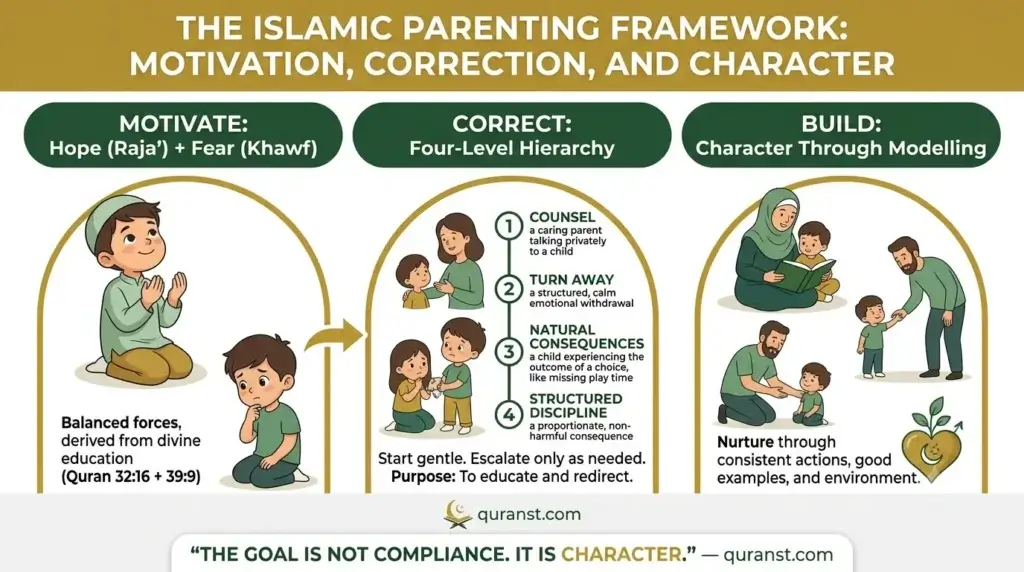
Section 1: The Quranic Framework — What Allah Says About Human Motivation
Before examining what to do with a misbehaving child, we need to understand the Islamic model of why human beings do anything at all — because this model fundamentally shapes the correct approach to discipline.
The Twin Engines of the Muslim Soul: Hope and Fear
The Quran does not motivate through punishment alone or through reward alone. It operates through a dynamic balance of two forces that the scholars call al-Raja’ wa al-Khawf — hope and fear:
تَتَجَافَىٰ جُنُوبُهُمْ عَنِ الْمَضَاجِعِ يَدْعُونَ رَبَّهُمْ خَوْفًا وَطَمَعًا
“Their sides forsake their beds to supplicate their Lord in fear and aspiration.”
— Quran 32:16
And:
أَمَّنْ هُوَ قَانِتٌ آنَاءَ اللَّيْلِ سَاجِدًا وَقَائِمًا يَحْذَرُ الْآخِرَةَ وَيَرْجُو رَحْمَةَ رَبِّهِ
“Is one who is devoutly obedient during periods of the night, prostrating and standing in prayer, fearing the Hereafter and hoping for the mercy of his Lord…”
— Quran 39:9
The Quranic model of motivation is explicitly dual: the believer is moved by both the fear of negative consequences and the hope of positive ones — and neither pole dominates the other. Imam al-Nawawi, in Riyadh al-Salihin, describes the ideal as a bird whose two wings are hope and fear: with only one wing, it cannot fly.
This has direct implications for parenting. A child raised exclusively through fear — punishment, threat, shame — develops compliance without internalization. A child raised exclusively through hope and reward — without any structure or consequence — develops expectation without responsibility. The Prophetic model, as we will see, navigates this balance with extraordinary precision.
The Divine Parenting of Allah as a Model
Allah Himself, in His relationship with human beings, models the balance of reward and consequence. The Quran contains 114 surahs, and the vast majority alternate between descriptions of divine mercy and divine justice. This is not accident — it is a pedagogical design, teaching human beings that both the reward and the consequence are real, that both matter, and that the space between them is the space in which moral choice is made.
Ibn al-Qayyim, in Madarij al-Salikin (1/513), writes:
“Allah educates His servants through both mercy and warning, through both promise and threat — because the human soul needs both to reach its full capacity for worship and virtue. Fear alone produces a slave who acts from terror; hope alone produces a dreamer who acts from fantasy. Together, they produce a believer who acts from love — and love-based action is the highest form.”
For parents: this is the model. Not fear-only discipline. Not permissiveness. A calibrated environment in which both the reward and the consequence are clearly understood, consistently applied, and emotionally delivered with love.
Section 2: What Modern Psychology Confirms — The Science Behind Reward and Punishment
Modern behavioral psychology — beginning with B.F. Skinner’s operant conditioning research in the mid-20th century and refined by decades of developmental research — has reached conclusions that the Islamic tradition articulated fourteen centuries ago.
What Works: Positive Reinforcement
Research consistently confirms that positive reinforcement — rewarding desired behavior — is the most effective tool for establishing lasting behavioral change in children. The Prophet ﷺ praised and rewarded individuals for acts of kindness, charity, and obedience to Allah, helping to reinforce positive behaviors and encouraging individuals to strive for moral excellence voluntarily.
Contemporary developmental psychologists including Dr. Dan Siegel (The Whole-Brain Child, 2012) and Dr. Ross Greene (The Explosive Child, 2014) confirm that behavior change in children is most durable when:
- The child understands why a behavior is expected (not just that it is expected)
- The desired behavior is noticed, named, and celebrated when it occurs
- The consequence of unwanted behavior is consistent, proportionate, and emotionally calm
All three principles are embedded in authentic Prophetic practice — as we will document in the next section.
What Doesn’t Work: Harsh Punishment
Research using Attachment Theory, developed by John Bowlby, highlights the importance of a strong emotional bond between parents and children for healthy psychological development. Harsh parenting can weaken this bond, making children feel neglected or rejected, which may result in difficulties in forming secure relationships later in life. Additionally, exposure to physical or verbal violence can trigger chronic anxiety in children, which may develop into mental health issues such as depression. Childhood experiences of harsh parenting can diminish self-esteem and impair coping mechanisms when dealing with stress or life challenges.
The Islamic tradition anticipated this finding precisely. <cite index=”7-1″>The Prophet Muhammad ﷺ never used harsh punishment and instead advocated for patience and understanding (Sahih Muslim, Hadith 2328). Discipline, according to Islamic guidelines, should aim to guide and correct rather than harm, promoting a loving and nurturing environment where children learn self-control and responsibility.</cite>
The Critical Distinction: Punishment vs. Consequence
Modern psychology distinguishes between punishment (something unpleasant imposed on a child to stop behavior) and natural or logical consequence (the child experiencing the real outcome of their choice). Research consistently shows that consequences produce more durable behavioral change than punishments — because consequences are connected to reality, while punishments are arbitrary impositions of adult power.
This distinction maps precisely onto the Islamic legal concept of ta’zir — which refers to discretionary correction designed to educate and redirect, not to harm or humiliate. The classical scholars are unanimous that any disciplinary act that damages the child — physically, emotionally, or psychologically — has crossed from Islamic discipline into prohibited harm.
Section 3: The Prophetic Model — Seven Methods the Prophet ﷺ Used With Children
The Prophet ﷺ was not only a religious guide and political leader. He was, in the words of Aisha (may Allah be pleased with her), “a walking Quran” — and his interactions with children are among the most educationally instructive scenes in the entire Seerah literature.
Method 1: Praise Publicly — The Power of Named Recognition
“The Prophet ﷺ said to Ibn Abbas: ‘O young man, I will teach you some words…’ — and he gave him focused, personal, respectful instruction.”
— Sunan al-Tirmidhi, Hadith 2516; classified as Sahih
The Prophet ﷺ’s use of “Ya ghulam” (O young man) — a term of respectful address — before giving Ibn Abbas instruction established the relational frame before the content. He was not correcting from above. He was teaching from alongside.
When the Prophet ﷺ noticed something praiseworthy in a companion, he named it specifically — not generically. Not “well done” but “you have done X, and X is what Y produces.” Named, specific praise is what developmental psychologists call process praise — and it produces children who understand their own strengths and replicate them intentionally.
Method 2: Correct Privately — Protect Dignity at All Costs
One of the most consistent features of the Prophet’s ﷺ approach to correction is that he corrected people in private — not in public. The classical scholars document that he would say to a companion who had erred: “Why do I see you doing such and such?” — addressing it quietly, one-to-one.
The Prophet ﷺ said:
“It is sufficient evil for a person to humiliate his Muslim brother.”
— Sahih Muslim, Hadith 2564
Public humiliation — even when the correction is accurate — creates shame, not behavioral change. Shame is experienced as an attack on the self, not on the behavior. A child who is corrected publicly learns to hide the behavior, not to change it. A child corrected privately learns to evaluate and adjust the behavior itself.
Practical rule: Praise in public. Correct in private. Always.
Method 3: Ask Before Assuming — The Socratic Correction
The Prophet ﷺ frequently opened corrections with a question rather than a statement. When he wanted to teach companions about backbiting, he asked:
“Do you know what backbiting is?”
— Sahih Muslim, Hadith 2589
When he wanted to teach about the highest ranks in Paradise, he asked the companions: “Shall I tell you who the people of Paradise are?” He led with inquiry before instruction.
For parents: before correcting a child’s behavior, ask. “Why did you do that?” Not accusatorially, but genuinely. The answer often reveals a misunderstanding, a need, or a fear that the parent did not know existed. Correction that begins with understanding is correction that actually reaches the child.
Method 4: Physical Affection as Positive Reinforcement
The Prophet ﷺ regularly expressed affection physically — touching, hugging, and kissing children — as an expression of approval, belonging, and love:
“The Prophet ﷺ kissed al-Hasan ibn Ali while al-Aqra’ ibn Habis was sitting with him. Al-Aqra’ said: ‘I have ten children and I have never kissed any of them.’ The Prophet ﷺ looked at him and said: ‘Whoever does not show mercy will not be shown mercy.'”
— Sahih al-Bukhari, Hadith 5997; Sahih Muslim, Hadith 2318
This is positive reinforcement in its most primal form. The child who is regularly held, touched, and physically affirmed by a parent develops a secure attachment that makes them want to maintain the parent’s approval. The child who experiences warmth primarily as a reward for good behavior — and coldness as punishment for bad behavior — learns to perform rather than to grow.
The lesson: physical affection should not be contingent on good behavior. It is the relational baseline from which all correction and all reward operate.
Method 5: Graduated Response — Starting Gentle, Not Harsh
When the companions complained of hardships, the Prophet ﷺ responded not with immediate solutions but with graduated responses — acknowledging, then reframing, then instructing. He never escalated before trying the gentler approach.
“Make things easy and do not make them difficult. Give glad tidings and do not repel people.”
— Sahih al-Bukhari, Hadith 69
This principle of taysir (making easy) governs Islamic discipline. The default is the lightest effective intervention. You escalate only when lighter approaches have been genuinely tried and genuinely failed — not because the lighter approach is more convenient to skip, but because the heavier one is more satisfying to your frustration.
Method 6: The Teaching Story — Using Narrative to Shape Behavior
The Prophet ﷺ was a master of instructional narrative. He did not typically tell people what not to do in abstract terms. He told them stories that made the right choice feel lived, emotionally resonant, and personally relevant.
نَحْنُ نَقُصُّ عَلَيْكَ أَحْسَنَ الْقَصَصِ
“We relate to you the best of stories.”
— Quran 12:3
For children who have misbehaved: rather than lecturing about the wrongness of the behavior, find — or create — a story that embodies the right behavior from a position they admire. A child who lies is not reformed by a lecture on honesty. They are reformed by genuinely internalizing the story of a person they love who chose honesty at great cost — and the outcome that followed.
Method 7: Dua — The Discipline That Operates on the Invisible Level
Perhaps the most underestimated parenting tool in the Islamic tradition is dua — supplication for the child. The Prophet ﷺ made specific du’a for children who came to him, for the children of companions, for the next generation of believers.
The practical dimension: a parent who prays for a child — specifically, by name, for specific qualities and specific challenges — is engaging in an act of tarbiyah that operates at a level no parenting technique reaches. It orients the parent’s heart toward the child’s flourishing rather than their compliance. And it enrolls the most powerful Force in existence in the project of the child’s development.
Section 4: The Islamic Hierarchy of Correction — Four Levels, Four Tools
The Islamic tradition, drawing on the Quranic verse about correcting one’s spouse and by scholarly extension to parent-child relationships, provides a graduated hierarchy of corrective responses. This hierarchy moves from the lightest intervention to the most structured — and crucially, each level should be genuinely tried before the next is employed.
وَاللَّاتِي تَخَافُونَ نُشُوزَهُنَّ فَعِظُوهُنَّ وَاهْجُرُوهُنَّ فِي الْمَضَاجِعِ وَاضْرِبُوهُنَّ
“…Admonish them, then forsake them in the marital bed, then…”
— Quran 4:34 (scholars have applied the principle of graduated response, not this specific verse, to parenting contexts)
Classical scholars — including Ibn al-Qayyim in Tuhfat al-Mawdud — explicitly develop a graduated framework for child correction:
Level 1: Al-Nasihah — Sincere Counsel
The first and default response to unwanted behavior is nasihah — sincere, private, gentle counsel. This is not lecturing. It is the parent sitting with the child, making eye contact, and calmly naming:
- What they observed the child do
- Why this behavior is problematic (with reasoning, not just assertion)
- What they want to see instead
- Their confidence that the child can make the right choice
The Prophet ﷺ modeled this consistently. His corrections were never humiliating decrees — they were conversations that treated the person being corrected as capable of better.
Level 2: Al-Hajar — Emotional Distance (Temporary Withdrawal of Engagement)
When counsel alone does not produce change, the next level involves a structured withdrawal of the warm engagement the child normally experiences. Not rejection, not coldness — but a clear communication that the relationship operates differently when certain behaviors are present.
This is the Islamic version of what developmental psychologists call time-out — but the Islamic form is relationally and contextually grounded. The parent says: “When you behave this way, I cannot be close to you in the way I want to be. That’s not a punishment. It’s a reality about relationships.”
This only works — in both the prophetic model and the psychological research — when the baseline relationship is warm enough that the child experiences the withdrawal as meaningful.
Level 3: Al-Tawbikh — Structured, Serious Expression of Disapproval
Beyond gentle counsel and temporary distance lies the direct, serious expression of parental disappointment — not anger, but gravity. The parent communicates, through tone and words, that what has occurred is genuinely serious.
This is not yelling. It is the lowered voice of real concern — the “I need you to hear me fully right now” conversation that children learn, over time, to recognize as the signal that something important is being addressed.
Al-Mawardi, in Adab al-Dunya wa al-Din, notes: “Effective discipline requires consistency, fairness, and the use of positive reinforcement alongside correction. He advises against excessive punishment and stresses the importance of understanding the child’s perspective, ensuring that discipline is a means of teaching rather than punishment.”
Level 4: Al-Ta’zir — Structured, Proportionate Consequence
Only at this fourth level — after the first three have been genuinely applied — does Islam permit structured disciplinary consequence. And even here, the classical scholars set firm parameters:
- Proportionality: The consequence must be proportionate to the behavior. Minor infractions receive minor consequences; persistent serious behavior receives more structured response.
- No harm: No consequence may cause physical or psychological damage. The scholars are explicit: any disciplinary act that harms is prohibited, regardless of the parent’s intention.
- Purposiveness: The purpose is correction and education — not venting the parent’s frustration, not establishing dominance, not satisfying a sense of justice.
- Calmness: Classical scholars note that discipline administered in anger is almost always excessive. The parent who is angry should wait until calm before taking any disciplinary action beyond the first level.
Section 5: What Doesn’t Work and Why — The Traps Muslim Parents Fall Into
Understanding the right approach is only half the picture. Understanding the common traps that undermine it is equally important.
Trap 1: Punishment as the First Response
The most common parenting error — across cultures and religions — is reaching for punishment before exhausting gentler responses. This happens because punishment appears to work: it stops the behavior in the moment. But stopping a behavior in the moment and changing a behavior long-term are entirely different things.
Research confirms what the Prophet ﷺ modeled: the first response to unwanted behavior should almost always be inquiry and counsel, not punishment. The parent who defaults to punishment trains the child to avoid detection — not to change the behavior.
Trap 2: Inconsistency — The Most Psychologically Damaging Parenting Pattern
A child who is punished severely one day for a behavior and ignored for the same behavior the next day does not learn that the behavior is wrong. They learn that consequences are unpredictable — which produces anxiety, not moral development.
The Prophet ﷺ said:
“The most beloved deeds to Allah are those that are most consistent, even if they are small.”
— Sahih al-Bukhari, Hadith 6465
This principle of consistency applies to parenting with full force. The consistent, predictable parent — who responds to behavior the same way each time — raises a child who can orient themselves morally because the moral environment is stable.
Trap 3: Shame and Public Humiliation
Public correction — whether in front of siblings, grandparents, or peers — is one of the most reliably counterproductive parenting behaviors documented in both Islamic scholarship and psychological research.
Attachment Theory highlights that harsh parenting weakens the parent-child bond, making children feel neglected or rejected, which may result in difficulties in forming secure relationships later in life.
Imam al-Ghazali, in Ihya’ Ulum al-Din (Vol. 3, Chapter on Child-Rearing), specifically warned against repeatedly correcting children — noting that the child who is constantly corrected becomes desensitized to correction and begins to treat it as background noise rather than meaningful communication.
Trap 4: Linking Religious Practice to Punishment
Perhaps the most damaging pattern in Muslim parenting is using religious obligations as a vehicle for punishment — forcing prayer as a punishment, making Quran memorization a consequence of bad behavior, threatening with hellfire as a behavior-management tool.
When religious practice is attached to negative emotional associations, children develop an aversion to the practice itself. The child who is sent to pray as punishment does not grow up loving prayer — they grow up associating prayer with the emotion it was connected to.
The Prophet ﷺ modeled precisely the opposite: he connected religious practice to joy, to reward, to community, to love. He made the adhan beautiful. He made the masjid a place of warmth. He praised and rewarded those who prayed, who memorized, who gave.
Trap 5: Anger-Driven Discipline
“A man said to the Prophet ﷺ: ‘Give me advice.’ The Prophet ﷺ said: ‘Do not get angry.’ The man repeated his question and the Prophet ﷺ kept saying: ‘Do not get angry.'”
— Sahih al-Bukhari, Hadith 6116
The repetition of this advice — do not get angry, do not get angry, do not get angry — indicates the Prophet’s ﷺ awareness that anger is one of the primary sources of human error. Discipline administered in anger almost always exceeds what the behavior warrants. And the child who is disciplined by an angry parent learns primarily about the parent’s emotional regulation — not about their own behavior.
Practical rule: If you are angry, do not discipline. Pause. Breathe. Return when calm.
Section 6: The Islamic Reward System — Practical Alternatives That Actually Work
Islam’s approach to positive behavior is not passive — it is actively constructive. The Prophet ﷺ did not merely avoid negative reinforcement. He deployed positive reinforcement with sophistication and consistency.
Here are six Prophetically grounded reward strategies that produce genuine behavioral and character change:
Strategy 1: The Named Praise
When the Prophet ﷺ praised someone, he named the specific quality he was affirming:
“Sa’d is the most skilled with the bow.” “The most trustworthy of my ummah is Abu Ubayda ibn al-Jarrah.” “The best in Quran recitation is Ubayy ibn Ka’b.”
Named, specific praise — “I noticed how patient you were with your sister just now, and patience is something Allah loves” — achieves three things simultaneously:
- It names the behavior precisely, so the child knows what to repeat
- It connects the behavior to an Islamic value, so the child understands its significance
- It connects the praise to Allah rather than solely to parental approval, so the motivation becomes internal
Strategy 2: The Tangible Reward — Used Sparingly and Strategically
The Prophet ﷺ did not oppose tangible rewards. He gave gifts, acknowledged achievements with material recognition, and used food and provision as expressions of honor for positive acts. What Islamic scholarship cautions against is making tangible rewards the primary or sole motivator — because children who only act for tangible reward stop acting when the reward disappears.
Use tangible rewards:
- For genuinely new behaviors being established (not for expected baseline behavior)
- As celebration of milestones, not as payment for routine compliance
- Attached to an explanation of why the behavior matters, so the intrinsic motivation grows alongside the extrinsic reward
Strategy 3: The Privilege System — Earned Access, Not Purchased Compliance
A structured system in which children earn specific privileges through consistent positive behavior — rather than having privileges arbitrarily granted or withdrawn — teaches the Islamic principle of cause and effect with clarity and fairness.
The key Islamic principle: the child must understand the system before it operates. A privilege structure applied without the child’s prior knowledge of it is not a consequence — it is a surprise punishment.
Strategy 4: Quality Time as the Most Powerful Reward
The Prophet ﷺ gave children his full, undivided presence. He sat with them. He listened. He played. He asked them questions and waited for their answers.
For children in the modern West, parental attention is genuinely scarce. The parent who offers deliberate, focused, screen-free quality time as a response to positive behavior — “Because you were so responsible today, let’s spend an hour just you and me doing whatever you want” — is offering what research consistently identifies as the highest-value reward available in the parent-child relationship.
Strategy 5: Public Recognition Within the Family
The Prophet ﷺ praised people in public — not to shame others by comparison, but to name and celebrate genuine virtue. Within the family system, this means:
- Mentioning a child’s positive behavior to the other parent when the child can hear it
- Sharing a child’s achievement at the family dinner table
- Calling grandparents to share a milestone
Public recognition within a loving family environment produces the same neurological reward as external social recognition — with none of the risks of making the child dependent on external approval.
Strategy 6: Connecting to Legacy — The Most Durable Motivator
The Prophet ﷺ connected behavior to identity and legacy constantly: “You are from the tribe of X, and the people of X are known for Y.” For Muslim children, the identity connection is even more powerful:
“You are a Muslim, and Muslims are known for their honesty — so when you told the truth today even though it was hard, you lived out who you are.”
This is behavior reinforcement operating at the deepest level of identity — not you did a good thing but you were who you truly are. Identity-based motivation is the most durable form because it does not require external reinforcement to sustain.
Section 7: Age-by-Age Islamic Discipline Framework
The Prophet ﷺ said:
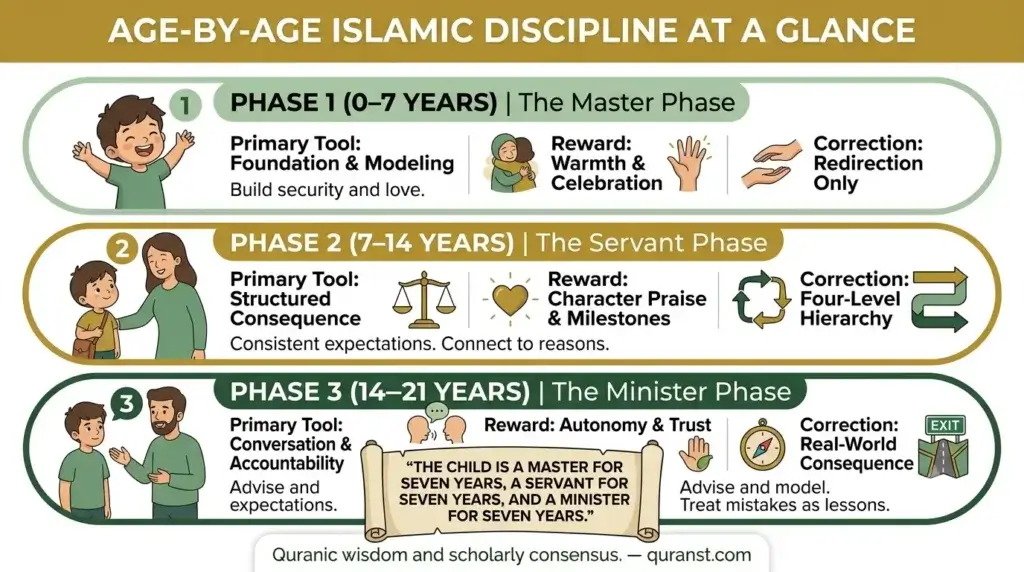
“The child is a master for seven years, a servant for seven years, and a minister for seven years.”
— Narrated in various forms; referenced in Ibn al-Qayyim, Tuhfat al-Mawdud, p. 123
This three-phase framework provides the broad developmental structure within which Islamic discipline operates:
Phase 1: Ages 0–7 — The Master Phase (Freedom and Foundation)
In this phase, the child is not yet morally accountable (mukallaf). The primary parenting task is not correction but foundation-building: establishing the emotional security, the loving association with Islamic practice, and the early habits of mind that will make the subsequent phases effective.
Discipline in this phase:
- Primarily through redirection, not correction
- Logical consequences for physical safety (don’t touch the stove = it burns)
- No punitive responses for developmentally normal behavior
- Heavy emphasis on modeling, routine, and environment
Reward in this phase:
- Immediate, warm, physical affirmation
- Celebration of every small milestone
- Connecting Islamic practice to joy: making wudu fun, Quran recitation musical, dhikr a family game
Phase 2: Ages 7–14 — The Servant Phase (Structure and Learning)
This is the phase of structured responsibility — where the child begins to carry real Islamic obligations (prayer at 7, accountability increasing toward 14) and where behavioral expectations become explicit and structured.
Discipline in this phase:
- The four-level hierarchy (nasihah → hajar → tawbikh → ta’zir) is now fully operational
- Logical consequences are the primary disciplinary tool
- Consistency is paramount — this is the phase when the behavioral environment must be most predictable
- The child should understand the reason behind every rule
Reward in this phase:
- Increasingly intrinsic: praise for character, not just behavior
- Milestones celebrated communally
- Earned privileges and increasing autonomy as trust is built
Phase 3: Ages 14–21 — The Minister Phase (Partnership and Accountability)
The adolescent is now approaching or has reached legal Islamic accountability (bulugh). Discipline in this phase looks less like parental correction and more like peer accountability — the parent shifts from authority to advisor.
Discipline in this phase:
- Direct consequences (including real-world ones — loss of resource, loss of trust)
- Conversation and reasoning, not command
- The parent models the behavior they want to see, more than ever before
- Mistakes are treated as learning opportunities, not as failures
“Do not restrict your children to your own learning, for they were born in a time other than yours.”
— Attributed to Ali ibn Abi Talib (raḍiAllahu ‘anh); cited in Ibn ‘Asakir, Tarikh Dimashq
Reward in this phase:
- Autonomy itself is the reward — increasing freedom as trust is demonstrated
- Being consulted, having opinions heard and respected
- Being entrusted with real responsibilities
Structured Curriculum Framework
quranst’s Smart Parenting track provides Muslim families with structured, Prophetically grounded frameworks for every phase of a child’s development — from the foundation years through adolescence. Taught through live, one-on-one parent coaching sessions.
Book your free 2-session trial →Conclusion: Discipline Is a Form of Love — But Not All Forms Are Equal
The Prophet ﷺ never disciplined a child out of frustration. He never corrected in public out of convenience. He never withheld affection as a punishment. He never connected religious practice to negative emotional experiences.
And yet no one in Islamic history produced more character transformation in the people around him — including the young people who came to him — than the Prophet ﷺ.
This is not a coincidence. It is a demonstration of the central principle of this guide: effective discipline is not primarily about controlling behavior. It is about forming character. And character is formed not through fear, but through love — love that is warm enough to hold firm, patient enough to correct consistently, and wise enough to know which tool to reach for in each moment.
The parent who reads this guide and feels overwhelmed — who looks at the gap between the Prophetic model and their daily reality — should know this:
The Prophet ﷺ also said:
“Make things easy and do not make them difficult.”
— Sahih al-Bukhari, Hadith 69
Start with one principle. Perhaps: praise publicly, correct privately. Perhaps: ask before assuming. Perhaps: wait until calm before disciplining. One principle, applied consistently, over three months — and watch what happens to the relationship, and to the behavior.
Because the goal was never a child who obeys.
The goal was always a child who, one day, will stand before Allah — and whose character, formed in your home, by your hands, with your love and your patience — is the answer to the question that matters most:
How did you spend your life?
يَا أَيُّهَا الَّذِينَ آمَنُوا قُوا أَنفُسَكُمْ وَأَهْلِيكُمْ نَارًا
“O you who have believed, protect yourselves and your families from a Fire.”
— Quran 66:6
🟢 Build Your Parenting Framework — The Hard CTA
Every parent has moments of doubt, frustration, and the quiet fear that they are getting it wrong. You are not alone — and you do not have to figure this out on your own.
quranst’s Smart Parenting track provides Muslim parents with:
- A complete Islamic behavioral framework — grounded in Quranic principle and authentic Sunnah — for every developmental stage
- Live, one-on-one parent coaching sessions with certified Islamic education professionals
- Age-specific strategies for common challenges: screen time, prayer resistance, sibling conflict, lying, disrespect
- Connection to a community of Muslim parents navigating the same challenges in the West
👇 Begin with Two Free Sessions
Two Ways to Begin
“Make things easy and do not make them difficult. Give glad tidings and do not repel people.”
— Sahih al-Bukhari, Hadith 69
Begin easy. Begin today.
بِسْمِ اللَّهِ — Begin.
References and Sources
Quranic References
- Quran 4:34 — Graduated response principle (applied by scholars to parenting contexts)
- Quran 12:3 — “We relate to you the best of stories”
- Quran 32:16 — Fear and aspiration as twin motivators
- Quran 39:9 — The devout believer fearing and hoping simultaneously
- Quran 66:6 — “Protect yourselves and your families from a Fire”
Hadith References
- Sahih al-Bukhari, Hadith 69 — “Make things easy and do not make them difficult”
- Sahih al-Bukhari, Hadith 5997; Sahih Muslim, Hadith 2318 — Prophet kissing al-Hasan; mercy toward children
- Sahih al-Bukhari, Hadith 6116 — “Do not get angry” (repeated counsel)
- Sahih al-Bukhari, Hadith 6465 — Most beloved deeds are consistent ones
- Sahih Muslim, Hadith 2328 — Prophet’s patience and understanding with people
- Sahih Muslim, Hadith 2564 — “It is sufficient evil to humiliate your Muslim brother”
- Sahih Muslim, Hadith 2589 — “Do you know what backbiting is?” — Socratic method
- Sunan al-Tirmidhi, Hadith 2516 (Sahih) — Prophet’s instruction to Ibn Abbas
Classical Scholarly Works
- Ibn al-Qayyim al-Jawziyyah: Tuhfat al-Mawdud bi-Ahkam al-Mawlud. Dar Ibn Hazm, Beirut. p. 123 (three-phase child development framework)
- Ibn al-Qayyim al-Jawziyyah: Madarij al-Salikin. Dar al-Kitab al-‘Arabi. Vol. 1: p. 513 (hope and fear as twin wings)
- Imam al-Ghazali: Ihya’ Ulum al-Din. Dar al-Ma’rifah, Beirut. Vol. 3, Chapter on Child-Rearing (on desensitization from repeated correction)
- Al-Mawardi: Adab al-Dunya wa al-Din. Dar Ibn Hazm. (Consistency and fairness in discipline; understanding the child’s perspective)
- Al-Nawawi: Riyadh al-Salihin. Dar al-Fayha. Chapter on Hope and Fear (the bird with two wings metaphor)
- Ibn ‘Asakir: Tarikh Dimashq. (Attribution of Ali ibn Abi Talib’s statement on children and their generation)
Contemporary Research Sources
- MDPI Religions, Vol. 17, Issue 5 (2026): “Islamic Parenting Style: Scale Development and Validation Based on Qur’an and Hadith.” DOI: 10.3390/rel17050511. Identified three factors in Islamic Parenting Style Scale: Compassionate, Guidance/Supervision, and Cognitive/Reflective domains. Cronbach’s alpha 0.92. Data from 818 parents.
- Journal of Islamic Parenting Studies (JIPSI): “Analysis of Harsh Parenting Practices: An Islamic and Psychological Perspective.” amorfati.id/JIPSI. Attachment Theory application to Islamic parenting; effects of harsh discipline on child development.
- Urwatul Wutsqo: Journal of Islamic Education Studies (2025): “Parenting Patterns in the Perspective of Hadith: A Literature Review.” Sources: Sahih al-Bukhari, Sahih Muslim, Sunan Abu Dawud, Sunan al-Tirmidhi, Musnad Ahmad. The Prophet’s parenting style includes compassion, uswah hasanah, respect, manners, and early spiritual education.
- Siegel, Daniel J., and Tina Payne Bryson. The Whole-Brain Child: 12 Revolutionary Strategies to Nurture Your Child’s Developing Mind. Bantam Books, 2012.
- Greene, Ross W. The Explosive Child: A New Approach for Understanding and Parenting Easily Frustrated, Chronically Inflexible Children. Harper, 2014.
- Bowlby, John. Attachment and Loss, Vol. 1: Attachment. Basic Books, 1969. (Foundational Attachment Theory referenced in contemporary Islamic parenting research)
Frequently Asked Questions
What does Islam say about physical or harsh punishment for children?
How does the Quran balance reward and discipline in human motivation?
What is the Islamic hierarchy of child discipline?
1. Al-Nasihah: Sincere, private counsel[cite: 1].
2. Al-Hajar: Temporary emotional distance or withdrawal of extra privileges[cite: 1].
3. Al-Tawbikh: Serious, calm expression of disapproval[cite: 1].
4. Al-Ta’zir: Structured, proportionate, non-harmful natural consequences[cite: 1].
Why shouldn’t parents use acts of worship (like Salah) as a punishment?
What are the three developmental phases of Islamic parenting?
• Ages 0–7 (The Master Phase): Focuses on love, warmth, modeling, and redirection[cite: 1].
• Ages 7–14 (The Servant Phase): Focuses on structured rules, explicit expectations, and logical consequences[cite: 1].
• Ages 14–21 (The Minister Phase): Focuses on mentorship, open dialogue, trust, and mutual accountability[cite: 1].
