

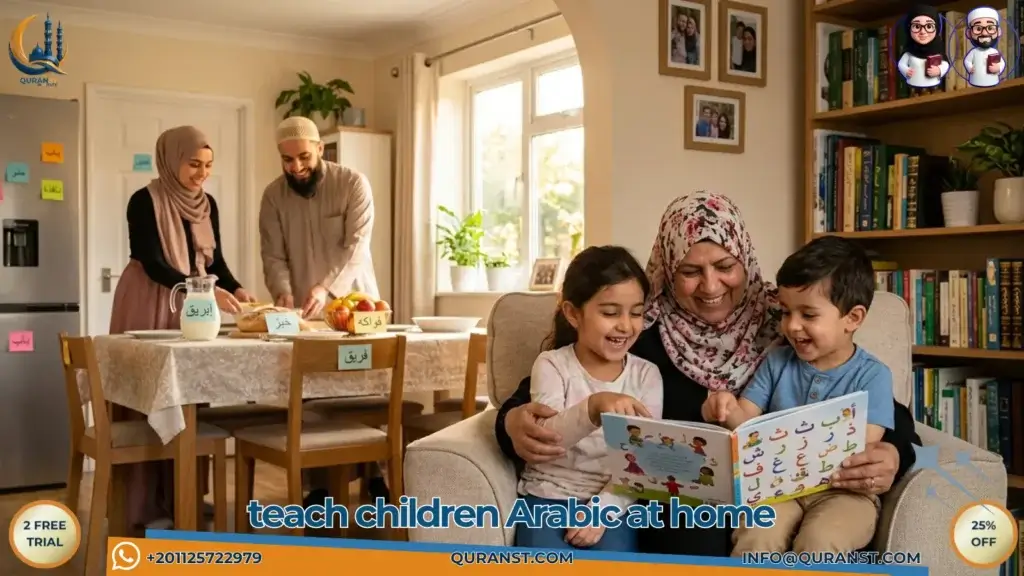
Introduction: The Language That Is Slipping Away {#introduction}
There is a conversation happening in millions of Muslim homes across America, Canada, Britain, and Australia — and it almost always goes the same way.
A parent speaks to a child in Arabic.
The child responds in English.
The parent, tired, switches to English.
And the Arabic slips a little further away.
It does not happen all at once. It happens sentence by sentence, conversation by conversation, year by year — until the child who could have grown up speaking the language of the Quran grows into a teenager who recognizes Arabic sounds but cannot produce them, who reads Al-Fatiha phonetically but cannot tell you what Rabb means without a translation, who feels a vague sense of loss when they visit an Arabic-speaking country and realize they are a stranger in the language of their own heritage.
This guide is about preventing that.
But it is also about something bigger than prevention. Because Arabic fluency for a Muslim child is not merely a cultural preservation project or a heritage language initiative. It is access — direct, unmediated, living access — to the words Allah chose to speak His final message in. A child who speaks Arabic fluently reads the Quran the way the Prophet ﷺ recited it: understanding every word, feeling every turn of phrase, catching the double meanings and the grammatical emphases that no translation can carry.
That is what is at stake in every Arabic conversation you choose to have — or avoid — at home tonight.
Structured Curriculum Framework
quranst’s Arabic Language track develops children’s speaking fluency through structured, live, one-on-one conversational sessions with native-speaking instructors — designed for Muslim families in the West.
Book your free 2-session trial →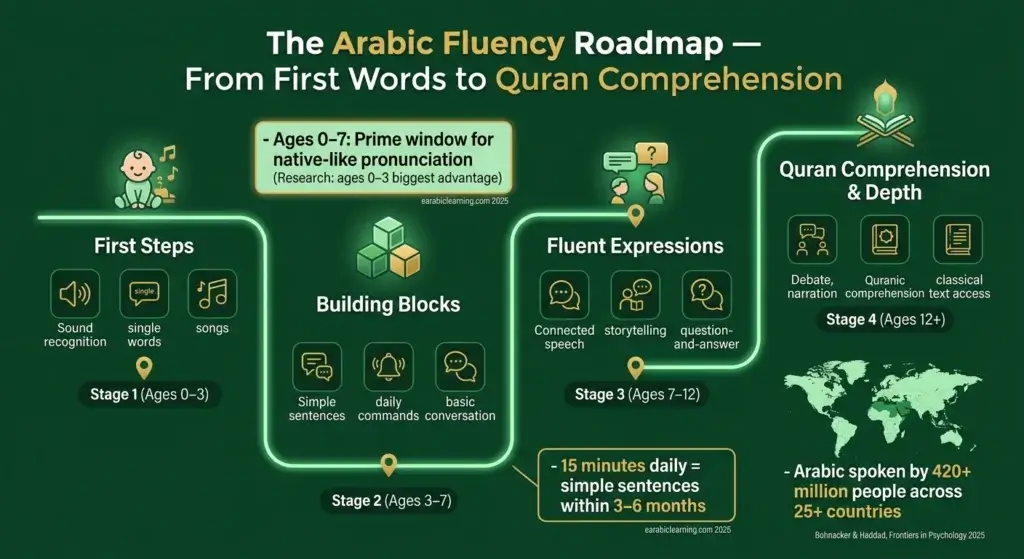
Section 1: Why Arabic Speaking Fluency Matters More Than Reading
Most Islamic education programs for children in the West focus almost exclusively on two skills: reading (being able to decode Arabic letters and recite Quranic text) and memorization (hifz of specific surahs and supplications). Both are valuable. Neither is sufficient.
Here is the gap that almost no one addresses: a child can recite Al-Fatiha perfectly and have no idea what they are saying. They can complete Juz’ Amma without understanding a single verse. They can memorize the Tashahhud phonetically and recite it in every prayer of their life without once knowing that they are declaring the shahada, sending blessings on the Prophet ﷺ, and asking for divine protection — within a single, brief, beautiful supplication.
Speaking fluency changes this. A child who speaks Arabic — even at a basic conversational level — develops a living relationship with the language. They begin to hear Arabic rather than merely recite it. They start catching familiar words in the Quran. They notice when an imam uses a word they know. They ask what an unfamiliar word means — because they now have the framework to absorb the answer.
Speaking fluency is the door through which Quranic understanding enters.
And the irony is this: speaking is the easiest Arabic skill to develop in young children — and the one that most families neglect most severely.
Section 2: The Research Window — What Science Says About Language Acquisition Timing
The neuroscience of language acquisition provides Muslim parents with both urgency and hope.
The urgency: Research shows that ages 0–7 are the prime window for achieving native-like pronunciation and fluency. Starting before age three gives the biggest phonetic advantage, but children up to seven still pick up new languages remarkably well. After this window, the brain’s language acquisition system gradually becomes less plastic — not closed, but significantly less efficient for producing native-like phonological patterns.
The hope: Language acquisition is not limited to this window. Children and adults continue learning languages throughout life — they simply learn them differently after the critical period. And critically, with daily exposure of just 15 minutes, many children can use simple Arabic words and phrases within 3–6 months. Full fluency takes years, but every word counts.
The research on heritage language families is particularly relevant for Muslim families in the West. A 2025 study published in Frontiers in Psychology (Bohnacker and Haddad, Uppsala University) on Arabic-heritage families in Sweden found that the key factors in successful home Arabic maintenance were: consistency of language choice, frequency of language use, and crucially — how language use was embedded in ongoing daily activities rather than treated as a separate educational task.
This finding is enormously practical: the most effective Arabic language learning for children happens not in dedicated “Arabic time” carved out of the schedule, but embedded in the natural flow of daily family life — cooking, playing, discussing the day, reading together, praying.
Additional research confirms that family language policy — the explicit or implicit decisions families make about which language to use in which context — is the single most powerful variable in heritage language maintenance. Families who have clear, consistent language policies maintain heritage languages significantly better than those who make ad hoc language choices.
The practical implication: You do not need more time. You need more intentionality with the time you already have.
Section 3: The Islamic Mandate — Why Arabic Is Not Optional for Muslims
Before the strategies, the motivation. Because strategies without motivation produce effort without sustainability.
The Islamic case for Arabic speaking fluency is not cultural sentimentality. It is theological necessity.
Allah Chose Arabic Specifically
إِنَّا أَنزَلْنَاهُ قُرْآنًا عَرَبِيًّا لَّعَلَّكُمْ تَعْقِلُونَ
“Indeed, We have sent it down as an Arabic Quran so that you might understand.”
— Quran 12:2
The phrase la’allakum ta’qilun — “so that you might understand” — is the divine purpose statement for the Arabic Quran. Allah did not send it in Arabic for cultural or historical reasons alone. He sent it in Arabic so that it could be understood. The language is not the container of the message — it is inseparable from the message itself.
وَإِنَّهُ لَتَنزِيلُ رَبِّ الْعَالَمِينَ ﴿١٩٢﴾ نَزَلَ بِهِ الرُّوحُ الْأَمِينُ ﴿١٩٣﴾ عَلَىٰ قَلْبِكَ لِتَكُونَ مِنَ الْمُنذِرِينَ ﴿١٩٤﴾ بِلِسَانٍ عَرَبِيٍّ مُّبِينٍ ﴿١٩٥﴾
“And indeed, the Quran is the revelation of the Lord of the worlds. The Trustworthy Spirit has brought it down upon your heart — that you may be of the warners — in a clear Arabic language.”
— Quran 26:192–195
The word mubin (clear, manifest, evident) in the final verse is significant: the clarity of the Quran is specifically described as a property of its Arabic. The clarity that Allah promises in His book is a clarity that resides in the Arabic language itself — and is accessible fully only to those who speak it.
The Scholarly Consensus on Arabic
Ibn Taymiyyah wrote — with characteristic directness — in Iqtida’ al-Sirat al-Mustaqim:
“The Arabic language is part of the religion. Knowledge of it is obligatory — because understanding the Quran and the Sunnah is obligatory, and they cannot be understood except through Arabic. What is necessary to fulfill an obligation is itself obligatory.”
— Ibn Taymiyyah, Iqtida’ al-Sirat al-Mustaqim, 1/527
Imam al-Shafi’i, who was himself an accomplished poet in Arabic, stated in Al-Risalah that every Muslim is obligated to learn whatever Arabic is necessary for their religious duties — and that the community as a whole is obligated to preserve and transmit the Arabic language.
The Prophetic Connection
The Prophet ﷺ said:
“Love the Arabs for three reasons: because I am Arab, because the Quran is in Arabic, and because the language of the people of Paradise is Arabic.”
— Al-Tabarani, Al-Mu’jam al-Awsat; cited in classical scholarship with varying levels of authentication — its meaning is supported by the Quranic verses above regardless of the hadith’s precise chain
When a Muslim child learns to speak Arabic, they are not merely acquiring a linguistic skill. They are drawing closer to the language of the Quran, the language of the Prophet ﷺ, and — according to the classical scholars — the language of the Garden.
Section 4: The Real Reasons Children Resist Speaking Arabic at Home
Before strategies, diagnose. Because most Arabic-at-home programs fail not because of wrong methods, but because of unaddressed resistance. Understanding why a child resists is the first step to solving it.
Reason 1: English Is Easier and More Rewarding
For a child growing up in an English-speaking country, English is the language of social reward — friendships, school success, entertainment, humor, belonging. Arabic, by contrast, is the language of effort, obligation, and adult expectation. The path of least resistance is always the dominant language.
The solution: Make Arabic the language of reward, not requirement. Make it the language of the special things — the bedtime story, the family joke, the secret phrase, the treat that comes with a correct Arabic sentence. Flip the emotional valence.
Reason 2: They Don’t See Arabic as Their Language
Many second-generation Muslim children in the West experience Arabic as a parent’s language — something that belongs to a country they did not grow up in, to relatives they rarely see, to a culture that feels distant. It has not been made theirs.
The solution: Connect Arabic to the child’s own identity and interests — not to a generational obligation. The child who discovers that their favorite Quranic surah contains a word they know, who catches an Arabic word in a cartoon they love, who successfully tells a joke in Arabic to their grandparent — that child begins to claim Arabic as part of their identity.
Reason 3: Fear of Making Mistakes
Children learning Arabic as a second language often struggle with confidence. Some Arabic sounds like ‘خ’ or ‘ض’ have no equivalent in English, and children become self-conscious about producing them incorrectly.
The solution: Build a mistake-tolerant Arabic environment at home. Celebrate every attempt, regardless of accuracy. Never correct pronunciation mid-sentence — wait until the thought is complete, then gently model the correct form without making the correction the focus. The child who feels safe making mistakes will make more of them — and that is how fluency develops.
Reason 4: Inconsistency in the Home Language Policy
Research consistently finds that inconsistent language policies — where Arabic is required sometimes and ignored other times — produce children with inconsistent Arabic skills. Children are exquisitely sensitive to the difference between a rule and a preference. If Arabic is negotiable, they will negotiate.
The solution: Choose specific contexts in which Arabic is consistently used — not the entire day, but specific times or activities that are always in Arabic — and maintain that consistency without exception. One predictable Arabic context, maintained daily, outperforms three unpredictable ones maintained sporadically.
Reason 5: The Parent Is Not Consistent Either
The most common reason Arabic speaking fails at home is the simplest: the parent gives up first. The child responds in English, the parent switches to English, and the Arabic language policy collapses in the face of the day’s friction.
The solution: The parent must be the anchor. Not rigid, not punishing — but consistent. The simple practice of always responding to the child’s English sentence with the Arabic equivalent of what you wish they had said, without pressure or correction, is one of the most effective language maintenance strategies documented in the research.
Section 5: Nine Proven Strategies for Building Arabic Speaking Fluency at Home
These strategies are drawn from language acquisition research, Islamic educational principles, and the practical experience of Muslim families who have successfully raised Arabic-speaking children in the English-dominant West.
Strategy 1: The One Parent, One Language (OPOL) Method
The most research-validated approach to bilingual language development is One Parent, One Language: each parent commits to speaking consistently in one language, giving the child exposure to both simultaneously through their relationship with each parent.
For Muslim families: if one parent speaks Arabic and one does not, the Arabic-speaking parent maintains Arabic exclusively in their interactions with the child. The child learns quickly to switch languages depending on who they are speaking to — a process that is neurologically natural and linguistically beneficial.
The Uppsala University study found that families with clear, consistent language choice maintained Arabic significantly better than those with inconsistent policies — even when the total hours of Arabic exposure were similar.
Strategy 2: Total Physical Response (TPR) — Movement and Language Together
Total Physical Response (TPR) links language learning to physical action — “اقفز!” (Jump!), “امشِ إلى الباب” (Walk to the door). It works because it connects language to the body, emotion, and memory — making it feel natural rather than academic.
For home use: daily commands in Arabic, connected to physical actions your child already does. Getting dressed in the morning — “البس قميصك” (Put on your shirt). Sitting for dinner — “اجلس” (Sit down). Going to bed — “نامْ يا حبيبي” (Sleep, my love).
These are not language lessons. They are language moments — and they accumulate.
Strategy 3: The Arabic-Only Zone
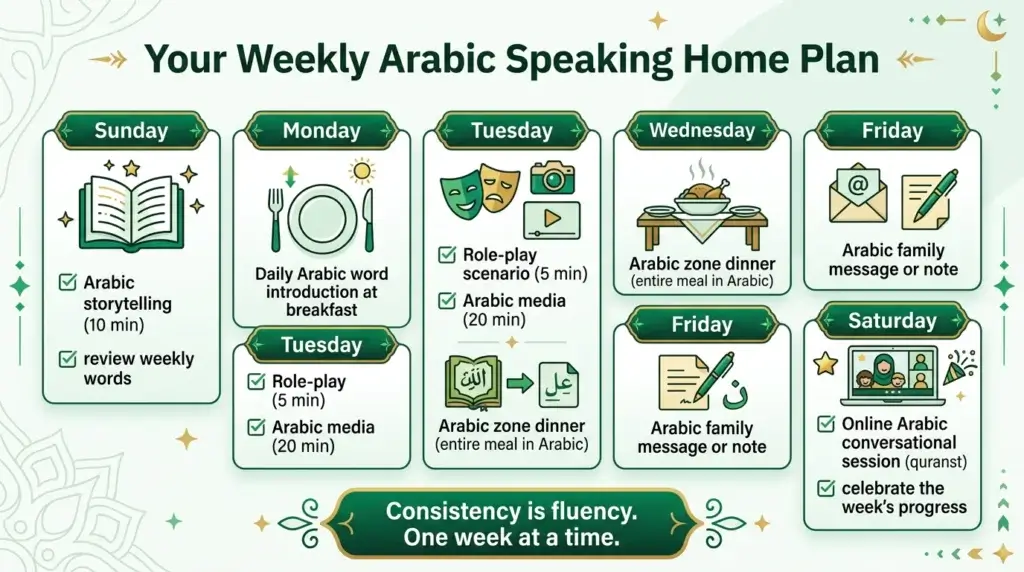
Rather than attempting to make the entire home Arabic-speaking (which overwhelms most families), designate one specific, non-negotiable Arabic zone:
- The dinner table — all conversation at dinner is in Arabic
- The car — car time is Arabic time (audiobooks, conversation, songs)
- Bedtime story — every bedtime story is told or read in Arabic
Consistent daily exposure, even in limited zones, produces measurable progress. Families who implement a specific daily Arabic context — and maintain it — see children developing situational fluency within months.
Strategy 4: Storytelling with Open-Ended Questions
Storytelling activates imagination, and repetition within narrative builds both comprehension and confidence in expression. Tell stories using expressive voice, visuals, and gestures — then ask open-ended questions: “ماذا قالت البنت؟” (What did the girl say?) “هل هو سعيد أم حزين؟” (Is he happy or sad?)
For Muslim families: the stories of the prophets — narrated simply, expressively, in Arabic — are simultaneously the best language content and the best Islamic educational content available. A child who hears the story of Yusuf told in Arabic, week by week, is developing Arabic vocabulary and Quranic comprehension simultaneously.
Strategy 5: The Label Method — Your Home as an Arabic Environment
Families who successfully maintained Arabic at home used environmental strategies — labeling objects, playing Arabic TV shows, celebrating Arabic-language holidays and cultural practices — alongside formal instruction.
Practical application:
- Label every object in your home in Arabic — the door (الباب), the window (النافذة), the kitchen (المطبخ)
- Change your phone and TV default language to Arabic
- Replace English lullabies with Arabic ones
- Play Arabic cartoons and audio during meals, car rides, and background time
The goal is to make Arabic the sound of the home — ambient, present, natural — rather than a scheduled event.
Strategy 6: The Repetition-Reward Loop
Children’s brains are wired for repetition. The same song, the same story, the same phrase repeated dozens of times is not boring to a young child — it is neurologically consolidating. The parent who tells the same Arabic bedtime story for three weeks is not being repetitive; they are building a neural pathway.
Connect repetition to reward: the child who correctly uses an Arabic word gets a small, immediate acknowledgment — not a prize, but a warm, specific, named celebration. “أحسنت! قلت ‘شكراً’ بالعربية — ممتاز!” (Well done! You said ‘thank you’ in Arabic — excellent!)
Strategy 7: The Role-Play Scenario
Role-playing daily life — going to the market, visiting a friend, greeting a teacher — builds situational fluency because it links language to the body, emotion, and memory.
Weekly family role-play scenarios in Arabic:
- “We are at a restaurant” — practice ordering food in Arabic
- “We are at the masjid” — practice greetings and Islamic phrases
- “We are calling Grandma” — practice telephone conversation in Arabic
- “We are at the doctor” — practice describing feelings and body parts
These scenarios build the specific vocabulary that children need for the specific situations they will encounter — making Arabic immediately useful rather than abstractly educational.
Strategy 8: The Arabic Media Diet
Families who successfully maintained Arabic combined formal instruction with rich Arabic media exposure — cartoons, songs, audiobooks — used consistently at home.
Building an Arabic media diet:
- Ages 2–6: Nasheed channels, Quranic recitation for children, Arabic cartoons (Baraem, Spacetoon)
- Ages 6–12: Arabic audiobooks of prophet stories, Arabic educational YouTube, Arabic dubbed versions of favorite shows
- Ages 12+: Arabic news (Al Jazeera Children), Arabic podcasts, Arabic music from genres the teenager already enjoys
The key principle: let the child choose the Arabic content. A child who chooses to watch an Arabic show is receiving language input with zero resistance. Forced Arabic viewing produces resentment, not fluency.
Strategy 9: The Structured Conversation Practice
Beyond ambient exposure, speaking fluency requires active production — the child must speak, not just hear. For families who cannot provide this in sufficient quantity, structured Arabic conversation practice with a native speaker is the most reliable supplement.
One or two classes per week alone is insufficient for fluency. But structured sessions with native speakers, combined with consistent home exposure — daily Arabic songs, greetings, and conversation — produce measurable results.
This is the precise gap that quranst’s Arabic conversational track addresses: live, one-on-one sessions with native Arabic instructors who focus specifically on speaking production — asking questions, telling stories, discussing the Quran — in the standard Arabic that bridges to Quranic comprehension.
Section 6: For Parents Who Don’t Speak Arabic — You Can Still Do This
One of the most common objections Muslim parents raise is: “I don’t speak Arabic myself. How can I raise an Arabic-speaking child?”
The answer is both honest and hopeful: you cannot be your child’s Arabic teacher. But you can absolutely be your child’s Arabic environment.
Many of the most successful bilingual families include parents who speak no Arabic at home. What non-Arabic-speaking parents can do — label objects, play Arabic songs, watch cartoons together, show enthusiasm — makes a huge difference without any fluency on their part. The parent’s role is to create the environment and provide the encouragement. The teacher handles the instruction.
What Non-Arabic-Speaking Parents Can Do
Create the environment:
- Play Arabic audio during car rides, meals, and background time
- Label objects around the home in Arabic
- Make the Arabic-speaking grandparent relationship a priority — video calls, visits, correspondence
- Choose Arabic as the language of Quranic recitation in the home, even if you recite without understanding
Provide the motivation:
- Express genuine enthusiasm for your child’s Arabic progress
- Connect Arabic to the things your child loves — “Imagine being able to understand Quran directly!”
- Celebrate every Arabic word your child produces, regardless of your ability to evaluate its accuracy
Provide the instruction:
- Enroll in structured, live Arabic instruction with native-speaking teachers
- Choose programs that emphasize speaking, not just reading — because speaking is the skill most families cannot provide at home
- Maintain the program consistently — “Fluency is a multi-year process, but every step along the way is genuinely useful.” (Alphabet Arabic Academy, 2026)
The parent who cannot speak Arabic but who creates a rich Arabic environment, celebrates Arabic progress warmly, and provides structured instruction with a native speaker — that parent can raise an Arabic-speaking child. It has been done. It is being done. It requires commitment, not fluency.
Section 7: Building the Arabic-Speaking Home Environment — Step by Step
Here is a practical 12-week implementation plan for families starting from minimal or no Arabic home use:
Weeks 1–4: The Foundation
Week 1 — Choose Your Arabic Zone: Select one daily context that will be consistently Arabic. The dinner table, the car, or bedtime story — pick one. Announce it to the family as a new family practice, not a punishment. Start gently and consistently.
Week 2 — The Label Project: Spend one afternoon labeling twenty objects in your home with Arabic words written on sticky notes. Review them together each morning. Change the labels weekly as the old ones are learned.
Week 3 — The Arabic Media: Find one Arabic media source your child genuinely enjoys — a cartoon, a nasheed channel, an Arabic version of a show they already love. Make it the default during one daily time slot.
Week 4 — The Arabic Greeting: Introduce one Arabic greeting that the entire family uses consistently. “صباح الخير” (Good morning). “تفضّل” (Please, come in). “بالعافية” (Enjoy your meal). One phrase, used daily, by everyone.
Weeks 5–8: Building Vocabulary
Week 5 — The Daily Arabic Word: Introduce one new Arabic word each day at breakfast. Write it on a whiteboard or card. Use it five times that day in natural conversation. Review it the next morning before introducing a new one.
Week 6 — The Storytelling Routine: Begin a weekly Arabic storytelling session. It does not need to be long — ten minutes of a prophet story told expressively in simple Arabic, followed by two or three questions. “ماذا فعل موسى؟” (What did Musa do?) “هل كان خائفاً؟” (Was he afraid?)
Week 7 — The Role-Play: Introduce the first role-play scenario. “We are at a restaurant.” Practice ordering food in Arabic together. Make it playful, not pressured.
Week 8 — The Arabic Connection to Quran: Choose one Quranic word your child knows from memorization and connect it to a word they now know in Arabic. “You know ‘Al-Fatiha’ — Fatiha means ‘the opener,’ from the root f-t-h (to open). You know that word now.” Every connection between spoken Arabic and memorized Quran is a door opening.
Weeks 9–12: Building Conversation
Week 9 — The Question Game: Start asking your child one question in Arabic each day that requires a sentence answer, not just yes/no. “ماذا أكلت في المدرسة؟” (What did you eat at school?) Accept English answers without criticism — model the Arabic sentence after hearing their response.
Week 10 — Enroll in Structured Speaking Practice: If not already enrolled, this is the week to add live conversational Arabic instruction. The home environment is now supportive enough for structured instruction to accelerate progress.
Week 11 — The Arabic Message: Introduce Arabic as the language of one specific communication channel — a family WhatsApp message in Arabic, a note left on the kitchen counter in Arabic, a bedtime du’a said together in Arabic with meaning explained.
Week 12 — Review and Celebrate: Sit with your child and review the last twelve weeks. What Arabic words do they know now that they did not know before? What phrases can they use? Celebrate the progress specifically and warmly — not “good job” but “you can now say [specific things]. Look how far you have come.”
Section 8: Age-by-Age Arabic Speaking Guide
Ages 0–3: Sound and Song
At this age, the child’s brain is most receptive to phonological patterns — the sounds that make up a language. The goal is not vocabulary or grammar but sound immersion.
What to do:
- Sing Arabic nasheeds and lullabies daily
- Use simple Arabic commands with physical action (TPR)
- Narrate daily activities in Arabic: “نلبس الثياب الآن” (We’re getting dressed now)
- Read simple Arabic picture books with expressive voice and gesture
What not to do:
- Do not correct pronunciation — just model correctly and move on
- Do not force production — enjoy the input phase
- Do not worry about comprehension — the patterns are being laid
Ages 3–7: Words and Simple Sentences
<cite index=”5-1″>This remains the prime window for native-like pronunciation and the critical period for phonological development.</cite> The focus shifts from pure sound immersion to vocabulary acquisition and simple sentence production.
What to do:
- Expand to fifty core vocabulary words across categories (food, family, body, home, feelings, colors)
- Introduce simple sentence structures: “أنا أحب…” (I love…), “أريد…” (I want…), “هذا…” (This is…)
- Play the label game — point to objects and ask “ما هذا؟” (What is this?)
- Introduce the first Quranic vocabulary connections
What to expect:
- Code-switching (mixing Arabic and English mid-sentence) is normal and developmentally appropriate — do not correct it, simply model the full Arabic sentence
- Progress is non-linear — plateau periods are followed by sudden leaps
Ages 7–12: Connected Speech and Conversation
At this stage, the child can begin developing genuine conversational Arabic — asking and answering questions, narrating events, expressing opinions.
What to do:
- Regular role-play scenarios building situational vocabulary
- Arabic storytelling with child participation and re-narration
- Structured conversational practice with a native speaker at least twice weekly
- Explicit connection between spoken Arabic and Quranic vocabulary — “That word you just used? It appears in Surah Al-Baqarah. Let me show you.”
Key milestone: A child who can ask and answer “who, what, where, when, why” questions in Arabic has the conversational infrastructure for genuine fluency development.
Ages 12+: Expression, Debate, and Quranic Access
The adolescent who has maintained Arabic through the earlier stages can now develop the full expressiveness of the language — humor, argument, nuance, classical text access.
What to do:
- Introduce Arabic news and current events as conversation starters
- Use Arabic to discuss topics the teenager is passionate about
- Begin explicit Quranic comprehension — reading a verse and discussing its meaning in Arabic
- Provide advanced conversational Arabic instruction that challenges them at their actual level
The reward of this stage: The teenager who can discuss ideas in Arabic, read Quranic commentary in Arabic, and access fourteen centuries of Islamic scholarship in the original language — that young person has received one of the most valuable gifts their family could have given them.
Structured Curriculum Framework
quranst’s Arabic Language track provides structured, live conversational Arabic sessions for children at every level — taught by native Arabic speakers trained to develop speaking fluency, not just reading and recitation. Serving Muslim families across the USA, Canada, UK, Australia, and the Gulf.
Book your free 2-session trial →Conclusion: The Language Is a Door. You Hold the Key.
There is a moment that Muslim parents who have raised Arabic-speaking children describe in strikingly similar terms.
It happens at different ages for different children — sometimes at seven, sometimes at twelve, sometimes not until a visit to an Arabic-speaking country. But the moment itself is always the same:
The child is in prayer, or listening to the Quran, or reading a surah — and they understand. Not phonetically. Not through translation. They hear the Arabic words and their meaning arrives directly, immediately, without the mediating step of “what does that mean in English?”
And something changes on their face.
This is the moment that every strategy in this guide is working toward. Not bilingualism as an achievement. Not Arabic as a cultural credential. The moment when the child of Allah, standing before their Lord, hears His words — and understands them.
Every Arabic sentence spoken at home tonight is a step toward that moment.
Every Arabic song played in the car. Every story told at bedtime. Every word labeled on the kitchen wall. Every consistent Arabic dinner table. Every live session with a native Arabic speaker. Every time a parent chose Arabic when English would have been easier.
All of it adds up.
Teaching Arabic to children is multifaceted: no single trick works alone. It’s the consistent mix — home rules, stories, structured practice, media, and family support — over years, that creates true fluency. For parents committed to raising bilingual children, persistence in these methods yields lifelong fluency. Kids resist at times, but persistence pays off.
You hold the key to a language that opens the Book of Allah. Use it every day.
إِنَّا أَنزَلْنَاهُ قُرْآنًا عَرَبِيًّا لَّعَلَّكُمْ تَعْقِلُونَ
“Indeed, We have sent it down as an Arabic Quran so that you might understand.”
— Quran 12:2
🟢 Develop Your Child’s Arabic Speaking Fluency
The home environment is essential. But home alone is not enough for speaking fluency — children need active production with a responsive native speaker who can answer their questions, correct their sentences in real time, and draw out the vocabulary they are building.
quranst’s Arabic Language track provides exactly this:
What the Arabic Speaking Track Includes
- Live, one-on-one conversational sessions with native Arabic speakers — not pre-recorded videos, not apps, but real responsive conversation
- Structured progression from basic greetings and commands through connected speech, storytelling, and Quranic vocabulary
- Quranic integration — every level connects spoken Arabic to the vocabulary and structures of the Quran the student is memorizing or reciting
- Age-appropriate curriculum — from pre-school sound immersion through teenage debate and classical text access
- Parent communication — regular updates on vocabulary progress, specific words to reinforce at home, and suggestions for the family’s Arabic home environment
Who It Is For
- Children aged 4–18 with any Arabic level — from complete beginners to heritage speakers wanting to develop fluency
- Muslim families in the USA, Canada, UK, Australia, and the Gulf
- Non-Arabic-speaking parents who want structured support for their child’s Arabic development
- Children who read Arabic but struggle to speak it
- Teenagers who want to understand the Quran directly
👇 Begin with Two Free Sessions
Two Ways to Begin
“Love the Arabs for three reasons: because I am Arab, because the Quran is in Arabic, and because the language of the people of Paradise is Arabic.”
— Al-Tabarani, Al-Mu’jam al-Awsat; classical scholarly citation
Start the language of Paradise today.
بِسْمِ اللَّهِ — Begin.
References and Sources
Quranic References
- Quran 12:2 — “We have sent it down as an Arabic Quran so that you might understand”
- Quran 26:192–195 — The Quran revealed in a clear Arabic language
Scholarly Works
- Ibn Taymiyyah: Iqtida’ al-Sirat al-Mustaqim Mukhalafat Ashab al-Jahim. Maktabat al-Rushd, Riyadh. Vol. 1: p. 527 (Arabic as part of the religion)
- Al-Shafi’i, Muhammad ibn Idris: Al-Risalah. Ed. Ahmad Muhammad Shakir. Maktabat al-Halabi, Cairo. (Obligation of learning Arabic for religious duties)
- Al-Tabarani: Al-Mu’jam al-Awsat. (Hadith on love of Arabic)
Academic Research Sources
- Bohnacker, Ute, and Rima Haddad. “Arabic as a home language in Sweden: family language practices and beliefs.” Frontiers in Psychology (2025). DOI: 10.3389/fpsyg.2025.1719805. Findings: Consistency of language choice and frequency of use are the primary predictors of Arabic maintenance in diaspora families.
- Said, et al. (2021); Chen et al. (2021); Montrul (2023). Research on family language policy and heritage language transmission. ResearchGate, 2021. Key finding: Family language policy — not linguistic ability of parents — is the strongest predictor of heritage language maintenance.
- ScienceDirect (2025). “The impact of English as a medium of instruction in international education on Arabic language preservation and cultural identity: Parents’ perspectives and strategies.” DOI: 10.1016/S2215-0390(25)00024-4. Key finding: Parental involvement and home strategies are the primary factors sustaining Arabic proficiency in predominantly English educational environments.
Contemporary Educational Sources
- Islam Legacy (2025). “How Do You Raise Your Child to Be Bilingual (Arabic + English)?” islamlegacy.com. Key findings: Ages 0–7 prime window for native-like pronunciation; 15 minutes daily yields phrase-level Arabic within 3–6 months; multi-year commitment + consistent mix of strategies produces fluency.
- eArabicLearning (September 2025). “Best Ways to Teach Arabic for Kids: A Complete Guide.” earabiclearning.com. Key findings: 420+ million Arabic speakers; Harvard research on bilingual cognitive advantages; recommended start age 3–4; micro-lessons (5–10 min) more effective than long sessions.
- eArabicLearning (June 2025). “Unlocking Little Voices: Teaching Arabic Conversation to Children as a Second Language.” earabiclearning.com. Key findings: TPR (Total Physical Response) links language to body and memory; storytelling builds comprehension and expression confidence; one or two classes per week alone insufficient for fluency.
- Alphabet Arabic Academy (2026). “Teaching Arabic to Children.” alphabetarabicacademy.com. Key finding: Non-Arabic-speaking parents can successfully raise Arabic-speaking children through environment creation and encouragement; full bilingual proficiency is a multi-year process.
- Mashariq Academy (January 2025). “Challenges and Solutions in Teaching Arabic to Children in Non-Arabic Speaking Countries.” mashariqacademy.com. Case studies: France (mosque classes + TV), Canada (apps + gamified learning), USA (custom homeschool curriculum + cultural activities).
