

Introduction: The GPS of the Quran
Imagine you are trying to navigate to an address — but your GPS coordinates are slightly off. Not by miles. By meters. And yet those meters take you to the wrong building, the wrong street, the wrong place entirely.
This is what happens when Arabic letters are produced from the wrong articulation point.
The Arabic language has 28 letters. Each one comes from a precise, specific location in the mouth or throat — its Makhraj (singular of Makharij). Even if you memorize all Tajweed rules perfectly, incorrect Makharij will make your recitation wrong. For example, saying ق (Qaf) from the wrong place makes it sound like ك (Kaf), which completely changes the meaning.
This is not a minor technical detail. The Quran is the literal word of Allah — preserved in its precise phonological form since its revelation, transmitted mouth to mouth across fourteen centuries of unbroken chain. Every letter matters. Every articulation point matters.
Every Tajweed rule you will ever learn — Noon Sakinah, Madd, Qalqalah, Ghunnah — sits on top of Makharij Al-Huruf. If your letter articulation is incorrect, every rule you apply will also be incorrect, no matter how well you understand it in theory.
This guide is designed for the non-Arabic-speaking Muslim who wants to recite the Quran the way the Prophet ﷺ recited it — correctly, precisely, beautifully. It explains all 17 articulation points, organized within their five regions, with practical guidance for the letters that non-Arabic speakers find most challenging, and a step-by-step practice methodology you can begin using tonight.
Structured Curriculum Framework
quranst’s Quran and Tajweed track provides live, one-on-one sessions with certified Tajweed instructors who specialize in teaching non-Arabic speakers. Makharij Al-Huruf is the foundation of every course.
Book your free 2-session trial →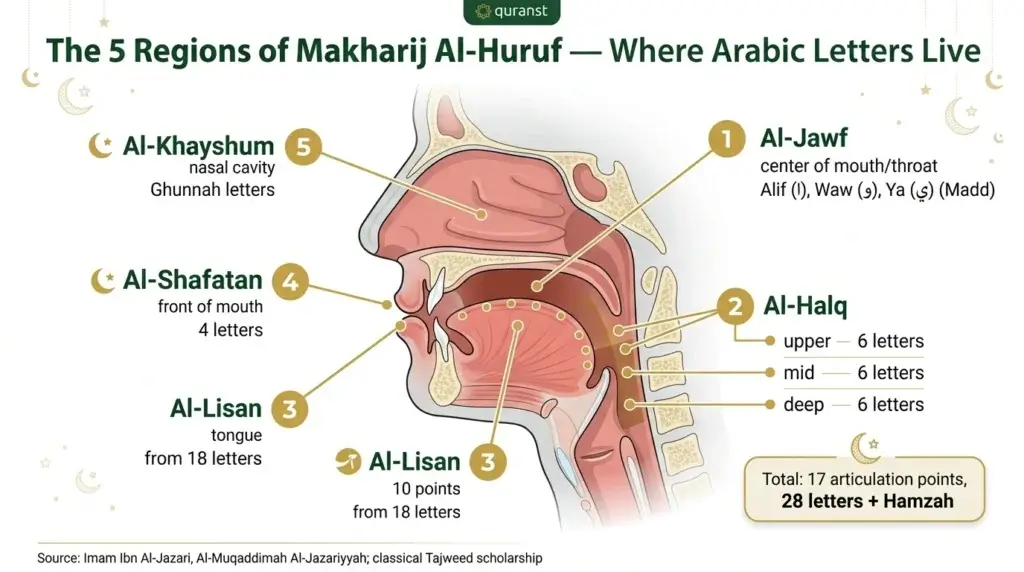
The Scholarly Foundation of Makharij
The science of Makharij Al-Huruf is not a modern innovation. It is among the oldest documented Islamic sciences — rooted in the Prophetic imperative to recite the Quran correctly.
The Prophet ﷺ said:
“The one who is proficient in the Quran will be with the noble, righteous angels; and the one who recites the Quran with difficulty, struggling with it, will have a double reward.”
— Sahih al-Bukhari, Hadith 4937; Sahih Muslim, Hadith 798
The word mahir (proficient) in this hadith refers specifically to mastery of correct recitation — including articulation. And the one who struggles (yatata’ta’u) is rewarded doubly precisely because they are making the effort to recite correctly despite difficulty.
The Quran itself commands its correct recitation:
وَرَتِّلِ الْقُرْآنَ تَرْتِيلًا
“And recite the Quran with measured recitation.”
— Quran 73:4
Imam Ali ibn Abi Talib (may Allah be pleased with him) defined tarteel as: “making the letters clear and knowing the stopping points” — both of which require knowledge of Makharij.
The Imam Who Systematized Makharij for All Time
The position adopted by the majority of classical Tajweed scholars, including Imam Ibn Al-Jazari, is that there are 17 articulation points. This 17-point system is the widely accepted standard today.
Imam Ibn Al-Jazari (751–833 AH / 1350–1429 CE) — the greatest Tajweed scholar in Islamic history, who memorized the Quran at age ten and later compiled the definitive works on Quranic recitation — wrote in his Al-Muqaddimah Al-Jazariyyah:
“Applying Tajweed is an obligation that cannot be abandoned — whoever recites the Quran without it is a sinner. For it is the manner in which Allah revealed it, and thus it descended from Him.”
— Imam Ibn Al-Jazari, Al-Muqaddimah Al-Jazariyyah, verse 13
This is the classical scholarly consensus: correct recitation — including correct Makharij — is not a virtue reserved for scholars. It is a basic obligation upon every Muslim who recites the Quran.
Why Makharij Comes Before Every Other Tajweed Rule
Students of Tajweed often want to jump to the famous rules: the Noon Sakinah rules, the Madd lengths, the Qalqalah. These are important. But they are the second floor of a building whose foundation is Makharij.
Consider the analogy offered by classical teachers: Think of Makharij like GPS coordinates for each letter. If you want to visit someone, you need their exact address. Similarly, to pronounce each Arabic letter correctly, you need to know its exact “address” in your mouth.
The word Makharij is the plural of Makhraj. It means the exit point of a letter. The expression Makharij Al-Huruf therefore means the articulation points of letters. Each Arabic letter has a specific articulation point or production zone. Some letters may seem close to non-Arabic speakers, such as س and ص, ت and ط, or ذ and ظ. However, they are not pronounced in the same way and do not always come from the same place. Working on articulation points helps distinguish letters, improve recitation, and read the Quran with greater attention. Repeated incorrect pronunciation can become a habit that is difficult to correct. It is better to learn letters with their articulation points from the beginning.
The classical method for identifying a letter’s Makhraj:
- Give the letter a Sukun (make it silent)
- Place a Hamzat Al-Wasl (أ) before it
- Pronounce it slowly — for example, pronounce “أَبْ” to find the Makhraj of Ba (ب)
- The letter’s sound terminates at its Makhraj — that is where it originates
The Five Main Regions of Articulation
There are 17 distinct Makharij (articulation points) for Arabic letters. These 17 specific locations are structurally divided into five main areas of the vocal apparatus: the lips (Al-Shafatan), the throat (Al-Halq), the tongue (Al-Lisan), the empty space of the mouth and throat (Al-Jawf), and the nasal cavity (Al-Khayshum).
Al-Lisan (the tongue) produces the most letters — 18 letters across 10 distinct articulation points. This makes the tongue the most active and complex organ in Arabic phonetics, requiring the most targeted practice to master, particularly for non-Arabic speakers whose native languages do not use many of the same tongue positions.
The five regions, from deepest to furthest forward:
| Region | Arabic Name | Number of Points | Letters |
|---|---|---|---|
| Empty space | Al-Jawf | 1 (approximate) | 3 (Madd letters) |
| Throat | Al-Halq | 3 | 6 |
| Tongue | Al-Lisan | 10 | 18 |
| Lips | Al-Shafatan | 2 | 4 |
| Nasal cavity | Al-Khayshum | 1 | Ghunnah letters |
Region 1: Al-Jawf — The Empty Space
What It Is
The empty space in the mouth and throat is a major area and an articulation point at the same time. The three Madd (lengthened) letters originate from this general area.
Al-Jawf is called taqdeeri (approximate) because the three Madd letters — Alif, Waw, and Ya — do not originate from a single definable point of contact. They flow from the throat outward through the open space of the mouth, ending wherever the extended sound naturally fades. There is no physical contact or constriction, making the point approximate rather than fixed.
The Three Letters of Al-Jawf
These are the Madd letters — the long vowel sounds that are elongated in Quranic recitation:
| Letter | Sound | Condition |
|---|---|---|
| أ — Alif | Long “aa” (as in “father”) | Preceded by Fathah: بَا |
| و — Waw Sakinah | Long “oo” (as in “moon”) | Preceded by Dhammah: بُو |
| ي — Ya Sakinah | Long “ee” (as in “seen”) | Preceded by Kasrah: بِي |
Quranic Example:
بِسْمِ اللَّهِ الرَّحْمَٰنِ الرَّحِيمِ
The Raa-heem contains the long “ee” of Ya Sakinah — extending from the open cavity of the mouth with no point of contact.
Region 2: Al-Halq — The Throat (6 Letters)
The throat produces six Arabic letters across three zones — moving from deepest to closest to the mouth:
Zone 1: The Deepest Throat (Aqsal-Halq)
Letters: ء (Hamzah) and هـ (Haa)
These are produced at the glottis — the space between the vocal cords at the very base of the throat.
ء Hamzah:
- The sharp “cut” at the beginning of any word beginning with a vowel sound in Arabic
- In English: the catch in the throat before “uh-oh”
- Quranic example: أَعُوذُ (I seek refuge)
هـ Haa:
- A soft, breathy “h” — like blowing on cold hands to warm them
- Completely different from the English aspirated “h” which is produced higher
- Quranic example: هُوَ (He)
- Common mistake: replacing with the English “h” — the Arabic Haa is significantly deeper and breathier
Zone 2: The Middle Throat (Wastal-Halq)
Letters: ع (‘Ain) and ح (Haa)
These are produced at the middle of the throat — what phonologists call the pharyngeal zone.
ع ‘Ain:
- The most challenging Makhraj for non-Arabic speakers — ‘Ain has no English equivalent.
- It requires a narrowing of the pharynx (back of the throat) while producing a voiced, strained sound
- Think of the feeling of a gentle “squeeze” in the middle of your throat
- Quranic example: عَلِيمٌ (All-Knowing)
- Practice tip: Place your hand on your throat, say “aaa,” then gradually constrict the throat while maintaining the sound
ح Haa:
- The voiceless equivalent of ‘Ain — same location, same constriction, but without vocal cord vibration
- Often confused with the English “h” but it is much deeper, more constricted
- Quranic example: الرَّحْمَٰنِ (The Most Merciful) — the Haa in Al-Rahman
- Practice tip: Say ‘Ain, then release the voice — the resulting whispered, constricted sound is Haa
Zone 3: The Upper Throat (Adnal-Halq)
Letters: غ (Ghayn) and خ (Khaa)
Produced at the uppermost part of the throat, near the back of the tongue:
غ Ghayn:
- A voiced, gargling sound from the upper throat
- Closest English approximation: the Parisian French “r” in “rouge”
- Quranic example: الْمَغْضُوبِ (those who have incurred anger) — in Al-Fatiha
- Practice tip: Gargle water, then produce the same constriction without water
خ Khaa:
- The voiceless equivalent of Ghayn — same location, no vocal cord vibration
- Like the Scottish “ch” in “loch” or the German “Bach”
- Quranic example: خَيْرٌ (good/better)
- Practice tip: Produce Ghayn, then whisper it — the result is Khaa
Region 3: Al-Lisan — The Tongue (18 Letters)
Al-Lisan (the tongue) produces the most letters — 18 letters across 10 distinct articulation points.
The tongue is the most complex articulator in Arabic phonology. Moving from the back of the tongue to the tip, the 10 points of the tongue produce letters in the following groups:
Group 1: Back of Tongue (Aqsal-Lisan)
ق Qaf and ك Kaf
ق Qaf:
- The very back of the tongue pressing against the soft palate (the flexible back of the roof of the mouth)
- Deep, full, “heavy” sound
- Quranic example: قُلْ هُوَ اللَّهُ أَحَدٌ (Say: He is Allah, the One) — Surah Al-Ikhlas
- Common mistake: producing Qaf from the same position as English “k” — Qaf is significantly further back
ك Kaf:
- The back of the tongue pressing against the hard palate — slightly further forward than Qaf
- Quranic example: كِتَابٌ (book/scripture)
Key distinction for non-Arabic speakers: Qaf (ق) vs Kaf (ك). Both involve the back of the tongue. But Qaf is at the soft palate; Kaf is at the hard palate. Say “key” in English — that produces something close to Kaf. Now push the “k” sound further back until it sounds deeper and fuller — that approaches Qaf.
Group 2: Middle of Tongue (Wastal-Lisan)
ج Jeem, ش Sheen, ي Ya (non-Madd)
ج Jeem:
- The middle of the tongue pressing against the middle of the hard palate
- Quranic example: الْجَنَّةَ (Paradise)
ش Sheen:
- Same location as Jeem, with wider air dispersion (the tongue is less tightly pressed)
- Like the English “sh” in “show” — but articulated slightly further back
- Quranic example: شَهِيدٌ (witness)
ي Ya (non-Madd):
- The middle of the tongue approaching (but not touching) the hard palate
- Produces the consonant “y” sound
- Quranic example: يَعْلَمُ (He knows)
Group 3: One Side or Both Sides of Tongue (Hafatal-Lisan)
ض Dad
The ض (Dad) is one of the most distinctive letters of the Arabic language — so distinctive that Arabic has historically been called Lughat Al-Dad (the language of Dad).
- Letters from this makhraj: ص, ض, ط, ظ, and ي. Three variations: left side, right side, or both sides of the tongue touching the gums.
- Dad is produced with the side edge of the tongue pressing against the upper back molars and gums
- It has a characteristic “heaviness” (Tafkheem) due to the tongue’s raised position
- Quranic example: الضَّالِّينَ (those who have gone astray) — in Al-Fatiha
Groups 4–10: Tip and Edge of Tongue
These groups produce the letters that involve the tip, blade, or edge of the tongue:
Tip against upper gums: ل (Lam), ن (Noon), ر (Ra) Tip against teeth root: ط (Ta), د (Dal), ت (Ta) Tip against upper teeth: ث (Tha), ذ (Dhal), ظ (Dha) Tip between teeth (interdental): same group as above
Critical Pairs for Non-Arabic Speakers
These pairs are the most commonly confused by English speakers because they occupy similar — but distinct — articulation positions:
| Pair | Letter 1 | Letter 2 | Key Distinction |
|---|---|---|---|
| س / ص | س Seen (light) | ص Sad (heavy) | Same position, different tongue posture — Sad has raised back of tongue |
| ت / ط | ت Ta (light) | ط Ta (heavy) | Same position — Taa raised back of tongue, changes Quran meaning |
| ذ / ظ | ذ Dhal (light) | ظ Dha (heavy) | Same interdental position — Dha is emphatic/heavy |
| ز / ض | ز Zayn | ض Dad | Completely different positions — Zayn is dental, Dad is lateral |
Region 4: Al-Shafatan — The Two Lips (4 Letters)
The lips produce four letters across two specific lip positions:
Position 1: Both Lips Together (Ijtima’ Al-Shafatayn)
ب Ba and م Meem
ب Ba:
- Both lips pressed firmly together, then released with vocal cord vibration
- Identical to the English “b”
- Quranic example: بِسْمِ اللَّهِ (In the name of Allah)
م Meem:
- Both lips pressed together, air released through nasal cavity
- Identical to the English “m” — but with careful attention to Ghunnah (nasal resonance)
- Quranic example: الْحَمْدُ لِلَّهِ (All praise is due to Allah) — the Meem at the end of Al-Hamdu
Position 2: Lower Lip and Upper Teeth (Batn Al-Shafah Al-Suflaa)
ف Fa and و Waw (consonant)
ف Fa:
- The inside of the lower lip against the edges of the upper front teeth
- Very similar to the English “f”
- Quranic example: فَاتِحَةِ (opener)
و Waw (consonant):
- Both lips rounded, approaching each other without touching
- Produces the consonant “w” sound
- Distinct from the Madd Waw which originates in Al-Jawf
- Quranic example: وَاللَّهُ (And Allah)
Region 5: Al-Khayshum — The Nasal Cavity
The nasal cavity produces one quality rather than individual letters: the Ghunnah — the nasal resonance that applies to:
- ن Noon in specific conditions (Noon Sakinah and Tanwin)
- م Meem in specific conditions (Meem Mushaddadah and Meem Sakinah with Ikhfaa)
The Ghunnah lasts 2 counts (harakat) in standard Tajweed — and is produced by allowing air to flow through the nasal cavity while the mouth position is maintained.
Quranic example:
إِنَّ اللَّهَ — The Noon Mushaddadah in inna carries Ghunnah for 2 counts
The Most Challenging Letters for Non-Arabic Speakers
The most challenging Makharij Al-Huruf for non-Arabic speakers are consistently: ع (Ain) — no English equivalent; ح (Ha) — different from the English “h.”
Based on both classical scholarship and contemporary teaching experience, here are the seven letters most commonly mispronounced by English speakers, with targeted correction guidance:
1. ع ‘Ain — The Pharyngeal Voice
Why it’s hard: English has no pharyngeal consonants at all. The pharyngeal zone of the throat is simply not activated in English speech.
What goes wrong: Most English speakers substitute the English vowel “a” or the glottal sound of Hamzah.
How to practice:
- Open your mouth wide and say “aaa”
- Gradually constrict the back of your throat (the pharynx) while continuing the sound
- The constricted, strained “aaa” you produce is approaching ‘Ain
- Practice with a qualified teacher who can hear and correct in real time
2. ح Haa — The Voiceless Pharyngeal
Why it’s hard: Like ‘Ain but voiceless — and has no English equivalent.
What goes wrong: Replaced by the English “h” (which is laryngeal, not pharyngeal).
How to practice:
- Produce ‘Ain (see above)
- Remove the voice — let only the air move, with the same pharyngeal constriction
- The result is Haa
3. ص Sad — The Emphatic Sibilant
Why it’s hard: English has “s” but not the emphatic version with raised tongue root.
What goes wrong: Pronounced as regular “s,” eliminating the heaviness that distinguishes it from Seen (س).
How to practice:
- Say the English “s”
- Now raise the back of your tongue toward the soft palate
- The resulting “heavier” s sound is approaching Sad
4. ض Dad — The Emphatic Lateral
Why it’s hard: No equivalent exists in any European language.
What goes wrong: Commonly pronounced as a “d” sound, completely missing the lateral (side-of-tongue) articulation.
How to practice:
- Press the side edge of your tongue against your upper back molars
- Maintain this contact and produce a voiced sound
- The result approximates Dad — though this letter particularly requires instruction from a qualified teacher
5. ق Qaf — The Deep Velar Stop
Why it’s hard: English “k” is produced at the hard palate; Qaf is at the soft palate — further back.
What goes wrong: Pronounced as English “k” or a regular “g.”
How to practice:
- Say English “k”
- Gradually push the tongue contact point further back (toward your throat)
- When the sound becomes noticeably deeper and more “back,” you are approaching Qaf
6. غ Ghayn — The Voiced Uvular Fricative
Why it’s hard: No English equivalent; closest is the French Parisian “r.”
What goes wrong: Often replaced by a regular “g” sound.
How to practice:
- Gargle water, note the back-of-throat sensation
- Produce the same gargling constriction without water, with voice
- A voiced version of this sensation is Ghayn
7. ط Ta (Emphatic) — Heavy Ta
Why it’s hard: Non-Arabic speakers often cannot hear the difference between ت Ta and ط Ta — but changing one to the other in the Quran changes the meaning.
What goes wrong: Pronounced identically to the light ت Ta.
How to practice:
- Say English “t”
- Raise the back of your tongue (same principle as Sad vs Seen)
- The heavier, “darker” sound you produce approximates Ta
How to Practice Makharij: The Step-by-Step Method
Start here: Learn the five main regions first, then practice each letter’s specific articulation point with mirror exercises and minimal pair drills. Stand in front of a mirror, put a light hand on your throat to feel voicing, and say each example slowly.
Here is the complete progressive practice methodology recommended by classical Tajweed scholars and validated by contemporary Tajweed educators:
Stage 1: Listen Before You Speak
Before attempting to produce any Makhraj, listen to a qualified reciter pronouncing the letter — repeatedly, in isolation, and then in Quranic context.
Why: The auditory model must be established before muscular training begins. The ear must recognize correct pronunciation before the mouth can produce it reliably.
How: Use authenticated recordings of Al-Azhar certified reciters for each letter in isolation. The quranst audio library provides these for every Makhraj group.
Stage 2: Isolate the Letter with the Classical Method
To find the precise Makhraj of an Arabic letter: give the letter a Sukun (make it silent), place a Hamzat Wasl (أ) before it, and pronounce it — for example, “ab” for Ba.
This method locates the precise physical origin of each letter by slowing the sound to its point of termination.
Stage 3: Mirror Work — See What You’re Doing
Stand in front of a mirror and observe:
- The position of your lips (are they where they should be for this letter?)
- The visible position of the tongue tip and blade
- The openness or narrowness of the mouth
For throat letters, place a hand lightly on your throat to feel:
- Whether vocal cords are vibrating (voiced letters: ع, غ, ج, ب, م, ن, و, ي)
- Whether constriction is being produced in the right zone
Stage 4: Minimal Pair Drills
A minimal pair is two words that differ only in one sound — perfect for training the distinction between similar letters.
| Minimal Pair | Distinction |
|---|---|
| سَعِيدٌ / صَعِيدٌ | Seen vs Sad |
| تَابَ / طَابَ | Light Ta vs Heavy Ta |
| ذَلَّ / ظَلَّ | Dhal vs Dha |
| كَلَبٌ / قَلَبَ | Kaf vs Qaf |
| حَالٌ / خَالٌ | Haa vs Khaa |
Stage 5: Apply to Quranic Text
Once the letter is being produced correctly in isolation, practice it within Quranic words and then verses. The goal is not isolation but fluency — producing correct Makharij within the flow of complete recitation.
Start with Al-Fatiha. Every articulation region is represented in Al-Fatiha. <cite index=”6-1″>Accurate pronunciation ensures the correct delivery of the Quranic message.</cite>
Stage 6: Real-Time Correction from a Qualified Teacher
All stages above can be practiced independently. But none of them replaces the essential element of live, real-time correction from a teacher who:
- Can hear the error the student’s own ears cannot detect
- Can model the correct sound at the precise moment of error
- Can identify which element of the Makhraj is incorrect (position, voicing, tension, contact)
This is why the transmission of Quran recitation has always been oral, person to person — from the Prophet ﷺ to Jibril, and from Jibril to the Prophet ﷺ, and from him to the Companions, and from them to the Tabi’un, to this day.
Structured Curriculum Framework
quranst’s certified Tajweed instructors — trained at Al-Azhar and equivalent institutions — provide real-time Makharij correction in live, one-on-one sessions. Every session begins with Makharij assessment and targeted correction.
Book your free 2-session trial →Common Mistakes That Change the Meaning of the Quran
This section is critically important. Some Makharij errors are a matter of beauty — the recitation is imperfect but the meaning is preserved. Others change the meaning of the Quran itself:
Mistake 1: Replacing ق Qaf with ك Kaf
Example: In Surah Al-Baqarah: قُلْ (Say!) pronounced as كُلْ (Eat!) — same letters rearranged differently, completely different command.
Mistake 2: Replacing ص Sad with س Seen
Example: صِرَاطَ (path/way) in Al-Fatiha — this word’s heaviness is essential to its meaning and its Quranic identity. Repeated incorrect pronunciation can become a habit that is difficult to correct — it is better to learn correctly from the beginning.
Mistake 3: Replacing ح Haa with هـ Haa or English “h”
Example: الرَّحْمَٰنِ (The Most Merciful) — the ح in Al-Rahman is the pharyngeal Haa, not the laryngeal Haa (هـ) or English “h.” Replacing it changes the word.
Mistake 4: Replacing ع ‘Ain with Hamzah or a vowel
Example: عَلِيمٌ (All-Knowing) — if ‘Ain is replaced with a simple vowel, the word is completely changed.
Mistake 5: Replacing ط Ta with ت Ta (or vice versa)
Example: تَابَ (he repented) vs طَابَ (it became good/pleasant) — one letter change, two entirely different meanings.
Conclusion: Every Letter Is a Door to the Divine
The word Makhraj in Arabic means “exit” — the place where a letter exits from you into the world. But in the context of Quranic recitation, it might also be read the other way: it is the place where the Quran enters you — where its sound, its meaning, its divine weight makes contact with your physical being.
When you prostrate your tongue at the precise location where ع ‘Ain originates — when you feel the pharynx constrict and the sound emerge from that deep, strained place — you are producing the same letter that was produced in the mouth of Jibril when he recited to the Prophet ﷺ in the Cave of Hira. The same letter. The same place in the throat. The same sound.
This is not technical exercise. This is connection to a chain of transmission that stretches back fourteen centuries to the moment of revelation.
Every Quranic letter has a Makhraj. Every Makhraj is a doorway. And the student who masters them has not merely learned to pronounce Arabic correctly — they have learned to receive the Quran the way it was delivered.
The Prophet ﷺ said:
“The Quran will come on the Day of Judgment as an intercessor for those who recited it.”
— Sahih Muslim, Hadith 804
May your recitation — correct, precise, learned with effort and love — be among those that intercede.
وَرَتِّلِ الْقُرْآنَ تَرْتِيلًا
“And recite the Quran with measured, precise recitation.”
— Quran 73:4
🟢 Learn Makharij Al-Huruf with Certified Tajweed Instructors
Reading about Makharij Al-Huruf is the beginning. Correcting them requires a teacher who can hear you, identify your specific errors, and guide your mouth to the right position in real time.
quranst’s Quran and Tajweed track provides:
- Live, one-on-one sessions with certified Tajweed instructors — Al-Azhar trained, specializing in non-Arabic speakers
- Makharij assessment in Session 1 — your specific articulation challenges are identified immediately, not after months of incorrect practice
- Progressive curriculum — from Makharij foundation through all Tajweed rules, in sequence, without skipping steps
- Real-time correction — errors are caught and corrected the moment they occur, preventing habit formation
- Quranic application — every Makhraj is practiced within Quranic text from the beginning
- Flexible scheduling — for Muslim families in the USA, Canada, UK, Australia, and the Gulf
👇 Begin with Two Free Sessions
Two Ways to Begin
“The one who is proficient in the Quran will be with the noble, righteous angels; and the one who recites with difficulty will have a double reward.”
— Sahih al-Bukhari, Hadith 4937; Sahih Muslim, Hadith 798
Begin the proficiency. Tonight.
بِسْمِ اللَّهِ — Begin.
References and Sources
Quranic References
- Quran 73:4 — “Recite the Quran with measured recitation (Tarteel)”
Hadith References
- Sahih al-Bukhari, Hadith 4937; Sahih Muslim, Hadith 798 — Proficiency and struggle in Quran recitation both rewarded
- Sahih Muslim, Hadith 804 — The Quran as intercessor for those who recite it
Classical Tajweed Scholarship
- Imam Ibn Al-Jazari (751–833 AH). Al-Muqaddimah Al-Jazariyyah (النشر في القراءات العشر). Verse 13 (obligation of Tajweed). The standard classical reference for 17 Makharij points.
- Imam Ali ibn Abi Talib (radhiAllahu ‘anh). Definition of Tarteel: “making the letters clear and knowing the stopping points” — cited in classical Tajweed literature.
- Al-Suyuti, Jalal al-Din. Al-Itqan fi Ulum al-Quran. Chapter on Makharij Al-Huruf.
Frequently Asked Questions
What are Makharij al-Huruf and why are they important?
What are the 5 major articulation regions (Makharij) in Tajweed?
- Al-Jawf (The Oral & Throaty Void): For the 3 long vowel elongation letters[cite: 4].
- Al-Halq (The Throat): Divided into bottom, middle, and top regions for 6 throat letters[cite: 4].
- Al-Lisan (The Tongue): The largest region containing 10 specific exit points for 18 letters[cite: 4].
- Ash-Shafatayn (The Lips): For 4 labial sounds[cite: 4].
- Al-Khayshoom (The Nasal Cavity): The source of Ghunnah (nasalization)[cite: 4].
