

Introduction: The Years That Define Everything
She used to hold your hand crossing the street.
She used to ask you to sit with her while she fell asleep. She used to run to you when something went wrong — when a friend was unkind, when a test was hard, when the world felt too big.
And then, somewhere between twelve and fifteen, something shifted.
The door closes. The answers get shorter. The eye contact becomes selective. The warmth that was once automatic now has to be negotiated — and the negotiation happens on terms you did not agree to and do not fully understand.
This is adolescence. And for Muslim parents raising Muslim children in the West — where the teenage years coincide with the heaviest pressure on Islamic identity, the widest gap between Islamic values and mainstream culture, and the most acute need for parental connection — it is the most consequential and the most challenging period in the entire arc of Islamic parenting.
This guide is for the parent standing at that closed door.
It is grounded in the Quran, the authentic Sunnah, and the classical Islamic scholarly tradition — alongside the most current peer-reviewed research on adolescent psychology, parenting styles, and Muslim minority youth identity. Its goal is not to give you a technique for managing a difficult phase. Its goal is to give you the understanding, the tools, and the prophetic framework that transform these years from a crisis to be survived into a foundation to be built.
Structured Curriculum Framework
quranst’s Smart Parenting track provides live, one-on-one coaching for Muslim parents navigating the teenage years — with Islamic education, Hadith-grounded strategies, and structured support for raising Muslim children in the West.
Book your free 2-session trial →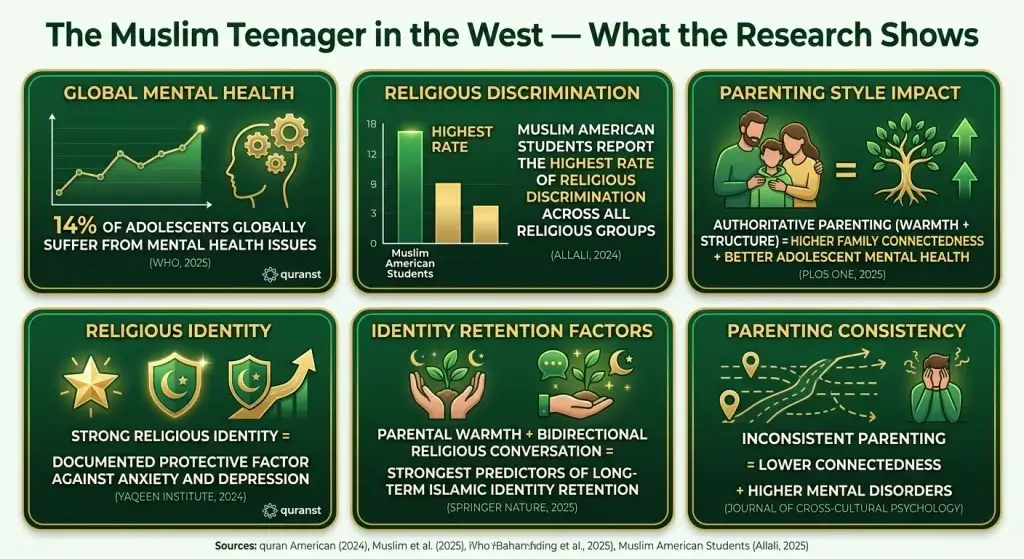
Section 1: Understanding the Muslim Adolescent — What the Research Says
Before strategies, understanding. Because the Muslim parent who misdiagnoses adolescence as rebellion will respond with the wrong tools — and the consequences can last a lifetime.
What Adolescence Actually Is
Adolescence is not a problem to be solved. It is a developmental stage with a specific biological, psychological, and social mandate: the formation of a stable, autonomous identity. The adolescent who appears to be rejecting their parents’ values is, in many cases, not rejecting those values — they are testing them, determining which of them are genuinely their own and which were simply inherited without examination.
The WHO’s adolescent mental health fact sheet (2025) identifies the key determinants of adolescent mental wellbeing: the quality of home life and relationships with peers, exposure to violence and harsh parenting, and the pressure to conform with peers during the exploration of identity. Media influence and gender norms can exacerbate the disparity between an adolescent’s lived reality and their perceptions or aspirations for the future.
For Muslim adolescents in the West, this pressure is compounded by the specific challenge of navigating two identity systems simultaneously — the Islamic and the Western — that sometimes appear to demand incompatible things.
The Muslim Teenager’s Unique Challenge
Research on Muslim minority youth in U.S. public schools found that Muslim American students report the highest rate of discrimination across all religious groups. This is not cause for despair — it is cause for preparation.
Due to rising Islamophobia in Europe today, Muslim ethnic minority adolescents are at great risk of experiencing identity-based harassment at school. Religion is often considered among the core cultural elements that immigrant parents aim to pass on to their children.
The Muslim teenager navigating these pressures is not simply going through “a phase.” They are navigating a genuine identity challenge that requires specific, informed, Islamically grounded parental support.
The Critical Role of Parenting Style
The research on parenting styles and adolescent outcomes is among the most consistent in developmental psychology:
The authoritative parenting style was found to be significantly associated with better outcomes and self-esteem among adolescents, while authoritarian parenting style is associated with depression and self-esteem difficulties, and permissive parenting style is associated with stress. Globally, fourteen percent of adolescents suffer from mental health issues.
Authoritative parenting was associated with a higher level of connectedness with the family and better mental health of adolescents. A higher level of adolescent-family connectedness is associated with better mental health of adolescents. Results indicate that inconsistency in parenting and inconsistency between the parenting style and the culture cause harm.
The Islamic parenting tradition — grounded in the Prophetic model — anticipates these findings precisely. The Prophet ﷺ demonstrated the authoritative model in every interaction with young people: warm, connected, and genuinely caring, while simultaneously setting clear ethical and behavioral expectations. The combination of warmth and structure is not a Western psychological discovery. It is the Sunnah.
Section 2: The Quranic Framework for Adolescent Development
The Quran does not use the word “adolescence” — but it provides the most comprehensive framework for this stage of life in its treatment of bulugh (maturity), aql (reason), and taklif (moral accountability).
The Moment of Accountability
In Islamic jurisprudence, bulugh — the onset of puberty — marks the beginning of full moral and religious accountability (taklif). The child who was previously exempt from religious obligation now stands before Allah as a full adult believer, responsible for their own prayer, their own fasting, their own choices.
This theological framework has profound implications for parenting: the teenager is no longer simply a child to be guided but a mukallaf (legally responsible person) to be respected as such. Parenting shifts from direction to partnership — from telling to consulting.
يَا أَيُّهَا الَّذِينَ آمَنُوا لَا تَسْأَلُوا عَنْ أَشْيَاءَ إِن تُبْدَ لَكُمْ تَسُؤْكُمْ
“O you who have believed, do not ask about things which, if they are shown to you, will distress you.”
— Quran 5:101
This verse — in its broader context — speaks to the Islamic principle of not overwhelming believers with more than they can bear. Applied to adolescent parenting: the parent who bombards a teenager with religious requirements, restrictions, and scrutiny beyond what they can currently carry may produce compliance without conviction — or rejection of both.
The Quranic Model of Gradual Revelation
One of the most instructive parenting lessons in the Quran is the nature of the revelation itself. The Quran was revealed over 23 years — not all at once. The most stringent rules — prohibition of alcohol, detailed inheritance law, the full Sharia framework — came gradually, after the foundational relationship between the believer and Allah had been established.
The classical scholar Ibn al-Qayyim explicitly applies this principle to Islamic education in Tuhfat al-Mawdud: do not burden young people with the full weight of religious obligation before their hearts have been prepared to carry it. Build the relationship with Allah first. The rules will be received as gifts rather than constraints once that relationship is genuine.
The Son of Nuh: The Adolescent Who Could Not Be Reached
The Quran preserves, with remarkable honesty, the story of a parent who failed to reach their own child — and the model it provides for how to respond:
وَنَادَىٰ نُوحٌ ابْنَهُ وَكَانَ فِي مَعْزِلٍ يَا بُنَيَّ ارْكَب مَّعَنَا وَلَا تَكُن مَّعَ الْكَافِرِينَ
“And Nuh called to his son who was apart: ‘O my son, come aboard with us and be not with the disbelievers.'”
— Quran 11:42
Three elements of Nuh’s call to his son are worth noting for Muslim parents:
- He called him personally — “O my son” — not through an intermediary, not through shame, not through threat
- He invited — “Come aboard with us” — an invitation to belong, not a command to obey
- He framed it positively — join us — not “stop what you’re doing”
And when his son refused — when the worst outcome a parent can imagine occurred — Nuh did not rage, did not abandon his mission, and did not stop making du’a. He turned to Allah.
The lesson for Muslim parents: your job is to call, invite, and make du’a. The response belongs to Allah.
The Prophet ﷺ — the greatest educator in human history — had a distinctive, documented relationship with young people. His approach was not simply gentle; it was strategically intelligent — designed to reach the developing adolescent mind and heart in ways that produced lasting transformation.
He Gave Young People Real Responsibility
The Prophet ﷺ gave ‘Usamah ibn Zayd command of an army at seventeen. He sent Mu’adh ibn Jabal to Yemen as a teacher, judge, and governor while still in his twenties. He trusted Anas ibn Malik with serving him for ten years — from the age of ten — and never once scolded him for a mistake.
The pattern is consistent: real responsibility, proportionate to the young person’s capacity, produces real confidence and real character. The teenager who is trusted — with genuine, meaningful tasks — develops the internal evidence that they are capable and valued.
He Made Space for Their Questions
The Prophet ﷺ regularly taught through questions — inviting young people to think rather than simply receive:
“O young man — shall I teach you some words?”
— Sunan al-Tirmidhi, Hadith 2516 (the famous teaching to Ibn Abbas)
The address — ya ghulam (O young man) — establishes immediate, personal connection. The offer — shall I teach you? — makes the learning a gift offered, not a command delivered. Ibn Abbas, at the time, was a child or young teenager. And the teaching he received that day shaped one of the greatest scholars in Islamic history.
He Honored Their Emotions
When the young Anas ibn Malik’s pet bird died, the Prophet ﷺ did not tell him to be grateful or to maintain perspective. He sat with him and asked softly: “O Abu ‘Umayr — what happened to the little nightingale?” (Sahih al-Bukhari, Hadith 6129). The emotion was dignified. The grief was honored. The relationship was maintained.
For Muslim parents of teenagers: the issue your teenager is bringing to you may seem small. The weight they are carrying it with is real. Honor the weight first. The Islamic perspective can be offered once the emotional connection is established.
He Corrected Privately, Never Publicly
Research published in the Journal of Islamic Thought and Civilization (2024) on Abd al-Karim Bakkar’s Al-Tarbiyyah Al-Rashidah identifies that effective Islamic parental communication with adolescents requires building familial bonds through positive communication rather than restrictive correction — consistent with the Prophetic model of dignified, private correction.
The Prophet ﷺ would say, to a companion who had erred: “What is it that I see you doing?” — quietly, one to one. Never in a group. Never to make an example. The dignity of the young person was preserved — and therefore the relationship through which further guidance could flow was preserved.
Section 4: The Five Biggest Mistakes Muslim Parents Make With Teenagers
Understanding what not to do is as important as understanding what to do — because the mistakes that damage the parent-teenager relationship in Muslim families are remarkably consistent, and remarkably reversible once identified.
Mistake 1: Prioritizing Compliance Over Connection
The most common and most damaging pattern in Muslim parenting of teenagers: focusing on what the teenager is doing (praying? wearing hijab? avoiding haram?) while neglecting who they are becoming (are they honest? are they kind? do they feel genuinely loved?).
The Yaqeen Institute’s 2024 paper on raising resilient Muslim children opens with the story of Hanan — a first-generation Muslim American who grew up in a home where the answer to religious questions was always “because I said so.” Hanan’s parents were deeply devout and loved their children. But their rigid, restriction-heavy approach to faith led Hanan to develop resentment toward both her parents and, gradually, toward Islam itself. She spent her childhood feeling neither “American enough” nor “Muslim enough.”
The teenager who complies out of fear will stop complying the moment fear is removed — at university, at work, when they leave home. The teenager who has been genuinely connected will carry their values internally, because those values are theirs — chosen, understood, and loved.
Mistake 2: Making Every Conversation a Lecture
The teenage brain is specifically wired to resist perceived authority — it is part of the developmental mandate of identity formation. A conversation that begins with a lecture ends with a closed door.
The Prophet ﷺ modeled a different approach: he asked before he taught. “Do you know what backbiting is?” (Sahih Muslim, Hadith 2589). “Shall I tell you who the people of Paradise are?” He led with curiosity, not instruction — and the companions leaned in rather than shutting down.
Practical rule: The ratio of listening to speaking with a teenager should be at least 3:1. Three parts genuine curiosity and attention to one part guidance.
Mistake 3: Using Religion as a Tool of Control
Religion used as a behavioral enforcement mechanism — threatening with hellfire, restricting privileges in the name of Islamic obligation, making halal/haram the framework for every parental preference — produces teenagers who associate Islam with parental control rather than with divine love and personal liberation.
Islam is a rahma — a mercy. When it is presented primarily as a restriction, it is being misrepresented. And teenagers are perceptive enough to feel the misrepresentation, even when they cannot articulate it.
Mistake 4: Inconsistency — The Silent Identity Destroyer
Results indicate that inconsistency in parenting and inconsistency between the parenting style and the culture cause harm to adolescents’ mental health. In these tests, adolescents raised according to the inconsistent parenting scored lower in connectedness and higher in mental disorders than those raised according to consistent parenting patterns.
The Muslim parent who holds firm on Islamic values on some days and abandons them under social pressure on others is not teaching flexibility — they are teaching the teenager that Islamic values are negotiable. And a teenager will take that lesson further than the parent intended.
Mistake 5: Competing with the Peer Group Instead of Understanding It
The peer group is the primary social reference point of adolescence. Competing with it — dismissing the teenager’s friends, criticizing their culture, forbidding their entertainment — rarely produces the intended effect. It produces secrecy.
The alternative: understand the peer group. Invite their friends home. Meet the people your teenager spends time with. Make your home the place where the social circle gathers — not the fortress from which the social circle is excluded.
Section 5: Eight Positive Parenting Strategies That Actually Work
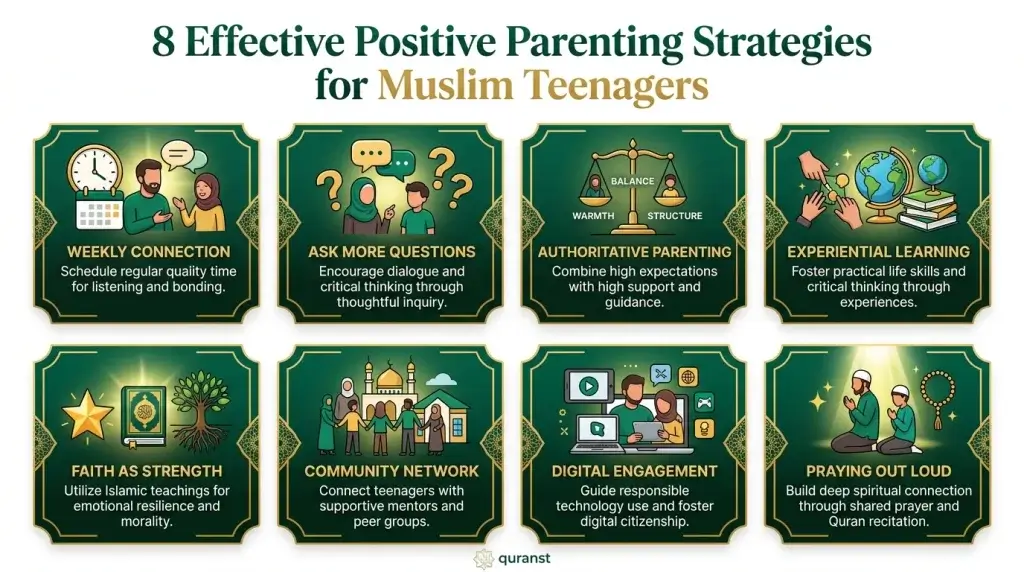
These strategies are drawn from the Prophetic model, classical Islamic scholarship on child-rearing, and peer-reviewed research on effective adolescent parenting — integrated into a coherent framework for the Muslim family.
Strategy 1: The Weekly One-on-One Connection
Designate one time per week — consistent, predictable, protected — for one-on-one time with each teenager. No agenda, no lecture, no Islamic education. Just presence and genuine interest.
The Prophet ﷺ was the busiest man in Madinah. He still made time for individual conversations, personal questions, and genuine curiosity about the people in his life. The relationship is the medium through which everything else is transmitted.
What it sounds like: “I don’t have anything specific to talk about. I just wanted to spend some time with you. What have you been thinking about lately?”
Strategy 2: Ask More Questions Than You Answer
Research on Muslim adolescent religious identity overwhelmingly identifies parental warmth and bidirectional religious conversation — where children’s questions are welcomed, not silenced — as the strongest predictors of long-term Islamic identity retention.
The teenager who knows they can bring any question to their parent — including doubts, including hard questions about Islam, including confusion about identity — is the teenager who stays connected to both the parent and the faith.
What it sounds like: “That’s a really interesting question. I don’t have a complete answer — let’s think about it together. What made you start wondering about that?”
The authoritative parenting style was found to be significantly associated with better adolescent outcomes and self-esteem. It consists of connection, regulation, and autonomy dimensions.
The Islamic equivalent: the parent who is warm enough that the teenager wants to maintain the relationship, and clear enough about Islamic values that the teenager knows exactly where the boundaries are.
This is not permissiveness — which abandons structure. And it is not authoritarianism — which abandons warmth. It is the middle path (wasatiyyah) in parenting, modeled by the Prophet ﷺ in every interaction with young people.
The practical formula:
- Connection first — always lead with relationship
- Explain the reason — never just issue commands; teenagers need to understand the why
- Give increasing autonomy — as trust is built, expand the space for independent decision-making
- Maintain clear non-negotiables — the Five Pillars, the fundamental ethical values — held consistently, with love
Strategy 4: Islamic Education Through Experience, Not Instruction
Study Islam online, engage with Islamic studies content, and attend Islamic education sessions — but the most powerful Islamic education for teenagers happens in experience, not instruction.
The teenager who fasts Ramadan with a family that makes it beautiful — with iftars that are celebrations, with Tarawih that feels like an event, with the night of Qadr as a genuine spiritual experience — learns more about Islam than from any lecture.
The teenager who performs Umrah or Hajj with parents who have prepared them to understand what they are doing — who have taken online Quran classes to understand the verses recited, who have learned the Quranic Arabic vocabulary of the Talbiyah — undergoes a transformation that a classroom cannot produce.
Make Islamic experience the context of Islamic learning.
Strategy 5: Connect Islamic Identity to Confidence, Not Restriction
Psychological research has found that religious identity provides a sense of continuity across time and place, and allows an individual to develop a sense of internal consistency despite the unavoidable changes that time brings to society, relationships, and self. The goal as parents is to help our children forge a durable identity through the stability offered by Allah’s guidance — an identity based on the truth of Islam.
Frame Islamic identity for your teenager not as a set of restrictions that separate them from their peers, but as a source of strength that equips them for the world their peers are navigating without adequate foundation.
What it sounds like:
- “Being Muslim means you know exactly who you are, even when the world is telling you to be someone else.”
- “The Quran gives you a framework for thinking about every hard question your friends are struggling with — that’s not a limitation, that’s a resource.”
- “Muslims built the world’s first university, developed algebra, and preserved Greek philosophy when Europe forgot it. You’re the heir to that tradition.”
Strategy 6: The Ummah Network — Three Levels of Community
Joining a group can make a person feel less alone, increase camaraderie, and tap into a network of physical resources, social connections, and intergenerational wisdom. In adolescents specifically, group support bolsters mental health, academic success, and self-esteem. Micro scale: Mentors, Muslim peers, Muslim Student Associations, study circles. Meso scale: local mosque, Islamic school, and community organizations — relationships that help children feel like they are a part of the local community. Macro scale: the ummah — a community that transcends space and time.
Build your teenager’s Islamic community at all three levels:
Micro: Muslim friends their age who are also navigating the same challenges. A study circle (halaqah). A Muslim mentor slightly older than them who has navigated what they are facing.
Meso: A masjid community where they are known by name, welcomed genuinely, and given real roles. An Islamic education program — online Quran classes, Islamic studies sessions, Arabic language learning — that connects them to Muslim peers globally.
Macro: Help them feel the weight and the glory of belonging to a community that extends across fourteen centuries and every continent on earth.
Strategy 7: Digital Life — With Them, Not Against Them
The teenager’s digital life is their social world. Trying to eliminate it produces the same result as eliminating any other central element of a teenager’s social world: resentment, secrecy, and loss of trust.
The alternative: be present in it. Know the platforms they use. Watch the content they watch. Ask about the people they follow. Discuss the values embedded in the media they consume — not to lecture, but to think together.
Child behavior management in the digital age is not about prohibition — it is about formation: building the internal capacity to evaluate what they encounter, the confidence to reject what contradicts their values, and the Islamic framework to understand why.
Strategy 8: The Du’a Practice — Out Loud, By Name
“And say: My Lord, have mercy upon them as they brought me up when I was small.”
— Quran 17:24
Make du’a for your teenager — out loud, in front of them, by name, for specific things they are facing.
The teenager who hears their parent say, “O Allah, give Yusuf clarity and confidence as he navigates this year. Make him someone who is proud of his Islam and strong in his character” — that teenager has received something no parenting technique can produce: the visceral knowledge that they are prayed for by someone who loves them completely.
This is the most powerful parenting tool available. It costs nothing. It requires no special training. And it operates at the level that no earthly technique reaches.
Section 6: The Identity Crisis — When Your Teenager Questions Their Faith
The moment many Muslim parents dread most: the teenager who says “I’m not sure I believe in Islam anymore” — or who stops praying, or who asks questions that seem designed to dismantle rather than understand.
What It Almost Always Is
In the vast majority of cases, the teenager who expresses doubts about Islam is not leaving the faith. They are testing the relationship — the relationship with their parents, and the relationship with the faith itself — to see whether it can survive scrutiny.
Research shows a growing interest in understanding the identity formation of Muslim youth, particularly in Muslim-minority contexts where questions of belonging, integration, and religious continuity become central. Contemporary Islamic parenting research emphasizes an interdisciplinary approach focused on Islamic-based moral and character formation as Muslim families navigate globalized, digital, and culturally diverse environments.
The teenager who asks hard questions about Islam is not the teenager who has lost faith. They are the teenager who is taking faith seriously enough to question it — which is exactly what Aqeedah (Islamic creed) encourages. The Quran itself invites intellectual engagement:
أَفَلَا يَتَدَبَّرُونَ الْقُرْآنَ أَمْ عَلَىٰ قُلُوبٍ أَقْفَالُهَا
“Then do they not reflect upon the Quran, or are there locks upon their hearts?”
— Quran 47:24
How to Respond
Don’t panic. The parent who responds to theological questions with panic signals to the teenager that Islam cannot withstand scrutiny — which is precisely the wrong message.
Don’t shut it down. The question that is silenced does not disappear — it goes underground, where it grows without any Islamic input and emerges later in more damaging form.
Engage with genuine curiosity. “That’s a really important question. What made you start thinking about that? I don’t have a perfect answer, but let’s explore it together.”
Connect them to Islamic intellectual resources. Study Islam online through credible scholars. Introduce them to the works of contemporary Muslim thinkers who engage honestly with the hard questions — Hamza Tzortzis, Yaqeen Institute researchers, Sheikh Hamza Yusuf. The Islamic intellectual tradition has been engaging with every major philosophical challenge for fourteen centuries. Your teenager’s question is not new — and the answers exist.
Make du’a. And then make more du’a.
Section 7: Building the Islamic Community Around Your Teenager
No family alone can provide everything a Muslim teenager needs to maintain Islamic identity under the pressures of the modern West. The community is not optional — it is what the Prophet ﷺ built first when he arrived in Madinah.
The Masjid as a Teen Space
The most effective mosques for Muslim teenagers are not those with the best programs for them — they are the ones where teenagers feel genuinely known, genuinely welcomed, and genuinely useful.
Practical steps:
- Find the masjid where the imam knows your teenager’s name
- Involve your teenager in volunteer roles — the teenager who sets up chairs for Friday prayer has a relationship with that masjid that the one who only attends does not
- Support the masjid’s youth programs financially and socially
The Muslim Peer Network
Research on ethnic-racial socialization shows that cultural socialization practices in the home are the most frequently reported and most positively associated with healthy minority identity outcomes. Children who grow up in homes rich with cultural and religious material develop stronger identity achievement and more positive affect around their group membership.
Build the Muslim peer network before it is needed. When the peer pressure comes — and it will — the teenager who already has Muslim friends navigating the same challenges is far better equipped than the one who faces it alone.
Islamic education programs — online Islamic studies courses, online Quran classes, Arabic language learning through platforms like quranst — provide exactly this: a community of Muslim peers globally, learning together, facing the same challenges together.
The Muslim Mentor
One of the most consistently powerful interventions for Muslim teenagers is a Muslim adult mentor — someone slightly older than them, who has navigated the same identity challenges they are facing, and who can speak from lived experience rather than from parental authority.
This might be an older cousin, a university student at the local Islamic center, a teacher at the Islamic school. The relationship should be warm, voluntary, and free of the power dynamics that sometimes complicate the parent-teenager relationship.
Section 8: Practical Communication Guide — What to Say and How to Say It
The right message, delivered in the wrong way, produces the wrong result. Here is a practical communication guide for the most common challenging conversations with Muslim teenagers:
When They Stop Praying
Don’t say: “You have to pray. You’re a Muslim. How can you not pray?“
Do say: “I’ve noticed you haven’t been praying lately. I’m not going to pressure you — I just want you to know I’m here if you want to talk about what’s going on. And I want you to know that I pray for you every day, even when you’re not praying yourself.”
Why: Pressure produces compliance or resistance — neither of which is the goal. Expressed concern without ultimatum keeps the door open.
When They Want to Do Something Haram
Don’t say: “Absolutely not. That’s haram. End of discussion.”
Do say: “I hear that this is important to you. Let’s talk about why. And let’s also talk about what Islam says about it and why — because I want you to understand, not just to comply.”
Why: A teenager who understands the wisdom behind an Islamic ruling is more likely to embrace it than one who simply experiences it as parental veto.
When They Ask a Hard Question About Islam
Don’t say: “You shouldn’t be asking that. Just have faith.”
Do say: “That’s a question that scholars have been thinking about for centuries. I don’t have a complete answer — but this is exactly what Islamic study is for. Let’s find some resources together.”
Why: Intellectual engagement with Islam produces intellectual ownership of Islam. The faith that can answer hard questions is the faith that gets kept.
When They Express Shame About Being Muslim
Don’t say: “You should be proud of being Muslim. Don’t let anyone make you ashamed.”
Do say: “Tell me what happened. I want to understand what you’re experiencing. And then I want to tell you some things about your history and your tradition that I think will change how you feel about it — because there’s a lot you might not know yet.”
Why: The instruction to feel proud does not produce pride. The knowledge that produces pride does.
Structured Curriculum Framework
quranst’s Islamic Studies and Smart Parenting tracks give Muslim teenagers structured Islamic education — Aqeedah, Fiqh, Hadith, Quranic Arabic — that builds the intellectual foundation for genuine faith. And gives Muslim parents the coaching framework to navigate the teenage years with connection, not conflict.
Book your free 2-session trial →Conclusion: The Teenager You Are Raising Is the Adult Who Will Pray for You
The Prophet ﷺ said:
“When a person dies, all action is cut off except three: ongoing charity, knowledge that benefits, or a righteous child who prays for him.”
— Sahih Muslim, Hadith 1631
The child who prays for their parent after their death is not the child who was forced to pray during their teenage years. It is the child who came to love prayer — because a parent made Islam beautiful, made the relationship strong, made questions welcome, made the ummah real, and made du’a for them every day.
The closed door is not a verdict. It is an invitation.
Behind it is a young person who is more confused, more pressured, and more in need of genuine connection than at any other point in their life. And the parent who understands this — who approaches that door with warmth instead of authority, with questions instead of lectures, with du’a instead of threats — is the parent whose teenager, years from now, will say:
“My faith survived because of my parents. Not despite them.”
That is the goal of Islamic parenting. Not compliance. Not performance. Not the preservation of cultural appearance.
The righteous child who prays for you after you are gone.
Everything in this guide is in service of that one outcome.
رَبِّ اجْعَلْنِي مُقِيمَ الصَّلَاةِ وَمِن ذُرِّيَّتِي ۚ رَبَّنَا وَتَقَبَّلْ دُعَاءِ
“My Lord, make me an establisher of prayer, and from my descendants. Our Lord, and accept my supplication.”
— Quran 14:40 — du’a of Ibrahim ﷺ for his children and their children
🟢 Build the Bridge to Your Teenager
The teenage years are not a phase to survive. They are a foundation to build. And the family that builds it well raises a young adult who carries Islam as a choice, not a burden — and who will pass it on, the same way, to the generation after them.
quranst supports Muslim families through every stage:
Smart Parenting Track — For Parents:
- Live coaching sessions with Islamic parenting specialists
- Hadith-grounded frameworks for the most challenging conversations
- Practical strategies for screen time, prayer resistance, identity challenges, and peer pressure
- Child behavior management tools rooted in the Prophetic model
Islamic Studies Track — For Teenagers:
- Aqeedah taught with intellectual rigor — engaging hard questions, not silencing them
- Fiqh and Hadith explained with wisdom and context — not just rules
- Study Islam online with certified scholars who understand the Western Muslim experience
- Islamic education that builds genuine conviction, not performed compliance
Arabic Language Track — For Families:
- Learn Arabic and Quranic Arabic so your teenager can access the Quran directly
- Online Arabic tutor sessions — live, one-on-one, for all levels
- Speak Arabic fluently through structured conversational practice
- Classical Arabic grammar for Quran comprehension
Quran Track:
- Online Quran classes with certified Online Quran teachers
- Tajweed, Quran memorization, and Quranic Arabic — building a direct relationship with the Book of Allah
- Quran lessons designed for teenagers navigating identity — connecting every surah to their lived experience
👇 Begin Today — Two Free Sessions
Two Ways to Begin
“When a person dies, all action is cut off except three: ongoing charity, knowledge that benefits, or a righteous child who prays for him.”
— Sahih Muslim, Hadith 1631
Raise the one who will pray for you.
بِسْمِ اللَّهِ — Begin.
References and Sources
Quranic References
- Quran 5:101 — Not overwhelming believers beyond their capacity
- Quran 11:42 — Nuh calling his son to the ark
- Quran 14:40 — Du’a of Ibrahim for his children and descendants
- Quran 17:24 — “Say: My Lord, have mercy upon them as they brought me up”
- Quran 47:24 — “Do they not reflect upon the Quran?”
Hadith References
- Sahih al-Bukhari, Hadith 6129 — Prophet with Anas about his bird; dignifying children’s emotions
- Sahih Muslim, Hadith 1631 — Righteous child who prays for the parent after death
- Sahih Muslim, Hadith 2589 — “Do you know what backbiting is?” — Socratic method
- Sunan al-Tirmidhi, Hadith 2516 — Prophet’s teaching to young Ibn Abbas
Classical Scholarly Works
- Ibn al-Qayyim al-Jawziyyah: Tuhfat al-Mawdud bi-Ahkam al-Mawlud. Dar Ibn Hazm, Beirut. (Graduated approach to religious obligation with young people)
- Bakkar, Abd al-Karim: Al-Tarbiyyah Al-Rashidah (Al-Murāhiq — The Adolescents, Vol. 4). (Islamic parenting strategies for the adolescent stage; contemporary Muslim family challenges)
Peer-Reviewed Research Sources
- Arifurrohman et al. (2025). “Mapping Islamic Parenting Research on Children and Families: A Bibliometric Review.” ResearchGate, December 2025. Key finding: 2023–2024 research shifts toward identity-oriented themes — adolescents, Islamic values, identity formation in Muslim-minority contexts.
- Journal of Islamic Studies — Al-Raniry University (2024). “A Module on Islamic-Based Parenting Education for Youth Family Development: Educating Muslim Teenagers for Future.” Vol. 24, No. 2, August 2024. Key finding: Authoritative parenting cross-nationally associated with higher life satisfaction.
- Ismail, Safinah et al. (2024). “Muslim Parents’ Communication Approach to Adolescents According to Al-Tarbiyyah Al-Rashidah.” Journal of Islamic Thought and Civilization 14(1): 283–302. DOI: 10.32350/jitc.141.17. Key finding: Effective Islamic parental communication builds familial bonds through positive strategies rather than restrictive correction.
- Journal of Cross-Cultural Psychology. “Parenting Styles, Individuation, and Mental Health of Arab Adolescents.” Study of 2,893 Arab adolescents across eight Arab societies. Key finding: Authoritative parenting associated with higher family connectedness and better adolescent mental health; inconsistent parenting associated with higher mental disorders.
- European Journal of Developmental Psychology, Vol. 21 (2024), Issue 4. “Ethno-religious discrimination and adjustment among Muslim adolescents.” Key finding: Muslim ethnic minority adolescents at great risk of identity-based harassment at school; religious identity central to immigrant parents’ cultural transmission.
- Khadka, Rabina et al. (2025). “Relationship of Parenting Styles on Depression, Anxiety, Stress and Self-Esteem of Adolescents.” PLOS ONE, December 2025. DOI: 10.1371/journal.pone.0332854. Key finding: Authoritative parenting significantly associated with better self-esteem; authoritarian parenting associated with depression; globally 14% of adolescents suffer from mental health issues.
- World Health Organization (WHO). “Adolescent Mental Health.” Fact Sheet, September 2025. Key finding: Quality of home life, harsh parenting, and identity exploration are primary determinants of adolescent mental health outcomes.
Frequently Asked Questions
Why do Muslim teenagers often experience an identity crisis in the West?
Which parenting style is most effective for raising Muslim adolescents?
How should I react if my teenager asks difficult questions about Islam?
What are the biggest mistakes parents make with teenagers?
- Prioritizing behavioral compliance over emotional connection.
- Turning every conversation into a lecture rather than listening.
- Using religion strictly as a tool of restriction or control.
- Inconsistent parenting rules and expectations.
- Isolating teenagers from their peer groups instead of guiding their social environment.
