

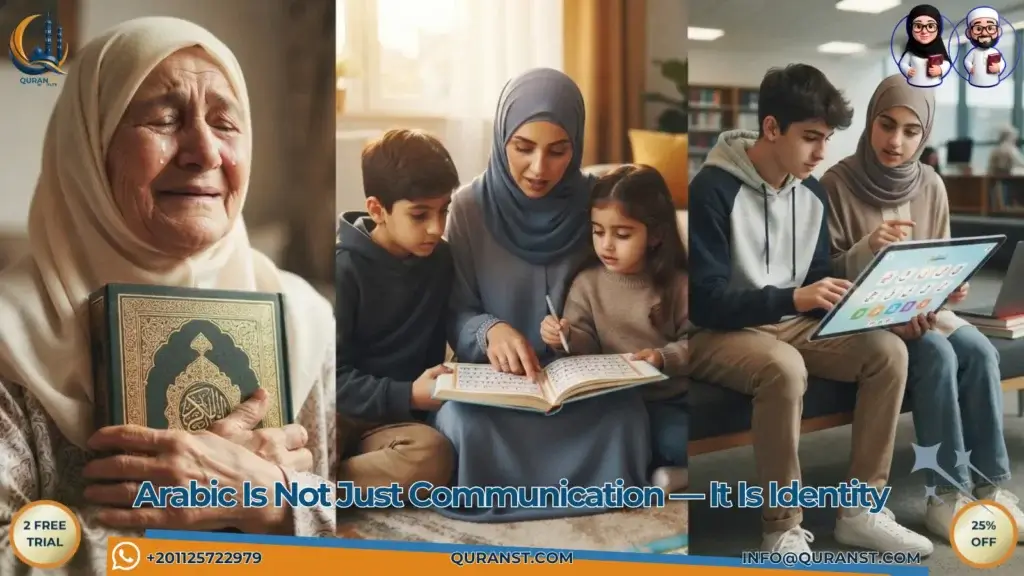
Introduction: The Language That Knows Your Name
There is a conversation that happens in Arabic-heritage Muslim families across America, Britain, Canada, and Australia — and it almost always ends the same way.
A grandmother calls from Egypt, or Jordan, or Morocco, or Somalia. She asks about school, about health, about life. The child picks up the phone and freezes. They recognize her voice. They recognize her love. They can feel the warmth of who she is through the phone.
But they cannot speak to her in her language.
And the grandmother — who has been waiting for this call, who has been praying for this grandchild by name — speaks slowly, repeats herself, tries simpler words. And still the gap grows, sentence by sentence, until the parent intervenes and translates between the two people who love each other most in the world.
This is what Arabic language loss looks like in practice. Not an abstract cultural loss. Not a statistic in a linguistics journal.
It looks like a grandmother and a grandchild, separated by a language that one generation chose not to transmit — and both of them knowing it.
This guide is about understanding why this happens — with precision, with research, and with honesty — and about what Muslim families can do to reverse it. Because the loss of Arabic is not inevitable. It is a consequence of specific, identifiable decisions and circumstances. And it is reversible — through specific, identifiable actions.
Structured Curriculum Framework
quranst’s Arabic Language track helps Muslim families reclaim Arabic at every level — from Arabic for beginners to classical Arabic and Quranic Arabic — through live, one-on-one sessions with native Arabic tutors.
Book your free 2-session trial →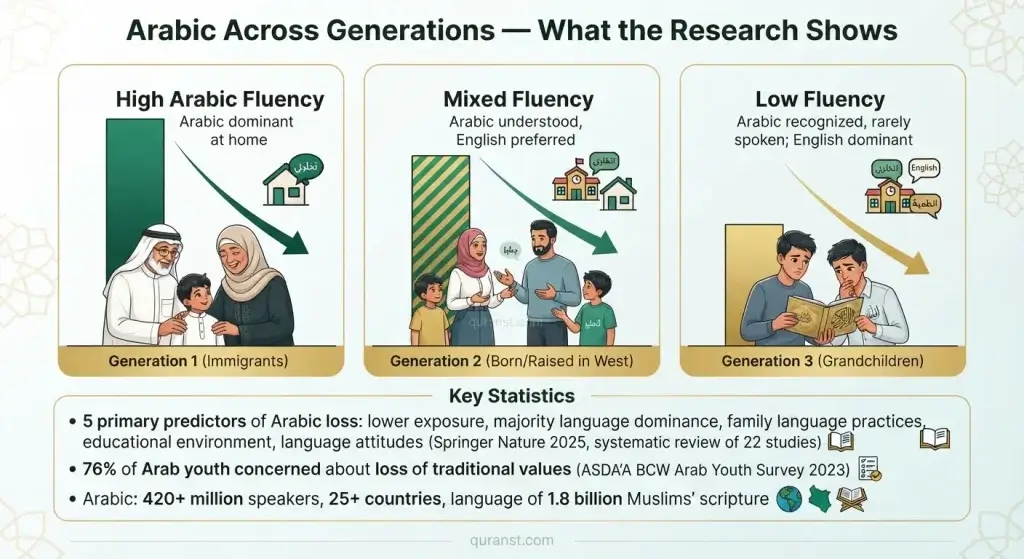
Section 1: The Numbers — How Fast Is Arabic Disappearing Across Generations?
The pattern of Arabic language loss in Western diaspora communities is not anecdotal. It is documented, systematic, and — without intentional intervention — almost inevitable.
A 2025 systematic literature review published in Society (Springer Nature), examining 22 peer-reviewed studies from 2019–2024 on Arabic first language attrition in Arab diaspora populations, identified five primary themes and 24 sub-themes related to Arabic loss: lower levels of exposure to Arabic, predominance of the majority language, language practices in the family, educational environments, and language attitudes.
The pattern follows a well-documented generational arc:
- Generation 1 (the immigrant generation): Arabic is the dominant language of home, thought, emotion, and prayer. English is functional but secondary.
- Generation 2 (raised in the West): Arabic is understood — the language of grandparents, of masjid, of summer visits. English is the language of school, friends, thought, and increasingly of the home.
- Generation 3 (born to Generation 2): Arabic is recognized as the language of their heritage. But they cannot speak it, cannot write it, and — critically — cannot access the Quran in it.
A study published in Cogent Social Sciences (2024) on Arabic in the USA found that Arabic has been more developed in America than in any other foreign country — yet despite strong institutional support at university level, grassroots community transmission remains the weakest link, with each generation showing measurably lower Arabic proficiency than the previous one.
The 15th annual ASDA’A BCW Arab Youth Survey (2023) found that 76 percent of Arab youth expressed concern about the loss of traditional values and culture — the highest percentage in five years. Yet the same survey found that Arabic language preservation ranked lower than religious and cultural identity as a priority — suggesting that young Arabs recognize the cultural threat without necessarily connecting Arabic language specifically as the vehicle of cultural transmission.
This is the core irony of the Arab diaspora’s relationship with Arabic: the generation that has most to lose is often the generation least equipped to understand what exactly is being lost.
Section 2: The Five Causes of Arabic Language Loss in Muslim Families
Understanding why Arabic is lost is the prerequisite for recovering it. The research identifies five primary causes — each of which has a specific, actionable solution:
Cause 1: The Dominance of the Majority Language
The most powerful force in Arabic language loss is the simplest: in English-speaking countries, English is the language of school, friendship, entertainment, professional success, and social belonging. It is the language of reward.
Arabic, by contrast, is often the language of obligation — prayer, Quran recitation, conversations with elderly relatives, and the formal register of Islamic education. When a language is associated primarily with obligation and the other with reward, the developing child’s brain makes a predictable calculation.
The systematic review confirmed that the predominance of the majority language is the single most consistent predictor of Arabic attrition — more powerful than parental attitudes toward Arabic, more powerful than formal Arabic education, and more powerful than cultural identity attachment.
The solution: Make Arabic the language of reward in the home — the language of stories, of celebration, of special time, of the things that matter most. The Arabic that is associated with joy and warmth is the Arabic that children keep.
Cause 2: Family Language Practices — The Decisions Made in Exhaustion
The most consequential Arabic-preservation decisions are made not in planning sessions but in moments of exhaustion. A parent who spoke Arabic to their child at breakfast switches to English at dinner when the day has been long. A grandparent who could have maintained Arabic in their home stays silent because they are afraid of not being understood. A family that intended to maintain Arabic gradually drifts into English because English is always easier in the moment.
Family language practices — the implicit and explicit decisions families make about which language to use in which context — ranked as the third primary predictor of Arabic attrition, behind majority language dominance and lower exposure levels. Families with clear, consistent language policies maintained Arabic significantly better than those with inconsistent practices — even when total exposure hours were similar.
The solution: A clear, explicit family language policy — not for every moment of every day, but for specific contexts that are consistently maintained. The dinner table, the car, the bedtime story, the morning greeting. Specific contexts, consistently Arabic, regardless of convenience.
Cause 3: Educational Environments That Exclude Arabic
Muslim children in Western countries spend 35+ hours per week in educational environments where Arabic has no presence — not as a subject, not as a medium of instruction, not as a socially valued language. The implicit message of a school environment is powerful: the languages taught here are the languages that matter.
Research with Muslim families in the USA found that non-Arab Muslims often feel alienated when their heritage languages are marginalized in religious spaces — and that Arabic proficiency can become a proxy for religious legitimacy in Islamic school environments, creating a painful paradox: the child who cannot speak Arabic may feel excluded in the very religious spaces meant to include them.
The solution: Supplement the school environment with structured Arabic education — online Quran classes, Arabic for beginners programs, and Quranic Arabic courses — that make Arabic a genuinely taught and valued skill, not merely a cultural aspiration.
Cause 4: Language Attitudes — When Arabic Feels Like a Burden
Perhaps the most difficult cause to address: the teenager who actively resists Arabic because they experience it as a marker of otherness — the language that makes them “different” in ways they do not want to be different.
This is not cultural betrayal. It is a developmentally normal response to a genuinely difficult situation: the adolescent who is navigating identity formation in a non-Muslim environment, for whom Arabic carries the weight of standing out, being questioned, being “other.”
The solution: Reframe Arabic from a cultural obligation to a personal superpower. The young Muslim who speaks Arabic fluently, reads classical Arabic texts, and understands the Quran directly — that young person is not burdened by their heritage. They are equipped with an access key to 14 centuries of civilization, to the words of Allah in His own language, and to a global community of 420+ million speakers. That is not a burden. That is an inheritance.
Cause 5: The Diglossia Gap — The Two Arabics That Confuse Everyone
Arabic presents a unique challenge that no other major world language shares to the same degree: diglossia — the existence of two dramatically different forms of the same language, used in entirely different contexts.
Modern Standard Arabic (Fusha) — the formal, written language of the Quran, classical scholarship, news, literature, and official discourse — is nobody’s native spoken language. Nobody grows up speaking it at home.
Colloquial Arabic (Ammiyya) — the dozens of regional dialects (Egyptian, Levantine, Gulf, Moroccan, etc.) — is what people actually speak, but varies so significantly across regions that Moroccan Arabic and Gulf Arabic are nearly mutually incomprehensible.
The Muslim child in the West who tries to “learn Arabic” is often confused about which Arabic they are learning and why — and the confusion itself becomes a barrier.
The solution: Clarity of purpose. For Quranic access, Fusha and classical Arabic are the priority. For speaking Arabic fluently with Arab relatives and communities, the relevant dialect is the priority. For a Muslim family in the West whose primary goal is understanding the Quran and Islamic texts, classical Arabic and Quranic Arabic are the investment that pays the highest returns.
Section 3: The Quranic and Prophetic Case for Arabic
Before strategies for recovery, the motivation for recovery — because Arabic is not merely a heritage language for Muslims. It is the language of their scripture, their prayer, and their theological tradition.
The Divine Choice of Arabic
إِنَّا أَنزَلْنَاهُ قُرْآنًا عَرَبِيًّا لَّعَلَّكُمْ تَعْقِلُونَ
“Indeed, We have sent it down as an Arabic Quran so that you might understand.”
— Quran 12:2
The phrase la’allakum ta’qilun (so that you might understand) is the divine statement of Arabic’s purpose: the Quran is in Arabic so that it can be understood. The language is not incidental — it is the vehicle of comprehension. And comprehension is the divine goal.
بِلِسَانٍ عَرَبِيٍّ مُّبِينٍ
“In a clear Arabic language.”
— Quran 26:195
The clarity (mubin) of the Quran is described as a property of its Arabic. The clarity that Allah promises in His book is accessible fully only through the Arabic in which it was revealed.
The Scholarly Consensus
Ibn Taymiyyah (661–728 AH) wrote in Iqtida’ al-Sirat al-Mustaqim:
“The Arabic language is part of the religion. Knowledge of it is obligatory — because understanding the Quran and the Sunnah is obligatory, and they cannot be understood except through Arabic. What is necessary to fulfill an obligation is itself obligatory.”
— Ibn Taymiyyah, Iqtida’ al-Sirat al-Mustaqim, 1/527
Imam al-Shafi’i, in Al-Risalah, stated that every Muslim is obligated to learn whatever Arabic is necessary for their religious duties — and that the Muslim community as a whole is obligated to preserve and transmit the Arabic language across generations.
What Is Lost Without Arabic
A Muslim who does not speak Arabic:
- Recites Al-Fatiha seventeen times daily without knowing what they are saying
- Memorizes the Tashahhud without understanding the shahada and blessings it contains
- Hears the imam’s Jumu’ah khutbah as sounds rather than meaning
- Cannot access fourteen centuries of Islamic scholarship in its original form
- Reads the Quran through the filter of a translator’s interpretation rather than Allah’s own words
This is not a minor inconvenience. It is the difference between performing Islam and understanding it — and the Muslim tradition has always held that understanding is the prerequisite for genuine conviction.
Section 4: Arabic Is Not Just Communication — It Is Identity
The loss of Arabic in Muslim families is not primarily a linguistic loss. It is an identity loss — and the research confirms this with striking clarity.
Language and Islamic Identity Are Inseparable
Research demonstrates that for Muslim children, Arabic proficiency is not merely a linguistic skill but a marker of religious identity and community belonging. The child who speaks Arabic is recognized as “authentically Muslim” in community spaces in ways that the non-Arabic-speaking Muslim is not — creating painful hierarchies of religious legitimacy that the research describes as “Arabic proficiency as a proxy for religious legitimacy.”
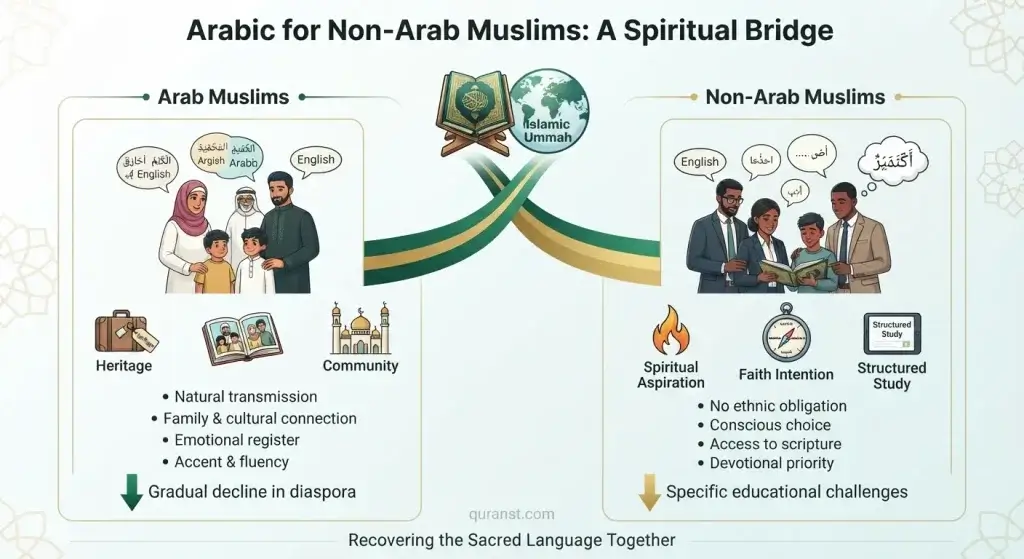
This dynamic cuts in both directions. For Arab Muslims, the loss of Arabic is the loss of authentic connection to their cultural and religious community. For non-Arab Muslims — Pakistanis, Indonesians, Somalis, Turks, and the many other Muslim communities for whom Arabic is not a heritage language — the inability to access Quranic Arabic represents a different but equally real loss: the inability to access the scripture of their faith in its original form.
The Identity Architecture of Language
Psycholinguistic research consistently demonstrates that heritage languages carry more than communication — they carry:
- Emotional register: The feelings, relationships, and memories encoded in the first language are not fully translatable. The grandmother’s love is not the same in English as it is in Arabic. The Quranic consolation is not the same in translation as it is in the original.
- Cultural memory: Languages carry the accumulated wisdom, humor, poetry, and worldview of a civilization. Arabic carries 14 centuries of Islamic intellectual tradition in its very structure — in its root system, its verb patterns, its grammatical architecture.
- Religious access: For Muslims, Arabic is not a heritage language in the ordinary sense. It is the language of every prayer, every Quranic verse, every hadith, every classical text. The Muslim who loses Arabic loses access to all of these in their original form.
Section 5: The Unique Loss of Non-Arab Muslim Families
It would be a significant oversight to discuss Arabic identity loss only in terms of Arab diaspora communities. The reality is that the majority of the world’s Muslims — and a substantial proportion of Muslim families in the West — are not ethnically Arab.
Pakistani, Bengali, Turkish, Somali, Indonesian, Bosnian, and West African Muslim families share a common challenge: Arabic is not their heritage language in the ethnic sense, but it is their sacred language. And for their children growing up in the West, the distance from Arabic can be even greater — there is no grandmother to call in Arabic, no cultural homeland where Arabic is spoken, no ethnic community to maintain Arabic through sheer social pressure.
Why This Makes Arabic More Important, Not Less
The non-Arab Muslim child who learns Arabic has accomplished something extraordinary: they have chosen, deliberately and without ethnic obligation, to access the scripture of their faith in its original language. This is not cultural inheritance — it is spiritual aspiration. And the community and personal resources required to make it happen are specific:
- An online Arabic tutor who specializes in teaching Arabic to non-native speakers
- A structured Arabic for beginners curriculum that starts from the alphabet rather than assuming phonetic familiarity
- Quranic Arabic courses that connect every grammar lesson to the Quran they already recite
- Classical Arabic grammar that opens the door to the texts of Islamic scholars across fourteen centuries
This is precisely the gap that quranst was built to fill — structured, live, one-on-one Arabic instruction for Muslim families regardless of their ethnic background, starting from wherever they are and building toward the Quran and the Islamic tradition.
Section 6: The Reclamation Roadmap — How to Bring Arabic Back
Arabic language recovery is not a mystical process. It is a practical one — requiring specific decisions, specific resources, and specific consistency. Here is a complete roadmap:
Step 1: Diagnose the Current Situation Honestly
Before building a plan, know exactly where your family stands:
- Can your child understand spoken Arabic? Which dialect? How much?
- Can they read Arabic script? At what level of fluency?
- Can they speak Arabic? In what contexts? With what confidence?
- Can they access the Quran in Arabic with comprehension? Which portions?
- What is their attitude toward Arabic — curious, neutral, or resistant?
The answers to these questions determine where to start — and the family that starts at the right level progresses dramatically faster than the one that starts too high (and produces frustration) or too low (and produces boredom).
Step 2: Choose Your Arabic Goal — And Be Specific
Arabic recovery programs fail most often not from lack of effort but from lack of clarity. “I want my child to know Arabic” is not a goal. It is a wish.
Specific goals that produce specific plans:
- Goal A: My child can understand Al-Fatiha and the Tashahhud completely → Quranic Arabic vocabulary, 200 core words
- Goal B: My child can speak basic conversational Arabic with grandparents → Dialect-specific spoken Arabic, 500 core expressions
- Goal C: My child can read and understand Quran directly → Classical Arabic grammar + 1,750 Quranic root words
- Goal D: My child can access classical Islamic scholarship in Arabic → Full classical Arabic grammar + vocabulary of the scholarly tradition
Each goal has a different curriculum, a different timeline, and different daily practice requirements. Clarity on the goal makes the path visible.
Step 3: Establish the Arabic Home Environment
Before structured study begins, build the environment that makes Arabic normal rather than exotic:
Audio immersion: Arabic audio in the car, at mealtimes, during background time. Quranic recitation by great reciters — not as background noise, but as intentional exposure. Arabic nasheeds. Arabic podcasts for the relevant age group.
Visual immersion: Arabic labeling of household objects. Arabic-English dual language books. Arabic script on visible surfaces — a beautiful piece of Quranic calligraphy, the 99 names of Allah on a wall, the children’s names in Arabic.
Social immersion: Arabic-speaking relatives — even via video call — as regular, valued presences in the child’s relational world. Arabic-speaking friends and community members. The masjid as an Arabic-rich environment.
Step 4: Structured Instruction with a Qualified Teacher
Environment alone is insufficient for language recovery. Speaking Arabic fluently requires active production — the child must speak, not only listen. And speaking requires a responsive native speaker who can answer questions, provide real-time correction, and adapt to the individual learner’s pace and challenges.
The classical Islamic tradition of transmission (isnad) was never self-directed. Knowledge — including Arabic — was transmitted person to person, teacher to student, with the quality of that relationship determining the quality of what was transmitted.
Online Arabic learning through a qualified, live instructor — an online Arabic tutor who specializes in heritage learners, diaspora families, and Muslim children — is the most reliable bridge between the Arabic environment built at home and the fluency that makes Arabic a living language rather than a studied subject.
Step 5: Connect Arabic to the Quran From Day One
The Muslim family’s greatest advantage in Arabic language recovery is the Quran itself. Unlike other heritage language learners, Muslim children already have a relationship — however phonetic — with Arabic text. They recite Al-Fatiha. They know certain surahs. They say Bismillah and Alhamdulillah and Subhanallah every day.
These are not starting from zero. They are starting from a foundation.
Every Arabic lesson should connect to Quranic vocabulary from the beginning. Not “here is the word for ‘book'” but “here is the word kitab — and it appears in the Quran 261 times, including in the very verse that describes the Quran itself: dhalika al-kitabu la rayba fih.”
When Arabic learning is Quran-anchored from the start, motivation stays high — because every lesson is directly connected to the student’s deepest purpose.
Step 6: Make Progress Visible and Celebrate It Specifically
Heritage language recovery is a multi-year project. Without visible milestones and specific celebration, families lose momentum before the compounding benefits of intermediate fluency begin to appear.
Build specific, visible milestones:
- Month 3: Can read the Arabic alphabet without reference
- Month 6: Knows 100 Quranic vocabulary words and can identify them in recitation
- Year 1: Can follow the meaning of Al-Fatiha and the short surahs in prayer
- Year 2: Can understand 30-40% of Jumu’ah khutbah without translation
- Year 3: Can read basic Quranic text with a dictionary and understand the general meaning
- Year 5: Can engage with classical Islamic commentary with teacher support
Each milestone reached is a door opened. Celebrate each one — not with generic praise but with specific acknowledgment: “You can now read Al-Fatiha and understand what every word means. You are praying with comprehension for the first time. That is extraordinary.”
Section 7: Classical Arabic vs Modern Arabic — Which Does Your Family Need?
This is the most common practical question in Arabic education for Muslim families — and the answer depends entirely on purpose:
| Goal | Arabic Type | Why |
|---|---|---|
| Understand the Quran directly | Classical Arabic + Quranic vocabulary | The Quran is written in classical Arabic — no modern translation of Arabic approaches it |
| Pray with comprehension | Quranic Arabic vocabulary | Al-Fatiha, Tashahhud, prayer phrases are classical Arabic |
| Access Islamic scholarship | Classical Arabic grammar (Fusha) | All classical Islamic texts are in Fusha |
| Communicate with Arab relatives | Relevant dialect (Egyptian / Levantine / Gulf etc.) | Dialects vary significantly — match to the family’s regional heritage |
| General communication across Arab world | Modern Standard Arabic (MSA) | Understood by educated Arabs across all regions |
| Speak Arabic fluently in daily life | MSA + relevant dialect | MSA for formal contexts, dialect for daily communication |
The quranst recommendation for Muslim families in the West: Begin with Quranic Arabic — classical Arabic grammar anchored in Quranic vocabulary. This serves Islamic studies, Quran comprehension, and prayer simultaneously. Add conversational practice in the relevant dialect for family communication. MSA develops naturally from classical Arabic as a foundation.
Section 8: The Role of Online Arabic Education in Heritage Recovery
For Muslim families living in English-dominant countries, the Arabic-language environment available in the home and community is rarely sufficient for genuine fluency development. The local masjid’s Arabic classes are often overcrowded and inconsistent. Weekend Islamic school Arabic programs are typically too limited in hours for meaningful progress. Private Arabic tutors vary widely in qualification and teaching methodology.
Online Arabic education — when designed correctly — solves all three problems simultaneously:
Access to qualified teachers: An online Arabic tutor platform serving Muslim families globally can recruit and certify instructors from the Arabic-speaking world — ensuring that every student has access to a native speaker with proper pedagogical training, regardless of where in the world the student lives.
One-on-one instruction: Unlike classroom settings where thirty students share one teacher’s attention, live online Arabic instruction is genuinely individual — the teacher knows this student’s specific challenges, their current vocabulary, their pronunciation errors, their pace of progress.
Consistency and flexibility: The greatest enemy of language learning in busy Western families is schedule inconsistency. Online sessions can be scheduled around the family’s existing commitments — evenings, weekends, school holidays — without the friction of commuting or fixed classroom timetables.
Quranic integration: The best online Arabic programs for Muslim families are not generic language programs. They are specifically designed to connect Arabic grammar and vocabulary to the Quran — ensuring that every lesson serves the family’s Islamic education goals simultaneously.
Structured Curriculum Framework
quranst’s Arabic Language track provides live, one-on-one sessions with native Arabic tutors — teaching classical Arabic, Quranic Arabic, and Arabic for beginners — designed specifically for Muslim families recovering heritage Arabic in the West.
Book your free 2-session trial →Conclusion: The Language Is Waiting
Somewhere in the gap between your grandparents and your children, something extraordinary slipped through.
Not through malice. Not through indifference. Through the ordinary, exhausting, well-intentioned business of building a life in a new country — where every hour spent on Arabic was an hour not spent on English homework, where every Arabic conversation required the extra effort that the dominant language never did, where each generation made the small, rational choices that accumulated into a large, irreversible loss.
But it is not irreversible.
Arabic has been more developed in America than in any other foreign country — with grassroots communities, educational institutions, and religious organizations all playing active roles in Arabic preservation. The prospects for Arabic in the USA, the research concludes, depend primarily on community commitment and intergenerational transmission rather than on institutional support alone.
The language is waiting. In the Quran that your child recites without understanding. In the prayers they perform seventeen times a day in words they do not know. In the classical texts of Ibn Khaldun and Ibn Taymiyyah and al-Ghazali and Ibn al-Qayyim — the intellectual heritage of a civilization that produced the world’s greatest thinkers while Europe was in its Dark Ages.
It is all in Arabic. All of it. Waiting for the generation that chooses to come back for it.
The grandmother waiting for a phone call in her own language is also waiting. The Quran — understood, not just recited — is waiting. The fourteen centuries of Islamic scholarship that cannot be fully translated are waiting.
And the children — who do not yet know what they are missing — are waiting too. Waiting to discover that the language their parents were too busy to teach them is the language of their deepest identity. The language Allah chose to speak His final message in. The language of the Prophet ﷺ. The language of Paradise.
You can still give them this.
It is not too late.
إِنَّا أَنزَلْنَاهُ قُرْآنًا عَرَبِيًّا لَّعَلَّكُمْ تَعْقِلُونَ
“Indeed, We have sent it down as an Arabic Quran so that you might understand.”
— Quran 12:2
🟢 Begin the Arabic Recovery
The Arabic your family has lost was not lost in a day. It was lost across years of small decisions made in exhaustion, in busyness, in the perfectly understandable prioritization of the language that seemed most urgent.
The recovery can begin today. In a single decision. With a single enrollment.
quranst’s Arabic Language track provides:
For absolute beginners (Arabic for beginners):
- Arabic alphabet with correct phonetics — the foundation everything else rests on
- 200 core Quranic vocabulary words — the words that appear most frequently in the Quran
- Basic Arabic grammar — enough to begin reading Quranic sentences with comprehension
For intermediate learners:
- Classical Arabic grammar (Nahw and Sarf) — the complete system that unlocks Quran and Islamic texts
- Quranic Arabic depth — understanding grammar structures as they appear in specific Quranic verses
- Arabic conversation practice — Speak Arabic fluently with an online Arabic tutor in live sessions
For heritage speakers rebuilding:
- Fluency restoration through structured conversation with native speakers
- Classical Arabic refinement — moving from colloquial to Fusha competence
- Advanced Quranic Arabic — reading classical Tafsir with comprehension
For families recovering together:
- Parent and child parallel tracks — so the family learns together
- Smart Parenting coaching alongside Arabic education — so the home becomes an Arabic-supporting environment
👇 Begin the Recovery — Two Free Sessions
Two Ways to Begin
“The Arabic language is part of the religion. Knowledge of it is obligatory — because understanding the Quran and the Sunnah is obligatory, and they cannot be understood except through Arabic.”
— Ibn Taymiyyah, Iqtida’ al-Sirat al-Mustaqim, 1/527
Reclaim what was always yours.
بِسْمِ اللَّهِ — Begin.
References and Sources
Quranic References
- Quran 12:2 — “We have sent it down as an Arabic Quran so that you might understand”
- Quran 26:195 — “In a clear Arabic language”
Classical Scholarly Works
- Ibn Taymiyyah, Ahmad ibn Abd al-Halim: Iqtida’ al-Sirat al-Mustaqim. Maktabat al-Rushd, Riyadh. Vol. 1: p. 527 (Arabic as part of the religion — obligatory knowledge)
- Al-Shafi’i, Muhammad ibn Idris: Al-Risalah. Ed. Ahmad Muhammad Shakir. (Obligation of learning Arabic for religious duties)
Peer-Reviewed Academic Sources
- Springer Nature / Society (2025). “Predictors of First Language Attrition Among Arab Heritage Speakers: A Systematic Literature Review.” Systematic review of 22 peer-reviewed studies (2019–2024) from Scopus and Web of Science databases. Key findings: 5 primary predictors of Arabic attrition — lower exposure, majority language dominance, family language practices, educational environments, language attitudes.
- Cogent Social Sciences / Taylor & Francis (2024). “Arabic in the USA and the genealogy of Arab-Americans: from migration to integration.” Published March 2024. Key findings: Arabic more developed in America than any other foreign country; prospects depend on community commitment and intergenerational transmission.
- ScienceDirect (2026). “The languages of faith and belonging: sociolinguistic repertoires of two American Muslim girls of West African descent.” Published May 2026. Key findings: Arabic proficiency as proxy for religious legitimacy; non-Arab Muslims experiencing linguistic exclusion in religious spaces.
- ASDA’A BCW Arab Youth Survey (2023). “15th Annual Arab Youth Survey.” Key findings: 76% of Arab youth concerned about loss of traditional values — highest in 5 years; Arabic language ranked lower than religious identity as preservation priority despite acknowledged threat.
Contemporary Arabic Education Sources
- Bohnacker, Ute, and Rima Haddad (2025). “Arabic as a home language in Sweden: family language practices and beliefs.” Frontiers in Psychology. DOI: 10.3389/fpsyg.2025.1719805. (Family language policy as primary predictor of Arabic maintenance)
- ScienceDirect (2025). “The impact of English as a medium of instruction on Arabic language preservation and cultural identity: Parents’ perspectives and strategies.” DOI: 10.1016/S2215-0390(25)00024-4.
Frequently Asked Questions
Why are new generations losing the Arabic language in the West?
Is learning Classical Arabic (Fusha) better than learning a dialect?
How can non-Arab Muslim families teach Arabic to their children?
What are the practical steps to bring Arabic back into the home?
- Diagnosing your family’s current language level honestly.
- Setting specific, measurable goals (e.g., understanding Quranic vocabulary or basic conversation).
- Establishing consistent home exposure (audio, storytelling, and visual cues).
- Partnering with professional online tutors for live conversational and grammar practice.
- Celebrating every milestone visibly to keep motivation high.
