


Introduction: “Whose Eid Is the Real Eid?”
It is the last evening of Ramadan.
Your eleven-year-old is on the couch with his phone, watching the family group chat scroll faster than he can read. His uncle’s family will celebrate Eid tomorrow. Yours will wait one more day. A cousin writes, “You’re all fasting on Eid. That’s haram.”
An aunt answers with three paragraphs. Someone sends an angry emoji. Someone leaves the group.
He looks up. “Dad, whose Eid is the real Eid?”
It is a good question, and a risky one, because what he does with it in the next five minutes shapes how he handles disagreement for decades.
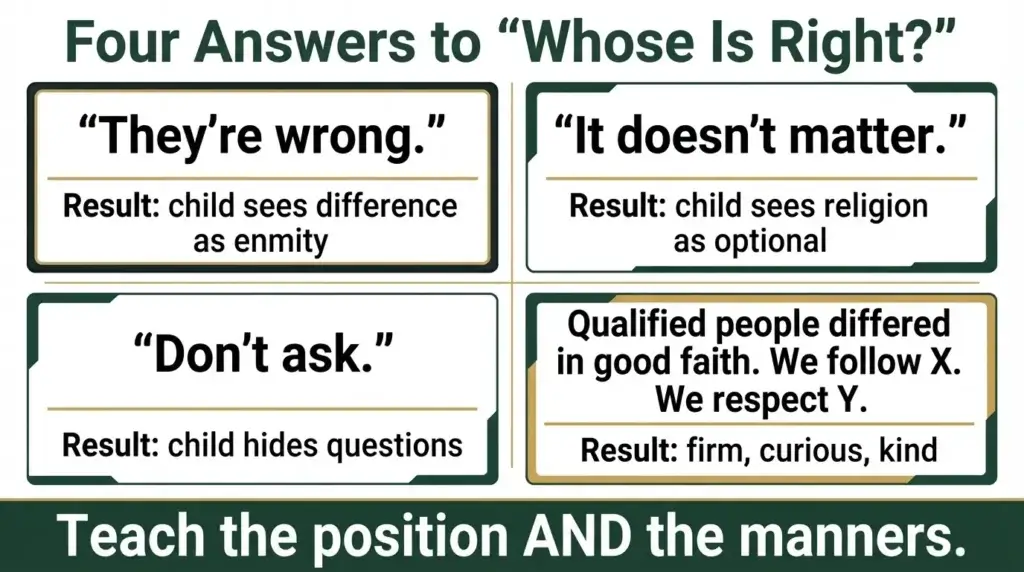
If you say, “They’re wrong and we’re right,” he learns that disagreement means enemies. If you say, “It doesn’t matter,” he learns that nothing in the religion is firm. If you say, “Don’t ask,” he learns that curiosity is dangerous.
There is a fourth answer, the oldest in our tradition: “Qualified people looked at the same sources and reached different conclusions in good faith. We follow the position our family follows, we respect those who follow the other, and we never let it cost us a relationship.”
That sentence is the whole subject of this guide: adab al-ikhtilaf, the etiquette of disagreement. Today’s Muslim child will meet more disagreement than any generation before: different practices at the masjid, different customs among cousins, different opinions in every corner of social media. A child without adab becomes combative or confused. A child with adab becomes firm in faith and gentle in manner.
designed for Muslim families in the West
quranst’s Islamic Studies and Smart Parenting tracks introduce Fiqh, Hadith, and Aqeedah in age-appropriate ways, so children learn what Muslims believe and how Muslims have handled differences.
Book your free 2-session trial →The Islamic Foundation
Diversity is part of creation
يَا أَيُّهَا النَّاسُ إِنَّا خَلَقْنَاكُم مِّن ذَكَرٍ وَأُنثَىٰ وَجَعَلْنَاكُمْ شُعُوبًا وَقَبَائِلَ لِتَعَارَفُوا ۚ إِنَّ أَكْرَمَكُمْ عِندَ اللَّهِ أَتْقَاكُمْ
“O mankind, indeed We have created you from male and female and made you peoples and tribes that you may know one another. Indeed, the most noble of you in the sight of Allah is the most righteous of you.” (Quran 49:13)
Variety of language, color, and custom is part of the design, and the measure of worth is taqwa, not tribe or accent.
The language of disagreement is commanded
وَقُل لِّعِبَادِي يَقُولُوا الَّتِي هِيَ أَحْسَنُ ۚ إِنَّ الشَّيْطَانَ يَنزَغُ بَيْنَهُمْ
“And tell My servants to say that which is best. Indeed, Satan induces [dissension] among them.” (Quran 17:53)
يَا أَيُّهَا الَّذِينَ آمَنُوا لَا يَسْخَرْ قَوْمٌ مِّن قَوْمٍ عَسَىٰ أَن يَكُونُوا خَيْرًا مِّنْهُمْ
“O you who have believed, let not a people ridicule [another] people; perhaps they may be better than them.” (Quran 49:11)
The reference point
يَا أَيُّهَا الَّذِينَ آمَنُوا أَطِيعُوا اللَّهَ وَأَطِيعُوا الرَّسُولَ وَأُولِي الْأَمْرِ مِنكُمْ ۖ فَإِن تَنَازَعْتُمْ فِي شَيْءٍ فَرُدُّوهُ إِلَى اللَّهِ وَالرَّسُولِ
“O you who have believed, obey Allah and obey the Messenger and those in authority among you. And if you disagree over anything, refer it to Allah and the Messenger.” (Quran 4:59)
Disagreement is expected, and the believer’s response is to return to the sources, with humility, through those qualified to interpret them.
Speech that wins hearts
ادْفَعْ بِالَّتِي هِيَ أَحْسَنُ فَإِذَا الَّذِي بَيْنَكَ وَبَيْنَهُ عَدَاوَةٌ كَأَنَّهُ وَلِيٌّ حَمِيمٌ
“Repel [evil] by that [deed] which is better; and thereupon the one whom between you and him is enmity [will become] as though he was a devoted friend.” (Quran 41:34)
فَبِمَا رَحْمَةٍ مِّنَ اللَّهِ لِنتَ لَهُمْ ۖ وَلَوْ كُنتَ فَظًّا غَلِيظَ الْقَلْبِ لَانفَضُّوا مِنْ حَوْلِكَ
“So by mercy from Allah, [O Muhammad], you were lenient with them. And if you had been rude [in speech] and harsh in heart, they would have disbanded from about you.” (Quran 3:159)
Section 1: The Map of Differences
The first mistake parents make is treating all differences as the same. A child who cannot tell “a different opinion” from “a different religion” will panic at every disagreement or shrug at all of them. Here is a teaching map. It is an aid for children, not a substitute for a qualified scholar’s judgment on any specific question.
| Category | Plain description | Child-level example | Stance |
|---|---|---|---|
| 1. Essentials of faith and practice | Clearly established and agreed upon | Allah is One; Muhammad ﷺ is His final Messenger; the Quran is Allah’s word; the five daily prayers | Firm |
| 2. Variety the Prophet ﷺ himself approved | Different valid forms | Different authentic modes of reciting the Quran | Welcome |
| 3. Questions where qualified scholars differ | The evidence allows more than one reasoned conclusion (ijtihad) | Some details of prayer; how a month’s start is determined | Respect: follow your family’s scholarly reference, honor the others |
| 4. Cultural customs | Habits of food, dress, language, celebration from a place | Cousins from different countries celebrate differently | Enjoy |
| 5. Personal style | Individual taste | Which masjid; early or late | Allow |
| 6. Matters that contradict the sources | Clear departures from established teaching | Parent-level conversation with a scholar | Advise gently, refer to the knowledgeable; not a child’s role to police |
Four words to teach
- Ikhtilaf: a legitimate difference among qualified people, or a valid variety of practice.
- Ijtihad: a qualified scholar’s disciplined effort to derive a ruling from the sources.
- Tafarruq: division and hostility, which the Quran warns against.
- Adab: manners, the beautiful way of doing things.
Ikhtilaf is not tafarruq. The sin is never in the difference. It is in the contempt.
Section 2: What the Research Shows
Most research on prejudice concerns attitudes toward other social groups, not disagreement within one faith. We use it as parallel evidence about how children learn respect, and we say so where it applies by analogy.
The Muslim community is diverse, and not always at ease with it
- Pew’s 2017 survey of U.S. Muslims (as reported by Religion News Service) found respondents from at least 75 nations; 55% identified as Sunni, 16% as Shiite, 4% with other groups, and 14% did not specify a tradition. No single racial or ethnic group was dominant. In the same survey, 64% said there is more than one true way to interpret Islam.
- ISPU’s 2017 poll found Muslims were the only faith community surveyed with no majority race (25% black, 24% white, 18% Asian, 18% Arab, 7% mixed race, 5% Hispanic). It also found that 33% of black Muslims, 26% of Arab Muslims, and 31% of Asian Muslims reported race-based discrimination in the last year from other Muslims. ISPU noted that intra-community racism is not unique to Muslims.
- ISPU’s 2025 poll again found no racial or ethnic group above 30%.
Your child will meet difference inside the community before they meet it anywhere else, and, as the ISPU numbers show, difference handled badly hurts.
Young Muslims can feel judged from within
Dr. Omar Suleiman’s Yaqeen Institute paper, based on interviews with 30 young American Muslims, quotes a 17-year-old describing how she wears hijab to signal different things to different audiences, including to “the aunties in the masjid” that she is still a good Muslim, and a 16-year-old who said she felt she was never Muslim enough. Harsh atmospheres in Muslim spaces can push children away from the faith they claim to defend. Adab is not decoration. It protects the child’s relationship with the religion.
How children learn respect
- Contact: Pettigrew and Tropp’s 2006 meta-analysis (713 samples from 515 studies) found that intergroup contact typically reduces prejudice. Their 2008 follow-up identified reduced anxiety and increased empathy and perspective-taking among the main mediators.
- Training: A 2014 meta-analysis of child and adolescent programs (Beelmann and Heinemann; 81 reports, 122 comparisons) found direct-contact and empathy or perspective-taking approaches had the strongest effects.
- Parents: Research summarized in a Leiden University review (citing Degner and Dalege, 2013) reports a medium association between parents’ and children’s intergroup prejudice.
For parents: children do not become respectful by being told to be. They become respectful when meeting difference is calm and friendly, when they practice imagining why someone sees things otherwise, and when they hear respectful language at home.
designed for Muslim families in the West
Children who understand why scholars differ are far less shaken by disagreement. quranst’s live, one-on-one Fiqh and Hadith sessions teach this background in simple language.
Book your free 2-session trial →Section 3: The Prophetic Models
Children remember stories. These four are in the authentic collections.
Story 1: Two ways of reciting
Umar heard Hisham ibn Hakim reciting Surat al-Furqan in a way he had not been taught. He nearly confronted him in the prayer, waited until Hisham finished, then seized him by his garment and brought him to the Prophet ﷺ. The Prophet ﷺ asked Hisham to recite and said, “It was revealed like this.” He asked Umar to recite and said the same, then added that the Quran was revealed in seven modes, so recite what is easy (Sahih al-Bukhari 2419; also 4992; Jami at-Tirmidhi 2943, graded hasan sahih).
Lesson: Umar, among the strongest of the Companions, first reacted with alarm to a difference that was part of revelation itself. Ask first. Understand. Then respond.
Story 2: The prayer on the road
On returning from al-Ahzab, the Prophet ﷺ told his Companions that none should pray ‘Asr except at Banu Qurayzah (in Bukhari’s wording; some narrations in Sahih Muslim 1770 give Dhuhr). The time of prayer came while they were on the road. Some said, “We will not pray until we get there.” Others said, “We will pray now; he did not mean this.” When it was mentioned to the Prophet ﷺ, he did not rebuke any of them (Sahih al-Bukhari 946 and 4119).
Lesson: sincere, well-reasoned people can understand one instruction two ways, and a wise leader does not condemn those acting in good faith.
Story 3: Fasting on the journey
Anas reported that the Companions traveled with the Prophet ﷺ, and “neither did the fasting persons criticize those who were not fasting, nor did those who were not fasting criticize the fasting ones” (Sahih al-Bukhari 1947; Sahih Muslim 1118; see also Muslim 1117).
Lesson: two valid practices, side by side, without criticism. This is the model for the Eid-date conversation.
Story 4: Two rewards, one reward
The Prophet ﷺ said that when a judge rules, striving to be correct, and is right, he has two rewards, and if he strives and errs, he has one (Sahih al-Bukhari 7352; Sahih Muslim 1716; Bulugh al-Maram 1400). The hadith speaks of a judge; commentators on it extend the principle to the qualified mujtahid, who is rewarded for sincere effort even when mistaken.
Lesson: a scholar who differs with us is not our enemy. Our job is to respect the effort and ask a qualified teacher when we need clarity.
On quarrels
The Prophet ﷺ said: “I guarantee a house on the outskirts of Paradise for one who gives up arguing even if he is in the right” (Sunan Abi Dawud 4800, graded hasan by al-Albani). The word is mira’, stubborn, contentious argument. It is not a ban on seeking or explaining the truth with wisdom. It is a warning against arguing to win.
Section 4: The ADAB Toolkit
A child cannot hold a ten-point manual. They can hold a four-letter word.
A: Ask first. “Before I judge, I ask.” Why do you do it that way? Where did your family learn it? Remember Umar: his first instinct was to grab Hisham’s garment, and the Prophet’s response was to listen to both.
D: Distinguish. “Is this an essential, an open question, or a custom?” Use the map in Section 1. A child who distinguishes neither panics at every difference nor shrugs at all of them.
A: Assume the best. “Maybe he has a reason I don’t know yet.”
يَا أَيُّهَا الَّذِينَ آمَنُوا اجْتَنِبُوا كَثِيرًا مِّنَ الظَّنِّ إِنَّ بَعْضَ الظَّنِّ إِثْمٌ
“O you who have believed, avoid much [negative] assumption. Indeed, some assumption is sin.” (Quran 49:12)
B: Be beautiful in speech. “If I disagree, I say it gently, privately when possible, never to humiliate.” The Prophet ﷺ said: “The Muslim is the one from whose tongue and hand the Muslims are safe” (Sahih al-Bukhari 10; Sahih Muslim 40).
Write A-D-A-B on a card on the fridge. When siblings, cousins, or the group chat disagree, ask: “Which letter are you using?”
Section 5: Scripts for Family Moments
| Moment | A calm script |
|---|---|
| Eid or Ramadan start differs between families | “Our masjid follows X. Other qualified scholars follow Y. Both sincerely seek Allah’s pleasure. We wish them Eid Mubarak when their Eid comes.” |
| A friend prays with hands in a different position | “I noticed you pray a bit differently. Where did you learn it?” (Ask; don’t correct.) |
| A cousin says “that’s haram” about your family’s practice | “Our family follows a scholar on this. We can ask our imam together.” |
| A classmate is Muslim but doesn’t pray or wear hijab | “Allah knows each person’s heart and journey. I can be a good friend.” |
| A cousin’s culture celebrates differently | “That’s a custom from their country. What’s the same is our faith.” |
| A non-Muslim friend believes differently | “I respect you. I believe differently, and here’s what I believe. To you your religion, to me mine.” (Quran 109:6) |
| An online comment attacks your family’s practice | “Pause. Don’t answer in anger. Screenshot and show a parent.” |
The dinner-table game: “Two Rewards”
Once a week, five minutes. Read Story 2 or Story 3 from Section 3. Ask: What did Group One think? Group Two? Why might both have had good reasons? Then ask your child for a time they and a friend had two different ideas, both with reasons. End with: “May Allah reward everyone who tries sincerely.” This is perspective-taking, the skill Section 2 identifies as central.
Section 6: “Why We Do It This Way”
Children need a home position. They cannot grow up with “it’s all just opinions.” They also must not grow up with “everyone else is wrong.”
The three-part formula
- Name your family’s reference. “In our family we follow the guidance of [scholar or school] on this.”
- Teach the reason in simple words. “They looked at the hadith about this and understood it this way.”
- Honor the other position. “Other scholars looked at the same sources and understood differently. We respect them and those who follow them.”
Children who know why their family does something are harder to shake. Children who know respected scholars differ will not be destabilized by a friend who prays differently. Children who hear honorable language about others do not need to attack another’s practice to defend their own.
Avoid: “That’s how they do it, and it’s wrong.” “We’re the real Muslims.” “It doesn’t matter, nothing is really right or wrong.”
Say instead: “We follow this because… Others follow that because… Both are sincere. If you want to learn more, we can ask a teacher.”
When the question is beyond you, say: “Great question. I don’t know. Let’s ask someone who does.” That sentence, repeated, teaches humility and respect for knowledge.
Section 7: Where Tolerance Ends
Respect for people is not agreement with every idea. Two opposite errors need naming.
Relativism: “Everything is equally true.” The child ends up polite to everyone and anchored to nothing.
Policing: “Anyone who differs from us is outside the fold.” The child ends up harsh and suspicious. The Prophet ﷺ gave a stern warning: “If a man says to his brother, ‘O disbeliever,’ it returns to one of them” (Sahih al-Bukhari 6103 and 6104; Sahih Muslim 60). Whether someone’s beliefs or actions place them outside the faith is a grave matter for qualified scholars, not for children, teens, or commenters.
The healthy middle:
- Firm on the essentials. Teach the Aqeedah clearly, with reasons. Children need certainty here.
- Respectful of people. We hold our faith with conviction and do not coerce others. We can say, “To you your religion, and to me mine” (Quran 109:6).
- Courteous to people of other faiths. Quran 60:8, quoted above, encourages righteousness and justice toward those who are peaceful.
- Humble about disputed questions. Know what you know, say what you don’t, and refer questions to scholars.
The Prophet ﷺ said: “None of you will have faith till he wishes for his brother what he likes for himself” (Sahih al-Bukhari 13; Sahih Muslim 45). Ask your child: “Would I want to be spoken to this way if I were the one doing it differently?”
Section 8: The Digital Arena
Today’s Muslim teen meets disagreement mostly on a screen: complex questions in thirty seconds, comment sections that reward the sharpest line, and algorithms that serve ten more of whatever you watched.
يَا أَيُّهَا الَّذِينَ آمَنُوا إِن جَاءَكُمْ فَاسِقٌ بِنَبَإٍ فَتَبَيَّنُوا
“O you who have believed, if there comes to you a disobedient one with information, investigate.” (Quran 49:6)
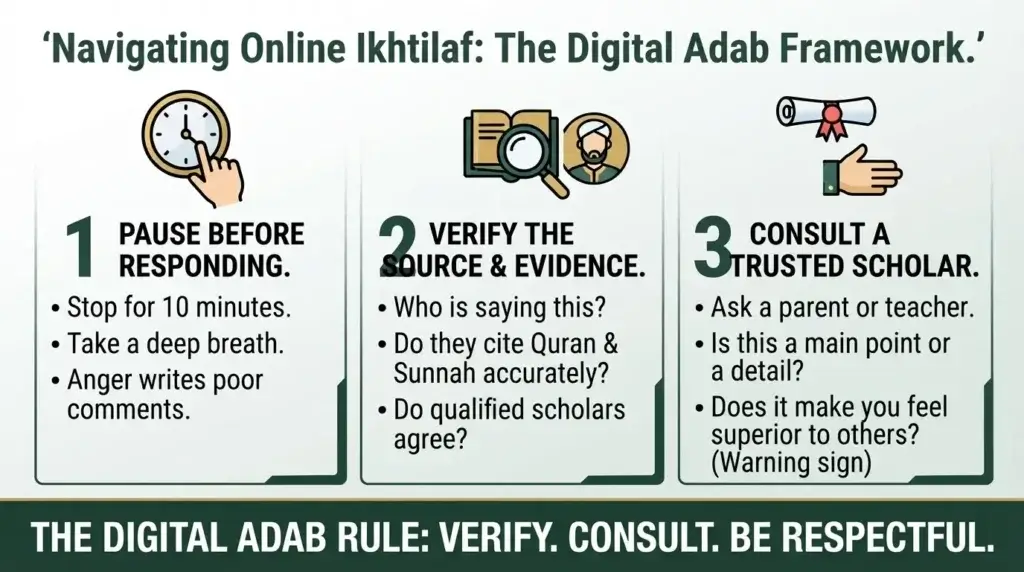
The teen’s three-step check before reacting or reposting:
- Pause. Ten minutes before replying. Anger writes poor comments.
- Source. Who is saying this, with what training and what evidence? Do they cite the Quran and Hadith accurately, and do qualified scholars agree?
- Scholar. Take it to a parent or teacher. If a video makes you want to look down on other Muslims, treat that feeling as a warning.
Online adab rules (print and post): we do not mock other Muslims (49:11); we verify before sharing (49:6); we do not argue to win (Abu Dawud 4800); we do not label others as outside the faith (Bukhari 6104); we write as if the person were standing in front of us.
Section 9: Age-by-Age Framework and the Parent’s Role
| Age | Main focus | Sample activity |
|---|---|---|
| 3–6 | Kindness and curiosity: “different, not wrong” | Visit a friend’s home and notice differences; picture books about different families |
| 7–9 | Noticing differences; introduce ADAB | Weekly “Two Rewards” game; a “food from around the Muslim world” night |
| 10–12 | Fairness and peer arguments; the Section 1 map | Ask your imam why scholars differ on one simple topic; role-play polite disagreement |
| 13–15 | Identity and online influence | Review a viral religious clip together with the three-step check |
| 16–18 | Independence; campus and workplace diversity | Discuss real examples of scholarly disagreement; practice disagreeing graciously |
Teens often test boundaries by pushing a stricter or looser view than yours. Before panicking, ask which question they are really wrestling with. It is often belonging or fear of being judged.
The parent as the living curriculum
Your child learns adab by watching you disagree. Ask yourself: How do I speak about people who pray, dress, or celebrate differently? What do I write in the family group chat? Can I say “I was wrong” and “I don’t know”? Am I learning too?
For hard conversations use five steps: welcome the question; return to the sources (“Let’s see what the Quran and Sunnah say and what qualified scholars have said”); honor the other side; be clear about the essentials; close with du’a.
رَبَّنَا هَبْ لَنَا مِنْ أَزْوَاجِنَا وَذُرِّيَّاتِنَا قُرَّةَ أَعْيُنٍ وَاجْعَلْنَا لِلْمُتَّقِينَ إِمَامًا
“Our Lord, grant us from among our spouses and offspring comfort to our eyes and make us a leader for the righteous.” (Quran 25:74)
Conclusion
Return to the eleven-year-old on the couch.
You put your hand on his shoulder and say, “Great question. Let’s look at it together.” You tell him that qualified people reached different conclusions on the start of the month, in good faith. You tell him which position your family follows and why. You tell him that the Prophet ﷺ did not rebuke the Companions who understood one instruction in two ways. Then you write one message in the family chat: “Eid Mubarak to everyone, whenever you celebrate. May Allah accept from all of us.”
He watches you do it. That is how adab al-ikhtilaf is passed on: not through a lecture, but through a thousand small moments in which a child sees a believer who is certain about the essentials, humble about the details, and gentle with everyone.
🟢 Build Knowledge and Character with quranst
quranst’s tracks give your child the knowledge that makes adab possible:
- Islamic Studies: Aqeedah, Fiqh, Hadith, and Seerah taught in age-appropriate ways: why scholars differ and how Muslims have handled disagreement. Study Islam online with certified instructors who welcome every question.
- Quran and Arabic: Learn Quran with Tajweed and Learn Arabic through live, one-on-one sessions, so your child can read the verses on adab for themselves.
- Smart Parenting: Islamic parenting guidance and child behavior management frameworks for raising Muslim children who are firm in faith and gentle in character.
👇 Begin with Two Free Sessions
Build the Child Who Inherits Both the Quran and the Scientific Tradition
The Islamic education that produces scientifically curious, intellectually confident Muslim children is the education that connects the Quran to the civilization it produced — including its extraordinary scientific tradition.
Your child is next. Begin. بِسْمِ اللَّهِ
Firm in faith. Soft in manner. Begin with adab.
بِسْمِ اللَّهِ — Begin.
References and Sources
Quran (Sahih International translation)
- Checked on Quran.com / legacy.quran.com: 3:159 · 41:34 · 49:6 · 49:11 · 49:12 · 49:13 · 60:8
- Cited by surah and verse; not re-fetched in the verification pass: 4:59 · 17:53 · 25:74 · 109:6
Hadith (checked on Sunnah.com)
- Sahih al-Bukhari 2419 and 4992; Jami at-Tirmidhi 2943 (hasan sahih): Umar, Hisham, and the seven modes
- Sahih al-Bukhari 946 and 4119 (wording: ‘Asr); Sahih Muslim 1770 (some wording: Dhuhr): the prayer on the road to Banu Qurayzah
- Sahih al-Bukhari 1947; Sahih Muslim 1118 (also 1117): neither the fasting nor the non-fasting traveler criticized the other
- Sahih al-Bukhari 7352; Sahih Muslim 1716; Bulugh al-Maram 1400: two rewards and one reward
- Sunan Abi Dawud 4800: “a house on the outskirts of Paradise for one who gives up arguing” (hasan per al-Albani)
- Sahih al-Bukhari 6103 and 6104; Sahih Muslim 60: “O disbeliever”
- Sahih al-Bukhari 13; Sahih Muslim 45: loving for one’s brother what one loves for oneself
- Sahih al-Bukhari 10; Sahih Muslim 40: the Muslim from whose tongue and hand the Muslims are safe
Surveys and research
- ISPU, American Muslim Poll 2017: Muslims at the Crossroads, Key Findings: racial composition; 33% / 26% / 31% race-based discrimination from other Muslims; intra-community racism “not unique to Muslims.”
- Spectrum News (Oct. 21, 2025), reporting ISPU/NORC American Muslim Poll 2025: no racial or ethnic group above 30%.
- Religion News Service via Baptist Standard (July 26, 2017), reporting Pew Research Center’s 2017 survey: at least 75 nations; 55% Sunni, 16% Shiite, 4% other, 14% unspecified; 64% say there is more than one true way to interpret Islam.
- Yaqeen Institute, Dr. Omar Suleiman, “Exploring the Faith and Identity Crisis of American Muslim Youth” (2017; updated 2026): 30 interviews; quotes on feeling “never Muslim enough.”
- Pettigrew, T. F., & Tropp, L. R. (2006). “A meta-analytic test of intergroup contact theory.” Journal of Personality and Social Psychology, 90(5), 751–783.
- Pettigrew, T. F., & Tropp, L. R. (2008). “How does intergroup contact reduce prejudice? Meta-analytic tests of three mediators.” European Journal of Social Psychology.
- Beelmann, A., & Heinemann, K. S. (2014). “Preventing prejudice and improving intergroup attitudes: A meta-analysis of child and adolescent training programs.” Summary:
- Leiden University review citing Degner & Dalege (2013).
Limits of the evidence
- The prejudice-reduction studies concern attitudes toward other social groups, not disagreement within a faith. They are used as parallel evidence.
- Pew 2017 figures are cited through a news report of the survey. The authorship of the 2014 meta-analysis was supplied from the author’s knowledge, since the summary page did not list it.
- The map in Section 1 is a teaching aid. The status of any specific question (essential, open to ijtihad, or custom) should be confirmed with a qualified scholar.
- The extension of the “two rewards” hadith from judges to mujtahids is the view of commentators; the hadith’s own wording concerns a judge.
- The ADAB toolkit, scripts, game, and age table are editorial parenting guidance, not findings from a single study.
Frequently Asked Questions
What is “adab al-ikhtilaf,” and why does it matter for Muslim children?
How can parents explain differences in Eid dates or prayer details without causing confusion?
How does the A-D-A-B toolkit help children handle everyday disagreements?
- A — Ask first: Ask with curiosity before judging or correcting.
- D — Distinguish: Tell apart core essentials of faith, open scholarly questions, cultural customs, and personal preferences.
- A — Assume the best: Give others the benefit of the doubt and avoid negative assumptions.
- B — Be beautiful in speech: Speak gently and respectfully, without mocking or arguing just to win.
