

Introduction: The Child Between Two Worlds
It is a Tuesday in October.
Your eight-year-old comes home quieter than usual. At dinner, you ask about school. He pushes his food around.
“Today at lunch, someone asked why I don’t eat the pepperoni,” he says. “I said it’s because we’re Muslim. Then nobody sat next to me.”
He is not crying. That is what worries you.
Every Muslim parent raising children in the United States knows some version of this moment. Not always dramatic. Often small. A comment. A silence. A choice your child makes at 12:15 in a school cafeteria about whether to say who they are out loud.
And you are left with a question that no parenting book written for a general audience fully answers:
How do I raise a child who is deeply, unapologetically Muslim — and who is also at ease in the society they were born into — without raising a child who is either at war with their surroundings or quietly hiding their faith to survive?
This is the central parenting challenge of the Muslim family in the West. And the answer is neither of the two instincts that most families fall back on.
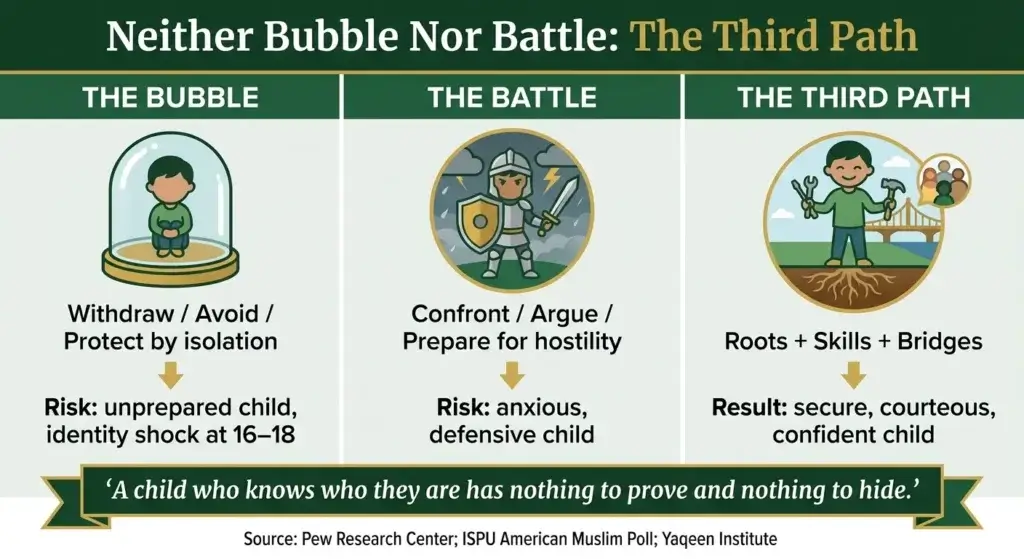
The first instinct is protection through withdrawal: keep the child inside a bubble, minimize exposure, and avoid the problem. It works until the child turns 13, 16, or 18 — and walks into a world they were never trained to navigate.
The second instinct is protection through confrontation: arm the child with arguments, teach them that the surrounding society is hostile, and prepare them for battle. It produces children who are anxious, defensive, and exhausted.
There is a third path. It is the path the Prophet ﷺ and his Companions walked in Makkah, in Abyssinia, and in Madinah: deep roots, practical skills, and open hands. A child who knows who they are, knows what to say, and knows how to be good to people — and therefore has no need to either hide or fight.
This guide is a complete framework for building exactly that child.
designed for Muslim families in the West
quranst’s Smart Parenting and Islamic Studies tracks are designed for Muslim families in the West — building Islamic knowledge, Arabic, and Quranic connection through live, one-on-one sessions that fit around the American school day.
Book your free 2-session trial →The Islamic Foundation: A Confident Identity Is Not a Confrontational One
Before any strategy, a principle: Islam does not ask the Muslim child to choose between being confident and being kind. The Quran joins them.
Identity Is Built Into the Child
The Prophet ﷺ said:
“Every child is born upon the fitrah (natural disposition). Then his parents make him a Jew, a Christian, or a Magian.”
The hadith is often quoted as a statement about conversion. It is equally a statement about parental influence: the child arrives with a natural orientation toward their Creator, and the home is the primary environment that shapes what grows from it. Your child’s identity does not begin at school. It begins in your kitchen, at your prayer mat, and in the way you speak about the world.
Confidence Without Arrogance
وَلَا تَهِنُوا وَلَا تَحْزَنُوا وَأَنتُمُ الْأَعْلَوْنَ إِن كُنتُم مُّؤْمِنِينَ
“Do not weaken and do not grieve, for you will be superior if you are [true] believers.”
— Quran 3:139
The “superiority” referred to here is not social dominance over neighbors. It is the inner elevation of a person whose worth is anchored in their relationship with Allah — and therefore cannot be lowered by a classmate’s comment. This is the exact kind of confidence we want for our children: a dignity that comes from the inside.
Courtesy Toward Neighbors Is Commanded
لَّا يَنْهَاكُمُ اللَّهُ عَنِ الَّذِينَ لَمْ يُقَاتِلُوكُمْ فِي الدِّينِ وَلَمْ يُخْرِجُوكُم مِّن دِيَارِكُمْ أَن تَبَرُّوهُمْ وَتُقْسِطُوا إِلَيْهِمْ ۚ إِنَّ اللَّهَ يُحِبُّ الْمُقْسِطِينَ
“Allah does not forbid you from being righteous and just toward those who have not fought you because of religion and have not driven you out of your homes. Indeed, Allah loves those who act justly.”
— Quran 60:8
يَا أَيُّهَا النَّاسُ إِنَّا خَلَقْنَاكُم مِّن ذَكَرٍ وَأُنثَىٰ وَجَعَلْنَاكُمْ شُعُوبًا وَقَبَائِلَ لِتَعَارَفُوا
“O mankind, indeed We have created you from male and female and made you peoples and tribes that you may know one another.”
— Quran 49:13
Notice the verb: li-ta’arafu — “that you may know one another.” Diversity is described as a design feature of creation and a basis for getting to know each other, not a threat.
The Pattern: Calling With Wisdom, Responding With Better
وَمَنْ أَحْسَنُ قَوْلًا مِّمَّن دَعَا إِلَى اللَّهِ وَعَمِلَ صَالِحًا وَقَالَ إِنَّنِي مِنَ الْمُسْلِمِينَ
“And who is better in speech than one who invites to Allah, does righteous deeds, and says, ‘Indeed, I am of the Muslims’?”
— Quran 41:33
ادْفَعْ بِالَّتِي هِيَ أَحْسَنُ فَإِذَا الَّذِي بَيْنَكَ وَبَيْنَهُ عَدَاوَةٌ كَأَنَّهُ وَلِيٌّ حَمِيمٌ
“Repel [evil] with that which is better; and thereupon the one between whom and you was enmity will become as though he was a devoted friend.”
— Quran 41:34
Read verse 33 carefully. The sentence “I am of the Muslims“ is spoken as a statement of belonging — plainly, without apology — and it is placed directly beside the command to respond to harm with something better. Saying who you are and responding with grace are not two separate skills. They are one posture.
This is the posture we are building in our children.
Section 1: What the Research Actually Says
A good parenting plan starts with an honest picture. The data on Muslim children in American schools is sobering — and it is also not the whole story.
The Challenge: Religion-Based Bullying
The Institute for Social Policy and Understanding (ISPU) has asked Muslim parents about this directly in its annual American Muslim Poll:
| Poll Year | Muslim families with school-age children reporting religion-based bullying of their child in the past year | Comparison |
|---|---|---|
| 2017 | 42% | 23% of Jewish, 20% of Protestant, and 6% of Catholic families |
| 2020 | 51% | 27% of the general public |
| 2022 | 48% | One in five of these families said it happened nearly every school day |
| 2025 | 47% | 23% of the general public |
(Sources: ISPU American Muslim Poll 2017 Key Findings; ISPU poll data as summarized by the University of Pittsburgh CERIS for 2020; StopBullying.gov for 2022; Spectrum News coverage of the 2025 poll. Full citations in the References section.)
Three further findings matter for parents:
- Adults are sometimes involved. In 2017, ISPU reported that a teacher or other school official was involved in about one in four bullying incidents involving Muslim students. In 2020, it was nearly one in three.
- Practices are often the target. StopBullying.gov notes that Muslim children are often bullied for faith-related practices such as prayer, fasting, and religious attire, including hijab.
- It follows them online. The same federal resource reports that bullying of Muslim students occurs both by trusted adults in school (42%) and online by peers (31%).
The Adult Experience Shapes the Atmosphere
Pew Research Center’s 2017 survey of U.S. Muslims found that roughly half (48%) had experienced at least one form of discrimination in the previous 12 months, and that visibly identifiable Muslims, including women who wear a headscarf, reported more of it. Pew’s 2026 portrait of Muslim Americans, published in September of this year, reports that 59% of U.S. Muslims say there is a lot of discrimination against Muslims.
The Part That Is Often Left Out: Pride and Support
Here is the other half of the picture, from the same Pew work:
- In 2017, 97% of U.S. Muslims surveyed said they were proud to be Muslim, and 89% said they were proud to be both American and Muslim (as reported by multiple news outlets covering the Pew survey).
- Pew found that the share of Muslims who said someone had expressed support for them because of their religion rose from 32% (2007) to 37% (2011) to 49% (2017). In the 2026 survey, 34% said this had happened in the past year.
The honest summary: there is real hostility, there is real support, and there is deep pride. A parenting approach built only on fear will miss the second and third. A parenting approach built only on optimism will miss the first.
What Research Says About Identity Itself
The Yaqeen Institute’s paper on American Muslim youth identity, written by Dr. Omar Suleiman, reports a qualitative study of 30 young American Muslims and also cites a smaller study of Muslim children aged 5–9 carried out at San Francisco State University for Noor Kids. According to the paper, that study concluded that 1 in 3 children did not want to tell others they were Muslim, 1 in 2 did not know whether they could be both Muslim and American, and 1 in 6 would sometimes pretend not to be Muslim.
An important caveat: these are qualitative findings from small samples, not national statistics. They are included here because they describe the inner experience behind the larger numbers — and because they identify exactly where parents can intervene.
Another finding cited in the same paper (from Kunst and colleagues, 2012): developing a healthy combined national and religious identity predicted greater confidence in young Muslims and greater civic contribution. And separately, ISPU’s 2016 work found that frequent attendance at religious services among Muslims is linked to civic engagement.
In other words, strong religious identity and strong participation in society are not opposites. In the research cited, they travel together.
designed for Muslim families in the West
Confident identity starts with real knowledge. quranst’s Islamic Studies program gives children the Aqeedah, Hadith, Seerah, and Fiqh foundations to answer “Why do you do that?” with ease.
Book your free 2-session trial →Section 2: The Three-Part Model — Roots, Skills, Bridges
Every strategy in this guide fits inside one frame.
ROOTS — Who am I? A child’s inner certainty: faith, language, story, and belonging. Built at home, over years.
SKILLS — What do I say and do? Practical language and habits for real situations: lunch tables, gym class, group projects, social media. Built through rehearsal.
BRIDGES — How do I live well among others? Character, service, and friendship across lines of difference. Built through example and participation.
A child with only roots may be strong inside and awkward outside. A child with only skills may be polished but hollow. A child with only bridges may be liked by everyone and unsure of who they are.
The confident Muslim child has all three.
The sections that follow take each in turn.
Section 3: Roots — Building the Identity at Home
Why the Family Comes First
The Yaqeen Institute’s review of religious identity development, “Will My Children Be Muslim?”, states that the family is the single most important source of religious socialization, and describes the mechanisms parents use: modeling, encouragement and reinforcement, parent–child coactivity, and the provision of religious materials and experiences. It also notes research indicating that when parents’ own actions are inconsistent with what they preach, children are rarely motivated to follow in their footsteps.
That is the research version of what the Prophet ﷺ said:
“Each of you is a shepherd, and each of you is responsible for his flock.”
— Sahih al-Bukhari, Hadith 893; Sahih Muslim, Hadith 1829
Four root systems, each reachable in a normal family week:
Root 1: A Living Relationship With Allah
The most protective thing a Muslim child can possess in any environment is not a debate script. It is closeness to Allah.
The Prophet ﷺ taught the young Ibn Abbas, a child riding behind him:
“O boy, I will teach you some words: Be mindful of Allah and He will protect you. Be mindful of Allah and you will find Him before you.”
— Sunan al-Tirmidhi, Hadith 2516 (graded hasan sahih)
Notice that this was said to a child, and that its subject is protection through connection, not protection through isolation.
Practical applications:
- Pray visibly at home and invite your child beside you. Teach prayer early; the Prophet ﷺ instructed parents to command children to pray at age seven (Sunan Abi Dawud, Hadith 495; graded hasan).
- Make du’a out loud in front of your children — for them by name.
- Create one family ritual of Quran per day, even five minutes.
Root 2: Language — The Bridge Back to the Source
A child who can read the Quran in Arabic, even slowly, holds something no classmate can argue them out of: direct contact with the text. They are not defending a “tradition they were told about.” They are reading the book.
This is why Learn Quran, Tajweed, and Quranic Arabic are not extras in a diaspora household. They are identity infrastructure. A Muslim child who can recite Surah al-Fatihah with understanding has something in their heart when the cafeteria goes quiet.
Root 3: Story — Who Are “We”?
Children identify with stories before they identify with arguments. Give them the full Muslim story:
- The Prophets, including Yusuf, who lived as a believer in a non-Muslim land and rose with integrity.
- The Companions who migrated to Abyssinia and lived under a Christian king.
- Scholars, scientists, and builders across fourteen centuries.
- American Muslim history, and the Muslim neighbors who live in your own town.
A child who knows they belong to a long, dignified story does not need to win the lunch-table argument. They already know where they come from.
Root 4: Belonging — A Community of Peers
Research cited by Yaqeen and ISPU links regular religious community involvement to stronger identity and civic engagement. For your child, that means other Muslim children their own age: at the masjid, in a weekend program, in an online class, at family gatherings.
The practical rule: a Muslim child in a mostly non-Muslim school needs at least one weekly space where being Muslim is simply normal.
Quick Self-Check for Parents ☐ Does my child pray with me at least some of the week? ☐ Can my child read a page of Quran? ☐ Can my child name three Prophets and one story about each? ☐ Does my child have at least two Muslim friends they see regularly? ☐ Does my child hear me speak about Islam with joy, not just rules?
Section 4: Skills — What Your Child Says and Does in Real Moments
Confidence is partly a feeling and partly a skill. Children freeze in awkward moments because they’ve never rehearsed them. Rehearsal turns panic into calm.
The Core Principle: Short, Warm, Unapologetic
The best response to nearly every “why do you…?” question is one friendly sentence, followed by a redirect. Not a lecture. Not an apology.
The Script Table
| Situation | What can go wrong | A calm script |
|---|---|---|
| Food at lunch or a party | Child quietly skips or feels singled out | “No thanks, I don’t eat that. I’m Muslim. But this looks great!” |
| Prayer time at school | Child skips prayer in silence, or prays and feels exposed | “I need ten minutes at lunch for my prayer. Is there a quiet room?” (Parent pre-arranges this with the school.) |
| Ramadan fasting | Teasing, or pressure to eat | “I’m fasting. It’s a Ramadan thing. It’s actually kind of cool, want me to tell you about it?” |
| Holiday celebrations | Awkwardness during class parties | “We don’t celebrate that one, but we celebrate Eid. Happy holidays to you!” |
| A curious question | Child feels interrogated | “Good question. In Islam we believe… [one sentence]. Want to hear more?” |
| A hostile comment | Child freezes, or fights back | “I’m not going to argue about this.” Then walk away and tell a teacher or parent. |
| “Are you a terrorist?”-type jokes | Shame, anger | “That’s not funny to me.” Report it. (See Section 6.) |
| Social media comment | Reply-war | Don’t respond. Screenshot. Tell parent. Block. |
The Three Tools Every Child Needs
Tool 1 — The One-Sentence Identity Statement. “I’m Muslim — that’s why I pray, fast, and don’t eat pork. It’s a big part of who I am.” Practice it until it can be said smiling.
Tool 2 — The Graceful Decline. Teaching children how to say “no thanks” without apology or hostility is the most underrated skill in the entire framework. It protects their practice and their friendships.
Tool 3 — The Walk-Away-and-Tell Rule. Courage includes knowing when to leave and who to tell. Your child needs to hear, repeatedly: “Telling me is never snitching. It is never weakness. It is the first thing a wise person does.”
Role-Play at the Dinner Table
Once a week, five minutes, run it like a game:
- Parent plays a curious classmate. Child answers.
- Switch roles.
- Parent plays a rude classmate. Child practices the calm response and the walk-away.
- Laugh, hug, and end with du’a.
This is the Islamic parenting version of a fire drill. Nobody expects the fire — but everyone knows the exit.
Speaking to People: The Quranic Standard
وَقُولُوا لِلنَّاسِ حُسْنًا
“And speak to people good [words].”
— Quran 2:83
This is the baseline for every interaction — including the difficult ones.
Section 5: Bridges — The Prophetic Model of Living Among Others
Roots and skills protect the child. Bridges make the child good for their society — and that, in turn, makes the child feel they belong to it.
Lesson 1: Abyssinia — A Muslim Minority Under a Non-Muslim King
When persecution in Makkah intensified, the Prophet ﷺ sent a group of Muslims to Abyssinia, a land ruled by a Christian king known for justice. The Companions lived there openly as Muslims, spoke clearly about their faith when asked, and lived in safety. The narration of Ja’far ibn Abi Talib’s address to the king is preserved in the Sirah literature (see Musnad Ahmad, Hadith 1740).
The lesson for parents: Muslims have lived as a faithful minority under non-Muslim rule from the very beginning of the Islamic story. Your child’s situation is not an anomaly. It is a chapter in the Muslim story with prophetic precedent.
Lesson 2: Yusuf — Excellence and Integrity in a Foreign Court
The Quran presents Yusuf (peace be upon him) rising in Egypt not by compromising his faith but through competence, honesty, and service to the public good. He did not run from the society he lived in. He improved it.
Children should hear this story as a model for their future careers: the Muslim doctor, engineer, teacher, or public servant who is excellent because of their faith, not in spite of it.
Lesson 3: The Neighbor
“Whoever believes in Allah and the Last Day, let him honor his neighbor.”
— Sahih al-Bukhari, Hadith 6018; Sahih Muslim, Hadith 47
The most direct bridge-building tool in the Islamic tradition is the neighbor. Practical ways to make it real:
- Bring food to neighbors, especially during Ramadan and Eid.
- Let your child carry the plate and say, “This is from our family. Happy Eid!”
- Invite neighbors and classmates’ families for an iftar or a simple Eid open house.
- Teach your child to remember birthdays, to say hello, to help carry groceries.
When a child’s identity is “the kind Muslim kid on our street,” bigoted assumptions have less room to grow.
Lesson 4: Character as Da’wah
The Prophet ﷺ taught:
“Fear Allah wherever you are, follow a bad deed with a good deed and it will erase it, and treat people with good character.”
— Sunan al-Tirmidhi, Hadith 1987 (graded hasan)
For a child in a mostly non-Muslim school, good character is the most persuasive thing they can say about Islam. No argument competes with being the classmate who is honest, helpful, and reliably kind.
Lesson 5: Service and Participation
ISPU’s research (as cited in the Yaqeen paper) links regular religious engagement to civic participation. Make it concrete: volunteer as a family at a food bank, a park cleanup, a community garden, or an interfaith service day. A child who has served alongside neighbors knows, from experience, that Muslim and American are not opposites.
Section 6: When Things Go Wrong — A Response Plan for Bullying
Even the best-prepared child may face bullying. The statistics in Section 1 make it responsible, not pessimistic, to have a plan.
Step 1 — Listen Before You Act
Your child’s first disclosure is a fragile moment. If they get anger, panic, or “just ignore it,” they may stop telling you.
Say: “Thank you for telling me. I’m proud of you. I’m so sorry that happened. You didn’t do anything wrong.”
Ask open questions: What happened? Who was there? How did it make you feel? What do you want to happen next?
Step 2 — Document
Write down dates, names, exact words, and witnesses. For online incidents, take screenshots. Keep them in one folder.
Step 3 — Report in Writing
Follow your school’s reporting procedure and put the report in an email so there is a record. Be factual and calm. Ask what steps the school will take and when you can expect a response.
Step 4 — If a Teacher or Staff Member Is Involved
ISPU found that adults at school were involved in a meaningful share of reported incidents. If the concern is about a staff member, do not confront the person directly in the first instance. Request a meeting with the principal or the district’s designated office, bring your documentation, and ask for the district’s process.
Step 5 — Know the Resources
- StopBullying.gov (U.S. Department of Health and Human Services) provides guidance on religious-based bullying and on how to report.
- ISPU’s Educators Toolkit offers handouts, including strategies for educators addressing religious-based bullying of Muslim children.
- National Muslim civil-rights and legal-aid organizations also provide support to families. Check each organization’s current guidance directly; it varies by state and situation.
Step 6 — Protect the Heart
After any incident, return to Roots: extra time together, a special family meal, a shared du’a, a reminder of the stories of the Prophets and Companions who were tested.
وَلَا تَهِنُوا وَلَا تَحْزَنُوا وَأَنتُمُ الْأَعْلَوْنَ إِن كُنتُم مُّؤْمِنِينَ
“Do not weaken and do not grieve — you will be superior if you are [true] believers.” — Quran 3:139
And watch for signs that your child may need professional emotional support: persistent withdrawal, sleep changes, school refusal, or a sudden drop in mood. Seek help from a qualified counselor; this is part of caring for the trust Allah has given you.
Why “Tell an Adult” Matters Doctrinally
Teaching children to seek help is not a departure from Islamic character. The Prophet ﷺ taught that the strong believer is not the one who bears everything silently:
“The strong believer is better and more beloved to Allah than the weak believer, while there is good in both.”
— Sahih Muslim, Hadith 2664
Strength includes wisdom, and wisdom includes seeking the right help.
Not all identity damage comes from outside. Some of the most important findings in the research are about what children begin to believe about themselves.
What the Research Describes
Dr. Omar Suleiman’s Yaqeen Institute paper describes the internalization of negative narratives about Islam among young Muslims, a phenomenon the paper compares with internalized racism. Interviewees described feeling that they had to choose between “American” and “Muslim” depending on the setting, with the “easier” identity chosen to fit in. One teen described not wanting to pray around non-Muslim friends so as not to remind them she was different.
Another dimension appears in interviews with teenage girls: pressure comes not only from the wider society, but also from within the Muslim community itself, where young people can feel judged for being “not Muslim enough” or “too religious,” depending on who is watching.
Warning Signs at Home
- Your child avoids saying they are Muslim, or switches names, or avoids prayer when friends are around.
- They express embarrassment about the family’s practices, food, language, or clothing.
- They describe Islam primarily through what the media says about it.
- They have started to see “being American” and “being Muslim” as a forced choice.
The Antidote: Make Both Identities Feel Whole
- Never frame it as “us vs. them.” Say “we” for your family and “our neighbors” for the wider community.
- Speak about America’s good with honesty, and about its failures with honesty. Children can handle a nuanced picture; they cannot handle being told one thing at home and seeing another outside.
- Remove the shame from difference. Cook the food. Wear the clothes. Speak the language. Let your child see you comfortable in your own skin.
- Name the pressure out loud. “Sometimes it feels like you have to choose. You don’t. You can be fully Muslim and fully at home here.” In the Pew data, 89% of Muslim respondents described themselves as proud of both identities. Your child is not an exception; they are part of a majority experience.
- Welcome their questions. The Family and Youth Institute (FYI) notes that Muslim teens who question rules and authority are often trying to understand the meaning behind those rules. A question is not a rejection. It is the first step toward making the faith their own. (For a complete framework on handling the hardest questions, see our guide on Rational Aqeedah for Children.)
Section 8: Age-by-Age Identity Framework {#section-8}
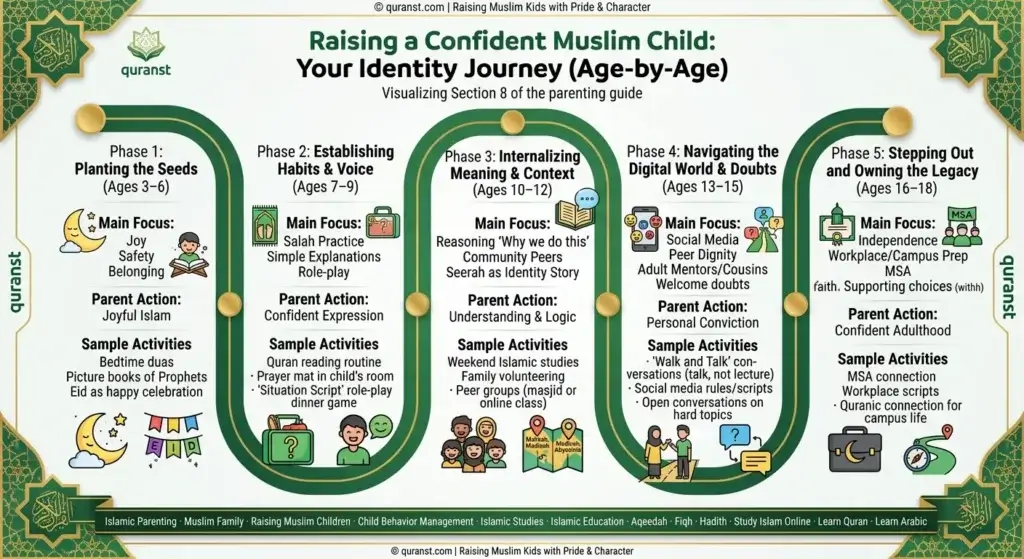
| Age | What Matters Most | Parent’s Main Focus | Sample Activity |
|---|---|---|---|
| 3–6 | Warmth, rhythm, belonging | Make Islam feel joyful and safe. Introduce Allah, Prophets, duas, and Eid as happy words. | Bedtime du’a; “Bismillah” before meals; Prophet stories with picture books |
| 7–9 | Awareness of difference (“Why don’t I…?”) | Give simple, proud explanations. Begin salah practice. Start script role-plays. | Weekly role-play dinner game; Quran reading routine; Ramadan calendar with kind-deed challenges |
| 10–12 | Peer influence; early questions | Strengthen friendship circles; add reasoning (“why we do this”); introduce Seerah as identity story. | Weekend Islamic studies; family volunteering; helping them lead a short talk at the masjid |
| 13–15 | Identity exploration; social media; belonging | Talk more, lecture less. Protect their dignity in front of peers. Welcome doubts. Provide mentors. | One-on-one “walk and talk” weekly; mentor or older cousin; open conversations on hard topics |
| 16–18 | Independence; preparation for adult life | Treat them as a junior partner. Prepare for college and work. Support their choices when they are within the faith. | Plan Muslim student association or campus resources together; discuss workplace situations |
Teen-Specific Notes
- Don’t take the phone war as the whole story. Teens are weighing who they are, just like their peers. Protect the relationship first.
- Make mentors available. A respected older Muslim (a cousin, a teacher, a youth leader) can say things a parent cannot.
- Keep the door open. A teen who knows they can ask anything without being shamed is far more likely to stay close to the faith than one who has learned to hide their doubts.
Discover Your Child’s True Intellectual Heritage
quranst’s Islamic Studies track teaches the Islamic intellectual tradition — including the scientific tradition — as part of a coherent, Quran-anchored curriculum. The child who learns with quranst learns who their intellectual ancestors were.
Explore Islamic Studies →Section 9: The Parent as the Living Curriculum
Everything above depends on the adult in the room.
Five Questions Parents Should Ask Themselves
1. How do I speak about non-Muslims at home? If your child hears contempt at the dinner table, they will bring it to school. If they hear respect, they will carry that, too.
2. How do I speak about Islam? Joy or only obligation? Meaning or only rules?
3. How do I respond when I’m provoked? Your child will learn what a Muslim does when insulted by watching what you do in traffic.
4. Am I building my own roots? Parents who are learning, reading Quran, studying, and attending community events model a faith that is alive.
5. Am I afraid, and is my child absorbing that fear? Fear is contagious. A parent who is calm and anchored in tawakkul gives the child the same.
The Five Response Principles for Hard Conversations
1. Welcome the story. “Thank you for telling me.”
2. Name the feeling. “That sounds really embarrassing. Anyone would feel that way.”
3. Affirm the identity. “Being Muslim is nothing to be ashamed of. It’s one of the best things about you.”
4. Offer a skill. “Next time, you could say…” Then practice it.
5. Close with du’a. “Ya Allah, make our child strong, kind, and proud of Your religion. Ameen.”
A Du’a for Parents
رَبَّنَا هَبْ لَنَا مِنْ أَزْوَاجِنَا وَذُرِّيَّاتِنَا قُرَّةَ أَعْيُنٍ وَاجْعَلْنَا لِلْمُتَّقِينَ إِمَامًا
“Our Lord, grant us from among our spouses and offspring comfort to our eyes and make us a leader for the righteous.”
— Quran 25:74
Make it daily. Make it by name.
Conclusion: Rooted, Not Rigid
Return to the eight-year-old in the cafeteria.
He told his classmate, “It’s because we’re Muslim.” That sentence took courage. It was not a failure. It was an act of identity, spoken truthfully, in front of children who did not understand it.
What he needed next was not a stronger argument. It was a parent who said: “I’m proud of you for saying that. Let’s practice how you can say it even more easily next time. And tomorrow, let’s invite that boy over for a snack.”
That is the third path. A child with roots that go all the way down to the Quran, the Prophets, and a daily relationship with Allah. A child with skills that make awkward moments manageable. A child with bridges that connect them to neighbors, classmates, and community with the best of character.
Such a child does not need to hide. They do not need to fight.
They simply need to be — fully, warmly, and unmistakably — what they already are.
وَمَنْ أَحْسَنُ قَوْلًا مِّمَّن دَعَا إِلَى اللَّهِ وَعَمِلَ صَالِحًا وَقَالَ إِنَّنِي مِنَ الْمُسْلِمِينَ
“And who is better in speech than one who invites to Allah, does righteous deeds, and says, ‘Indeed, I am of the Muslims’?”
— Quran 41:33
🟢 Build a Confident Muslim Identity with quranst
Knowledge of the right approach is the beginning. A weekly structure that builds Quranic connection, Islamic knowledge, Arabic, and character — through live sessions with a teacher who knows your child — is what turns the plan into a habit.
quranst’s tracks give your child the roots that confidence grows from:
Quran and Arabic:
- Learn Quran with Tajweed through live, one-on-one sessions
- Learn Arabic and Quranic Arabic so your child reads the text for themselves
- Flexible scheduling that works around the American school day
Islamic Studies:
- Aqeedah, Fiqh, Hadith, and Seerah taught in age-appropriate ways
- Study Islam online with certified instructors who welcome your child’s questions
- The Prophetic stories that give children a proud, dignified sense of “who we are”
Smart Parenting Support:
- Islamic parenting guidance for Muslim families raising children in the West
- Child behavior management frameworks rooted in the Prophetic model
- Raising Muslim children who are secure, kind, and confident
👇 Begin with Two Free Sessions
Build the Child Who Inherits Both the Quran and the Scientific Tradition
The Islamic education that produces scientifically curious, intellectually confident Muslim children is the education that connects the Quran to the civilization it produced — including its extraordinary scientific tradition.
Your child is next. Begin. بِسْمِ اللَّهِ
“The most perfect of the believers in faith is the one who is best in moral character.”
— Sunan Abu Dawud, Hadith 4682; Sunan al-Tirmidhi, Hadith 1162
Confidence is rooted in faith. Kindness is its fruit. Build both, together.
بِسْمِ اللَّهِ — Begin.
References and Sources
Quranic References
- Quran 2:83 — “Speak to people good [words]”
- Quran 3:139 — “Do not weaken and do not grieve… you will be superior if you are believers”
- Quran 25:74 — “Our Lord, grant us… comfort to our eyes”
- Quran 41:33–34 — “Who is better in speech… ‘I am of the Muslims'” / “Repel [evil] with that which is better”
- Quran 49:13 — “…peoples and tribes that you may know one another”
- Quran 60:8 — “Allah does not forbid you from being righteous and just toward those who have not fought you”
Hadith References
- Sahih al-Bukhari, Hadith 893; Sahih Muslim, Hadith 1829 — “Each of you is a shepherd”
- Sahih al-Bukhari, Hadith 1358; Sahih Muslim, Hadith 2658 — “Every child is born upon the fitrah”
- Sahih al-Bukhari, Hadith 6018; Sahih Muslim, Hadith 47 — Honoring the neighbor
- Sahih Muslim, Hadith 2664 — “The strong believer is better…”
- Sunan al-Tirmidhi, Hadith 2516 — “Be mindful of Allah and He will protect you” (hasan sahih)
- Sunan al-Tirmidhi, Hadith 1987 — “Fear Allah wherever you are… treat people with good character” (hasan)
- Sunan Abi Dawud, Hadith 495 — Commanding children to pray at age seven (hasan)
- Sunan Abu Dawud, Hadith 4682; Sunan al-Tirmidhi, Hadith 1162 — “The most perfect believers in faith are the best in character”
- Musnad Ahmad, Hadith 1740 — Narration of the migration to Abyssinia
Editorial note: Hadith numbers follow the numbering commonly used on Sunnah.com and should be cross-checked against that site before publication. Hadith gradings are those commonly cited by hadith scholars (including al-Albani for the Abu Dawud and Tirmidhi narrations).
Research and Data Sources
- Institute for Social Policy and Understanding (ISPU), American Muslim Poll 2017: Muslims at the Crossroads (Dalia Mogahed and Youssef Chouhoud). Key findings: 42% of Muslims with K–12 children report religion-based bullying, compared with 23% of Jews, 20% of Protestants, and 6% of Catholics; a teacher or school official was involved in about one in four incidents.
- ISPU American Muslim Poll 2020, as summarized by the University of Pittsburgh Center for Ethnic and Religious Inclusion Studies (CERIS). Key findings: 51% of Muslim families reported religion-based bullying versus 27% of the general public; nearly a third of Muslim cases involved a teacher or school official.
- StopBullying.gov (U.S. Department of Health and Human Services), “Help Prevent Bullying of Muslim Youth” (October 2024). Key findings: 48% of Muslim families with school-age children reported religion-based bullying in the prior year (American Muslim Poll 2022); one in five said it occurred nearly every school day; common targets include prayer, fasting, and religious attire; bullying occurs by trusted adults in school (42%) and online by peers (31%).
- Spectrum News (October 2025), coverage of the American Muslim Poll 2025 (ISPU with NORC at the University of Chicago). Key findings: 47% of Muslim families with school children reported religion-based bullying in the past year, versus 23% of the general public; 63% of Muslims reported religious discrimination in the past year.
- Pew Research Center, “25 Years After 9/11, a Portrait of Muslim Americans” (September 3, 2026). Key findings: Pew’s 2007, 2011, and 2017 in-depth studies show consistent patterns of both discrimination and support; support expressed to Muslims because of religion rose from 32% (2007) to 37% (2011) to 49% (2017), and was reported by 34% in 2026; 59% of U.S. Muslims in 2026 say there is a lot of discrimination against Muslims; visibly identifiable Muslims report more discrimination.
- Pew Research Center 2017 U.S. Muslim survey, as reported by HuffPost and the Baptist Standard. Key findings: 48% experienced at least one form of discrimination in the prior 12 months; 97% proud to be Muslim; 89% proud to be both American and Muslim. HuffPost:
- Yaqeen Institute for Islamic Research — Dr. Omar Suleiman, “Exploring the Faith and Identity Crisis of American Muslim Youth” (2017; updated 2026). Key findings: qualitative interviews with 30 young American Muslims; internalized Islamophobia and identity confusion; youth feeling pressure to choose between “American” and “Muslim”; cites a study of children aged 5–9 reporting that 1 in 3 did not want to tell others they were Muslim, 1 in 2 did not know whether they could be both Muslim and American, and 1 in 6 would sometimes pretend not to be Muslim; cites Kunst et al. (2012) linking a healthy combined identity to confidence and civic contribution, and ISPU (2016) linking frequent religious attendance to civic engagement.
- Yaqeen Institute, “Will My Children Be Muslim? The Development of Religious Identity in Young People” (updated 2026). Key findings: the family is the most important source of religious socialization; parents influence children through modeling, encouragement and reinforcement, coactivity, and provision of religious materials and experiences; inconsistency between parents’ preaching and actions undermines children’s religious motivation.
- The Family and Youth Institute (FYI), research bulletin on Muslim youth identity development (Madiha Tahseen, Ph.D., with Sameera Ahmed, Ph.D., and Anwar Hussein). Key findings: teens who question rules and authority are often trying to understand the meaning behind them; includes guidance for parents building resilient Muslim identities in America.
- ISPU Educators Toolkit. Resources on addressing bullying of Muslim children, including handouts of strategies for educators.
Frequently Asked Questions
What is “The Third Path” in raising a confident Muslim child in America?
Can a child be both proudly Muslim and comfortably American?
How should my child respond to questions about halal food, prayer, or fasting at school?
- At lunch: “No thanks, I don’t eat that. I’m Muslim. But this looks great!”
- During Ramadan: “I’m fasting. It’s a Ramadan thing. It’s actually kind of cool, want me to tell you about it?”
- For hostile remarks: “I’m not going to argue about this,” followed by walking away and informing a trusted adult.
