

Introduction: The Child Who Thinks Science and Islam Are Opposites
Somewhere in a science classroom in London, in Houston, in Sydney — there is a Muslim child sitting with a contradiction they have not been given the tools to resolve.
On one side: Islam. Five prayers. Ramadan. Quran memorization. The life of faith their family has built and sustained.
On the other side: science. Evolution. The Big Bang. The age of the universe in billions of years. The unspoken assumption in every science textbook that rational inquiry and religious belief occupy different — perhaps incompatible — intellectual territories.
And nobody has told this child the most important historical fact available to them:
The civilization that did more than any other in human history to establish rational, empirical scientific inquiry as the foundation of knowledge was an Islamic civilization.
The algebra in their math textbook: an Arabic word, from an Arabic book, written by a Muslim mathematician.
The optical principles behind their phone camera: developed by a Muslim physicist in 11th-century Cairo.
The surgical instruments their doctor uses today: designed by a Muslim surgeon in 10th-century Córdoba.
The word “algorithm” itself — the concept behind every computer program ever written: derived from the name of a Muslim scholar who worked in Baghdad.
The child who does not know this history sits with a contradiction. The child who knows it sits with an inheritance.
The Islamic Golden Age (roughly 750–1258 CE) produced foundational contributions to algebra, optics, medicine, surgery, astronomy, and chemistry. Al-Khwarizmi founded algebra and gave us the word ‘algorithm.’ Ibn al-Haytham proved how human vision works and introduced controlled experiments. Muslim scholars during this period invented algebra, advanced optics, modern surgical techniques, and established the first public hospitals.
This guide gives Muslim children that inheritance — in stories, in documented facts, and in the Quranic intellectual framework that motivated every discovery. And it shows how the Islamic education their family is building through quranst is the direct continuation of the tradition that produced the greatest scientific civilization the medieval world ever saw.
Connect Islamic History to Faith & Knowledge
quranst’s Islamic Studies track connects Islamic history — including the scientific tradition — to Aqeedah, the Quran, and the Arabic language that was the medium of the Islamic Golden Age’s greatest discoveries.
Book your free 2-session trial →The Quranic Engine of Scientific Curiosity
The question that Western educators consistently fail to answer — and that Muslim children urgently need answered — is: Why did the Islamic civilization produce this explosion of scientific discovery?
The answer is in the Quran itself.
The First Word: Iqra
اقْرَأْ بِاسْمِ رَبِّكَ الَّذِي خَلَقَ
“Read in the name of your Lord who created.”
— Quran 96:1
The first word revealed to the Prophet ﷺ was not “pray” or “believe” or “submit.” It was “Read.” The Islamic revelation began with a command to engage with the world intellectually — to read, to learn, to understand.
The scholars of the Golden Age understood this as a direct divine mandate: the study of creation is an act of worship, because creation is the ayat (signs) of the Creator.
سَنُرِيهِمْ آيَاتِنَا فِي الْآفَاقِ وَفِي أَنفُسِهِمْ حَتَّىٰ يَتَبَيَّنَ لَهُمْ أَنَّهُ الْحَقُّ
“We will show them Our signs in the horizons and within themselves until it becomes clear to them that it is the truth.”
— Quran 41:53
Ibn al-Haytham studying how light moves through the eye was studying an aya of Allah. Al-Khwarizmi developing algebraic methods to solve inheritance calculations was applying Quranic principles of justice to mathematical form. Jabir ibn Hayyan purifying chemical compounds was exploring the signs of Allah in material creation.
The Prophet ﷺ said:
“Seeking knowledge is obligatory upon every Muslim.”
— Sunan Ibn Majah, Hadith 224; authenticated by al-Albani
This hadith was not interpreted by the classical scholars as “seek religious knowledge only.” It was understood as a comprehensive mandate — the obligation to know, to understand, to investigate.
إِنَّمَا يَخْشَى اللَّهَ مِنْ عِبَادِهِ الْعُلَمَاءُ
“Indeed, it is only those who have knowledge among Allah’s servants who fear Him.”
— Quran 35:28
Al-‘ulama’ — the scholars — are named as those closest to Allah in consciousness. And the classical tradition understood ‘ilm (knowledge) to encompass all legitimate domains of human inquiry, not only theology.
The Islamic Golden Age was not a historical accident. It was the direct product of a civilization that read its scripture as a command to know — and acted on it with extraordinary energy for five centuries.
Section 1: The Five Scientists Who Changed Everything
These are not simply historical figures for children to memorize. They are the intellectual ancestors of every Muslim child alive today — the people whose curiosity, grounded in Islamic faith, built the foundation on which the modern world stands.
1. Muhammad ibn Musa Al-Khwarizmi (c.780–850 CE) — The Man Whose Name Runs the Internet
Where he worked: The Bayt al-Hikmah (House of Wisdom), Baghdad — the greatest intellectual institution of the medieval world.
What he believed: Al-Khwarizmi was a devout Muslim who understood mathematical inquiry as a form of understanding Allah’s creation. His greatest work — Kitab al-mukhtasar fi hisab al-jabr wal-muqabala — opened with Bismillah al-Rahman al-Raheem.
What he invented: Al-Khwarizmi gave us algebra. The word itself derives from the title of his book: al-jabr. His step-by-step methods for solving linear and quadratic equations introduced rules for balancing and simplifying equations, complete with practical examples from daily life — inheritance, trade, architecture, and land measurement.
Algorithms — the backbone of all AI and computer programming — are named after Al-Khwarizmi himself. His name, Latinized as “Algoritmi,” gave the word “algorithm” to human civilization. Every search engine, every app, every AI system runs on a concept named after a Muslim scholar from Baghdad.
The connection to today: The phone in every child’s hand runs on algorithms. Every algorithm is named after a Muslim who said Bismillah before he picked up his pen.
For the child: “Next time you use a calculator or a computer or your phone — the whole concept of how those devices think was invented by a Muslim named Muhammad who worked in Baghdad 1,200 years ago. He named his book with the name of Allah. The math runs in every device today.”
2. Ibn al-Haytham / Alhazen (965–1040 CE) — The Father of the Scientific Method and the Camera
Where he worked: Cairo, Egypt — under house arrest for ten years, which he spent studying light.
What he believed: Ibn al-Haytham’s approach to knowledge was explicitly Islamic — observation and experiment as the path to understanding the signs of Allah in creation.
What he discovered: Ibn al-Haytham proved how human vision works and introduced controlled experiments. His Book of Optics (Kitab al-Manazir) explained how light enters the eye, not the reverse (the Greek theory). He proved this with an ingenious experiment: a camera obscura (a darkened room with a small hole) that projected an image of the outside world onto the opposite wall. He used this as experimental evidence — observe, hypothesize, test, repeat. This is the scientific method.
Ibn al-Haytham’s most enduring legacy is his rigorous emphasis on an empirical, experimental methodology that resembles the modern scientific method. Roger Bacon, Kepler, and Descartes were all directly influenced by his work. The modern camera operates on optical principles that he experimentally verified.
The connection to today: Every photograph ever taken. Every camera in every phone. Every optical instrument from the microscope to the telescope. All built on the principles Ibn al-Haytham documented while under house arrest in Cairo.
For the child: “The person who invented the scientific method — the rules that all of science uses to test whether something is true — was a Muslim. He invented it while he was stuck in his room for ten years, studying light to pass the time. And the camera in your phone uses exactly what he discovered.”
3. Jabir ibn Hayyan (c.721–815 CE) — The Father of Chemistry
Where he worked: Kufa, Iraq — under the patronage of the Abbasid Caliphate.
What he believed: Jabir approached the study of matter as an investigation of Allah’s creation — the same creation that the Quran repeatedly invites humanity to observe.
What he invented: Jabir ibn Hayyan developed the first systematic experimental methods in chemistry — specifically the processes of distillation and crystallization that are still foundational laboratory techniques today. He designed early instruments including the alembic (still used in distilleries and laboratories), and his systematic approach to chemical experimentation laid the foundation for modern chemistry centuries before the European “Scientific Revolution.”
The words alcohol and alkali both derive from Arabic — al-kuhul and al-qaly — coined by Jabir and his contemporaries in the Arabic chemical tradition.
The connection to today: Every medicine manufactured through distillation. Every pharmaceutical product purified through crystallization. Every scientific experiment that tests a hypothesis through controlled observation. All trace their methodology to Jabir.
For the child: “Chemistry class is full of Arabic words — alcohol, alkali, alembic — because a Muslim named Jabir invented the field. Every time you see a ‘chemistry lab’ sign, you are seeing a room designed around principles a Muslim established 1,200 years ago.”
4. Ibn Sina / Avicenna (980–1037 CE) — The Doctor Whose Textbook Lasted 600 Years
Where he worked: Across the Islamic world — Bukhara, Hamadan, Isfahan — memorizing the Quran at age ten, mastering medicine by sixteen.
What he invented: (cite index=”5-1″>Ibn Sina authored Al-Qanun fi al-Tibb (The Canon of Medicine), a five-volume medical encyclopedia that remained the standard medical textbook in European universities until the 17th century — more than six hundred years after he wrote it. He described over 760 drugs, detailed the contagious nature of diseases, recommended quarantine for tuberculosis, described the anatomy of the eye, and discussed the treatment of mental disorders with clinical precision that anticipated modern psychiatry.</cite>
He memorized the Quran at age ten. His extraordinary intellectual development — mastering logic, natural sciences, mathematics, and medicine before age eighteen — was shaped by an Islamic educational tradition that understood the Quran’s first word as a comprehensive mandate to learn.
For the child: “Every doctor, every medical student, every pharmacist today is working in a tradition that was organized and systematized by a Muslim who memorized the Quran as a child. The textbook he wrote at age twenty-something was still the standard medical reference in European universities six centuries later.”
5. Al-Zahrawi / Abulcasis (936–1013 CE) — The Surgeon Who Invented Modern Surgery
Where he worked: Córdoba, Islamic Spain (Al-Andalus) — the most sophisticated city in medieval Europe.
What he invented: Al-Zahrawi (known in Europe as Abulcasis) wrote a thirty-volume medical encyclopedia — Kitab al-Tasrif — that included the first systematic illustration of surgical instruments ever produced. He designed over 200 surgical instruments, many of which are still recognizable in modern operating rooms. He pioneered the use of catgut sutures (still used), developed the lithotomy forceps, and described procedures for tonsillectomy, dental surgery, and the treatment of skull fractures.
For the child: “The surgical instruments the doctor uses to operate today — the forceps, the retractors, the suture needles — were first designed and systematically illustrated by a Muslim surgeon who lived in Spain 1,000 years ago. He drew pictures of them in his book so that other surgeons could use them. Modern surgery began in an Islamic civilization.”
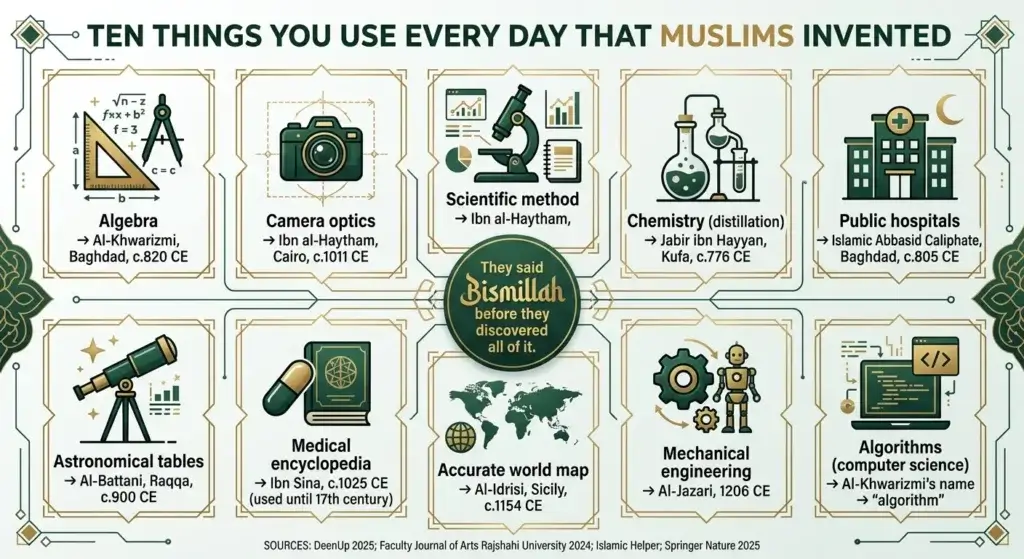
Section 2: Ten Islamic Inventions Your Child Uses Every Single Day {#section-2}
| What | Who | When | How Your Child Uses It Today |
|---|---|---|---|
| Algebra | Al-Khwarizmi | c.820 CE | Every math class, every equation |
| Algorithms | Al-Khwarizmi (name) | c.825 CE | Every app, every computer, every AI |
| Camera optics | Ibn al-Haytham | c.1011 CE | Every photograph ever taken |
| Scientific method | Ibn al-Haytham | c.1011 CE | Every science experiment in every school |
| Chemistry (distillation) | Jabir ibn Hayyan | c.776 CE | Every medicine, every purified substance |
| Medical diagnosis | Ibn Sina | c.1025 CE | Every clinical examination |
| Surgical tools | Al-Zahrawi | c.1000 CE | Every operating room in the world |
| Accurate world map | Al-Idrisi | c.1154 CE | The foundation of all subsequent cartography |
| Mechanical engineering | Al-Jazari | 1206 CE | First crank mechanism — basis of every engine |
| University system | Fatima al-Fihri | 859 CE | Every university your child will attend |
Section 3: The Scientific Method Was Muslim First
Artificial intelligence — often seen as a modern Western invention — has its roots in the Islamic Golden Age. Al-Khwarizmi, Al-Kindi, Ibn Sina, and Al-Jazari developed early ideas in algorithms, logic, and automated machines key to today’s AI. Al-Khwarizmi’s step-by-step procedures laid the foundation for programming logic, enabling machines to process data, make decisions, and learn from patterns.
The history of science as taught in Western schools credits the Scientific Revolution to 16th and 17th century European thinkers — Copernicus, Galileo, Newton. What this narrative omits:
The scientific method itself — controlled observation, hypothesis formation, experimental testing, and iterative revision — was documented and practiced by Ibn al-Haytham in Kitab al-Manazir in the year 1011 CE. Five hundred years before Galileo.
The experimental approach to chemistry — systematic testing of hypotheses about material properties — was established by Jabir ibn Hayyan in the 8th century.
Astronomical observation and calculation — Al-Battani (858–929 CE) calculated the length of the year to a precision not surpassed in Europe for six centuries. He corrected Ptolemy’s astronomical predictions and was cited by Copernicus in De Revolutionibus.
The European “Scientific Revolution” was, in significant part, a European Renaissance of ideas that had been developed, documented, and transmitted to Europe through Arabic manuscripts — often translated by Christian and Jewish scholars in Toledo, Sicily, and Palermo who learned Arabic specifically to access Islamic scientific knowledge.
The discoveries and innovations of Islamic scholars were often translated into Latin, transmitting crucial knowledge that fueled the European Renaissance and the Scientific Revolution. Today’s computer algorithms are fundamentally based on the principles Al-Khwarizmi introduced, and modern cameras operate on optical principles experimentally verified by Al-Haytham.
The child who knows this history does not sit with a contradiction between science and Islam. They sit with a responsibility: to continue the tradition of their intellectual ancestors, motivated by the same divine mandate to read and observe and know.
Section 4: How quranst Plants the Scientific Spirit Alongside Islamic Learning
The connection between Islamic learning and scientific curiosity is not a modern addition to Islamic education. It is an ancient, foundational, Quranic dimension of what Islamic knowledge is.
quranst’s curriculum embeds this connection in three specific ways:
The Arabic Connection to the Golden Age
Every child who learns Arabic at quranst is learning the language in which the greatest scientific civilization of the medieval world conducted its research, wrote its discoveries, and transmitted its knowledge.
The discoveries and innovations of Islamic scholars during the Islamic Golden Age were compiled and communicated in Arabic — the language of the Quran and the lingua franca of the Islamic world. Learning Arabic is therefore not only Quranic access; it is access to the primary sources of the Islamic scientific tradition that shaped the modern world.
The child who learns Arabic through quranst is learning to read Ibn al-Haytham in the language he wrote. To access Al-Khwarizmi’s algebra in the original. To understand Ibn Sina’s medical reasoning in the words he used. The Arabic they learn for the Quran is the same Arabic in which the Golden Age wrote everything else.
The Quranic Mandate as Scientific Motivation
In every quranst Islamic Studies session, the Quranic verses that command observation, reflection, and inquiry are taught not as spiritual metaphors but as intellectual mandates:
“Do they not look at the camels — how they were created? And at the sky — how it was raised? And at the mountains — how they were erected? And at the earth — how it was spread out?” (Quran 88:17–20)
These four questions — directed by Allah Himself to human beings — are science questions. They are the divine mandate to observe creation with the curiosity that Ibn al-Haytham carried into his study of light, that Al-Khwarizmi carried into his study of numbers, that Jabir ibn Hayyan carried into his study of matter.
The child who learns these verses in a quranst Islamic Studies session and then encounters the story of Ibn al-Haytham studying light in a darkened room is connecting two things that were always one thing: the divine command to observe, and the human response of scientific inquiry.
The Seerah as Scientific Inspiration
The Prophet ﷺ said:
“Allah has not sent down a disease except that He has also sent down its cure.”
— Sahih al-Bukhari, Hadith 5678
This single hadith motivated generations of Muslim physicians to search — systematically, experimentally, relentlessly — for the cures Allah had placed in creation. Ibn Sina’s Canon of Medicine, Al-Razi’s clinical distinctions between diseases, Al-Zahrawi’s surgical innovations — all driven, in part, by the Prophetic guarantee that the cures exist and must be found.
The child who learns this hadith in a quranst session and then learns the story of Ibn Sina or Al-Razi has received the most powerful scientific motivation available: not career prospects or exam grades, but the belief that knowledge is a divine gift and the search for it is an act of worship.
Section 5: Raising the Scientifically Curious Muslim Child — A Practical Framework
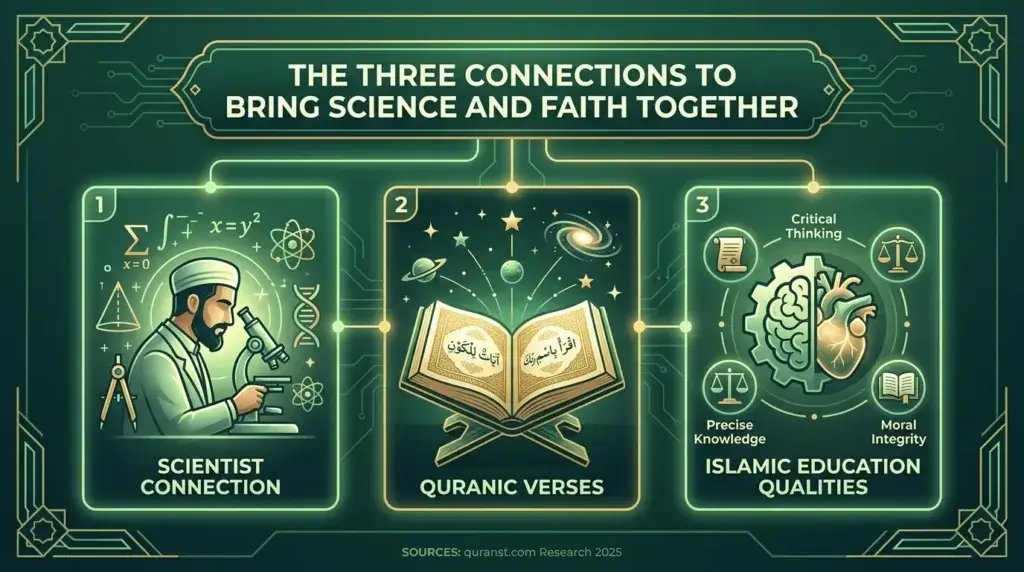
The Three Connections That Change Everything
Connection 1: Every scientific discovery has a Muslim pioneer. Make it a family habit: whenever a science topic comes up in homework, news, or conversation — find the Muslim connection. Chemistry? Jabir ibn Hayyan. Algebra? Al-Khwarizmi. Optics and photography? Ibn al-Haytham. Surgery? Al-Zahrawi. Medicine? Ibn Sina.
This is not historical revisionism. It is historical accuracy. The connections are real, documented, and profound. They just have not been taught.
Connection 2: The Quran asks scientific questions. When your child studies any topic in science, open the Quran to a relevant verse and read it together. Studying astronomy? “And it is He who created the night and the day and the sun and the moon; all in an orbit are swimming.” (Quran 21:33) Studying biology? “And He created every living thing from water.” (Quran 21:30)
The child who encounters the Quran alongside their science education discovers that their faith and their intellectual life are pointing in the same direction.
Connection 3: Islamic education develops the same qualities as scientific education. The qualities that make a great scientist — patience, precision, willingness to test assumptions, commitment to truth over convenience, intellectual humility — are exactly the qualities that Islamic education aims to produce.
The hafiz who memorizes the Quran with precision is developing precision. The Arabic student who learns the root system is developing systematic thinking. The Islamic studies student who learns to distinguish between authenticated and weak hadith is developing critical source evaluation — one of the most fundamental skills in scientific methodology.
The Weekly Scientist Story
Once per week — alongside the regular Islamic learning — introduce one Islamic scientist story at the family dinner table:
“This week’s scientist: Ibn al-Haytham. He was stuck in a room for ten years. Instead of giving up, he studied how light works. Let me show you the experiment he did that proved how your eyes actually see…”
The story + a simple home experiment (the camera obscura can be recreated in a dark room with a pinhole in a window cover) + the connection to daily life + the Islamic motivation (“He was studying a sign of Allah in creation”) = a ten-minute investment that could shape how a child sees their faith and their science for the rest of their life.
Section 6: The Modern Muslim Scientist — Connecting Heritage to Future
The story of Islam and science does not end with the Golden Age. It continues today — in Muslim scientists, physicians, engineers, and mathematicians working in every country and every field.
The Muslim child who is told that the Islamic tradition is intellectually rich — who knows that Al-Khwarizmi invented algebra, that Ibn al-Haytham developed the scientific method, that the modern world runs on discoveries made by people who said Bismillah before they worked — that child approaches their science education with a different relationship to their own identity.
They are not Muslims despite being interested in science. They are Muslims because of a tradition that commanded scientific inquiry as an act of worship.
They are not choosing between their faith and their intellectual ambitions. They are inheriting a civilization that refused to make that choice — and produced the most scientifically productive period in human history as a result.
Discover Your Child’s True Intellectual Heritage
quranst’s Islamic Studies track teaches the Islamic intellectual tradition — including the scientific tradition — as part of a coherent, Quran-anchored curriculum. The child who learns with quranst learns who their intellectual ancestors were.
Explore Islamic Studies →Conclusion: The Discovery That Begins with Bismillah
Al-Khwarizmi began his algebra book with Bismillah al-Rahman al-Raheem.
Ibn al-Haytham conducted his optical experiments in a civilization that understood the study of creation as an act of worship.
Ibn Sina, who memorized the Quran at age ten, wrote the medical textbook that doctors used for six hundred years.
They did not separate their faith from their science. They did not choose between their Islam and their intellectual ambition. They experienced them as the same thing — the divine command to read, to observe, to know — expressed through different disciplines but driven by the same source.
The child who inherits this understanding has no contradiction to carry. They have an inheritance to build on.
The science teacher who tells the class that rational inquiry requires leaving religion at the door has not reckoned with Al-Khwarizmi. The cultural narrative that presents Islam as intellectually backward has not encountered Ibn al-Haytham. The assumption that faith and science are incompatible has not yet met the civilization that developed both, together, grounded in the Quran’s first word:
Iqra. Read.
اقْرَأْ بِاسْمِ رَبِّكَ الَّذِي خَلَقَ
“Read in the name of your Lord who created.”
— Quran 96:1
Read. Discover. Inherit. Continue.
The civilization that said Bismillah before it discovered everything is waiting for the generation that will say it next.
🟢 Build the Child Who Inherits Both the Quran and the Scientific Tradition
The Islamic education that produces scientifically curious, intellectually confident Muslim children is the education that connects the Quran to the civilization it produced — including its extraordinary scientific tradition.
quranst’s Islamic Studies track provides:
Islamic History and Civilization:
- The Islamic Golden Age as part of the Islamic studies curriculum
- Muslim scientists and inventors connected to Quranic intellectual mandates
- Study Islam online — the intellectual tradition that shaped the modern world
The Quranic Connection:
- Verses commanding observation, reflection, and inquiry — taught as intellectual mandates
- Hadith that motivated scientific research — including Ibn Sina’s medical tradition
- Aqeedah — Islamic creed that integrates reason and revelation
The Arabic Connection:
- Learn Arabic — the language in which every Golden Age discovery was documented
- Classical Arabic — the gateway to primary sources of the Islamic scientific tradition
- Online Arabic tutor — teaching the language of both the Quran and the scholars
The Complete Islamic Education:
- Islamic parenting coaching — how to connect Islamic learning to scientific curiosity at home
- Raising Muslim children with both deep faith and intellectual confidence
- Islamic education that produces children who know their heritage
👇 Begin with Two Free Sessions
Build the Child Who Inherits Both the Quran and the Scientific Tradition
The Islamic education that produces scientifically curious, intellectually confident Muslim children is the education that connects the Quran to the civilization it produced — including its extraordinary scientific tradition.
Your child is next. Begin. بِسْمِ اللَّهِ
“Seeking knowledge is obligatory upon every Muslim.”
— Sunan Ibn Majah, Hadith 224; authenticated by al-Albani
They sought it. They found it. They changed the world.
Your child is next. Begin.
بِسْمِ اللَّهِ — Begin.
References and Sources
Quranic References
- Quran 21:30 — “And He created every living thing from water”
- Quran 21:33 — “The sun and the moon — all in an orbit are swimming”
- Quran 35:28 — “It is only those who have knowledge among Allah’s servants who fear Him”
- Quran 41:53 — “We will show them Our signs in the horizons and within themselves”
- Quran 88:17–20 — “Do they not look at the camels, the sky, the mountains, the earth?”
- Quran 96:1 — “Read in the name of your Lord who created”
Hadith References
- Sahih al-Bukhari, Hadith 5678 — “Allah has not sent down a disease except that He has also sent down its cure”
- Sunan Ibn Majah, Hadith 224 — “Seeking knowledge is obligatory upon every Muslim” (authenticated by al-Albani)
Academic Research Sources
- Majallah — Jamia UK (2021). “Inventions of the Islamic Golden Age.” Key findings: Jabir ibn Hayyan, Al-Jazari, Al-Zahrawi, Abbas ibn Firnas among influential inventors; Al-Khwarizmi introduced algebra; Ibn al-Haytham developed optics and camera obscura; Islamic inventions shaped the modern world.
- Islamic Helper / Historical Reference. “The Islamic Golden Age: Great Inventors and the Invaluable Gifts They Bestowed.” Key findings: Jabir ibn Hayyan (c.721–815 CE) — Father of Chemistry; Al-Khwarizmi algebra books translated into Latin; Ibn al-Haytham influenced Roger Bacon, Kepler, Descartes; Al-Jazari described 50 mechanical inventions with illustrations; complete biographical table of Golden Age scientists.
- Aura Magazine (2025). “Muslim Scientists Who Changed the World: A Legacy of Genius, Curiosity, and Innovation.” Key findings: Al-Khwarizmi organized equations systematically; Ibn al-Haytham’s most enduring legacy is empirical, experimental methodology resembling modern scientific method; Al-Jazari 50 mechanical inventions became major source for mechanical engineering in Europe; Jabir ibn Hayyan designed early alembic instrument.
- Springer Nature / Communities (July 2025). “Islamic Golden Era scholars’ Contributions to Artificial Intelligence: An Inclusive Historical Perspective.” Key findings: AI roots lie in the Islamic Golden Age; Al-Khwarizmi’s algorithms are the backbone of all AI; Al-Kindi’s logic supported rule-based reasoning; Al-Jazari’s automata demonstrated physical machine intelligence; Al-Khwarizmi’s Kitab al-Jabr established algebra as basis for symbolic computation.
- DeenUp App (2025). “Muslim Golden Age Inventions That Changed the World” and “Islamic Scientists: Pioneers of the Golden Age.” Key findings: Islamic Golden Age (750–1258 CE) produced foundational contributions; Al-Khwarizmi founded algebra and gave us “algorithm”; Ibn al-Haytham proved how vision works and introduced controlled experiments; Ibn Sina’s Canon of Medicine shaped medicine for 600 years; Jabir ibn Hayyan developed first systematic experimental methods in chemistry; Al-Biruni calculated Earth’s circumference with remarkable precision.
- ResearchGate / Faculty Journal of Arts Rajshahi University (January 2024). “Muslim Scientists of the Golden Age.” Key findings: Ibn al-Haytham (965-1040 CE) — father of modern optics; pioneer of camera obscura; influenced European scientists; Jabir ibn Hayyan pioneered experimental methodology centuries before European recognition; Islamic Golden Age scientific achievements well-documented.
- Studio Arabiya (2025). “Top 25 Islamic Golden Age Inventions That Shaped Our World.” Key findings: Al-Razi differentiated smallpox from measles; Al-Zahrawi most skilled surgeon of his time; Ibn al-Haytham invented camera obscura; Islamic scientists engineered first proper magnifying glasses; same encouragement to explore, ask, and learn fostered in child-friendly Islamic learning.
Frequently Asked Questions
Why do Muslim children need to learn about the Islamic Golden Age?
Who were some of the key Muslim scientists and what did they invent?
- Al-Khwarizmi: Founded algebra and gave us the concept of algorithms.
- Ibn al-Haytham: Established the scientific method and optical principles behind the camera.
- Jabir ibn Hayyan: Pioneered chemistry and distillation methods.
- Ibn Sina: Wrote The Canon of Medicine, which shaped medicine for 600 years.
How does learning Arabic connect children to the scientific tradition?
How can parents foster scientific curiosity alongside Islamic education?
- Connect Discoveries: Tie everyday science topics to Muslim pioneers (e.g., algebra to Al-Khwarizmi).
- Explore Quranic Signs: Read Quranic verses that invite observation of the universe (Ayat in the horizons).
- Consistent Learning: Combine spiritual development with structured academic frameworks.
