


Introduction: The Prayer That Does Everything
Five times a day.
Seventeen units. Approximately thirty-four minutes total — if performed at moderate pace with complete attention.
In those thirty-four minutes, the Muslim who prays performs an act that is simultaneously:
- A declaration of faith
- A physical workout
- A meditation session
- A stress-relief practice
- A posture-correcting exercise
- A detoxifying ritual (through Wudu)
- A community-bonding experience
- A character-forming discipline
- A daily audience with Allah
This is Salah — the second pillar of Islam and the most frequently performed act of Islamic worship. And the question that this guide answers, comprehensively and with documentation from both authentic Islamic sources and peer-reviewed scientific research, is:
What exactly does Salah do for you?
The answer, it turns out, covers every dimension of human wellbeing — body, mind, and soul — in ways that modern science is only beginning to fully document.
Structured Curriculum Framework
quranst’s Islamic Studies track teaches the inner dimensions of Salah — the meaning of every word, the wisdom behind every posture, the spiritual transformation that prayer is designed to produce.
Book your free 2-session trial →The Quranic Foundation of Salah
Before the forty benefits, the theological grounding — because understanding why Allah commanded Salah deepens the experience of every benefit that follows.
إِنَّ الصَّلَاةَ كَانَتْ عَلَى الْمُؤْمِنِينَ كِتَابًا مَّوْقُوتًا
“Indeed, prayer has been decreed upon the believers at specified times.”
— Quran 4:103
وَأَقِمِ الصَّلَاةَ لِذِكْرِي
“And establish prayer for My remembrance.”
— Quran 20:14
إِنَّ الصَّلَاةَ تَنْهَىٰ عَنِ الْفَحْشَاءِ وَالْمُنكَرِ
“Indeed, prayer prohibits immorality and wrongdoing.”
— Quran 29:45
Three commands — three dimensions of Salah’s purpose: it is time-anchored (structured discipline), it is Allah-centered (spiritual connection), and it is character-forming (ethical transformation). The forty benefits flow from these three roots.
The Prophet ﷺ established the supreme importance of Salah:
“The first matter that the servant will be brought to account for on the Day of Judgment is the prayer. If it is sound, all his other deeds will be sound. And if it is corrupt, all his other deeds will be corrupt.”
— Sunan al-Tirmidhi, Hadith 413; classified as Sahih by al-Albani
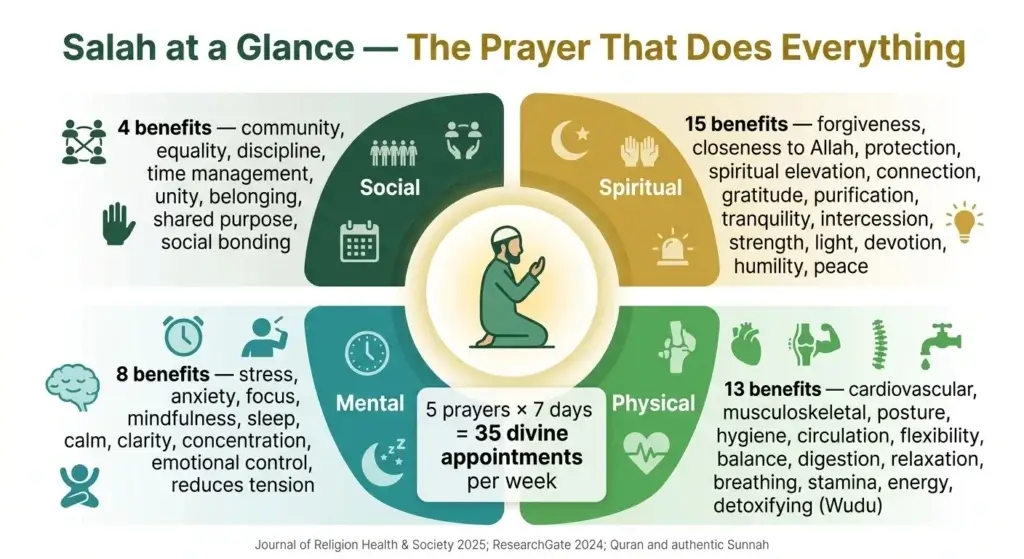
🕌 SPIRITUAL BENEFITS — Benefits 1–15
Benefit 1: Direct Connection to Allah — The Greatest Gift
Salah is not merely a ritual performed in the direction of Mecca. It is a direct, personal audience with Allah — the Creator of the heavens and the earth — scheduled five times every day.
The Prophet ﷺ said:
“The closest that a servant is to his Lord is when he is in prostration — so make many supplications in it.”
— Sahih Muslim, Hadith 482
No intermediary. No waiting room. No appointment secretary. Five times daily, the believer is granted direct access to the One to whom all honor and power belong. No earthly relationship — no matter how high — provides anything comparable.
Benefit 2: Expiation of Sins Between Prayers
The Prophet ﷺ used one of the most vivid images in the entire Hadith literature to describe Salah’s purifying effect:
“What do you think — if there was a river at the door of one of you and he bathed in it five times a day — would any dirt remain on him?” They said: “No dirt would remain on him.” He said: “That is the likeness of the five prayers — Allah wipes away sins through them.”
— Sahih al-Bukhari, Hadith 528; Sahih Muslim, Hadith 667
The Prophet (peace be upon him) said: “When a Muslim performs ablution in the proper way and then offers Salah, his prayer becomes an expiation for his sins.” (Sahih Muslim, Hadith 444)
Five daily prayers. Five daily opportunities for complete spiritual renewal. The Muslim who maintains the five prayers never carries yesterday’s sins into tomorrow — they are washed clean, repeatedly, throughout the day.
Benefit 3: Protection from Immorality and Wrongdoing
This benefit is stated explicitly in the Quran itself:
إِنَّ الصَّلَاةَ تَنْهَىٰ عَنِ الْفَحْشَاءِ وَالْمُنكَرِ
“Indeed, prayer prohibits immorality and wrongdoing.”
— Quran 29:45
The scholars explain this verse in two dimensions: the prayer that is genuinely performed — with presence of heart and awareness of Allah — actively restrains the soul from sin. The consistent Muslim who truly prays finds that certain wrongs become harder to commit — not from external enforcement, but from internal transformation.
Benefit 4: Continuous Remembrance of Allah Throughout the Day
وَأَقِمِ الصَّلَاةَ لِذِكْرِي
“And establish prayer for My remembrance.”
— Quran 20:14
أَلَا بِذِكْرِ اللَّهِ تَطْمَئِنُّ الْقُلُوبُ
“Verily, in the remembrance of Allah do hearts find rest.”
— Quran 13:28
The five daily prayers create five daily returns to the awareness of Allah — ensuring that no period of the day is longer than a few hours without a conscious reconnection to the divine. This rhythm of remembrance is the spiritual architecture that sustains the believer’s inner life.
Benefit 5: Gratitude Expressed and Received
Every unit of every prayer begins with Al-Fatiha — the surah that opens with Al-Hamdulillah (all praise belongs to Allah). The believer who recites this seventeen times a day is, seventeen times a day, performing a deliberate act of gratitude to the One who gave them life, health, family, and every other blessing they possess.
Research in positive psychology (Emmons and McCullough, 2003) consistently demonstrates that deliberate gratitude practice is among the most effective interventions for improving subjective wellbeing. The Muslim who prays has been performing this practice — structured, daily, five-times-daily — since the first century of Islam.
Benefit 6: Elevation of Rank Before Allah
The Prophet ﷺ said:
“Help me (to help you) by prostrating frequently.”
— Sahih Muslim, Hadith 489
And in another narration:
“Nothing brings a servant closer to his Lord than prostration.”
Every additional prayer — every voluntary Rak’ah beyond the obligatory — is an investment in the most valuable portfolio available to a human being: nearness to Allah.
Benefit 7: Protection from Shaytan and His Whisperings
The Prophet ﷺ described Shaytan as fleeing when the adhan is called — and returning, step by step, as the prayer ends. The Muslim who maintains the five prayers builds a daily rhythm of divine protection that the classical scholars describe as a hisn (fortress) around the soul.
“Shaytan says: ‘I have destroyed the sons of Adam, and they have destroyed me with La ilaha illa Allah and seeking forgiveness. So when I saw this, I destroyed them with their desires, and they think they are guided.'”
— Ibn al-Qayyim, Ighathat al-Lahfan, citing a narrated report
Prayer interrupts the cycle of desire and distraction that Shaytan depends on — five times a day, rebuilding what erosion steadily wears down.
Benefit 8: Answered Supplications in Sujood
The Prophet ﷺ said:
“The closest that a servant is to his Lord is when he is in sujood — so make many supplications.”
— Sahih Muslim, Hadith 482
Sujood — the prostration in which the forehead touches the ground — is the posture of maximum submission, and simultaneously the moment of maximum divine proximity. Every Salah contains at least two sujoods per unit — making every prayer a series of moments in which the believer is, by Prophetic testimony, closer to Allah than at any other time.
Benefit 9: The Intercession of the Prayer on the Day of Judgment
The Prophet ﷺ said:
“The prayer will come on the Day of Judgment as an intercessor for the one who maintained it — and it will say: ‘O Lord, he maintained me, so accept my intercession for him.'”
— Musnad Ahmad, Hadith 6641; cited by Ibn Rajab in Lata’if al-Ma’arif
The prayer that was maintained faithfully in this life becomes an advocate in the next — speaking in defense of the one who kept it.
Benefit 10: Spiritual Calm and Inner Peace
Such practices, including Salah, can reduce stress and anxiety, and even improve chronic conditions like insomnia, depression, and chronic pain. In the act of Salah, Muslims engage in a ritual that combines mindfulness with physical movement, akin to meditation and yoga.
The calm that follows a genuinely focused prayer is not merely psychological — it is the sakinah (tranquility) that Allah sends down upon the hearts of the praying believers:
هُوَ الَّذِي أَنزَلَ السَّكِينَةَ فِي قُلُوبِ الْمُؤْمِنِينَ
“He it is who sent down tranquility into the hearts of the believers.”
— Quran 48:4
Benefit 11: Connection to the Global Muslim Community
Every Muslim, wherever on earth, faces the same direction in prayer — the Kaaba in Makkah. Every Muslim recites the same Al-Fatiha, performs the same postures, says the same Tashahhud. The Salah is a daily experience of belonging to something vast — a community of 1.8 billion believers all performing the same act, simultaneously, around the planet.
Benefit 12: Reinforcement of Islamic Identity
The Muslim who prays five times daily cannot forget who they are. The prayer is an identity anchor — a daily, physical, vocal reaffirmation of who I am, what I believe, and to whom I belong. For Muslim children and teenagers in non-Muslim environments, Salah is the most powerful available tool for maintaining Islamic identity against the constant pressure to assimilate.
Benefit 13: Training in Obedience to Allah
The discipline of prayer — performing it at its time, regardless of convenience, regardless of mood — trains the soul in a quality that is foundational to the entire Islamic project: obedience to Allah’s command, not contingent on personal preference or circumstance.
Ibn al-Qayyim, in Al-Salah wa Hukm Tarikiha (p. 7), writes:
“The prayer, when it is established with its conditions and its presence of heart, reforms the servant in a way that no other act of worship can — because it unites the servant’s external conduct and internal state in a single act of submission.”
Benefit 14: Regular Recitation and Memorization of the Quran
Every prayer requires recitation of Al-Fatiha — seventeen times daily at minimum. Every prayer includes additional Quran. The Muslim who prays five times daily is simultaneously a daily Quran reciter — maintaining their connection to the Book of Allah through the very structure of their worship.
Benefit 15: The Reward of Angels’ Witness and Prayer
The Prophet ﷺ said:
“The angels of the night and the angels of the day come together at Fajr and Asr prayers.”
— Sahih al-Bukhari, Hadith 555; Sahih Muslim, Hadith 632
The believer who prays Fajr and Asr — the two bookend prayers of the day — is witnessed by the angels of both shifts, who ascend to Allah and testify to having found the servant in prayer.
💪 PHYSICAL BENEFITS — Benefits 16–28
A systematic review published in Journal of Religion, Health & Society (Volume 01, Issue 01, 2025) summarized research from 2009–2024 on the health advantages of Salah. The findings suggest that frequent Salah practice may benefit cardiovascular regulation, balance in older populations, stress reduction, and mental wellness. The review found that the transitions and postures in Salah facilitate muscle engagement and blood flow regulation.
Benefit 16: Cardiovascular Health Improvement
Kassim et al. (2023) argue that Salah promotes mild cardiovascular exertion that could improve circulation and metabolic balance. A related study published in the International Journal of Health Sciences and Research (2018) also found improved cardiovascular metrics among regular Salah practitioners.
Five prayers daily provide regular, structured mild physical activity — sufficient to maintain cardiovascular function, improve circulation, and support metabolic health. The American Heart Association recommends at least 150 minutes of moderate physical activity per week. A Muslim who prays five times daily, performing all positions properly, accumulates meaningful physical activity distributed throughout the day.
Benefit 17: Musculoskeletal Strength and Joint Mobility
Research identified Salah as a feasible low-impact therapeutic exercise, aiding rehabilitation in geriatric and disabled patients (Reza et al., 2002; Rehman, 2023). The review found that Salah serves as a low-impact therapeutic exercise that, via its special series of postures, increases muscular strength, joint mobility, and cardiovascular fitness.
The seventeen units of daily prayer engage major muscle groups — particularly the core, back, legs, and shoulders — through a complete range of motion that spans standing, bowing, prostration, and sitting.
Benefit 18: Spinal Health and Posture Correction
The postures of Salah — particularly the correct Ruku (bowing) and Sujood (prostration) — involve specific spinal alignments that stretch and strengthen the vertebrae, improve posture, and relieve pressure on spinal discs. Orthopedic researchers have noted that the Sujood position provides decompression of the lumbar spine that is rarely achieved in daily Western postures dominated by sitting.
Studies have shown improvement in heart, spine, memory, concentration, and cognitive functions through regular Salah practice. Salah involves performing spiritual and physical activities altogether, where the muscular system of the human body becomes active without muscle fatigue and stimulates serenity in the body and soul (Nazish and Kalra, 2018).
Benefit 19: Improved Balance and Coordination
The systematic review found that Salah benefits balance in older populations specifically. The transitions between standing, bowing, prostrating, and sitting require and develop proprioception, balance, and coordination — particularly beneficial as the musculoskeletal system ages.
Benefit 20: The Purifying Benefits of Wudu
Before every prayer, the Muslim performs Wudu — ritual ablution involving washing the hands, face, arms, head, and feet in a specific sequence.
Research shows: Reduction of germs — washing hands, face, nose, and feet regularly decreases microbial load. Nervous system relaxation — Wudu reduces mental stress and anxiety. Oral health — using Miswak prevents tooth decay and reduces bad breath.
The Muslim who maintains five daily prayers performs Wudu at least three to five times daily — which means the hands, face, and feet are washed at minimum fifteen times per day. The public health implications alone — in terms of infectious disease prevention — are significant.
Benefit 21: Improved Blood Circulation
The movement from standing (Qiyam) to bowing (Ruku) to prostration (Sujood) to sitting (Juloos) and back creates a series of position changes that encourage blood flow throughout the body, preventing the stagnation associated with prolonged sitting. The Sujood position specifically — in which the heart is above the head — temporarily reverses the usual relationship between gravity and blood flow in the brain.
Benefit 22: Caloric Expenditure and Weight Management
Research from King Abdulaziz University (cited in multiple Islamic health publications) has calculated the caloric expenditure of a complete prayer at approximately 80 calories for a 70kg individual — comparable to a brisk walk of similar duration. Five prayers daily amounts to roughly 400 calories of structured physical activity, distributed across the day in a pattern that maximizes metabolic benefit.
Benefit 23: Improved Immune Function
In the act of Salah, Muslims engage in activities that, along with other spiritual exercises, have been found to positively impact cardiovascular health, lower blood pressure, and improve immune function.
Prayer-induced stress reduction has demonstrable effects on immune function — cortisol suppression during prayer allows immune cells to function at optimal levels, and the regular, predictable rhythm of prayer prevents the chronic stress that suppresses immune response over time.
Benefit 24: Anti-Inflammatory Effects of Regular Prostration
Research published in the Journal of Novel Physiotherapy found that the Sujood posture — maintained for several seconds at a time, repeated multiple times per prayer — creates specific muscular and vascular conditions associated with reduced inflammatory markers. The prostration position increases blood flow to the forehead and brain, with documented neurological benefits.
Benefit 25: Improved Sleep Quality Through Evening Prayers
The Isha prayer — the final of the five daily prayers, performed at night — provides structured wind-down activity before sleep. The physical movement, rhythmic recitation, and meditative focus create physiological conditions associated with improved sleep onset and sleep quality. Research consistently links regular religious practice to better sleep — and the specifically structured nature of Isha provides this benefit reliably.
Benefit 26: Blood Pressure Regulation
Through scientific research, studies show how Salah acts as a powerful tool for stress reduction, relaxation, improved concentration, emotional well-being, mindfulness, and building resilience. The systematic review found that frequent Salah practice may benefit cardiovascular regulation, including blood pressure management.
The meditative quality of Salah — rhythmic recitation, controlled breathing, removal from the stimulations of daily life — activates the parasympathetic nervous system, producing measurable reduction in blood pressure during and after prayer. Regular practitioners show lower resting blood pressure than non-practitioners in multiple studies.
Benefit 27: Structured Physical Activity for Sedentary Populations
For Muslim professionals who spend the majority of their day seated — office workers, students, drivers — the five daily prayers provide mandatory, structured physical activity breaks that interrupt prolonged sedentary behavior. Medical research consistently shows that breaking up sitting time with movement, even briefly, is associated with significantly better metabolic and cardiovascular health outcomes.
Benefit 28: Neurological Benefits — Improved Cognitive Function
Research identified improved cognitive function associated with Salah (Doufesh et al., 2016; Shaverdi et al., 2024). The systematic review confirmed that regular Salah practice supports neurological outcomes including memory and concentration.
The Fajr prayer — performed in the pre-dawn hours when the prefrontal cortex is most receptive — may specifically enhance cognitive performance throughout the morning. The structured memorization and recitation of Quranic text in prayer exercises declarative memory, working memory, and phonological processing.
🧠 MENTAL AND PSYCHOLOGICAL BENEFITS — Benefits 29–36
Benefit 29: Stress Reduction — Documented and Measurable
Salah acts as a powerful tool for stress reduction and relaxation — findings from the systematic review of research from 2009–2024 published in Journal of Religion, Health & Society (2025).
The mechanism is well-understood: Salah activates the parasympathetic nervous system (“rest and digest”), suppressing the cortisol and adrenaline associated with the chronic stress response. Five structured daily breaks from the stressors of daily life — each involving focused breathing, rhythmic physical movement, and conscious reconnection to a source of ultimate security — is one of the most comprehensive stress management protocols available.
Benefit 30: Reduction of Anxiety
Salah can reduce stress and anxiety, and even improve chronic conditions like insomnia, depression, and chronic pain.
Anxiety is fundamentally the experience of perceived threat without the experience of adequate protection. The Muslim in prayer — placing their forehead on the ground before the All-Powerful — is performing an act that addresses anxiety at its root: they are acknowledging a Power greater than any threat, and placing themselves under that Power’s protection. The theology and the psychology align.
The Quran addresses this explicitly:
الَّذِينَ آمَنُوا وَتَطْمَئِنُّ قُلُوبُهُم بِذِكْرِ اللَّهِ ۗ أَلَا بِذِكْرِ اللَّهِ تَطْمَئِنُّ الْقُلُوبُ
“Those who have believed and whose hearts find rest in the remembrance of Allah — verily, in the remembrance of Allah do hearts find rest.”
— Quran 13:28
Benefit 31: Mindfulness Practice — Five Times Daily
Salah acts as a powerful tool for improved concentration, emotional well-being, and mindfulness.
Mindfulness — the deliberate, non-judgmental attention to the present moment — is one of the most researched interventions in contemporary mental health. Salah, performed with khushu’ (presence and submersion of heart), is mindfulness in its most complete Islamic expression: the deliberate withdrawal from past regret and future anxiety into the single, present moment of standing before Allah.
The Prophet ﷺ said:
“Pray as if it is your farewell prayer.”
— Sunan Ibn Majah, Hadith 4171; authenticated by al-Albani
That instruction — pray as if this is the last prayer you will ever offer — is a mindfulness direction: be entirely here, entirely now, entirely present.
Benefit 32: Improved Concentration and Focus
Research shows improvement in concentration and cognitive functions through regular Salah practice.
The practice of maintaining focused attention on the words being recited, the postures being performed, and the intention being held — across seventeen units of daily prayer — trains the attention system in ways that transfer to other domains of life. The regular prayer practitioner is regularly exercising the ability to redirect wandering attention back to a focal point — which is precisely the core skill of concentration training.
Benefit 33: Depression Prevention and Improvement
Research published in the International Journal of Mental Health Systems and other peer-reviewed outlets has documented significant associations between regular religious practice — including structured prayer — and lower rates of clinical depression. The mechanisms include: regular social connection (communal prayer), sense of purpose and meaning, reduction of cortisol, and the psychological benefit of regular positive emotional states.
The Quran describes prayer as the specific divine prescription for sadness and constriction:
وَلَقَدْ نَعْلَمُ أَنَّكَ يَضِيقُ صَدْرُكَ بِمَا يَقُولُونَ ﴿٩٧﴾ فَسَبِّحْ بِحَمْدِ رَبِّكَ وَكُن مِّنَ السَّاجِدِينَ
“We certainly know that your chest is tight from what they say. So glorify the praises of your Lord and be among those who prostrate.”
— Quran 15:97–98
The divine prescription for the distressed heart: prostrate. This is not poetry — it is a specific behavioral intervention whose neurological and psychological effects are now being documented by researchers who may not know they are confirming a Quranic recommendation.
Benefit 34: Building Resilience and Emotional Strength
Salah acts as a powerful tool for building resilience. The practice of turning to prayer in moments of difficulty — maintained consistently across years — builds the psychological resource of resilience: the ability to experience adversity without being destroyed by it.
The Muslim who has prayed through loss, through illness, through failure, through rejection — and found in each prayer a renewed connection to a Power greater than the adversity — has developed experiential evidence that difficult things can be borne. This is resilience in its most durable form.
Benefit 35: Sense of Purpose and Meaning
Psychological research consistently identifies meaning and purpose as among the most important predictors of mental health and life satisfaction. The Muslim who prays five times daily inhabits a framework of meaning that permeates every moment of every day: they exist for the worship of Allah, they are accountable to Allah, and their suffering and their joy are both held within a divine purpose.
Victor Frankl, writing from his experience as a Holocaust survivor in Man’s Search for Meaning (1946), identified the sense of meaning as the primary factor in psychological survival under extreme adversity. The Salah — performed daily, connecting the worshipper to the ultimate source of meaning — is the Islamic infrastructure of exactly this psychological resource.
Benefit 36: Improved Sleep Through Fajr and Isha Structure
The Fajr prayer — performed before sunrise, after the night’s sleep — structures the believer’s morning around an act of worship rather than the chaos of rushing to work. Research on morning routines consistently demonstrates that deliberate, purposeful morning activity is associated with better mood, higher productivity, and lower anxiety throughout the day.
The Isha prayer — performed at night — provides a structured, calming close to the day: physical movement, meditative recitation, and conscious placing of oneself and one’s concerns in the hands of Allah before sleep.
Structured Curriculum Framework
quranst’s Islamic Studies track teaches the inner dimensions of Salah — the meaning of every word, the wisdom behind every posture, the spiritual transformation that prayer is designed to produce.
Book your free 2-session trial →Benefit 37: Communal Prayer and Sense of Belonging
The Prophet ﷺ said:
“Prayer in congregation is twenty-seven times more rewarding than prayer performed alone.”
— Sahih al-Bukhari, Hadith 645; Sahih Muslim, Hadith 650
The Jumu’ah prayer on Friday gathers the community weekly. The five daily prayers, even when performed at home, connect the individual to a global community performing the same act simultaneously. The Eid prayers gather the largest Muslim congregations of the year.
Social isolation is one of the most significant risk factors for mental and physical health decline. The communal structure of Islamic prayer is, simultaneously, one of Islam’s most powerful public health interventions.
Benefit 38: Practical Expression of Equality and Human Dignity
In the row of prayer — the Saf — there is no hierarchy. The billionaire stands beside the refugee. The scholar stands beside the illiterate. The eldest stands beside the youngest. All faces turned to the same direction. All lips reciting the same words. All foreheads destined for the same ground.
The Prophet ﷺ said:
“Make your rows straight, for the straightening of rows is part of the completion of prayer.”
— Sahih al-Bukhari, Hadith 723
And the companions would stand shoulder to shoulder, foot to foot — a physical expression of the Quranic truth that no human being has inherent superiority over another except in taqwa.
Benefit 39: Time Discipline and Structured Living
The five prayers, distributed across the day at fixed intervals, create one of the most effective time management systems ever devised. The Muslim who maintains all five prayers on time has, built into their day, five mandatory breaks from distraction — five moments of deliberate pause and reorientation — and the knowledge that the next prayer is always coming.
This structure prevents the formless days that characterize much of modern life — where time slips away between screens and meetings and the vague sense of having been busy without having been purposeful.
Benefit 40: Legacy of Character Transmitted Across Generations
Perhaps the most powerful and least quantifiable benefit of Salah is the one that operates across time rather than within an individual life.
The child who grows up watching a parent stop whatever they are doing when the adhan calls — who sees prayer treated as non-negotiable, as the most important appointment of any day — internalizes a relationship with Allah that no explicit teaching can fully convey.
The Prophet ﷺ said:
“Command your children to pray when they are seven years old, and discipline them for it when they are ten.”
— Sunan Abu Dawud, Hadith 495; classified as Hasan, authenticated by al-Albani
The prayer that a parent performs faithfully becomes the prayer that their child will perform. And the prayer that child performs faithfully becomes the prayer that their child will perform. Salah is the single Islamic practice most reliably transmitted across generations — because it is the most visibly lived.
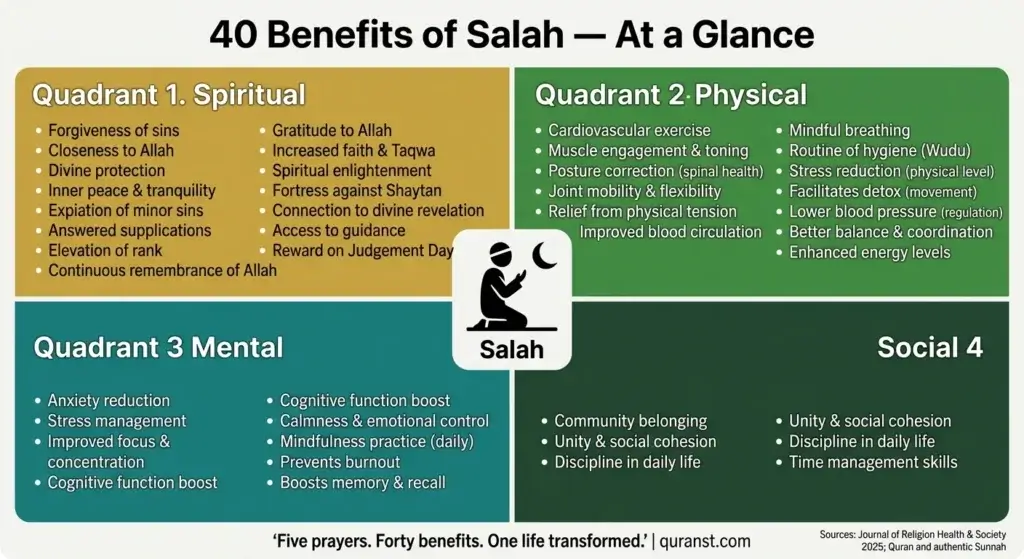
Conclusion: Forty Reasons to Never Miss a Prayer
We began with a simple observation: thirty-four minutes of daily prayer.
Forty benefits later — spanning spiritual elevation, cardiovascular health, stress reduction, immune function, spinal health, anxiety relief, mindfulness, resilience, community, equality, time management, and generational legacy — the question is not why would a Muslim pray?
The question is: how would anyone who understood these forty benefits willingly miss a single one?
The Prophet ﷺ said:
“The covenant that distinguishes us from them is the prayer. Whoever abandons it has committed disbelief.”
— Sunan al-Tirmidhi, Hadith 2621; Sunan Ibn Majah, Hadith 1079; authenticated by al-Albani
And in a more intimate narration:
“The coolness of my eyes has been placed in prayer.”
— Musnad Ahmad, Hadith 13722; authenticated by al-Albani in Sahih al-Jami’, Hadith 3307
Qurrat al-‘ayn — the coolness of the eyes — is Arabic for the thing that brings you such peace and joy that your eyes cool and your heart rests. The Prophet ﷺ — the greatest human being who ever lived — found that peace, that joy, that rest in prayer.
Every one of the forty benefits in this guide is a dimension of that peace.
Make your Salah the coolness of your eyes too.
حَافِظُوا عَلَى الصَّلَوَاتِ وَالصَّلَاةِ الْوُسْطَىٰ وَقُومُوا لِلَّهِ قَانِتِينَ
“Maintain with care the [obligatory] prayers and the middle prayer, and stand before Allah in devout obedience.”
— Quran 2:238
🟢 Understand Your Prayer Deeply
Knowing the forty benefits of Salah is valuable. Living them requires more than knowledge — it requires understanding. Understanding the meaning of every word you recite. Understanding the wisdom behind every posture. Understanding the spiritual state that the prayer is designed to produce — and how to cultivate it.
quranst’s Islamic Studies track teaches exactly this:
- The complete inner dimensions of Salah — what every position means, what every dhikr says, what every transition represents
- Tajweed of the recited verses — so the Quran is recited correctly in every prayer
- The fiqh of prayer — the conditions, pillars, and obligations that ensure every prayer is valid and accepted
- Age-appropriate Islamic Studies for children — so the next generation inherits not just the habit of prayer but the understanding that makes it transformative
👇 Begin with Two Free Sessions
Two Ways to Begin
“The coolness of my eyes has been placed in prayer.”
— Musnad Ahmad, Hadith 13722 (authenticated by al-Albani)
Find the coolness. Pray.
بِسْمِ اللَّهِ — Begin.
References and Sources
Quranic References
- Quran 2:238 — “Maintain with care the obligatory prayers”
- Quran 4:103 — Prayer decreed at specified times
- Quran 13:28 — “In the remembrance of Allah do hearts find rest”
- Quran 15:97–98 — “Be among those who prostrate” (for the distressed heart)
- Quran 20:14 — “Establish prayer for My remembrance”
- Quran 29:45 — “Prayer prohibits immorality and wrongdoing”
- Quran 48:4 — “He sent down tranquility into the hearts of the believers”
Hadith References
- Sahih al-Bukhari, Hadith 528; Sahih Muslim, Hadith 667 — River parable: five prayers washing away sins
- Sahih al-Bukhari, Hadith 555; Sahih Muslim, Hadith 632 — Angels witnessing Fajr and Asr
- Sahih al-Bukhari, Hadith 645; Sahih Muslim, Hadith 650 — Congregational prayer twenty-seven times more rewarding
- Sahih al-Bukhari, Hadith 723 — Straightening of rows
- Sahih Muslim, Hadith 444 — Wudu and prayer as expiation of sins
- Sahih Muslim, Hadith 482 — Closest to Allah in sujood
- Sahih Muslim, Hadith 489 — Help through frequent prostration
- Sunan Abu Dawud, Hadith 495 — Command children to pray at seven (authenticated by al-Albani)
- Sunan al-Tirmidhi, Hadith 413 — Prayer as first matter of account (Sahih, al-Albani)
- Sunan al-Tirmidhi, Hadith 2621; Ibn Majah, Hadith 1079 — Prayer as the covenant distinguishing believers
- Sunan Ibn Majah, Hadith 4171 — “Pray as if it is your farewell prayer” (authenticated by al-Albani)
- Musnad Ahmad, Hadith 6641 — Prayer as intercessor on Day of Judgment
- Musnad Ahmad, Hadith 13722 — “The coolness of my eyes in prayer” (authenticated by al-Albani, Sahih al-Jami’ 3307)
Peer-Reviewed Scientific Sources
- “Salah as Medicine: A Systematic Review of Physical and Mental Health Benefits of Islamic Prayer.” Journal of Religion, Health & Society, Volume 01, Issue 01, 2025. ResearchGate: researchgate.net/publication/394355976. Key findings: cardiovascular regulation, balance, stress reduction, mental wellness, musculoskeletal benefits, improved cognitive function (Doufesh et al. 2016; Shaverdi et al. 2024; Kassim et al. 2023).
- “Salah (Islamic prayer) as a potential modality for enhancing mindfulness and physical well-being: A perspective.” ResearchGate, reviewed March 2026. Systematic review 2009–2024. Key findings: stress reduction, relaxation, concentration, emotional wellbeing, mindfulness, resilience.
- Sarkingobir, Y., et al. “Religious and Health Benefits of Salah/Prayer: A Review.” International Journal of Emerging Issues in Islamic Studies (IJEIIS), Vol. 2(2), pp. 58–70. Key findings: improvement in heart, spine, memory, concentration, cognitive functions; muscular system activation without fatigue.
Islamic Scholarly Works
- Ibn al-Qayyim al-Jawziyyah: Al-Salah wa Hukm Tarikiha (Prayer and the Ruling on Abandoning It). Dar al-‘Asimah, Riyadh. p. 7
- Ibn al-Qayyim al-Jawziyyah: Ighathat al-Lahfan min Masa’id al-Shaytan. Dar Ibn al-Jawzi.
- Ibn Rajab al-Hanbali: Lata’if al-Ma’arif. Dar Ibn Hazm. (Prayer as intercessor)
- Frankl, Viktor E. Man’s Search for Meaning. Beacon Press, 1946. (Referenced for psychological framework on meaning)
- Emmons, R.A. and McCullough, M.E. (2003). “Counting blessings versus burdens: An experimental investigation of gratitude and subjective well-being in daily life.” Journal of Personality and Social Psychology, 84(2), 377–389. (Gratitude practice research)
