

Introduction: The Gap Between Knowing and Being
Ask a Muslim child if lying is wrong.
They will say yes — immediately, confidently, and correctly.
Ask them if they have lied this week.
The conversation gets more complicated.
This is the gap that every parent of a Muslim child in the modern world knows: the gap between knowing Islamic values and living them. Between understanding that patience is a virtue and actually being patient when the homework is hard and the sibling is annoying and the screen is calling. Between agreeing that honesty matters and actually choosing honesty when the truth is inconvenient.
This gap is not a failure of Islamic education. It is a human developmental reality — and closing it requires something more than more information. Information alone does not change behavior. What changes behavior is practice — specific, consistent, emotionally engaged practice of specific behaviors in specific contexts until the behavior becomes a habit that no longer requires active decision-making.
The Prophet ﷺ understood this with a clarity that behavioral psychology has only recently confirmed. He did not teach Islamic ethics as a list of virtues to be memorized. He built them — through specific behavioral practices, through direct observation and correction, through repeated experiences of virtue in action, and through the creation of environments in which good character was the natural output rather than the effortful exception.
This guide is the action plan for that kind of character building — for the Muslim family that wants not children who know what is right, but children who are what is right.
Structured Curriculum Framework
quranst’s Islamic Studies track builds Islamic ethics systematically — connecting every Akhlaq lesson to specific daily practices, Quranic foundations, and prophetic examples.
Book your free 2-session trial →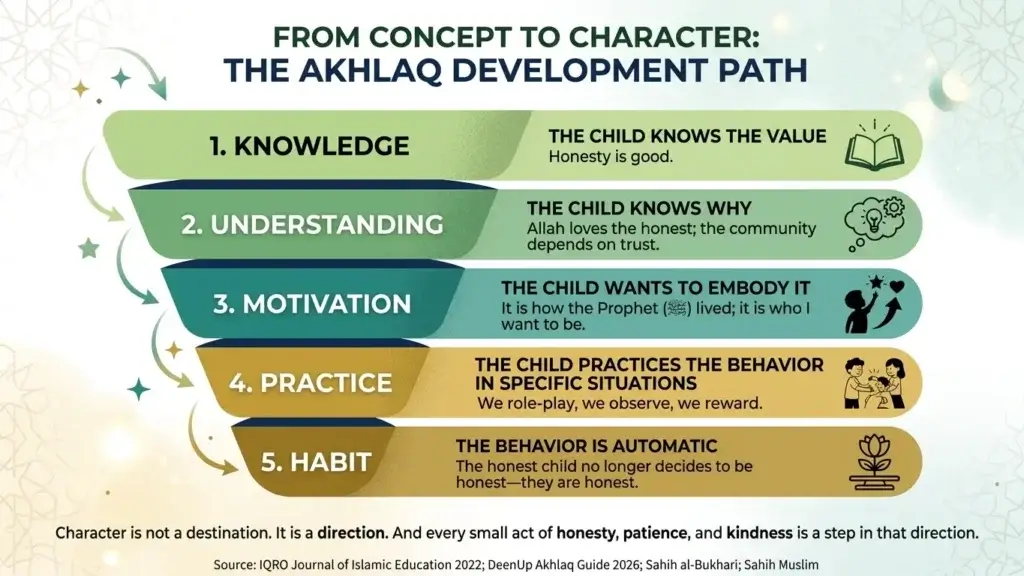
The Islamic Framework: What Akhlaq Actually Is
Before the action plan, precision about what we are building — because the parent who understands the Islamic concept of Akhlaq will pursue it with a different quality of intention than the parent who thinks of it as “good manners.”
Al-Ghazali defined Akhlaq as deep-rooted qualities of the soul that produce actions naturally. According to him, purification of the heart is the key to good character. He emphasized that true Akhlaq cannot exist without correct belief and obedience to Allah.
Three elements of this definition are worth unpacking:
“Deep-rooted qualities of the soul” — Akhlaq is not surface behavior. The child who is polite because they are being watched has adab (etiquette), not Akhlaq. True Akhlaq is the quality of the person that produces polite behavior whether or not anyone is watching. The Islamic standard is the character that is consistent in public and private — as the Prophet ﷺ modeled with absolute consistency.
“That produce actions naturally” — the goal of Akhlaq education is habit, not effort. The child who has to decide whether to be honest every time they face a temptation to lie has not yet developed the Akhlaq of honesty. The child who is honest automatically — because honesty is who they are, not what they choose in each individual moment — has achieved what Islamic moral formation aims for.
“Purification of the heart is the key” — character is not built from the outside in. It is built from the inside out. The heart that is connected to Allah, regularly examined (muhasabah), and consistently engaged with the Quran will naturally produce better outward behavior than any external behavioral program.
The Prophet ﷺ was the living proof of this inside-out model. When Aisha (may Allah be pleased with her) was asked about his character, she did not list his behaviors. She said:
“His character was the Quran.”
— Sahih Muslim, Hadith 746
His behavior was the automatic output of a heart that was completely aligned with Allah. That is the standard. That is what Islamic character education is working toward — not compliance with external rules, but a heart so aligned with the divine that goodness becomes its natural expression.
The essence of Islamic character (Akhlaq) is to reflect the beauty of Allah’s names through our actions — mercy, patience, justice, humility, and generosity. Islam doesn’t separate faith from behavior; rather, it perfects belief through character.
Section 1: The Root of All Character — Taqwa and the Heart
Every specific Islamic virtue — honesty, patience, generosity, justice — has a single root: Taqwa (consciousness of Allah, God-fearing awareness).
وَتَزَوَّدُوا فَإِنَّ خَيْرَ الزَّادِ التَّقْوَىٰ
“And take provisions, for indeed the best provision is Taqwa.”
— Quran 2:197
The Prophet ﷺ said, pointing to his chest three times:
“Taqwa is here. Taqwa is here. Taqwa is here.”
— Sahih Muslim, Hadith 2564 (in the context of the hadith on not wronging people)
Taqwa is the foundation of character. It controls desires and ensures ethical behavior even in private. Akhlaq must be sincere — actions done for show lose moral and spiritual value.
The implication for parents is profound: no system of behavioral rewards, consequences, and character lessons will produce lasting Islamic character if the child’s heart is not connected to Allah. The child who is honest because they fear their parents will stop being honest when their parents are not watching. The child who is honest because they are aware of Allah — because Taqwa is present in their heart — will be honest everywhere, always.
This does not mean behavioral training is useless. It means behavioral training is only the scaffolding. The building is the heart.
The practical application: Every Akhlaq lesson should connect to Allah explicitly. Not “be honest because honesty is good” but “be honest because you are a Muslim, and Muslims are known before Allah for their truthfulness — Al-Sadiq was the Prophet’s ﷺ title, and when you choose honesty, you are choosing to be like him.”
Section 2: Seven Core Islamic Values — From Concept to Daily Behavior
For each of the seven core Islamic values below, this section provides:
- The Quranic and hadith foundation
- The scholarly commentary on its depth
- The specific daily behaviors that embody it
- The specific situations in a child’s life where it is practiced
Value 1: Al-Sidq (Truthfulness / Honesty)
The Foundation:
“Be truthful — for indeed, truthfulness leads to righteousness (birr), and righteousness leads to Paradise. A man keeps being truthful until he is recorded with Allah as a truthful person (Siddiq). And beware of lying — for indeed, lying leads to wickedness (fujur), and wickedness leads to the Fire.”
— Sahih al-Bukhari, Hadith 6094; Sahih Muslim, Hadith 2607
The hadith maps the complete chain: a single honest act → righteousness → Paradise. A single lie → wickedness → the Fire. Not eventually. Not in aggregate. Each individual act is a step on one of two paths.
Truthfulness in speech, business, and promises is mandatory in Islam. Good Akhlaq in daily life includes speaking truthfully even under pressure.
The Daily Behaviors:
- Tells the truth about mistakes before being asked
- Keeps small promises reliably (if you said you would call, you call)
- Does not exaggerate to make themselves look better in stories
- Corrects misunderstandings even when staying quiet would be easier
The Situations to Practice:
- When they broke something and could hide it
- When they made a mistake on a task and could pretend they did not
- When the truth would make them look bad in front of peers
- When a small lie would make a social situation easier
The Parent Script: “You told the truth even though it was uncomfortable. That is what Al-Amin means — the trustworthy one. That was the Prophet’s ﷺ title before he was a prophet. When you choose honesty in hard moments, you are choosing who you are.”
Value 2: Al-Sabr (Patience)
The Foundation:
وَبَشِّرِ الصَّابِرِينَ ﴿١٥٥﴾ الَّذِينَ إِذَا أَصَابَتْهُم مُّصِيبَةٌ قَالُوا إِنَّا لِلَّهِ وَإِنَّا إِلَيْهِ رَاجِعُونَ
“And give good news to the patient — those who, when affliction strikes them, say: ‘Indeed we belong to Allah, and indeed to Him we will return.'”
— Quran 2:155–156
The Prophet ﷺ said:
“No one is given a gift better and more comprehensive than patience.”
— Sahih al-Bukhari, Hadith 1469; Sahih Muslim, Hadith 1053
The Daily Behaviors:
- Waits for their turn without complaining
- Continues a difficult task without giving up
- Responds to frustration with a breath before a reaction
- Accepts “not now” from parents without a scene
The Situations to Practice:
- Homework that is genuinely hard
- Waiting for something they want
- When a sibling has something they want
- When a plan changes and they are disappointed
The Parent Script: “I noticed that you kept going even when that was really hard. Sabr is not the same as not feeling frustrated — it is feeling frustrated and choosing to continue anyway. The Prophet ﷺ said no gift is better than patience. You practiced that gift today.”
Value 3: Al-Shukr (Gratitude)
The Foundation:
لَئِن شَكَرْتُمْ لَأَزِيدَنَّكُمْ
“If you are grateful, I will certainly give you more.”
— Quran 14:7
The Prophet ﷺ said:
“Whoever does not thank people does not thank Allah.”
— Sunan Abu Dawud, Hadith 4811; Sunan al-Tirmidhi, Hadith 1954; authenticated by al-Albani
The Daily Behaviors:
- Says Alhamdulillah after meals and waking up — not as a reflex but with awareness
- Expresses specific thanks to people who help them (not generic “thanks” but “thank you for staying late to help me”)
- Names three specific things they are grateful for before sleep
- Notices blessings without being prompted (a beautiful sunset, a kind moment, health on a sick day)
The Situations to Practice:
- Daily meals — the Alhamdulillah that follows eating
- After receiving a gift, a favor, or help
- When things go well — acknowledging that they went well
- When they wake up — the first awareness of another day
Practice gratitude together — make it a family activity. Encourage children to share something they are thankful for at the end of each day. This helps instill the habit of recognizing and appreciating blessings.
Value 4: Al-Karam (Generosity)
The Foundation:
The Prophet ﷺ said:
“The generous person is close to Allah, close to people, close to Paradise, and far from the Fire. The miser is far from Allah, far from people, far from Paradise, and close to the Fire.”
— Sunan al-Tirmidhi, Hadith 1961; classified as Hasan
And:
“The upper hand (giving) is better than the lower hand (receiving).”
— Sahih al-Bukhari, Hadith 1427; Sahih Muslim, Hadith 1033
The Daily Behaviors:
- Shares snacks, toys, and resources without being asked
- Offers help to a sibling or friend before being requested
- Donates from their own savings or pocket money to charity regularly
- Gives their time to someone who needs it — sitting with a sad friend, helping a sibling with homework
The Situations to Practice:
- When they have something a sibling wants
- When they have more than they need
- When someone around them needs help and it would cost them something to give it
- When they could spend money on themselves or give it
Value 5: Al-‘Adl (Justice and Fairness)
The Foundation:
إِنَّ اللَّهَ يَأْمُرُ بِالْعَدْلِ وَالْإِحْسَانِ
“Indeed, Allah commands justice and good conduct.”
— Quran 16:90
The Prophet ﷺ said:
“Help your brother whether he is an oppressor or an oppressed one.”
When asked how to help the oppressor, he said:
“By preventing him from oppressing others.”
— Sahih al-Bukhari, Hadith 2444
The Daily Behaviors:
- Speaks up when something is unfair — even when staying quiet is safer
- Takes responsibility for their own mistakes without blaming others
- Treats all peers with the same respect regardless of social popularity
- Refuses to participate in cruelty or exclusion even when the group is doing it
The Situations to Practice:
- When a sibling is wrongly blamed for something they did
- When a classmate is being excluded or mocked
- When they could get away with blaming someone else for their mistake
- When the popular choice is an unjust one
Value 6: Al-Hilm (Forbearance / Emotional Restraint)
The Foundation:
The Prophet ﷺ said to a man who asked for advice three times:
“Do not be angry.”
— Sahih al-Bukhari, Hadith 6116
And:
“The strong person is not the one who can wrestle others. The strong person is the one who controls themselves when angry.”
— Sahih al-Bukhari, Hadith 6114; Sahih Muslim, Hadith 2609
The Daily Behaviors:
- Pauses before responding when angry — counts to three, takes a breath, leaves the room
- Uses words to express anger rather than physical or verbal aggression
- Returns to a conversation calmly after cooling down
- Accepts correction without defensiveness or retaliation
The Situations to Practice:
- When a sibling takes or breaks something they value
- When a parent says no to something they want
- When a friend says something hurtful
- When they make a mistake and are corrected
Value 7: Al-Tawadu’ (Humility)
The Foundation:
The Prophet ﷺ said:
“No one humbles themselves for the sake of Allah except that Allah raises them.”
— Sahih Muslim, Hadith 2588
And he modeled humility in every dimension of his life — mending his own sandals, sitting on the floor with his Companions, visiting the sick and the poor, never speaking of his own virtues unless it served a teaching purpose.
The Daily Behaviors:
- Credits others genuinely when they contribute to the child’s success
- Does not boast about achievements — lets the work speak
- Accepts help without embarrassment
- Treats the cleaner, the server, and the teacher with the same respect
The Situations to Practice:
- After winning a competition or achieving something
- When they know more than someone else about a topic
- When they receive praise — how do they respond?
- When they need help and could ask for it
Section 3: The Action Plan — How to Build One Character Trait at a Time
The mistake that most Akhlaq education makes is trying to build everything at once. The family that decides to work on honesty, patience, gratitude, generosity, justice, forbearance, and humility simultaneously will make real progress on none of them.
The research in behavior change — Islamic and secular — agrees: one behavior at a time, with focused attention, consistent practice, and specific feedback, produces lasting change. Seven behaviors pursued simultaneously produce overwhelm.
Here is the monthly action plan:
The Four-Week Akhlaq Cycle
Week 1 — Foundation:
- Introduce the value at the family dinner table. Not a lecture — a story. What does honesty look like? Tell the story of the Prophet ﷺ before prophethood, known as Al-Amin.
- Name the daily behaviors that embody this value (see Section 2)
- Identify the specific situations in your child’s week where this value will be tested
Week 2 — Practice:
- The value is the weekly family focus. When it appears — naturally, in the flow of daily life — name it: “That was patience. You just practiced Sabr.”
- When the child fails to embody it — without shame: “That was a moment where Sabr would have helped. What could you have done differently?”
- Daily five-minute reflection: “Did you have a chance to practice [value] today? Tell me what happened.”
Week 3 — Deepening:
- Read or listen to a Seerah story that demonstrates this value in the Prophet’s ﷺ life
- Find three Quranic verses that mention this value — read them together, discuss what they mean
- Ask: “Why do you think Allah made this a virtue? What would happen to families and communities if nobody practiced it?”
Week 4 — Consolidation and Transition:
- Name three specific moments this month where the child demonstrated this value
- Celebrate specifically: “I noticed three times this month where you chose honesty even when it was hard. That is not small — that is who you are becoming.”
- Ask the child: “What do you feel in your chest when you choose the right thing?” This builds internal emotional awareness of virtue — the beginning of Taqwa.
- Transition to the next value — but continue noticing and naming the previous one
Character education in the Islamic perspective — drawing from the Prophet’s ﷺ model in Hadith — involves putting essential values on students through learning and valuable assistance in such a way that students are able to understand, experience, and integrate core values into their personality. Such education embeds character and promotes values to preserve distinct character when living daily life.
Section 4: The Muhasabah System — Daily Self-Accounting for Children
Muhasabah — the Islamic practice of daily self-examination — is the most important internal mechanism for character development, and the one most consistently overlooked in Islamic education for children.
Muhasabah (محاسبة) means self-accounting — taking honest stock of your own conduct without defensiveness. Practically, it means taking five minutes at the end of each day to ask: Where did I fall short today? Was I patient? Improving Akhlaq starts with muhasabah and focusing on one character trait at a time.
The Quran commands it:
يَا أَيُّهَا الَّذِينَ آمَنُوا اتَّقُوا اللَّهَ وَلْتَنظُرْ نَفْسٌ مَّا قَدَّمَتْ لِغَدٍ
“O you who have believed, fear Allah. And let every soul look to what it has put forward for tomorrow.”
— Quran 59:18
Umar ibn al-Khattab (may Allah be pleased with him) said:
“Hold yourself accountable before you are held accountable.”
For children, the daily Muhasabah should be:
- Brief — five minutes maximum
- Specific — focused on the current character value being developed
- Non-judgmental — an observation, not a punishment
- Forward-looking — ending with tomorrow’s intention, not today’s failure
The Three Muhasabah Questions for Children
At bedtime — after the night du’a, in the quiet before sleep:
1. “Did you have a chance to practice [honesty / patience / gratitude] today? What happened?”
2. “Was there a moment today where you wish you had made a different choice? What was it?”
3. “What is one thing you will try tomorrow?”
These three questions, asked consistently every evening for a month, build the habit of self-examination that is the engine of all lasting character development.
Islamic ethics education must be required to begin at an early age because childhood is the most appropriate period to instill good habits. The Hadith narrated by Bukhari Muslim on Islamic ethics education shows that the Prophet ﷺ emphasized teaching ethics from early childhood as this is the period when habits are most naturally and durably formed.
Section 5: The Parent as the Living Curriculum
The most honest truth in this entire guide — and the one that requires the most courage to face:
No Akhlaq education system will produce results in a child whose parent does not model the same values.
Parents, as the first teachers, play a critical role in modeling these behaviors and creating an environment where good manners are valued and practiced.
The child who watches their parent choose honesty at personal cost learns more about honesty in that moment than in a year of Akhlaq lessons. The child who watches their parent lose their temper and then apologize genuinely learns more about forbearance and accountability than any hadith lecture on anger.
The parent is not the teacher of Akhlaq. The parent is the Akhlaq — in their child’s eyes, in their child’s nervous system, in the behavioral templates that are being silently downloaded every hour of every day.
This is simultaneously the most humbling and the most empowering dimension of Islamic parenting. Humbling because it demands change in the parent, not just curriculum design for the child. Empowering because it means that every act of genuine Islamic character you display — every moment of patience, every honest admission, every generous choice, every just decision — is direct, immediate, and powerful Islamic education for your child.
The Prophet ﷺ said:
“Every one of you is a shepherd and is responsible for their flock.”
— Sahih al-Bukhari, Hadith 893; Sahih Muslim, Hadith 1829
The shepherd’s first responsibility is to go where the flock needs to go. Not to point from a distance. To lead.
Section 6: Age-by-Age Akhlaq Development Framework
| Age Range | Primary Values | Methods That Work | What to Expect |
|---|---|---|---|
| 3–6 | Truthfulness, sharing, gratitude | Immediate praise, simple stories, parental modeling | Frequent regression — this is normal; consistency is everything |
| 7–10 | All seven + responsibility, apology | Story + reflection + specific praise + light Muhasabah | Growing capacity to reflect; begins connecting values to identity |
| 11–14 | All seven + justice, courage | Seerah parallels, weekly value focus, full Muhasabah | Tests values under peer pressure; parent as advisor not authority |
| 15–18 | All seven + integrity, legacy | Open discussion, lived examples, accountability partnership | Values must be genuinely owned; external pressure the key test |
The Foundation Years (3–6): Habits Before Understanding
At this age, the child cannot understand complex moral reasoning. But they can form habits — and habits formed at this age are the most durable of any developmental period.
The parent’s job in these years is not moral education but moral environment: an environment in which honesty is the natural thing, in which gratitude is expressed at every meal, in which generosity is modeled daily, in which patience is practiced visibly.
The child who grows up in this environment enters age seven with behavioral grooves already laid — paths of least resistance that lead toward virtue rather than away from it.
The Learning Years (7–12): Understanding Deepens Practice
At this age, the child can begin to understand why Islamic values matter — theologically, communally, and personally. This is the age for:
- Explicit teaching of the Quranic and hadith foundations of each value
- The monthly Akhlaq cycle described in Section 3
- The daily Muhasabah
- Connecting the values to study Islam online through Islamic Studies courses — where Aqeedah, Fiqh, and Hadith provide the theological roots of everything in this guide
The Testing Years (13–18): Values Under Pressure
Adolescence is the proving ground of everything built in the earlier years. The teenager who has been practicing honesty since age seven has a behavioral foundation to return to under peer pressure. The teenager who was told honesty is important but never practiced it consistently is building from scratch under the worst possible conditions.
Akhlaq is not just about being kind or gentle — it is about having the courage to do what is right, even when it is unpopular or difficult. This level empowers students to be people of principle, rooted in justice, honesty, fairness, and resilience.
The parent of a teenager shifts roles — from moral instructor to moral accountability partner. The conversation changes from “this is what you should do” to “how did that situation feel? What did you choose? What would the Prophet ﷺ have done?”
Structured Curriculum Framework
quranst’s Islamic Studies track builds Akhlaq systematically through age-appropriate Hadith study, Seerah character analysis, and practical value application sessions — taught live, one-on-one, by certified instructors.
Book your free 2-session trial →Conclusion: Character Is Not a Destination. It Is a Direction.
Your child will not arrive at a moment when they are fully honest, fully patient, fully generous, fully just, fully humble. Neither will you. Neither has anyone ever.
The Muslim tradition has always understood character as a process — Tazkiyat al-Nafs (purification of the soul) — that continues until the soul returns to its Lord.
قَدْ أَفْلَحَ مَن زَكَّاهَا ﴿٩﴾ وَقَدْ خَابَ مَن دَسَّاهَا
“Successful is the one who purifies it. Losing is the one who corrupts it.”
— Quran 91:9–10
The success is in the purification — the active, ongoing, never-finished work of turning toward goodness. Not in having arrived.
For your child, this means: the goal is not to produce a perfect seven-year-old. The goal is to produce a child who is oriented toward goodness — who has habits, practices, and an internal moral compass (Taqwa) that reliably points them in the right direction, even when they err.
Every small act of honesty you notice and name is moving that compass. Every practice of patience you celebrate is building the muscle. Every evening Muhasabah is developing the self-awareness that is the beginning of genuine Islamic character.
Without Akhlaq, religious practice loses its true spirit. True Akhlaq cannot exist without correct belief and obedience to Allah — and when the heart is connected to Allah, goodness becomes its natural expression.
The Prophet ﷺ made du’a for good character — even he, whose character Allah declared supreme:
“O Allah, You have made my form beautiful — so make my character beautiful too.”
— Musnad Ahmad, Hadith 3823; authenticated by al-Albani in Sahih Ibn Hibban, 959
If the greatest human character that ever existed made du’a for better character — then the work of character development is for every soul, in every generation, at every level of development.
Make that du’a with your child tonight.
Make it tomorrow morning.
Make it every day.
And then live, together, in its direction.
وَإِنَّكَ لَعَلَىٰ خُلُقٍ عَظِيمٍ
“And indeed, you are of a great moral character.”
— Quran 68:4
🟢 Build Islamic Character with quranst
Knowledge of Islamic values is the beginning. The curriculum that connects values to practice, practice to habit, and habit to character — through weekly Hadith study, Seerah character analysis, and live Akhlaq application sessions — is what turns knowing into being.
quranst’s Islamic Studies track delivers the complete Akhlaq curriculum:
Hadith and Ethics:
- Core character Hadith memorized with context and application
- Weekly Akhlaq focus mapped to the child’s real developmental stage
- Study Islam online through live, one-on-one sessions flexible for school schedules
Aqeedah and Foundation:
- Taqwa as the root of character — taught with intellectual depth, not just memorization
- The connection between Islamic belief (Aqeedah) and Islamic behavior (Akhlaq)
- Fiqh — the practical jurisprudence that translates values into specific actions
Seerah and Character Modeling:
- The Prophet ﷺ as the living model — specific situations, specific responses, specific lessons
- Character analysis: what made the Prophet ﷺ respond the way he did? How can your child do the same?
Smart Parenting Support:
- Islamic parenting coaching for parents navigating the Akhlaq development of children at every age
- Child behavior management frameworks rooted in the Prophetic model
- Raising Muslim children with character — not just compliance
👇 Begin with Two Free Sessions
Two Ways to Begin
“The most perfect of the believers in faith is the one who is best in moral character.”
— Sunan Abu Dawud, Hadith 4682; Sunan al-Tirmidhi, Hadith 1162; authenticated by al-Albani
Perfect faith through perfect character. Build it together.
بِسْمِ اللَّهِ — Begin.
References and Sources
Quranic References
- Quran 2:155–156 — “Give good news to the patient”
- Quran 2:197 — “The best provision is Taqwa”
- Quran 14:7 — “If you are grateful, I will give you more”
- Quran 16:90 — “Allah commands justice and good conduct”
- Quran 59:18 — “Let every soul look to what it has put forward for tomorrow”
- Quran 68:4 — “And indeed, you are of a great moral character”
- Quran 91:9–10 — “Successful is the one who purifies their soul”
Hadith References
- Sahih al-Bukhari, Hadith 893; Sahih Muslim, Hadith 1829 — “Every one of you is a shepherd”
- Sahih al-Bukhari, Hadith 1427; Sahih Muslim, Hadith 1033 — “The upper hand is better than the lower hand” (generosity)
- Sahih al-Bukhari, Hadith 1469; Sahih Muslim, Hadith 1053 — “No gift better than patience”
- Sahih al-Bukhari, Hadith 6094; Sahih Muslim, Hadith 2607 — “Be truthful — it leads to righteousness”
- Sahih al-Bukhari, Hadith 6114; Sahih Muslim, Hadith 2609 — “The strong person controls themselves when angry”
- Sahih al-Bukhari, Hadith 6116 — “Do not be angry” (three times)
- Sahih Muslim, Hadith 746 — “His character was the Quran”
- Sahih Muslim, Hadith 2564 — “Taqwa is here” (pointing to the chest)
- Sahih Muslim, Hadith 2588 — “No one humbles themselves except that Allah raises them”
- Sunan Abu Dawud, Hadith 4682; Sunan al-Tirmidhi, Hadith 1162 — “The most perfect in faith is the best in character” (authenticated by al-Albani)
- Sunan Abu Dawud, Hadith 4811; Sunan al-Tirmidhi, Hadith 1954 — “Whoever does not thank people does not thank Allah” (authenticated by al-Albani)
- Sunan al-Tirmidhi, Hadith 1961 — “The generous person is close to Allah, Paradise, and people” (Hasan)
- Musnad Ahmad, Hadith 3823 — Prophet’s du’a for beautiful character (authenticated by al-Albani)
Academic Sources
- Academia.edu (July 2025). “Hadith as a Source of Morality in Daily Life.” Key findings: Islamic ethics education must begin at early age; childhood is the most appropriate period to instill good habits; Prophet ﷺ emphasized teaching ethics from early childhood.
- IQRO: Journal of Islamic Education (2022). “Character Education for Children in the Perspective of Hadith.” Key findings: Character education involves helping students understand, experience, and integrate core values into personality; Prophet Muhammad’s model in Hadith is the primary framework.
- ResearchGate (December 2024). “Islamic Ethics: Exploring its Principles and Scope.” Al-Ghazali’s definition of Akhlaq; Husn-i-Akhlaaq as the Islamic model of character refinement; character development as measurable and attainable goal.
Contemporary Islamic Sources
- Kuttab.com. “Islamic Manners for Kids: Teaching Akhlaq.” Key findings: Good Akhlaq is closely tied to faith in Islam; parents as first teachers in modeling behaviors; practice gratitude as family activity; reflection after mistakes fosters self-awareness.
- Southern Islamic Institute. “Akhlaq: Character and Ethics.” Key findings: Essence of Akhlaq is to reflect Allah’s names through actions; Islam perfects belief through character; Akhlaq includes moral courage to do what is right under pressure.
- Amaan Foundation. “Akhlaq in Islam — Islamic Character Explained with Quran and Hadith.” Key findings: Al-Ghazali — Akhlaq as deep-rooted soul qualities; Taqwa as foundation of character; Akhlaq must be sincere; Al-Ghazali on purification of heart; without Akhlaq, religious practice loses its spirit.
- DeenUp (July 2026). “Akhlaq Meaning: Islamic Character and Ethics.” Key findings: Muhasabah as daily self-accounting practice; improving Akhlaq starts with focusing on one character trait at a time; dhikr and Quran recitation soften the heart; du’a for good character as established starting point.
Frequently Asked Questions
What is the main difference between knowing Islamic values and living them?
How can parents build Islamic character traits effectively without overwhelming the child?
- Week 1 (Foundation): Introduce the value through stories (e.g., Al-Amin) and define daily behaviors.
- Week 2 (Practice): Focus on identifying and practicing the value in daily situations.
- Week 3 (Deepening): Connect the trait to Quranic verses and Seerah lessons.
- Week 4 (Consolidation): Celebrate progress, build self-awareness, and transition to the next trait.
What is the Muhasabah system and how does it help Muslim children?
- “Did you have a chance to practice today’s value?”
- “Was there a moment you wish you had made a different choice?”
- “What is one thing you will try tomorrow?”

Pingback: 40 Amazing Benefits of Salah (Islamic Prayer) for Body, Mind, and Soul
Pingback: Islamic Emotional Intelligence: Parenting Muslim Kids in Western Diaspora