

Introduction: The Parent Who Loves Their Child but Cannot Reach Them
She loves her daughter completely. Unconditionally. With a depth that no measure can capture.
She provides everything: education, food, safety, Islamic education, a warm home, sacrifices that her daughter does not know about and may never know about.
And yet — when her daughter comes home from school carrying something heavy, something that happened, something that is hurting her — she does not come to her mother.
She goes to her room. She closes the door. And the mother sits in the kitchen wondering: why won’t she talk to me?
This is the quiet crisis in the majority of Muslim diaspora families — not a crisis of love, not a crisis of provision, not even a crisis of Islamic commitment. It is a crisis of emotional connection: the specific quality of relationship that makes a child feel safe enough to be genuinely known by their parent.
The accelerating pace of sociocultural change — particularly driven by rapid technological advancement and the pressures of minority-community life — presents distinctive challenges to children’s emotional development within Muslim family contexts. Parents’ roles in shaping children’s emotional intelligence are central to healthy child development, yet this dimension of Islamic parenting is the most frequently under-resourced and under-discussed.
Empirical research shows that prophetic parenting practices positively affect adolescents’ psychological wellbeing and prosocial behavior. The need to instill moral responsibility, emotional warmth, and religious commitment — in line with the Quran and Sunnah — to navigate contemporary socio-cultural challenges is well-documented. Yet no empirically standardized tool currently measures the emotional intelligence dimension of Islamic parenting against these criteria.
This guide fills that gap — for the Muslim parent who loves deeply but wants to connect more deeply, who is committed to raising good Muslims but wants their children to choose that identity rather than resent it, who provides everything materially but knows that the most important provision — genuine emotional connection — requires a different kind of attention.
Structured Curriculum Framework
quranst’s Smart Parenting track provides live coaching sessions for Muslim parents navigating the specific emotional and relational challenges of raising children in diaspora environments — grounded in the Prophetic model and the best of contemporary research.
Book your free 2-session trial →The Quranic Framework: Emotional Intelligence as Islamic Virtue
The Islamic tradition does not have a direct Arabic translation for “emotional intelligence” — but it has something richer: a complete theological and behavioral framework for the qualities that emotional intelligence describes, rooted in the Quran, modeled by the Prophet ﷺ, and elaborated by fourteen centuries of Islamic scholarship on the human heart (qalb) and its relationship to virtue.
Rahmah: The Root of All Connection
The word Allah uses most frequently to describe His own relationship with human beings — Al-Rahman, Al-Rahim — both come from the root r-h-m, which also gives us rahim (the womb): the most tender, most encompassing, most unconditional form of care available in human experience.
وَرَحْمَتِي وَسِعَتْ كُلَّ شَيْءٍ
“And My mercy encompasses all things.”
— Quran 7:156
This is the divine model of emotional connection: encompassing. All-inclusive. Not contingent on the child’s performance, their compliance, their Islamic commitment level, or how they make their parent feel. The mercy that encompasses all things does not exclude the difficult child, the questioning teenager, the child who is struggling.
The Prophet ﷺ said:
“Show mercy to those on earth, and the One above the heavens will show mercy to you.”
— Sunan al-Tirmidhi, Hadith 1924; authenticated by al-Albani
And he modeled this mercy specifically toward children — sitting with them, calling them by affectionate names, asking them about their lives, honoring their emotions without dismissing them.
Qaulan Layyinan: The Gentle Word
The Quran instructs Musa (peace be upon him) — sent to the most powerful and most tyrannic ruler in history — to speak with a gentle word:
فَقُولَا لَهُ قَوْلًا لَّيِّنًا لَّعَلَّهُ يَتَذَكَّرُ أَوْ يَخْشَىٰ
“And speak to him with gentle words — perhaps he may be reminded or fear.”
— Quran 20:44
If Qaulan Layyinan — the gentle word — is required even toward Pharaoh, how much more is it required toward a child? Toward a teenager who is struggling? Toward a son or daughter navigating the specific pressures of diaspora life?
The Quran establishes six types of communication for different contexts — Qaulan Sadida (truthful), Qaulan Ma’rufa (kind), Qaulan Baligha (effective/persuasive), Qaulan Maysura (easy to understand), Qaulan Layyina (gentle), and Qaulan Karima (honorable). Together, they form the complete Islamic framework for emotionally intelligent communication — adapting tone, register, and approach to the specific person and situation rather than defaulting to one mode regardless of context.
Luqman’s Model: The Parent Who Names, Teaches, and Connects
The Quran’s most detailed example of positive parenting is Luqman’s conversations with his son — preserved in Surah Luqman (verses 13-19). What is striking about this Quranic model is not only what Luqman teaches (Tawheed, gratitude, ethics) but how he teaches:
- He speaks directly to his son — “O my son” — personal, not institutional
- He narrates rather than commands — explaining the why behind each teaching
- He addresses his son’s inner life — what his son will feel, what he will face, how he should carry himself
- He expresses concern for the son’s eternal wellbeing without triggering defensive resistance
This is emotionally intelligent Islamic parenting: the parent who teaches through relationship, not through authority alone.
Analysis of Surah Luqman verses 13-19 reveals the role of parents as exemplars — with Luqman himself, as an individual who received wisdom from Allah, imparting various educational principles and methodologies to his children. The Quranic parenting model emphasizes the quality of relationship as the medium through which all other teaching flows.
Section 1: The Research — What Science and Islamic Scholarship Say Together
Neuroparenting — which emphasizes affection, attention, empathy, and emotional validation — is very much in line with the concept of Islamic parenting, which emphasizes mercy, education, and the formation of morals. The convergence between neuroscience-informed parenting research and Islamic parenting principles is striking: both identify emotional warmth and attunement as the foundational conditions for healthy child development.
Emotional regulation in Islam — such as patience and good communication — can help shape children’s strong character, while parental stress can be managed through tawakkul methods, prayer, dhikr, and consultation with the Muslim community. Islamic parenting offers potential strengths in fostering resilience, ethical engagement, and cross-generational communication — areas where existing secular models may fall short.
What Secure Attachment Produces
The research on attachment theory — pioneered by John Bowlby and developed extensively since — establishes that secure attachment between parent and child produces:
- Higher academic achievement and cognitive development
- Better emotional regulation and mental health outcomes
- More positive peer relationships and social competence
- Greater resilience under stress and adversity
- Stronger identity formation and sense of self
Research confirms a positive correlation between Islamic parenting patterns and children’s spiritual intelligence. Parents who adhere to Islamic parenting styles nurture a strong spiritual foundation in their children — and regular religious practices such as praying and reading the Quran together establish beneficial parent-child relationship patterns. The emotional warmth that characterizes secure attachment is both the medium and the message of Islamic parenting.
The Muslim parent who builds secure emotional attachment with their child is simultaneously:
- Fulfilling the Prophetic model of parenting
- Building the conditions for the child’s Islamic identity to be genuinely chosen rather than merely inherited
- Creating the relationship through which all other Islamic teaching will be received
The Diaspora Complication
For Muslim families in the West, the standard challenges of parent-child emotional connection are compounded by specific diaspora dynamics — which we address directly in Section 3.
Section 2: The Six Dimensions of Islamic Emotional Intelligence
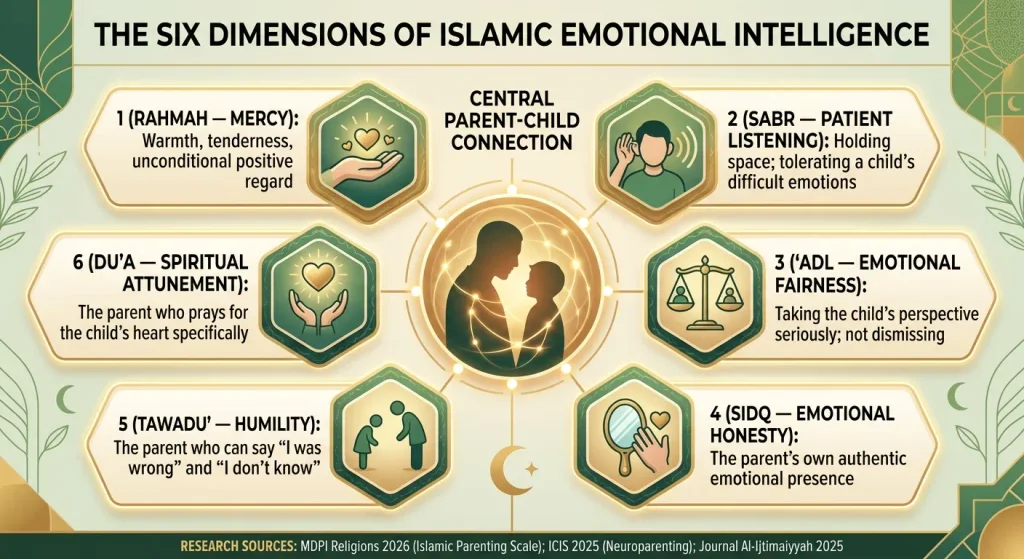
Islamic Emotional Intelligence — the capacity to connect with one’s child at the emotional level in a way that is both psychologically effective and Islamically grounded — has six identifiable dimensions, each rooted in a Quranic and prophetic foundation.
Dimension 1: Rahmah — Unconditional Emotional Warmth
What it is: The experience of being fundamentally loved and accepted — not contingent on performance, compliance, or Islamic adherence.
The Quranic root: “My mercy encompasses all things.” (Quran 7:156)
What it looks like in practice: Physical affection given freely. Warmth that does not disappear when the child disappoints. The parent who can say “I love you” without “but” immediately following.
What it is NOT: Permissiveness. Rahmah does not mean the absence of expectation or consequence. It means the child experiences the parent’s love as stable — a constant beneath which expectations and consequences operate, but which is never the consequence itself.
The common failure mode: The Muslim parent who unconsciously withdraws warmth when their child fails to meet Islamic expectations — the prayer not prayed, the hijab not worn, the Arabic not practiced — communicates that parental love is conditional. This is the single most damaging pattern in Muslim diaspora parenting.
Dimension 2: Sabr — Patient Listening Without Premature Resolution
What it is: The capacity to hold a child’s difficult emotion without rushing to fix, advise, correct, or lecture.
The Prophetic root:
“Whoever does not show patience, Allah will not be patient with him.”
The Prophet ﷺ modeled this by sitting with companions in their grief and difficulty without immediately providing solutions. When Anas ibn Malik’s pet bird died, he did not tell Anas to be patient — he sat with him and asked about the bird by name. (Sahih al-Bukhari, Hadith 6129)
What it looks like in practice: When the child says “I had a terrible day,” the emotionally intelligent Islamic parent does not say “Make du’a, it will get better.” They say: “Tell me what happened.” And then they listen.
What it is NOT: Agreeing with everything the child says or validating behavior that is wrong. It is listening to understand, not listening to respond.
Dimension 3: ‘Adl — Emotional Fairness and Perspective-Taking
What it is: Taking the child’s perspective seriously — even when you disagree with it. Judging from the child’s position, not only from your own.
The Quranic root:
وَإِذَا حَكَمْتُم بَيْنَ النَّاسِ أَن تَحْكُمُوا بِالْعَدْلِ
“And when you judge between people, judge with justice.” — Quran 4:58
Justice in parenting is emotional justice: the parent who acknowledges when they have contributed to a conflict, who hears the child’s version of events before forming a conclusion, who can say “I can see why you felt that way” — even when the child’s behavior requires correction.
What it looks like in practice: The child says “You never listen to me.” The emotionally intelligent Islamic parent does not immediately defend themselves. They ask: “When have you felt that most? Tell me what that’s been like.”
Dimension 4: Sidq — Emotional Honesty and Authentic Presence
What it is: The parent’s own willingness to be emotionally genuine — to express real feelings, real concerns, real struggles — rather than performing a role of perfect Islamic parent-hood.
The Prophetic root: The Prophet ﷺ was emotionally authentic. He wept publicly. He expressed joy openly. He said “I feel for you” and meant it. He said “I fear for you” and it carried weight precisely because it was genuine.
What it looks like in practice: The parent who can say “I’m struggling with this too” — “I don’t know the answer to that question” — “I made a mistake in how I handled that, and I’m sorry” — is a parent whose emotional presence is real. Children detect inauthenticity with extraordinary precision. The parent who performs emotional stability they do not feel will lose their child’s trust gradually but inevitably.
Dimension 5: Tawadu’ — Parental Humility
What it is: The willingness to be taught by your child, to be corrected by your child, to acknowledge the limits of your knowledge and experience.
The Prophetic root:
“No one humbles themselves for the sake of Allah except that Allah raises them.” — Sahih Muslim, Hadith 2588
The Prophet ﷺ modeled humility toward those younger and less experienced than him. He consulted his Companions. He changed his position when presented with better evidence. He said “I don’t know” when he didn’t know.
What it looks like in practice: When a child challenges your opinion about something, the emotionally intelligent Islamic parent considers whether the child might be right before defending their position. When a child expresses a different perspective on an Islamic question, the parent explores it rather than shutting it down.
Dimension 6: Du’a — Spiritual Attunement Through Prayer
What it is: The practice of praying specifically, personally, and regularly for the child’s heart, their struggles, their emotional wellbeing — not just their Islamic performance.
The Quranic root:
رَبِّ هَبْ لِي مِنَ الصَّالِحِينَ
“My Lord, grant me from among the righteous.” — Quran 37:100 — du’a of Ibrahim for his children
The emotionally intelligent Islamic parent prays for their child’s qalb (heart) — that it be soft, that it be connected to Allah, that it be protected from the specific pressures they are facing.
And the practice of praying for a child — specifically, by name, for specific known struggles — keeps the parent’s heart oriented toward the child’s genuine flourishing rather than just their compliance.
Section 3: The Diaspora Amplifier — Why Emotional Distance Is Greater in the West
For Muslim families living in Western countries, the ordinary challenges of parent-child emotional connection are amplified by a specific set of diaspora dynamics that require direct acknowledgment.
The Generational Language Gap
Many first-generation Muslim parents think, dream, and feel in Arabic, Urdu, Somali, Turkish, or their native language. Their children think, dream, and feel in English (or French, or German). This is not merely a communication inconvenience — it is a profound emotional gap.
Emotion is encoded in language. The specific connotations of a word, the cultural weight it carries, the emotional associations it holds — all of these are language-specific. When a parent says “ana kunt khayif ‘alayk” (I was afraid for you) in Arabic, and the child hears the English translation “I was worried” — something essential is lost. The depth of the Arabic parental fear does not fully survive translation.
Muslim families navigating the integration of faith-based principles — including emotional communication in an Islamic framework — into contemporary parenting practices face unique challenges when the primary language of parenting differs from the primary language of the child’s emotional experience.
The practical response: Learn to express emotional content in both languages. The parent who can say “I love you” in Arabic and in English has bridged something important. The parent who teaches their child the Quranic emotional vocabulary — rahmah, sabr, shukr, tawadu’ — in Arabic with genuine meaning has given their child a shared emotional language that spans both worlds.
The Cultural Authenticity Pressure
Muslim children in diaspora environments navigate a specific dual-loyalty tension: the expectation of Islamic and cultural authenticity from their family and community, and the expectation of cultural fluency from their school and peer environment.
This tension frequently produces one of two failure modes:
- The code-switcher: A child who is one person at home (Islamic, observant, Arabic/Urdu-speaking) and a different person at school (secular, English-only). This is exhausting and ultimately unsustainable.
- The rebel: A child who resolves the tension by abandoning the home identity — choosing the peer-world’s values over the family’s — because the family identity has been presented as an obligation rather than an embrace.
The emotionally intelligent Islamic parent creates a third option: a home environment where the child’s entire experience — including the school-world, the friend world, the questions and confusions that arise from navigating two cultures — can be brought and discussed openly, without shame, without panic, without the parental fear reaction that teaches the child to hide rather than share.
The Islamic Identity Pressure
Muslim children in Western schools frequently experience their Islamic identity as a social liability. They are the children who cannot eat certain foods at parties, who cannot attend certain events, who are asked questions about terrorism and oppression and violence that they do not know how to answer.
The emotionally intelligent Islamic parent does not minimize this experience or dismiss it with “be grateful you’re Muslim.” They engage with it directly — validating the difficulty, providing tools to navigate it, and building the case for Islamic identity as a strength, not merely as a burden to be borne.
Section 4: The Prophetic Model of Emotional Connection
The Prophet ﷺ demonstrated, in documented behavioral detail, what Islamic emotional intelligence looks like in practice. His interactions with children and young people are among the most instructive passages in the entire Seerah.
He Used Their Names — Affectionately
The Prophet ﷺ called Anas ibn Malik “O little Anas” (Ya Unays). He called ‘Umar ibn Abi Salamah by his kunyah. He gave affectionate nicknames. He personalized his connection to each person he engaged with.
The child who is called by an affectionate name — specifically, warmly, repeatedly — experiences something neurologically significant: the reward system in the brain associates the name with warmth. The child who is only ever addressed by their full name in a corrective tone learns to brace when they hear it.
He Asked Before He Told
As documented throughout this guide’s previous articles: the Prophet ﷺ led with questions rather than statements. “Do you know what backbiting is?” He created space for the other person’s response before offering his own position.
The parent who asks before telling has made a profound shift in relational dynamics: they have moved from authority figure to conversation partner. This shift is critical for the diaspora teenager who experiences too much authority and too little genuine dialogue.
He Honored Small Things
When Anas’s pet bird died — a small thing in the adult world — the Prophet ﷺ stopped, noticed, and asked about the bird by name. (Sahih al-Bukhari, Hadith 6129)
“What happened to the little nightingale?”
This question — to a child, about a bird — is a model of emotional intelligence that every Muslim parent should carry. The child’s world contains things that are large to them and small to us. The emotionally intelligent parent learns to enter the child’s world and treat what is large there as genuinely large.
He Validated Emotions Without Enabling Wrong Behavior
When a young man came to the Prophet ﷺ and asked for permission to commit zina (forbidden relations), the Prophet ﷺ did not shame or rebuke him immediately. He first validated the young man’s experience by asking questions — “Would you want this for your mother? Your sister? Your daughter?” — leading the young man to his own understanding through emotional engagement. Then he prayed for him.
(Musnad Ahmad, Hadith 22211; cited in multiple classical sources)
This is the critical Islamic skill: validating the emotion (the desire, the confusion, the struggle) without validating the wrong behavior. It requires the emotional intelligence to separate the feeling from the action — to say “I understand what you’re feeling” without saying “and therefore what you’re doing is acceptable.”
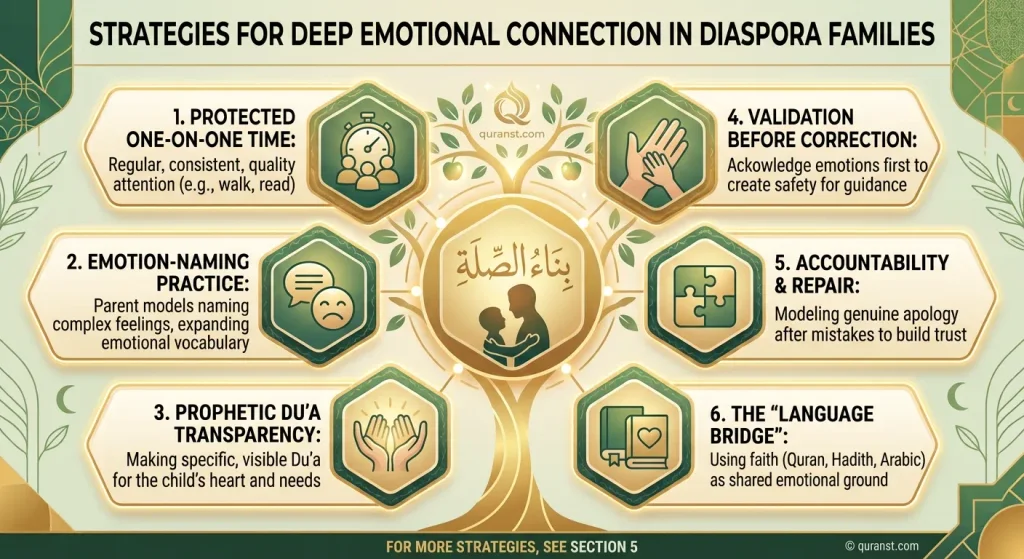
Section 5: Eight Practical Strategies for Building Deep Connection
Strategy 1: The One-on-One Time — Undivided, Consistent, Protected
Designate one-on-one time with each child — weekly at minimum, specifically protected from phones, siblings, and other interruptions. The child who knows they have a dedicated, consistent window of their parent’s complete attention will use it. Eventually.
The first few sessions may feel awkward. Continue anyway. The investment pays in the long run.
Strategy 2: The Emotion-Naming Practice
Children — particularly boys in cultures that discourage male emotional expression — often cannot name what they are feeling. The parent who models emotion-naming (“I’m feeling frustrated right now because…” “I notice I’m anxious about…”) gives their child a vocabulary and a permission.
The practice: once daily, name one feeling you are experiencing in front of your child. Make it genuine. Not a lesson — just honest self-disclosure. The child who sees their parent emotionally literate develops emotional literacy.
Strategy 3: The Prophetic Question Protocol
Replace “How was school?” (generates “fine”) with:
- “What was the most interesting thing that happened today?”
- “Was there a moment today that was hard? Tell me about it.”
- “Who did you notice today who might have needed something?”
These questions are not interrogations. They are genuine curiosity. The child who is asked genuinely interesting questions begins to bring genuinely interesting answers.
Strategy 4: The Mistake Ceremony
The parent who can say “I was wrong” — specifically, about a specific incident, with a specific apology — does more for parent-child connection in that moment than months of correct behavior.
Practiced regularly (because parents are regularly wrong about things), the mistake ceremony teaches the child:
- That mistakes are acknowledged and repaired, not hidden
- That the parent respects the child enough to apologize to them
- That Islamic character includes genuine accountability
The Prophet ﷺ accepted when he was wrong. The parent who does the same is following his model.
Strategy 5: The Emotional Check-In Before the Islamic Correction
The most common parenting error in Islamic families: leading with correction when a child is already emotionally dysregulated.
A child who comes home upset, or who has made a mistake they are already carrying, cannot receive Islamic correction effectively. They can receive connection. Only after connection can correction be heard.
The sequence: Connect first. Correct later.
“I can see something happened today. Tell me about it.” — then, after the emotion has been received and the child feels heard — “Can I share some thoughts about how you might handle this next time?”
Strategy 6: The Islamic Affirmation — Naming What Allah Loves in Your Child
Once weekly: name one quality in your child that is a genuine Islamic virtue — with the Islamic connection explicit.
Not: “You were so helpful today.” But: “The way you helped your brother without being asked — that is what Karam (generosity) looks like. That is a quality Allah loves.”
The child who hears their Islamic character named and affirmed develops an Islamic identity built on genuine virtue rather than performance anxiety.
Strategy 7: The Du’a Transparency
Make your du’a for your child visible to them — not always, but regularly. Say it aloud in front of them.
“Ya Allah, make Yusuf someone who is strong in his faith and confident in his identity. Help him navigate the pressures he faces at school this week.”
The child who hears their parent pray for them — specifically, by name, for the specific things they are actually facing — receives something no parenting technique can replicate: the visceral knowledge that they are seen and prayed for by the person who loves them most.
Strategy 8: The Story Exchange
Once weekly: the parent shares a genuine personal story — from their own childhood, their own struggle with faith, their own moment of doubt or difficulty — and invites the child to share their own.
The parent who reveals vulnerability unlocks the child’s vulnerability. The child who discovers that their parent also struggled, also doubted, also found things difficult, also had moments of failure — that child experiences a connection that the perfect Islamic parent performance cannot produce.
Section 6: The Language Bridge — When Faith Becomes the Emotional Common Ground
The most powerful tool available to the Muslim diaspora parent for building emotional connection with their child is — perhaps unexpectedly — the Quran itself.
Not the Quran as obligation. Not the Quran as the source of the rules their child is expected to follow. But the Quran as the language of their deepest shared identity — the text that both parent and child turn to when life is hard, that both carry in different ways, that both are in relationship with.
The parent who opens Surah Al-Duha after a difficult week and says to their teenager: “This surah — ‘Your Lord has not abandoned you, nor does He hate you’ — I want you to know that this is how I feel about you too” — that parent has done something that no parenting strategy can manufacture.
They have used the language of Allah to say what they feel — and in doing so, they have given the child a framework in which parental love and divine love are experienced as connected rather than competing.Islamic parenting offers potential strengths in cross-generational communication — areas where existing secular models may fall short. The shared language of faith — the Quran, the Hadith, the Islamic emotional vocabulary — provides a medium for emotional communication that transcends the generation gap and the cultural distance of diaspora life.
Section 7: The Crisis Moments — When the Connection Is Most Needed and Most Tested
When the Child Questions Their Faith
The teenager who voices doubt is not leaving Islam. They are testing the relationship — with their parents and with the faith. The emotionally intelligent Islamic parent responds not with panic but with curiosity:
“Tell me what you’re thinking. What made you start questioning that? I want to understand.”
The parent who shuts down the question teaches the child that faith cannot survive scrutiny. The parent who engages it teaches the child that faith is strong enough to be questioned — and that their parent is a safe person to question with.
When the Child Fails Islamically
The teenager who missed prayers for a month, who was caught in a compromising situation, who has been doing something they know is wrong — comes to the parent (or is discovered) in a state of guilt, shame, and defensive readiness.
The emotionally intelligent Islamic parent leads with: “I love you. That doesn’t change. Tell me what happened.”
Only from that position — received, not rejected — can any Islamic correction be genuinely heard.
When the Parent Has Failed the Child
The parent who has been too harsh, too distant, too conditional — who recognizes the emotional distance that has developed and wants to close it — faces the hardest conversation.
“I want to talk to you about something. I’ve been thinking about the way I’ve been with you, and I don’t think I’ve been the parent I want to be. I’ve been too [harsh / distant / focused on your mistakes / unavailable]. I’m sorry. I want to do better. Can you help me understand what you need from me?”
This conversation is terrifying and will feel out of character. Do it anyway. The child who is apologized to by their parent — genuinely, specifically, without self-justification — experiences a relational shift that nothing else can produce.
Structured Curriculum Framework
quranst’s Smart Parenting track provides live coaching for Muslim parents working through specific relational challenges with their children — from faith crises to communication breakdowns to the specific pressures of diaspora parenting.
Book your free 2-session trial →Conclusion: The Child Who Knows Their Parent Knows Them
There is a quality that every child needs from their parent — and that no Islamic education program, no Quran memorization, no Islamic school can provide.
The experience of being known.
Not known as “my Muslim child” or “my daughter who memorizes Quran” or “my son who has good grades.” Known as themselves — in their full complexity, their struggles, their questions, their fears, their specific personality, their particular way of experiencing the world.
Neuroparenting — which emphasizes affection, attention, empathy, and emotional validation — is very much in line with the concept of Islamic parenting, which emphasizes mercy, education, and the formation of morals. The child who is genuinely known by their parent grows into an adult who genuinely knows themselves.
The child who knows their parent knows them — who has experienced the six dimensions of Islamic emotional intelligence in the relationship — is the child who:
- Brings their real problems to their parent instead of hiding them
- Receives Islamic guidance as wisdom rather than control
- Develops a genuine Islamic identity rather than a performed one
- Carries their faith into adulthood as a freely chosen conviction rather than a cultural inheritance they are not sure they want
This is the purpose of Islamic emotional intelligence. Not to make parenting easier. Not to produce more compliant children. But to raise the kind of human being that a deeply connected, genuinely Muslim parent produces: one who knows who they are, whose they are, and why it matters.
وَأَمَّا بِنِعْمَةِ رَبِّكَ فَحَدِّثْ
“And of the blessing of your Lord — speak.”
— Quran 93:11
Your child is the blessing of your Lord. Know them. Connect with them. Speak of them — to Allah in du’a, and to them in genuine presence.
Begin tonight.
🟢 Build the Connection That Makes Everything Else Possible
Islamic education is most powerful when it is delivered through a relationship — when the child wants to learn because the people around them are genuinely connected to what they are learning.
quranst supports both dimensions:
Smart Parenting Track — For the Parent:
- Live coaching sessions on Islamic emotional intelligence and parent-child connection
- Specific guidance for diaspora parenting challenges: faith conversations, identity pressures, cultural tension
- Child behavior management tools rooted in the Prophetic model of emotional attunement
- Raising Muslim children in the West — practical frameworks for the specific challenges you face
Islamic Studies Track — For the Child:
- Islamic education delivered through genuine relationship with certified, culturally fluent instructors
- Study Islam online — study that the child actually looks forward to
- Aqeedah taught with intellectual respect for the child’s questions
- Hadith and Seerah connected to the child’s emotional and social reality
Arabic Language Track:
- Learn Arabic — the language that bridges the generational gap
- The parent who learns Arabic alongside their child creates a shared Islamic linguistic world
- Quranic Arabic vocabulary as the emotional common ground
👇 Begin with Two Free Sessions
Two Ways to Begin
“Show mercy to those on earth, and the One above the heavens will show mercy to you.”
— Sunan al-Tirmidhi, Hadith 1924; authenticated by al-Albani
Show mercy. Build the connection. Raise the child who chooses Islam.
بِسْمِ اللَّهِ — Begin.
References and Sources
Quranic References
- Quran 4:58 — “And when you judge between people, judge with justice”
- Quran 7:156 — “My mercy encompasses all things”
- Quran 20:44 — “Speak to him with gentle words”
- Quran 37:100 — Du’a of Ibrahim for righteous children
- Quran 93:11 — “Of the blessing of your Lord — speak”
Hadith References
- Sahih al-Bukhari, Hadith 6129 — The Prophet ﷺ with Anas about his bird
- Sahih Muslim, Hadith 2588 — “No one humbles themselves except that Allah raises them”
- Sunan al-Tirmidhi, Hadith 1924 — “Show mercy to those on earth” (authenticated by al-Albani)
- Musnad Ahmad, Hadith 22211 — The young man who came seeking permission for zina
Academic Research Sources
- MDPI Religions, Vol. 17 Issue 5 (April 2026). “Islamic Parenting Style: Scale Development and Validation Based on Qur’an and Hadith.” DOI: 10.3390/rel17050511. Key findings: Empirical research confirms prophetic parenting practices positively affect adolescents’ psychological wellbeing and prosocial behavior; need for Islamic parenting tool measuring emotional warmth, moral responsibility, and religious commitment.
- 8th International Conference on Islamic Studies 2025 (ICIS 2025). “Neuroparenting and Digital Mentoring in Muslim Families.” Key findings: Neuroparenting (affection, attention, empathy, emotional validation) is in line with Islamic parenting emphasis on mercy, education, and morals; Quran reading and Islamic online learning integrated into parenting practice.
- At-Turas Journal of Islamic Studies, Vol. 12 No. 2 (June 2025). “Parenting Trends in the Digital Era: A Bibliometric Analysis from an Islamic Perspective.” Key findings: Emotional regulation in Islam shapes children’s strong character; Islamic parenting offers strengths in resilience, ethical engagement, and cross-generational communication; tawakal, dhikr, and Islamic community consultation as parental stress management.
- ResearchGate (August 2024). “Millennial era Islamic parenting studies: A bibliometric analysis utilizing the Scopus database.” Key findings: Surah Luqman verses 13-19 — parents as exemplars; Luqman imparts educational principles and methodologies to children through relationship rather than authority.</cite>
- Assyfa Journal of Islamic Studies, Vol. 2 (2) 2024. “The Influence of Islamic Parenting Patterns and Parents’ Religious Understanding on Children’s Spiritual Intelligence.” Key findings: Positive correlation between Islamic parenting patterns and children’s spiritual intelligence; Islamic parenting styles nurture strong spiritual foundation; regular religious practices (praying and Quran together) establish beneficial parent-child bonds.
- Bulletin of Indonesian Islamic Studies (2025). “The Ethics of Parent-Child Communication in Islam: Insights from the Qur’an and Sunnah.” Key findings: Six Quranic communication types — Qaulan Sadida, Ma’rufa, Baligha, Maysura, Layyina, Karima; Islamic communication framework adapts to person and situation; role of parental communication in improving children’s language intelligence through Quran and Hadith.
- Jurnal Al-Ijtimaiyyah (2025). “Parental Roles in Shaping Children’s Emotional Intelligence Amid Sociocultural Change: A Qualitative Study of Muslim Families.” Key findings: Rapid sociocultural change presents distinctive challenges to children’s emotional development in Muslim family contexts; parental roles in shaping emotional intelligence are central to healthy child development; descriptive qualitative study using Miles and Huberman’s interactive model.
Frequently Asked Questions
What is Islamic Emotional Intelligence in parenting?
Why is emotional distance more common in Muslim diaspora families?
- Generational Language Gap: Parents and children often think and express emotions in different primary languages[cite: 1].
- Cultural Authenticity Pressure: Children navigate dual identities between home and school cultures[cite: 1].
- Islamic Identity Pressure: Children often experience their faith as a social liability in minority settings[cite: 1].
