

Introduction: The Child Whose Anger You Don’t Know How to Meet
It starts as a small thing.
He asked for something and was told no. Or she wanted to stay longer and it was time to leave. Or the homework was too hard, or the sibling touched something that was his, or the plan changed without warning.
And then it is not small anymore.
The voice rises. The face changes. The body engages — hands, feet, sometimes the floor. The words become things you did not know your child knew. The refusal is total. The negotiation is impossible. The room has become something that requires management.
You are managing a tantrum. Or an anger outburst. Or stubborn, locked-in refusal that no argument, no threat, and no plea can reach.
And in this moment — the moment when your child most needs skilled, patient, wise parenting — you are least equipped to provide it, because their dysregulation has triggered your own.
Human behavior cannot be altered solely through guidance and advice, nor through frequent preaching and emphasizing noble values and etiquettes, regardless of their significance. Instead, substantial changes occur when linked to sustained behavioral patterns over prolonged periods, reinforced by the surrounding environment. Practical applications and behavioral training are crucial in forming lasting habits. The Quran and the noble Sunnah offer numerous practical behavioral models and applications across diverse life scenarios.
This guide is about the Quranic and prophetic approach to behavior modification — specifically for the three most challenging behavior patterns Muslim parents face: anger outbursts, tantrums, and stubborn refusal. It draws on authenticated Hadith, Quranic principles, classical Islamic behavioral scholarship (particularly Al-Ghazali), and contemporary research on child behavior — integrated into a practical, implementable system.
Structured Curriculum Framework
quranst’s Smart Parenting track provides live coaching sessions for Muslim parents navigating specific child behavior challenges — grounded in the Prophetic model and the best of contemporary research.
Book your free 2-session trial →The Islamic Science of Behavior: Beyond Commands and Prohibitions
The Islamic approach to behavior modification is not a list of rules. It is a complete behavioral science — grounded in a sophisticated understanding of the human soul (nafs), its tendencies, its vulnerabilities, and the specific mechanisms through which it can be trained toward virtue and away from vice.
Imam Al-Ghazali — whose Ihya’ ‘Ulum al-Din (Revival of the Religious Sciences) remains the most comprehensive Islamic treatment of human psychology — wrote:
“The soul must be trained as the body is trained: through exercise that begins gently, increases gradually, and is sustained consistently. The one who attempts to change a habit suddenly will fail; the one who changes it gradually will succeed.”
— Al-Ghazali, Ihya’ ‘Ulum al-Din, Vol. 3 (Book of the Condemnation of Anger)
Al-Ghazali indicated in The Revival of the Sciences of Religion several methods mentioned in Islamic heritage to modify behavior, using the term “soul sport” (riyada al-nafs) to emphasize the importance of continuous practical training to acquire and stabilize desired behaviors. He demonstrates how to control anger and learn patience through training that begins with acting and provoking — if necessary — for a period until the behavior becomes established.
The Islamic behavioral framework rests on three pillars that contemporary behavioral psychology is only now fully articulating:
Pillar 1: Change requires sustained practice, not one-time instruction The child who is told once “be patient” will not become patient. The child who practices patience repeatedly, in structured situations, with feedback and reinforcement — gradually becomes a patient person. This is Al-Ghazali’s riyada al-nafs and contemporary habit formation research confirming the same principle.
Pillar 2: The environment shapes behavior as powerfully as instruction (cite index=”3-1″>The surrounding environment reinforces behavior patterns. Practical applications and behavioral training are crucial in forming lasting habits — more important, in many cases, than the verbal guidance that most parenting programs prioritize.</cite>
Pillar 3: Behavior modification requires the parent’s own behavior to change first This is the principle that Islamic scholarship places before everything else — and the one that most behavior modification programs never address. The parent who tries to teach anger management while modeling anger dysregulation has built their behavioral program on a cracked foundation.
Section 1: Understanding Anger and Stubbornness in Islamic Psychology
The Nature of Ghadab (Anger) in Islamic Thought
The Prophet ﷺ said:
“The strong person is not the one who can wrestle others. The strong person is the one who controls themselves when angry.”
— Sahih al-Bukhari, Hadith 6114; Sahih Muslim, Hadith 2609
This hadith does not describe anger as sin. It describes the inability to regulate anger as weakness. The Islamic framework for anger is sophisticated: anger itself is a created capacity — it can be used in the service of justice (the Prophet ﷺ became angry when the limits of Allah were violated) or it can become a destructive force when it overwhelms reason and choice.
For children, anger is developmentally normal — and in Islamic psychology, it is the nafsal-ammarah (the soul inclined toward evil) expressing itself most visibly. The parent’s job is not to eliminate anger but to help the child develop the inner regulation that chooses what to do with anger rather than simply being carried by it.
Ibn al-Qayyim, in Rawdat al-Muhibbin, describes anger as fire:
“Anger is fire — it begins small and burns what is nearby. The wise person douses it when it is a spark; the heedless allows it to become a conflagration.”
For children, “dousing the spark” requires parental skill — because the child’s prefrontal cortex (the brain region responsible for impulse regulation) is not fully developed until age 25. The child who appears to “choose” to have a tantrum is not making a rational choice — they are in a state of genuine neurological dysregulation. Understanding this transforms the parental response from moral judgment to skilled intervention.
The Nature of ‘Inad (Stubbornness)
Stubbornness in children is the assertion of a developmental need — specifically, the need for autonomy and self-determination that is embedded in the human fitrah. The Quran affirms:
وَنَفَخْتُ فِيهِ مِن رُّوحِي
“And I breathed into him from My spirit.”
— Quran 15:29
The human being — created with divine breath — has a fundamental dignity and a fundamental will. The child’s stubbornness, while frustrating, is an expression of this God-given will — and the appropriate response is not its elimination (which is impossible and destructive) but its formation and channeling.
The child who is allowed no autonomy becomes either passive and dependent or secretly defiant. The child whose will is honored within appropriate Islamic limits develops the capacity for genuine, self-chosen compliance — the only kind of compliance that produces authentic virtue.
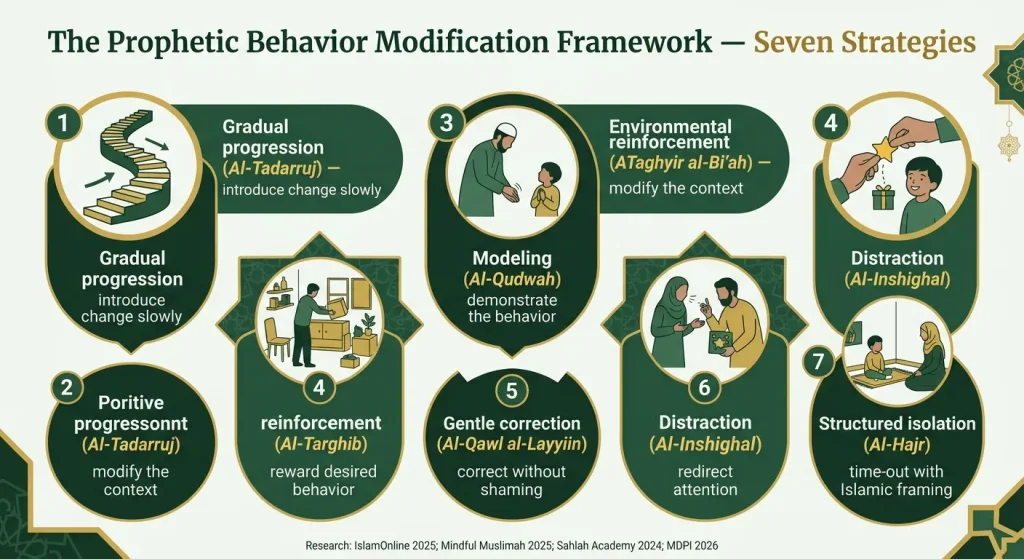
Section 2: The Prophet’s ﷺ Behavioral Toolkit — Seven Documented Strategies
The Prophet ﷺ was, among all his other roles, the greatest behavioral modifier in human history. He transformed a society that buried female infants alive, worshipped idols, and considered revenge a virtue — into the most ethically sophisticated community in the medieval world. He did it not through terror but through a specific set of documented behavioral strategies.
Strategy 1: Al-Tadarruj — Gradual Progression
The Quran was not revealed all at once. Alcohol was not prohibited in a single command. The full framework of Islamic obligation was introduced across twenty-three years — each stage building on the foundation of the previous, each change introduced when the community was ready to receive and maintain it.
The Prophet ﷺ said:
“Make things easy, do not make things difficult. Give glad tidings and do not repel people.”
— Sahih al-Bukhari, Hadith 69
For child behavior: The parent who tries to change multiple behaviors simultaneously will change none of them. Choose one. Work on it consistently for one month. Then — and only then — address the next.
For anger specifically: Do not expect the child who has been having tantrums for three years to stop after one correction. The gradual approach: first, help them recognize anger before it peaks. Then, practice one regulation tool repeatedly. Then, gradually, over months — the pattern shifts.
Strategy 2: Taghyir al-Bi’ah — Environmental Modification
The Prophet ﷺ told the angry man, when he first came seeking advice and was told “do not be angry”:
“If one of you becomes angry while standing, let him sit down. If the anger passes, then well and good; otherwise, let him lie down.”
— Sunan Abu Dawud, Hadith 4782; authenticated by al-Albani
This is environmental modification: change the physical context to interrupt the behavioral pattern. Sitting interrupts the physical activation of standing anger; lying down interrupts it further.
For tantrums: Remove the child from the triggering environment. The tantrum that began at the grocery store checkout line will de-escalate more quickly in the car or in a quiet corner. Not as punishment — as neurological interruption.
For stubborn refusal: Change the physical environment in which the request was made. The child who refuses at the dinner table might agree in the car or during a walk. The change of context reduces the emotional load attached to the previous refusal.
Strategy 3: Al-Qudwah — Behavioral Modeling
The Prophet ﷺ demonstrated the behavior he expected. He did not tell his Companions to be gentle — he was gentle with them. He did not command patience — he was patient with them. Behavioral modeling is the most powerful behavior modification tool available to a parent: the child’s brain has specialized mirror neurons that learn by observing and replicating the behaviors of those they are attached to.
The uncomfortable implication: The parent who loses their temper at the child’s tantrum is demonstrating exactly the behavior they want to extinguish. The parent who maintains calm — in the presence of the child’s storm — is demonstrating the regulation they want to build.
The hadith on teaching children to pray teaches us to remind continuously with love — approximately 5,475 times over three years. The capacity to be patient 5,475 times over a simple matter is the prophetic standard of parental behavioral modeling. This is not about perfection but about the sustained, patient, loving consistency that the Prophet ﷺ demonstrated.
Strategy 4: Al-Targhib — Positive Reinforcement
The Prophet ﷺ actively celebrated the behaviors he wanted to encourage. He praised publicly, specifically, and warmly. He gave gifts. He elevated people’s status when they demonstrated virtuous behavior.
For child behavior: Catch the child being good — and name it immediately. Not “good job” but “you felt angry just now and you stopped yourself from shouting. That is exactly what patience looks like. I am proud of you.”
The behavior that is specifically, immediately, and genuinely reinforced is the behavior that repeats.
Research shows that Islamic educational interventions based on Quran and Hadith can provide a strong foundation for the development of children’s morals, ethics, and personality through structured educational methods — allowing for holistic spiritual, moral, and character development. Positive reinforcement aligned with Islamic values produces measurable behavioral change.
Strategy 5: Al-Qawl al-Layyiin — The Gentle Word
فَقُولَا لَهُ قَوْلًا لَّيِّنًا
“And speak to him with gentle words.”
— Quran 20:44
As established in the previous article: if the gentle word is required even toward Pharaoh, it is required toward a child in the middle of a tantrum.
The gentle word in the midst of a child’s behavioral storm does three things simultaneously:
- Neurological: Activates the child’s parasympathetic nervous system (“rest and digest”) through the low, calm vocal tone that signals safety
- Relational: Maintains the attachment bond rather than triggering the child’s defensive response
- Modeling: Demonstrates the precise regulation the child is being asked to develop
Strategy 6: Al-Inshighal — Distraction and Redirection
The Prophet ﷺ used distraction and redirection in conflict resolution — changing the subject, introducing a new element, shifting the attention from the source of conflict to something else entirely.
For tantrums: In the middle of a young child’s tantrum, a calm, unexpected redirection — “I wonder what’s outside the window” — can interrupt the neurological loop more effectively than any reasoning or consequence.
For stubborn refusal: Offer a different pathway to the same destination. The child who refuses to put on their shoes can be asked “which shoe first — left or right?” The choice within the requirement provides autonomy within the limit.
Strategy 7: Al-Hajr al-Tarbawi — Structured Withdrawal
The Prophet ﷺ did not engage with Ka’b ibn Malik during his community isolation — but this withdrawal was structured, purposeful, and time-limited. It was not abandonment; it was a formal, clear consequence with a clear end point.
For behavior: The Islamic “time-out” — properly framed — is not punishment but structured calm recovery. The child who is too dysregulated to receive input needs a quiet space to regulate, without parental engagement, before any discussion or correction is possible.
The key distinction: Structured withdrawal is with love and with explanation: “I love you too much to talk to you when we are both this upset. Let’s both calm down, and then we will talk.” It is not abandonment, not anger, not rejection — it is the wisdom of knowing that no productive conversation is possible in the midst of a storm.
Section 3: Anger — The Complete Islamic Response Framework
The Three-Stage Anger Protocol
The Prophet ﷺ provided, across multiple authenticated Hadith, a complete three-stage protocol for anger management — applicable to both the child who is angry and the parent who is responding to the child’s anger.
Stage 1 — The Refuge (immediate):
“I seek refuge in Allah from the accursed Shaytan.”
The Prophet ﷺ prescribed this specifically for anger: “When one of you becomes angry and says ‘A’udhu billahi min al-Shaytan al-Rajim,’ his anger will subside.” (Sahih al-Bukhari, Hadith 3282)
Teach children to say this — not as a magic formula but as a trained pause. The five syllables of A’udhu billahi create a deliberate interruption in the anger escalation cycle. They require breathing to say. They redirect attention to Allah. They are, neurologically, a regulatory intervention.
Stage 2 — The Posture Change (seconds to minutes):
“If one of you becomes angry while standing, let him sit down. If the anger passes, then well and good; otherwise, let him lie down.”
— Sunan Abu Dawud, Hadith 4782; authenticated by al-Albani
The physical change interrupts the physiological activation. Standing increases blood pressure and heart rate; sitting decreases them. Lying down decreases them further. The body leads the emotion.
Stage 3 — Wudu (if needed):
“Anger comes from Shaytan. Shaytan was created from fire, and fire is extinguished with water. So when one of you becomes angry, let him perform Wudu.”
— Sunan Abu Dawud, Hadith 4784; authenticated by al-Albani
For older children and parents: Wudu as a de-escalation tool. The physical act of washing — the cool water on the face, the hands, the arms — is both physiologically calming and spiritually grounding.
Teaching Children the Anger Protocol
| Age | What to Teach | How |
|---|---|---|
| 3–6 | The “big feelings” signal and the Refuge phrase | Role-play: “When you feel the big feeling, say these words with me” |
| 7–10 | A’udhu billahi + sitting down + deep breaths | Practice in calm moments; role-play the angry scenario |
| 11+ | Full three-stage protocol + Wudu for major anger | Discuss the Hadith; practice together; track progress in a journal |
Section 4: Tantrums in Young Children — The Prophetic Model in Practice
The Prophet ﷺ dealt with children in a way that has direct practical implications for tantrum management. When he saw a child upset, he did not ignore them or minimize their pain because of their age. He would go down to their level — on his knee. He would approach with a loving, warm face of concern. He might touch the child on the arm or shoulder and empathize. Children would open up to him. Empathy lets them know that they matter and their feelings matter — this protects their self-esteem and overall emotional health. Step one is to empathize to interrupt the reactive behavior.
The Five-Step Prophetic Tantrum Response
Step 1 — Go to their level: Physically lower yourself to the child’s eye level. Do not stand over them. The physical equalizing communicates safety rather than authority.
Step 2 — Warm face, gentle touch: Even in the middle of the storm — maintain a warm face. No anger, no exasperation visible. A hand on the arm or shoulder. Not restraining — connecting.
Step 3 — Name the emotion: “You’re feeling really upset right now. That’s okay. I can see it’s very big.” Not “stop crying” or “there’s nothing to be upset about” — both of which communicate that the child’s emotional experience is wrong.
Step 4 — Hold the limit with gentleness: (cite index=”9-1″>This is where the parent explains what they will not allow — in a very calm way, without sarcasm and without anger. Clear, gentle, firm. The limit stands; the gentleness is non-negotiable.</cite>
“I can see you really wanted that. And we’re not getting that today. That doesn’t change.” The Prophetic model does not abandon limits in the face of emotional storms — but it delivers limits with Qawl al-Layyiin.
Step 5 — Wait: Do not attempt to reason, explain, or teach in the middle of a tantrum. The child’s rational brain is offline. Wait for the storm to pass. Then — and only then — engage with the behavior, the limit, and the alternative.
The Quran provides comprehensive guidance on disciplining children, emphasizing justice, mercy, patience, and understanding. By incorporating these principles into their parenting, parents can create a nurturing and structured environment that promotes moral and spiritual development. The Sunnah, derived from the teachings and practices of the Prophet ﷺ, encompasses key principles aimed at nurturing positive behavior — with gentleness and kindness as the foundational principle.
Section 5: Stubbornness and Refusal — When the Child Says No
Understanding the ‘Inad
The child who refuses is not evil. They are developmentally asserting their will — a capacity that is, in the right direction, one of the most important Islamic qualities: the capacity to resist when something wrong is demanded.
The parent who eliminates this capacity will later be horrified to discover they have raised a child who cannot say no to peer pressure, to social coercion, to the many situations in adult life that require the courage to refuse.
The goal is not to eliminate stubborn refusal. It is to channel the strong will toward the right refusals.
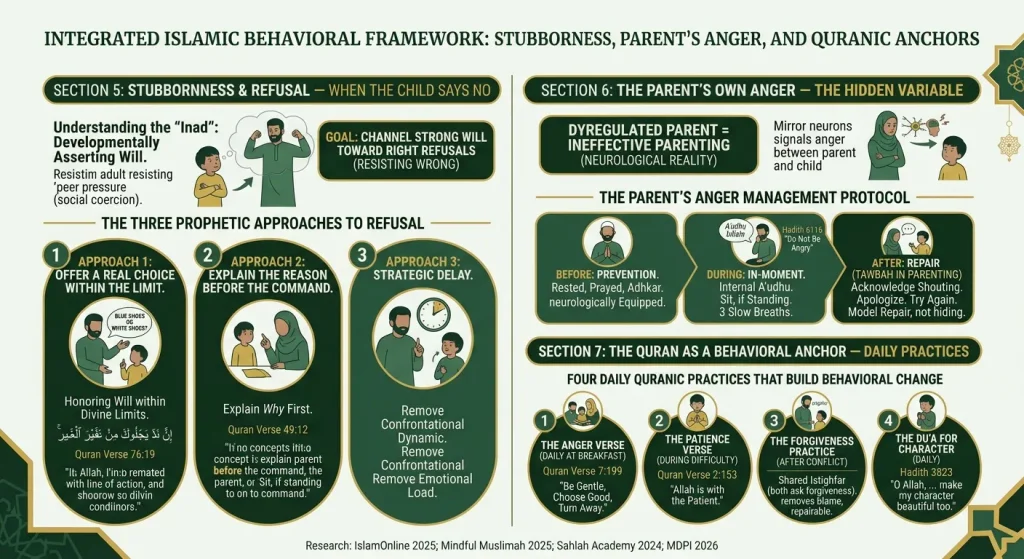
The Three Prophetic Approaches to Refusal
Approach 1 — Offer a real choice within the limit: The child who refuses “Put on your shoes” may comply with “Which shoes — the blue ones or the white ones?” The choice within the requirement provides autonomy without abandoning the limit. This is not manipulation — it is the Islamic principle of honoring the human will within divine limits. Allah Himself says:
إِنَّا هَدَيْنَاهُ السَّبِيلَ إِمَّا شَاكِرًا وَإِمَّا كَفُورًا
“Indeed, We guided him to the way — whether he would be grateful or ungrateful.”
— Quran 76:3
The choice is given — within the framework. This is the divine model of respecting will within limits.
Approach 2 — Explain the reason before the command: The Prophet ﷺ regularly explained the reason behind his guidance before delivering the guidance itself. “The one who backbites is like the one who eats the flesh of his dead brother — would any of you want that?” (Quran 49:12) The reason arrives before the prohibition.
The child who understands why they are being asked to do something is more likely to comply — and more likely to internalize the principle — than the child who is commanded without reason.
Approach 3 — Strategic delay: Sometimes, the most effective response to stubborn refusal is not engagement but delay. The parent who says “I hear that you don’t want to. Let’s revisit this in ten minutes” has removed the confrontational dynamic without abandoning the requirement. Often, after ten minutes, the child complies without further negotiation — because the emotional load of the original refusal has dissipated.
Everything in this guide becomes exponentially more difficult — or effectively impossible — when the parent is also dysregulated.
This is not a criticism. It is a neurological reality. When the parent is angry, their mirror neurons are signaling anger to the child, their vocal tone is triggering the child’s threat response, their body language is communicating danger — and everything they do to “manage” the child’s behavior is working against the neurological conditions required for the child’s regulation.
The Prophet ﷺ said, when a man came to him three times asking for guidance and received the same answer each time:
“Do not be angry.”
— Sahih al-Bukhari, Hadith 6116
Three times. The same answer. Because it was — and remains — the most important behavioral intervention available.
The Parent’s Anger Management Protocol
Before the behavior: Prevention is the primary intervention. A parent who is well-rested, has eaten, has prayed, has made adhkar — is neurologically more equipped to respond to a child’s behavior storm than one who has not. Self-care is not selfishness in the Islamic parenting framework; it is the prerequisite for effective parenting.
During the behavior: Apply your own three-stage anger protocol before applying the child’s. Say A’udhu billahi internally. Sit if you are standing. Take three slow breaths before you speak.
After the behavior: If you lost your temper — repair it. Do not pretend it did not happen. Sit with your child and say: “I raised my voice just now and that was wrong of me. I’m sorry. I was feeling very frustrated and I did not manage it well. Let me try again.”
If you end up shouting, it is important to rectify your mistake instead of going with the flow. The parent who repairs after rupture is modeling something more valuable than the parent who never ruptures: they are demonstrating that mistakes are acknowledged and corrected, not hidden — the Islamic standard of tawbah applied to everyday parenting.
Section 7: The Quran as a Behavioral Anchor — Daily Practices That Change Patterns
Beyond specific behavioral interventions, the Muslim family has access to a practice that secular behavioral science cannot offer: the Quran as a daily environmental influence that gradually, consistently, and deeply shapes behavioral patterns over time.
The Quran and Behavior: The Documented Connection
Islam and its role in shaping behavior is well-documented: By adhering to Islamic values, children can achieve significant improvements in their behavior, contributing to the building of a healthy and cohesive society. Behavior is easily promoted through worship in Islam — prayer specifically teaches patience, discipline, and the regulation of the body and impulse.
Four Daily Quranic Practices That Build Behavioral Change
1. The Anger Verse — Daily Before the Day Begins
خُذِ الْعَفْوَ وَأْمُرْ بِالْعُرْفِ وَأَعْرِضْ عَنِ الْجَاهِلِينَ
“Take what is given freely, enjoin what is good, and turn away from the ignorant.”
— Quran 7:199
Read this verse together at breakfast. One sentence of commentary: “This verse tells us to be gentle, to choose good, and to walk away from situations that will make us worse. Today, when something makes you angry, remember this verse.”
2. The Patience Verse — During Difficulty
إِنَّ اللَّهَ مَعَ الصَّابِرِينَ
“Indeed, Allah is with the patient.”
— Quran 2:153
Teach your child to recite this internally when they feel the anger or frustration rising. Three words in Arabic. Enormous theological weight. “Allah is with me in this hard moment.”
3. The Forgiveness Practice — After a Conflict
After a behavioral episode — once both parent and child have regulated — begin the repair with Istighfar together:
“Let’s ask Allah to forgive us both for what happened. Astaghfirullah.”
This practice does three things: it removes blame from a single party (both ask for forgiveness), it frames the behavioral failure as something that can be repaired (not a permanent character verdict), and it establishes Allah as the relational reference point for behavior (we are answerable to Allah, not just to each other).
4. The Du’a for Character — Daily
Teach the child the du’a the Prophet ﷺ made for himself:
“O Allah, You have made my form beautiful — so make my character beautiful too.”
— Musnad Ahmad, Hadith 3823; authenticated by al-Albani in Sahih Ibn Hibban, 959
The child who prays daily for good character has placed themselves in the most powerful behavioral change program available: asking Allah to do the work that parenting alone cannot complete.
Structured Curriculum Framework
quranst’s Smart Parenting track provides specific, session-by-session coaching for Muslim parents navigating children’s anger, tantrums, and stubborn refusal — with Prophetic strategies, practical tools, and a community of Muslim parents facing the same challenges.
Book your free 2-session trial →Conclusion: The Child Whose Behavior Was Changed by Love, Not Fear
The child who stops having tantrums because they were punished enough has not developed emotional regulation. They have developed the capacity to suppress their emotion in the presence of authority — and the suppressed emotion will reappear, in different forms, at different times, with different people.
The child whose behavior changes because they have been genuinely helped to regulate — whose anger is met with calm, whose stubbornness is honored within limits, whose emotional storms are waited out with patience and then processed with warmth — that child is developing something real: the internal capacity for emotional regulation that will serve them for the rest of their life.
This is what Islamic behavioral modification produces when it is done correctly. Not compliance from fear. Not suppression of emotion. But the genuine, internal, sustainable regulation that the Prophet ﷺ pointed to when he said:
“The strong person is the one who controls themselves when angry.”
The strength he was describing was not an absence of anger. It was the capacity to choose, in the presence of anger, what to do with it.
That capacity is built across years of patient, skilled, Prophetically grounded parenting. It cannot be shortcut. It cannot be produced by a single conversation, a single consequence, or a single session.
But it can be built. One patient response at a time. One regulated parent meeting one dysregulated child. One A’udhu billahi said together before the anger peaks. One repair after one rupture.
All of it adding up, over years, to the child who does not need to be feared into good behavior — because good behavior has become who they are.
إِنَّ اللَّهَ مَعَ الصَّابِرِينَ
“Indeed, Allah is with the patient.”
— Quran 2:153
Be patient. Be consistent. Be with Allah in the hard moments.
The change is coming.
🟢 Get Specific Guidance for Your Child’s Behavior
The strategies in this guide work. They work better when you have a qualified Islamic parenting coach alongside you — guiding the application, troubleshooting the specific challenges of your specific child, and providing the accountability structure that sustains difficult behavioral change over time.
quranst’s Smart Parenting track provides:
Behavior-Specific Coaching:
- Live, one-on-one sessions with Islamic parenting specialists
- Specific, session-by-session guidance for anger, tantrums, and stubborn refusal
- Child behavior management frameworks rooted in the Prophetic model
- Troubleshooting for when the standard strategies are not working for your specific child
Islamic Foundation:
- Islamic studies components that provide the theological grounding for behavioral change
- Hadith study — the specific Prophetic narrations relevant to your child’s behavioral challenges
- Study Islam online alongside the parenting coaching
Arabic and Quran Integration:
- Learn Quran — the daily Quranic practices that anchor behavioral change
- Learn Arabic — so the Quranic du’as and verses the child is learning have genuine meaning
- The Quran as a living behavioral anchor — not a decorative element
👇 Begin with Two Free Sessions
Two Ways to Begin
“Make things easy, do not make things difficult. Give glad tidings and do not repel people.”
— Sahih al-Bukhari, Hadith 69
Be easy. Give glad tidings. Build the child Allah entrusted to you.
بِسْمِ اللَّهِ — Begin.
References and Sources
Quranic References
- Quran 2:153 — “Indeed, Allah is with the patient”
- Quran 7:199 — “Take what is given freely, enjoin what is good, turn away from the ignorant”
- Quran 15:29 — “And I breathed into him from My spirit”
- Quran 20:44 — “Speak to him with gentle words”
- Quran 49:12 — “Would any of you want to eat the flesh of his dead brother?”
- Quran 76:3 — “We guided him — whether grateful or ungrateful”
Hadith References
- Sahih al-Bukhari, Hadith 69 — “Make things easy; do not make things difficult”
- Sahih al-Bukhari, Hadith 3282 — “A’udhu billahi” prescribed for anger
- Sahih al-Bukhari, Hadith 6114; Sahih Muslim, Hadith 2609 — “The strong person controls themselves when angry”
- Sahih al-Bukhari, Hadith 6116 — “Do not be angry” (three times)
- Sunan Abu Dawud, Hadith 4782 — “If standing, sit; if anger passes, well; otherwise lie down” (authenticated by al-Albani)
- Sunan Abu Dawud, Hadith 4784 — Wudu for anger (authenticated by al-Albani)
- Musnad Ahmad, Hadith 3823 — “Make my character beautiful” du’a (authenticated by al-Albani)
Classical Scholarly Works
- Al-Ghazali, Abu Hamid: Ihya’ ‘Ulum al-Din (Revival of the Religious Sciences). Dar al-Ma’rifa, Beirut. Vol. 3 — Book of the Condemnation of Anger. (Gradual behavior change; riyada al-nafs; soul sport methodology)
- Ibn al-Qayyim al-Jawziyyah: Rawdat al-Muhibbin. (Anger as fire metaphor; soul training methodology)
Research Sources
- ResearchGate (June 2024). “Islamic Education Interventions in Children: Study Using the Al-Qur’an Approach.” Key findings: Islamic educational interventions based on Quran and Hadith provide strong foundation for children’s morals, ethics, and personality through structured educational methods; holistic spiritual, moral, and character development achievable through consistent Quranic approach.
- ResearchGate (August 2025). “Islam and its Role in Shaping Behavior and Resolving Behavioral Problems.” IOSR Journal. Key findings: Guidance and counseling play significant role in correcting behavior in a gentle and non-violent manner; good behavior is a sign of faith; prayer teaches patience, discipline, and impulse regulation; Islamic values produce measurable behavioral improvement.
- IslamOnline (August 2025). “The Messenger’s Approach in Changing Behavior and Habits.” Key findings: Behavior cannot be altered by guidance alone; sustained behavioral patterns over prolonged periods produce change; Al-Ghazali’s riyada al-nafs as gradual training; modern Islamic behavioral sciences combine Quran and Sunnah with psychology and behavioral science.
- AYEINA (May 2020). “Controlling Parental Anger through Islam.” Key findings: Hadith on teaching children to pray = 5,475 repetitions over 3 years; capacity for patient repetition as prophetic standard; importance of rectifying mistakes after shouting; parental modeling as primary behavior modification tool.
- Sahlah Academy (July 2024). “Discipline Child in Islam: Balancing Kindness, Patience, and Firmness.” Key findings: Quran provides comprehensive guidance on disciplining children — justice, mercy, patience, understanding; Prophet ﷺ emphasized gentleness and kindness as foundational principle; Sunnah discipline nurtures positive behavior and moral conduct.
- Mindful Muslimah (November 2025). “How to Handle Toddler Tantrums — An Approach Closer to the Sunnah.” Key findings: Prophet ﷺ went to child’s level (on knee); warm face and empathetic touch; empathy interrupts reactive behavior; protects self-esteem and emotional health; then explains what will not be allowed — calmly, without sarcasm or anger.
Frequently Asked Questions
How does Islamic behavior modification differ from secular parenting methods?
What are the primary Prophetic strategies for handling child tantrums and anger?
- Gradual Progression (Al-Tadarruj): Implementing change step-by-step rather than all at once[cite: 3].
- Environmental Change (Taghyir al-Bi’ah): Modifying physical position or setting during emotional outbursts[cite: 3].
- Behavioral Modeling (Al-Qudwah): Demonstrating calm regulation before expecting it from the child.
- The 3-Stage Anger Protocol: Teaching the child to seek refuge (A’udhu billahi), change posture (sit/lie down), and perform Wudu[cite: 3].
