

Introduction: The Question That Every Muslim Child Will Ask
It usually happens at the most unexpected moment.
In the car, on the way to school. At the dinner table on a Tuesday. Before bed, when the lights are dim and the guard is down.
“Does Allah really exist? How do we know?”
Or: “If Allah is so merciful, why did my friend’s dad die?”
Or: “Why do I have to be Muslim? My friend is Christian and she’s a really good person.”
Or — the one that silences rooms and makes parents grip the steering wheel: “Who made Allah?”
The Muslim parent who has not prepared for these questions does one of three things. They silence the question — “Don’t ask that.” They give an answer that satisfies neither the child nor themselves — “Just have faith.” Or they panic, reading the question as evidence of imminent apostasy rather than as evidence of a developing mind doing exactly what a developing mind should do.
Islamic religious education can be a place for navigating the existential — exploring fundamental human questions about being, meaning, and existence. The child who asks hard questions about faith is not leaving faith; they are engaging it at the level of genuine subjectification — making faith genuinely their own through free inquiry rather than merely inheriting it as a social identity. This is not a crisis. This is the educational purpose of Aqeedah.
The hard existential questions a Muslim child asks are not a problem to be managed. They are an opportunity — the most significant intellectual and spiritual opportunity in the child’s religious development. The parent or teacher who meets these questions with genuine engagement, honest acknowledgment of difficulty, and the intellectual resources of fourteen centuries of Islamic rational theology produces something extraordinary: a young Muslim whose faith is built on genuine conviction rather than unexamined inheritance.
That faith survives university. It survives the internet. It survives atheist roommates and skeptical professors and the countless intellectual challenges that the modern world delivers to every Muslim who ventures into it.
This guide provides the answers — age-appropriate, intellectually honest, Quranic and rationally grounded — to the six most common and most important existential questions Muslim children ask.
Structured Curriculum Framework
quranst’s Islamic Studies track teaches Aqeedah with intellectual depth — connecting every belief to its Quranic foundation, rational argument, and real-world relevance. Live, one-on-one sessions with certified instructors who welcome the hard questions.
Book your free 2-session trial →The Islamic Foundation: Reason and Revelation Together
The most important thing to understand before addressing any of the six questions is this: Islam does not ask children — or anyone — to believe without evidence.
The Quran does not say “believe and do not question.” It says:
أَفَلَا يَتَدَبَّرُونَ الْقُرْآنَ أَمْ عَلَىٰ قُلُوبٍ أَقْفَالُهَا
“Do they not reflect upon the Quran, or are there locks upon their hearts?”
— Quran 47:24
Reflection (tadabbur) is commanded. The Quran repeatedly invites its reader to look, to think, to consider, to observe:
قُلْ سِيرُوا فِي الْأَرْضِ فَانظُرُوا
“Say: Travel through the land and observe.”
— Quran 6:11
Faith is not irrational. Ibn al-Qayyim and his teacher Ibn Taymiyyah warned against relying solely on Greek philosophical proofs for Allah’s existence — but they did not warn against rational engagement with faith itself. Rather, they insisted that faith integrates the rational, moral, and spiritual dimensions together — it is the reality that enables us to validate and utilize all our faculties. Recognizing spirituality as an instinct places religion alongside fundamental human faculties like sensory perception and reason, making it a cosmic fact that must be integrated with empirical and logical understanding.
The Aqeedah curriculum methodology aims to know Allah, love Him, and obey Him in the manner He pleases — establishing the constants of religion in the soul through intellectual, rational, then psychological and doctrinal approaches. The rational approach comes first.
The classical Islamic tradition produced, across fourteen centuries, the most sophisticated rational theology in the history of world religions — the science of ‘Ilm al-Kalam. Scholars like Al-Ash’ari, Al-Maturidi, Ibn Rushd, and Ibn Taymiyyah developed rigorous rational arguments for Islamic beliefs that engage with philosophy, logic, and the nature of existence at the highest intellectual level.
The child who encounters these arguments — in age-appropriate form — discovers that their faith is not incompatible with thinking. It is its most natural product.
An Islamic worldview addresses the five fundamental philosophical questions: What is the nature of reality? How can we gain knowledge? What is the nature of human beings? What is the basis of morality? What is the purpose of life? The foundational Islamic assertion of Tawheed — the oneness of Allah — provides coherent answers to all five. The child who learns to engage these questions through an Islamic intellectual framework develops what scholars call the Islamic mind — a mode of engaging with reality that is simultaneously rational, moral, and spiritual.
Section 1: The Developmental Framework — When Children Ask What Questions
Not every question requires the same answer at every age. The developmental readiness for intellectual engagement with Aqeedah follows a documented pattern:
For a child, there are three stages of religious development: The Fairy Tale Stage (0–6) — children conceptualize religious realities in concrete, physical terms; the Literal Stage (7–11) — beginning rational engagement, but still concrete; and the Abstract Stage (12+) — genuine capacity for abstract philosophical reasoning. This underscores the need for age-appropriate religious education that considers the child’s cognitive development. Abstract religious teachings at the Fairy Tale stage produce either confusion or mechanical memorization without genuine understanding.
| Age Range | Question Capacity | Best Approach | Goal |
|---|---|---|---|
| 3–6 | “Why?” about observed phenomena | Sense of wonder + simple Tawheed | Allah is the Creator who loves us |
| 7–9 | Basic “how do we know?” questions | Simple evidence + story | Allah’s signs in creation |
| 10–12 | Genuine logical questions | Rational argument at accessible level | Belief based on evidence |
| 13+ | Complex philosophical challenges | Full classical argument + scholarly sources | Intellectual conviction |
The parent who answers a seven-year-old’s “Does Allah exist?” with a graduate-level philosophical argument has failed the developmental moment as completely as the parent who answers a fifteen-year-old’s same question with “because I said so.”
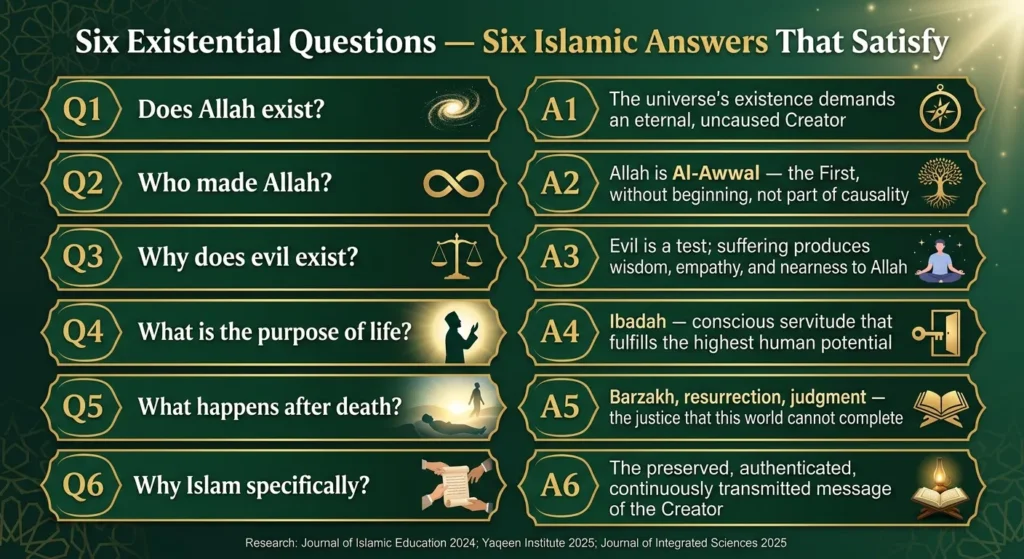
Section 2: Question 1 — Does Allah Exist?
Why children ask it: Because they live in a world where nothing is accepted without evidence — in science class, in math class, in every domain of intellectual life. The question is not disrespectful. It is the natural application of the evidential standard their education has given them.
The Quranic Framework:
أَمْ خُلِقُوا مِنْ غَيْرِ شَيْءٍ أَمْ هُمُ الْخَالِقُونَ
“Were they created by nothing? Or were they themselves the creators?”
— Quran 52:35
This verse — cited by the classical scholars as among the most powerful rational arguments in the Quran — presents the logical alternatives with elegant simplicity: something exists. Either it came from nothing (logically impossible), or it created itself (also logically impossible), or something else created it. The chain must end somewhere — at an uncreated Creator.
The Classical Argument (age-appropriate versions):
For ages 7–9 (The Painting Argument): “If you walked into a room and found a beautiful painting, would you think it appeared by itself? No — you’d know someone painted it. The universe is infinitely more complex and beautiful than any painting. Does it make sense that it appeared by itself?”
For ages 10–12 (The Causal Argument): “Everything that exists was caused by something else. Your phone was made by engineers. The engineers were born from parents. The parents came from food that grew in soil that… every chain has to start somewhere. Something has to have always existed that was never created — uncaused, eternal. Muslims call that Allah.”
For ages 13+ (The Cosmological Argument): “The universe began — the Big Bang is established science. Whatever begins to exist has a cause. Therefore the universe has a cause. That cause must be: uncaused (eternal), outside space and time, enormously powerful, and singularly responsible for the universe’s existence. This is precisely what the Islamic concept of Allah describes.”
The Fitrah Argument:
“Every child is born on the fitrah.”
— Sahih al-Bukhari, Hadith 1358; Sahih Muslim, Hadith 2658
The fitrah — the innate human predisposition toward recognition of a Creator — is itself evidence. The universal human tendency to seek transcendence, to believe in something beyond the material, to experience awe before the vast and mysterious — is not a cultural accident. It is the imprint of the Creator on the created.
Recognizing spirituality as an instinct places religion alongside fundamental human faculties like sensory perception and reason, making it a cosmic fact. The spiritual drive within the human being that inspires them to answer existential questions and contemplate a higher reality is built into the human constitution — the fitrah that the Quran describes.
What to say to your child:
“That’s one of the most important questions anyone can ask. Let’s think through it together. You agree that the universe exists. Where did it come from? Everything that begins has a cause. So what caused the universe? The cause has to be outside time and space, uncaused and eternal, incredibly powerful. We call that cause Allah — and the Quran described this logic fourteen centuries before modern cosmology confirmed that the universe had a beginning.”
Section 3: Question 2 — Who Made Allah?
Why children ask it: It is the logical follow-up to any “Allah made everything” answer. It is not heresy — it is logical consistency.
The Answer:
The question contains a hidden assumption: that everything requires a maker. But this assumption only applies to things that begin to exist — things that are contingent, dependent, created.
Allah is not one of those things.
هُوَ الْأَوَّلُ وَالْآخِرُ
“He is the First and the Last.”
— Quran 57:3
Al-Awwal — The First — means there was no “before” Allah. He did not begin. He has always existed, without a starting point, without a creator, without dependency on anything external.
Age-appropriate explanation:
For ages 7–9: “Who made Allah? No one — because Allah has always been there. You know how numbers go forever? Before 1 comes zero, before zero comes negative one, and it goes on forever? Allah isn’t like a number in a sequence — He’s the one who exists outside all sequences, always there, with no beginning and no end.”
For ages 10–12: “The question ‘who made Allah?’ assumes that Allah needs to be made — but only things that begin to exist need a cause. Allah has always existed — He is what we mean by ‘the Eternal.’ Asking ‘who made Allah?’ is like asking ‘what is north of the North Pole?’ The question doesn’t apply.”
For ages 13+: “The cosmological argument doesn’t lead to an infinite regress — it leads to a necessary being: something that exists by its own nature, that cannot not exist, that requires no external cause. Ibn Sina called this the Wajib al-Wujud — the Necessarily Existent. This is Allah. The question ‘who made Allah?’ misunderstands what Allah is — He is by definition the uncaused cause, not another caused thing in the chain.”
Section 4: Question 3 — Why Does Evil and Suffering Exist?
Why children ask it: Because they have experienced or witnessed suffering — the death of a grandparent, a serious illness, a natural disaster, an injustice they cannot explain. This question arises from pain, not from philosophy.
The Quranic Framework:
وَلَنَبْلُوَنَّكُم بِشَيْءٍ مِّنَ الْخَوْفِ وَالْجُوعِ وَنَقْصٍ مِّنَ الْأَمْوَالِ وَالْأَنفُسِ وَالثَّمَرَاتِ ۗ وَبَشِّرِ الصَّابِرِينَ
“And We will surely test you with something of fear and hunger and a loss of wealth and lives and fruits — but give glad tidings to the patient.”
— Quran 2:155
Suffering, in the Quranic framework, is not evidence against Allah. It is evidence of His design — a design that includes testing, growth, and the development of qualities that cannot be developed without difficulty.
The Problem of Evil implicitly assumes God’s existence and targets specific divine attributes — mercy, justice, omnipotence — rather than God’s existence itself. This reframing invalidates it as an atheistic proof. The question is not “why does evil exist?” but “what is the purpose of evil within an all-knowing, all-merciful, just divine plan?”
The Four Islamic Answers to Evil:
1. Testing and Growth: The Prophet ﷺ said: “The greatest reward comes with the greatest trial. When Allah loves a people, He tests them. Whoever accepts that wins His pleasure; whoever is discontent with that earns His wrath.” (Sunan Ibn Majah, Hadith 4031; authenticated by al-Albani)
The suffering that produces sabr, empathy, and nearness to Allah is not pointless suffering. It is the forge in which the most valuable human qualities are made.
2. The Limits of Human Perspective:
وَعَسَىٰ أَن تَكْرَهُوا شَيْئًا وَهُوَ خَيْرٌ لَّكُمْ
“And it may be that you hate something but it is good for you.”
— Quran 2:216
Human beings see a fragment of a vast narrative. What appears as evil from inside a single human moment may be, from the perspective of the full picture — which Allah alone sees — part of something purposeful.
3. Evil Has Causes in Human Choice: Much of what we call evil is the consequence of human free will — the freedom that allows love to be real also allows cruelty to be real. Allah granted humanity real freedom, and real freedom includes the freedom to harm.
4. Justice Requires an Afterlife: The suffering in this world that ends with no redress, no justice, no accounting — the child who grew up in poverty through no fault of their own, the oppressor who died in comfort — this world cannot complete justice. The existence of unjust suffering is actually an argument for the afterlife: a final justice that this world cannot provide.
What to say to your child (when the question comes from pain):
Before the intellectual answer — the emotional response: “It makes sense that this confuses you. I find it hard too. Can I tell you what Islam says about it? Not because it makes the pain smaller — but because it might make more sense of it.”
Section 5: Question 4 — What Is the Purpose of Life?
Why children ask it: Because they encounter a world that offers many competing answers — success, pleasure, family, career — and they sense, rightly, that none of these is fully sufficient.
The Quranic Answer:
وَمَا خَلَقْتُ الْجِنَّ وَالْإِنسَ إِلَّا لِيَعْبُدُونِ
“And I did not create the jinn and mankind except to worship Me.”
— Quran 51:56
Ibadah — worship — is not a narrow answer. The classical scholars defined it as: every word, action, and state that Allah loves and is pleased with, whether outward or inward. (Ibn Taymiyyah, Al-‘Ubudiyyah)
This means: cooking for your family with awareness of Allah is Ibadah. Studying with the intention of serving humanity is Ibadah. Treating people well is Ibadah. The entire human life — properly oriented — is worship.
The Islamic teleological answer to “what is the purpose of life?” is grounded in Tawheed: because all of existence comes from Allah, all of existence is oriented toward Allah. The human being — created with the divine breath of Al-Ruh — has a unique position in this orientation: the capacity for conscious, chosen, loving servitude. The purpose of life is not servitude as slavery but servitude as the fulfillment of the highest human potential.
Age-appropriate explanation:
For ages 7–9: “Allah made you because He loves you, and He wants you to know Him and love Him back. Everything good that you do — being kind, helping people, learning, praying — is how you show Allah that you love Him. That’s what life is for.”
For ages 13+: “The Islamic answer to the purpose of life is Ibadah — but it’s a bigger word than it looks. It means: every moment of genuine awareness of Allah, every action oriented toward what He loves, every relationship treated with the dignity He commanded. The person who lives this way has not just found the purpose of life — they have lived it.”
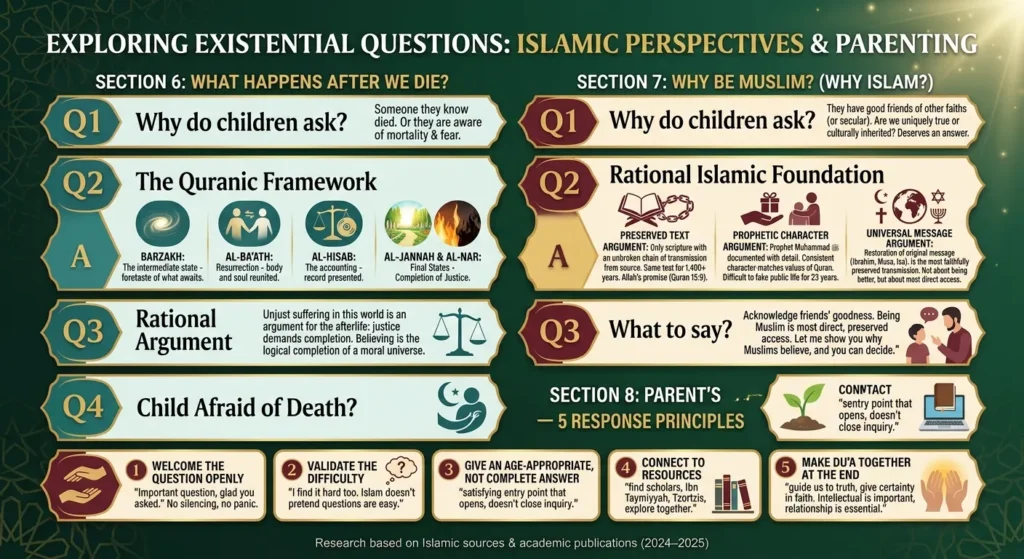
Section 6: Question 5 — What Happens After We Die?
Why children ask it: Usually, because someone they know has died. Or because they have become aware of their own mortality. Or because they are afraid.
The Quranic Framework:
كُلُّ نَفْسٍ ذَائِقَةُ الْمَوْتِ ۖ وَإِنَّمَا تُوَفَّوْنَ أُجُورَكُمْ يَوْمَ الْقِيَامَةِ
“Every soul shall taste death. And only on the Day of Resurrection will you be given your full reward.”
— Quran 3:185
The Islamic answer to death is not “nothing happens” (which is both intellectually unsatisfying and emotionally devastating) nor is it vague spiritual reassurance. It is a specific, documented, Quranic framework:
Barzakh: The intermediate state — the soul lives in a state between death and resurrection, experiencing a foretaste of what awaits.
Al-Ba’ath: The resurrection — the body and soul are reunited on the Day of Judgment.
Al-Hisab: The accounting — every soul’s record is presented, complete.
Al-Jannah and Al-Nar: The final states — Paradise and the Fire — the completion of justice that this world could not provide.
The rational argument for the afterlife:
The existence of unjust suffering in this world — the good person who suffers without redress, the oppressor who thrives without consequence — is an argument for the afterlife: justice demands completion. If there is no afterlife, the universe is fundamentally unjust. The Muslim’s belief in the afterlife is not wishful thinking — it is the logical completion of a moral universe.
What to say when a child is afraid of death:
The Prophet ﷺ said: “Whoever loves to meet Allah, Allah loves to meet them.” (Sahih al-Bukhari, Hadith 6507) And he described his own passing with peace — the anticipation of meeting the Lord he had served with his life.
The child who has a living relationship with Allah — who has been raised to know, love, and communicate with Him through prayer and Quran — faces death differently from the child for whom death is simply termination.
Section 7: Question 6 — Why Should I Be Muslim and Not Something Else?
Why children ask it: Because they have good friends who are Christian, Jewish, Hindu, or secular — who seem genuinely good people. They are asking whether Islam is uniquely true or just culturally inherited.
This is the most important question — and the most honest one.
The child who asks this deserves the most complete answer — because they are asking for the intellectual basis of their own faith. And they have every right to one.
The Preserved Text Argument:
The Quran is the only religious scripture in the world with an unbroken, authenticated chain of oral and written transmission from its source. It has not been edited, revised, or compiled from competing manuscripts. Every copy of the Quran in the world — from a 1,400-year-old manuscript to one printed this morning — contains the same text.
Allah promised this: “Indeed, it is We who sent down the message, and indeed, We will be its guardian.” (Quran 15:9)
This claim is empirically verifiable — and it is verified.
The Prophetic Character Argument:
The Prophet Muhammad ﷺ was documented by his companions with extraordinary detail — his daily life, his personal habits, his treatment of his family, his treatment of his enemies, his humor, his sadness, his fears. The character documented in the Seerah is consistent, morally coherent, and matches the values the Quran articulates at a level that would be extraordinarily difficult to fake over twenty-three years of documented public life.
The Universal Message Argument:
Islam does not claim to be a new religion. It claims to be the restoration of the original, universal message — the message of Ibrahim, of Musa, of Isa, of all the prophets. The question is not “why Islam over other religions?” but “which transmission of the original divine message has been most faithfully preserved?” The Islamic claim is that the Quran, with its documented preservation and transmission, is the answer.
What to say to your child:
“That’s a great question. You’re right that your Christian friend is a good person. Being Muslim isn’t about being better than other people. It’s about having the most direct, most preserved, most complete access to the message Allah sent. Let me show you why Muslims believe the Quran is uniquely preserved — and then you can decide what you think.”
Section 8: The Parent’s Guide — How to Respond Without Shutting Down
The most important thing a parent can do when a child asks an existential question is not to have the perfect answer. It is to have the right response — a response that keeps the conversation open.
The Five Response Principles
1. Welcome the question openly: “That’s a really important question. I’m glad you asked me.” — Never, under any circumstances, “Don’t ask that” or “Just have faith” or the visible panic that communicates “this question is dangerous.”
2. Validate the difficulty: “Honestly, I find that hard too. Islam doesn’t pretend these questions are easy.” — The parent who admits the difficulty of the question is modeling intellectual honesty. The child who sees their parent take the question seriously takes both the question and the answer seriously.
3. Give an age-appropriate answer — not a complete one: The goal is not to exhaustively answer the question in one conversation. The goal is to provide a satisfying entry point that opens rather than closes the inquiry. “Here’s the beginning of the Islamic answer to that. There’s much more to this — want to explore it more?”
4. Connect to resources: “There are scholars who have thought about this for centuries. Ibn Taymiyyah wrote about this. Hamza Tzortzis has a whole book on it. Let’s find something together.”
5. Make du’a together at the end: “Ya Allah — guide us to the truth and give us certainty in our faith. Ameen.” — The intellectual engagement is important. The turning to Allah at the end is essential. It is a reminder that Aqeedah is not only a philosophical exercise — it is a relationship with the One being argued about.
The Aqeedah methodology aims to know Allah, love Him, and obey Him — through intellectual, rational, then psychological and doctrinal approaches. The intellectual approach opens the door; the love relationship is the destination. The parent who engages the question intellectually and then says “and now let’s talk to Allah” has demonstrated this integration perfectly.
Structured Curriculum Framework
quranst’s Islamic Studies track teaches Aqeedah through exactly this framework — intellectual engagement, classical scholarly arguments, and a curriculum that welcomes every question your child might bring. Live, one-on-one sessions with certified instructors.
Book your free 2-session trial →Conclusion: The Faith That Welcomes Questions
The theologian Al-Ghazali — whose intellectual journey from doubt to certainty is one of the most documented in Islamic history — wrote in his autobiography Deliverance from Error (Al-Munqidh min al-Dalal):
“The thirst for understanding the true nature of things was my habit and way from the beginning of my youth. It was an instinct and a natural disposition placed in my very nature by Allah Most High, not something resulting from my own choosing or contriving.”
The child who asks “Does Allah exist?” is not a danger. They are a young Al-Ghazali — their intellectual instinct turned, as Allah designed it, toward the most important questions available to a human mind.
The family that meets these questions with intellectual engagement, with the resources of fourteen centuries of Islamic rational theology, with genuine curiosity and genuine faith — that family raises children who discover, through their own reasoning and their own inquiry, that Islam is not a constraint on their intellect.
It is its fulfillment.
Faith is not irrational. Faith is the reality that enables us to validate and utilize all our faculties, skills, and talents to reach our destiny in life. It is the very justification for rationality. The child who discovers this — through genuine inquiry, met with genuine Islamic intellectual engagement — does not merely inherit faith. They choose it. And faith that is chosen is the only faith that lasts.
سَنُرِيهِمْ آيَاتِنَا فِي الْآفَاقِ وَفِي أَنفُسِهِمْ حَتَّىٰ يَتَبَيَّنَ لَهُمْ أَنَّهُ الْحَقُّ
“We will show them Our signs in the horizons and within themselves until it becomes clear to them that it is the truth.”
— Quran 41:53
Show them the signs. Welcome the questions. Let the truth reveal itself.
🟢 Give Your Child the Intellectual Foundation Their Faith Deserves
The questions in this guide will not come once. They will come repeatedly, in different forms, at different ages, with increasing sophistication. The child who has been given intellectual tools to engage them — who has studied Aqeedah not as a list of beliefs to memorize but as a living intellectual framework for engaging reality — is the child who emerges from every challenge with stronger, not weaker, conviction.
quranst’s Islamic Studies track provides:
Aqeedah — Rational and Rooted:
- The existence of Allah — cosmological, teleological, and fitrah-based arguments
- Tawheed — the three dimensions of divine oneness and their implications
- The Problem of Evil — Islamic responses from Al-Ghazali, Ibn Taymiyyah, and contemporary scholars
- The afterlife — Barzakh, resurrection, and judgment — with Quranic foundations
- Prophetic authenticity — the Seerah as evidence for the Prophet’s ﷺ truthfulness
Islamic Studies Complete:
- Fiqh — the practical jurisprudence that connects belief to action
- Hadith — the authenticated narrations that illuminate every Aqeedah question
- Study Islam online — flexible scheduling for Muslim families in the West
- Islamic education spanning ages 5–18
Arabic — The Language of the Arguments:
- Learn Arabic — the classical Arabic of the Aqeedah scholars
- Quranic Arabic — understanding the Quran’s own rational arguments directly
👇 Begin with Two Free Sessions
Two Ways to Begin
“We will show them Our signs in the horizons and within themselves until it becomes clear to them that it is the truth.”
— Quran 41:53
Show them the signs. Let the truth reveal itself. Begin the conversation.
بِسْمِ اللَّهِ — Begin.
References and Sources
Quranic References
- Quran 2:155 — “We will surely test you — but give glad tidings to the patient”
- Quran 2:216 — “It may be that you hate something but it is good for you”
- Quran 3:185 — “Every soul shall taste death”
- Quran 6:11 — “Travel through the land and observe”
- Quran 15:9 — “Indeed, We will be its guardian” (the Quran’s preservation)
- Quran 41:53 — “We will show them Our signs until it becomes clear it is the truth”
- Quran 47:24 — “Do they not reflect upon the Quran?”
- Quran 51:56 — “I did not create except to worship Me”
- Quran 52:35 — “Were they created by nothing? Or were they themselves the creators?”
- Quran 57:3 — “He is the First and the Last”
Hadith References
- Sahih al-Bukhari, Hadith 1358; Sahih Muslim, Hadith 2658 — “Every child is born on the fitrah”
- Sahih al-Bukhari, Hadith 6507 — “Whoever loves to meet Allah, Allah loves to meet them”
- Sunan Ibn Majah, Hadith 4031 — “The greatest reward comes with the greatest trial” (authenticated by al-Albani)
Classical Scholarly Works
- Al-Ghazali: Al-Munqidh min al-Dalal (Deliverance from Error). (Intellectual journey from doubt to certainty)
- Ibn Taymiyyah: Al-‘Ubudiyyah (Servitude to Allah). (Definition of Ibadah as comprehensive worship)
- Ibn Sina (Avicenna): Wajib al-Wujud framework. (The Necessarily Existent — rational argument for Allah’s existence)
Research Sources
- Journal of Integrated Sciences (2025). “The Problem of Evil and Islamic Theology.” Key findings: Problem of Evil implicitly assumes God’s existence and targets divine attributes rather than existence itself; Islamic theological responses across classical and contemporary scholarship; systematic Islamic engagement with atheistic objections.
- Taylor & Francis, British Journal of Religious Education (2025). “Learning with(in) religious tradition. Navigating the existential in Islamic religious education.” DOI: 10.1080/01416200.2025.2508488. Key findings: Islamic religious education can be a place for navigating existential questions; subjectification — making faith genuinely one’s own through free inquiry — is the educational purpose of RE; children who engage questions genuinely are making faith their own.
- Journal of Islamic Education, Vol. 9 No. 2 (June 2024). “Islamic Education Interventions in Children: Study Using the Al-Qur’an Approach.” Key findings: Three developmental stages of religious understanding (Fairy Tale, Literal, Abstract); abstract religious teachings at early stages produce confusion; Tawheed as the foundational introduction to Islamic Aqeedah; age-appropriate religious education essential.
- IqraNetwork — Aqeedah Essentials Course (2025). Key findings: Aqeedah methodology establishes constants of religion through intellectual, rational, psychological, and doctrinal approaches in sequence; rational approach comes first in the classical Aqeedah methodology.
- Taylor & Francis, Educational Philosophy and Theory, Vol. 57 Issue 2 (2025). “Rethinking contemporary schooling in Muslim contexts: An Islamic conceptual framework.” DOI: 10.1080/00131857.2024.2411325. Key findings: Islamic worldview addresses five foundational philosophical questions; Tawheed provides coherent answers to ontology, epistemology, anthropology, axiology, and teleology; Islamic education develops the “Islamic mind.”
- Yaqeen Institute (2025). “In Pursuit of Conviction: Faith & Certainty.” Key findings: Faith is not irrational — it is the justification for rationality; Ibn al-Qayyim and Ibn Taymiyyah integrate rational, moral, and spiritual dimensions; spirituality as instinct alongside sensory perception and reason; the fitrah as cosmic fact; Al-Ghazali’s integrated approach to faith and certainty.
- IqraNetwork — Aqeedah Course (2025). Key findings: Aqeedah methodology aims to know Allah, love Him, and obey Him through intellectual then psychological approaches; establishing constants of religion in the soul through combined intellectual and doctrinal frameworks.
Frequently Asked Questions
How can I explain the existence of Allah to my child rationally?
How should parents answer when a child asks, “Who made Allah?”
Why does evil and suffering exist according to Islamic Aqeedah?
What is the best way to respond when children ask existential questions about faith?
- Welcome the question: Never shut down inquiry or panic[cite: 5].
- Validate the difficulty: Acknowledge that intellectual questions are normal[cite: 5].
- Provide age-appropriate answers: Adapt arguments to their developmental stage[cite: 5].
- Connect to scholarly resources: Show them classical scholarly heritage[cite: 5].
- Make Du’a together: Anchor intellectual conviction in spiritual connection[cite: 5].
