

Introduction: The Muslim Who Recites What They Cannot Read
He has memorized Surah Ya-Sin.
All 83 verses. Every word in the correct order. Tajweed applied correctly throughout — the Ghunnas, the Madd lengths, the Qalqalah letters vibrating precisely as they should.
He recites it every Friday morning. It takes him about eight minutes.
He does not know that Ya-Sin opens with one of the Quran’s most mysterious oaths — “Ya-Sin. By the Quran, full of wisdom” — and that classical scholars have discussed the meaning of Hakim (full of wisdom, as a description of the Quran itself) for fourteen centuries.
He does not know that verse 12 contains one of the most theologically significant statements about divine knowledge in the entire Quran: “Indeed, it is We who bring the dead to life and record what they have put forth and what they left behind — and all things We have enumerated in a clear register.”
He does not know that the final section of Ya-Sin — the argument for resurrection from creation — is structured as a series of rhetorical questions that build to the most powerful one-line statement about divine power in Arabic: “His command, when He intends a thing, is only that He says ‘Be,’ and it is.” (Quran 36:82)
He is reciting one of the most intellectually and spiritually rich chapters in the Quran. He is producing sounds. He is not yet reading.
For parents, raising children with genuine Quranic Arabic comprehension gives them a relationship with their faith that no translation or summary can replace. Understanding the Quran directly — without the intermediary of translation — changes everything about the Muslim’s experience of prayer, of the Quran itself, and of their relationship with Allah.
This guide is about closing the gap — specifically, through the Arabic for Specific Purposes (ASP) approach that quranst has built into the core of its Arabic curriculum: the systematic, Quran-anchored method for learning the Arabic vocabulary, grammar, and root system that transforms Quranic recitation from phonetic reproduction into genuine comprehension.
Structured Curriculum Framework
quranst’s Arabic Language track delivers the ASP methodology — every vocabulary lesson, every grammar point, every root system explanation anchored in the Quran the student is already reciting. Live, one-on-one sessions with certified native Arabic instructors.
Book your free 2-session trial →The Quranic Imperative: Understanding Is the Point
The Arabic for Specific Purposes approach to Quranic Arabic begins with the Quran’s own stated purpose for its Arabic:
إِنَّا أَنزَلْنَاهُ قُرْآنًا عَرَبِيًّا لَّعَلَّكُمْ تَعْقِلُونَ
“Indeed, We have sent it down as an Arabic Quran so that you might understand.”
— Quran 12:2
The phrase la’allakum ta’qilun — “so that you might understand” — is the divine purpose statement for the Arabic of the Quran. Allah did not reveal the Quran in Arabic as an arbitrary linguistic choice. He revealed it in Arabic so that it could be understood. Comprehension is the explicit divine goal.
كِتَابٌ أَنزَلْنَاهُ إِلَيْكَ مُبَارَكٌ لِّيَدَّبَّرُوا آيَاتِهِ
“A blessed Book which We have revealed to you, so that they might reflect upon its verses.”
— Quran 38:29
Tadabbur — deep reflection on the Quran’s verses — requires comprehension. And the first step to comprehension is vocabulary: knowing what the words mean.
This is where Arabic for Specific Purposes (ASP) — the methodology of targeting a specific, defined vocabulary and grammar set in service of a specific practical goal — is perfectly suited to the Quranic Arabic learner. The goal is not general Arabic fluency. The goal is Quranic comprehension. And Quranic comprehension has a defined, research-documented vocabulary path.
Section 1: The Research — What Arabic for Specific Purposes Means for Muslim Learners
Arabic for Specific Purposes is a branch of the broader Language for Specific Purposes (LSP) framework — a well-established applied linguistics methodology that has transformed professional language education in law, medicine, business, and technology.
A Language for Specific Purpose (LSP) curriculum for Quranic Arabic helps learners master a closed set of syntactic rules and vocabularies in the context of the Quran, so that they can recall an idiomatic translation in their native language while they recite or listen to the Quran. This approach directly addresses the needs of the large demographic segment of adult learners and Muslim families who want Quranic comprehension specifically — not general Arabic fluency as a lifetime project.
Arabic for Specific Purposes presents a specific approach to language teaching where knowledge is transferred from teacher to learners through particular teaching methods and materials targeted to the specific domain. For Quranic Arabic, this means: the vocabulary of the Quran, the grammar of the Quran, and the rhetorical structures of the Quran — prioritized over the vocabulary, grammar, and structures of Modern Standard Arabic that a general Arabic curriculum would cover.
Why General Arabic Courses Fail the Quranic Learner
A standard general Arabic course teaches: greetings, family vocabulary, numbers, shopping vocabulary, basic conversation, then gradually — over months — exposes the learner to news Arabic, formal writing, and eventually classical texts.
The Quranic Arabic learner needs a completely different sequence: the divine names of Allah, the particles that structure Quranic sentences (min, fi, ‘ala, bi), the verbs of creation and judgment, the theological vocabulary of Iman and Taqwa and Jannah — immediately, from lesson one, anchored in the verses the learner is already reciting in prayer.
There is a statistically significant, relatively strong, and positive correlation between listening to the Quran and learning Arabic vocabulary. The outcomes demonstrate that spending time listening to the Quran can effectively support the development of Arabic vocabulary — and that a curriculum that integrates Quranic listening with structured vocabulary acquisition produces significantly faster Quranic comprehension than either approach alone.
Section 2: The 80/20 Discovery — The Most Important Statistic in Quranic Education
This is the number that changes everything for the Quranic Arabic learner who has been told that Arabic is impossibly difficult:
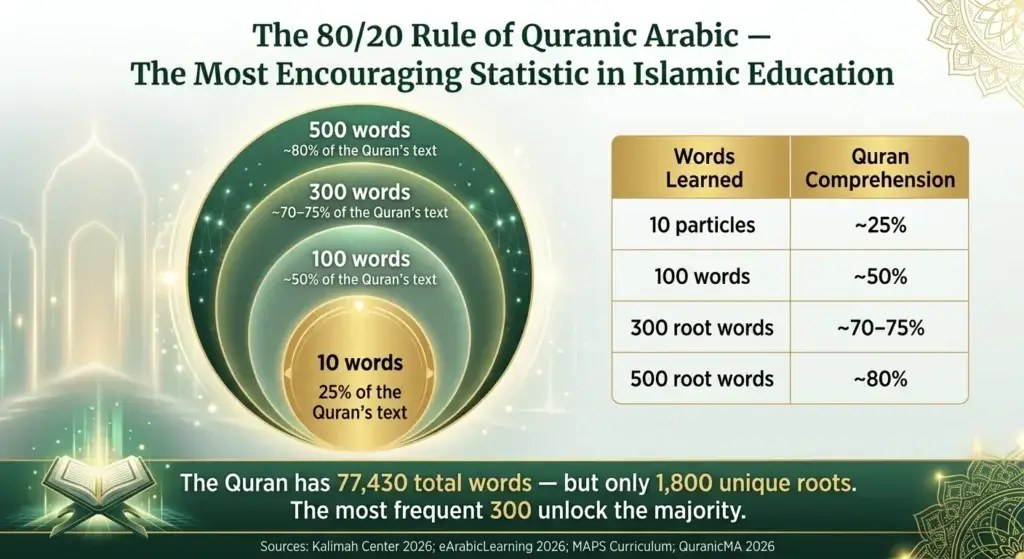
The Quran contains approximately 77,430 total words. But only 300–500 high-frequency root words account for approximately 80% of the entire text.
Let that land for a moment.
The most comprehensive, the most linguistically rich, the most theologically dense text in the Arabic language — and 80% of its vocabulary can be accessed through the systematic study of 300–500 words.
The Quran has approximately 77,430 total words but only 14,870 unique word forms, and just 300–500 root words account for roughly 80% of the entire text. The progression:
- Top 10 words: approximately 25% of Quranic text
- Top 100 words: approximately 50% of Quranic text
- Top 300–500 root words: approximately 75–80% of Quranic text
The 80/20 rule in Quranic Arabic: approximately 80% of the Quran is composed of a specific set of repeated vocabulary — about 300–400 words. 500 high-frequency words cover approximately 80% of the Quran. Three learning pillars: Alphabet + Tajweed / High-frequency vocabulary / Grammar (Nahw + Sarf).
A relatively small set of roughly 300 high-frequency words accounts for close to 80% of the words in the Quran by how often they occur. Learning this core list early is the fastest single route to recognising what you read. The 300 most frequent words give you recognition of close to 80% of the words in the Quran by occurrence.
What the 80/20 Means in Practice
The Muslim who learns the top 10 most frequent Quranic words — Allah, wa (and), fi (in), min (from), ‘ala (upon), qala (he said), rabbi (my Lord), alladhina (those who), lahu (for Him), kana (was) — has access to approximately 25% of the Quran’s total word count.
Every time they encounter these words — in Al-Fatiha, in the short surahs they memorize, in any Quranic verse — they will know those words. The Quran will begin to partially open.
The Muslim who learns the top 100 words has access to approximately 50% of the Quran. Half of every verse they read will be recognizable.
At 300 words: 70–80% of the Quran is accessible.
At 500 words: the threshold where genuine reading comprehension begins — where the Muslim can read a verse, look up the unfamiliar words, and construct meaning from the whole.
This is not a shortcut. It is the most direct path to the explicitly stated Quranic goal: “so that you might understand.”
Section 3: The Three Pillars of Quranic Arabic Comprehension
Learning Arabic to understand the Quran requires two distinct skill sets: Tajweed (correct recitation rules) and Quranic comprehension (understanding meaning through grammar and vocabulary). To understand the Quran in Arabic, a learner needs: the Arabic alphabet and Tajweed (1–3 months), Quranic vocabulary — the 500 most common words covering approximately 80% of the Quran (3–6 months), and basic Quranic grammar including Nahw and Sarf (6–12 months).
Pillar 1: Arabic Script and Tajweed (The Access Gateway)
Before any vocabulary can be learned, the learner must be able to read Arabic script — the letters, the vowel markers, the connective forms. Without this foundation, every vocabulary lesson requires a workaround.
Timeline: 1–3 months of consistent study The quranst approach: Arabic script teaching is integrated with Tajweed from the first session — so the learner reads correctly from the beginning rather than developing habits that must be unlearned later.
The specific letters that matter most for Quranic Arabic: The Quranic letters that cause most difficulty for non-Arabic speakers — ‘Ayn (ع), Ha (ح), Ghayn (غ), Kha (خ), Dad (ض), Ta (ط), Za (ظ), Qaf (ق) — are given disproportionate early attention in the quranst curriculum, because these are the letters that most frequently appear in high-frequency Quranic vocabulary.
Pillar 2: High-Frequency Vocabulary (The Comprehension Unlock)
The sequenced, systematic learning of the 300–500 most frequent Quranic words is the core of the ASP approach. The specific sequence matters — the quranst curriculum prioritizes:
Tier 1 (words 1–50): Particles, pronouns, and prepositions that appear on almost every page — wa (and), fi (in), min (from), ‘ala (upon), bi (with/by), hum (they), huwa (he), hiya (she), anta (you), la (no/not).
Tier 2 (words 51–150): Core theological nouns and verbs — Allah, Rabb (Lord), Rahman, Rahim, Jannah (Paradise), Nar (Fire), Iman (faith), Taqwa (God-consciousness), qala (said), ja’a (came), ra’a (saw), amana (believed), kafara (disbelieved).
Tier 3 (words 151–300): Extended theological vocabulary and narrative verbs — ‘adhab (punishment), rahma (mercy), khawf (fear), shukr (gratitude), sabr (patience), hikma (wisdom), ‘ilm (knowledge), ‘amal (deed), fatwah, ayah (sign/verse).
Each word is taught with:
- Its Arabic script form
- Its transliteration
- Its core meaning
- Its Quranic frequency (how many times it appears)
- Three Quranic verses in which it appears
Pillar 3: Arabic Grammar — Nahw and Sarf (The Structural Understanding)
Vocabulary alone produces fragmented comprehension. Grammar provides the connective tissue — the understanding of how words relate to each other within a Quranic sentence.
Quranic Arabic grammar requires understanding word patterns, and the key distinction: understanding the Quran does not require the ability to actually speak or write Arabic. These two skills can be de-emphasized while Nahw (syntax — how sentences are structured) and Sarf (morphology — how words are formed from roots) are prioritized for comprehension.
The three grammar priorities in the quranst ASP curriculum:
- Noun-adjective agreement — understanding that al-Rahman al-Rahim is two qualities of the same entity, not two different entities
- Verb tense and form — distinguishing past, present, and command forms that change meaning fundamentally
- The construct case (Idafa) — the most frequent grammatical structure in the Quran: Rabb al-‘alamin (Lord OF the worlds), Kitab Allah (Book OF Allah)
Section 4: The quranst ASP Methodology — How Every Arabic Lesson Serves the Quran
The defining feature of the quranst Arabic for Specific Purposes approach is the Quran-Anchored Lesson Structure: every vocabulary word, every grammar rule, every root pattern is introduced through a Quranic verse — and the lesson ends with the student able to understand something in the Quran they could not understand before.
The Quran-Anchored Lesson Structure
Opening (5 minutes): The instructor presents a verse from a surah the student has already memorized or is currently memorizing. The verse is recited. Then the question: “Which words in this verse do you already know?”
Vocabulary Focus (10 minutes): Two to three new words introduced — not in isolation, but in the context of this verse and two additional Quranic verses where the same word appears. The student learns the word’s root, its derivatives, and its Quranic frequency.
Grammar Application (10 minutes): One grammar structure, illustrated from within the same verse. “The word ‘Rabb’ followed by ‘al-‘alamin’ — this is the Idafa construction. It means ‘Lord OF the worlds.’ Any time you see two nouns connected this way in the Quran, the first one owns or relates to the second.”
Comprehension Moment (5 minutes): The instructor opens the Quran and the student encounters a previously unfamiliar verse containing the newly learned vocabulary and grammar. They work through its meaning — directly, in Arabic, without translation.
Closing Reflection (5 minutes): “What did you understand from the Quran today that you could not understand before this session?” The student names it specifically. The progress is made concrete.
The Weekly Quran Connection
Each week, the student’s Arabic learning is connected to one surah they are currently reciting in prayer. Every vocabulary word learned that week is flagged if it appears in that surah. By the end of the week, the student recites the surah in prayer and recognizes the words they just learned.
The distance between the Arabic class and the prayer mat collapses. Arabic is no longer a separate subject from Quran — it is the key to the Quran they are already holding.
Section 5: The Vocabulary Learning System — 300 Words, Systematically
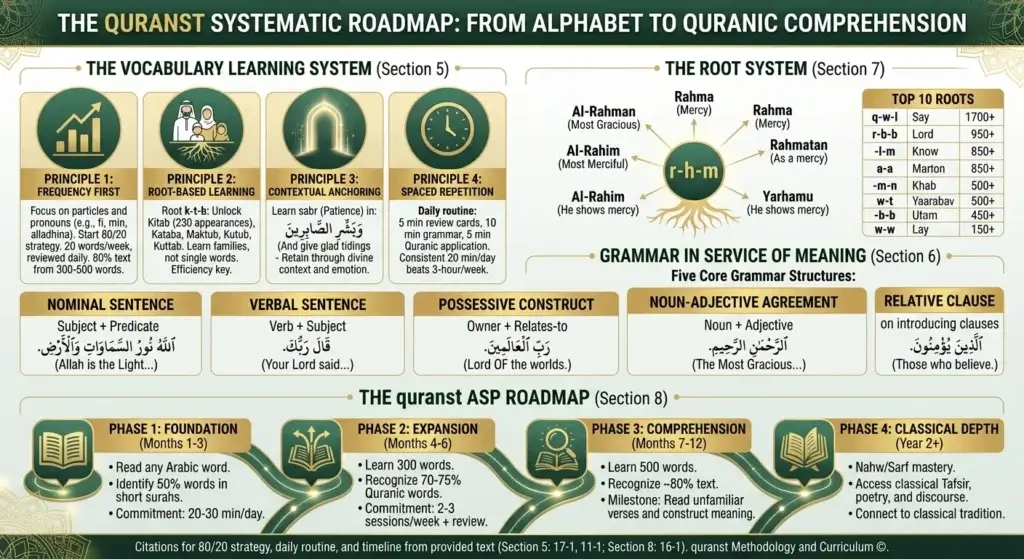
The quranst vocabulary system is built around four principles drawn from both classical Arabic pedagogy and contemporary vocabulary acquisition research:
Principle 1: Frequency First
The most frequent Quranic words are taught first — always. The student who spends weeks on month names and color vocabulary (common in general Arabic courses) has not taken a step toward Quranic comprehension. The student who learns fi, min, ‘ala, wa, bi in their first week encounters these words in approximately every Quranic verse they ever read.
The 80/20 vocabulary strategy: just 300 to 500 high-frequency root words account for approximately 80% of the entire Quranic text. Start with the particles and pronouns that appear on almost every page: min (from), fi (in), alladhina (those who), kana (was). Twenty new words a week, reviewed daily, gets through the core list in about four months.
Principle 2: Root-Based Learning
Arabic is a root-based language — most words derive from a three-letter root that carries a core semantic meaning. Learning one root unlocks multiple words simultaneously.
The root k-t-b (to write):
- Kitab — book (appears 230 times in the Quran)
- Kataba — he wrote
- Maktub — written, decreed
- Kutub — books (plural)
- Kuttab — scribes
The student who learns the root k-t-b has not learned one word. They have learned a family of words — and every time they encounter any derivative of this root in the Quran, they have access to its meaning.
The Quran has approximately 1,800 unique root words. Of these, the 300 most frequently occurring — with their conjugations and derivations — cover approximately 80% of the text. Root-based learning is therefore the most efficient approach: each root learned is a key that unlocks multiple Quranic words simultaneously.
Principle 3: Contextual Anchoring in Quranic Verses
Vocabulary learned in isolation is vocabulary forgotten. Vocabulary learned in the context of a beautiful, meaningful Quranic verse — with the full emotional and spiritual weight of that verse attached to it — is vocabulary retained.
The student who learns sabr (patience) in the context of:
وَبَشِّرِ الصَّابِرِينَ
“And give glad tidings to the patient.” — Quran 2:155
…has not merely learned a word. They have learned a word in the context of a divine promise. The next time they feel the need for patience, that verse will surface. The vocabulary is now personally meaningful.
Principle 4: Spaced Repetition with Quranic Review
The vocabulary retention system combines spaced repetition (reviewing words at the optimal interval before forgetting occurs) with Quranic review (revisiting the Quranic verses in which each word appears as part of the review process).
A learner who studies 20 minutes every day will outpace someone who does a 3-hour session once a week. A simple daily routine: 5 minutes — review vocabulary flashcards (focus on high-frequency Quranic words); 10 minutes — grammar study or instructor session; 5 minutes — apply to a Quranic verse.
Section 6: Grammar in Service of Meaning — Nahw Through the Quran’s Own Sentences
The traditional Arabic grammar sequence begins with abstract rules, then moves to examples, then eventually reaches Quranic text. The quranst ASP approach inverts this: it begins with Quranic sentences, extracts the grammar rule from within the verse, and applies it back to additional Quranic examples.
The Five Core Grammar Structures in the quranst Curriculum
These five structures appear in virtually every Quranic page — mastering them unlocks the majority of the Quran’s syntactic architecture:
Structure 1: The Nominal Sentence (Al-Jumla al-Ismiyya)
Subject + Predicate — the most fundamental Arabic sentence pattern.
Quranic example:
اللَّهُ نُورُ السَّمَاوَاتِ وَالْأَرْضِ
“Allah is the Light of the heavens and the earth.” — Quran 24:35
Allah = subject; Nur al-samawat wal-ard = predicate.
Structure 2: The Verbal Sentence (Al-Jumla al-Fi’liyya)
Verb + Subject (+ Object) — the primary pattern for action and narrative.
Quranic example:
قَالَ رَبُّكَ
“Your Lord said…”
Qala = verb (said); Rabbuka = subject (your Lord).
Structure 3: The Possessive Construct (Al-Idafa)
First noun OWNS/RELATES TO second noun — the most frequent Quranic grammatical structure.
Quranic example:
رَبِّ الْعَالَمِينَ
“Lord OF the worlds” — Al-Fatiha
Rabb = first noun (Lord); al-‘alamin = second noun (the worlds). The second noun is always definite; the first takes no article.
Structure 4: Noun-Adjective Agreement (Al-Na’t)
Adjective follows noun and agrees in gender, number, and definiteness.
Quranic example:
الرَّحْمَٰنِ الرَّحِيمِ
“The Most Gracious, the Most Merciful” — Al-Fatiha
Both Al-Rahman and Al-Rahim are adjectives describing Allah — agreeing with it in definiteness and case.
Structure 5: The Relative Clause (Al-Jumla al-Sifiyya)
“Those who…” / “The one who…” — introduces conditional or descriptive clauses.
Quranic example:
الَّذِينَ يُؤْمِنُونَ
“Those who believe”
Alladhina = relative pronoun; yu’minun = present tense verb. This structure appears dozens of times in Al-Baqarah alone.
Section 7: The Root System — Arabic’s Gift to the Quran Learner
The Arabic root system is, from the perspective of the Quranic learner, one of the most remarkable features of the language — and one that makes Quranic Arabic significantly more learnable than it appears.
The root r-h-m (mercy):
- Al-Rahman — the Most Gracious (appears in Al-Fatiha and 57 times in the Quran as a divine name)
- Al-Rahim — the Most Merciful (appears in Al-Fatiha and throughout the Quran)
- Rahma — mercy (appears 79 times)
- Rahmatan — as a mercy (appears in phrases like rahmatam min rabbika — “a mercy from your Lord”)
- Yarhamu — He shows mercy
The student who learns this one root — r-h-m — has access to five of the most frequently repeated words in the Quran. And the beautiful circularity: the words themselves are about mercy, so learning them is itself an encounter with the mercy they describe.
The top 10 Quranic roots and what they unlock:
| Root | Core Meaning | Key Quranic Words | Quranic Frequency |
|---|---|---|---|
| r-h-m | Mercy | Al-Rahman, Al-Rahim, Rahma | 300+ total occurrences |
| k-t-b | Write | Kitab, Kutub, Maktub, Kataba | 300+ |
| ‘-l-m | Know | ‘Alim, ‘Ilm, Ya’lam, ‘Allama | 850+ |
| q-w-l | Say | Qala, Yaqul, Qawl | 1,700+ |
| ‘-m-n | Believe | Amana, Iman, Mu’min | 800+ |
| r-b-b | Lord | Rabb, Rabbuna, Rabbika | 950+ |
| ‘-b-d | Worship | ‘Abada, ‘Ibadah, ‘Abd | 275+ |
| y-w-m | Day | Yawm, Ayyam | 400+ |
| n-f-s | Soul | Nafs, Anfus | 295+ |
| k-f-r | Disbelieve | Kafara, Kafir, Kufr | 500+ |
A student who masters these 10 roots — with their conjugations and derivatives — has access to several thousand Quranic word occurrences. The Quran is opening, word family by word family.
Section 8: A Realistic Roadmap — From Alphabet to 80% Comprehension
A realistic timeline for Quranic Arabic comprehension:
- Stage 1 (Script and reading): Read any Arabic word correctly — 1–2 months
- Stage 2 (High-frequency vocabulary): Recognise approximately 80% of Quranic words — 3–4 months
- Stage 3 (Core grammar): See sentence structure in a verse — 3–6 months
The quranst ASP Roadmap
Phase 1 — Foundation (Months 1–3): The Alphabet and First 100 Words
Learning outcomes:
- Read Arabic script without difficulty
- Correct pronunciation with Tajweed basics applied
- First 100 high-frequency Quranic words memorized with meanings
- Can identify 50% of words in Al-Fatiha, Al-Ikhlas, Al-Falaq, Al-Nas
- Understands the three core grammar structures (nominal sentence, Idafa, adjective agreement)
Daily commitment: 20–30 minutes — 5 minutes vocabulary review, 15 minutes instructor session (quranst), 5 minutes Quranic application
Phase 2 — Expansion (Months 4–6): Words 101–300 and Grammar Deepening
Learning outcomes:
- 300 high-frequency Quranic words learned
- Recognizes 70–75% of words in any Quranic verse
- Can parse basic Quranic sentences independently
- Understands Al-Fatiha, all Juz’ ‘Amma surahs, and portions of Al-Baqarah directly
- Verbal sentence structure and relative clauses mastered
Weekly sessions: Two to three sessions with quranst instructor + daily independent review
Phase 3 — Comprehension (Months 7–12): Words 301–500 and Deep Grammar
Learning outcomes:
- 500 high-frequency words learned
- Recognizes approximately 80% of Quranic text
- Can read any Quranic verse and construct meaning from the familiar vocabulary
- Looks up unfamiliar words and understands how they function in context
- Quran reading has transformed: prayer feels different, Jumu’ah khutbah is partially accessible, Quran recitation carries meaning
The milestone: At this phase, the student opens the Quran to a random verse, reads it, and understands the majority of what they are reading. This is the moment the Quran becomes a direct, unmediated source of divine communication.
Phase 4 — Classical Depth (Year 2+): Grammar Mastery and Tafsir Access
Learning outcomes:
- Full Nahw and Sarf mastery
- Access to classical Tafsir in Arabic
- Ability to understand khutbahs, Arabic Islamic lectures, and religious discourse fully
- Beginning to learn Arabic classical poetry and prose as a window into the rhetorical tradition the Quran inhabits
This phase is where the quranst Arabic curriculum connects to the full classical Arabic tradition — because the student who has mastered Quranic Arabic has already learned the most sophisticated Arabic that exists. General classical Arabic expands naturally from this foundation.
Structured Curriculum Framework
quranst’s Arabic Language and Quranic Courses tracks are built around this ASP roadmap — every session connected to the student’s specific Quran learning, every vocabulary lesson Quran-anchored, every grammar rule illustrated through the verses the student is already reciting.
Book your free 2-session trial →Conclusion: The Prayer That Becomes a Conversation
There is a moment that every Muslim who completes Phase 2 of the quranst ASP roadmap describes in almost identical terms.
It happens in prayer.
They are reciting Al-Fatiha — the surah they have recited thousands of times. And something is different.
“Al-Hamdulillah” — and they feel the praise, because they know that hamd means praise and lillah means “belonging to Allah” — they are saying “all praise belongs to Allah,” and they know it.
“Rabb al-‘alamin” — and they see the scope, because they know ‘alamin means “worlds” and rabb means Lord — they are addressing the Lord of all of existence, and the scale of it is audible in the Arabic.
“Iyyaka na’budu” — and they mean it, because they know iyyaka means “only You” and na’budu means “we worship” — the exclusivity of Islamic worship is in the grammar, iyyaka placed before the verb to emphasize restriction, and they can hear it.
The prayer has become a conversation.
وَاللَّهُ يَعْلَمُ مَا تُسِرُّونَ وَمَا تُعْلِنُونَ
“And Allah knows what you conceal and what you reveal.”
— Quran 16:19
The student who has learned Quranic Arabic has not learned a language. They have learned to be known by it.
300 words. The distance between recitation and comprehension.
Begin tonight.
🟢 Begin the ASP Journey with quranst
The Arabic for Specific Purposes roadmap requires two things: the right curriculum and the right teacher. The curriculum that begins with Quranic frequency vocabulary, anchors every lesson in the Quran, and builds toward genuine comprehension — combined with a live instructor who knows where the student is and what they need next — is the combination that produces results.
quranst’s Arabic Language track provides:
Arabic for Specific Purposes — Quranic Focus:
- Learn Arabic through the frequency-first, Quran-anchored methodology
- Arabic for beginners — from the alphabet through the first 100 high-frequency Quranic words
- Online Arabic tutor — live, one-on-one, native-speaking instructor who delivers the ASP curriculum
The Three Pillars Delivered:
- Arabic script and Tajweed — correct reading foundation from Session 1
- High-frequency vocabulary — the 300-word roadmap, systematically
- Arabic grammar — Nahw and Sarf through Quranic sentences, not abstract rules
Connected to Quran Learning:
- Quranic Arabic — every Arabic lesson connected to the student’s current Quran memorization
- Online Quran classes — Arabic and Quran learning in integrated, coordinated sessions
- Learn Quran with comprehension, not just recitation
The Classical Arabic Path:
- Classical Arabic — the foundation for accessing fourteen centuries of Islamic scholarship
- Arabic grammar — full Nahw mastery for the student ready for Phase 4
- Speak Arabic fluently — conversational Arabic development for students with broader Arabic goals
👇 Begin with Two Free Arabic Sessions
Two Ways to Begin
“Indeed, We have sent it down as an Arabic Quran so that you might understand.”
— Quran 12:2
Understand it. Directly. In His language. Begin tonight.
بِسْمِ اللَّهِ — Begin.
References and Sources
Quranic References
- Quran 12:2 — “We have sent it down as an Arabic Quran so that you might understand”
- Quran 16:19 — “Allah knows what you conceal and what you reveal”
- Quran 24:35 — “Allah is the Light of the heavens and the earth”
- Quran 36:82 — “His command, when He intends a thing, is only: ‘Be,’ and it is”
- Quran 38:29 — “A blessed Book — so that they might reflect upon its verses”
Research Sources
- ResearchGate (September 2024). “Learning Qur’anic Arabic through Interactive Web-Based Software: A Pragmatic Approach in Language for Specific Purpose.” Key findings: LSP curriculum for Quranic Arabic helps learners master a closed set of syntactic rules and vocabularies in the context of the Quran; designed for demographic of adult learners wanting comprehension without general fluency.
- Academia.edu (2025). “Arabic Vocabulary Learning Strategies — Pengaruh Mendengarkan Murottal Ayat Al-Qur’an terhadap Pengetahuan Kosakata.” Key findings: Statistically significant positive correlation (0.518, p < 0.05) between listening to Quran and Arabic vocabulary development; advocates incorporating Quran listening as supplementary strategy in Arabic language education.
- ResearchGate. “Arabic for Specific Purposes in Malaysia: A Literature Review.” Key findings: ASP presents a specific approach to language teaching where knowledge is transferred through particular teaching methods and materials targeted to the specific domain; increasing career and religious learning prospects.
- Kalimah Center (June 2026). “Learn Quranic Arabic Online: The Ultimate Beginner’s Guide 2026.” Key findings: 80/20 rule — 80% of the Quran consists of repeated words; 500 high-frequency words cover approximately 80%; three learning pillars: Alphabet + Tajweed / Vocabulary / Grammar (Nahw + Sarf).
- Kalimah Center (June 2026). “100 Most Common Quranic Arabic Words.” Key findings: Quran has 77,430 total words but only 14,870 unique word forms; 300–500 root words account for 80% of entire text; progression: Top 10 words = 25%; Top 100 = 50%; Top 300–500 = 75–80%.
- Kalimah Center (June 2026). “Learn Arabic to Understand the Quran: Step-by-Step Guide.” Key findings: 14,870 unique word forms; 1,800 unique root words; 500 most frequent = 80% of text; Stage timeline: alphabet (1–3 months), vocabulary (3–6 months), grammar (6–12 months).
- eArabicLearning (May 2026). “Why Understanding the Quran Directly Changes Everything.” Key findings: 300 most frequent word-forms cover approximately 70–80% of the Quran; 1,800 unique root words; raising children with Quranic Arabic comprehension gives them a faith relationship no translation can replace.
- MAPS Curriculum — Understand Quranic Arabic. Key findings: High-frequency vocabulary first: 10 words = 25% of Quran; 60 words = 50%; approximately 500 words = 80%; understanding does not require speaking or writing Arabic — these skills can be de-emphasized; three-level curriculum reaching 80% vocabulary and grammar coverage.
- QuranicMA.com (September 2026). “How to Learn Arabic for Quran: Step-by-Step Roadmap.” Key findings: 300 high-frequency words account for close to 80% of the Quran by occurrence; start with particles and pronouns; realistic timeline: script/reading (1–2 months), vocabulary (3–4 months), grammar (3–6 months).
- FinancialContent/BusinessWire (September 2026). “How to Start Learning Quranic Arabic From Scratch.” Key findings: 300–500 high-frequency root words account for approximately 80% of the entire Quranic text; 20 minutes daily outpaces 3-hour weekly sessions; 5-minute vocabulary flashcard review as core daily practice.
Frequently Asked Questions
What is Arabic for Specific Purposes (ASP) for Quranic learning?
How does learning 300 to 500 root words unlock 80% of the Quran?
Do I need to speak Arabic fluently to understand the Quran?
What are the three core pillars of Quranic Arabic comprehension?
- Arabic Script and Tajweed: Mastering reading accuracy and correct pronunciation from the start.
- High-Frequency Vocabulary: Learning the top 300 to 500 repeated Quranic words and roots.
- Essential Arabic Grammar: Understanding basic Nahw and Sarf to see how words connect within verses.
