


The Cold Open: A Letter Never Sent
Dear Quran,
I started memorizing you when I was nine. My teacher was a retired schoolteacher who lived two streets away. He had memorized you fifty years ago in Cairo and never forgotten a word.
I would sit across from him three evenings a week in his small apartment, and he would listen to me recite. When I made an error, he would say nothing — just recite the correct version once, quietly, and wait for me to try again.
By the time I was twelve, I had memorized Juz’ Amma and six other Juz.
Then we moved to Texas.
There was no teacher. There was school six days a week. There was American football season, and homework, and a social life that penalized anyone who spent their evenings memorizing a book in a language their classmates couldn’t identify.
The Hifz didn’t end in a dramatic moment. It just… stopped. Gradually. The way a fire goes out when no one adds wood.
I am forty-three years old. I still remember Juz’ Amma. I still carry the grief of the Juz I lost.
Your hafiz-who-wasn’t, Every Muslim who moved West in the last fifty years
Introduction: The Hifz Graveyard
There is an uncatalogued phenomenon in Muslim diaspora communities across America, Canada, Britain, and Australia:
The unfinished Hifz.
The child who memorized three Juz in their home country and stopped at four in the West. The teenager who knew ten Juz before their family emigrated and lost six within two years of arriving. The university student who completed Hifz at age thirteen and returned to prayer after twenty years of absence only to discover that half of what they memorized was gone.
Among the documented challenges of sustaining Quranic memorization: being occupied with other activities, environmental challenge, lack of conducive environment, lack of time, and social interference. The research specifically identifies the environmental factor as uniquely powerful — participants who moved to non-Muslim environments experienced accelerated memorization loss compared to those who remained in Muslim-majority contexts.
The Western environment does not intend to destroy Hifz. It simply provides no infrastructure to support it, and every infrastructure to compete with it:
- A school system that values six to eight hours of daily academic content and almost none of Quranic content
- A social environment in which Islamic excellence carries zero social capital and often negative social cost
- A digital environment specifically engineered to capture and hold the attention that Hifz requires
- An absence of local Hifz institutions, Hifz teachers, Hifz communities, and the ambient cultural reinforcement that sustains memorization in Muslim-majority contexts
The Hifz that survived in Cairo for a thousand years is being asked to survive in Phoenix.
And the families who are making it survive — the ones who are producing hafiz graduates from living rooms in New Jersey and Toronto and London — are doing something specific. Not just more committed. More strategic.
This guide documents what they are doing. What the research shows. And how quranst fits into a system that is producing results that the Western Islamic education establishment did not think were possible.
Structured Curriculum Framework
quranst’s Hifz track was designed specifically for the Western Muslim family — the challenges, the schedule, the absence of local infrastructure, and the specific needs of a child memorizing the Quran in a non-Islamic environment.
Book your free 2-session trial →Section 1: The Research — Why Western Environments Specifically Break Hifz
The challenges of Hifz are universal. But the Western environment amplifies them in specific, documented ways that require specific, targeted responses.
The Environment Factor — Not Character Weakness
Research published in the Journal of Islamic Educational Research specifically identifies the environment as a primary challenge in sustaining Quranic memorization. Participants who moved from Muslim-majority environments to non-Muslim environments experienced what researchers call bi’ah (environmental) challenges — the loss of the ambient cultural reinforcement that sustains memorization without explicit effort in Muslim-majority contexts.
In Cairo, Damascus, or Karachi, Hifz is embedded in the cultural infrastructure: the masjid five times daily with its Quran recitation, the Quran school on every street, the social status attached to memorization, the grandparents who quiz children on their Juz, the community events that celebrate hafiz graduates. None of this requires explicit parental effort — it exists as the ambient environment.
In Phoenix, Manchester, or Vancouver: none of it exists unless the parent builds it deliberately and sustains it consciously.
Research confirms that the success of Quran memorization is strongly influenced by the synergy of family, school, and social environments. Parental support provided through motivation, emotional encouragement, a conducive environment, and active involvement in accompanying memorization is the strongest single predictor of Hifz success — more powerful than the student’s natural aptitude, the teacher’s method, or the quality of the curriculum. In Western environments, where school and social reinforcement are absent or actively competing, parental support carries an even greater proportionate weight.
The Forgetting Curve — The Universal Challenge Made Worse
Retention loss between 24–72 hours after memorization is the most scientifically documented challenge in Hifz pedagogy. Without daily active review, newly memorized material decays within 48 to 72 hours due to normal neurological processes. The solution is a structured three-layer revision system covering new material, recent material (last two weeks), and older material simultaneously.
The forgetting curve operates in every environment. But in Western environments, it operates more destructively — because the daily environmental exposure to Quranic recitation that reinforces memory in Muslim-majority contexts is simply absent. The child in Cairo hears Quranic recitation from the masjid speakers, from relatives, from television, from school — and each exposure reinforces previously memorized material without explicit effort. The child in London hears nothing of the sort unless their family creates it deliberately.
The Time Competition — School vs. Quran
The Western academic curriculum requires approximately 6–8 hours of school daily, plus 1–3 hours of homework. Sports, extracurriculars, and social commitments consume the remainder. The Hifz that needs 30–60 minutes of daily focused practice is competing with a schedule that has already consumed every available hour.
Among the primary challenges identified in Quranic memorization research: time constraint is consistently cited as the most frequently mentioned obstacle. In environments where academic success is the primary social and familial value, the time allocated to Hifz is systematically crowded out by competing demands — not from any single dramatic decision, but from the accumulation of small, rational prioritizations that individually seem reasonable and collectively eliminate the Hifz entirely.
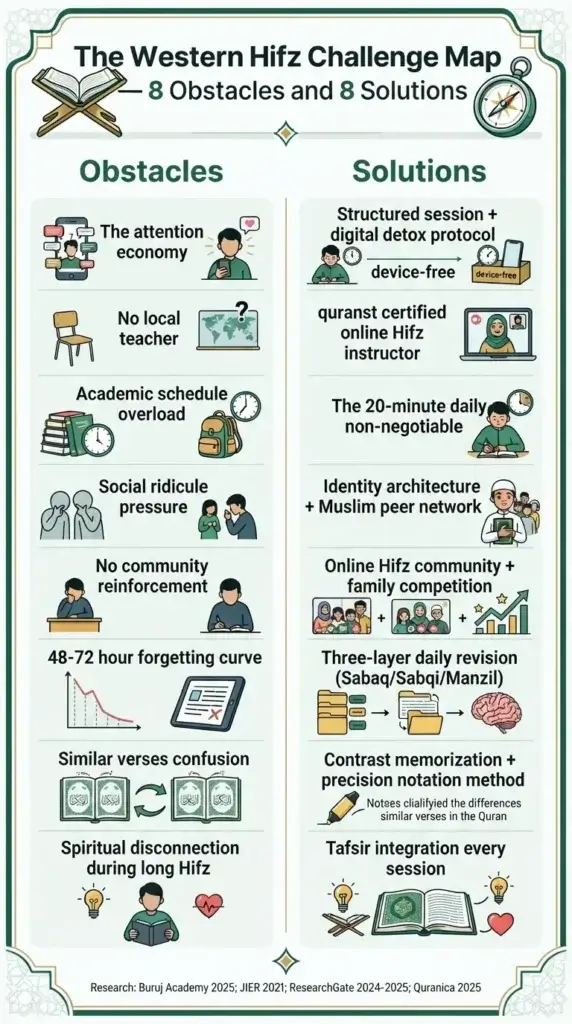
Section 2: The Eight Specific Challenges and Their Non-Obvious Solutions
Challenge 1: The Attention Economy — Your Child’s Brain Is Under Attack
The average Muslim child in the West spends 4–7 hours daily exposed to digital content specifically designed by the world’s most sophisticated behavioral engineers to capture and hold their attention. TikTok’s algorithm, Instagram’s infinite scroll, YouTube’s autoplay — each of these is optimized to make the sustained, focused attention that Hifz requires feel impossible by comparison.
The attention environment of modern digital life creates a baseline state of fragmented attention that directly competes with the concentrated focus required for Quranic memorization. Hifz requires what psychologists call deep focus — the ability to direct sustained, undivided attention to a single demanding cognitive task for an extended period. This is precisely the mode of attention that digital environments systematically erode.
The non-obvious solution:
The solution is not to eliminate screens — which is both impractical and often counterproductive. It is to create a screen-free fortress around the Hifz session. The thirty minutes of Hifz are preceded by a fifteen-minute transition: phone in a different room, a brief Wudu, two minutes of Quran recitation without memorization pressure. The brain needs a decompression chamber between the digital world and the deep focus of Hifz.
And the timing matters: the thirty to forty minutes immediately after Fajr, when the phone is not yet checked and the day has not yet begun its assault, is neurologically the optimal Hifz window. In a Western context where most academic demands begin at 7:30 AM and digital engagement begins the moment eyes open, the pre-dawn window is genuinely a fortress.
Challenge 2: No Local Hifz Teacher — The Most Common Reason Hifz Stops
In Muslim-majority countries, qualified Hifz teachers are abundant — in masjids, in schools, in private homes. In the average Western city, a family seeking a qualified Tajweed-certified Hifz teacher within a reasonable commute distance faces a search that may span years and end unsuccessfully.
The non-obvious solution:
The absence of local teachers is not a barrier to Hifz. It is a reason to use quranst.
Digital solutions — including online learning platforms — now provide unprecedented access to Quranic education, overcoming geographical and temporal limitations. These tools address pressing needs: enhancing accessibility, offering standardized resources for non-native Arabic speakers, and supporting learners striving towards accurate recitation and memorization.
The quranst Hifz track provides what no local shortage can eliminate: a certified, Al-Azhar-standard Hifz instructor, live, one-on-one, in the child’s home at whatever time works for the family’s schedule. The teacher who is not available in Phoenix is available at quranst. The teacher who has memorized the full Quran with an unbroken chain of transmission back to the Prophet ﷺ — and whose certification has been verified — is accessible from any device with internet connection.
The geography problem has been solved. The question is whether families know it has been solved.
Challenge 3: The Academic Schedule Overload — When There Is No Time Left
The Western school week is genuinely full. A child who attends school from 7:30 AM to 3:30 PM, participates in one extracurricular, and completes two hours of homework has, by 8 PM, consumed twelve hours in structured activities. The Hifz that requires sixty minutes is being asked to appear from nothing.
The non-obvious solution:
The Hifz does not need sixty minutes. It needs twenty — and not all in one sitting.
The structured three-layer revision system (Sabaq/Sabqi/Manzil) requires less total time than most families assume when organized correctly. New memorization (Sabaq): 10 minutes in the morning, immediately after Fajr. Recent review (Sabqi): 5 minutes during a transition — in the car, during lunch, while walking. Older review (Manzil): 5 minutes before sleep, recited quietly or from memory. Total: 20 minutes, distributed across three natural daily transition points.
The family that attempts to carve sixty consecutive minutes from a schedule that has none will fail. The family that integrates twenty minutes across three existing daily transitions will succeed — and often find that over time, the habit expands naturally as the child’s relationship with the Quran deepens.
The Muslim child in a non-Muslim school carries a specific social burden that no child in a Muslim-majority country experiences: being different in ways that cost social capital. The child who mentions memorizing the Quran risks being the object of confusion, dismissal, or active mockery. The teenager for whom Islamic identity is already a social liability is unlikely to voluntarily add “aspiring hafiz” to that liability.
The non-obvious solution:
Build the identity architecture before the social pressure arrives.
Academic hardiness — the ability to persist through difficult academic challenges — is significantly predicted by perceived social support and self-efficacy. For Hifz specifically, the child who has been given a positive Hifz identity — who sees themselves as a hafiz in progress, whose family celebrates their Hifz milestones publicly and specifically, who has connection to other Muslim children doing the same — has the identity armor to withstand social pressure that the child without this identity architecture cannot maintain.
The quranst online Hifz community provides what no local environment can: other Muslim children, at similar levels, working toward the same goal, visible to your child through their regular sessions. The child who knows that a peer in London is also on Juz 5, and another in Dubai just completed Juz 8, is not a lone exception in a non-Islamic world. They are part of something large, global, and explicitly celebrated.
Challenge 5: The 48-72 Hour Forgetting Curve — The Silent Hifz Killer
The most common reason Hifz falls apart is not dramatic. It is this: a verse memorized on Monday is not reviewed until Thursday, and by Thursday it has gone.
Retention loss between 24–72 hours after memorization is the most scientifically documented challenge in Hifz. Without daily active review, newly memorized material decays within 48 to 72 hours. The solution is same-day revision as a non-negotiable habit — material memorized in the morning must be reviewed before sleep, without exception.
The non-obvious solution:
The Manzil (older material review) is the most underestimated component of the Hifz system. Families that focus only on new memorization (Sabaq) produce children who have memorized everything and retained nothing. The quranst Hifz system tracks each student’s complete memorized Quran — what was memorized when, when it was last reviewed, what the review schedule should be — and the teacher manages the Manzil review as systematically as the new memorization.
This is what a qualified Hifz teacher provides that no app or self-directed system can replicate: the knowledge of the individual student’s complete memorization history and the authority to say “Today we are not memorizing anything new. Today we are reviewing everything from Juz 3.”
Challenge 6: The Similar Verses Problem — When the Quran Seems to Repeat Itself
The Quran contains numerous pairs of nearly identical verses that appear in different Surahs — and the child who memorizes both frequently confuses them in ways that take months to correct.
Similar verses are a well-known technical challenge of Hifz. The solution is not just repetition — it is precision. The learner must create a “trigger” for their brain. In a dedicated notebook, write the verse from Al-Baqarah on one page and the similar one from Aal-Imran on the facing page. Circle the exact point of difference. Note whether the difference is a single letter, a word, a particle.
The non-obvious solution:
The quranst approach: the “contrast memorization” session. When two similar verses are encountered, the teacher stops the normal memorization sequence and spends a dedicated session on the comparison. The student recites both. The teacher identifies the exact point of difference. The student creates a mnemonic note for that specific difference. The two verses are then tested alternately — first one, then the other — until the distinction is automatic.
Challenge 7: Spiritual Disconnection — When the Quran Becomes Meaningless Sounds
The child who memorizes for years without understanding what they are memorizing gradually experiences what Hifz researchers describe as spiritual disconnection — the experience of the Quran as an obligation rather than a relationship.
Losing spiritual connection to the Quran during long memorization periods is a documented pattern in Hifz pedagogy — not a personal failure. The solution is structural: integrating brief, accessible Tafsir engagement alongside memorization. Even five minutes per session of meaning-connection — understanding one word’s root, knowing one sentence’s message — prevents the spiritual disconnection that is the most common long-term dropout cause.
The non-obvious solution:
Every quranst Hifz session ends with five minutes of meaning connection. One word from the day’s memorization — its root, its Quranic frequency, its meaning in context. The student who memorizes “wa-ma arsalnaka illa rahmatan lil-‘alamin” and learns that rahmah (mercy) is the root of Rahman and Rahim — the two names that open every Surah — has just connected their memorization to the Quranic Arabic vocabulary that makes the Quran genuinely readable. Hifz and Arabic for Specific Purposes, integrated in the same session.
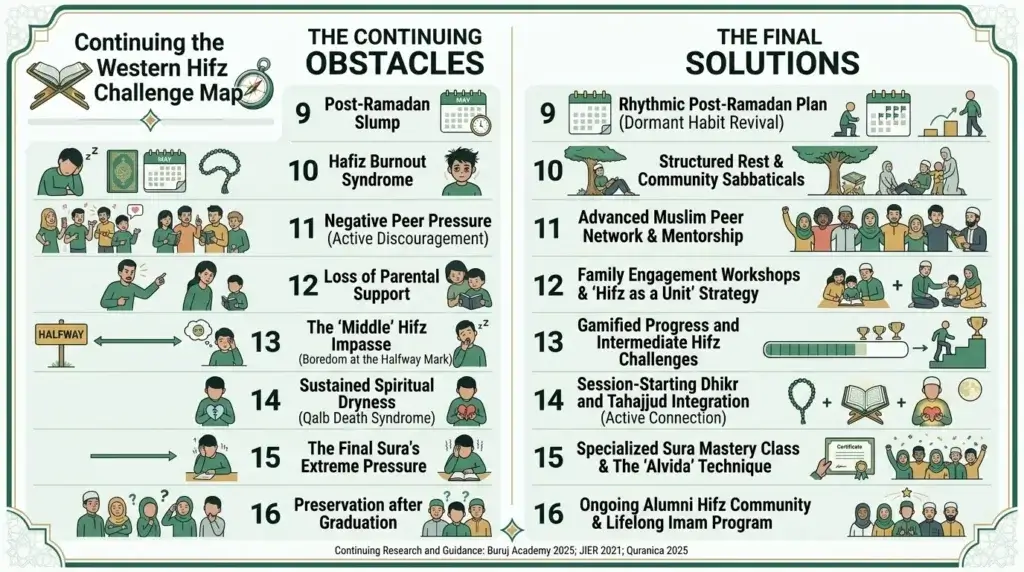
Challenge 8: The Consistency Collapse — When Life Gets in the Way
School exams. Family travel. Illness. Ramadan schedule changes. A new sibling. The first week back after summer break. These disruptions are not exceptional in a Western family’s life — they are the normal rhythm. And each one threatens to be the break after which Hifz never restarts.
The non-obvious solution:
The most successful Hifz practitioners adopt specific strategies to sustain their practice through disruption: seeking meaning in memorized verses (which makes review emotionally rewarding rather than mechanically obligatory), environmental preparation (creating a physical Hifz space that is available regardless of schedule), and emotional regulation (the conscious practice of returning to Hifz after a break without guilt or self-judgment).
The quranst protocol: the restart session costs nothing. A student who missed a week due to illness restarts in the next session at exactly where they left off — with the teacher adjusting the pace for the first week back, reducing new memorization while maintaining Manzil review. No guilt. No lost ground.
Section 3: The quranst Solution — How an Online Hifz System Turns the Environment Inside Out
Everything in the Western environment that makes Hifz harder — the schedule, the geography, the absence of community, the digital attention competition — has a specific structural response in the quranst system.
The Three-Part Daily Structure (Sabaq / Sabqi / Manzil)
This is the classical Hifz methodology that every traditional madrasa has used for centuries — adapted to the Western family’s daily rhythm:
| Component | What It Is | When | How Long |
|---|---|---|---|
| Sabaq (new lesson) | Today’s new memorization | After Fajr (morning) | 10–15 minutes |
| Sabqi (recent review) | Last 7–10 days’ material | During a transition | 5–10 minutes |
| Manzil (old review) | Previously solidified material | Before sleep | 5–10 minutes |
| quranst session | Live teacher session | 3× weekly | 30–45 minutes |
Total daily commitment outside sessions: 20–30 minutes. This is not a sacrifice. This is less time than the average child spends on a single social media app per day.
The Technology That Serves Hifz (Not Replaces It)
quranst integrates technology in service of the human teacher-student relationship — not as a replacement for it:
- Session recording: Every quranst session is recorded. Parents can review it. Students can watch their own recitation. Progress from six months ago versus today is documentary evidence of development.
- Progress tracking: The teacher tracks every verse memorized, every review session completed, every error pattern noticed. No Juz falls through the cracks.
- Multi-reciter audio library: The student listens to their verses recited by Sheikh Mahmoud Khalil Al-Husary or other certified reciters before and after each session — embedding the correct sound before each memorization attempt.
The Certification Guarantee
Every quranst Hifz instructor has:
- Complete Quran memorization with an authenticated chain of transmission (isnad)
- Certification in Tajweed to the standard of Al-Azhar or equivalent institution
- Specific training in teaching Hifz to non-Arabic-speaking students in Western environments
- English-medium communication capability for parents and students who do not speak Arabic
The Prophet ﷺ said:
“The one who is proficient in the Quran will be with the noble, righteous angels; and the one who recites the Quran with difficulty, struggling with it, will have a double reward.”
— Sahih al-Bukhari, Hadith 4937; Sahih Muslim, Hadith 798
Both the proficient and the struggling are honored. What quranst provides is the path from one to the other — specific, structured, guided by a certified teacher who has walked it themselves.
Section 4: Real Families, Real Environments, Real Results
The following represent the categories of families that the quranst Hifz track is designed to serve — based on the documented challenges and their specific solutions:
The Immigrant Family: Parents Who Memorized Abroad, Children Who Must Memorize Here
The situation: Both parents completed portions of Hifz in their home country. Their children, born or raised in the West, have the benefit of parents who can help with Arabic pronunciation — but the absence of any local Hifz infrastructure.
What works: The parents’ Quranic literacy makes them strong home environment builders — they can maintain the Manzil review at home, model daily recitation, and participate in the family Hifz sessions. quranst provides the structured progression and the certified teacher that the parents’ own Hifz training can supplement but not replace.
The Revert Family: No Arabic Background, Maximum Islamic Commitment
The situation: Parents who embraced Islam as adults have children who are the first generation of Muslims in their family. No Arabic background, no Hifz tradition in the family, no community infrastructure.
What works: The quranst instructor is not supplementing a family’s existing Hifz knowledge — they are the primary Hifz authority. The three-part daily structure is taught explicitly to the family as a household system. The parent learns alongside the child — and the quranst instructor monitors both.
The Busy Professional Family: Maximum Schedule Pressure, Real Islamic Commitment
The situation: Both parents work full-time in demanding careers. The children have demanding school and extracurricular schedules. The intention to do Hifz is genuine; the available time is genuinely limited.
What works: The 20-minute daily distributed system is exactly designed for this family. The quranst sessions are scheduled during the family’s existing schedule margins — early mornings on weekdays, extended sessions on weekends. The consistency is maintained by the accountability of the scheduled quranst session three times a week — which creates the deadline that makes the daily home practice happen.
Section 5: The Parent’s Role in a Non-Motivating Environment
Parental support is the strongest single predictor of Hifz success — more powerful than the student’s natural aptitude, the teacher’s method, or the quality of the curriculum. In Western environments, where school and social reinforcement are absent, parental support carries an even greater proportionate weight.
The parent’s role in a Western Hifz program is not passive. It is the most active variable in the entire system.
The five non-negotiable parental contributions:
1. The morning anchor: The parent who wakes with the child for Fajr and sits beside them for their Sabaq — even silently, even while making coffee — communicates that this matters more than sleep.
2. The daily review witness: Someone who hears the child’s Sabqi — even if they cannot judge its accuracy — provides the social accountability that prevents “I’ll do it later” from becoming “I didn’t do it.”
3. The celebration of milestones: Specific, named, proportionate celebration of every Hifz milestone. Not “good job” — “You just completed Juz 28. You now carry more Quran in your chest than 99% of the people on this earth. That is extraordinary.“
4. The du’a: The parent who makes du’a for their child’s Hifz — specifically, by name, for the specific Juz being memorized — invites the most powerful support available. And when the child knows the du’a is happening, it produces a quality of motivation that no external reward system can replicate.
5. The non-negotiable: The parent who says “No” when the Hifz session is at risk of being displaced — who treats the quranst session with the same non-negotiability as a school exam or a doctor’s appointment — provides the structural backbone that the child cannot yet provide for themselves.
Section 6: Building the Hifz-Supporting Home in a Non-Islamic Country
The Western environment will not support your child’s Hifz. You have to build the supporting environment inside your home.
The Physical Environment
The Hifz corner: A specific, designated physical space — a corner, a prayer mat, a small desk — that is associated exclusively with Quran and Hifz. The brain’s location-dependent memory means that the same physical space, used consistently for the same purpose, supports recall and focus in ways that a general shared space cannot.
Acoustic Quran: Arabic Quran recitation as ambient audio during transitions — meal preparation, car rides, family cleanup time. Not as background noise, but as intentional exposure. The child who hears the verse they are memorizing three times per day in the ambient environment retains it more robustly than the child who encounters it only in the focused memorization session.
The Hifz chart: A visible, physical tracker — on the refrigerator, on the bedroom wall — showing which Juz are memorized, which are in progress, which remain. The child who can see their progress across the complete Quran is motivated by the visible accumulation in a way that abstract knowledge of progress cannot replicate.
The quranst community: Other Muslim children at similar Hifz levels, visible through regular online sessions and community features. The child who knows their peers are also on Juz 5 has a social relationship with Hifz that the isolated Western Muslim child cannot build locally.
The extended family network: Grandparents, cousins, aunts who quiz the child on their Hifz during calls and visits. The child whose grandmother asks to hear their Juz on every video call has a social audience for their Hifz achievement that is warm, emotionally significant, and consistently motivating.
The masjid connection: Even if the local masjid does not have a Hifz program, the child who recites their memorized Juz in Tarawih, who leads the family in recitation, who is recognized by the community as a hafiz in progress — that child has a community identity attached to their Hifz that sustains motivation through the hard weeks.
Structured Curriculum Framework
quranst’s Hifz track was designed specifically for the Western Muslim family — the challenges, the schedule, the absence of local infrastructure, and the specific needs of a child memorizing the Quran in a non-Islamic environment.
Book your free 2-session trial →Conclusion: The Hafiz the West Didn’t Expect
The letter at the beginning of this guide was never sent.
But it is real. It lives in the memory of every Muslim who moved West with a Hifz in progress and lost it to the environment. In the regret of parents who meant to help their children memorize and didn’t know how. In the grief of the adult hafiz-who-wasn’t, who still recites Juz’ Amma in every prayer and knows, somewhere in the chest, that there should be more.
This does not have to be the story of the next generation.
The Muslim family in New Jersey who started their child’s Hifz on quranst three years ago — who maintained the twenty-minute daily system, who attended the online sessions three times a week, who celebrated the milestone of Juz 10 with the extended family on a video call — has produced what the environment said was impossible:
A hafiz. In the West.
Not despite the environment. In the presence of it. With strategies built specifically for it.
“Read and ascend. Recite as you used to recite in the world. Your rank will be at the last verse you recite.”
— Sunan Abu Dawud, Hadith 1464; Sunan al-Tirmidhi, Hadith 2914; authenticated by al-Albani
The rank is available. The verses are waiting.
The environment is difficult. The system is ready.
Begin.
وَرَتِّلِ الْقُرْآنَ تَرْتِيلًا
“And recite the Quran with measured, precise recitation.”
— Quran 73:4
🟢 Start Your Child’s Western Hifz Journey
The environment is not going to change. The Quran is not going to become easier to memorize. The school schedule is not going to get shorter. The digital competition for your child’s attention is not going to reduce.
But the system for succeeding anyway — specifically, structurally, with certified instruction and documented results — exists. And it is available to your family, from wherever in the Western world you are reading this, starting this week.
quranst’s Hifz track provides:
- Certified Hifz instructor with complete memorization and authenticated chain of transmission
- Trained specifically for non-Arabic-speaking students in Western environments
- English-medium communication for parents and students
- Three live, one-on-one sessions per week with flexible scheduling
- Sabaq/Sabqi/Manzil structure managed by the teacher, with daily home component
- Progress tracking across the student’s complete memorization history
- Tajweed-integrated memorization — no bad habits embedded
- Tafsir meaning-connection at the end of every session
The Support:
- Session recording for parent review and student progress tracking
- Multi-reciter audio library for between-session practice
- Milestone celebration built into the curriculum
- Parent guidance for building the Hifz-supporting home environment
The Path:
- From absolute beginner (alphabet + basic reading) through complete Hifz
- Available in USA, Canada, UK, Australia, Gulf, and all diaspora communities
- Flexible around school schedules, exams, and family life
👇 Begin with Two Free Hifz Sessions
Two Ways to Begin
“Whoever reads the Quran, memorizes it, and acts upon it — on the Day of Judgment his parents will be crowned with a crown of light.”
— Sunan Abu Dawud, Hadith 1453; authenticated by al-Albani
The crown is available. Even in the West.
The Hifz is possible. Even in the West.
بِسْمِ اللَّهِ — Begin.
References and Sources
Quranic References
- Quran 73:4 — “Recite the Quran with measured, precise recitation”
Hadith References
- Sahih al-Bukhari, Hadith 4937; Sahih Muslim, Hadith 798 — Proficiency and struggle in Quran recitation
- Sunan Abu Dawud, Hadith 1453 — Crown of light for parents of hafiz (authenticated by al-Albani)
- Sunan Abu Dawud, Hadith 1464; Sunan al-Tirmidhi, Hadith 2914 — “Read and ascend — your rank at the last verse” (authenticated by al-Albani)
Academic Research Sources
- Journal of Islamic Educational Research (JIER), Volume 6 (2021). “Exploring the Challenges of Sustaining Qur’anic Memorization: A Case Study.” Key findings: 12 challenges of sustaining Quranic memorization documented; environment (bi’ah) is a primary challenge; participants who moved to non-Muslim environments experienced accelerated memorization loss; parental support is the most influential factor in memorization motivation.
- Journal of Islamic Educational Research (JIER). “Exploring the Challenges of Sustaining Qur’anic Memorization.” Key findings: Primary challenges include being occupied with other activities, environmental challenge, lack of conducive environment, lack of time, and social interference; strategies: refer back to Quran, fixed schedule, tawakkul, specific spaces for memorization.
- ResearchGate (2024-2025). “Memorizing the Quran: Exploring Academic Hardiness, Self-Efficacy, and Perceived Social Support in Islamic Schools.” Key findings: Success of Quran memorization strongly influenced by synergy of family, school, and social environments; parental support (motivation, emotional encouragement, conducive environment, active involvement) is strongest predictor; peer support through group memorization and healthy competition contributes positively.
- ResearchGate (2025). “Flow Experience in Qur’an Memorization Among University Students Living in Pesantren.” Key findings: Strategies to sustain flow include seeking meaning in memorized verses, environmental preparation, and emotional regulation; quiet environment, peer encouragement, and parental support play significant roles; spiritual and community context influences psychological experience of memorization.
- Buruj Academy (2025). “Islamic Quran Memorization and Recitation Challenges.” Key findings: Retention loss 24–72 hours after memorization is the most documented challenge; same-day revision as non-negotiable habit; three-layer revision system (new/recent/old material); losing spiritual connection is a documented Hifz pattern not a personal failure; Tafsir integration as structural solution.
- ResearchGate (2024). “Challenges and Difficulties in Memorizing the Qur’an in the Tahfiz Classes Among Secondary Learners.” Key findings: Time constraint is consistently cited as most frequently mentioned obstacle; motivation is the instrumental role in Tahfiz students’ memorization; parental prayer and advice cited by participants as primary motivation support.
- >Quranica (2025). “Islamic Quran Memorization and Recitation Challenges.” Key findings: Similar verses are a well-known technical challenge requiring precision not just repetition; contrast memorization notebook method; stopping and feeling — rather than thinking — as the correct approach to difficult letters.
- arXiv (2025). “A Critical Review of the Need for Knowledge-Centric Evaluation of Quranic Recitation.” Key findings: Contemporary challenges include time constraints, scarcity of qualified instructors (especially outside Muslim-majority regions), and difficulty achieving Tajweed mastery later in life; digital solutions and online learning platforms provide unprecedented access to Quranic education overcoming geographical limitations.
Frequently Asked Questions About Hifz in the West
Is it really possible for a child to memorize the Quran while living in a Western country?
What are the biggest challenges of Quran memorization in Western countries?
- Limited access to qualified local Hifz teachers.
- Busy school and homework schedules.
- Digital distractions and fragmented attention.
- Lack of a supportive Quran memorization community.
- Social pressure and feeling different from peers.
- Forgetting previously memorized portions.
- Confusion between similar Quranic verses.
- Losing spiritual connection during a long memorization journey.
How does quranst help children who cannot find a qualified Hifz teacher locally?
How much time does a child need each day for Hifz?
- Sabaq: New memorization — approximately 10–15 minutes.
- Sabqi: Recent revision — approximately 5–10 minutes.
- Manzil: Older revision — approximately 5–10 minutes.
What are Sabaq, Sabqi, and Manzil in Quran memorization?
Sabqi is the recent memorization that needs regular revision.
Manzil is the older memorized portion that must continue to be reviewed so that previously memorized Quran remains strong.
quranst integrates these three components into a structured Hifz routine to balance new memorization with retention.
How does quranst prevent children from forgetting what they have already memorized?
How does quranst deal with similar Quranic verses that children often confuse?
How does quranst keep Hifz meaningful instead of turning it into simple memorization?
What role do parents play in their child’s Hifz journey?
What happens if my child misses Hifz sessions because of school, exams, travel, or illness?
Can beginners start Hifz with quranst?
How are quranst Hifz lessons scheduled?
What makes quranst different from learning Quran memorization through an app?
- Live one-on-one Hifz instruction.
- Progress tracking.
- Session recordings.
- Multi-reciter audio resources.
- Structured Sabaq, Sabqi, and Manzil revision.
- Parent guidance and accountability.
Can Hifz be combined with Tajweed, Quran reading, and Quranic Arabic?
How can I start my child’s Hifz journey with quranst?
Book your free trial:
quranst.com/free-trial
Or contact quranst through WhatsApp to discuss your child’s level and Hifz goals.
