

Introduction: The Child Who Carries Something Different
You can recognize them, sometimes, before they recite a single verse.
There is something in how they sit — a stillness that is not passivity. Something in how they speak — not careful, exactly, but considered. Something in how they enter a room and how they leave it.
The classical scholars described it in precise language: al-samt — the gravity of presence. Al-waqar — dignified composure. Al-khushu’ — the quality of a heart that has been softened by something greater than itself.
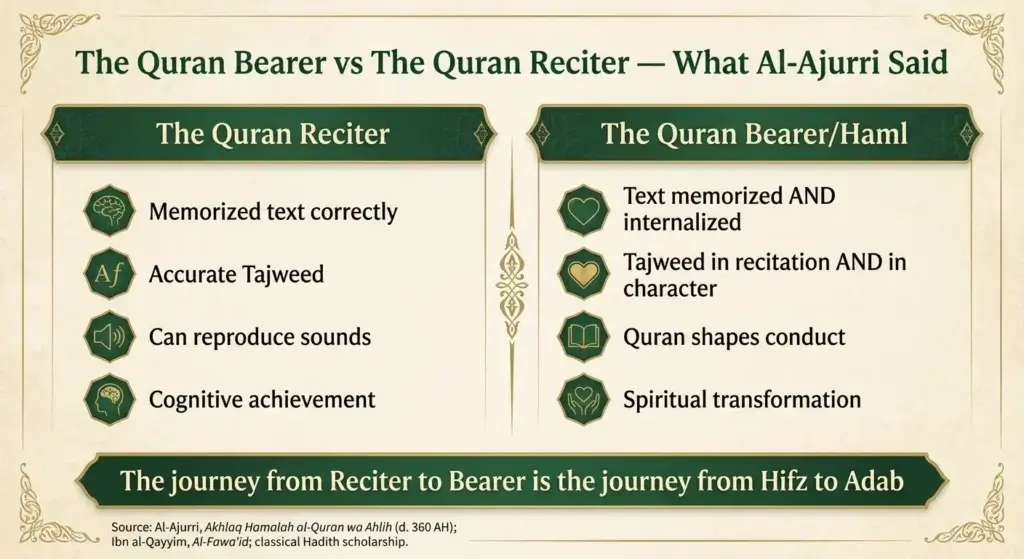
This is the child who carries the Quran. Not the child who recites it — who can reproduce its sounds correctly and has scored high in Tajweed evaluation. The child who carries it — in whose character the Quran has taken up residence, shaping their manner, softening their heart, disciplining their tongue, orienting their daily life toward the standard they hold inside their chest.
There is a difference between the two. And the classical Islamic tradition was exquisitely clear about it.
Imam Al-Ajurri — the 10th-century Baghdad scholar whose Akhlaq Hamalah al-Quran wa Ahlih (The Character of the Bearers of the Quran and Its People) remains the most comprehensive treatment of this subject in the Islamic tradition — wrote:
“It does not befit the bearer of the Quran to show harshness, heedlessness, or loudness. Rather, it befits him to let the Quran inform his character, for the Quran was not revealed to be carried merely in the chest and on the tongue — but to be a light in the heart, a purification of the soul, and a transformation of the person who carries it.”
— Al-Ajurri, Akhlaq Hamalah al-Quran wa Ahlih (d. 360 AH)
This guide is about that transformation — what it looks like, how it is cultivated, what prevents it, and what the Muslim family can do to support the Hifz journey not just as a memorization project but as a character-formation project, as it was always meant to be.
Structured Curriculum Framework
quranst’s Hifz and Quranic Studies track integrates character formation — Adab and Akhlaq grounded in the classical tradition — alongside Tajweed and memorization. The complete Quran bearer, not merely the accurate reciter.
Book your free 2-session trial →The Classical Source: Imam Al-Ajurri and the Original Text
Before the practical guidance, the scholarly foundation — because the Muslim parent who understands the depth of the classical tradition behind this subject will approach their child’s Hifz journey with a different quality of intention.
Al-Ajurri’s Akhlaq Hamalah al-Quran wa Ahlih discusses the manners and required character of the Quran’s bearers and people. The book was divided by the author into sections covering the etiquette of the Quran bearer in recitation, in reflection, in conduct, and in daily life. Imam Abu Bakr Muhammad ibn al-Husayn al-Ajurri (d. 360 AH) was described by classical scholars including Al-Khatib al-Baghdadi, Al-Sam’ani, Ibn al-Jawzi, Al-Dhahabi, and Ibn Kathir as a scholar, hafiz, and imam who embodied what he wrote.
Al-Ajurri’s text opens with a statement that establishes the entire framework:
“Know — may Allah have mercy upon you — that whoever Allah has honored with the memorization of His Book should know that Allah has distinguished him with a great distinction over those who have not been honored with it. He must honor this distinction with the best of character, the most beautiful of conduct, and the most refined of manners — so that the Quran he carries is a witness for him, not against him.”
— Al-Ajurri, Akhlaq Hamalah al-Quran, Opening Chapter
“A witness for him, not against him.” This single phrase contains the entire ethical framework of Hifz.
The Quran that is memorized but not embodied is not neutral. According to the classical scholarship, the relationship between the Quran and its bearer is active, alive, and consequential. The hafiz whose character contradicts what they carry has created an internal contradiction that the Prophet ﷺ warned about explicitly.
The Quranic and Prophetic Foundation
The Character That the Quran Is
When Aisha (may Allah be pleased with her) was asked to describe the Prophet’s ﷺ character, she gave the most concise and most complete answer in the entire biographical tradition:
“His character was the Quran.”
— Sahih Muslim, Hadith 746
This is the prophetic standard for the hafiz: not memorization of the Quran, but being the Quran — the complete alignment of character with the text carried inside.
The Quran’s Own Claim About Its Effect
وَنُنَزِّلُ مِنَ الْقُرْآنِ مَا هُوَ شِفَاءٌ وَرَحْمَةٌ لِّلْمُؤْمِنِينَ
“And We send down of the Quran that which is healing and mercy for the believers.”
— Quran 17:82
Shifa’ — healing. Not information, not instruction alone, but active healing. The Quran is described as a medical intervention — something that changes the condition of the one who receives it. The hafiz who carries Shifa’ in their chest and does not experience any healing is like a patient who keeps medicine without taking it.
The Standard of the Hafiz
The Prophet ﷺ said:
“The most perfect of the believers in faith is the one who is best in moral character.”
— Sunan Abu Dawud, Hadith 4682; Sunan al-Tirmidhi, Hadith 1162; authenticated by al-Albani
And specifically about the Quran bearer:
“There is nothing heavier than good character put in the scale of a believer on the Day of Resurrection.”
— Sunan al-Tirmidhi, Hadith 2002; authenticated by al-Albani
The hafiz who has memorized thirty Juz but whose character weighs nothing on the scale has carried the Quran without being transformed by it. The hafiz whose character is heavy on the scale — patient, honest, gentle, generous, dignified — has become what the Quran intended them to become.
Section 1: The Inner Adab — What the Hafiz Carries in the Heart
Al-Ajurri organized the adab of the Quran bearer into inner (batin) and outer (zahir) dimensions. The inner adab is the foundation; the outer adab is its natural expression.
1. Niyyah (Intention): The Quran Memorized for Allah
The Prophet ﷺ said:
“Actions are judged by intentions.”
— Sahih al-Bukhari, Hadith 1; Sahih Muslim, Hadith 1907
The hafiz who memorizes the Quran for status — to be called “hafiz” at the masjid, to impress family members, to earn social reward — has placed their Hifz on an unstable foundation. The status will eventually not satisfy. The memorization, without the right intention, does not produce the character transformation it was designed to produce.
The hafiz who memorizes the Quran for Allah — to be close to the Book of His Lord, to carry what His Prophet ﷺ carried, to be an intercessor for their family on the Day of Judgment — has placed their Hifz on the only foundation that sustains across decades.
Teaching the intention to children: Not a lecture. A single sentence, spoken at the beginning of each Hifz session: “Whose words are you memorizing today? Why do you think Allah gave us this Quran? Let’s say Bismillah together — for Him.”
2. Ta’dhim (Reverence): The Quran As the Greatest Thing the Hafiz Carries
Al-Ajurri wrote:
“It befits the one whom Allah has taught the Quran that he be known by his night when people are asleep, by his day when people are heedless, by his grief when people laugh, by his humility when people are arrogant, and by his silence when people speak vainly.”
— Al-Ajurri, Akhlaq Hamalah al-Quran, Chapter on the Night of the Hafiz
The reverence of the Quran bearer is not performative religiosity. It is the natural result of understanding what they carry. The child who genuinely understands that they hold in their memory the uncreated words of Allah — the exact words that Jibril brought to the Prophet ﷺ in the Cave of Hira — relates to what they carry with awe that has no other appropriate description.
This reverence then naturally shapes the outer conduct: the tongue that carries the Quran cannot simultaneously speak coarsely. The heart that holds “Verily, Allah is with the patient” cannot simultaneously be dominated by impatience and complaint.
3. Tadabbur (Reflection): Memorization That Engages the Mind
أَفَلَا يَتَدَبَّرُونَ الْقُرْآنَ
“Do they not reflect upon the Quran?”
— Quran 47:24
Al-Ajurri made a distinction that modern Hifz education often overlooks: the difference between hifz al-lafz (memorizing the text) and hifz al-ma’na (memorizing the meaning). The hafiz who memorizes only the text has achieved something. The hafiz who memorizes the text while reflecting on its meaning — who cannot recite “Indeed, Allah is with the patient” without their heart engaging with patience — is becoming what the Quran was designed to produce.
The imam Al-Hasan al-Basri said:
“Truly, this Quran is recited by slaves and children who have no knowledge of its interpretation. But it will not be established except in those who reflect upon it.”
— Cited in Al-Ajurri, Akhlaq Hamalah al-Quran
Section 2: The Outer Adab — How the Quran Shapes Conduct and Demeanor
The outer adab of the Quran bearer is not a list of additional obligations imposed on the memorizer. It is the natural external expression of the inner transformation — what happens when the heart genuinely carries what the Quran contains.
Adab of Speech
The Prophet ﷺ said:
“Whoever believes in Allah and the Last Day, let him say something good or remain silent.”
— Sahih al-Bukhari, Hadith 6018; Sahih Muslim, Hadith 47
The hafiz who carries verses about the weight of every spoken word on the scale of deeds — “Not a word does one utter except that there is a ready watcher beside him” (Quran 50:18) — relates to speech differently. Not fearfully, but deliberately. The tongue that carries the Quran has an internal standard for what words are worth speaking.
For children practically: The hafiz child is taught that their tongue has two responsibilities: to carry the Quran correctly, and to carry only what is good otherwise. Not as a burden — as a dignity. “You memorize the words of Allah. That makes your tongue a special responsibility. What you say next matters more, not less.”
Adab of Listening
Al-Ajurri specifically addressed the adab of listening to the Quran — the hafiz who truly carries the Book responds to its recitation with presence, not performance.
وَإِذَا قُرِئَ الْقُرْآنُ فَاسْتَمِعُوا لَهُ وَأَنصِتُوا لَعَلَّكُمْ تُرْحَمُونَ
“And when the Quran is recited, listen to it attentively and remain silent that you may receive mercy.”
— Quran 7:204
The hafiz child who has truly internalized the Quran goes quiet when it is recited — not because they have been told to, but because the Quran being heard activates something inside them that demands stillness.
Adab of Presence and Demeanor
Al-Ajurri writes: “It does not befit the bearer of the Quran to show harshness, heedlessness, or loudness — nor is it appropriate for him to be known for arrogance, hard-heartedness, anger, or pomposity. Rather, the Quran should humble him, soften his heart, and make him gentle toward those weaker than him.”
The demeanor that the Quran produces in its genuine bearer is described by the classical scholars with consistent vocabulary:
- Al-Waqar (dignified composure): Not pomposity, not rigidity — a settled quality of presence that is not disturbed by trivial things
- Al-Sakina (tranquility): The inner stillness that radiates outward — the child who has sat with the Quran daily has practiced, daily, the centering of their attention on something real and permanent
- Al-Hilm (forbearance): The patience that comes not from the absence of strong feeling but from the capacity to choose what to do with it
- Al-Tawadu’ (humility): The humility of someone who knows they carry something they did not create and cannot fully comprehend — what Ibn al-Qayyim called “the humility of knowledge”
Section 3: The Seven Signs That the Quran Has Taken Root
Al-Fudayl ibn ‘Iyad — the 8th-century scholar and former highwayman who became one of the most respected Islamic scholars of his era — said:
“It befits a bearer of the Quran to be known by his night when people are asleep; by his day when people are occupied; by his sadness when people laugh; by his weeping when people are pleased; by his silence when people are vain; by his humility when people are arrogant.”
— Cited in Al-Ajurri, Akhlaq Hamalah al-Quran, Chapter 41
These six qualities — expanded with one from the broader classical tradition — constitute the seven observable signs that the Quran has genuinely taken root in a hafiz:
Sign 1: Night Engagement The hafiz who genuinely carries the Quran has a different relationship with the night than those who do not. The Quran specifically honors those who “spend the night prostrating and standing” (Quran 25:64). For a child, this is not Tahajjud from age seven — it is the early morning Hifz session before school, the Quran review before sleep, the gradual development of a relationship with the Quran that extends beyond daytime hours.
Sign 2: Heedfulness When Others Are Heedless The hafiz who carries “Do they not reflect upon the Quran?” (Quran 47:24) has been invited to a level of awareness that the heedless person has not accessed. This shows up as the child who notices what others walk past — injustice, beauty, the need of a person nearby — because the Quran has trained their attention toward what matters.
Sign 3: Seriousness About What Is Serious The hafiz child is not somber or joyless — the Prophet ﷺ laughed and played and raced with Aisha. But the hafiz child is serious about what is genuinely serious: about their Hifz session, about their obligations, about the treatment of other people. They have been shaped by a book that treats the serious things with uncompromising weight.
Sign 4: The Capacity for Genuine Grief The Quran produces the capacity for genuine emotional response to what is genuinely moving. The hafiz who cannot be moved by the verses of the Day of Judgment, who cannot feel the beauty of the descriptions of Paradise, who recites the du’a of Ibrahim for righteous children without feeling the weight of that du’a — has not yet arrived at the emotional depth the Quran is designed to produce.
Sign 5: Controlled Speech — Words in Their Right Place The hafiz child does not speak vainly — not from social reserve or awkwardness, but from an internal standard that the Quran has established. They have memorized too many verses about the weight of words to use them carelessly.
Sign 6: Genuine Humility The hafiz who is arrogant about their memorization has missed the fundamental character quality the Quran aims to produce. Ibn al-Qayyim wrote: “Knowledge produces humility in those who carry it genuinely — for the one who truly knows how much they do not know cannot be arrogant about what they do know.”
Sign 7: Gentleness with Those Who Are Weaker Al-Ajurri specifically emphasizes gentleness toward the weak as a defining character marker of the genuine Quran bearer. The Quran is full of commands toward the orphan, the poor, the needy, the traveler. The hafiz who carries these commands and is harsh toward the weaker members of their community has memorized the words without embodying the commands.
Section 4: Common Mistakes That Separate Memorization from Character
Al-Ajurri devoted a significant portion of his text to the incorrect hafiz — the person who carries the Quran in words but not in character. This section deserves honest engagement because it describes patterns that are common in modern Hifz education.
Mistake 1: Hifz as Status Pursuit
Al-Ajurri wrote:
“Among the bearers of the Quran are those who make the Quran a means of earning livelihood and seeking status and prestige from rulers and others. Allah’s refuge is sought from this.”
The child whose Hifz is primarily motivated by the title “hafiz,” by the family praise at Eid gatherings, by the elevated status in the community — has a motivation structure that will not survive the hard middle years of Hifz, when the novelty is gone and the genuine commitment is required.
The correction: Parents should be deliberate about which celebrations they emphasize. Celebrating the child’s Hifz milestone is Islamic — it is authentic Sunnah. But the celebration should be explicitly connected to its purpose: “You completed Juz 10. This means the Quran has appointed ten Juz as witnesses for you. Today we celebrate not your achievement but the Quran’s gift to you.”
Mistake 2: Hifz Without Tajweed and Meaning
The Quran should be recited correctly — Tajweed is not optional decoration. And the memorization that proceeds without any engagement with meaning is the memorization that Al-Hasan al-Basri warned about: the Quran recited by those who “have no knowledge of its interpretation.”
The correction: Every quranst Hifz session connects at least one word from the day’s memorization to its meaning. Not a full Tafsir lecture — one word. “The word ‘sabr’ in this verse — you’ve heard us talk about sabr before. Here it is in the Quran, in the context of Allah promising He is with the patient. Every time you recite this verse in prayer, you will know that promise is there.”
Mistake 3: Arrogance About Quran Level
The child hafiz who looks down on children who have memorized less, or who speaks about their Hifz to establish superiority rather than to share something precious, has allowed the Quran to become a source of arrogance rather than humility.
The correction: The Prophet ﷺ said: “The most beloved among you to me and the nearest to sit with me on the Day of Judgment is the best of you in character.” (Sunan al-Tirmidhi, Hadith 2018) The hafiz who is not also the kindest, the most generous, the most humble in the room has not yet understood what they are carrying.
Mistake 4: Public Excellence, Private Neglect
Al-Ajurri described the hafiz who recites beautifully in public gatherings but neglects their review in private — who performs the Quran rather than living it.
The Prophet ﷺ said:
“Maintain the Quran, for by the One in Whose Hand is the soul of Muhammad, it escapes more quickly than a camel from its tying rope.”
— Sahih al-Bukhari, Hadith 5033; Sahih Muslim, Hadith 791
The Quran that is not reviewed privately will not be maintained publicly. The private relationship with the Quran — the daily review, the morning recitation before the world is awake, the nighttime connection — is the foundation of everything visible.
Section 5: How to Build the Character of a Hafiz at Home
The character of a Quran bearer is not built only in the Hifz session. It is built in every interaction, every daily moment, every conversation between parent and child — shaped by the Quranic values the family has made explicit.
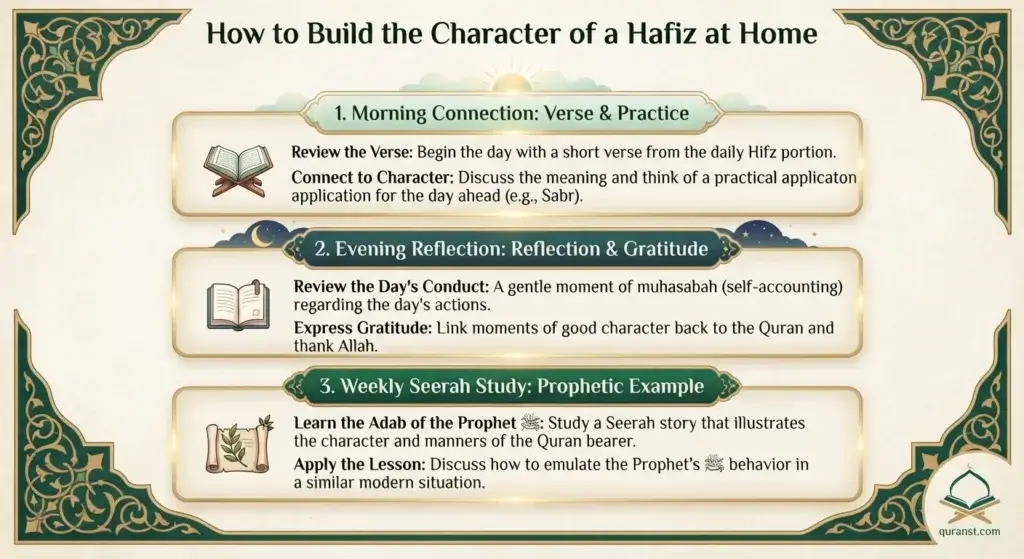
The Three Daily Character Connections
Morning: Before the Hifz session — one verse from the day’s memorization, its meaning, and a character connection: “This verse says ‘Allah is with the patient.’ Today — when is a moment you might need patience? Let’s think about it before you memorize these words.”
Evening: After the day’s experiences — one character moment named and connected to the Quran: “You were patient with your brother today when he broke your toy. That’s exactly what ‘Allah is with the patient’ looks like in real life. You practiced a verse today without even knowing it.”
Weekly: One Seerah story that illustrates the adab of the Quran bearer — the Prophet ﷺ when insulted, when generous, when grieving, when joyful. The hafiz child who is building the adab of the Quran bearer needs a human model, not just a textual one.
The Hafiz Mirror: Reflecting the Quran Back
Once per month, sit with your child and ask:
“The Quran says ‘Indeed, the most honorable of you before Allah are the most righteous of you.’ If the Quran looked at your last month and described what it saw — what do you think it would say? What would it be most pleased about? What would it want to see more of?”
This is not a performance evaluation. It is a muhasabah — a self-accounting — that connects the Hifz journey to the character journey explicitly and regularly.
Section 6: The Adab of the Quran in Daily Life — A Practical Guide for Children
The etiquette of handling, reading, and relating to the Quran in daily life is a comprehensive framework that connects the written text to every dimension of the child’s experience. Children who learn these etiquettes develop a visceral sense of the Quran’s sacred status that abstract instruction cannot produce.
Adab with the Physical Mushaf
Purity before touching: The Quran is handled in a state of Wudu — not because the book itself requires legal purity, but because the practice trains the child to transition into a different mode of awareness before engaging with the Quran. The Wudu before the Mushaf is the physical signal that ordinary time is ending and sacred time is beginning.
Physical handling: The Mushaf is placed on a Quran stand (rihal) or cushion — not on the floor, not on top of other books, not left open and face-down. The care of the Mushaf’s physical placement communicates, without words, that this object is categorically different from all other objects.
Closing it with intention: When the session ends, the Mushaf is closed deliberately, returned to its elevated place, with a brief du’a. The ending ritual is as important as the opening ritual — it completes the sacred time rather than simply stopping it.
Adab of Recitation
The Isti’adha: “A’udhu billahi min al-Shaytan al-Rajim” — before every recitation session. Not as a formula but as a genuine seeking of protection: the hafiz who is about to engage with the Quran is explicitly placing themselves under divine protection from the interruption of the one who most opposes Quranic engagement.
The Basmalah: “Bismillah al-Rahman al-Rahim” — the name of the One whose words are being recited, invoked before the first word.
The voice: Reciting with a beautiful voice is explicitly encouraged by the Prophet ﷺ — not performance, but the natural response to content that deserves beauty. The child whose recitation becomes beautiful through Tajweed instruction has given the Quran the vocal honor it deserves.
Sitting properly: Not reclining while memorizing new material — the position of the body signals to the mind the level of engagement required.
Adab with the Quran in Prayer
The hafiz who understands what they are reciting in prayer — even partially, through Quranic Arabic vocabulary study — recites differently than the one who produces sounds without meaning. The goal of the complete quranst curriculum is this: the hafiz who recites “Al-Hamdulillah” in prayer and means the praise, who recites “Iyyaka na’budu” and feels the exclusive worship.
Structured Curriculum Framework
quranst’s integrated curriculum — Hifz, Tajweed, and Quranic Arabic — builds toward this: the hafiz who recites with understanding, whose prayer is a conversation, and whose character has been shaped by what they carry.
Book your free 2-session trial →Conclusion: The Quran That Walks Among People
There is a hadith — narrated with scholarly discussion about its precise attribution but widely cited in classical Islamic scholarship — that describes what a complete hafiz looks like from the outside:
“The hafiz of the Quran is the one in whom the Quran is visible — in their patience, in their honesty, in their gentleness, in their night, in their day — so that when people see them, they remember the Quran.”
Not “when people see them, they remember that this person has memorized the Quran.” When people see them, they remember the Quran itself — the Quran becomes visible through the character of its bearer.
This is the complete vision of Hifz. Not the impressive graduate who can recite from cover to cover without error — though that is genuinely impressive. But the young person who walks into a room and brings something of the Quran with them. Whose patience in a difficult moment reminds someone of “And Allah is with the patient.” Whose honesty under pressure makes someone think of “O you who believe, be upright for Allah, witnesses in justice.” Whose gentleness with someone weaker makes someone recall the dozens of Quranic commands about the orphan, the poor, the traveler.
The Quran that walks among people. In the character of its bearer. In your child.
وَإِنَّكَ لَعَلَىٰ خُلُقٍ عَظِيمٍ
“And indeed, you are of a great moral character.”
— Quran 68:4
This was said of the one whose character was the Quran.
Give your child the Quran. Then give them the character to carry it.
🟢 Build the Complete Quran Bearer
Memorization is the beginning. The character of the Quran bearer is the destination. The quranst curriculum is designed to build both — in an integrated system that connects every Hifz session to character formation, every Arabic lesson to meaning, and every recitation to the living relationship with the Quran that the classical scholars described.
quranst’s Quranic Courses track provides:
The Hifz Foundation:
- Quran memorization — the three-part structure (Sabaq/Sabqi/Manzil) managed by a certified Online Quran teacher
- Tajweed — correct recitation from the first session; the Quran given its vocal honor
- Online Quran classes — live, one-on-one, flexible for Western family schedules
The Meaning Dimension:
- Quranic Arabic — vocabulary and grammar connected to the verses being memorized
- Tafsir integration — meaning connections at the end of every session
- Learn Quran with understanding alongside sound
The Character Formation:
- Islamic studies — Aqeedah, Hadith, and the adab of the Quran bearer taught alongside Hifz
- Study Islam online — the inner and outer adab of the hafiz as part of the curriculum
- Online Quran teacher — certified instructors who model the adab they teach
The Arabic Completion:
- Learn Arabic — for the child ready to begin reading Tafsir directly
- Classical Arabic — the language of Al-Ajurri, Ibn al-Qayyim, and the scholars of the Quran
- Online Arabic tutor — building the linguistic access to the Quran’s full depth
👇 Begin with Two Free Quran Sessions
Two Ways to Begin
“His character was the Quran.”
— Aisha (may Allah be pleased with her), describing the Prophet ﷺ — Sahih Muslim, Hadith 746
Give them the Quran. Help them become it.
بِسْمِ اللَّهِ — Begin.
References and Sources
Quranic References
- Quran 7:204 — “When the Quran is recited, listen to it attentively and remain silent”
- Quran 17:82 — “We send down of the Quran that which is healing and mercy”
- Quran 25:64 — Those who spend the night prostrating and standing
- Quran 47:24 — “Do they not reflect upon the Quran?”
- Quran 50:18 — “Not a word does one utter except that there is a ready watcher”
- Quran 68:4 — “And indeed, you are of a great moral character”
Hadith References
- Sahih al-Bukhari, Hadith 1; Sahih Muslim, Hadith 1907 — “Actions are judged by intentions”
- Sahih al-Bukhari, Hadith 5033; Sahih Muslim, Hadith 791 — “Maintain the Quran — it escapes like a camel”
- Sahih al-Bukhari, Hadith 6018; Sahih Muslim, Hadith 47 — “Say something good or remain silent”
- Sahih Muslim, Hadith 746 — “His character was the Quran” (Aisha on the Prophet ﷺ)
- Sunan Abu Dawud, Hadith 4682; Sunan al-Tirmidhi, Hadith 1162 — “Most perfect in faith is best in character” (authenticated by al-Albani)
- Sunan al-Tirmidhi, Hadith 2002 — “Nothing heavier than good character on the scale” (authenticated by al-Albani)
- Sunan al-Tirmidhi, Hadith 2018 — “Most beloved and nearest to me is the best in character”
Classical Scholarly Works — Primary Sources
- Al-Ajurri, Abu Bakr Muhammad ibn al-Husayn (d. 360 AH): Akhlaq Hamalah al-Quran wa Ahlih (The Character of the Bearers of the Quran and Its People). Published Beirut, 1986. The foundational classical text on the adab of the hafiz — cited throughout this guide.
- Al-Fudayl ibn ‘Iyad (d. 187 AH): Sayings on the character of the Quran bearer, preserved in Al-Ajurri’s text, Chapter 41.
- Al-Hasan al-Basri (d. 110 AH): Statement on recitation without reflection, preserved in Al-Ajurri’s text.
- Ibn al-Qayyim al-Jawziyyah: Al-Fawa’id (Benefits) and Madarij al-Salikin. On the humility of genuine knowledge; on the character of the Quran bearer.
Contemporary Sources
- Unity1 Store (2009 upload of classical text). “The Character of the People of the Quran — A Translation of Akhlaq Hamalah al-Quran wa Ahlih by Imam Al-Ajurri.” Translation of key passages: Al-Khatib al-Baghdadi, Al-Sam’ani, Ibn al-Jawzi, Al-Dhahabi, Ibn Kathir on Al-Ajurri’s biography; Al-Fudayl’s seven signs; Al-Ajurri on the bearer who does not show harshness; Al-Ajurri on the bearer making Quran a means of status.
- JeddahMom (2024). “Rules for Reading and Handling the Holy Quran: Taught to Children from an Early Age.” Key findings: Wudu for handling; physical placement etiquettes; dress etiquette; beginning with Isti’adha and Basmalah; children who learn these etiquettes develop visceral sense of Quran’s sacred status.
- DuaForAll (2026). “Adab in Daily Life: Islamic Etiquette & Manners.” Key findings: Adab is the outward expression of the purified heart (Al-Ghazali); good character (akhlaq) and adab are two sides of the same coin — akhlaq is the inner virtue, adab is its outward expression in conduct; Imam Ghazali on Adab Tilawat al-Quran.
Frequently Asked Questions
What is Adab Haml al-Quran and why is it essential for children?
How does online Quran classes integrate character development with Hifz?
What is the difference between a Quran reciter and a true Quran bearer (Hafiz)?
How can parents support hafiz adab Islamic growth at home?
- Morning Connection: Linking a newly memorized verse to a character trait like patience (Sabr).
- Evening Reflection: Reviewing daily actions through self-accounting (Muhasabah).
- Weekly Seerah Study: Exploring the prophetic model as the living embodiment of the Quran.
