

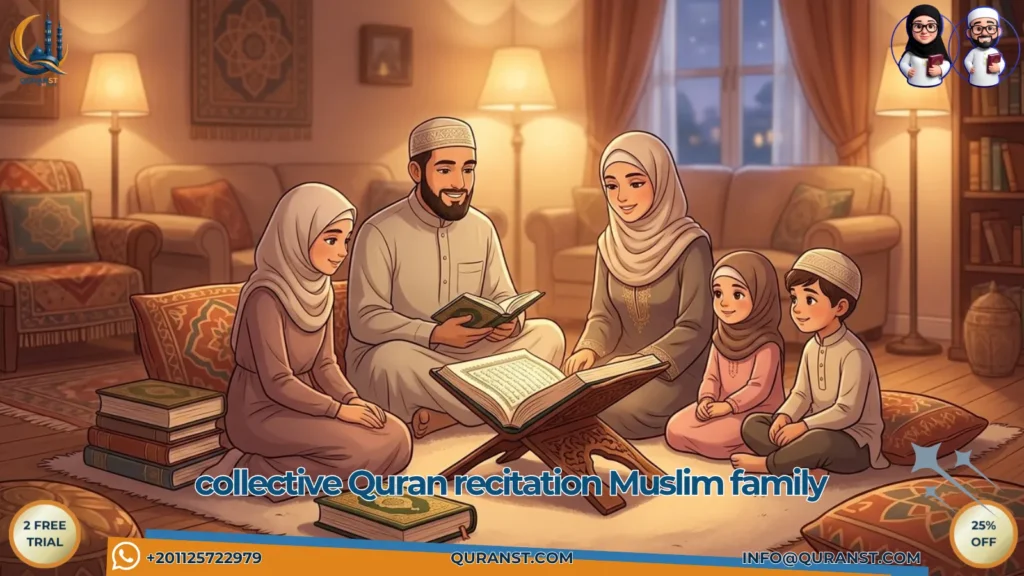
Introduction: The Home That Sounds Like the Quran
The Prophet ﷺ said:
“Do not turn your houses into graveyards. Indeed, Shaytan flees from the house in which Surah Al-Baqarah is recited.”
— Sahih Muslim, Hadith 780
A graveyard is silent. Still. Nothing grows. Nothing moves.
The Prophet ﷺ is describing a different silence — the silence of a home from which the Quran has been absent. Not the peaceful silence of a family gathered after a Quran session. The silence of a home where the Quran is rarely recited, rarely heard, rarely the sound that fills the rooms.
In a world full of distractions, intentionally creating space for family Quran reading can transform your household into a beacon of faith, love, and understanding. It is an investment in your children’s spiritual future and a profound way to strengthen Islamic bonds within the family. When spiritual practices become individual tasks rather than shared ones, the family misses one of the most powerful bonding experiences available to Muslims.
The wird — the daily portion of Quran that a Muslim commits to reading — is one of the oldest personal practices in the Islamic tradition. But the family wird — the deliberate, structured, collective daily engagement with the Quran as a household — is something rarer, more powerful, and more transformative than any of its individual components.
The family that reads the Quran together does not simply accumulate individual rewards in parallel. They create something that did not exist before: a shared relationship with the Book of Allah, a common language of faith, a household identity anchored to the most important text in existence, and the specific promise that wherever two or more Muslims gather for the study of Allah’s book — the angels descend, mercy covers them, and Allah mentions them to those around Him.
This guide is the complete practical system for building that family wird — from the first conversation about starting it to the celebration of the first completed Khatm.
Structured Curriculum Framework
quranst’s Quran track provides the individual Quran instruction that powers a strong family wird — Tajweed, Quranic Arabic, and memorization for each family member at their own level.
Book your free 2-session trial →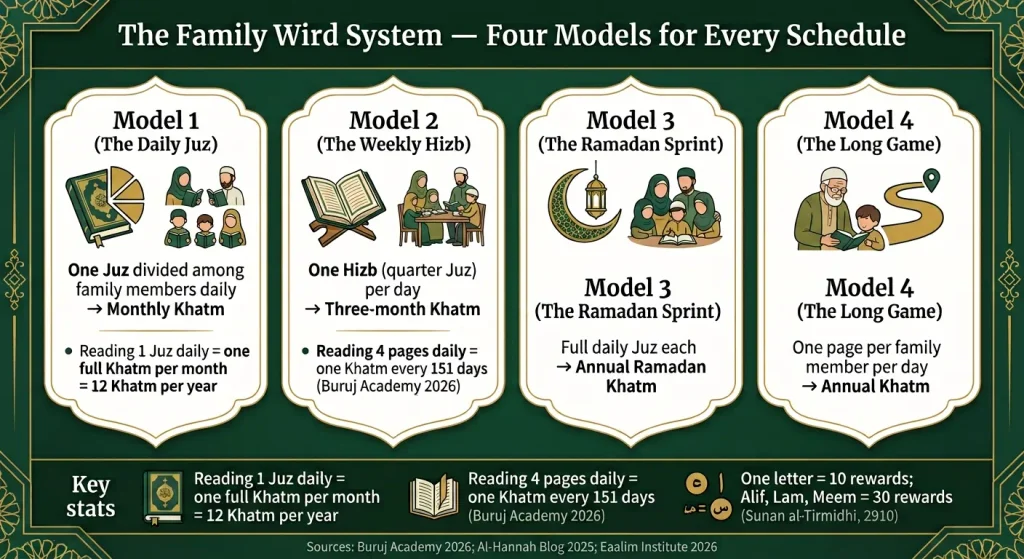
The Prophetic Foundation of the Family Wird
The daily Quran wird is not a cultural custom. It is an authenticated Prophetic practice with documented precedent in the Companions’ lives and explicit prophetic endorsement.
The Prophet’s Own Daily Wird
The Prophet ﷺ maintained a consistent daily relationship with the Quran — and specifically an annual Khatm:
“Jibril used to review the Quran with the Prophet ﷺ once every year. In the year the Prophet ﷺ died, Jibril reviewed it with him twice.”
— Sahih al-Bukhari, Hadith 4998
The annual review with Jibril — and the double review in the final year — establishes the pattern of consistent, structured, complete engagement with the entire Quran as the Prophetic standard.
The Prophetic Reward for Every Letter
“Whoever reads a letter from the Book of Allah, he will have a reward, and that reward will be multiplied by ten. I do not say that ‘Alif, Lam, Meem’ is a letter — rather, Alif is a letter, Lam is a letter, and Meem is a letter.”
— Sunan al-Tirmidhi, Hadith 2910; classified as Sahih
Reading just Surah Al-Fatiha (approximately 70 letters) earns 700+ rewards. A full daily Juz (approximately 12,000 letters) earns 120,000+ rewards. For a family of four, each reading their daily portion, the collective reward accumulates at a scale that is genuinely extraordinary to calculate — and genuinely impossible to replicate through any other act of worship in the same time investment.
The Reward for Gathering for the Quran
The Prophet ﷺ said:
“Whenever people gather in one of the houses of Allah, reciting the Book of Allah and studying it among themselves — tranquility descends upon them, mercy covers them, angels surround them, and Allah mentions them among those who are with Him.”
— Sahih Muslim, Hadith 2699
This hadith — one of the most powerful in the entire Islamic tradition — is specifically about gathering: “whenever people gather.” Not the individual who reads alone. The family that reads together.
The four blessings promised are:
- Sakinah — divine tranquility descending on the home
- Rahma — mercy covering the family
- Angels surrounding them — divine witnesses to the gathering
- Allah’s mention of them — “Allah mentions them among those who are with Him”
The last blessing is perhaps the most breathtaking: Allah — whose praise is sought by every created being — mentions this family to the angels. This is the spiritual reality of the family Quran gathering.
Section 1: What a Family Wird Actually Does — The Documented Benefits
Daily recitation of the Quran arouses the feeling of unity among family members, which strengthens bonds through recitation, discussion, and shared spiritual experience. These spiritual gatherings not only enhance Quranic knowledge but also provide mental and spiritual support that helps in the overall improvement of life. Regular relations with the Quran develop qualities like humility, honesty, and righteousness — and the Quran’s healing properties are activated through regular collective engagement.
Ibn al-Qayyim in Madarij al-Salikin identifies three layers of Quranic healing: of the spirit (shifa al-arwah), of the body (through authenticated Ruqyah practices), and of relationships — when families recite together, the Quran’s healing extends to the family bonds themselves.
Six Documented Benefits of the Family Wird
1. Family Bonding Through Shared Sacred Purpose The family that has a shared Islamic practice — that does something together specifically in service of Allah — creates a relational bond that no other shared activity can replicate. The children who grew up doing family Quran together remember it as one of the defining experiences of their upbringing — not because it was always easy, but because it was genuinely sacred.
2. Children’s Quranic Identity Family Quran time creates an environment where faith feels natural, not forced. Children who grow up in homes where the Quran is heard and read together naturally absorb a relationship with the Quran that becomes genuinely their own — not a parental obligation imposed from outside, but a family practice they inhabited from childhood.
3. Consistent Individual Progress Through Collective Accountability The family werd system — in which each member has a specific daily portion — creates the accountability structure that makes individual consistency possible. The child who knows the family is gathering after Maghrib to read their portions is more likely to have prepared their portion than the child with no accountability structure.
4. Tadabbur (Reflection) Through Dialogue When one person reads the Quran alone, any confusion they encounter tends to remain unresolved. When the family reads together, questions arise naturally, meanings are discussed, connections are made across family members with different levels of knowledge. The child who asks “why does it say that?” and receives an answer from their parent has had a Tafsir session that no textbook can replicate.
5. Islamic Identity Reinforcement Your “golden hour” — a protected, non-negotiable appointment with the words of Allah — when treated with importance and established as a family practice, becomes one of the primary identity anchors of the Muslim household. It communicates, without words, that this family’s primary identity is shaped by the Quran.
6. The Accumulated Reward of the Khatm The completion of the Quran — the Khatm — is described in authentic narrations as a moment when du’a is particularly answered. The family that completes the Quran together, multiple times per year, has accumulated multiple moments of this special blessing — together.
Section 2: The Four Models of Family Quran Completion
The family wird system begins with choosing the right model — one that is ambitious enough to be meaningful but realistic enough to be maintained. The model that lasts is always better than the model that is impressive for three weeks.
Model 1: The Monthly Khatm (One Juz Per Day, Divided)
The structure: One full Juz per day, divided among family members proportionate to their recitation ability. In a family of four: parent 1 (8 pages), parent 2 (6 pages), teenager (4 pages), younger child (2 pages). Adjusted so the daily total reaches approximately 20 pages (one Juz).
Completion time: One full Khatm per month — 12 Khatm per year.
Best for: Families with strong Quran readers at multiple levels; families during Ramadan when commitment is highest.
The classical practice of the Companions — distributing recitation across all five prayer windows — prevents mental fatigue, maintains consistent focus across each sitting, and naturally anchors Quran reading to the daily prayer rhythm. The monthly Khatm model adapts this classical approach to the family context.
The session: After Maghrib each evening, 15–25 minutes. Each family member recites their portion while others listen. The family ends together with the post-Khatm du’a whenever a Juz is completed.
Model 2: The Quarterly Khatm (Four Pages Per Day)
The structure: Each family member reads four pages (approximately one Hizb, or quarter of a Juz) per day.
Completion time: One Khatm every 75 days — approximately four to five Khatm per year.
Best for: Families with younger children or smaller households; families building the habit gradually.
“Reading 4 pages per day completes the Quran in approximately 151 days — for the individual. For a family reading together and building on each other’s portions, the pace is faster and the motivation is sustained by the collective accountability.” (Buruj Academy, 2026)
Model 3: The Ramadan Intensive (Full Khatm in Ramadan)
The structure: During Ramadan specifically, the family commits to one full Juz per day — read at specific times (before Suhoor, between Dhuhr and Asr, after Tarawih). This is the primary annual Khatm event.
Completion time: One Khatm in 30 Ramadan days.
Best for: Families who find year-round commitment difficult; families wanting a distinct Ramadan practice.
“Each session distributing the Juz among family members could be up to 1.5 hours depending on Juz length — but the reward and the community experience make it the most significant Islamic family practice of the year.”
The tradition: In many Muslim cultures, the Ramadan family Khatm is completed on Laylat al-Qadr — the Night of Decree — or on Eid eve, with a special du’a session and celebration.
Model 4: The Long Game (One Page Per Member Per Day)
The structure: Each family member reads exactly one page per day — no more, no less. Together, in a family of four, that is four pages daily, completing the Quran in approximately 150 days.
Completion time: Two to three Khatm per year.
Best for: Families with very young children, very busy schedules, or those just beginning the family wird practice.
For a one-month Khatm, commit to one Juz daily. For those preferring a slower pace, reading and reflecting on one page per day fosters steady progress without fatigue. Create a peaceful space — a consistent location, a familiar mushaf, and the habit of beginning with Bismillah together.
Section 3: The Practical Framework — Building Your Family Wird System
Step 1: The Family Conversation
Before any schedule is built, the family has a conversation. Not a parental announcement — a genuine discussion:
“We want to establish a family time with the Quran. What do you think would work? When could we do this together? What would make it something you actually look forward to?”
The family members who helped design the system are far more likely to maintain it than those who had it imposed on them.
Step 2: Choose the Model and Set the Time
Choose from the four models above — or design a hybrid. Then identify the specific daily time that will be the family’s Quran time:
The best times, according to Islamic tradition and practical research:
| Time | Advantage | Best For |
|---|---|---|
| After Fajr | The blessing of the Quran at dawn; the day begins with the Quran | Early-rising families; Ramadan |
| After Maghrib | Natural daily gathering point; everyone is home; short gap before Isha | Most Western families |
| After Isha | Quiet evening; the day is complete | Night-owl families |
| After Asr on weekends | Longer weekend session; can cover more ground | Weekend intensives |
Your “golden hour” should be a protected, non-negotiable appointment. Once you have chosen your time, treat it with importance. Many find the quiet moments after Fajr or before sleep work best — but the best time is the one your family will consistently keep.
Step 3: Assign Portions Equitably
Divide the daily Quran portion according to each family member’s recitation ability — not age alone:
- The non-reader or young child: Listens while others read; recites one memorized surah they know
- The beginning reader: One page, read slowly with the parent following along
- The intermediate reader: Two to five pages
- The fluent reader: Six to ten pages
- The hafiz: Recites from memory — covering more pages quickly, freeing them to also listen to others
The Golden Rule: No one should feel their portion is unfair or impossible. The system that causes resentment will not last.
Step 4: Create the Physical Environment
Create a peaceful space — a consistent location, a familiar, clear-scripted mushaf that minimizes reading fatigue, and a comfortable rug. Light a small piece of bakhoor (incense). Keep tasbih prayer beads handy for post-recitation glorification. Invite accountability partners — a family group chat ensures consistency and offers a forum to discuss difficult verses.
The physical environment communicates the importance of the practice:
- A dedicated spot: The family Quran place — a rug, cushions arranged in a circle, the Qurans placed there before the session
- No screens during the session: The family that silences their phones for twenty minutes communicates that the Quran has priority over every notification
- The opening and closing ritual: Begin with Bismillah together; end with the post-recitation du’a together. The ritual signals that this time is different from ordinary time.
Step 5: Build Accountability Without Rigidity
The family wird that misses one day is not a failed family wird. It is a family wird that had a Tuesday.
The accountability structure that works:
- The family Quran chart: A visible tracker (whiteboard, chart on the refrigerator) showing daily completion
- The catch-up rule: A missed day’s portion can be made up on the following day — no guilt, just makeup
- The zero-streak rule: Even if the session cannot happen, each member reads their individual portion. The family session is the preferred form; individual reading is the backup
Section 4: The Tadabbur Dimension — From Recitation to Reflection
The wird that is only recitation is valuable — immensely, documented, prophetically endorsed. But the wird that includes Tadabbur — genuine reflection on the meaning of what is recited — is the wird that transforms the family.
أَفَلَا يَتَدَبَّرُونَ الْقُرْآنَ أَمْ عَلَىٰ قُلُوبٍ أَقْفَالُهَا
“Do they not reflect upon the Quran, or are there locks upon their hearts?”
— Quran 47:24
Allah’s direct invitation — “will they not reflect?” — establishes Tadabbur as the intended relationship with the Quran. Not merely recitation. Reflection.
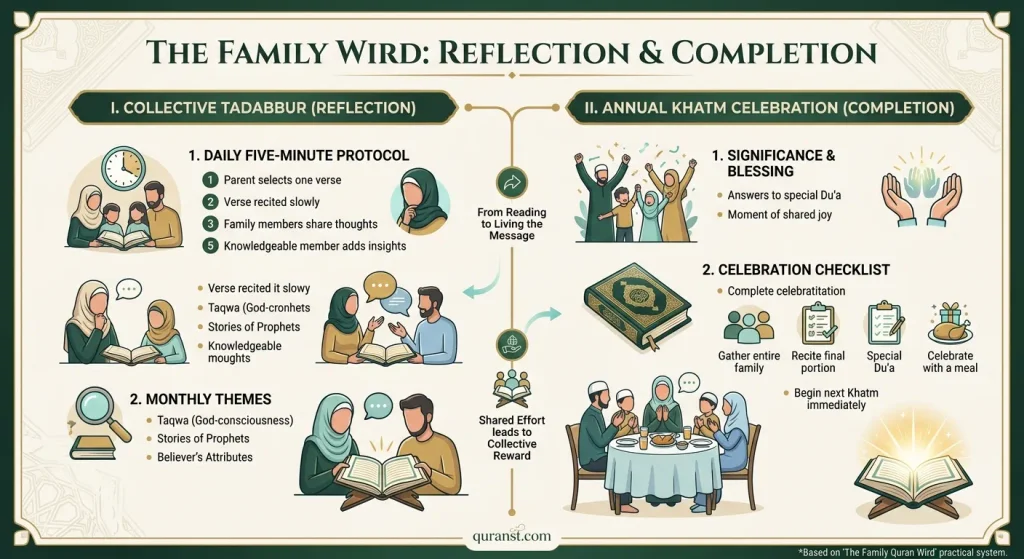
The Five-Minute Tadabbur Protocol
After the recitation session, add five minutes for reflection:
1. The parent (or the most knowledgeable family member) selects one verse from the day’s portion.
2. The verse is recited again, slowly.
3. The parent asks: “What does this verse mean? What does Allah want us to know from this?”
4. Each family member offers one thought — even the youngest, with an age-appropriate interpretation.
5. The parent adds any scholarly insight they know, connecting the verse to a Hadith, a Seerah story, or a relevant life situation.
The five-minute Tadabbur session, practiced daily across one year, produces a family that has reflected on 365 Quranic verses together. That is not a Sunday school class. That is a living relationship with the Quran.
The Monthly Tadabbur Theme
Choose one Quranic theme per month — and watch for it throughout the month’s recitation:
- Month 1: Every mention of Jannah (Paradise)
- Month 2: Every mention of Taqwa (God-consciousness)
- Month 3: Every story of a prophet
- Month 4: Every command directly addressed to believers
When a family member spots the month’s theme in their daily portion, they mark it and bring it to the session. The family discovers how frequently their theme appears — and what the pattern of its appearance reveals.
Section 5: The Annual Khatm Celebration — Marking the Completion
The classical Islamic tradition treated the completion of the Quran as one of the most significant events in a Muslim’s life. The Khatm du’a — the supplication made at the completion of the Quran — is one of the most answered du’as available to a believer:
Anas ibn Malik (may Allah be pleased with him) narrated that his family would gather when one of them was about to complete the Quran, make du’a together, and consider the completion a moment of special blessing.
(Referenced in Ibn Abi Dawud, Kitab al-Masahif; cited by Ibn Taymiyyah in Majmu’ al-Fatawa)
For the family that completes the Quran together, the celebration should be proportionate to the achievement:
The Khatm Celebration Checklist
- Gather the whole family — every member present, even those who only listened
- Each person recites their final portion in the completion session
- The last page of Al-Baqarah (or the last page of the Quran in the reading order used) is recited by the youngest member who can recite
- The Khatm du’a — a collective supplication at the completion of the Quran
- A special meal — the family celebrates with food and gratitude
- Begin immediately from Al-Fatiha — the classical practice is to begin the next Khatm immediately upon completing, reading the first five verses of Al-Baqarah — signaling that the relationship with the Quran has no end point
The Khatm Du’a
One of the most widely narrated du’as for the completion of the Quran is:
“O Allah, have mercy upon me through the Quran, and make it for me a guide, a light, a mercy, and a healing. O Allah, remind me of what I have forgotten from it, teach me what I am ignorant of, provide me with its recitation in the hours of night and day, and make it an argument for me, O Lord of all the worlds.”
— Cited in classical du’a collections; widely narrated from Hasan al-Basri and others; referenced in Al-Adhkar of Imam al-Nawawi
Section 6: Age-by-Age Participation Guide
Ages 3–6: The Listening Participant
At this age, the child participates primarily by being present — sitting with the family during the wird, hearing the Quran recited, absorbing the sounds and the atmosphere of a family that gathers for Allah’s Book.
Their contribution:
- Sitting with the family (even for five minutes before their bedtime)
- Reciting one memorized surah when it is their turn (Surah Al-Ikhlas, Surah Al-Kawthar, Surah Al-Falaq)
- Saying Bismillah at the opening and Alhamdulillah at the closing
What not to expect: Sustained attention, comprehension, or willingness to sit for twenty minutes. Five to ten minutes of genuine presence is a success at this age.
Ages 7–10: The Active Participant
At this age, the child can read independently — slowly, with errors, requiring correction — but genuinely participating in the recitation.
Their contribution:
- One to two pages of independent recitation per session
- Listening carefully while others read
- Answering simple Tadabbur questions at their level
The parent’s role: Follow along as the child reads; correct errors gently after they finish a verse (not mid-word); celebrate the completion of their portion specifically and warmly.
Ages 11–14: The Developing Contributor
At this age, the child can read more fluently, can contribute genuine Tadabbur observations, and can take on leadership roles in the family session.
Their contribution:
- Three to five pages of recitation per session
- Leading the family in the opening or closing du’a
- Bringing the monthly Tadabbur theme observation from their portion
Ages 15+: The Co-Leader
At this age, the young adult can co-facilitate the family session — choosing the Tadabbur verse, leading the reflection, bringing their own research or Tafsir observation.
Their contribution:
- Five to ten pages of recitation
- Occasional facilitation of the Tadabbur portion
- Accountability partner for younger siblings
Structured Curriculum Framework
quranst’s Quran reading and Tajweed track ensures each family member has the recitation skills to contribute confidently to the family wird — from the beginning reader to the advanced reciter.
Book your free 2-session trial →Section 7: When the Wird Breaks Down — and How to Restart
Every family wird breaks down. School exams, travel, illness, Ramadan disruptions, a new baby, a difficult season — the wird that seemed unshakeable gets interrupted.
The wird that never restarts is the only failed wird.
The Restart Protocol
1. No guilt, no accounting: Do not spend time calculating how many days were missed or how much of the schedule was not kept. Begin again tonight.
2. Begin with a shorter commitment: The family that was doing one Juz per day can restart with half a Juz per day until momentum is rebuilt.
3. Reconnect with the motivation: Re-read the hadith about gathering for the Quran (Sahih Muslim, 2699). Remind the family of the reward structure. Reconnect with why before rebuilding the how.
4. Change the format if necessary: If the after-Maghrib session is no longer working, try after Fajr on weekends. If the twenty-minute session is now too long, try ten minutes. The format serves the practice; when the format is the obstacle, change the format.
The Prophet ﷺ said:
“The most beloved of deeds to Allah are those that are most consistent, even if they are small.”
— Sahih al-Bukhari, Hadith 6464
Five minutes of consistent family Quran time is worth infinitely more than a perfect system practiced for three weeks.
Conclusion: The House of the Quran
The Prophet ﷺ said that Shaytan flees from the house in which Surah Al-Baqarah is recited.
He did not say Shaytan is merely inconvenienced. He did not say Shaytan steps back momentarily. He said Shaytan flees.
The house that is regularly filled with the Quran — where the sound of recitation is normal, where family members gather for Allah’s Book, where children grow up knowing what a Khatm feels like and what a Khatm du’a sounds like — is the house that Shaytan cannot take root in.
This is not a metaphor. It is a Prophetic statement about the spiritual reality of a household whose primary sound is the Quran.
Regular engagement with the Quran develops qualities like humility, honesty, and righteousness in the individual. When a family engages with the Quran collectively, these qualities develop across the household — creating a shared moral and spiritual environment that shapes every member.
The family wird is not a productivity hack. It is not a spiritual discipline for high-performing Muslims. It is the most accessible, most consistently rewarded, most practically transformative practice available to any Muslim family — regardless of their knowledge level, their schedule pressure, their children’s ages, or their geographic location.
It requires only two things: a Quran and a decision.
كِتَابٌ أَنزَلْنَاهُ إِلَيْكَ مُبَارَكٌ لِّيَدَّبَّرُوا آيَاتِهِ وَلِيَتَذَكَّرَ أُوْلُوا الأَلْبَابِ
“This is a blessed Book which We have revealed to you — so that they might reflect upon its verses, and so that those of understanding would be reminded.”
— Quran 38:29
Open the Quran. Gather the family. Begin tonight.
🟢 Build the Individual Skills That Power the Family Wird
The family wird is most powerful when each family member has the Quran skills to contribute confidently. The parent who reads fluently, the teenager whose Tajweed is correct, the child whose page is genuinely prepared — together they create a session that is genuinely engaging for every participant.
quranst’s Quran track builds each family member’s individual skills:
Quran Reading:
- Learn Quran from the alphabet through fluent independent recitation
- Quran reading at every level — from absolute beginner to advanced fluency
- Online Quran teacher — certified, live, one-on-one correction
Tajweed:
- Tajweed — all rules taught systematically from the first session
- Real-time correction that ensures the family wird sounds beautiful
Memorization:
- Quran memorization — the hafiz who has memorized reads from memory, covering more and contributing more
- Online Quran classes — flexible scheduling around the family’s existing week
Comprehension:
- Quranic Arabic — enabling the Tadabbur dimension; the family member who understands what they are reciting contributes differently to the reflection session
- Islamic studies — Tafsir context for the monthly Tadabbur theme
👇 Begin with Two Free Sessions
Two Ways to Begin
“Whenever people gather in one of the houses of Allah, reciting the Book of Allah and studying it among themselves — tranquility descends upon them, mercy covers them, angels surround them, and Allah mentions them among those who are with Him.”
— Sahih Muslim, Hadith 2699
Gather. Recite. Be mentioned by Allah.
بِسْمِ اللَّهِ — Begin.
References and Sources
Quranic References
- Quran 38:29 — “A blessed Book — so that they might reflect upon its verses”
- Quran 47:24 — “Do they not reflect upon the Quran, or are there locks upon their hearts?”
Hadith References
- Sahih al-Bukhari, Hadith 4998 — Jibril reviewing the Quran with the Prophet ﷺ annually
- Sahih al-Bukhari, Hadith 6464 — “Most beloved deeds are the most consistent”
- Sahih Muslim, Hadith 780 — “Shaytan flees from the house in which Al-Baqarah is recited”
- Sahih Muslim, Hadith 2699 — Gathering for Quran: sakinah, mercy, angels, divine mention
- Sunan al-Tirmidhi, Hadith 2910 — Ten rewards per letter of the Quran (Sahih)
Classical Scholarly Works
- Ibn al-Qayyim al-Jawziyyah: Madarij al-Salikin. Three layers of Quranic healing (spiritual, physical, relational)
- Imam al-Nawawi: Al-Adhkar. The Khatm du’a and post-recitation supplications
- Ibn Taymiyyah: Majmu’ al-Fatawa. The classical practice of gathering for Khatm and collective du’a
- Ibn Abi Dawud: Kitab al-Masahif. The narration of Anas ibn Malik gathering for the Khatm
Contemporary Research Sources
- Muslim Pro Content Team (April 2025). “Ramadan Khatam Quran Challenge.” Key findings: Daily community Quran recitation (one Juz per session); sessions up to 1.5 hours; completion of full Quran in 30 days; “Verily, that was tranquility which came down for the recitation of the Quran” (Sahih Muslim).
- Al-Hannah Blog (November 2025). “What Is Khatam? The Spiritual, Communal, and Cultural Dimensions of Completing the Qur’an.” Key findings: Framework for community/family Khatm programs; select familiar mushaf; create accountability partnerships; family group chat for daily consistency and discussion of difficult verses; begin next Khatm immediately upon completion.
- Qima Quran Academy (July 2025). “Strengthen Family Bonds: Engaging in Family-Based Quran Study Together.” Key findings: Family Quran time creates environment where faith feels natural; children in homes where Quran is regularly read develop genuine relationship with it; collective spiritual practice is investment in children’s spiritual future; transforms household into beacon of faith and understanding.
- Buruj Academy (April 2026). “Daily Quran Reading Schedule: Practical Plans For Every Level.” Key findings: 4 pages daily = Khatm in 151 days; 20 pages daily = monthly Khatm; classical Companions’ model distributed recitation across five prayer windows; prevents mental fatigue; anchors Quran reading to daily prayer rhythm.
- Quranica (January 2026). “Quran Reading Schedule and Planner.” Key findings: Goal-based scheduling (recitation, understanding, or revision); identify consistent “golden hour”; treat time with importance; post-Fajr or pre-sleep most effective for many families.
- Eaalim Institute (June 2026). “Benefits of Reciting Quran Daily.” Key findings: Letter-by-letter reward calculation (10 per letter); full Juz = 120,000+ rewards; Ibn al-Qayyim’s three layers of Quranic healing; family recitation creates homes where Shaytan finds it harder to influence.
- Islamic Info Center (October 2025). “Benefits of Reciting Quran Daily.” Key findings: Daily recitation strengthens faith and develops qualities like humility, honesty, and righteousness; arouses feeling of unity among family members; strengthens bonds through recitation, discussion, and shared spiritual experience; provides mental and spiritual support.
Frequently Asked Questions
What is a family Quran wird and how does it differ from individual reading?
Which family Quran completion model is best for beginners?
How can young children participate if they cannot read Quran fluently?
- Ages 3–6: Listen attentively and recite short memorized Surahs[cite: 1].
- Ages 7–10: Read 1–2 pages with gentle parental support[cite: 1].
- Ages 11–14: Read 3–5 pages and join simple reflection discussions[cite: 1].
- Ages 15+: Read larger portions and help co-lead the session[cite: 1].
