

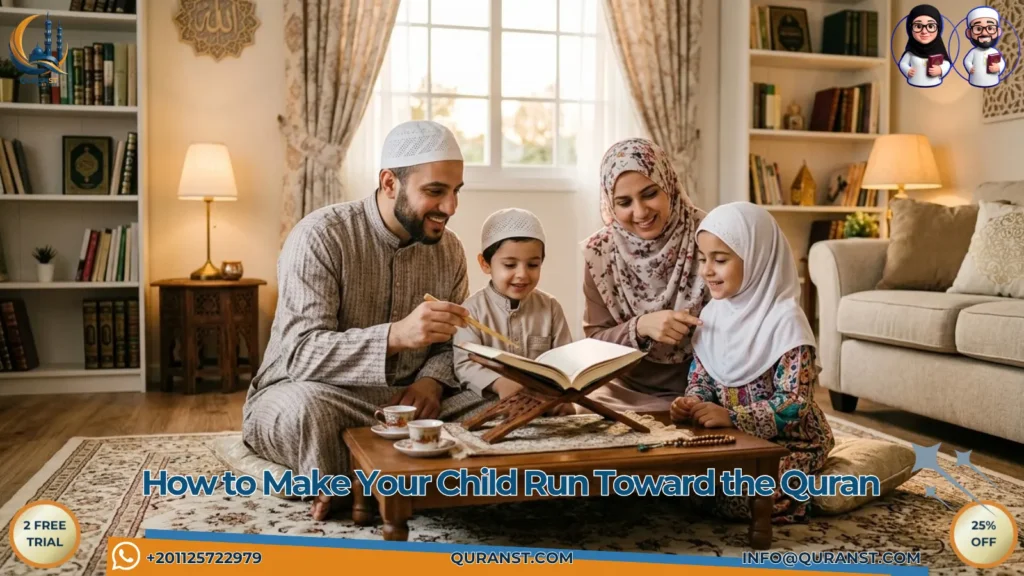
Introduction: The Child Who Runs Toward the Quran
There is a specific kind of morning that every Muslim parent who has used competition well will recognize.
The child wakes up before being called. Not for school. Not for a game. But because today is competition day — the day they get to show how much Surah Al-Mulk they have memorized, the day they get to beat their sibling’s record, the day the family gathers around the dinner table to hear them recite.
They have been reviewing in their head since they woke up. Their lips are moving.
This is the child who runs toward the Quran.
Compare that to the child who has to be reminded, cajoled, incentivized with screen time, and eventually threatened with consequences before they open the Quran for their daily session. Both children are learning the Quran. Only one of them is building a love for it.
The difference, very often, is not talent. It is not parenting skill. It is structure — specifically, the structure of competition: a clear goal, a clear measure of progress, a real audience, and a genuine reward attached to genuine effort.
The Islamic tradition did not stumble upon this insight accidentally. Allah Himself used the language of competition to describe the right relationship with the next world — and the Prophet ﷺ modeled competitive engagement with Islamic learning in ways that his Companions documented with care.
This guide is the complete system for bringing that energy into your home — specifically around Quran memorization, recitation, and comprehension — through home competitions that motivate without damaging, that celebrate without creating arrogance, and that make the Quran the thing your child wants to excel in above all else.
Structured Curriculum Framework
quranst’s Quran track provides the structured Quran curriculum — memorization, Tajweed, and Quranic Arabic — that gives your child something genuinely worth competing about.
Book your free 2-session trial →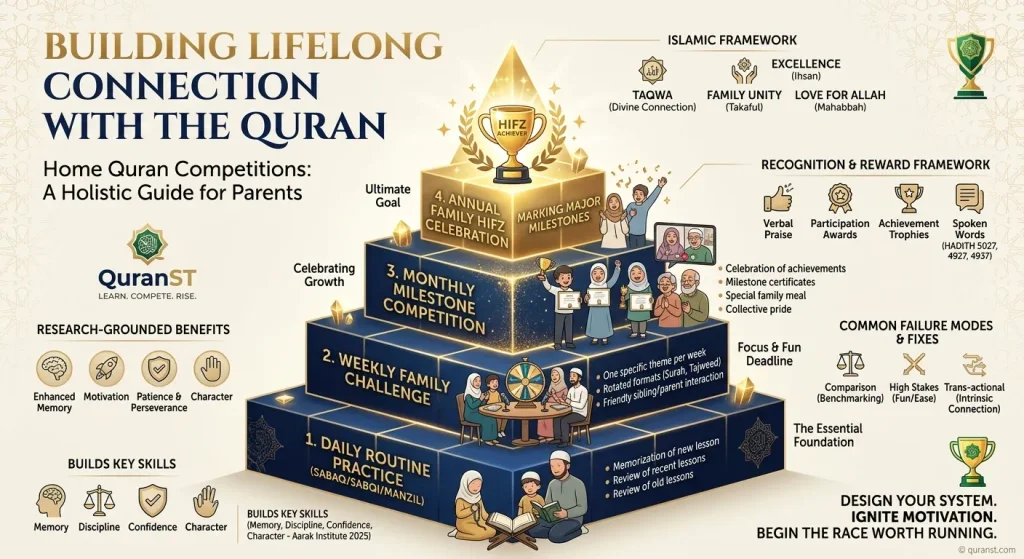
The Islamic Foundation: Al-Tanafus — The Competition Allah Praises
The Islamic tradition not only permits healthy competition — it commands it.
وَفِي ذَٰلِكَ فَلْيَتَنَافَسِ الْمُتَنَافِسُونَ
“And for that let the competitors compete.”
— Quran 83:26
The word tanafus — from the root nafasa (to breathe, to compete, to excel) — describes a specific kind of competition: the race toward something genuinely valuable. The verse is referring to the delights of Paradise — and Allah is saying: this is the competition worth entering. This is the race worth running.
The Prophet ﷺ established the specific framework for Quranic competition with one of the most precise and documented statements in the entire Hadith literature:
“The best of you are those who learn the Quran and teach it.”
— Sahih al-Bukhari, Hadith 5027
And he said, establishing the hierarchy of excellence in the Quran:
“The one who is proficient in the Quran will be with the noble, righteous angels; and the one who recites the Quran with difficulty, struggling with it, will have a double reward.”
— Sahih al-Bukhari, Hadith 4937; Sahih Muslim, Hadith 798
Both descriptions — the proficient and the struggling — are described with dignity. This is the Islamic framework for Quranic competition: the goal is excellence, but effort at every level is honored.
The Prophet ﷺ also modeled competition personally. He raced with Aisha (may Allah be pleased with her). He challenged his Companions to virtue. He said “Who among you will learn these verses?” and the Companions competed for the honor of being the one who went and taught.
Ibn al-Qayyim, reflecting on the Prophetic model of Quranic education, wrote in Miftah Dar al-Sa’adah:
“The Prophet ﷺ kindled in his Companions a flame of competition for the Quran — not merely by commanding its memorization, but by making excellence in the Quran the greatest status a person could achieve in his community. When people compete for the most valuable things, they bring their highest capacities to bear.”
Section 1: The Research — What Competition Does to a Child’s Motivation
Research from Aarak Institute (2025) confirms that Quran competitions for children produce a consistent set of benefits: enhanced memory and concentration through the discipline required for precise memorization; increased motivation to continue learning; development of patience and perseverance toward goals; strengthening of self-confidence through public recognition of effort; promotion of Islamic values including honesty, modesty, and cooperation; and the development of healthy competitive relationships with peers.
Research and community practice data from the Valley Muslim Community Foundation confirms that formal Quran competitions — when designed with both winners and all participants receiving recognition — motivate continued Quran learning and inspire community members who observe the competitions to engage more deeply with the Quran themselves. The most effective competitions begin preparation six to seven months in advance — indicating that the preparation process itself is a primary vehicle of learning.
The psychological mechanism is well understood:
Goal specificity: Competition provides a specific, concrete, measurable goal — recite this surah from memory, achieve this Tajweed standard, learn this number of verses — that replaces the vague aspiration “learn Quran” with a clear target. Goal specificity dramatically improves sustained effort.
Social motivation: The presence of an audience — even a family audience — activates a level of motivation that private practice cannot replicate. The child who knows their recitation will be heard by people they love performs their practice with a different quality of attention.
Reward psychology: A clearly defined, meaningful, proportionate reward attached to a specific achievement creates what behavioral psychologists call operant conditioning — the child’s behavior (practicing Quran) is reinforced by a consequence (reward) that makes the behavior more likely to recur.
Identity formation: When a child wins a Quranic competition — or even participates in one publicly — they begin to form the identity of “someone who memorizes Quran.” Identity-based motivation is the most durable form available, because the behavior is no longer just what they do; it becomes who they are.
Quran competitions directly contribute to shaping a child’s character — extending far beyond mastering memorization. They are a powerful experience that shapes the whole person — discipline, confidence, community, and the relationship with the Quran that sustains everything else.
Section 2: The Three Principles of Islamically Sound Competition
Not all competition produces the positive outcomes described above. Badly designed competition can produce anxiety, resentment, sibling rivalry, and an association between the Quran and stress.
The Islamic framework for competition — derived from the Sunnah and the classical scholarly tradition — establishes three principles that ensure competition remains genuinely tanafus (the praiseworthy kind) rather than hasad (envy) or kibr (arrogance):
Principle 1: The Goal Must Be Allah — Not Victory Over Others
The Prophet ﷺ said:
“Actions are judged by intentions.”
— Sahih al-Bukhari, Hadith 1; Sahih Muslim, Hadith 1907
Before every Quran competition — home or formal — the intention must be established: “We are doing this to get closer to the Quran, to earn Allah’s pleasure, and to motivate each other toward what is best.” Not: “We are doing this to prove that I am better than my sibling.”
The parent who frames competition with the correct intention at the beginning will find that the competition produces the right outcomes. The parent who allows the intention to drift toward ego and comparison will find that the competition eventually damages the relationships it was meant to strengthen.
Principle 2: Effort Must Be Honored — Not Just Excellence
The prophetic hadith specifically includes the one who struggles — “double reward for the one who struggles” — alongside the one who excels. This is not consolation. It is a theological statement about the nature of virtue: effort matters, not just outcome.
Every home Quran competition must have a structure that honors effort at every level — not only the winner. This does not mean eliminating winners; it means ensuring that participation itself is dignified and rewarded, so that the child who is slower to memorize is not left with only shame while their faster sibling takes all the recognition.
Well-designed Quran competitions ensure that all participants receive recognition and appreciation for their efforts — with winners receiving additional motivation through more significant prizes. The participation itself is valued and acknowledged, preventing the discouragement that unmitigated competitive structures can produce.
Principle 3: The Quran Must Remain a Source of Joy — Not Anxiety
The most important indicator that a home Quran competition is correctly calibrated is this: after the competition, does the child want to do more Quran? Does the experience leave them feeling motivated, capable, and connected to the Quran — or anxious, defeated, and relieved it is over?
If the competition is producing motivation — even in children who did not win — it is correctly designed. If it is producing dread — even in children who won — something needs to change.
The Prophet ﷺ said:
“Make things easy and do not make them difficult. Give glad tidings and do not repel people.”
— Sahih al-Bukhari, Hadith 69
The Quran competition that repels children from the Quran has failed at the only thing that matters.
Section 3: Eight Home Quran Competition Formats That Work
These eight formats are designed for home use — requiring no equipment beyond a Quran, willing participants, and a parent willing to serve as judge and host.
Format 1: The Weekly Surah Championship 🏆
How it works: Each week, the family selects one surah (the same surah for all participants at their respective levels). Everyone memorizes it — or reviews it if already memorized — during the week. On Friday evening (or any consistent family time), each person recites from memory. Points awarded for: completeness of memorization, Tajweed accuracy, and fluency.
Why it works: The weekly cycle creates consistent motivation, a predictable deadline, and a recurring community event that the child looks forward to rather than dreads.
Adaptations by level:
- Young children: one or two short surahs, recited with the parent
- Older children: full surah with Tajweed criteria
- Parents: participate too — the parent who recites alongside their children teaches that Quranic excellence is for everyone
Reward: Small weekly prize (sticker, choice of weekend activity, extra story time) + the Quran progress chart updated publicly.
Format 2: The Tajweed Precision Challenge 🎯
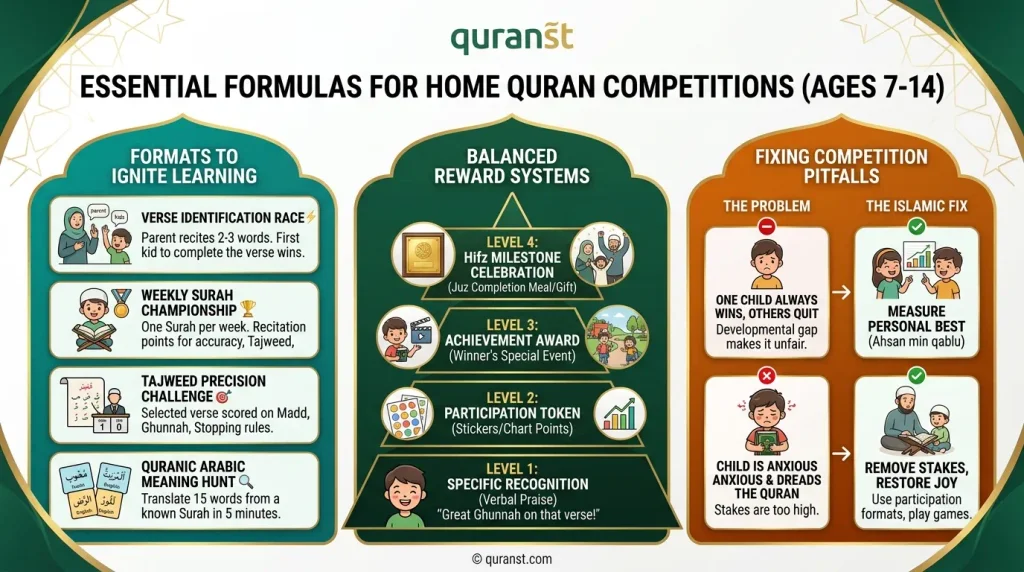
How it works: The judge (parent or older sibling) selects a verse from a surah the child knows. The child recites it, and the judge marks specific Tajweed points: Madd lengths, Ghunnah accuracy, Qalqalah, stopping rules. The child with the highest Tajweed score wins.
Why it works: This format rewards quality over quantity — the child who has learned fewer verses but recites them perfectly can beat the child who has memorized more but recites sloppily.
Tajweed excellence is one of the three core categories of formal Quran competitions — alongside memorization (Hifz) and understanding (Tafsir). Accuracy, fluency, and pronunciation are the specific evaluation criteria.
Adaptations: For younger children, simplify to three Tajweed criteria only (correct letters, Madd, stopping). For older children, use the full formal Tajweed rubric.
Teaching note: After the competition, spend five minutes on the most common error made — not to shame but to teach. The competition reveals the gap; the teaching session closes it.
Format 3: The Verse Identification Race ⚡
How it works: The judge recites the first two to three words of a verse from within surahs the children know. First child to correctly complete the verse earns the point. Play to twenty points.
Why it works: Speed and recall under pressure — this format trains the quick retrieval of memorized material that is the hallmark of genuine Hifz (as opposed to memorization that only works with a warm-up).
For younger children: Use only surahs from Juz’ Amma. Allow a second chance if the first attempt is close.
For older children: Draw from multiple juz; add a Tajweed requirement (the completion must also be recited with correct Tajweed to earn the point).
Format 4: The Monthly Hifz Milestone Ceremony 🎖️
How it works: At the end of each month, each family member presents their month’s Quran progress — how many new verses memorized, how many old verses reviewed. The child who has made the most progress (relative to their starting point — not in absolute terms) is honored.
Why it works: This format rewards relative progress — the child who was at verse 10 and reached verse 50 is more celebrated than the child who was at verse 200 and only reached verse 210. This prevents the discouragement of children who are slower without removing the motivation of those who are faster.
The ceremony: Make it an event. A special meal, a family gathering, each child reciting their month’s memorization in front of the family. Grandparents via video call. The formality of the ceremony communicates the importance of the achievement.
Format 5: The Quranic Arabic Meaning Hunt 🔍
How it works: The judge selects fifteen Arabic words from surahs the family knows. Each participant gets a sheet with the Arabic words. The first to correctly translate the most words in five minutes wins.
Why it works: This format specifically rewards Quranic Arabic comprehension — the bridge between recitation and genuine understanding. It motivates children to learn what the words they recite actually mean.
The MAS-ICNA Quran Competition explicitly includes understanding and meaning alongside memorization and Tajweed as essential dimensions of Quranic excellence. The competition is designed to develop spiritual, mental, and performing skills of the young Muslim generation.
Teaching note: After the competition, go through all fifteen words together — not just the ones the winner knew. The competition reveals gaps for everyone.
Format 6: The Ramadan Hifz Sprint 🌙
How it works: During Ramadan, the family sets a collective Hifz target — a specific number of verses to be memorized by Eid. Each family member sets their individual target. The family tracks progress on a visible chart. On Eid morning, everyone recites their Ramadan memorization in a brief family ceremony.
Why it works: The Ramadan context adds powerful external motivation — the month itself carries spiritual weight, the Eid ceremony creates a meaningful deadline, and the collective target builds family solidarity rather than purely individual competition.
The Prophet ﷺ on Ramadan and the Quran:
“Jibril used to meet the Prophet ﷺ every night in Ramadan and they would review the Quran together.” — Sahih al-Bukhari, Hadith 6
The family that reviews the Quran together in Ramadan is doing what Jibril and the Prophet ﷺ did — in their own capacity, at their own level.
Format 7: The Sibling Sahih (Accuracy) Challenge 🤝
How it works: Pairs of siblings take turns reciting to each other. The listener marks any errors in the recitation (wrong word, incorrect Tajweed). At the end, the listener reports the errors to the parent-judge. The reciter with the fewest errors across the session wins.
Why it works: This format builds the critical skill of listening to Quran with attention — the sibling who is listening carefully to catch errors is engaging with the Quran at a sophisticated level. It also builds accountability and honesty (the listener who misses errors to help their sibling win is practicing dishonesty — an important Islamic teachable moment).
Format 8: The Annual Family Quran Day 🌟
How it works: Once a year — the family Quran Day — the entire day is organized around the Quran. Morning: each person recites their favorite memorized surah. Afternoon: Quran games, competitions, and activities. Evening: the annual awards — a family ceremony in which each child is recognized for their year’s Quranic achievements with a specific, named acknowledgment and a meaningful gift.
Why it works: The annual Quran Day makes the Quran the center of the family’s celebratory culture. The child who grows up with an annual Quran Day grows into an adult for whom the Quran is associated with warmth, celebration, family, and joy — not merely obligation.
Section 4: The Reward System — What to Give and How
The reward system is where home Quran competitions most frequently go wrong. Too little reward, and the competition feels meaningless. Too much (or inappropriate) reward, and the child learns to perform for the reward rather than for the Quran.
The Islamic Framework for Reward
The Prophet ﷺ gave gifts. He honored achievement publicly. He praised specifically and warmly. The companions competed for positions of honor in teaching and recitation. This is authentic Islamic reward practice.
And the Prophet ﷺ also said:
“The Quran will come on the Day of Judgment and intercede for its companion.” — Sahih Muslim, Hadith 804
The highest reward — the intercession of the Quran itself — is the frame within which all earthly rewards should be understood. Earthly rewards celebrate earthly achievement; the ultimate reward belongs to Allah.
The Four-Level Reward Structure
Level 1 — Recognition (Always): Every participant receives verbal recognition — specific, named, genuine. Not “good job” but “I noticed that you remembered the Ghunnah in that verse that you got wrong last week. That is improvement.” Recognition is the most important reward at any age.
Level 2 — Participation Reward (Always): Every participant receives a small, symbolic reward for taking part — a sticker, a certificate, a point on the family Quran chart. This ensures that the child who did not win leaves with a positive association with the experience.
Level 3 — Achievement Reward (For winners/milestone-reachers): A meaningful, but not excessive, reward for genuine achievement. Appropriate rewards include:
- Experiences: A trip to the park, a special outing, the child chooses the family movie
- Books and Islamic learning materials: A beautiful Quran, an Islamic book they wanted
- Time and attention: The winner gets a dedicated hour of parent-and-child time doing whatever they choose
- Community recognition: The winner’s achievement is mentioned at the next family gathering, or posted in the family group chat
Level 4 — The Prophetic Reward (For major milestones): For significant Hifz completions — Juz’ Amma, ten juz, full Quran — the celebration should be proportionate to the achievement. Classical Islamic culture celebrated the completion of Quran memorization as one of the most significant events in a family’s life. A meal for extended family and community, public recitation, and a gift of genuine significance.
What NOT to Give as Reward
- Cash for verses memorized: This creates a transactional relationship with the Quran that is difficult to undo. The child who expects payment for memorization will eventually refuse to memorize without payment.
- Screen time as reward for Quran: This creates a hierarchy in which screens are more valuable than the Quran — the message being communicated is the opposite of the one intended.
- Punishment for losing: Losing a competition is not a failure to be punished. It is information to be used and an experience to learn from.
Section 5: Moving from Home to Community — External Quran Competitions
Home competitions build the foundation. Community and formal competitions provide the next level of motivation, the experience of public performance, and the identity-forming experience of being known in the community as a Quran student.
The Valley Muslim Community Foundation’s competition, distributed prizes and certificates on Eid ul-Fitr — connecting Quranic achievement to one of the most joyous occasions in the Islamic calendar. This timing is significant: it connects the achievement of Quranic learning with communal celebration, inspiring others in the community to engage more deeply with the Quran.
Finding External Competitions
USA and Canada:
- MAS-ICNA Annual Convention (Chicago) Quran Competition — designed for competitors in the USA and Canada motivated to memorize the Quran and perfect Tajweed. Categories: memorization, Tajweed, and tilawah. Goal: develop Quranic spiritual, mental, and performing skills of the young Muslim generation.
- Local masjid competitions — check with your Islamic center, as most organize annual competitions around Ramadan or other Islamic occasions
- The Shatibi Competition in Canada — Hifz Division (ages 8–25, categories from 1 Juz to full 30 Juz), Best Voice Division (Tajweed excellence), and an Islamic Studies category. Special feature: every participant in the 1 Juz Memorization Division is automatically entered for a fully-sponsored Umrah package.
UK and Australia:
- National Quran competitions organized by major Islamic organizations — contact your local Islamic educational authority or search for annual events
- Online Quran competitions — increasingly common platforms that connect Muslim children globally in structured Quranic competition, such as quranst’s Annual Ramadan Quran Competition.
Preparing for External Competition
Formal competitions typically require six to seven months of preparation. The preparation process itself — the structured daily practice, the regular review, the goal-specific Tajweed work — is where the primary learning happens.
The child who prepares for a competition and does not win has still:
- Memorized more than they would have without the competition
- Developed practice discipline they will carry forward
- Experienced public Quran recitation and built confidence
- Connected to a community of Quran learners
The participation is the primary value. The placing is the secondary one.
Structured Curriculum Framework
quranst’s Hifz and Tajweed track prepares Muslim children for both home family competitions and formal community competitions — with certified Online Quran teachers, real-time Tajweed correction, and structured memorization management.
Book your free 2-session trial →Section 6: Age-by-Age Competition Guide
| Age | Best Formats | Competition Structure | Reward Type |
|---|---|---|---|
| 3–6 | Verse Identification Race (parent-led) · Surah recitation for grandparents | Non-competitive sharing, not ranked | Stickers, hugs, applause, special story |
| 7–10 | Weekly Surah Championship · Monthly Ceremony · Meaning Hunt | Gently ranked; everyone receives recognition | Experiences, Islamic books, family outings |
| 11–14 | Tajweed Precision Challenge · Sibling Sahih Challenge · Ramadan Sprint | Formally ranked; full ceremony | Meaningful gifts, community recognition, Umrah aspiration |
| 15+ | External community competitions · Full Hifz milestones · Quranic Arabic depth | Full competitive environment with real stakes | Significant gifts, family and community celebration |
The Parent’s Role at Each Stage
Ages 3–6: The parent is the audience. Applaud everything. Make every recitation feel like a performance for the most important audience in the world.
Ages 7–10: The parent is the host. Design the format, keep the rules, award the points, celebrate warmly and specifically. Do not participate in judging in a way that could feel biased between siblings.
Ages 11–14: The parent is the coach. Prepare the child for competition, review their recitation regularly, give honest feedback alongside warm encouragement.
Ages 15+: The parent is the supporter. Step back from designing and managing. The teenager participates in choosing their competitions, sets their own targets, and receives the parent’s unconditional support for their goals.
Section 7: When Competition Goes Wrong — and How to Fix It
Problem 1: One Child Always Wins — and the Other Has Given Up
Why it happens: Competitions with identical criteria for children at different developmental levels will always advantage the older or more naturally capable child.
The fix: Never compare children to each other. Only compare each child to their own previous performance. The competition is “Did you do better than last month?” — not “Did you do better than your sibling?” Introduce the concept of personal best (ahsan min qablu — better than before) as the primary competitive framework.
Problem 2: The Child Has Become Anxious About Quran
Why it happens: The competition structure has become too intense, the stakes too high, or the parental reaction to poor performance too negative.
The fix: Immediately reduce the stakes. Return to participation-only formats with no ranking. Spend time on Quran that is purely enjoyable — listening to beautiful recitation together, talking about the meaning of a favorite surah, playing Quran games without scores.
The Quran must return to being a source of joy before it can be a source of competition again.
Problem 3: The Child Is Memorizing for the Reward — Not for Allah
Warning signs: The child immediately asks “What do I get?” before any Quran session. The child refuses to practice without a promised reward. The child expresses no intrinsic interest in the Quran beyond the competition.
The fix: Two-step response. First: reduce or eliminate tangible rewards temporarily. Second: increase the meaning dimension — read Tafsir together, connect the surah being memorized to a story the child loves, discuss what the Prophet ﷺ said about this surah. The child who understands what they are memorizing develops intrinsic motivation that no reward structure can fully replace.
The Prophet ﷺ said:
“The most beloved of deeds to Allah are those that are most consistent, even if they are small.” — Sahih al-Bukhari, Hadith 6464
Consistency from intrinsic motivation is worth more than intensity from extrinsic reward.
Conclusion: The Race Worth Running
There is a race that will be run on the Day of Judgment.
The Prophet ﷺ said that the hafiz will be told:
“Read and ascend. Recite as you used to recite in the world. Your rank will be at the last verse you recite.”
— Sunan Abu Dawud, Hadith 1464; Sunan al-Tirmidhi, Hadith 2914; authenticated by al-Albani
The rank. The ascent. The last verse.
This is the ultimate Quran competition — and it does not have a registration deadline, a minimum age requirement, or a prize draw. It is open to every Muslim who carries the Quran in their chest and recites it on that day.
The home competitions in this guide are not ends in themselves. They are training sessions for that race — building the habit, the love, the discipline, and the memory that will allow your child to stand and recite on that day at whatever rank their earthly practice has built.
وَفِي ذَٰلِكَ فَلْيَتَنَافَسِ الْمُتَنَافِسُونَ
“And for that let the competitors compete.”
— Quran 83:26
Design the competition. Ignite the motivation. Begin the race that matters.
🟢 Give Your Child Something Worth Competing For
The competitions in this guide motivate best when the child has a genuine Quran curriculum behind them — real Tajweed to demonstrate, real memorization to present, real Quranic Arabic to display.
quranst’s Quran track provides the curriculum your competition system needs:
Hifz (Memorization):
- Quran memorization — the three-part structure managed by a certified Online Quran teacher
- Online Quran classes — live, one-on-one, real-time correction
- Quran lessons customized to your child’s pace and level
Tajweed:
- Tajweed — all rules taught systematically and applied in recitation from the first session
- Quran reading — from the alphabet through fluent independent recitation
Comprehension:
- Quranic Arabic — vocabulary and grammar that allows genuine understanding alongside memorization
- Islamic studies — Tafsir context that transforms recitation into comprehension
Preparation for Formal Competition:
- Certified Online Quran teacher who understands formal competition standards
- Structured preparation plans for community competitions
- Regular milestone assessments that mirror competition evaluation criteria
👇 Begin with Two Free Quran Lessons
Two Ways to Begin
“The best of you are those who learn the Quran and teach it.”
— Sahih al-Bukhari, Hadith 5027
Be the best. Learn it. Teach it. Compete for it.
بِسْمِ اللَّهِ — Begin.
References and Sources
Quranic References
- Quran 83:26 — “And for that let the competitors compete”
- Quran 96:1 — “Read in the name of your Lord who created”
Hadith References
- Sahih al-Bukhari, Hadith 6 — Jibril and the Prophet ﷺ reviewing the Quran in Ramadan
- Sahih al-Bukhari, Hadith 69 — “Make things easy and do not make things difficult”
- Sahih al-Bukhari, Hadith 1; Sahih Muslim, Hadith 1907 — “Actions are judged by intentions”
- Sahih al-Bukhari, Hadith 4937; Sahih Muslim, Hadith 798 — Proficient and struggling reciters
- Sahih al-Bukhari, Hadith 5027 — “The best of you are those who learn the Quran and teach it”
- Sahih al-Bukhari, Hadith 6464 — “Most beloved deeds are most consistent”
- Sahih Muslim, Hadith 804 — The Quran interceding for its companion
- Sunan Abu Dawud, Hadith 1464; Sunan al-Tirmidhi, Hadith 2914 — “Read and ascend” (authenticated by al-Albani)
Classical Scholarly Works
- Ibn al-Qayyim al-Jawziyyah: Miftah Dar al-Sa’adah. Dar Ibn ‘Affan. (The Prophet ﷺ kindling competition for the Quran among the Companions)
Contemporary Research Sources
- Quran Kids Canada (June 2026). “Ultimate Quran Competition for All Ages 2026.” Key findings: Quran competitions shape character beyond memorization; Shatibi Competition categories: Hifz (1 Juz to 30 Juz, ages 8–25), Best Voice/Tajweed, Ten Qiraat, Islamic Studies; Umrah prize for 1 Juz participants.
- Aarak Institute (January 2025). “Exciting Quran Competitions for Kids.” Key findings: Enhanced memory and concentration; increased motivation to learn; patience and perseverance development; self-confidence through public recognition; promotion of Islamic values (honesty, modesty, cooperation); healthy competitive relationships with peers.
- Valley Muslim Community Foundation. “Quran Competition.” Key findings: Formal competitions motivate continued Quran learning; inspire community engagement; preparation begins 6–7 months in advance; prize distribution on Eid ul-Fitr connects achievement to Islamic celebration; all participants receive recognition.
- MAS-ICNA Annual Convention. “Quran Competition.” Key findings: Designed for USA and Canada competitors; categories: memorization, Tajweed, tilawah; goal: develop spiritual, mental, and performing skills; provides encouraging Islamic educational environment for goal-driven students.
- Quran Easy Academy (April 2023). “The Benefits of Quran Competitions for Kids.” Key findings: All participants receive recognition; winners receive additional motivation; competitions boost confidence, improve memorization skills, enhance social skills, develop discipline and time management, strengthen parent-child relationships.
Frequently Asked Questions
Is competition in learning the Quran Islamically encouraged?
How can parents prevent healthy Quran competition from turning into sibling rivalry?
- Set the Pure Intention: Remind children that the goal is getting closer to Allah, not outperforming others.
- Honor Effort, Not Just Victory: Reward personal milestones, consistency, and progress relative to each child’s level.
- Avoid Direct Comparison: Benchmark children against their own previous performance rather than their siblings.
What types of home Quran competitions are best for different age groups?
- Ages 3–6: Non-competitive sharing, parent-led verse identification, and recitation for family members with sticker rewards.
- Ages 7–10: Weekly Surah championships, Quranic meaning hunts, and monthly progress ceremonies.
- Ages 11+: Tajweed precision challenges, sibling accuracy audits, and preparation for external community competitions.

Pingback: The Family Quran Wird: A Complete System for Daily Recitation & Khatm