

Introduction: The Fortress That Goes Wherever Your Child Goes
The school bus pulls away at 7:45 AM.
Your child is on it. And for the next eight hours, they will navigate a world you cannot see — social pressures, academic stress, moments of exclusion and inclusion, the constant low-grade anxiety of belonging and performance and identity in an environment that is often indifferent to their faith and sometimes actively hostile to it.
You cannot go with them.
But you can send them with something.
Not a strategy. Not a coping mechanism. Not a mindfulness technique developed by a therapist who has never heard of Allah.
You can send them with the words that Allah Himself taught — through His Prophet ﷺ — specifically for the moments when the world is too much. The words that, as the research is now confirming, measurably reduce anxiety, lower cortisol, regulate the nervous system, and produce the quality of inner peace that the Quran describes as itmina’n al-qalb — the tranquility of the heart.
Research increasingly validates what Islamic tradition has long held: structured spiritual practices — specifically dhikr — reduce cortisol and support emotional regulation. Morning adhkar function as a structured, intention-driven practice that shifts attention from worries to gratitude and trust in Allah. They orient the ego correctly: before ambition takes over, morning adhkar remind you who you are — ‘abd, a servant of Allah — and who He is — Al-Hayy al-Qayyum, the Ever-Living Sustainer. This is the correct starting frame for any productive day.
The child who leaves for school with the morning adhkar recited — who has sealed themselves with the protection of the words their Prophet ﷺ taught — is not leaving for school unprotected. They are leaving with a fortress built around them in words. And that fortress goes wherever they go.
This guide is the complete system for building that fortress — for your child, in your home, starting today.
Structured Curriculum Framework
quranst’s Islamic Studies track teaches the adhkar as a structured curriculum — memorized with meaning, understood with context, and practiced with the consistency that transforms them from recited sounds into genuine psychological armor.
Book your free 2-session trial →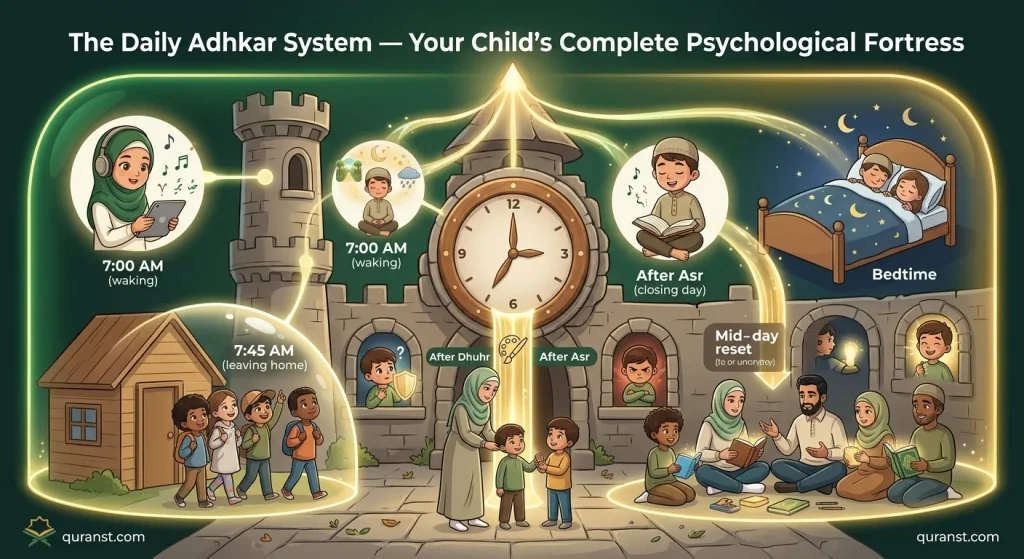
The Quranic and Prophetic Foundation of Adhkar
The adhkar are not pious customs that accumulated over time. They are a precisely transmitted, authenticated system of divine prescription for human wellbeing — revealed to the Prophet ﷺ and preserved through authenticated chains of narration to this day.
Allah Commands Dhikr Explicitly and Repeatedly
يَا أَيُّهَا الَّذِينَ آمَنُوا اذْكُرُوا اللَّهَ ذِكْرًا كَثِيرًا ﴿٤١﴾ وَسَبِّحُوهُ بُكْرَةً وَأَصِيلًا
“O you who have believed, remember Allah with much remembrance and exalt Him morning and afternoon.”
— Quran 33:41–42
أَلَا بِذِكْرِ اللَّهِ تَطْمَئِنُّ الْقُلُوبُ
“Verily, in the remembrance of Allah do hearts find rest.”
— Quran 13:28
وَاذْكُر رَّبَّكَ فِي نَفْسِكَ تَضَرُّعًا وَخِيفَةً وَدُونَ الْجَهْرِ مِنَ الْقَوْلِ بِالْغُدُوِّ وَالْآصَالِ وَلَا تَكُن مِّنَ الْغَافِلِينَ
“And remember your Lord within yourself in humility and in fear without being apparent in speech — in the mornings and the evenings. And do not be among the heedless.”
— Quran 7:205
The phrase “do not be among the heedless” — wa la takun min al-ghafilin — is the Islamic framing of what mental health researchers call mindlessness: the autopilot state in which a person moves through life without awareness, without presence, without connection to what is real and permanent. Dhikr is the cure.
The Prophetic Prescription
The Prophet ﷺ said:
“The comparison of the one who remembers his Lord and the one who does not is like the living and the dead.”
— Sahih al-Bukhari, Hadith 6407; Sahih Muslim, Hadith 779
He also said, establishing the specific morning and evening timing:
“Whoever says in the morning: ‘La ilaha illa Allahu wahdahu la sharika lahu, lahu al-mulku wa lahu al-hamdu wa huwa ‘ala kulli shay’in qadir’ — one hundred times — it will be equivalent to freeing ten slaves, one hundred good deeds will be written for him, one hundred bad deeds will be erased, and it will be a protection for him from Shaytan that day until evening.”
— Sahih al-Bukhari, Hadith 3293; Sahih Muslim, Hadith 2691
Protection. Erasure of wrongdoing. Good deeds multiplied. And all of it attached to a specific morning practice — one that takes, at a measured pace, approximately three minutes.
Ibn al-Qayyim on the Adhkar as Fortress
Ibn al-Qayyim al-Jawziyyah — whose Al-Wabil al-Sayyib min al-Kalim al-Tayyib (The Provision of the Traveler from Pure Words) is the classical masterwork on dhikr — writes:
“The morning and evening adhkar are for the heart what armor is for the soldier — and just as armor differs in its quality of protection, so do the adhkar differ in their strength. The one who enters the morning with the complete adhkar is the one who enters it armored; and the one who enters it without them is the one who enters exposed.”
— Ibn al-Qayyim, Al-Wabil al-Sayyib, p. 156 (Dar Ibn al-Jawzi)
This is not poetry. It is a precise description of a spiritual mechanism — and one that modern research is beginning to confirm.
Section 1: The Research — What Science Confirms About Dhikr and the Mind
A 2025 research paper published on ResearchGate examining “The Effects of Dhikr on Mental Health” confirmed dhikr’s role in human spiritual and psychological health through scientific evidence. The research found that dhikr activates the calming of the sympathetic nervous system (the stress response system), increases self-awareness and spiritual wellbeing, and has been demonstrated to reduce blood pressure and anxiety in clinical settings. The study calls for further large-scale research to establish a stronger scientific foundation for dhikr’s integration with modern psychotherapy methods.
Research published in Semanticscholar (2024) on dhikr and peace of mind cites Hawari’s finding that “the practice of dhikr and prayer, when viewed from the point of view of mental medicine, is a psychiatric therapy that is at a higher level when compared to ordinary psychotherapy.” Even verses of the Quran and hadith have guided humans to reduce anxiety, stress, depression, and conflicts by increasing dhikr to Allah — dhikr itself has the urgency to deal with psychological disorders, especially for Muslims.
Research on the psychological benefits of Quranic reading and dhikr identifies the following documented effects: protection from disturbances and evil; production of inner peace and tranquility; reduction and overcoming of stress, anxiety, fear, depression, sadness, phobia, restlessness, and muscle tension. Dhikr also has an impact in controlling emotional responses.
The Mechanism: Why Dhikr Works Neurologically
Research increasingly validates what Islamic tradition has long held: structured spiritual practices reduce cortisol and anxiety. Morning adhkar function as precisely this — a structured, intention-driven practice that shifts attention from worries to gratitude and trust in Allah.
The neurological mechanism is well understood:
Cortisol reduction: The stress response (fight-or-flight) floods the body with cortisol and adrenaline. Repetitive, rhythmic, meaningful verbal practice — which is precisely what dhikr is — activates the parasympathetic nervous system (the rest-and-digest system), reducing cortisol levels and returning the body to a calmer baseline.
Attentional redirection: Anxiety is fundamentally a disorder of attention — the mind dwelling on threat, real or imagined. Dhikr redirects attention, actively and repeatedly, to Allah — who is Al-Hafidh (the Guardian), Al-Wakil (the Trustee), Al-Qadir (the All-Capable). This is not mere distraction — it is replacement of an anxiety-generating attentional object with a security-generating one.
Meaning and coherence: Research in positive psychology consistently identifies meaning and coherence — the sense that one’s life is part of a larger, purposeful narrative — as the most durable protectors against anxiety and depression. The child who has been taught the adhkar with their meanings carries exactly this: a framework in which every difficulty is contextualised within Allah’s knowledge, Allah’s mercy, and Allah’s ultimate control.
For Muslim children in the modern West — navigating the specific anxieties of minority identity, academic pressure, social exclusion, and the ambient anxiety of a digital world optimized to keep them worried — the adhkar are not a supplement to psychological wellbeing. They are its foundation.
Section 2: The Complete Daily Adhkar System for Children
The authentic adhkar system — as transmitted from the Prophet ﷺ — is organized around the natural rhythm of the Islamic day. It covers every transition point, every vulnerable moment, and every situation where the human soul needs to return to its anchor.
For children, the system is introduced gradually — by age, by capacity, by the developmental readiness to sustain attention and meaning. The goal is never to overwhelm with quantity but to build genuine habit through consistent, meaningful practice.
The complete system for children has four components:
| Component | Timing | Core Function |
|---|---|---|
| Morning Adhkar | After Fajr or upon waking | Sealing the day’s beginning with protection |
| Evening Adhkar | After Asr or Maghrib | Closing the day with peace and accounting |
| Post-Salah Adhkar | After each of the five prayers | Mid-day anchoring and reset |
| Situational Adhkar | As circumstances arise | Real-time response to specific challenges |
Section 3: The Morning Adhkar — Starting the Day with Armor
The Theological Frame
The morning adhkar are the first words the believing child speaks with intentionality each day. Before the school bus, before breakfast, before the screen — the morning adhkar establish who the child is, whose they are, and what protection surrounds them.
Ibn al-Qayyim wrote of the morning:
“The morning is the beginning of the day and its root — and what is built on it determines what follows. The one who begins their morning with the adhkar has made a deposit in Allah’s protection for the entire day.”
— Al-Wabil al-Sayyib, p. 158
The Core Morning Adhkar for Children
Each adhkar below includes:
- Arabic text
- Transliteration (for children learning)
- English meaning
- Authentic source
- The specific psychological function it serves
1. Ayat Al-Kursi — The Verse of the Throne
اللَّهُ لَا إِلَٰهَ إِلَّا هُوَ الْحَيُّ الْقَيُّومُ…
“Allah — there is no deity except Him, the Ever-Living, the Sustainer of existence…” — Quran 2:255
Source: The Prophet ﷺ said: “Whoever recites Ayat al-Kursi after every obligatory prayer — nothing will prevent them from entering Paradise except death.” (Al-Nasa’i; authenticated by al-Albani)
Psychological function: Establishes Allah’s absolute sovereignty and protection at the beginning of the day. The child who recites Ayat al-Kursi has, in one verse, affirmed that the One who controls everything — everything that will happen today, in that school, in those classrooms — is Al-Hayy al-Qayyum: the Ever-Living, the One who never sleeps or is absent.
2. Al-Mu’awwidhat — The Three Protective Surahs
Surah Al-Ikhlas (once), Surah Al-Falaq (once), Surah Al-Nas (once)
Source: The Prophet ﷺ said: “Recite Qul Huwa Allahu Ahad, Qul A’udhu bi-rabb al-falaq, and Qul A’udhu bi-rabb al-nas — three times each in the morning and three times each in the evening — they will suffice you against everything.” (Sunan Abu Dawud, Hadith 5082; Sunan al-Tirmidhi, Hadith 3575; authenticated by al-Albani)
Psychological function: The three protective surahs address the three primary sources of harm the child will encounter: internal (the whispering Shaytan), interpersonal (the envy of others), and cosmic (the general evil in creation). Together, they create a comprehensive spiritual protection protocol.
3. Sayyid Al-Istighfar — The Master of Seeking Forgiveness
اللَّهُمَّ أَنْتَ رَبِّي لَا إِلَهَ إِلَّا أَنْتَ، خَلَقْتَنِي وَأَنَا عَبْدُكَ…
“O Allah, You are my Lord. There is no deity except You. You created me and I am Your servant. I am upon Your covenant and promise as best I can. I seek refuge in You from the evil of what I have done. I acknowledge Your favor upon me and I acknowledge my sin. So forgive me, for surely no one forgives sins except You.”
Source: Sahih al-Bukhari, Hadith 6306
Psychological function: The Sayyid al-Istighfar addresses guilt — one of the most psychologically corrosive experiences for children who have made mistakes and carry them silently. The child who recites this du’a has made a formal, Prophetically authenticated request for the slate to be wiped clean before the day begins. The feeling of starting fresh — psychologically verified as one of the most powerful wellbeing interventions — is built into this single practice.
4. The Morning Tawhid Declaration
لَا إِلَٰهَ إِلَّا اللَّهُ وَحْدَهُ لَا شَرِيكَ لَهُ، لَهُ الْمُلْكُ وَلَهُ الْحَمْدُ وَهُوَ عَلَىٰ كُلِّ شَيْءٍ قَدِيرٌ
“There is no deity except Allah, alone, without partner. To Him belongs the dominion and to Him belongs all praise, and He is over all things capable.”
Source: Sahih al-Bukhari, Hadith 3293 (100 times in the morning)
Psychological function: This declaration is specifically described by the Prophet ﷺ as “a protection from Shaytan that day until evening.” For children navigating social pressure — the Shaytan of peer conformity, the Shaytan of self-doubt, the Shaytan of identity compromise — this protection is directly relevant to the specific form of spiritual attack they will face.
5. The Morning Du’a for Wellbeing
اللَّهُمَّ إِنِّي أَسْأَلُكَ الْعَافِيَةَ فِي الدُّنْيَا وَالْآخِرَةِ
“O Allah, I ask You for wellbeing (‘afiyah) in this world and the next.”
Source: Sunan Ibn Majah, Hadith 3871; authenticated by al-Albani
Psychological function: ‘Afiyah is one of the most comprehensive concepts in Islamic theology — it encompasses physical health, mental health, social peace, protection from harm, and the preservation of one’s religion and one’s mind. The child who asks for ‘afiyah is asking for everything they need to face the day, in a single word.
The Morning Adhkar Sequence for Children (5 Minutes)
| Order | Adhkar | Times | Time Required |
|---|---|---|---|
| 1 | Ayat al-Kursi | 1× | ~30 seconds |
| 2 | Al-Ikhlas, Al-Falaq, Al-Nas | 3× each | ~2 minutes |
| 3 | Sayyid Al-Istighfar | 1× | ~30 seconds |
| 4 | La ilaha illa Allah wahdahu… | 10× (beginners) | ~1 minute |
| 5 | Allahumma inni as’aluka al-‘afiyah | 1× | ~15 seconds |
Total: approximately 5 minutes. Before the school bus. Every morning. Building a fortress.
Section 4: The Evening Adhkar — Closing the Day with Peace
The Theological Frame
If the morning adhkar seal the beginning, the evening adhkar seal the close. They are the muhasabah (self-accounting) and the tawakkul (trust in Allah) that the child takes into sleep — into what the Quran describes as the nightly return of the soul to Allah.
اللَّهُ يَتَوَفَّى الْأَنفُسَ حِينَ مَوْتِهَا وَالَّتِي لَمْ تَمُتْ فِي مَنَامِهَا
“Allah takes the souls at the time of their death, and those that do not die during their sleep.”
— Quran 39:42
The Core Evening Adhkar for Children
6. Al-Mu’awwidhat (Evening)
The same three protective surahs — Al-Ikhlas, Al-Falaq, Al-Nas — recited three times each before sleep.
Source: Aisha (may Allah be pleased with her) narrated: “Every night when the Prophet ﷺ went to bed, he would cup his hands, blow into them, and recite Qul Huwa Allahu Ahad, Qul A’udhu bi-rabb al-falaq, and Qul A’udhu bi-rabb al-nas — then wipe them over his body.” (Sahih al-Bukhari, Hadith 5017)
Psychological function: The physical gesture — hands cupped, breath, wiping — makes this adhkar embodied. The child who does this does not just recite words; they enact protection, connecting the physical body to the spiritual practice. For children who struggle with nighttime anxiety (one of the most common anxiety presentations in children), this practice provides a tangible ritual of protection that is both theologically genuine and psychologically effective.
7. Ayat Al-Kursi (Before Sleep)
“Whoever recites Ayat al-Kursi before sleeping — Allah appoints a guardian over them, and Shaytan does not approach them until morning.”
— Sahih al-Bukhari, Hadith 5010
Psychological function: The specific promise — divine guardianship through the night — addresses the particular vulnerability of sleep: the time when conscious control is released and the child is most susceptible to fear and anxiety. The child who has been taught this promise and believes it genuinely sleeps differently from the one who has not.
8. The Sleeping Du’a
بِاسْمِكَ اللَّهُمَّ أَمُوتُ وَأَحْيَا
“In Your name, O Allah, I die and I live.”
Source: Sahih al-Bukhari, Hadith 6312
Psychological function: The framing of sleep as a nightly death and waking as a daily resurrection — directly from the Prophet ﷺ — gives the child a theological context for the vulnerability of sleep. They are not disappearing into unconsciousness alone; they are returning their soul to its Creator for the night, in His name.
9. The Evening Forgiveness
أَسْتَغْفِرُ اللَّهَ الَّذِي لَا إِلَٰهَ إِلَّا هُوَ الْحَيُّ الْقَيُّومُ وَأَتُوبُ إِلَيْهِ
“I seek the forgiveness of Allah — there is no deity except Him, the Ever-Living, the Sustainer of existence — and I repent to Him.”
Source: Sunan Abu Dawud, Hadith 1517; authenticated by al-Albani
Psychological function: The evening istighfar closes the day’s account. Whatever happened — whatever was said, whatever was done, whatever was left undone — is formally placed before Allah with a request for forgiveness. The child who ends the day with this practice does not carry the accumulated weight of the day’s mistakes into sleep. They enter sleep lighter.
Section 5: The Situational Adhkar — The Right Words for Hard Moments
Beyond the morning and evening systems, the authentic Sunnah provides specific adhkar for specific difficult moments — the real-time toolkit that the child carries into every challenge of their day.
When Anxious or Worried:
حَسْبِيَ اللَّهُ لَا إِلَٰهَ إِلَّا هُوَ، عَلَيْهِ تَوَكَّلْتُ وَهُوَ رَبُّ الْعَرْشِ الْعَظِيمِ
“Allah is sufficient for me. There is no deity except Him. Upon Him I have relied, and He is the Lord of the great Throne.”
Source: Sunan Abu Dawud, Hadith 5081; authenticated by al-Albani
Teaching moment: “When you feel worried about something at school — before a test, before a presentation, when someone is being unkind — say these words. They mean: Allah is enough. I don’t have to figure this out alone. He controls everything.”
When Angry:
“I seek refuge in Allah from the accursed Shaytan.”
Source: Sahih al-Bukhari, Hadith 3282; Sahih Muslim, Hadith 2610
The Prophet ﷺ specifically prescribed this for anger: “If a man gets angry and says: ‘I seek refuge in Allah from the accursed Shaytan,’ his anger will subside.” (Sahih al-Bukhari, Hadith 3282)
Teaching moment: “When you feel anger building inside you, say: ‘A’udhu billahi min al-Shaytan al-Rajim.’ The Prophet ﷺ said this is specifically for anger. It works because anger is often the Shaytan finding a crack. When you say these words, you are closing the crack.”
When Leaving Home:
بِسْمِ اللَّهِ، تَوَكَّلْتُ عَلَى اللَّهِ، وَلَا حَوْلَ وَلَا قُوَّةَ إِلَّا بِاللَّهِ
“In the name of Allah. I rely upon Allah. There is no power and no strength except by Allah.”
Source: Sunan Abu Dawud, Hadith 5095; Sunan al-Tirmidhi, Hadith 3426; authenticated by al-Albani
Teaching moment: “Every morning when you leave the house, say these words. They mean: I go in Allah’s name, trusting Allah, and I know that all power belongs to Allah — not to the teacher, not to the group, not to the problem. This is your farewell armor for the day.”
When Something Good Happens:
الْحَمْدُ لِلَّهِ الَّذِي بِنِعْمَتِهِ تَتِمُّ الصَّالِحَاتُ
“All praise is to Allah by whose grace good things are completed.”
Source: Sunan Ibn Majah, Hadith 3803; authenticated by al-Albani
Teaching moment: “When something good happens — you did well on a test, a friend was kind, something you hoped for worked out — say this instead of just ‘yes!’ It connects the good moment to the One who made it happen.”
When Something Hard Happens:
إِنَّا لِلَّهِ وَإِنَّا إِلَيْهِ رَاجِعُونَ، اللَّهُمَّ أْجُرْنِي فِي مُصِيبَتِي وَأَخْلِفْ لِي خَيْرًا مِنْهَا
“Indeed we belong to Allah, and indeed to Him we will return. O Allah, reward me in my calamity and replace it with something better.”
Source: Sahih Muslim, Hadith 918 (the hadith of Umm Salama — she said this when her husband Abu Salama died, and then the Prophet ﷺ himself asked for her hand)
Teaching moment: “When something hard happens — when you fail, when something you wanted doesn’t come, when someone hurts you — say these words. Umm Salama said them when the hardest thing happened to her. And then something better came. The words are a promise: Allah will replace it with something better, if you ask.”
Section 6: Teaching Adhkar by Age — A Developmental Guide
The adhkar system is introduced progressively — building on each stage, never overwhelming, always connecting to meaning rather than just sound.
Ages 3–6: The Sound Before the Meaning
At this age, the child absorbs sounds, rhythms, and patterns before semantic meaning. The goal is not comprehension but familiarity — creating the neural pathways of recognition that meaning will later inhabit.
What to teach:
- Bismillah before every action — the most foundational Islamic phrase
- Alhamdulillah after every good thing
- SubhanAllah when something beautiful is noticed
- Allahu Akbar when something big or impressive is observed
How to teach: Through repetition in context. “Say Bismillah with me before we eat.” “Alhamdulillah — we got to the park! Say it with me.” The parent’s natural, joyful modeling is the entire curriculum at this age.
Ages 7–10: The Meaning Behind the Sound
At this age, children can begin to understand what the adhkar mean — and why they matter. The teaching shifts from modeling to explanation.
What to teach:
- The complete morning adhkar sequence (simplified: Al-Mu’awwidhat + Ayat al-Kursi + Sayyid al-Istighfar)
- The sleeping adhkar
- The leaving-home du’a
- The anxiety and anger adhkar
How to teach: Connect every adhkar to a situation the child has experienced. “Remember when you were nervous about the test? There is a du’a specifically for that. Let me teach you.”
Ages 11–15: The Conviction Behind the Meaning
At this age, the child is capable of genuine Islamic intellectual engagement — understanding the Hadith sources, the scholarly commentary, and the personal relevance.
What to teach:
- The complete morning and evening systems
- The sources of each adhkar (which hadith, authenticated by whom)
- The classical scholars’ commentary on the adhkar
- The research on dhikr and mental health
How to teach: Through conversation and study. “Have you heard of Ibn al-Qayyim? He wrote an entire book about the adhkar we say every morning. Let me show you what he said.” The teenager who encounters the adhkar through authentic scholarly tradition — not just parental instruction — develops intellectual ownership of them.
Section 7: Making Adhkar Stick — The Habit Architecture
The Prophet ﷺ said: “The most beloved of deeds to Allah are those that are most consistent, even if they are small.” (Sahih al-Bukhari, Hadith 6464). Start small — pick three pieces, not all of them. The broader habit of daily dhikr — morning and evening — is built through consistent small practice rather than occasional comprehensive sessions.
The research on habit formation in behavioral psychology aligns precisely with the Prophetic guidance: consistency matters more than quantity. Three adhkar practiced daily for six months will produce more genuine habit than ten adhkar practiced for three weeks.
The Three Anchors of Adhkar Habit
Anchor 1: Attach to existing practices The morning adhkar are attached to Fajr prayer — which is already happening. The evening adhkar are attached to Maghrib — which is already happening. Post-salah adhkar are naturally positioned. Habit-stacking — attaching a new behavior to an existing one — is the most reliable mechanism for habit formation in both Islamic tradition and behavioral research.
Anchor 2: Make it collective The family that says adhkar together builds a social reinforcement structure that individual practice cannot replicate. The morning du’a said in the car on the way to school, with siblings reciting together, becomes a family ritual that children carry into adulthood.
Anchor 3: Connect meaning to moment Every time an adhkar is practiced, name the connection explicitly once. “We say Bismillah before we eat because Allah provided this food, and we want to remember that.” One connection per repetition is enough. Over time, the child internalizes the connection and no longer needs it named.
The Family Adhkar Schedule
| Time | Activity | Adhkar |
|---|---|---|
| Fajr | After prayer together | Post-salah tasbih (33-33-34) + Ayat al-Kursi |
| Leaving home | At the door before school | Bismillah tawakkaltu ‘ala Allah |
| After school | In the car or at the table | “What happened today? Let’s say Alhamdulillah or Inna lillahi for whatever needs it” |
| Maghrib | After prayer together | Post-salah tasbih + Evening Mu’awwidhat |
| Bedtime | In bed, lights dim | Ayat al-Kursi + Three Quls + Sleeping du’a |
Structured Curriculum Framework
quranst’s Islamic Studies track teaches the adhkar as a complete, structured curriculum — with Arabic memorization, Hadith context, meaning, and the habit architecture that makes them genuinely daily.
Book your free 2-session trial →Conclusion: The Child Who Carries the Fortress
Years from now, your child will be in a situation you cannot anticipate.
A moment of real fear. A moment of real temptation. A moment of real grief. A moment when the world presses in and they need to find something solid to hold onto.
And if you have built the adhkar into the rhythm of their childhood — if the morning du’a was said in your car every school morning for eight years, if the sleeping du’a was whispered every night before the lights went off, if they learned to say “A’udhu billahi min al-Shaytan al-Rajim” when anger rose and “Hasbiyallahu la ilaha illa Hu” when fear arrived — they will not have to look for something solid to hold onto.
It will already be in their mouth.
It will already be in their memory.
It will already be in their body — in the muscle memory of cupped hands and recited words and the quiet that settles after the Mu’awwidhat are done.
The fortress is not built in a single day. It is built in the daily repetition of words that seem small individually and become, across years, the architecture of a soul that knows where to turn when the world becomes too much.
أَلَا بِذِكْرِ اللَّهِ تَطْمَئِنُّ الْقُلُوبُ
“Verily, in the remembrance of Allah do hearts find rest.”
— Quran 13:28
Build the fortress. Word by word. Day by day. Begin tonight.
🟢 Build Your Child’s Adhkar Practice with quranst
The adhkar system in this guide requires three things to become genuine daily practice: memorization with correct pronunciation, understanding of meaning and source, and the habit structure that sustains it across years.
quranst’s Islamic Studies track provides all three:
Adhkar Memorization with Tajweed:
- Every adhkar memorized with correct Arabic pronunciation
- Taught alongside Quranic Arabic vocabulary so the child understands what they are reciting
- Integrated with Learn Quran sessions — the adhkar and the Quran are one curriculum
Meaning and Hadith Context:
- Every adhkar taught with its authentic Hadith source and its authentication
- Ibn al-Qayyim’s Al-Wabil al-Sayyib drawn on for the classical scholarly framework
- Islamic studies connecting Aqeedah (who Allah is) to adhkar (how we address Him)
Habit Architecture Support:
- Smart Parenting track guidance for building the family adhkar schedule
- Islamic parenting coaching for maintaining consistency through the year’s disruptions
- Raising Muslim children with a daily Islamic practice that is genuinely theirs
👇 Begin with Two Free Sessions
Two Ways to Begin
“The comparison of the one who remembers his Lord and the one who does not is like the living and the dead.”
— Sahih al-Bukhari, Hadith 6407; Sahih Muslim, Hadith 779
Be among the living. Begin the remembrance.
بِسْمِ اللَّهِ — Begin.
References and Sources {#references}
Quranic References
- Quran 7:205 — “Remember your Lord in the mornings and evenings — do not be among the heedless”
- Quran 13:28 — “In the remembrance of Allah do hearts find rest”
- Quran 33:41–42 — “Remember Allah with much remembrance — morning and afternoon”
- Quran 39:42 — “Allah takes the souls at the time of their death and during sleep”
Hadith References — Primary Sources
- Sahih al-Bukhari, Hadith 5010 — Ayat al-Kursi before sleep: divine guardian appointed
- Sahih al-Bukhari, Hadith 5017 — The Prophet’s bedtime practice with the three Quls (Aisha’s narration)
- Sahih al-Bukhari, Hadith 6306 — Sayyid al-Istighfar text and virtue
- Sahih al-Bukhari, Hadith 6312 — Sleeping du’a “Bismika Allahumma amutu wa ahya”
- Sahih al-Bukhari, Hadith 6407; Sahih Muslim, Hadith 779 — “Living and dead” comparison
- Sahih al-Bukhari, Hadith 6464 — “Most beloved deeds are most consistent ones”
- Sahih al-Bukhari, Hadith 3282; Sahih Muslim, Hadith 2610 — “I seek refuge in Allah” for anger
- Sahih al-Bukhari, Hadith 3293; Sahih Muslim, Hadith 2691 — Morning Tawhid declaration (100 times)
- Sahih Muslim, Hadith 918 — Inna lillahi: Umm Salama and the replacement
- Sunan Abu Dawud, Hadith 1517 — Evening istighfar formula (authenticated by al-Albani)
- Sunan Abu Dawud, Hadith 5081 — “Hasbiyallahu la ilaha illa Hu” for anxiety (authenticated by al-Albani)
- Sunan Abu Dawud, Hadith 5082; Sunan al-Tirmidhi, Hadith 3575 — Three Quls morning and evening
- Sunan Abu Dawud, Hadith 5095; Sunan al-Tirmidhi, Hadith 3426 — Leaving home du’a (authenticated by al-Albani)
- Sunan Ibn Majah, Hadith 3803 — Alhamdulillah alladhi bi-ni’matihi tatimmu al-salihat (authenticated by al-Albani)
- Sunan Ibn Majah, Hadith 3871 — “Allahumma inni as’aluka al-‘afiyah” (authenticated by al-Albani)
- Al-Nasa’i (authenticated by al-Albani) — Ayat al-Kursi after every obligatory prayer
Classical Scholarly Works
- Ibn al-Qayyim al-Jawziyyah: Al-Wabil al-Sayyib min al-Kalim al-Tayyib. Dar Ibn al-Jawzi. pp. 156, 158 (Morning and evening adhkar as fortress; the soul’s morning armor)
Academic Research Sources
- IOU International Islamic University / ResearchGate (2024). “Psychological Benefit from Quranic Reading.” Key findings: Protection from disturbances; production of inner peace and tranquility; reduction of stress, anxiety, fear, depression, sadness, phobia, restlessness, and muscle tension; impact on controlling emotional responses. Morning and evening dhikr as daily protective practice.
- ResearchGate (June 2025). “The Effects of Dhikr on Mental Health.” Key findings: Dhikr activates calming of sympathetic nervous system; increases self-awareness and spiritual wellbeing; reduces blood pressure and anxiety in clinical settings; calls for large-scale research to integrate with modern psychotherapy.
- Shifa Therapy / DeenUp (June 2026). “Dhikr: Meaning in Islam, How to Do It & Role in Mental Health.” Key findings: Structured spiritual practices reduce cortisol and support emotional regulation; morning adhkar function as structured intention-driven practice shifting attention to gratitude and trust in Allah; Prophet ﷺ on consistency as the most beloved quality of deeds.
- Semanticscholar (2024). “Analysis of Dhikr Toward Peace of Mind.” Key findings: Dhikr is psychiatric therapy at higher level than ordinary psychotherapy (Hawari); Quran and Hadith guide reduction of anxiety, stress, depression, and conflict through dhikr; dhikr has urgency to deal with psychological disorders for Muslims.
- DeenUp Blog (June 2026). “Morning Adhkar: Texts, Meanings, and Daily Practice.” Key findings: Research validates structured mindfulness practices reduce cortisol and anxiety; morning adhkar orient ego correctly — ʿabd before Allah’s names; consistency over volume as Prophetic principle.
Frequently Asked Questions
How do daily Adhkar psychologically protect children from anxiety?
At what age should I start teaching daily Adhkar to my children?
How can parents build a consistent daily Adhkar routine at home?
- Lead by Example: Recite morning and evening Adhkar aloud so children naturally absorb them.
- Bedtime Anchoring: Link nighttime Adhkar with calm wind-down activities like Quran recitation.
- Interactive Visuals: Use Adhkar charts or visual cards in child-accessible spaces.
- Explain the Meaning: Briefly share stories and simple Tafsir behind key phrases to foster emotional connection.
- Positive Reinforcement: Celebrate consistency with encouragement and milestone rewards.
