

Introduction: The Book That Has the Answer to Every Question Your Child Will Ever Ask
Your child comes home from school, sits at the kitchen table, and says something that stops you cold.
“Amina told everyone my secret. I trusted her and she told everyone.”
Or: “The teacher corrected me in front of the whole class and everyone laughed.”
Or: “They keep leaving me out. Every lunch, every group — I’m always the one not included.”
Or: “I did something wrong and I don’t know how to fix it.”
These are not small problems. These are the moments that shape how a child understands trust, humiliation, belonging, and repair. And in these moments, the Muslim parent has access to something no parenting book, no child psychologist, and no school counselor can provide:
A fourteen-century-old, divinely preserved biography of a human being who faced every one of these situations — with perfect wisdom, perfect patience, and a character that Allah Himself described as the highest possible standard.
وَإِنَّكَ لَعَلَىٰ خُلُقٍ عَظِيمٍ
“And indeed, you are of a great moral character.”
— Quran 68:4
The Seerah is not a history book. It is not a collection of battle dates and migration routes. It is a living curriculum — a complete, documented, authenticated record of how a human being navigated rejection, betrayal, grief, success, failure, loneliness, leadership, and love.
And every situation your child will face in their growing-up years has a parallel in the Seerah. Not a vague parallel — a specific one, with a specific response, from a specific person whose character Allah described as the greatest ever given to a human being.
The question is not whether the answer is there. The question is whether we know how to find it — and how to deliver it to a child in a way they can actually use.
This guide teaches exactly that.
Structured Curriculum Framework
quranst’s Islamic Studies track teaches the Seerah as a living curriculum — not a list of events to memorize, but a framework for navigating real life. Live, one-on-one sessions with certified instructors who connect every Seerah lesson to the child’s actual challenges.
Book your free 2-session trial →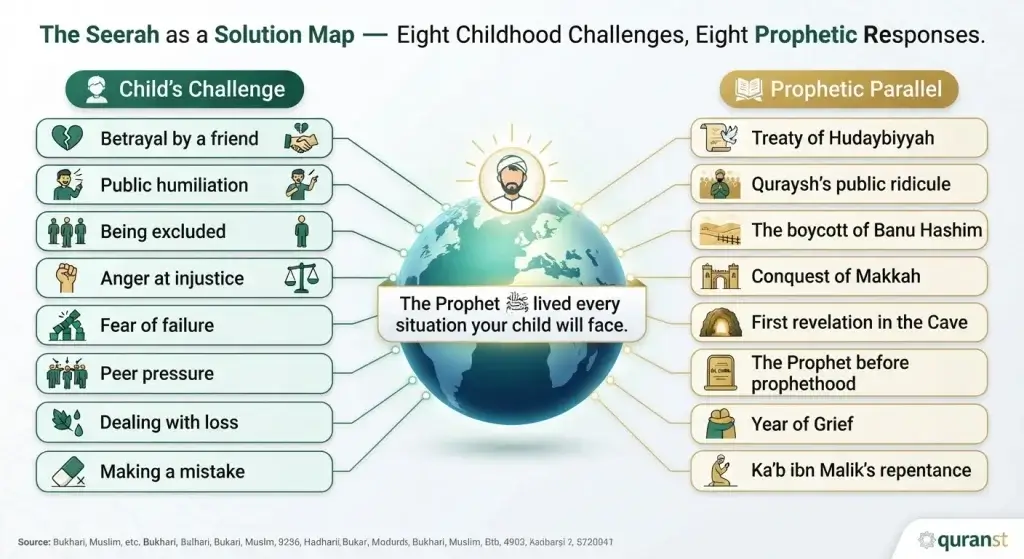
The Quranic Command to Follow His Example
Before the practical framework, the theological foundation — because the parent who understands why the Seerah is uniquely authoritative as a life curriculum will teach it with a conviction that transforms how the child receives it.
Allah did not simply send a message. He sent a messenger who lived the message — in every possible human situation — so that every human being who came after could see, in documented detail, what the message looks like in practice.
لَّقَدْ كَانَ لَكُمْ فِي رَسُولِ اللَّهِ أُسْوَةٌ حَسَنَةٌ لِّمَن كَانَ يَرْجُو اللَّهَ وَالْيَوْمَ الْآخِرَ وَذَكَرَ اللَّهَ كَثِيرًا
“There has certainly been for you in the Messenger of Allah an excellent example — for whoever hopes for Allah and the Last Day and remembers Allah often.”
— Quran 33:21
The word uswah (example) is not passive. In classical Arabic, it carries the meaning of a model to be actively followed — not merely admired from a distance.
Aisha (may Allah be pleased with her) — the most knowledgeable person about the Prophet’s ﷺ daily life — described the nature of this living example with the most concise possible precision:
“His character was the Quran.”
— Sahih Muslim, Hadith 746
The Quran’s values — patience, justice, mercy, forgiveness, courage, gratitude — were not abstract principles in the Prophet’s ﷺ life. They were behaviors. Documented behaviors. In specific situations. With specific outcomes.
That is a life curriculum.
The Seerah of Prophet Muhammad ﷺ is more than just a historical account — it is an entire model of a divinely guided human life covering belief (Aqeedah), worship (Ibadah), character (Akhlaq), social behavior (Mu’amalat), leadership, governance, patience, justice, and mercy.
Section 1: Why Children Need a Hero They Can Learn From — Not Just Admire
There is a distinction in child psychology between a hero and a role model — and it matters enormously for how we teach the Seerah.
A hero is someone whose achievements inspire admiration from a distance — too extraordinary to emulate. A role model is someone whose responses — not just their outcomes — provide a template for the child’s own life. The role model says: “When I faced what you are facing, this is what I did.”
The Prophet ﷺ is not merely Islam’s hero. He is Islam’s role model — deliberately, explicitly, by Quranic designation. And this distinction transforms how the Seerah should be taught to children.
Authentic Seerah learning helps students see how Islam was lived in reality, offering guidance on patience, resilience, justice, and compassion through the Prophet’s ﷺ example.
The child who learns the Seerah as a series of impressive historical events learns to admire the Prophet ﷺ. That is valuable. But the child who learns the Seerah as a series of situations and responses — what did he do when he was rejected? When he was betrayed? When he was afraid? When he succeeded beyond expectation? — learns to model the Prophet ﷺ.
Modeling produces behavior change. Admiration produces emotional warmth. Both matter. But only one of them helps a child navigate the friend who broke their trust on a Tuesday afternoon.
Section 2: Eight Real Childhood Challenges — Eight Prophetic Solutions
These are real situations drawn from the documented Seerah — paired with real challenges Muslim children face in the modern world. Each pairing includes the specific hadith or Seerah narration, the classical source, and a practical script for presenting it to a child.
Challenge 1: Betrayal by a Friend
The child’s situation: A close friend shared their secret. Broke a confidence. Turned against them socially. The specific pain of trust violated by someone they chose to trust.
The Seerah parallel — The Treaty of Hudaybiyyah (Year 6 AH)
The Prophet ﷺ had traveled with 1,400 Companions to perform Umrah in peace. Quraysh stopped them and demanded a treaty the Companions found deeply unjust — including a clause that Muslims who fled to Madinah would be returned, while Quraysh who fled to Makkah would not.
Umar ibn al-Khattab (may Allah be pleased with him) was furious. He said: “Are you not Allah’s Messenger? Are we not Muslims? Are they not pagans? Why should we accept this humiliation?” (Sahih al-Bukhari, Hadith 2731–2732)
The Prophet ﷺ accepted the treaty without anger, with full tawakkul in Allah. And then Allah revealed:
إِنَّا فَتَحْنَا لَكَ فَتْحًا مُّبِينًا
“Indeed, We have given you a clear conquest.”
— Quran 48:1
Within two years, the treaty had paved the direct path to the conquest of Makkah.
What to say to your child: “When someone treats you unfairly — even someone you trusted — you can react from anger, which often makes things worse. Or you can respond with trust in Allah, which often produces outcomes you could not have predicted. The Prophet ﷺ accepted what seemed like humiliation. Two years later, Allah called it a clear victory. The betrayal that feels like your worst moment might be the beginning of something you cannot see yet.”
Challenge 2: Public Humiliation
The child’s situation: Laughed at in class. Corrected in front of everyone. The specific sting of being made small in public.
The Seerah parallel — Quraysh’s Public Ridicule (Early Makkan Period)
For thirteen years, the Prophet ﷺ was publicly mocked, called a madman, a poet, a sorcerer — in front of the entire city of Makkah. Abu Lahab would follow him through the streets publicly contradicting everything he said. Allah documented this and responded:
وَلَقَدْ نَعْلَمُ أَنَّكَ يَضِيقُ صَدْرُكَ بِمَا يَقُولُونَ ﴿٩٧﴾ فَسَبِّحْ بِحَمْدِ رَبِّكَ وَكُن مِّنَ السَّاجِدِينَ
“We certainly know that your chest is tight from what they say. So glorify the praises of your Lord and be of those who prostrate.”
— Quran 15:97–98
The Prophet ﷺ did not respond to mockery with counter-mockery. He increased his connection with Allah and continued his mission.
What to say to your child: “The people who laughed at you — Allah knows. He told the Prophet ﷺ — whose entire city mocked him — that He knew what they were saying. And His advice was: come back to Me. Then keep going. The same Allah who comforted the Prophet ﷺ knows what that classroom felt like for you today.”
Challenge 3: Being Excluded and Left Out
The child’s situation: Every lunch, every group project, every social gathering — on the outside. Not rejected dramatically, but simply not included.
The Seerah parallel — The Boycott of Banu Hashim (Years 7–10 AH)
For three years, the Prophet ﷺ and his entire clan were confined to a valley outside Makkah, cut off from all commerce and social contact. Children cried from hunger. Adults ate leaves. The entire society withdrew from them.
And in this isolation, the Prophet ﷺ continued to pray, to recite Quran, to teach, to maintain the inner life of his community — even while the outer world had cut them off entirely. The community that emerged from the boycott was the most tightly bonded in the history of Islam.
What to say to your child: “The Prophet ﷺ and his entire family were excluded from their society for three years — not from one lunch table, but from an entire city. And they emerged more bonded than any community in history. Sometimes the people who leave you out are inadvertently showing you who your real people are.”
Challenge 4: Anger at Genuine Injustice
The child’s situation: Something genuinely unfair happened — and the anger is real because the injustice is real.
The Seerah parallel — The Conquest of Makkah
The Prophet ﷺ entered Makkah at the head of ten thousand Muslims — having been expelled from that city, having watched his companions tortured, having seen Sumayyah killed with a spear, having lived through the boycott, the Year of Grief, and Ta’if.
He had the power to act on thirteen years of accumulated injustice.
He stood at the door of the Kaaba and said:
“O people of Quraysh! What do you think I will do to you?” They said: “You are a generous brother and the son of a generous brother.” He said: “Go, for you are free.”
— Ibn Hisham, Al-Sirah al-Nabawiyyah, 4/55; Al-Bayhaqi, Al-Sunan al-Kubra
What to say to your child: “You have every right to feel angry when something unfair happens. The Prophet ﷺ had more reasons to be angry than you or I could imagine. But anger is energy — and the question is what you do with it. You can be angry, name the injustice, address it calmly. What you cannot do — without losing part of yourself — is let it become bitterness. The Prophet ﷺ chose freedom for his enemies. That freedom was as much for him as it was for them.”
Challenge 5: Fear and Self-Doubt
The child’s situation: The exam is coming. The tryout is tomorrow. The presentation terrifies them. Fear of not being enough.
The Seerah parallel — The First Revelation (Year 1 of Prophethood)
When Jibril first appeared in the Cave of Hira and commanded “Iqra'” (Read!), the Prophet ﷺ responded:
“Ma ana bi-qari'” — “I am not one who reads.”
— Sahih al-Bukhari, Hadith 3
He fled from the cave trembling, went home to Khadijah (may Allah be pleased with her), and said: “Cover me! Cover me!” — and “I fear for myself.”
The greatest human being who ever lived began his prophethood by saying: “I cannot do this.” And trembling. And needing to be held.
What to say to your child: “The night the Prophet ﷺ received his first revelation — the night that changed the history of humanity — he ran home terrified and said ‘I am not capable of this.’ He trembled. He needed to be covered. You are allowed to be afraid. The Prophet ﷺ was afraid. What matters is what you do after the trembling.”
Challenge 6: Peer Pressure
The child’s situation: Their friend group is doing something wrong. The pressure of “everyone else is doing it” is real and heavy.
The Seerah parallel — The Prophet ﷺ Before Prophethood
In the Jahiliyyah, the Prophet ﷺ lived in a society that practiced idol worship, drank alcohol, and buried female infants alive. “Everyone” was doing all of these things.
Guided only by the fitrah Allah placed in him, the Prophet ﷺ never participated in any of it. He was known as Al-Amin (The Trustworthy) and Al-Sadiq (The Truthful) — specifically because he was different from everyone around him.
He later said:
“Be in the world as a stranger.”
— Sahih al-Bukhari, Hadith 6416
What to say to your child: “Before he was even a prophet, the Prophet ﷺ was different from everyone around him — in a society where being different had a real social cost. He was called Al-Amin not because everyone else was honest, but because he was honest when everyone else was not. Your willingness to be different from the group when the group is wrong — that is the quality that earned the Prophet ﷺ his title.”
Challenge 7: Grief and Loss
The child’s situation: A grandparent died. A pet died. A friendship ended in a way that felt final. The weight of losing something that cannot be recovered.
The Seerah parallel — The Year of Grief (Year 10 of Prophethood)
In the space of weeks, the Prophet ﷺ lost Khadijah (his wife of twenty-five years, the first Muslim, the one who held him through every early fear) and Abu Talib (his uncle and protector). He named that year Aam al-Huzn — The Year of Grief.
He did not minimize the grief. He named it. He wept. And years later, when Khadijah’s sister visited, the Prophet ﷺ stood and welcomed her — weeping — saying:
“She used to believe in me when others disbelieved, and she affirmed my truth when others rejected me…”
— Sahih al-Bukhari, Hadith 3821; Sahih Muslim, Hadith 2435
What to say to your child: “The Prophet ﷺ named his year of grief. He wept. He talked about the people he loved years later with the same specific memories. Islam does not ask you to pretend loss is not painful. It asks you to feel it fully — and then trust that the One who allows loss also provides what comes after it. The Prophet ﷺ emerged from his Year of Grief and was taken on the Night of Isra and Mi’raj. Loss is real. What follows it is also real.”
Challenge 8: Making a Mistake and Not Knowing How to Repair It
The child’s situation: They did something wrong. They hurt someone. And now the weight of it sits on them and they do not know how to come back.
The Seerah parallel — Ka’b ibn Malik and the Best Day of His Life
Ka’b ibn Malik (may Allah be pleased with him) did not join the Prophet ﷺ in the Battle of Tabuk without a legitimate excuse — and then lied about his reason when asked. The Prophet ﷺ ordered the community to cut off social contact with him for fifty days.
At the end of fifty days, Allah revealed his forgiveness:
وَعَلَى الثَّلَاثَةِ الَّذِينَ خُلِّفُوا حَتَّىٰ إِذَا ضَاقَتْ عَلَيْهِمُ الْأَرْضُ بِمَا رَحُبَتْ
“And upon the three who were left behind — until the earth, vast as it is, straitened for them…”
— Quran 9:118
Ka’b ibn Malik said of the day he received the news of his forgiveness:
“I have never experienced a better day than the day Allah accepted my repentance.”
— Sahih al-Bukhari, Hadith 4418
What to say to your child: “Ka’b ibn Malik made a serious mistake — and he didn’t hide it or explain it away. He told the truth when the truth was costly. And he waited. Fifty days of everyone cutting contact. And then Allah’s forgiveness came — and he said it was the best day of his life. Tell the truth about what you did. Make what repair you can. The day the repair comes — if you have been honest — might be the best day you can remember too.”
Section 3: How to Present the Seerah So Children Actually Absorb It
Knowing the Seerah stories is necessary but not sufficient. The delivery determines whether the story becomes a living resource or a filed-away fact.
The Three-Moment Method
The most effective moment to deliver a Seerah lesson is in the three minutes immediately after the child presents their challenge — while the emotion is still present and the need is still felt.
Moment 1 — Listen and Validate: Before the Seerah, the emotion. “That sounds really painful. It makes sense that you feel that way.” The child who feels heard is the child who can receive a lesson.
Moment 2 — The Pivot: “Can I tell you about something the Prophet ﷺ did when something like this happened to him?” Not a lecture. A story. An offer.
Moment 3 — The Application Question: After the story: “What do you think he felt in that moment? What could you do that’s a bit like what he did?” The child who generates their own application has internalized it far more deeply than the one who receives it pre-packaged.
Age-Appropriate Entry Points
| Age | What Works | Example |
|---|---|---|
| 5–8 | Simple story + one feeling | “The Prophet ﷺ was also left out once. Want to hear?” |
| 9–12 | Story + context + one question | “What do you think the Prophet ﷺ was feeling when they said that?” |
| 13+ | Story + full context + open discussion | “Let’s talk about Hudaybiyyah and what’s happening with your situation” |
What to Avoid
Do not use the Seerah as a shame-based comparison: “The Prophet ﷺ would never have gotten angry like that” is not a Seerah lesson — it is an accusation.
Do not skip straight to the lesson before the emotion has been honored.
Do not sanitize the Prophet’s ﷺ humanity into heroic composure. The trembling in the cave, the tears over Ibrahim, the grief of the Year of Grief — these are the elements that make the Seerah relatable, not just admirable.
Section 4: The Seerah and Emotional Intelligence
One of the most underappreciated dimensions of the Seerah as a life curriculum is what it models about emotions — specifically, that a person of the highest character does not transcend emotion but relates to emotion with wisdom.
The Prophet ﷺ wept. Over the death of his son Ibrahim. Over the body of Sa’d ibn Mu’adh. Over the graves of believers. The Companions noted it. It was recorded.
“The eyes shed tears and the heart grieves, and we only say what pleases our Lord. O Ibrahim, we are grieved by your parting.”
— Sahih al-Bukhari, Hadith 1303
He felt joy — genuine, expressed joy. He raced with Aisha. He played with Hasan and Husayn. He smiled so consistently that the Companions described his smile as a defining feature of his presence.
(cite index=”9-1″>Core attributes highlighted in Hadith literature: truthfulness (Sidq), trustworthiness (Amanah), patience (Sabr), gratitude (Shukr), and forgiveness. His personality was the Quran — the living embodiment of its values in every emotional register.</cite>
For Muslim children navigating a world that often treats emotional expression as weakness — particularly Muslim boys in cultures that discourage male emotional expression — the Seerah is both a corrective and a permission:
You are allowed to feel. The Prophet ﷺ felt. Feeling is not weakness. It is being human. The question is what you do with what you feel.
Section 5: From Story to Strategy — The Three-Step Weekly Method
For families who want to build the Seerah as a proactive framework — not just using it reactively in crisis moments:
Step 1: The Weekly Seerah Situation
Each week at the family table, introduce one Seerah situation — not the full biographical context, but the specific moment of challenge:
“This week’s situation: The Prophet ﷺ went to Ta’if after the worst year of his life, and the people threw stones at him until his sandals were soaked in blood. What do you think he did next?”
Let the children guess. Then reveal — the du’a of Ta’if, the Angel of the Mountains, the response about the children of Quraysh. Then ask: “Has anything like that ever happened to you? Going somewhere for help and being turned away?”
Step 2: The Weekly Application Challenge
After the story, issue a specific behavioral challenge for the week:
“This week, when something doesn’t go the way you wanted, your challenge is to wait twenty-four hours before deciding it’s a failure. That’s what the Prophet ﷺ did at Hudaybiyyah — and within two years, Allah called it a clear victory.”
Step 3: The Friday Review
At the end of the week, revisit:
“Did you have a chance to try the Hudaybiyyah patience this week? What happened?”
The child who reports back — whether it succeeded or failed — has processed a Seerah lesson at the deepest available level: personal application and reflection.
A strong Seerah curriculum explains the context behind major events — the early struggles in Makkah, the migration to Madinah, the establishment of the first Muslim community — helping students see how Islam was lived in reality.
Structured Curriculum Framework
quranst’s Islamic Studies curriculum teaches the Seerah as this kind of living framework — connecting every story to the child’s real challenges, every lesson to their emotional development, every situation to the character qualities that Islamic education aims to build.
Book your free 2-session trial →Conclusion: The Best Answer Is Always Already There
The next time your child comes home carrying a problem — and they will, because that is what growing up is — you have something most parents in the world do not have.
A fourteen-century-old record of a human being who was told by Allah to be the model — who was tested with betrayal, exclusion, public humiliation, grief, fear, anger, and loss — and who navigated all of it with documented wisdom, documented patience, and documented humanity.
The answer to your child’s problem is already there.
Not as a command. Not as a shame-based comparison. As a story. As a parallel. As a fellow human being who felt what they are feeling and chose how to respond — whose choice was so wise that Allah preserved it in an authenticated, transmitted, unbroken chain across fourteen centuries to this moment, in your kitchen, after school.
Tell them the story.
Ask them the question.
Watch the Seerah become not a subject they study, but a resource they live.
لَّقَدْ كَانَ لَكُمْ فِي رَسُولِ اللَّهِ أُسْوَةٌ حَسَنَةٌ
“There has certainly been for you in the Messenger of Allah an excellent example.”
— Quran 33:21
The example is there. The life is documented. The situations are yours.
🟢 Learn the Seerah as a Living Curriculum
quranst’s Islamic Studies track delivers the Seerah as a living curriculum:
- The Makkan period — thirteen years of patience, persecution, and character-building
- The Madinan period — leadership, justice, and community in action
- Character modules — specific lessons from specific situations: anger, betrayal, fear, loss, success
- Child-specific application — lessons connected to the challenges Muslim children face in Western schools
- Authenticated sources — Ibn Hisham, Ibn Kathir, Sahih al-Bukhari, Sahih Muslim — no weak narrations
Alongside the Seerah track:
- Islamic studies — Aqeedah, Fiqh, Hadith, and Tafsir in a coherent curriculum
- Study Islam online — flexible scheduling around your family’s school week
- Hadith — foundational narrations memorized with context and application
- Learn Arabic — the language of the Seerah, accessed directly through our Arabic Language track
- Learn Quran — the Quran the Prophet ﷺ lived and embodied
👇 Begin with Two Free Sessions
Two Ways to Begin
“His character was the Quran.”
— Aisha (may Allah be pleased with her), Sahih Muslim, Hadith 746
The Quran as character. The character as curriculum. The curriculum as your child’s life.
بِسْمِ اللَّهِ — Begin.
References and Sources
Quranic References
- Quran 9:118 — The three who were left behind and their repentance
- Quran 15:97–98 — “Your chest is tight — prostrate to your Lord”
- Quran 33:21 — “An excellent example in the Messenger of Allah”
- Quran 48:1 — “Indeed, We have given you a clear conquest”
- Quran 68:4 — “And indeed, you are of a great moral character”
Hadith References
- Sahih al-Bukhari, Hadith 3 — First revelation and the Prophet’s fear
- Sahih al-Bukhari, Hadith 1303 — “The eyes shed tears” on the death of Ibrahim
- Sahih al-Bukhari, Hadith 2731–2732 — Umar’s reaction to Hudaybiyyah
- Sahih al-Bukhari, Hadith 3821; Sahih Muslim, Hadith 2435 — Prophet ﷺ on Khadijah
- Sahih al-Bukhari, Hadith 4418 — Ka’b ibn Malik and the best day of his life
- Sahih al-Bukhari, Hadith 6416 — “Be in the world as a stranger”
- Sahih Muslim, Hadith 746 — “His character was the Quran”
Classical Seerah Sources
- Ibn Hisham: Al-Sirah al-Nabawiyyah, Vol. 4, p. 55 (Conquest of Makkah — “Go, for you are free”)
- Ibn Kathir: Al-Bidaya wa al-Nihaya (Seerah narrations)
- Al-Bayhaqi: Al-Sunan al-Kubra (Conquest declaration)
- Al-Mubarakfuri: Al-Rahiq al-Makhtum (The Sealed Nectar)
Contemporary Sources
- IqraNetwork.com (January 2026). “Where Can I Find Reliable Online Lessons on the Seerah?” Key findings: Authentic Seerah learning built on Ibn Hisham, Ibn Kathir, and authenticated Hadith; guidance on patience, resilience, justice, and compassion through the Prophet’s ﷺ example.
- AlQuranDesk.com (February 2026). “Powerful Lessons from the Life of Prophet Muhammad (PBUH).” Key findings: Seerah as complete model — Aqeedah, Ibadah, Akhlaq, Mu’amalat; core attributes: Sidq, Amanah, Sabr, Shukr, forgiveness; “his character was the Quran.”
Frequently Asked Questions
Why is the Seerah essential as a life curriculum for Muslim children?
How can parents present the Seerah so children actually absorb it?
- Listen and Validate: Honor the child’s emotion immediately after they face a challenge.
- The Pivot: Offer a parallel Seerah story naturally without lecturing.
- The Application Question: Ask open-ended questions like “What do you think he felt?” or “How can you respond like him?” to let the child internalize the lesson.

Pingback: Islamic Ethics in Action: A Complete Plan for Turning Moral Concepts into Your Child's Daily Behaviors - Quranst