

Introduction: Play Is Not the Opposite of Learning. It Is Its Best Form.
Watch a four-year-old pretend to be a shopkeeper.
They are not playing. They are calculating change, negotiating prices, deciding what is fair, managing disappointment when a customer says no, and experiencing the satisfaction of a completed transaction — all in the space of fifteen minutes.
Watch a seven-year-old and their siblings fight over whether a game rule was followed correctly.
They are not arguing. They are developing moral reasoning, learning to articulate a position under social pressure, experiencing the difference between what is technically permitted and what is genuinely fair — and figuring out how communities make decisions when people disagree.
Watch a ten-year-old quietly hand their last cookie to a sibling who is upset.
They are not giving away a cookie. They are practicing generosity — the specific emotional and behavioral act of choosing another person’s need over their own desire — in a moment of genuine cost.
This is what play is. This is what it has always been.
Children absorb spiritual concepts most naturally between ages 3 and 12, when their brains actively form identity markers and moral reasoning patterns. Research from educational psychology shows that early religious education correlates with stronger ethical development and community belonging throughout adolescence and adulthood.
Play enhances social competence and moral reasoning — confirmed by research from Bronikowska et al. (2024). Early exposure to community values through play helps children develop strong social bonds and a sense of responsibility towards others.
This guide gives you 50 specific, practical, home-ready activities — seven for each of seven core Islamic values — that connect your child to Islamic ethics through the most powerful learning medium available to them: play.
Each activity is:
- Grounded in an authentic hadith or Quranic verse
- Practical — requiring no special equipment or preparation
- Age-adapted — with notes on the best developmental window
- Explicitly connected to the Islamic value it teaches — so the child knows what they are practicing
Because the child who plays with Islamic values grows into the adult who lives them.
Structured Curriculum Framework
quranst’s Islamic Studies and Smart Parenting tracks complement home play-based learning with structured, live instruction — connecting every value your child practices at home to its Quranic foundation, Hadith context, and prophetic example.
Book your free 2-session trial →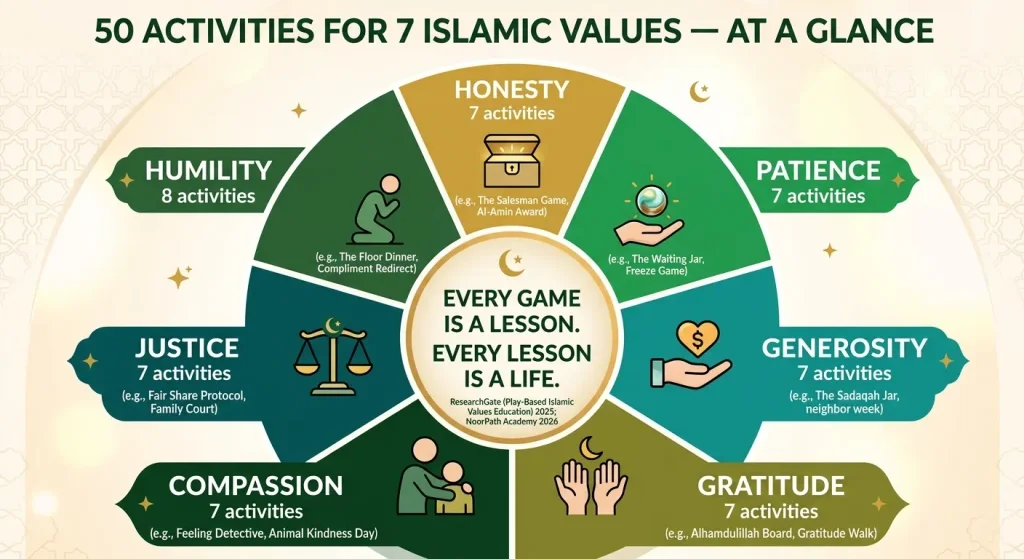
The Research: Why Play-Based Islamic Learning Works {#research}
A 2025 study published on ResearchGate examining play-based learning as a pedagogical approach for Islamic values in early childhood education found that play-based methods are among the most effective for transmitting Islamic values. The study identified storytelling, role-playing, and structured games as particularly powerful vehicles — engaging children emotionally and cognitively in ways that abstract instruction cannot match.
Research published in 2026 on Islamic game-based moral education confirmed that when moral teachings are embedded in gameplay mechanics — through challenges, collectibles, narrative progression, and rewards — rather than being presented in a didactic or instructional manner, children demonstrate both deeper cognitive engagement and stronger moral reflection. Game-based approaches support self-regulation and resilience, which are essential components of character formation.
The mechanism is developmental. During play, children:
- Practice behaviors without the stakes of real consequence — they can try being generous, being honest under pressure, choosing justice over comfort, in a context where failure is safe
- Experience the emotions of virtue — the genuine satisfaction of being kind, the internal discomfort of lying even in a game, the warmth of receiving gratitude
- Repeat behaviors until they become habits — the same scenario played dozens of times builds the behavioral groove that eventually becomes automatic character
Islamic education should develop the whole person, preparing them to navigate the complexities of life while adhering to Islamic principles. This philosophy emphasises the importance of character building alongside academic achievement.
The Prophet ﷺ understood this instinctively — and his own engagement with children and play is one of the most instructive elements of his Seerah.
The Prophetic Foundation: The Prophet ﷺ at Play
The Prophet ﷺ did not merely tolerate play. He participated in it — with genuine joy, with full presence, with the kind of undivided attention that children remember for a lifetime.
He raced with Aisha (may Allah be pleased with her):
“I raced with the Prophet ﷺ and I outran him. Then when I had put on weight, I raced with him again and he outran me. He said: ‘This is for that race.'”
— Sunan Abu Dawud, Hadith 2578; authenticated by al-Albani
He played with Hasan and Husayn (may Allah be pleased with them):
“The Prophet ﷺ would put out his tongue for al-Hasan ibn Ali and the boy would see its redness and come to him.”
— Sahih al-Bukhari, Hadith 6002 (narrated by Abu Hurayrah)
He honored children’s play:
“When the Prophet ﷺ passed by a group of boys playing and laughing, he did not scold them or silence them. He smiled at them.”
— Narrated in classical biographical sources
And he specifically described how play and delight are part of the believer’s nature:
“Entertain the hearts from time to time, for when the heart becomes tired it goes blind.”
— Attributed to Ali ibn Abi Talib; widely cited in classical Islamic scholarship
The prophetic model is unambiguous: play is not a distraction from Islamic development. It is one of its primary vehicles.
How to Use This Guide
Before each activity:
- Connect the activity to its Islamic value explicitly: “We’re going to play a game that practices [value]. The Prophet ﷺ said [relevant hadith].”
- Keep the connection brief — one sentence, maximum two. Children do not need a lecture. They need a hook.
During the activity:
- Observe, but do not over-correct. The child who makes the “wrong” moral choice in a game is learning more from that experience and its consequences than from being stopped and redirected.
- Name what you see: “I noticed you chose to share even when you didn’t have to. That’s generosity.”
After the activity:
- One question, maximum: “How did it feel when you [chose the honest answer / shared / waited patiently]?”
- The child who articulates the feeling of virtue is building the internal emotional reward system that makes virtue self-sustaining.
Age notes throughout this guide:
- 🟢 = Best for ages 3–7
- 🟡 = Best for ages 7–12
- 🔴 = Best for ages 10–16
VALUE 1: Honesty (Al-Sidq) — 7 Activities
The Foundation:
“Be truthful — for indeed, truthfulness leads to righteousness, and righteousness leads to Paradise.” — Sahih al-Bukhari, Hadith 6094; Sahih Muslim, Hadith 2607
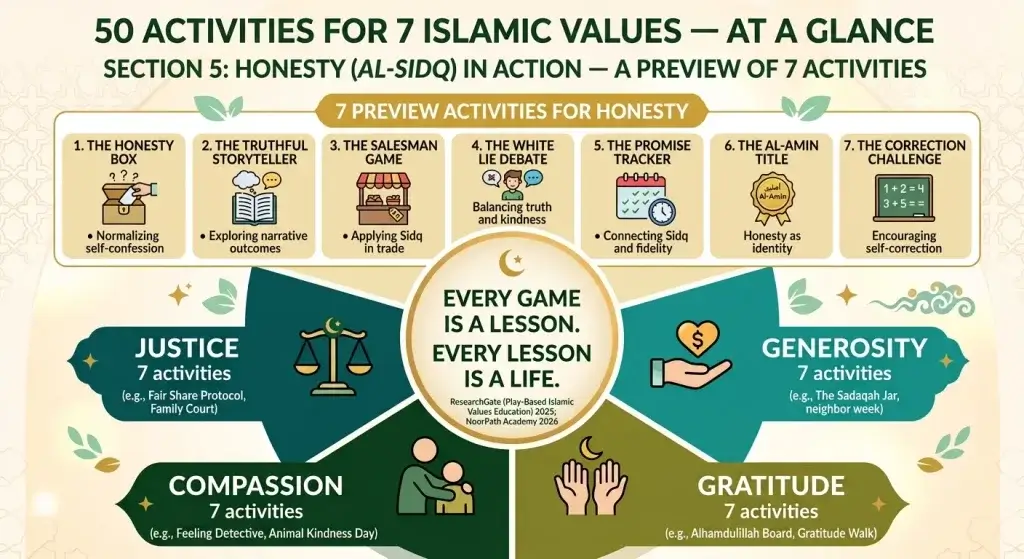
Activity 1: The Honesty Box 🟢 Place a decorated box in a visible location. Each day, anyone in the family can anonymously put a note inside confessing a small mistake they made. At Friday dinner, someone draws a note and the family discusses — without judgment — what they would do in that situation. Value taught: Creating a safe environment for honesty; normalizing confession without shame.
Activity 2: The Truthful Storyteller 🟢🟡 Tell a short story about a character who faces the choice to lie or tell the truth. Stop at the decision point and ask the child to finish the story — both versions. Then discuss: “Which ending felt better to you? Why?” Value taught: Exploring the consequences of honesty and dishonesty in a safe, narrative context.
Activity 3: The Salesman Game 🟡 Set up a pretend market with objects from around the house. One player is the seller, one the buyer. The seller must describe each item honestly — including its flaws. The buyer must decide whether to buy based only on the honest description. Value taught: Honesty in commerce; the hadith about the seller and buyer who are honest being blessed. (Sahih al-Bukhari, Hadith 2079)
Activity 4: The White Lie Debate 🔴 Present a scenario: “Your grandmother cooked a meal that isn’t very good. She asks if you liked it. What do you say?” Debate as a family — what is the Islamic balance between honesty and kindness? Explore the concept of tawriyah (indirect truthful statement) from classical Fiqh. Value taught: The nuance of honesty; that Islam values both truth and compassion, not brutality in the name of honesty.
Activity 5: The Promise Tracker 🟡 For one week, every family member tracks every promise they make — in a notebook or on a wall chart. At the end of the week: how many were kept? The Prophet ﷺ said: “Three characteristics are those of a hypocrite… when he makes a promise, he breaks it.” (Sahih al-Bukhari, Hadith 33) Value taught: The connection between honesty and promise-keeping; the hadith on the signs of the hypocrite.
Activity 6: The Al-Amin Title 🟢🟡 Introduce the title Al-Amin (the trustworthy) that the Prophet ﷺ earned before prophethood. Each week, the family votes to give the “Al-Amin Award” to the family member who demonstrated the most consistent honesty that week. Write the name on a certificate and post it visibly. Value taught: Honesty as identity, not just behavior; the prophetic example of earned trustworthiness.
Activity 7: The Correction Challenge 🟡🔴 During any board game or family activity, introduce a “correction round” — anyone who notices and corrects their own mistake (even when it costs them points or advantage) earns a bonus. The person who catches their own error and reports it gets more reward than the person who waits to be caught. Value taught: Self-correction as a form of honesty; the internal compass of Sidq.
VALUE 2: Patience (Al-Sabr) — 7 Activities
The Foundation:
“No one is given a gift better and more comprehensive than patience.” — Sahih al-Bukhari, Hadith 1469; Sahih Muslim, Hadith 1053
Activity 8: The Waiting Jar 🟢 Every time a child waits patiently (for food, for their turn, for something they want), they put a marble in a jar. When the jar is full, they receive a reward of their choosing. The visible, accumulating marbles make patience tangible and motivating. Value taught: Patience as an accumulating virtue with real reward — mirroring the Quranic promise.
Activity 9: The Slow Build 🟡 Begin a multi-week craft or building project together — something genuinely complex that cannot be completed in one session. A puzzle with 500+ pieces. A birdhouse. A model. Check in weekly. The value is in the sustained engagement over weeks, not the completion. Value taught: Long-term patience; the understanding that great things require sustained effort.
Activity 10: The Freeze Game — Islamic Version 🟢 Play musical chairs or freeze dance — but with a twist. When the music stops, instead of the standard freeze, the child must recite a du’a for patience: “Allahumma inni as’aluka al-sabr” (O Allah, I ask You for patience). Only when recited correctly can they continue. Value taught: Patience + du’a as connected practices; turning play into Dhikr.
Activity 11: The Hunger Hour 🟡🔴 On a non-fasting day, agree as a family to delay a meal by one hour (age-appropriate — not for young children). During the hour, discuss: “This is a tiny taste of Ramadan fasting. What does the body feel? What does the mind do? How do you keep going?” Value taught: Embodied experience of Sabr; connection to Ramadan and the Quranic praise of the patient.
Activity 12: The Sabr Story Hour 🟢🟡 Each week, tell one Seerah story focused on patience — the boycott, the Ta’if incident, the years in Makkah. Follow it with: “That was years of patience. What do you think kept the Prophet ﷺ going?” Value taught: Patience as sustained orientation, not just momentary restraint.
Activity 13: The Pause Button Game 🟡🔴 When conflict arises between siblings (or during a game), any family member can call “Pause Button.” Everyone stops, takes three breaths, and the person who called it gets thirty seconds to say how they feel without interruption. This game regularizes the pause before reaction. Value taught: Emotional patience — the specific Sabr of not reacting immediately from anger. (Sahih al-Bukhari, Hadith 6116 — “Do not be angry”)
Activity 14: The Long Game 🔴 Introduce a family challenge that takes a full month — a physical challenge, an Arabic memorization goal, a Quran review target. Track progress weekly. Celebrate the endurance, not just the completion. Value taught: Patience as the foundation of achievement; the hadith on the most beloved deeds being consistent ones. (Sahih al-Bukhari, Hadith 6465)
VALUE 3: Generosity (Al-Karam) — 7 Activities
“The upper hand (giving) is better than the lower hand (receiving).” — Sahih al-Bukhari, Hadith 1427; Sahih Muslim, Hadith 1033
Activity 15: The Sadaqah Jar 🟢🟡 Each family member has a jar. When they do a chore, behave well, or choose generosity unprompted, they receive a coin for their jar. At the end of the month, each person decides where to donate their jar — a charity, a cause, a person in need. Value taught: Generosity as a habit connected to personal choice and personal giving.
Activity 16: The Last Cookie Challenge 🟢🟡 When a treat is almost finished and only one or two pieces remain, observe (without commenting) what the child does. If they choose to offer it to someone else, name it immediately and warmly: “You just gave away something you wanted. That is Karam — generosity. The Prophet ﷺ said the generous person is close to Allah and close to Paradise.” Value taught: Generosity at personal cost — the highest form.
Activity 17: The Giving Box 🟢🟡 Each month, every family member selects three items from their belongings to give to those who need them. The items must be things they genuinely like — not things they would have discarded anyway. Discuss: “Does it feel different to give something you actually want to keep?” Value taught: Generosity as sacrifice, not surplus-disposal; the Quranic principle: “You will not attain righteousness until you spend from what you love.” (Quran 3:92)
Activity 18: The Neighbor Week 🟡🔴 For one week, the family collectively performs one act of service for a neighbor — delivering food, helping with a task, sending a gift. The child is the primary actor in choosing and delivering the act. Value taught: Generosity to the community; the hadith about the neighbor’s rights. (Sahih al-Bukhari, Hadith 6015)
Activity 19: The Time Gift 🟡🔴 Introduce the concept that time is the most generous gift. Each week, the child commits to giving one hour of their own free time to someone else — a younger sibling, a parent, an elderly relative via video call. Value taught: Generosity of time — the form of giving that costs the most and is most valued.
Activity 20: The Prophet’s Generosity Story Hour 🟢🟡 Weekly: Tell the story of the Prophet ﷺ in the month of Ramadan — Ibn Abbas narrated: “The Prophet ﷺ was the most generous of people, and he was most generous in Ramadan.” (Sahih al-Bukhari, Hadith 6) Ask: “What do you think made him so generous? What did he feel when he gave?” Value taught: Generosity as a prophetic character trait; Ramadan generosity as annual renewal.
Activity 21: The Generosity Journal 🟡🔴 Keep a family journal for one month. Each evening, everyone writes (or dictates) one act of generosity they witnessed — either giving or receiving. Read entries aloud weekly. The child who begins to notice generosity around them has developed a capacity that is the prerequisite for practicing it. Value taught: Awareness of generosity as a prerequisite for practicing it; the Shukr-Karam connection.
VALUE 4: Gratitude (Al-Shukr) — 7 Activities
The Foundation:
“Whoever does not thank people does not thank Allah.” — Sunan Abu Dawud, Hadith 4811; authenticated by al-Albani
Activity 22: The Alhamdulillah Board 🟢🟡 On a whiteboard or large paper on the wall, every family member adds one thing they are grateful for each morning — written or drawn. Read them together at dinner. After one week, look at the accumulation: “Look at all the blessings in our home.” Value taught: Gratitude as an observable, named daily practice; the Quranic promise: “If you are grateful, I will give you more.” (Quran 14:7)
Activity 23: The Gratitude Walk 🟢🟡 A weekly family walk with one rule: for the duration of the walk, name everything you are grateful for that you see, hear, or experience. The tree. The rain. The ability to walk. The color of the sky. Value taught: Gratitude for created beauty; the Quranic invitation to “travel through the land and observe.” (Quran 6:11)
Activity 24: The Thank You Mission 🟡🔴 Each week, the child writes (or creates) a specific, personal thank-you for one person in their life — a teacher, a grandparent, a friend. The thank-you must name something specific: “Thank you for [exact thing you did] because it made me feel [exact feeling].” Value taught: Specific, named gratitude to people — the prophetic connection between thanking people and thanking Allah.
Activity 25: The Before-and-After Blessing Hunt 🟡 At dinner, ask: “What would today have been like without [one specific blessing — electricity, eyesight, your hands, your sibling]?” Take turns imagining the day without that blessing, then naming why you are grateful for it. Value taught: Gratitude through imaginative contrast — the most powerful form of Shukr awareness.
Activity 26: The Du’a Discovery Game 🟢🟡 Introduce the concept that every daily act has an Islamic du’a attached to it — waking up, eating, drinking, dressing, entering the home. The game: who can spot the most du’a opportunities in a single day? Award points for each du’a said correctly at the right moment. Value taught: Gratitude as the texture of daily life; Islamic du’a as the formalized expression of Shukr.
Activity 27: The Blessing Reverse Game 🟡🔴 List five things your family has that they take for granted. Research together: “What percentage of the world’s population does not have access to clean water? To education? To a home?” Then: “What does Alhamdulillah mean for us, right now, in this home?” Value taught: Gratitude grounded in global awareness; Shukr as a response to real understanding of privilege.
Activity 28: The Shukr Circle 🟢🟡🔴 At the end of every family gathering — dinner, Friday evening, a celebration — go around the circle. Every person names one thing they are grateful for from that day. No repeats. No “pass” option. Build it as the family closing ritual. Value taught: Gratitude as communal practice; the normalization of expressing thankfulness verbally in community.
VALUE 5: Compassion (Al-Rahmah) — 7 Activities
The Foundation:
“Show mercy to those on earth, and the One above the heavens will show mercy to you.” — Sunan al-Tirmidhi, Hadith 1924; authenticated by al-Albani
Activity 29: The Feeling Detective 🟢🟡 During a book, TV show, or family situation, pause and ask: “How do you think [character/person] is feeling right now? How do you know? What would you do if you were them?” Value taught: Empathy as a developed skill — the cognitive foundation of compassion.
Activity 30: The Comfort Box 🟢🟡 Create a “Comfort Box” together — filled with items chosen by the child (a favorite book, a soft toy, a kind note, a snack) that they would want if they were sad or sick. When a family member is having a hard day, the child offers the box. Value taught: Compassion as preparation — anticipating others’ needs before they are expressed.
Activity 31: The Animal Kindness Day 🟢🟡 The Prophet ﷺ spoke extensively about mercy to animals. Spend a day focused on kindness to animals — filling a bird bath, avoiding stepping on insects, learning about Islamic teachings on animal welfare. (Sahih al-Bukhari, Hadith 2363 — the woman who tied a cat) Value taught: Rahmah extends beyond humans; the Islamic cosmology of mercy as all-encompassing.
Activity 32: The Role-Play Rescue 🟡🔴 Act out scenarios where one character is in need and another must decide how to respond. Rotate roles — the same child plays both the one in need and the one choosing whether to help. After the role-play: “How did it feel to need help? How did it feel to choose to give it?” Value taught: Embodied empathy; the emotional learning that comes from inhabiting both roles.
Activity 33: The Community Compassion Project 🟡🔴 Once a month, the family performs a community service activity together — a food bank, a neighbor in need, a cleanup project. The child is not an observer — they are the primary actor. Value taught: Compassion as action, not just feeling; the transition from empathy to Rahmah in practice.
Activity 34: The “What Would the Prophet ﷺ Do?” Game 🟡🔴 Present real scenarios: “A new student joins the class and has no one to sit with at lunch. What would the Prophet ﷺ do?” Base the answers on specific documented Seerah incidents — the Prophet ﷺ and the woman who used to throw garbage on him, his visit to the sick, his greeting of strangers. Value taught: Compassion modeled through the Seerah; specific prophetic examples as behavioral templates.
Activity 35: The Softness Practice 🟢🟡 When a sibling is crying or upset, the rule is: before anything else, the other children must ask one question: “Are you okay? Do you want me to sit with you?” No solutions, no comfort items — just presence and a question. Practice this in role-play first. Value taught: The compassion of presence before the compassion of solutions; the prophetic quality of being genuinely with people in difficulty.
VALUE 6: Justice (Al-‘Adl) — 7 Activities
The Foundation:
إِنَّ اللَّهَ يَأْمُرُ بِالْعَدْلِ وَالْإِحْسَانِ
“Indeed, Allah commands justice and good conduct.” — Quran 16:90
Activity 36: The Fair Share Protocol 🟢🟡 When dividing anything — food, screen time, family resources — introduce a structured fairness protocol: one person divides, another person chooses first. The divider has a built-in incentive to be genuinely fair. Discuss afterward: “Was that fair? How do you know?” Value taught: Justice as structural design, not just individual intention.
Activity 37: The Family Court 🟡🔴 When a family conflict arises, establish a structured “family court” — each person presents their perspective without interruption, then the family agrees on what is fair. A family member (rotating) serves as the “judge” and must listen to both sides before deciding. Value taught: Justice as a process, not just an outcome; the importance of hearing all sides.
Activity 38: The Wrongly Blamed Game 🟡🔴 Tell a story where a character is wrongly blamed for something. Stop and ask: “What would the just response be from each person in the story? What should the person who made the wrong accusation do?” Connect to the hadith about the Prophet ﷺ and justice even against oneself. Value taught: Justice as including the courage to correct injustice and acknowledge one’s own wrongdoing.
Activity 39: The Equal Treatment Test 🟡🔴 For one week, the family observes and reports: “Did I treat everyone the same today, regardless of how popular or powerful they are?” Report at Friday dinner. The child who can identify moments of unequal treatment — and correct them — has developed genuine ‘Adl awareness. Value taught: Justice as consistency of treatment regardless of social status — the prophetic standard.
Activity 40: The News Justice Discussion 🔴 Once a month, find a news story involving injustice (age-appropriate). Discuss: “What happened? Who was wronged? What would a just response look like? What does Islam say about this kind of situation?” Value taught: Justice as a civic and global value — connected to the Islamic concept of the Muslim as a witness to justice in the world. (Quran 2:143)
Activity 41: The Speak-Up Scenario 🟡🔴 Role-play: a classmate is being left out or mocked. The child can stay silent or speak up. Practice both options. Then: “Which option feels more like a Muslim? What would it cost you to speak up? Is that cost worth it?” Value taught: The courage component of justice — the Prophet ﷺ said: “Help your brother whether he is an oppressor or an oppressed one.” (Sahih al-Bukhari, Hadith 2444)
Activity 42: The Prophet’s Justice Story 🟢🟡🔴 Tell the story of the conquest of Makkah and the Prophet’s ﷺ declaration: “Go, for you are free.” Or the story of his insistence that if his own daughter Fatimah had stolen, he would have applied the law equally. Then: “What does this tell us about what justice means in Islam?” Value taught: Justice as the most demanding form of consistency — applied equally to oneself, to loved ones, to enemies.
VALUE 7: Humility (Al-Tawadu’) — 8 Activities
The Foundation:
“No one humbles themselves for the sake of Allah except that Allah raises them.” — Sahih Muslim, Hadith 2588
Activity 43: The Floor Dinner 🟢🟡 Once a month, eat dinner on the floor — without the table, without chairs. Discuss: “The Prophet ﷺ ate on the floor with his Companions. Why do you think he chose that?” Value taught: Humility as physical practice; the prophetic rejection of status-display in dining.
Activity 44: The Compliment Redirect 🟡🔴 When someone receives a compliment, practice saying: “Alhamdulillah — thank you, but [name someone who helped you] deserves the credit too.” Practice this in role-play until it feels natural. Value taught: Humility in success — the practice of distributing credit generously.
Activity 45: The Apprentice Game 🟡🔴 Each week, a family member teaches the family something they know — a skill, a piece of knowledge, a craft. The rule: everyone must participate as genuine students, including the parent. The parent learning from the child is itself a lesson in humility. Value taught: Humility as openness to learning from anyone; the prophetic principle that wisdom can come from unexpected sources.
Activity 46: The Mistake Museum 🟢🟡 Create a “Mistake Museum” in the home — a space (a wall, a board) where family members can post mistakes they made and what they learned from them. Not current mistakes — past ones, already resolved. The parent starts. Value taught: Humility about past failures; the normalization of acknowledging imperfection.
Activity 47: The Serving Day 🟢🟡🔴 One day per month, the child serves the rest of the family — helps prepare the meal, clears the table, serves drinks. Not as a punishment, but as an intentional practice of service. Connect explicitly: “The Prophet ﷺ mended his own sandals, helped around the home, and served his companions.” Value taught: Humility through service; the prophetic model of leadership as serving.
Activity 48: The Credit Chain 🟡🔴 After any family achievement (a good meal, a successful event, a completed project), go around the circle naming everyone who contributed — including the people who are not present. The child learns to trace the chain of contribution that underlies any success. Value taught: Humility about achievement — nothing is accomplished alone.
Activity 49: The Status-Free Zone 🟡🔴 Establish one time per week (perhaps Friday dinner) as a “status-free zone” — no one is allowed to mention grades, trophies, achievements, or social status during that meal. The conversation is only about ideas, feelings, and stories. Value taught: The practice of being valued for presence rather than performance; humility as the default relational register.
Activity 50: The Du’a of Humility 🟢🟡🔴 Introduce and memorize together the Prophet’s ﷺ du’a: “Allahumma inni a’udhu bika min al-kibr” (O Allah, I seek refuge in You from arrogance). Say it together after prayer for one month. Connect it to the value: “Every time we ask Allah to protect us from arrogance, we are practicing Tawadu’.” Value taught: Humility as a daily spiritual practice and a requested divine gift.
Building the Play-Based Islamic Home Environment
The 50 activities above are most effective when embedded in a home that has the following:
A well-defined identity enhances children’s confidence and helps them navigate social challenges. Educators and parents can effectively teach Islamic values through storytelling, role-playing, and structured community activities that help children develop strong social bonds and a sense of responsibility towards others.
The Islamic Rhythm of the Home: Daily prayers as anchors, Islamic audio as background, Arabic vocabulary as home language, Quran as the sound of morning and evening.
The Permission to Play: Play is not the break from Islamic development. It is Islamic development. A home that treats play as distraction from “real learning” misunderstands both play and Islamic education.
The Noticing Parent: The activities above work best when parents are present as observers — not instructors. The parent who notices, names, and celebrates Islamic values in action is the most powerful Islamic education tool available.
Structured Learning Alongside Play: Play builds the emotional foundation and behavioral habits. Structured Islamic education — Study Islam online through live sessions, Hadith study, Quranic Arabic learning — builds the theological understanding and intellectual conviction that make those habits meaningful.
Structured Curriculum Framework
quranst’s Smart Parenting and Islamic Studies tracks complement home play-based learning with structured instruction — connecting the values your child practices through these activities to their Quranic foundations, Hadith context, and prophetic example.
Book your free 2-session trial →Conclusion: Every Game Is a Lesson. Every Lesson Is a Life.
The four-year-old playing shopkeeper is practicing justice and fairness.
The seven-year-old arguing over a game rule is practicing moral reasoning.
The ten-year-old handing over their last cookie is practicing generosity.
None of them know they are doing Islamic ethics. They are just playing.
And that is the point.
The child who has played with honesty one hundred times — who has experienced the satisfaction of choosing truth in a game, who has felt the discomfort of a lie even in a pretend scenario, who has heard the word Sidq attached to moments of genuine emotional significance — that child has built something that a hundred Akhlaq lectures could not.
A habit. A groove. A natural orientation toward truth that will show up, automatically, in the real moments where it matters — the classroom, the friendship, the future workplace, the home they will build for their own children one day.
(cite index=”4-1″>Islamic educational games offer an innovative approach to conveying religious concepts to children. With their interactive features and engaging content, games can captivate children’s interest and provide a deep understanding of Islamic teachings — increasing children’s interest in learning and understanding Islam in ways that abstract instruction cannot match.</cite>
Every one of these 50 activities is a small investment. Fifteen minutes. A marble in a jar. A walk with a naming rule. A story stopped at a choice point.
Small, consistent, joyful investments in the character of a child who will one day stand before Allah and be asked how they lived.
قَدْ أَفْلَحَ مَن زَكَّاهَا
“Successful is the one who purifies their soul.”
— Quran 91:9
Play is purification. Begin tonight.
🟢 Build the Complete Islamic Character Curriculum
The activities in this guide build habits through play. The curriculum that provides the theological roots — the Quranic foundations, the Hadith context, the prophetic modeling — that makes those habits genuinely Islamic rather than simply moral is structured Islamic education.
quranst provides both dimensions:
Islamic Studies Track:
- Akhlaq taught systematically — each value connected to Quran, Hadith, and Seerah
- Study Islam online — flexible scheduling around your family’s week
- Aqeedah as the root of character — Taqwa taught from the inside out
- Fiqh — the practical jurisprudence that connects values to specific actions
- Islamic education spanning ages 5–18
Smart Parenting Track:
- Islamic parenting coaching for the parents implementing these activities
- Child behavior management frameworks rooted in the Prophetic model
- Guidance for raising Muslim children who embody Islamic values — not just know them
Arabic and Quran Tracks:
- Learn Arabic — the language of the values described in these activities
- Learn Quran — the source from which every value in this guide is drawn
- Online Quran classes — connecting play-based learning to Quranic comprehension
👇 Begin with Two Free Sessions
Two Ways to Begin
“Show mercy to those on earth, and the One above the heavens will show mercy to you.”
— Sunan al-Tirmidhi, Hadith 1924; authenticated by al-Albani
Raise the merciful. Play the values. Live the deen.
بِسْمِ اللَّهِ — Begin.
References and Sources
Quranic References
- Quran 2:143 — “We have made you a middle nation to be witnesses over mankind”
- Quran 3:92 — “You will not attain righteousness until you spend from what you love”
- Quran 6:11 — “Travel through the land and observe”
- Quran 14:7 — “If you are grateful, I will give you more”
- Quran 16:90 — “Allah commands justice and good conduct”
- Quran 91:9 — “Successful is the one who purifies their soul”
Hadith References
- Sahih al-Bukhari, Hadith 6 — The Prophet ﷺ was the most generous in Ramadan
- Sahih al-Bukhari, Hadith 33 — Three characteristics of the hypocrite
- Sahih al-Bukhari, Hadith 1427; Sahih Muslim, Hadith 1033 — “The upper hand is better than the lower hand”
- Sahih al-Bukhari, Hadith 1469; Sahih Muslim, Hadith 1053 — “No gift better than patience”
- Sahih al-Bukhari, Hadith 2079 — The blessed buyer and seller who are honest
- Sahih al-Bukhari, Hadith 2363 — The woman who tied a cat (mercy to animals)
- Sahih al-Bukhari, Hadith 2444 — “Help your brother whether he is oppressor or oppressed”
- Sahih al-Bukhari, Hadith 6002 — The Prophet playing with al-Hasan
- Sahih al-Bukhari, Hadith 6015 — The neighbor’s rights
- Sahih al-Bukhari, Hadith 6094; Sahih Muslim, Hadith 2607 — “Be truthful — it leads to righteousness”
- Sahih al-Bukhari, Hadith 6116 — “Do not be angry”
- Sahih al-Bukhari, Hadith 6465 — Most beloved deeds are consistent ones
- Sahih Muslim, Hadith 2588 — “No one humbles themselves except that Allah raises them”
- Sunan Abu Dawud, Hadith 2578 — Racing with Aisha (authenticated by al-Albani)
- Sunan Abu Dawud, Hadith 4811 — “Whoever does not thank people does not thank Allah” (authenticated by al-Albani)
- Sunan al-Tirmidhi, Hadith 1924 — “Show mercy to those on earth” (authenticated by al-Albani)
Academic Research Sources
- ResearchGate (October 2025). “Play-Based Learning as a Pedagogical Approach to Promote Islamic Values in Early Childhood Education.” Vol. 08 No. 02. Key findings: Play enhances social competence and moral reasoning (Bronikowska et al. 2024; Gómez Poyato et al. 2024); storytelling, role-playing, and structured games are particularly powerful vehicles for Islamic values; Islamic education should develop the whole person.
- ResearchGate (July 2024). “Literature Review of The Use of Islamic Educational Games to Increase Interest in Learning and Understanding Islamic Teachings in Children.” EL-TARBAWI, 16(1). Key findings: Islamic educational games offer innovative approach to conveying religious concepts; interactive features and engaging content increase children’s interest in Islamic teachings.
- ResearchGate (February 2026). “‘A Family Again’: Design of a mobile Islamic game as an educational tool for children.” Key findings: Islamic moral teachings embedded in gameplay mechanics produce deeper engagement and moral reflection than didactic instruction; game design fosters self-regulation and resilience as components of character formation.
- NoorPath Academy (July 2026). “Basic Islamic Knowledge for Kids: Easy Guide & Fun Activities.” Key findings: Children absorb spiritual concepts most naturally between ages 3 and 12; early religious education correlates with stronger ethical development and community belonging; play-based methods match developmental stage for optimal learning.
Frequently Asked Questions
Why is play-based learning so effective for teaching Islamic values?
How do I start using these 50 activities without feeling overwhelmed?
- Early Childhood (Ages 3–6): Focus on sensory and play-based activities like the Sadaqah Jar or Bismillah Sensory Bin.
- Middle Childhood (Ages 7–10): Use role-playing, Quran reflection journals, and family challenges.
- Pre-Teens (Ages 11+): Engage them in practical community service, digital content creation, or ethical debate sessions.
