
Introduction: The Longing That Never Leaves
There is a specific ache that every Muslim knows.
It comes during Dhul-Hijjah, when the images of millions circling the Kaaba fill every screen. It comes during Ramadan, when the Tarawih Imam recites the verses of pilgrimage with trembling voice. It comes in the middle of an ordinary Tuesday, when something — a fragrance, a phrase, a sudden memory of the Prophet’s ﷺ final sermon — pulls the heart toward Mecca with a longing that reason cannot fully explain.
That longing is not accidental. It is architectural. Allah built it into the fitrah of every believer. The Kaaba was not built as a landmark. It was built as a gravitational center — pulling hearts across centuries and continents toward the most sacred coordinates on earth.
But here is what many Muslims discover only after the journey: the physical arrival is not the destination. Millions of pilgrims board their flights having spent years saving, planning, and preparing logistically. Far fewer have spent equivalent time preparing the one organ that the pilgrimage is actually designed to transform — the heart.
The Prophet ﷺ said:
“Whoever performs Hajj for the sake of Allah and does not have sexual relations, commit sin, or dispute unjustly — he returns as the day his mother bore him.”
— Sahih al-Bukhari, Hadith 1521; Sahih Muslim, Hadith 1350
That return to spiritual purity is not produced by the flight ticket or the hotel booking. It is produced by knowledge, intention, presence, and the inner work that begins long before the Miqat.
This guide exists to bridge that gap. It is a roadmap for the pilgrim who wants not merely to perform Hajj and Umrah — but to understand them, live them, and carry their transformation back into everyday life.
Hajj & Umrah ReadyPreparing for Hajj or Umrah?
Get structured Islamic Studies and Arabic guidance with a free 2-session trial designed for families in the West.
Book your place →2 Free SessionsIslamic StudiesArabic Guidanceor message us on WhatsApp: +20 112 572 2979
Section 1: The Sacred Blueprint — Step-by-Step Guide to Umrah and Hajj
Understanding the Three Types of Hajj
Before examining the individual steps of pilgrimage, it is essential to understand that Hajj takes three legitimate forms, each with distinct rulings according to the Sunnah:
Hajj al-Tamattu (Interrupted Pilgrimage): The pilgrim performs Umrah first, exits Ihram, then re-enters Ihram for Hajj in the same season. This is the form the Prophet ﷺ recommended for those not bringing a sacrificial animal, and it is the most commonly practiced form today.
Hajj al-Qiran (Combined Pilgrimage): The pilgrim enters a single Ihram for both Umrah and Hajj simultaneously and does not exit Ihram between them. A sacrificial animal is required.
Hajj al-Ifrad (Isolated Pilgrimage): The pilgrim enters Ihram for Hajj only, without Umrah. No sacrifice is required specifically for this form.
The Prophet ﷺ himself performed Hajj al-Qiran in his Farewell Pilgrimage, as narrated in Sahih al-Bukhari and Sahih Muslim, though he expressed preference for his companions to perform Tamattu when possible. Ibn Abbas reported:
“The Messenger of Allah commanded them to change their Hajj to Umrah so that they might complete it, then exit the state of Ihram.”
— Sahih al-Bukhari, Hadith 1709; Sahih Muslim, Hadith 1211
Step-by-Step Guide to Umrah
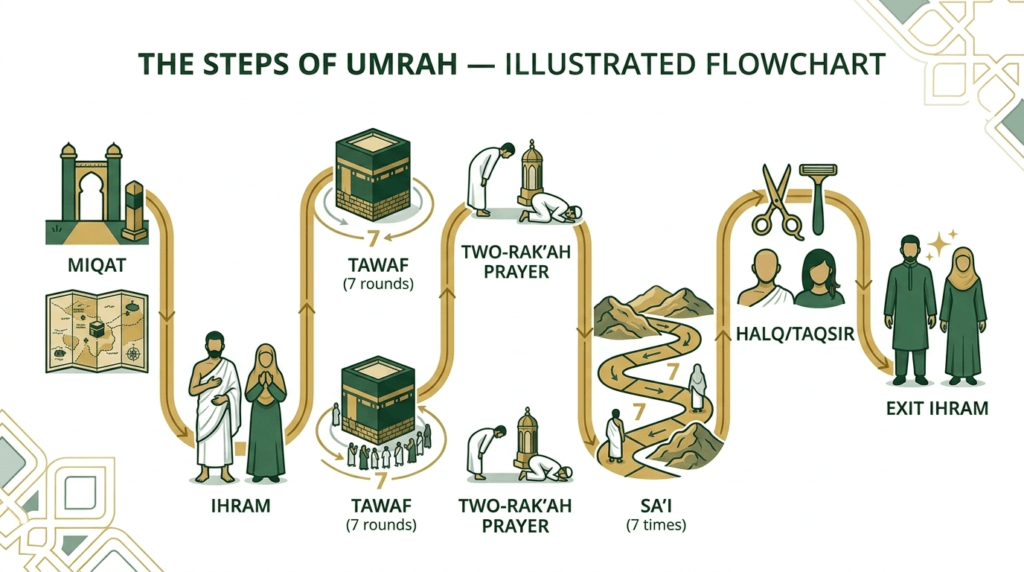
Umrah is described by the scholars of Ahl al-Sunnah as containing four essential elements: Ihram (intention and sacred state), Tawaf (circumambulation of the Kaaba), Sa’i (running between Safa and Marwa), and Halq or Taqsir (shaving or trimming the hair).
Step 1: The Miqat and Entering Ihram
The Miqat refers to the geographic boundary beyond which no pilgrim may proceed without entering the sacred state of Ihram. There are five designated Miqat points — Dhul-Hulaifah (for those coming from Madinah), Al-Juhfah (for those from the Levant), Qarn al-Manazil (from Najd), Yalamlam (from Yemen), and Dhat Irq (from the east).
The pilgrim performs ritual purification (Ghusl), puts on the Ihram garments — for men, two unstitched white cloths; for women, modest covering that reveals only the face and hands — and makes the intention (Niyyah) for Umrah. The Talbiyah is then recited aloud:
“Labbayka Allahumma labbayk. Labbayka la shareeka laka labbayk. Inna al-hamda wa-ni’mata laka wal-mulk. La shareeka lak.”
“Here I am, O Allah, here I am. Here I am, You have no partner, here I am. Verily all praise, grace, and sovereignty belong to You. You have no partner.”
This is the pilgrim’s first declaration of total presence and surrender. Ibn Umar reported that the Prophet ﷺ would raise his voice with the Talbiyah from the moment he mounted his mount at Dhul-Hulaifah. (Sahih al-Bukhari, Hadith 1514; Sahih Muslim, Hadith 1184)
Step 2: Tawaf — The Circumambulation
Upon arriving at Masjid al-Haram, the pilgrim begins Tawaf — seven complete circuits around the Kaaba, beginning and ending at the Black Stone (Hajr al-Aswad), keeping the Kaaba on the left.
The first three circuits are performed at a brisk pace (Ramal) by men, followed by four at a normal pace. During Tawaf, the pilgrim engages in dhikr, du’a, and the specific supplications transmitted from the Prophet ﷺ. At the Yemeni corner, the pilgrim says: “Rabbana atina fid-dunya hasanatan wa fil-akhirati hasanatan wa qina ‘adhab an-nar.” (Quran 2:201; narrated in Musnad Ahmad and authenticated by scholars).
Step 3: Two-Rak’ah Prayer at Maqam Ibrahim
After completing Tawaf, the pilgrim prays two Rak’ahs behind Maqam Ibrahim, in accordance with the Quranic command:
“And take, [O believers], from the standing place of Ibrahim a place of prayer.”
— Quran 2:125
It is recommended to recite Surah al-Kafirun in the first Rak’ah and Surah al-Ikhlas in the second, following the practice narrated from the Prophet ﷺ in Sahih Muslim.
Step 4: Sa’i Between Safa and Marwa
The pilgrim then proceeds to Safa, faces the Kaaba, and begins the Sa’i — traversing seven times between Safa and Marwa. The journey from Safa to Marwa counts as one, and Marwa back to Safa as another, completing the circuit at Marwa on the seventh.
Allah says:
“Indeed, Safa and Marwa are among the symbols of Allah. So whoever makes Hajj to the House or performs Umrah — there is no blame upon him for walking between them.”
— Quran 2:158
Step 5: Halq or Taqsir
Upon completing the Sa’i, men either shave the head completely (Halq — the more virtuous option) or trim the hair (Taqsir). Women trim a fingertip’s length from their hair. This act marks the conclusion of Umrah and the exit from Ihram.
The Prophet ﷺ made du’a three times for those who shaved and once for those who trimmed, as narrated in Sahih al-Bukhari, Hadith 1727.
Step-by-Step Guide to Hajj al-Tamattu
For pilgrims performing Hajj al-Tamattu, the following steps are performed after completing Umrah and before the days of Hajj:
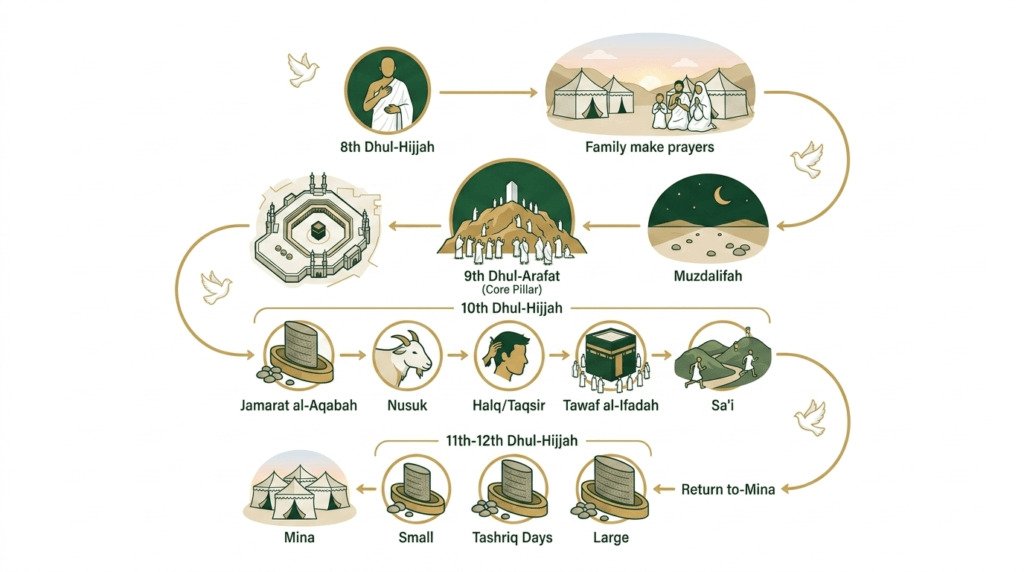
8th Dhul-Hijjah — Yawm al-Tarwiyah (Day of Preparation): The pilgrim re-enters Ihram for Hajj, travels to Mina, and spends the day and night in prayer and dhikr. The Prophet ﷺ spent this day in Mina, praying Dhuhr, Asr, Maghrib, Isha, and Fajr — shortening without combining. (Sahih Muslim, Hadith 1218)
9th Dhul-Hijjah — Yawm Arafat (The Pillar of Hajj): This is the supreme day of Hajj. The Prophet ﷺ declared:
“Hajj is Arafat.”
— Sunan al-Tirmidhi, Hadith 889; Sunan Abu Dawud, Hadith 1949; authenticated by Ibn Khuzaymah and declared Sahih
The pilgrim must be present within the boundaries of Arafat — a plain approximately 20 kilometers southeast of Mecca — from after midday until sunset. This wuquf (standing) is the pillar without which Hajj is void. The pilgrim devotes this sacred window entirely to du’a, dhikr, and repentance.
The Prophet ﷺ said on this day:
“The best supplication is that of the Day of Arafat.”
— Sunan al-Tirmidhi, Hadith 3585; authenticated by al-Albani
After sunset, the pilgrim travels to Muzdalifah, performs Maghrib and Isha combined, rests, and collects pebbles for the Jamarat.
10th Dhul-Hijjah — Yawm al-Nahr (Day of Sacrifice): This is the greatest day of the Islamic year. Four acts are performed, ideally in sequence:
- Rami al-Jamarat (Stoning): Seven pebbles are thrown at the large pillar (Jamarat al-Aqabah), with Takbeer on each throw.
- Nusuk (Sacrifice): A sacrificial animal is slaughtered as an act of gratitude and worship.
- Halq or Taqsir: The hair is shaved or trimmed, marking partial exit from Ihram.
- Tawaf al-Ifadah: The pilgrim returns to Masjid al-Haram and performs the obligatory Tawaf of Hajj — one of the three pillars of Hajj alongside Ihram and Wuquf at Arafat. Allah commands:
“Then let them end their untidiness and fulfill their vows and perform Tawaf around the Ancient House.”
— Quran 22:29
Sa’i follows Tawaf al-Ifadah for those who did not perform it after their initial Tawaf al-Qudum. The pilgrim then returns to Mina.
11th–12th Dhul-Hijjah — Ayyam al-Tashriq: The pilgrim stones all three Jamaraat each day — the small, medium, and large pillars — seven times each, after midday. These are the “Days of Remembrance” about which Allah says:
“And remember Allah during the appointed days.”
— Quran 2:203
The pilgrim may depart after the 12th Dhul-Hijjah (the earlier departure) or remain through the 13th (the later departure, which is more virtuous). The final act before leaving Mecca is the Tawaf al-Wada’ (Farewell Tawaf) — a confirmed Sunnah that the scholars of Ahl al-Sunnah regard as obligatory upon all pilgrims except menstruating women.
Section 2: The Philosophy of Rituals — The Why Behind Every Step
Understanding how to perform Hajj and Umrah is essential. However, understanding why each ritual was prescribed is what transforms the pilgrim from a tourist of sacred sites into a student of divine wisdom.
What Ihram Teaches Us About Equality
The moment a Muslim enters Ihram, all markers of social distinction vanish. The billionaire and the laborer wear identical white cloth. No rank, no nationality, no profession, no family lineage — only the name of Allah on every tongue and the same horizon ahead.
This is not symbolism. It is a lived experience of Quranic truth:
“O mankind, indeed We have created you from male and female and made you peoples and tribes that you may know one another. Indeed, the most noble of you in the sight of Allah is the most righteous of you.”
— Quran 49:13
The Ihram is an enforced democracy of the soul — a reminder that every human being, stripped of their constructed identity, stands before Allah in equal nakedness and equal need. For Muslim families raising children in the West, where identity is often defined by achievement, appearance, and social status, this lesson carries enormous pedagogical weight.
What the Talbiyah Teaches Us About Submission
The Talbiyah is not merely an opening chant. It is a comprehensive declaration of presence, surrender, and exclusivity of worship. The word labbayk — often translated as “here I am” — carries a deeper grammatical weight in Arabic: it is a dual emphasis (labbayk, not labbay), meaning “I am entirely present, repeatedly and completely.”
For the pilgrim who learns Quran by grammar, the Talbiyah becomes a masterclass in the Arabic of surrender. The phrase la shareeka lak (You have no partner) echoes the Shahadah. The acknowledgment that al-hamda wa-ni’mata laka wal-mulk (all praise, grace, and sovereignty belong to You) is the heart of Tawhid declared aloud, in motion, by millions simultaneously.
This is precisely why the scholars of Ahl al-Sunnah describe the Talbiyah as the Takbeer al-Ihram of Hajj — mirroring the opening Takbeer that initiates prayer. In both cases, the believer formally enters a state of consecrated presence. Understanding this connection changes the way a pilgrim recites it.
What the Tawaf Teaches Us About the Center of Existence
The Kaaba is the first house of worship established for mankind, as confirmed in the Quran:
“Indeed, the first House established for the people was that at Mecca — blessed and a guidance for the worlds.”
— Quran 3:96
The history of the Kaaba stretches from Ibrahim and his son Ismail, who rebuilt its foundations according to the divine command (Quran 2:127), through to the Prophet ﷺ who purified it of idols upon the conquest of Mecca. Every circuit of the Tawaf is a reconnection with that unbroken chain of monotheism — a statement that this house, this direction, and this God have been the center of the universe since before recorded time.
What Sa’i Teaches Us About Resilience
The Sa’i — running between Safa and Marwa — re-enacts the desperate search of Hajar, the mother of Ismail, for water in the barren valley of Mecca. She ran seven times between the two hills, not in despair, but in active trust: I will do everything within my power, and my Lord will provide.
Allah caused the Zamzam well to spring beneath the feet of her infant son. And then He commanded every pilgrim who would follow to run those same hills — for the rest of time.
The lesson is not simply historical commemoration. It is a physical embodiment of a spiritual principle: effort + trust = divine response. For the Muslim navigating the challenges of life in the West — raising children between two cultures, maintaining faith under secular pressure, working toward goals whose outcomes remain unknown — the Sa’i is a choreographed reminder that persistence in the service of Allah is never wasted.
What Wuquf at Arafat Teaches Us About the Final Day
The gathering at Arafat is, in the words of classical scholars, a rehearsal for the Day of Resurrection. Millions of pilgrims, in white garments, stripped of worldly distinction, standing on a plain under an open sky, calling upon Allah with total focus and desperate sincerity.
The Prophet ﷺ said on the Day of Arafat:
“This day I have perfected for you your religion and completed My favor upon you and have approved for you Islam as religion.”
— Quran 5:3 — revealed at Arafat during the Farewell Pilgrimage (Sahih al-Bukhari, Hadith 45)
Standing at Arafat with this knowledge is not merely ritual geography. It is standing at the precise coordinate where the divine message was declared complete — and understanding that everything that followed, including the Muslim’s own life and its Islamic education, flows from that moment.
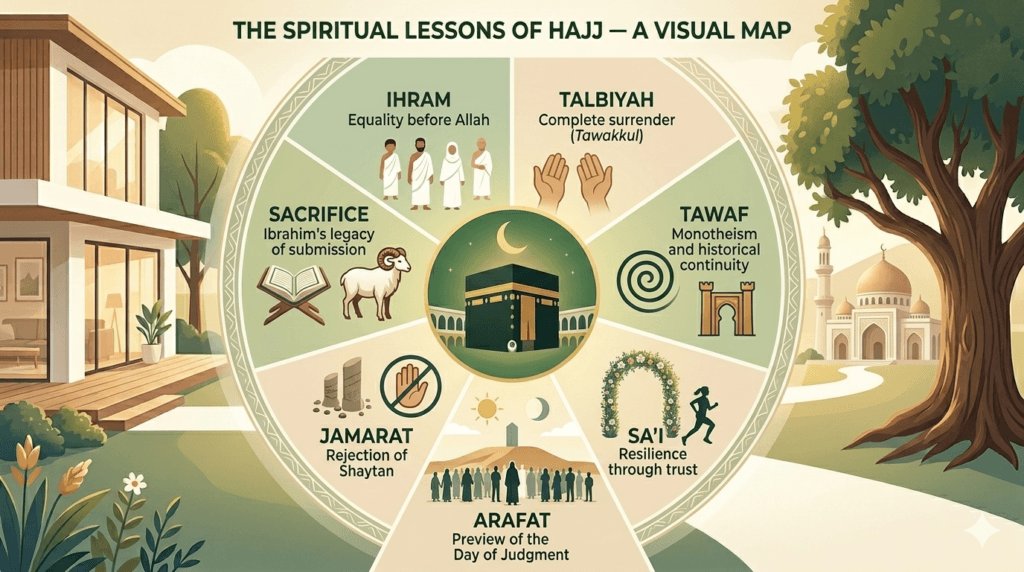
What the Jamarat Teaches Us About Resolve
The stoning of the Jamarat re-enacts Ibrahim’s rejection of the devil’s temptation at three points — when Shaytan appeared to dissuade him from obeying Allah’s command to sacrifice his son Ismail. Ibrahim did not debate. He did not negotiate. He threw stones.
The theological lesson is precise: there are moments in the believer’s life when the internal voice of doubt, the external pressure of social conformity, or the whisper of compromise must be met with decisive rejection — not intellectual deliberation. The Jamarat is a training in spiritual resolve.
Section 3: The Educational Gap — Why Millions Perform Without Truly Understanding
The Crisis of Ritual Without Knowledge
Every year, millions of pilgrims complete the manasik al-Hajj — the rites of pilgrimage — without understanding the Arabic words on their lips, the fiqh rulings governing their actions, or the spiritual philosophy embedded in each step.
They recite the Talbiyah in Arabic without knowing that labbayk is a dual emphasis of complete presence. They circle the Kaaba without knowing the history of the Kaaba or why it was originally built. They perform Sa’i between Safa and Marwa without fully internalizing the story of Hajar. They stand at Arafat — the pillar of Hajj — without understanding why this specific location carries this specific status.
This is not an indictment of their sincerity. It is, however, an honest assessment of a systemic failure in Islamic education — a failure to connect the physical performance of rituals with the intellectual and spiritual understanding that would allow those rituals to produce lasting transformation.
The Language Problem
At the heart of this gap is a language barrier. The Quran was revealed in Arabic. The Talbiyah is in Arabic. The supplications at each stage of pilgrimage are in Arabic. The Fiqh of pilgrimage — the sharia rulings on Ihram, the conditions of valid Tawaf, the rulings of Sa’i — was codified in Arabic.
A pilgrim who does not understand Arabic performs pilgrimage the way a person might navigate a foreign city without a map: they can follow the crowd, reach the destination, and survive the journey — but they miss the meaning of what they are walking through.
This is why learning Arabic for Hajj is not merely a convenience. It is an act of preparation that transforms the pilgrimage from a physical journey into an intellectual and spiritual one.
Consider the Talbiyah. Most pilgrims who have learned Quran by grammar understand immediately that the phrase la shareeka lak is not casual conversation. In Arabic grammar, the negation la followed by a noun in the accusative case (shareeka) with the prepositional phrase (lak) creates one of the strongest possible negations in the language. The sentence does not merely say “Allah has no partner.” It says: “There is absolutely, categorically, and structurally no partner that belongs to You.”
When a pilgrim recites the Talbiyah with this understanding, the words change. The heart changes. The experience changes.
The Fiqh Problem
Beyond language, there is the question of Fiqh — the body of Islamic jurisprudential rulings that govern the pilgrimage. Many pilgrims are unaware of the difference between the pillars of Hajj (the acts whose omission renders the Hajj void) and the obligations of Hajj (the acts whose omission requires expiation) and the recommended acts (the acts whose performance increases reward but whose omission has no consequence).
For example: Wuquf at Arafat is a pillar — missing it renders the Hajj entirely void. The Farewell Tawaf is an obligation — missing it requires the slaughter of a compensatory animal. Performing Ramal (brisk walking) in the first three circuits of Tawaf is a Sunnah — missing it results in no penalty.
Without this knowledge, the pilgrim who accidentally misses the time for Arafat has no framework for understanding what happened or what must be done. The pilgrim who violates one of the prohibitions of Ihram out of ignorance may unknowingly incur a ransom obligation.
The Quran is explicit about the requirement of knowledge:
“So ask the people of knowledge if you do not know.”
— Quran 16:43; Quran 21:7
Studying authentic Islamic education — the sharia rulings on Ihram, the history of the Kaaba, and the fiqh of pilgrimage according to the Sunnah — is not an academic exercise. It is an act of worship in preparation for an act of worship.
Islamic Studies TrackFiqh al-Ibadat — Scholar-Supervised Learning
Our Islamic Studies track includes dedicated modules on Fiqh al-Ibadat, covering Hajj, Umrah, and pilgrimage preparation in structured sessions.
Explore the Islamic Studies track →Fiqh al-IbadatScholar SupervisedStructured ModulesHave a fiqh question? Message us on WhatsApp: +20 112 572 2979
Section 4: Why Authentic Education Transforms the Pilgrim for Life
The Difference Between an Accepted Hajj and a Habitual One
The Prophet ﷺ described the reward of an accepted Hajj — Hajj Mabrur — in terms that have no equivalent:
“An accepted Hajj has no reward except Paradise.”
— Sahih al-Bukhari, Hadith 1773; Sahih Muslim, Hadith 1349
The scholars of Ahl al-Sunnah, including Ibn Rajab al-Hanbali in Jami al-Ulum wa al-Hikam and Ibn Hajar al-Asqalani in Fath al-Bari, explain that Hajj Mabrur — the accepted, righteous pilgrimage — is one in which the pilgrim returns not to the state of pre-Hajj spiritual routine, but to a fundamentally altered trajectory.
The pilgrim whose Hajj is Mabrur does not simply return with souvenirs and photographs. They return with a recalibrated relationship with Allah, a clarified sense of purpose, and — critically — a commitment to continuing the journey of knowledge and practice that the pilgrimage ignited.
This is precisely why authentic Islamic education is not a preparation for Hajj. It is both the preparation and the continuation.
The Four Tracks That Sustain the Pilgrim’s Transformation
Track 1: Quranic Studies — Connecting Every Ritual to the Book of Allah
The pilgrimage is saturated with Quranic references. The command to build the Kaaba is in the Quran. The story of Hajar’s Sa’i is reflected in the Quran. The Day of Arafat witnessed the completion of the Quranic revelation. The Hajj itself is commanded in the Quran:
“And complete the Hajj and Umrah for Allah.”
— Quran 2:196
A pilgrim who has enrolled in Quranic classes online — learning recitation, Tajweed, and basic understanding — approaches each ritual with a textual anchor. They recognize the Quranic verses being referenced in the imam’s sermon at Arafat. They understand the supplications they are making because they have learned the grammar and vocabulary of the language in which those supplications were composed.
Track 2: Arabic Language — Unlocking the Talbiyah and Every Du’a
Learning Arabic for Hajj is one of the most practically transformative preparations a pilgrim can make. This does not require fluency. It requires familiarity — with the root system of Arabic, the key vocabulary of worship, and the grammatical structures that give the Talbiyah, the du’as of Tawaf, the supplications at Arafat, and the recitations at Jamarat their full weight.
Students who pursue conversational Arabic class online before their Hajj consistently report the same experience: standing at Arafat and understanding — word by word — what they are saying to Allah. The emotional and spiritual impact of that comprehension is qualitatively different from reciting the same words without understanding.
Track 3: Islamic Studies — Understanding the Fiqh and History Before You Travel
Our best online Islamic studies courses for pilgrimage preparation cover three dimensions:
- Fiqh of Pilgrimage: The sharia rulings on Ihram, the manasik al-Hajj explained in detail, the conditions and obligations and Sunnahs of each rite — so the pilgrim knows exactly what they are required to do, what is recommended, and what to avoid.
- History of the Kaaba: From the construction by Ibrahim and Ismail, through the preservation of the site across the pre-Islamic period, to the Prophet’s ﷺ purification of the Kaaba — so that each circuit of the Tawaf is a walk through living history.
- Islamic Studies for families: Parents who have studied the fiqh of pilgrimage are equipped to teach their children the meaning of Hajj before and after the journey — extending the transformation across generations.
Track 4: Smart Parenting — Transmitting the Hajj Experience to the Next Generation
For Muslim families in the West, Hajj is often the most significant shared spiritual experience of a lifetime. However, the transformation that parents experience in Mecca frequently fails to reach their children — either because the children did not accompany them, or because no structured framework exists for transmitting the lessons of Hajj in a way that connects with young people raised in a Western environment.
The Smart Parenting track at quranst provides Muslim parents with the tools to bring Hajj into the home — through storytelling, through connecting daily Islamic practices to the lessons of pilgrimage, and through age-appropriate explanations that make Arafat, the Sa’i, and the sacrifice meaningful for a twelve-year-old in Toronto or a fifteen-year-old in Houston.
A child who grows up understanding the story of Hajar — the courage, the trust, the divine response — is a child who has been given a framework for resilience that will serve them in every difficult moment of their life.
The Mabrur Hajj Lasts a Lifetime — But Only with Knowledge
The scholars are consistent on this point: the signs of an accepted Hajj are not visible on the day of return. They become visible in the weeks, months, and years that follow. Does the pilgrim pray more consistently? Do they engage with the Quran differently? Do they treat their family with the patience and presence that the Ihram demanded of them?
These are not automatic outcomes. They are the fruits of a pilgrimage that was prepared with knowledge, performed with understanding, and followed with continued learning.
This is the argument — grounded in the Sunnah and the scholarly tradition — for authentic Islamic education remote from the physical journey itself. The Hajj is not an event. It is a turning point. And turning points only produce lasting change when they are supported by structure, guidance, and community.
Meaningful RitualsMake Every Ritual Meaningful
Whether you are preparing for your first Umrah or your tenth Hajj, quranst’s Islamic Studies and Arabic tracks are designed to make every ritual meaningful.
Start with a free 2-session trial →2 Free SessionsIslamic StudiesArabic TracksHave a fiqh question? Message us on WhatsApp: +20 112 572 2979
Conclusion: Don’t Let Your Pilgrimage Be a One-Time Event
You have spent years saving for Hajj.
You have spent months preparing the logistics — the visa, the hotel, the flights, the group, the packing list.
Now consider: have you spent equivalent time preparing the inner journey?
Because the Kaaba will receive you regardless. The plains of Arafat will hold you regardless. The Tawaf will encircle you regardless. But the transformation — the return as the day your mother bore you — that is not guaranteed by the flight ticket.
It is guaranteed by the quality of what you bring to the journey. And what you carry forward from it.
The Prophet ﷺ said:
“When a person dies, all action is cut off except three: ongoing charity, knowledge that benefits, or a righteous child who prays for him.”
— Sahih Muslim, Hadith 1631
Of the three things that outlive us, two are directly connected to education: knowledge that benefits, and the righteous child — who is, above all else, the product of intentional Islamic education.
The Hajj you perform this lifetime is a physical journey of days. The knowledge you build is a legacy that outlives you.
Don’t let your pilgrimage be a one-time event. Transform it into a lifelong journey of knowledge. Enroll in our Islamic Studies or Arabic tracks today to understand the language of the Revelation — the language in which the Talbiyah was first recited, in which the Quran was revealed, and in which the supplications of Arafat ascend to Allah.
Your Hajj Preparation Starts Here — The Hard CTA
You are reading this because something in you wants more than the checklist.
You want to stand at Arafat and know — in the deepest sense of the word — where you are, what you are doing, and what you are saying.
You want your children to understand why their parent returned from Mecca changed.
You want the ‘Mabrur’ status to be something you live — not just something you hope for.
quranst is your partner in that preparation.
What Your Enrollment Includes
Islamic Studies Track:
- Fiqh of Hajj and Umrah — manasik al-Hajj explained with scholarly authenticity
- Sharia rulings on Ihram — what is permitted, prohibited, and required
- History of the Kaaba and the prophetic legacy of the sacred sites
- Character development (Akhlaq) — so the spiritual state of Hajj becomes a permanent character trait
Arabic Language Track:
- Learn Arabic for Hajj — vocabulary, supplications, and Talbiyah comprehension
- Learn Quran by grammar — so you understand every word you recite at the sacred sites
- Conversational Arabic class online — for communicating with guides, scholars, and fellow pilgrims at the Haram
Quran Track:
- Online Quran recitation course — with certified Tajweed instructors
- Quran recitation classes online — live, one-on-one, real-time correction
Smart Parenting Track:
- Transmit the Hajj experience to your children in ways that resonate with their Western upbringing
- Build an Islamic household where the lessons of pilgrimage live year-round
Two Ways to Begin — Right Now
The best time to prepare for Hajj was the year before you went. The second-best time is today.
Register for your free 2-session trial →“Pilgrimage to this House is an obligation by Allah upon whoever is able among the people.”
— Quran 3:97
You are able.
Now prepare — with the knowledge the journey deserves.
بِسْمِ اللَّهِ — Begin.
References and Sources
Quranic References
- Quran 2:125 — Maqam Ibrahim as a place of prayer
- Quran 2:127 — Ibrahim and Ismail building the Kaaba
- Quran 2:158 — Safa and Marwa as symbols of Allah
- Quran 2:196 — “Complete the Hajj and Umrah for Allah”
- Quran 2:201 — Supplication at the Yemeni corner
- Quran 2:203 — “Remember Allah during the appointed days”
- Quran 3:96 — The first House established for mankind
- Quran 3:97 — Pilgrimage as an obligation
- Quran 5:3 — The completion of the religion at Arafat
- Quran 16:43; 21:7 — “Ask the people of knowledge if you do not know”
- Quran 22:29 — Tawaf around the Ancient House
- Quran 49:13 — Equality of mankind before Allah
Hadith References
- Sahih al-Bukhari, Hadith 45 — Revelation of Quran 5:3 at Arafat (Farewell Pilgrimage)
- Sahih al-Bukhari, Hadith 1514; Sahih Muslim, Hadith 1184 — Prophet’s Talbiyah from Dhul-Hulaifah
- Sahih al-Bukhari, Hadith 1521; Sahih Muslim, Hadith 1350 — Hajj Mabrur and return to purity
- Sahih al-Bukhari, Hadith 1709; Sahih Muslim, Hadith 1211 — Tamattu recommended by the Prophet ﷺ
- Sahih al-Bukhari, Hadith 1727 — Prophet’s du’a for those who shaved
- Sahih al-Bukhari, Hadith 1773; Sahih Muslim, Hadith 1349 — Accepted Hajj earns Paradise
- Sahih Muslim, Hadith 1218 — Prophet’s prayers in Mina on 8th Dhul-Hijjah
- Sahih Muslim, Hadith 1631 — Three deeds that continue after death
- Sunan al-Tirmidhi, Hadith 889; Sunan Abu Dawud, Hadith 1949 — “Hajj is Arafat” (authenticated by Ibn Khuzaymah)
- Sunan al-Tirmidhi, Hadith 3585 — Best supplication is that of the Day of Arafat (authenticated by al-Albani)
Classical Scholarly Works
- Ibn Rajab al-Hanbali. Jami al-Ulum wa al-Hikam. Dar al-Ma’rifah, Beirut. (Commentary on Hajj Mabrur hadith)
- Ibn Hajar al-Asqalani. Fath al-Bari Sharh Sahih al-Bukhari. Dar al-Ma’rifah, Beirut. (Vol. 3, Book of Hajj)
- Sayyid Sabiq. Fiqh al-Sunnah. Vol. 1, Chapter on Hajj. Dar al-Fath, Cairo.
- General Presidency for the Affairs of the Two Holy Mosques. Official maps and guides. gph.gov.sa
- Dar al-Ifta al-Misriyyah. Manual of Hajj, Umrah and Ziyarah. (Available at dar-alifta.org)
Frequently Asked Questions
Everything you need to know about preparing for Hajj and Umrah with quranst’s Islamic Studies and Arabic programs.
No, Arabic is not required to perform the physical rites of Hajj and Umrah. However, understanding the Arabic of the Talbiyah, the supplications at each stage, and the Quranic verses referenced during pilgrimage transforms the experience from a physical journey into a deeply spiritual one. Our Arabic Language Track is designed specifically for pilgrims who want to comprehend — not just recite — the words they speak at the sacred sites.
Hajj al-Tamattu is the most common form: you perform Umrah first, exit Ihram, then re-enter Ihram for Hajj in the same season. The Prophet ﷺ recommended this for those not bringing a sacrificial animal. Hajj al-Qiran combines Umrah and Hajj in a single Ihram without exiting between them, requiring a sacrifice. Hajj al-Ifrad is for Hajj only, without Umrah. Our Fiqh al-Ibadat module covers each form in detail with authentic scholarly references.
We recommend starting at least 6 to 12 months before your intended pilgrimage. This allows sufficient time to complete the Fiqh of Hajj and Umrah module, build foundational Arabic vocabulary for the rituals, and internalize the spiritual lessons of each stage. However, even if your departure is sooner, our structured one-on-one sessions can accelerate your preparation. Book a free trial and our advisors will create a personalized timeline based on your departure date.
Absolutely. quranst specializes in family-centered Islamic education for Muslim families in the West. We offer age-appropriate tracks for children, teenagers, and adults — all taught by certified instructors who understand the unique challenges of growing up Muslim in Western societies. Our Smart Parenting Track also equips parents to transmit the Hajj experience to their children in meaningful, age-appropriate ways.
Your free trial includes two live, one-on-one sessions (30–45 minutes each) with a certified quranst instructor. In the first session, we assess your current knowledge level, learning goals, and pilgrimage timeline. In the second session, we deliver a sample lesson from your recommended track — whether that’s Quranic Studies, Arabic Language, Islamic Studies (Fiqh), or Smart Parenting. There is no commitment, no credit card required, and no pressure to enroll. Claim your free trial today.
All quranst classes are live and interactive, conducted one-on-one between you and your certified instructor via video call. This format allows real-time correction in Quran recitation, immediate answers to fiqh questions, and personalized pacing based on your progress. We do not use pre-recorded content for core instruction — because authentic Islamic education requires human connection, scholarly supervision, and the ability to adapt to each student’s unique background and needs.
quranst serves Muslim families across all major Western time zones — USA (EST, CST, MST, PST), Canada, UK (GMT/BST), Australia (AEST, ACST, AWST), and Europe. Our instructors are available for scheduling across these zones, with peak availability during evening and weekend hours in each region. When you book your free trial, our team will match you with an instructor whose availability aligns with your local time.
Yes. Upon completion of the Fiqh al-Ibadat: Hajj & Umrah Preparation module, you will receive a digital certificate of completion from quranst, signed by your supervising instructor. This certificate verifies your completion of the manasik al-Hajj curriculum, including the fiqh rulings on Ihram, the step-by-step rites of Umrah and Hajj al-Tamattu, and the spiritual philosophy of each ritual. Many pilgrims find this certificate valuable for personal documentation and for sharing their preparation journey with family.
Still have questions? Our Islamic Studies advisors are here to help.
Message us on WhatsApp