
Introduction: The Question That Haunts Every Muslim Parent
It usually arrives on a quiet evening.
A child — eight years old, nine, twelve — looks up from their homework and asks, with disarming simplicity: “Why do we pray?” Or: “What happens after we die?” Or, most common of all: “Why does Allah allow bad things to happen?”
And the parent realizes, in that moment, that the answer they want to give is sitting somewhere in the back of their memory — half-remembered from a childhood madrasa, or from a Friday khutbah heard years ago — but not assembled, not organized, not ready.
This is the educational gap that defines Islamic parenting in the modern West. Most Muslim parents love their children fiercely and want Islam to be central to their lives. What many lack is not devotion — it is structure. A clear map of what their child should know, in what order, at what age, and why.
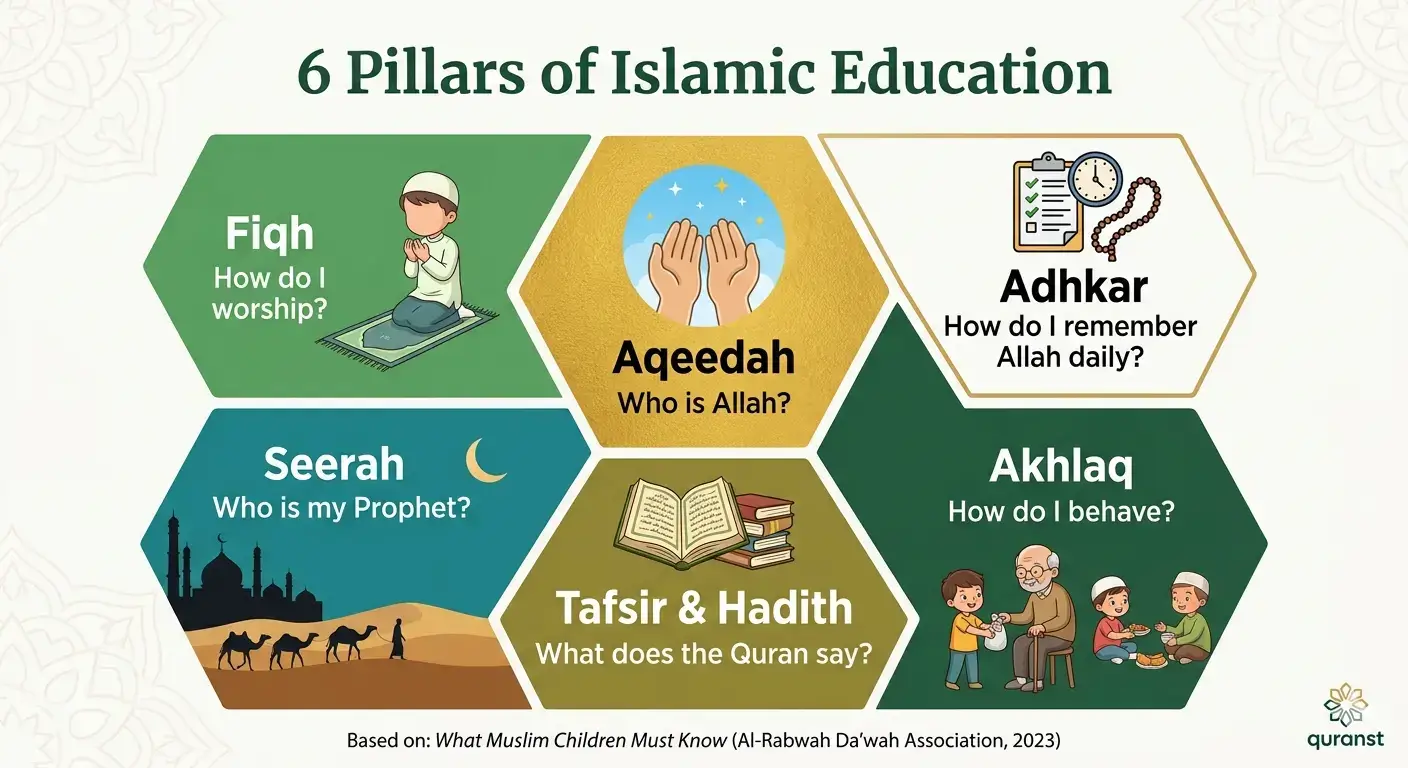
The book “What Muslim Children Must Know” — published by the Da’wah and Awareness Association at Al-Rabwah and the Islamic Content Service Association — provides exactly that map. It is a structured, comprehensive, and authentically grounded curriculum covering Aqeedah (Islamic creed), Fiqh (jurisprudence), Seerah (prophetic biography), Tafsir (Quranic interpretation), Hadith, and Akhlaq (character) — organized in a question-and-answer format that engages the child’s mind as well as their memory.
This guide uses that curriculum as a foundation to provide Muslim families everywhere — in Houston, Toronto, London, Melbourne, and beyond — with a roadmap for raising children who genuinely know their religion. Not just its rituals. Its reasons.
Islamic Studies TrackStructured Curriculum Framework
quranst’s Islamic Studies track is built around exactly this curriculum framework — teaching Aqeedah, Fiqh, Seerah, and Akhlaq through structured, live, one-on-one sessions with certified teachers.
Book your free 2-session trial →Aqeedah & FiqhSeerah & AkhlaqLive 1-on-1 Sessionsor message us on WhatsApp: +20 112 572 2979
What Does a Muslim Child Actually Need to Know?
The Featured Snapshot Answer
Before going deep, here is the direct answer to what every Muslim child must know — organized by category:
- About Allah: Who He is, His names and attributes, and why He alone deserves worship (Tawhid)
- About Islam: The Five Pillars and Six Articles of Faith — with understanding, not just memorization
- About the Prophet ﷺ: His biography, character, and the lessons embedded in every phase of his life
- About worship: How to perform Salah, Wudu, fasting, and Zakat correctly — according to the Sunnah
- About the Quran: The meaning of the surahs they recite daily — especially Al-Fatiha
- About character: The ethics of Islam — honesty, mercy, generosity, avoidance of lying, backbiting, and envy
- About daily life: The adhkar (remembrances) that connect every moment to Allah
In short: A Muslim child who has mastered these six areas has the intellectual armor, the spiritual identity, and the practical framework to live as a confident Muslim — anywhere in the world.
Section 1: Aqeedah — The Foundation Before Everything Else
Why Aqeedah Must Come First
There is a reason the very first words revealed to the Prophet ﷺ were “Iqra” — “Read” — and not “Pray” or “Fast.” Before Allah commanded worship, He commanded knowledge. And the most foundational knowledge in Islam is Aqeedah: the correct belief about Allah, about His religion, and about the purpose of human existence.
Al-Bukhari narrates that the Prophet ﷺ said:
“When Allah intends good for someone, He gives him understanding of the religion.”
— Sahih al-Bukhari, Hadith 71
Understanding the religion begins with understanding Allah.
The Three Dimensions of Tawhid
The “What Muslim Children Must Know” curriculum teaches Tawhid — the oneness of Allah — through its three classical dimensions, as understood by the scholars of Ahl al-Sunnah wal-Jama’ah:
1. Tawhid al-Rububiyyah (Oneness of Lordship) The belief that Allah alone is the Creator, Sustainer, Owner, and Administrator of all that exists. No child can fully understand why they should worship Allah until they understand that He is the One who brought them into existence, provides for them in every breath, and controls every outcome in their life. The Quran establishes this:
“All praise is due to Allah, Lord of all the worlds.” — Quran 1:2
2. Tawhid al-Uluhiyyah (Oneness of Worship) The belief that only Allah deserves to be worshipped — that no prayer, supplication, sacrifice, or act of devotion may be directed to anyone other than Him. This is the dimension of Tawhid that the Prophet ﷺ spent 23 years calling people to, and it is the dimension that directly addresses the greatest spiritual threat facing Muslim children in the West: the subtle drift toward attributing ultimate worth to people, institutions, or outcomes rather than to Allah.
3. Tawhid al-Asma wa al-Sifat (Oneness of Names and Attributes) The belief that Allah’s names and attributes — as mentioned in the Quran and authentic Sunnah — are real, unique, and unlike anything in creation. They are affirmed without likening Allah to His creation (tashbih), and without distorting or denying their meaning (ta’wil or ta’til).
Teaching a child all three dimensions does not require theological complexity. It requires consistent, warm, example-embedded conversation — the kind of conversation this guide’s practical sections provide.
The Six Pillars of Iman
The curriculum grounds the Six Pillars of Faith in the famous hadith of Jibril, narrated by Umar ibn al-Khattab (may Allah be pleased with him):
“Faith is: to believe in Allah, His angels, His books, His messengers, the Last Day, and to believe in divine decree — both its good and its evil.”
— Sahih Muslim, Hadith 8 (Hadith Jibril)
Each pillar is taught not as an abstract theological proposition but as a lived reality. A child who believes in the angels understands that they are never alone. A child who believes in the Last Day understands that every act — however private — is recorded. A child who believes in divine decree carries both a permission to work hard and a permission to rest in trust.
The curriculum also addresses the nature of Iman itself — that it is not static but dynamic: it increases through obedience and decreases through disobedience. This is the Ahl al-Sunnah position, and teaching it early prevents the dangerous misconception that faith is either entirely present or entirely absent.
Section 2: Fiqh and Worship — Turning Belief into Practice
Why Correct Worship Requires Correct Knowledge
The Prophet ﷺ said:
“Pray as you have seen me pray.”
— Sahih al-Bukhari, Hadith 631
This hadith establishes a principle that governs all of Islamic worship: the correct method is not invented by the worshipper, nor inherited from cultural custom alone. It is transmitted — through authentic chains of narration, from the Prophet ﷺ himself, through his companions and their successors, to the scholars of every generation.
For Muslim families in the West, where the transmission of correct practice is often fragmented across generations of migration and cultural adaptation, structured Fiqh education is not optional. It is the difference between worship that is accepted and worship that is deficient.
Purity and Wudu: The Key to Prayer
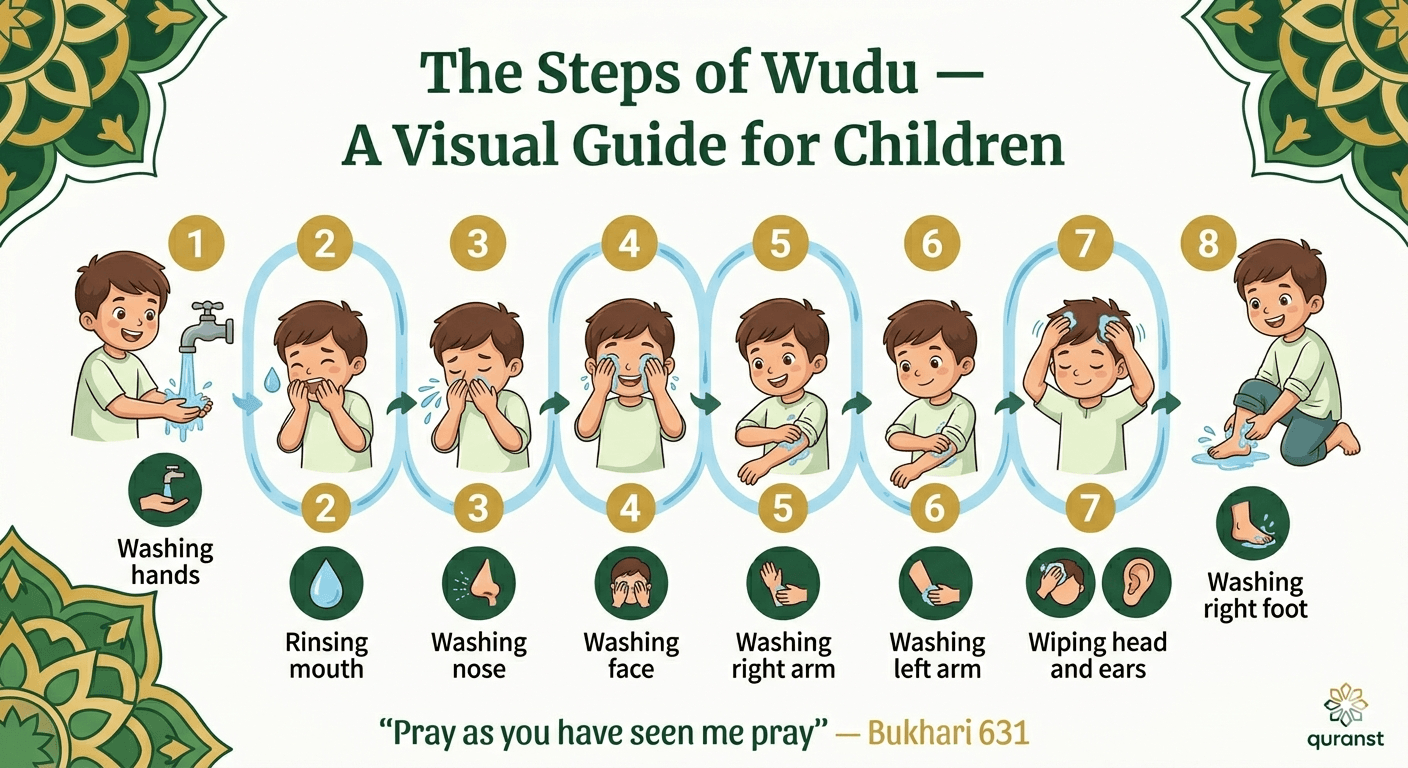
The “What Muslim Children Must Know” curriculum begins Fiqh education with the most practical gate of worship: Taharah (purity) and Wudu (ritual ablution). The eight steps of Wudu are taught in sequence:
- Intention (Niyyah) — the internal act that distinguishes ritual from habit
- Washing both hands three times
- Rinsing the mouth (Madmadah) and the nose (Istinshaq) three times each
- Washing the face three times
- Washing both arms up to and including the elbows, three times
- Wiping the head and ears once
- Washing both feet up to and including the ankles, three times
- Saying the Shahadah after completing Wudu — as narrated in Sahih Muslim, Hadith 234
The curriculum also introduces the Sharia-sanctioned concession of wiping over leather socks (masah ala al-khuffayn) — an important practical ruling for Muslim children navigating daily life in Western schools and workplaces.
Salah: The Pillar of the Religion
The curriculum establishes the absolute centrality of Salah through the prophetic warning:
“The first matter that the servant will be brought to account for on the Day of Judgment is the prayer. If it is sound, all his other deeds will be sound. And if it is corrupt, all his other deeds will be corrupt.”
— Sunan al-Tirmidhi, Hadith 413; classified as Sahih by al-Albani
Children are taught to pray at age seven and made to practice it consistently from age ten — as established in the hadith narrated by Abdullah ibn Amr in Sunan Abu Dawud, Hadith 495.
The curriculum covers the prayer comprehensively:
The Conditions of Prayer (Shurut al-Salah):
- Islam, sanity, discernment
- Entry of the prayer time
- Covering the ‘awrah
- Ritual purity
- Facing the Qiblah
The Pillars of Prayer (Arkan al-Salah) — fourteen in total: Including Takbeerat al-Ihram (the opening Takbeer), recitation of Al-Fatiha in every unit, Ruku (bowing), rising from Ruku, Sujood (prostration), sitting between two prostrations, the final Tashahhud, and Tasleem (the closing salutation).
The Invalidators of Prayer (Mubtilatat al-Salah): Including speaking intentionally during prayer, eating or drinking, missing a pillar of prayer, and losing ritual purity.
Teaching these three categories — conditions, pillars, and invalidators — gives the child a complete framework for self-monitoring their worship. They are no longer dependent on an adult to tell them whether their prayer was valid. They know the standard and can evaluate themselves against it.
Zakat, Fasting, and Hajj: The Remaining Pillars
The curriculum introduces the three remaining pillars in terms of principle and wisdom before detail:
- Zakat is the right of the poor that Allah has placed in the wealth of the rich — a reminder that wealth is a trust, not a possession. It is presented not as a tax but as an act of purification (the word zakat itself means both “purification” and “growth”).
- Sawm (Fasting) is the voluntary surrender of all that Allah has made permissible — food, drink, intimacy — for His sake alone. The Quran states its purpose in one word: Taqwa (consciousness of Allah). “That you may become conscious of Allah” (Quran 2:183). A child who understands that fasting is training in Taqwa — not merely a test of hunger — fasts with a completely different quality of intention.
- Hajj is the complete submission: the pilgrim leaves their home, their clothes, their social rank, and their daily comfort — and stands before Allah with nothing but their intention and their Talbiyah.
Section 3: Seerah — The Living Curriculum of the Prophet ﷺ
Why Every Muslim Child Needs to Know the Prophet ﷺ
The Prophet ﷺ is not a historical figure to be admired from a distance. He is the living embodiment of the Quran — as described by his wife Aisha (may Allah be pleased with her) when she was asked about his character: “His character was the Quran.” (Sahih Muslim, Hadith 746)
Teaching children the Seerah is, therefore, not teaching them history. It is teaching them the applied Quran — what Islam looks like when lived perfectly, in every dimension of human experience.
The Key Milestones of the Seerah
The “What Muslim Children Must Know” curriculum covers the Seerah through its major phases, giving children an anchored narrative of the Prophet’s life:
Birth and Lineage: Muhammad ibn Abdillah ibn Abd al-Muttalib was born in Makkah in the Year of the Elephant — approximately 570 CE — into the noble tribe of Quraysh, the custodians of the Kaaba. His father died before his birth, and his mother passed away when he was six years old. He was subsequently raised by his grandfather Abd al-Muttalib, and then by his uncle Abu Talib.
The Call: The first revelation came to the Prophet ﷺ in the Cave of Hira, through the Angel Jibril, when he was forty years old. The first word revealed — “Iqra” (Read) — established knowledge as the foundation of the prophetic mission. Da’wah was carried out secretly for approximately three years, then openly upon the divine command: “Proclaim what you have been commanded and turn away from the polytheists.” (Quran 15:94)
Patience in Makkah: The Prophet ﷺ and his companions endured thirteen years of persecution, mockery, economic boycott, and physical torture in Makkah — without abandoning their mission or retaliating with violence. For Muslim children facing bullying, social exclusion, or Islamophobia in Western schools, this period of the Seerah carries an immediate and practical lesson: steadfastness under pressure is not weakness — it is the Prophetic model.
Hijrah to Madinah: After thirteen years, the Prophet ﷺ emigrated to Madinah — a migration that marks the beginning of the Islamic calendar. The Hijrah is a lesson in strategic patience: sometimes the right response to an unsustainable situation is not to fight, but to build — to establish new roots in new soil and grow from there.
Character and Physical Description: The curriculum also teaches children the physical and moral qualities of the Prophet ﷺ — his modesty, his warmth toward children, his sense of humor, his patience with those who wronged him, his generosity, and his unbreakable connection with Allah. A child who knows that the Prophet ﷺ used to play with his grandchildren, who raced with his wife, who wept in the night in prayer — that child has a relationship with the Prophet ﷺ, not merely information about him.
Section 4: Tafsir and Hadith — Understanding the Words of Allah and His Messenger
The Surahs They Pray Must Be the Surahs They Understand
Every Muslim child who prays recites Al-Fatiha seventeen times a day. Most cannot tell you what it means.
This is perhaps the most precise illustration of the educational gap in Islamic parenting: the most frequently recited words in a Muslim child’s life are among the least understood.
The “What Muslim Children Must Know” curriculum addresses this directly. It covers the Tafsir of Al-Fatiha in detail — explaining every verse, every key term, and the overall purpose of the surah as the opening chapter of the Quran and the foundational prayer of Islam.
Key Teaching Points from the Tafsir of Al-Fatiha:
- “Al-Hamdulillah” — Praise that is complete, comprehensive, and belongs exclusively to Allah; not merely gratitude for a specific favor but acknowledgment of His essential worthiness of all praise
- “Rabb al-Alameen” — Allah is the Lord not just of Muslims but of all creation — every human, every animal, every galaxy and microorganism
- “Ar-Rahman, Ar-Raheem” — Two names from the same root (rahmah, mercy) — one denoting the universal mercy that encompasses all creation, the other denoting the specific, ongoing mercy reserved for the believers
- “Malik Yawm al-Din” — Master of the Day of Judgment — the day when all accounts are settled, all apparent injustices are corrected, and every soul receives exactly what it earned
- “Iyyaka na’budu wa iyyaka nasta’een” — The pivot of the surah: we worship You alone, and we seek help from You alone. The grammatical fronting of iyyaka (you alone) in Arabic creates one of the strongest possible emphasis constructions — exclusivity of worship and exclusivity of reliance
The curriculum then extends to the short surahs from Al-Zalzalah to Al-Nas — the surahs that children most commonly memorize and recite in prayer. Each is taught with its meaning, key vocabulary, and practical lesson.
Hadith: The Moral Grammar of a Muslim Life
Beyond the Quran, the curriculum selects a set of foundational ahadith that serve as ethical anchors for a Muslim child’s daily life:
“Actions are judged only by intentions, and every person will have what they intended.” — Sahih al-Bukhari, Hadith 1; Sahih Muslim, Hadith 1907
This hadith — the first in Sahih al-Bukhari — teaches children that the internal dimension of their actions matters as much as the external. It is the foundation of Ikhlas (sincerity) and the antidote to performance-based religiosity.
“Whoever introduces something new into this matter of ours that is not from it, it will be rejected.” — Sahih al-Bukhari, Hadith 2697; Sahih Muslim, Hadith 1718
This hadith teaches children the concept of Bid’ah (religious innovation) — the importance of grounding every act of worship in authentic evidence, not personal preference or cultural tradition.
“A man will be with those whom he loves.” — Sahih al-Bukhari, Hadith 6168; Sahih Muslim, Hadith 2641
This hadith — reportedly one of the most beloved statements of the Companions upon hearing it — teaches children the centrality of companionship and role models. Who you love, you will follow. Who you follow, you will become. This is perhaps the most practically important hadith for Muslim parents in the West thinking about their children’s friendships, influences, and aspirations.
Section 5: Akhlaq and Daily Adhkar — Where Knowledge Meets Life
The Test of Islamic Education Is in the Character It Produces
The Prophet ﷺ said:
“The most complete of believers in faith are those who are best in character.” — Sunan al-Tirmidhi, Hadith 1162; classified as Hasan Sahih
This hadith establishes a standard that every Islamic curriculum must internalize: knowledge is not the destination — character is. A child who has memorized the six pillars of Iman but lies to their parents, a child who can recite the conditions of valid Salah but treats younger siblings with cruelty — these children have received information without transformation.
The “What Muslim Children Must Know” curriculum addresses this by dedicating an entire section to Akhlaq, organized into:
Praiseworthy Character Traits (Akhlaq Mahmudah):
- Sidq (Truthfulness): The Prophet ﷺ described truthfulness as the pathway to righteousness, and righteousness as the path to Paradise. (Sahih al-Bukhari, Hadith 6094)
- Amanah (Trustworthiness): The Prophet ﷺ was known even before prophethood as Al-Amin — the Trustworthy — establishing that Islamic character must be visible to everyone, not just fellow Muslims
- Haya (Modesty): Described in a famous hadith as a branch of faith (Sahih al-Bukhari, Hadith 9) — encompassing not just physical modesty but a deep shyness before Allah that restrains the believer from what displeases Him
- Rahmah (Mercy): “Show mercy to those on earth, and the One above the heavens will show mercy to you.” (Sunan al-Tirmidhi, Hadith 1924; authenticated by al-Albani)
- Birr al-Walidayn (Honoring Parents): Commanded immediately after the command to worship Allah alone in the Quran (17:23), establishing that the relationship with parents is the closest human reflection of the relationship with Allah
Blameworthy Character Traits (Akhlaq Madhmumah): The curriculum does not merely list virtues — it explicitly names and warns against the vices that Islamic character must exclude:
- Kadhib (Lying): The Prophet ﷺ described consistent lying as a path to hypocrisy
- Ghishsh (Cheating): “Whoever cheats us is not one of us.” (Sahih Muslim, Hadith 101)
- Gheebah (Backbiting): Defined in the Quran as eating the flesh of one’s dead brother (49:12) — a viscerally unforgettable image that prevents children from treating gossip as harmless conversation
- Hasad (Envy): The Prophet ﷺ warned that envy devours good deeds as fire devours wood (Sunan Abu Dawud, Hadith 4903; authenticated by al-Albani)
Daily Adhkar: The Architecture of a God-Conscious Day
Among the most practically transformative sections of the curriculum is the daily adhkar — the specific supplications that the Prophet ﷺ taught for every significant moment of daily life:
| Moment | Dhikr |
|---|---|
| Upon waking | “Al-Hamdu lillahilladhi ahyana ba’da ma amatana wa ilayhi al-nushur” |
| Before eating | “Bismillah” |
| After eating | “Al-Hamdulillah” |
| Entering the home | “Bismillah walajnaa, wa bismillah kharajnaa, wa ‘ala Rabbina tawakkalna” |
| Leaving the home | “Bismillah, tawakkaltu ‘alallah, wa la hawla wa la quwwata illa billah” |
| Morning and evening | Ayat al-Kursi, Al-Mu’awwidhat (Surahs 112, 113, 114) |
A child who has internalized these adhkar is not performing isolated religious exercises. They are living in a constant, unbroken conversation with Allah — across every ordinary moment of a day that would otherwise pass without divine awareness.
The Quran captures the purpose of this constant remembrance in one verse:
“Verily, in the remembrance of Allah do hearts find rest.” — Quran 13:28
Section 6: The Educational Gap — Why This Knowledge Is More Urgent Than Ever
What Happens When Muslim Children Don’t Have This Foundation
The consequences of an Islamic education built on ritual performance without theological understanding are well-documented — and increasingly visible in Muslim communities across the West.
Children who grow up knowing how to pray but not why they pray will pray only when supervised. Children who have memorized the five pillars but have never been given a coherent answer to “Why is Islam true?” are one hostile question away from crisis. Children who have been told that lying and backbiting are wrong, but have never been given the Quranic and prophetic framework for why — and the practical tools for what to do instead — will default to the ethical standards of their peer group.
Meanwhile, the pressures on Muslim children in the West intensify every year. When children learn the foundations of Aqeedah, Fiqh, and Akhlaq from an early age, they develop confidence in their faith and identity, respect and empathy toward others, and clarity about right and wrong through Quranic values.
That development does not happen automatically. It requires structure. It requires curriculum. It requires a teacher who understands both the content and the context — who knows authentic Islamic scholarship and knows what it means to grow up Muslim in a Western school.
The Question-and-Answer Method: Why It Works
One of the distinctive pedagogical features of “What Muslim Children Must Know” is its consistent use of the question-and-answer format — an approach that mirrors the famous Hadith of Jibril, in which the Angel came to the Prophet ﷺ in human form and asked him the defining questions of faith, Islam, and excellence.
This format works for children for three reasons:
First, it activates the child’s mind rather than filling it passively. A child who is asked “Who is your Lord?” and must formulate an answer is engaging their understanding, not just their memory.
Second, it mirrors the questions they will actually face — from classmates, from teachers, from online content, and from their own developing intellect. A child who has answered “Why do Muslims pray?” in a structured educational context will not freeze when asked the same question in the cafeteria.
Third, it is the method of the Prophet ﷺ himself. He regularly taught through questions: “Do you know what gheebah (backbiting) is?” (Sahih Muslim, Hadith 2589). “Do you know who the bankrupt person is?” (Sahih Muslim, Hadith 2581). The question precedes the answer — and the answer, once discovered rather than merely received, is retained.
Section 7: How quranst Delivers This Curriculum to Families Anywhere in the World
The Problem with Most Online Islamic Education
Most online Islamic education platforms fall into one of two traps: they are either too academic (designed for adult learners with existing theological foundations) or too superficial (content that entertains but does not build genuine understanding).
The curriculum described in this guide — the knowledge that every Muslim child must know — requires something specific: a teacher who has mastered authentic Islamic scholarship, who can calibrate that scholarship to a child’s developmental stage, and who understands the specific cultural and psychological context of a Muslim child growing up in the West.
Faith Publications’ Islamic Studies curriculum is carefully structured to make learning relevant, engaging, and deeply rooted in authentic Islamic knowledge while still connecting to the child’s modern-day challenges. This is precisely the standard quranst holds itself to.
The quranst Islamic Studies Track: What It Covers
The quranst Islamic Studies track delivers the complete knowledge framework of “What Muslim Children Must Know” through structured, live, one-on-one sessions — customized to the individual child’s age, level, and learning style:
Module 1 — Aqeedah:
- The three types of Tawhid explained with examples from daily life
- The Six Pillars of Faith with their implications for how a Muslim thinks and lives
- A developmentally appropriate treatment of theological questions children actually ask: “Can Allah do anything?” “Why did Allah create us?” “What happens after death?”
Module 2 — Fiqh of Worship:
- The correct method of Wudu and Salah according to authentic Sunnah
- The pillars, obligations, Sunnahs, and invalidators of prayer
- The Fiqh of fasting, Zakat, and an introduction to Hajj
Module 3 — Seerah:
- The Prophet’s ﷺ life as a narrative — emotionally engaging, historically grounded, and practically applied
- Character lessons extracted from specific incidents in the Seerah
- The Prophet ﷺ as a model for navigating exactly the kind of challenges Muslim children in the West face: minority status, social pressure, persecution, and the tension between principle and pragmatism
Module 4 — Tafsir and Hadith:
- The meaning of every surah the child recites in prayer
- The foundational ahadith of Islamic ethics — understood, not merely memorized
- Grammar-based Quran understanding: why the word order in Al-Fatiha matters, why the names of Allah appear where they appear, what specific Arabic constructions reveal about meaning
Module 5 — Akhlaq and Adhkar:
- The Islamic virtues and vices — with specific, practical behavioral applications
- The complete system of daily adhkar — taught in context, with their meaning and purpose
- Role-play and scenario-based learning: “What do you do when a friend asks you to lie for them? What do you say when someone at school asks why you pray?”
The Four Tracks That Support the Islamic Studies Curriculum
The Islamic Studies track does not operate in isolation at quranst. It is supported by three complementary tracks that ensure the child’s Islamic education is comprehensive rather than fragmented:
Quran Track: Correct Tajweed and recitation — so that the surahs taught in the Tafsir module are recited properly. Learn Quran online with certified instructors who correct phonetic errors in real time.
Arabic Language Track: Foundation Arabic that allows children to begin understanding the Quran in its original language — the most direct path to Islamic understanding available.
Smart Parenting Track: For parents, not children — providing the frameworks, vocabulary, and strategies that allow parents to reinforce at home what is taught in class. Because the most important Islamic education a child receives is the one they see lived in their own home.
Ages 5–18Islamic Studies for Children & Teens
The quranst Islamic Studies track is available for children aged 5–18, in flexible scheduling across all time zones.
Explore the curriculum and enroll →All Time ZonesFlexible ScheduleCertified TeachersOr message us on WhatsApp: +20 112 572 2979
Section 8: Practical Guidance for Muslim Parents — How to Reinforce This Curriculum at Home
The Home Is the First Madrasa
Regardless of the quality of the Islamic school, weekend program, or online platform a child attends, the most powerful Islamic education they receive is the one they observe in their own home — every day, in the ordinary moments that no curriculum can replace.
Here is a practical weekly framework for Muslim parents to reinforce the six pillars of Islamic education at home:
Daily (5 minutes): Teach one new dhikr per week. On Monday: the morning dhikr. On Tuesday: the evening dhikr. Make it a family act — not a homework assignment.
Daily (at meals): Before eating, say “Bismillah” together as a family. After eating, say “Al-Hamdulillah”. When something goes wrong, say “Inna lillahi wa inna ilayhi raji’oon.” When something goes right, say “Al-Hamdulillah.” These micro-rituals, repeated daily across years, build the architecture of a God-conscious life.
Weekly (15 minutes): Tell one story from the Seerah at dinner. Not a lecture — a story. “Did you know that the Prophet ﷺ used to make jokes with his companions? Let me tell you one.” Or: “Did you know that when the Prophet ﷺ was your age, he had already lost both his parents? Let me tell you what happened.” Stories build the emotional relationship with the Prophet ﷺ that no amount of factual memorization can produce.
Monthly (one conversation): Ask your child one open-ended question about their faith: “What is the hardest thing about being Muslim at your school?” Listen completely. Do not correct or lecture. Then — the following week — find the relevant Seerah story, Quranic verse, or prophetic hadith that speaks directly to what they shared, and bring it naturally into conversation.
Annually: Review what your child has learned across the year. Celebrate specific knowledge milestones — not with grades, but with acknowledgment: “You can now explain all six pillars of faith. Your grandfather spent his whole life trying to understand these things. You already know them.” Honor the knowledge as a legacy, not a performance.
Global Islamic EducationIslamic Studies & Smart Parenting Support
quranst provides Muslim parents in the USA, Canada, UK, Australia, and the Gulf with a structured Islamic Studies curriculum delivered by certified teachers — alongside Smart Parenting coaching to help parents reinforce learning at home.
Book your free 2-session trial for your child →Smart Parenting CoachingCertified TeachersStructured CurriculumWhatsApp: +20 112 572 2979
Conclusion: The Child Who Knows Their Religion
Picture two children.
The first child can recite Al-Fatiha flawlessly. They know the five pillars by name. They pray when their parents remind them to. But they cannot explain why they pray. They freeze when a classmate challenges their faith. They feel, in some way they cannot articulate, that Islam is something that belongs to their parents — not quite to them.
The second child knows the same verses. But they also know what every word of Al-Fatiha means. They know why they pray — not just when and how. They know the story of Bilal who endured torture rather than deny “Ahad, Ahad” — and when someone mocks their faith in the hallway, they remember it. They know that lying destroys trust, that envy destroys peace, and that mercy is one of the ninety-nine names of their Lord.
The difference between these two children is not intelligence. It is not commitment. It is not even the quality of their parents’ love.
It is the quality of their Islamic education.
The knowledge contained in “What Muslim Children Must Know” — Aqeedah, Fiqh, Seerah, Tafsir, Hadith, and Akhlaq — is not advanced theology. It is not a luxury for the spiritually elite. It is the minimum viable equipment for a Muslim child navigating the world as it actually exists in 2025.
Your child deserves that equipment. And they deserve teachers who can deliver it with the authenticity, the warmth, and the understanding of their world that this moment requires.
وَلِلَّهِ الْعِزَّةُ وَلِرَسُولِهِ وَلِلْمُؤْمِنِينَ
“And to Allah belongs all honor, and to His Messenger, and to the believers.” — Quran 63:8
🟢 Enroll Your Child in the Islamic Studies Track
You have read this far because you want something real for your child.
Not just recitation. Not just ritual. Knowledge that produces character. Education that produces identity.
quranst’s Islamic Studies track delivers the complete curriculum of “What Muslim Children Must Know” — structured, sequenced, scholar-supervised, and taught by certified teachers who understand Muslim children growing up in the West.
What Your Child Gets
- Aqeedah: Tawhid, the Six Pillars of Faith, and answers to the theological questions they will actually face
- Fiqh: Correct Wudu, Salah, and the jurisprudence of worship — according to authentic Sunnah
- Seerah: The Prophet’s ﷺ life as a living, applicable curriculum — not memorized history
- Tafsir: The meaning of every surah they recite in prayer — understood, not just sounded
- Hadith: The ethical anchors of Islamic life — internalized, not merely memorized
- Akhlaq and Adhkar: The character and daily remembrance that make Islam a lived reality, not a weekly ritual
What You Get as a Parent
- A placement assessment that tells you exactly where your child stands in each of the six areas
- A personalized learning plan — not one-size-fits-all
- Live, one-on-one sessions with a certified Islamic Studies teacher who knows your child by name
- Regular progress reports against concrete knowledge benchmarks
- Access to the Smart Parenting track — coaching for you, so you can be the Islamic educator your child’s home needs
Two Ways to Begin
“When Allah intends good for someone, He gives him understanding of the religion.” — Sahih al-Bukhari, Hadith 71
Intend the good. Begin the knowledge.
بِسْمِ اللَّهِ — Begin.
References and Sources
Primary Source
- What Muslim Children Must Know (Ma Yajib ‘ala al-Tifl al-Muslim Ma’rifatuhu). Published by the Da’wah and Awareness Association at Al-Rabwah and the Islamic Content Service Association, 2023. Available at: islamhouse.com
Quranic References
- Quran 1:2 — “All praise is due to Allah, Lord of all the worlds”
- Quran 2:183 — Fasting prescribed for Taqwa
- Quran 13:28 — “In the remembrance of Allah do hearts find rest”
- Quran 15:94 — Command to proclaim the message openly
- Quran 17:23 — Honoring parents alongside worshipping Allah
- Quran 49:12 — Backbiting described as eating dead flesh
- Quran 63:8 — Honor belongs to Allah, His Messenger, and the believers
Hadith References
- Sahih al-Bukhari, Hadith 1 — “Actions are judged by intentions” (also Muslim 1907)
- Sahih al-Bukhari, Hadith 9 — Haya (modesty) as a branch of faith
- Sahih al-Bukhari, Hadith 71 — Understanding of religion as a sign of Allah’s good intention for a person
- Sahih al-Bukhari, Hadith 631 — “Pray as you have seen me pray”
- Sahih al-Bukhari, Hadith 2697; Sahih Muslim, Hadith 1718 — Rejection of religious innovation
- Sahih al-Bukhari, Hadith 6094 — Truthfulness leads to righteousness and Paradise
- Sahih al-Bukhari, Hadith 6168; Sahih Muslim, Hadith 2641 — “A man will be with those whom he loves”
- Sahih Muslim, Hadith 8 — Hadith Jibril: the Six Pillars of Faith
- Sahih Muslim, Hadith 101 — “Whoever cheats us is not one of us”
- Sahih Muslim, Hadith 234 — Shahadah after Wudu
- Sahih Muslim, Hadith 746 — “His character was the Quran” (Aisha on the Prophet ﷺ)
- Sahih Muslim, Hadith 2581 — “Do you know who the bankrupt person is?”
- Sahih Muslim, Hadith 2589 — “Do you know what backbiting is?”
- Sunan Abu Dawud, Hadith 495 — Command to pray at age seven (Hasan; authenticated by al-Albani)
- Sunan Abu Dawud, Hadith 4903 — Envy devours good deeds (authenticated by al-Albani)
- Sunan al-Tirmidhi, Hadith 413 — Prayer as the first matter of account (Sahih; authenticated by al-Albani)
- Sunan al-Tirmidhi, Hadith 1162 — “Best in character” as the most complete in faith (Hasan Sahih)
- Sunan al-Tirmidhi, Hadith 1924 — “Show mercy to those on earth” (authenticated by al-Albani)
