

Introduction: The Child Who Carries a Book in Their Chest
There is a scene that repeats itself in madrasas, Islamic schools, and humble family living rooms across the Muslim world — and increasingly in homes in Dearborn, London, Toronto, and Sydney.
A child sits with their eyes closed. Their lips move. The words come — thirty words, fifty words, a hundred — in a language their classmates at school do not speak, in verses that are fourteen centuries old, with a precision that would challenge many adults.
They are memorizing the Quran.
To the outside observer, it looks like an impressive but narrow religious practice. The research says something entirely different.
Multiple research studies confirm that the ability to memorize the Quran has positive impacts on children’s learning achievement and academic mastery across subjects. The cognitive benefits include: sharpening the ability of memorization generally, stimulating critical thinking, providing a foundation for mastering other knowledge, and supporting students’ overall academic achievement.
The child memorizing the Quran is not performing a religious exercise in isolation from the rest of their cognitive development. They are training their brain — in memory capacity, in attention, in language processing, in emotional regulation, in disciplined practice — in ways that transfer to every other domain of their intellectual life.
This guide documents what the research shows, grounds it in the Quranic and prophetic tradition, and provides Muslim families with a practical framework for supporting their children’s Hifz journey — not just as an act of religious devotion, but as one of the most comprehensive investments in a child’s intellectual and character development available anywhere.
Structured Curriculum Framework
quranst’s Quran memorization track provides live, one-on-one Hifz sessions with certified Online Quran teachers — designed for Muslim children in the USA, Canada, UK, Australia, and the Gulf.
Book your free 2-session trial →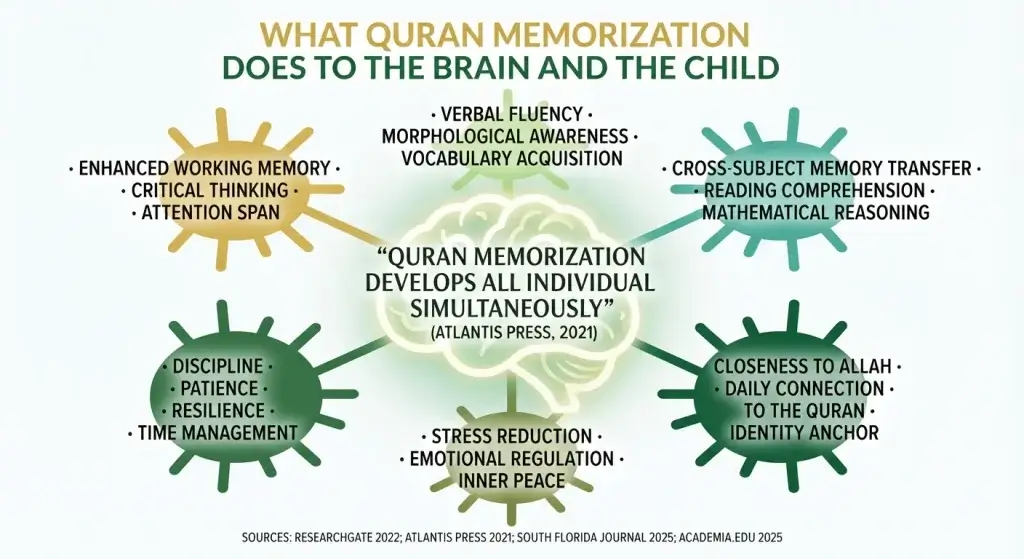
The Prophetic and Quranic Foundation of Hifz
Before the science, the revelation — because the Muslim family’s motivation for Hifz is not primarily neurological. It is theological. And the theological case for Quran memorization is among the most powerful in the entire Islamic tradition.
Allah Commands Measured, Deep Engagement
وَرَتِّلِ الْقُرْآنَ تَرْتِيلًا
“And recite the Quran with measured recitation.”
— Quran 73:4
The word tarteel encompasses more than slow recitation — classical scholars define it as reciting with precision, presence of heart, and full engagement of the mind. Memorization is the most complete form of tarteel available: the hafiz does not read — they recall from within, word by word, with their entire attention.
إِنَّ الَّذِينَ يَتْلُونَ كِتَابَ اللَّهِ وَأَقَامُوا الصَّلَاةَ
“Indeed, those who recite the Book of Allah and establish prayer…”
— Quran 35:29
The Prophetic Promises for the Hafiz and Their Family
The reward structure around Hifz in the authentic Sunnah is among the most documented and most specific in the entire prophetic tradition:
“The one who is proficient in the Quran will be with the noble, righteous angels; and the one who recites the Quran with difficulty, struggling with it, will have a double reward.”
— Sahih al-Bukhari, Hadith 4937; Sahih Muslim, Hadith 798
“The Quran will come on the Day of Judgment and intercede for its companion.”
— Sahih Muslim, Hadith 804
“Whoever reads the Quran, memorizes it, and acts upon it — on the Day of Judgment his parents will be crowned with a crown of light, whose brightness is like the sun.”
— Sunan Abu Dawud, Hadith 1453; authenticated by al-Albani in Sahih Abu Dawud
“It will be said to the companion of the Quran: Read and ascend, and recite as you used to recite in the world. Your rank will be at the last verse you recite.”
— Sunan Abu Dawud, Hadith 1464; Sunan al-Tirmidhi, Hadith 2914; authenticated by al-Albani
This last hadith is particularly significant for parents: every verse memorized by a child is a rank elevated — not just in the next life, but in the formation of the child’s relationship with Allah in this life.
The Greatest Scholars Were Hafiz First
The classical Islamic tradition produced its greatest minds from a foundation of Quran memorization. Imam al-Bukhari memorized the Quran as a child. Imam al-Nawawi completed memorization before the age of ten. Ibn Taymiyyah memorized the Quran at seven. Imam al-Shafi’i at nine. Ibn Kathir by ten.
This is not coincidence. The classical scholars understood — long before neuroscience confirmed it — that Quran memorization was the foundational cognitive training that made everything else possible. The Quran was not simply the first thing they memorized. It was the training ground on which their extraordinary intellectual capacities were built.
Section 1: What Science Says — Quran Memorization and the Developing Brain
The scientific research on Quran memorization and cognitive development has grown substantially in the past decade, with a consistent pattern of findings across multiple countries, methodologies, and age groups.
Working Memory Enhancement
Regular engagement with the Quranic text and its recitation can significantly improve brain activity, memory, and cognitive development. Research has demonstrated that Quranic memorization develops working memory — the cognitive system responsible for temporarily holding and manipulating information — which structural equation modeling has confirmed as the best predictor of general, fluid, and crystallized intelligence in children and adolescents.
Working memory is the cognitive capacity that determines how much information a child can hold in mind while simultaneously processing new information. It predicts performance in mathematics, reading comprehension, problem-solving, and the ability to follow complex instructions. Children with higher working memory capacity consistently outperform their peers across academic subjects — and Quran memorization specifically trains this capacity.
The Neuroscience of Repetition and Memory Consolidation
Studies show that the cognitive activities involved in Quran memorization include far more than text storage; they alter verbal memory, verbal fluency, and cognitive verbal skills in general. Research using neuropsychological measures applied to students engaged in intensive Quran memorization found improvement in verbal fluency and memory scores substantially after three months, indicating that strenuous mental work is carried out during the memorization process.
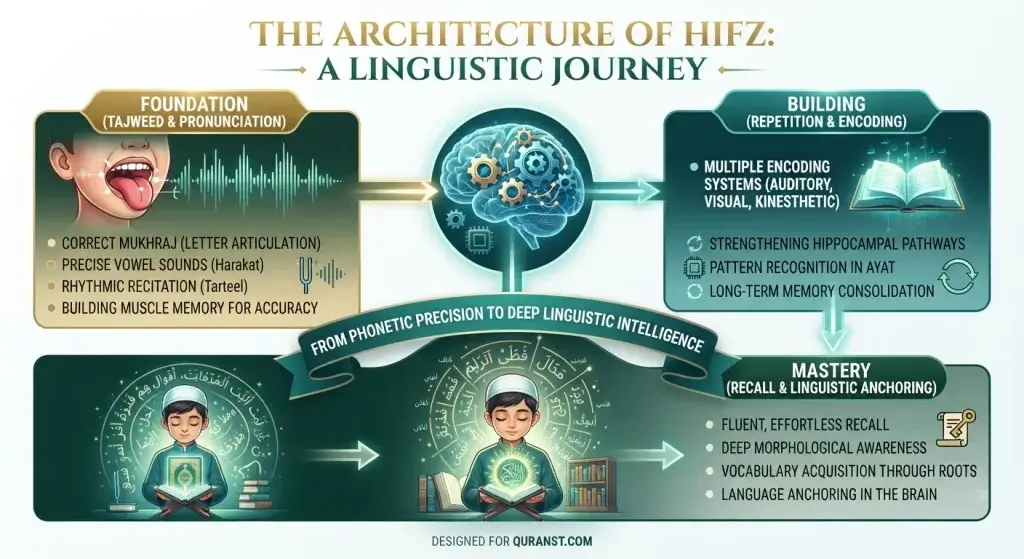
The mechanism is well understood: the repetition required for Hifz — going over the same verses dozens of times until they are retained — triggers the hippocampal memory consolidation processes that strengthen neural pathways and enhance long-term memory formation. But uniquely, the Quran’s rhythmic structure, its internal patterns of sound and meaning, and its Tajweed rules create a multi-layered encoding that engages more memory systems simultaneously than ordinary text memorization.
Early Childhood Brain Development
A case-control study with neuroscience approach published in 2025, involving 316 kindergarten children aged 60–84 months, demonstrated that Quran memorization positively influences early childhood development across six aspects — including cognitive and linguistic skills. Children who memorized more chapters showed significant differences in development compared to those who memorized fewer, with cognitive and linguistic benefits being among the most pronounced.
This finding is significant for Muslim parents making decisions about early education: the years between ages five and eight are not too early for Hifz. They are, in many ways, the optimal window — when the brain’s phonological and memory systems are at their most plastic, and when the Arabic sounds of the Quran can be encoded with the same native-like precision as any other language the child is exposed to.
The Association with Mathematical Reasoning
Research has demonstrated that Quranic memorisation is associated with positive effects on students’ ability to understand mathematics — alongside cognitive intelligence generally. The discipline of pattern recognition, sequential logic, and systematic processing required by Hifz transfers to mathematical reasoning in ways that researchers describe as “provision to mastery of other knowledge.”
This is one of the most counterintuitive findings in the research: a child memorizing an ancient religious text develops skills that improve their mathematics performance. The connection lies in the cognitive demands of both: both require working memory, pattern recognition, disciplined sequential processing, and the ability to hold complex structures in mind while processing sub-components.
Section 2: Academic Achievement — The Unexpected Classroom Benefits of Hifz
The research on Quran memorization and academic performance is consistent across multiple studies and multiple countries:
(cite index=”7-1″>Tarmuji et al. (2022) found a positive relationship between Quran memorisation and students’ academic performance across subjects. Memorising the Quran enhances cognitive abilities, linguistic skills, vocabulary acquisition, reading comprehension, oral communication, public speaking skills, critical thinking, analytical skills, and deep reflection.</cite>
The Transfer Effect: How Hifz Improves Other Subjects
The cognitive skills developed through Hifz do not stay in the domain of religious memorization. They transfer — measurably and substantially — to academic performance across subjects:
Memory capacity transfer: The child who has memorized ten juz of the Quran has developed a memory capacity that makes memorizing historical dates, scientific formulas, and mathematical theorems significantly more efficient. The training wheels of Hifz produce a memory muscle that lifts heavier weights in other domains.
Attention and focus transfer: Hifz requires sustained, precise attention — every letter matters, every vowel mark changes the word. The child who has trained their attention through Hifz has a quality of focus that teachers consistently report as distinctive. These children sit still longer, follow instructions more carefully, and return to interrupted tasks more readily.
Discipline and study habits transfer: The daily practice structure of Hifz — new memorization every day, daily review of previously memorized material, weekly consolidation — is a study habits training program of extraordinary rigor. The child who maintains a Hifz schedule develops study habits that would cost thousands of dollars to teach through executive function coaching.
Oral Communication and Public Speaking
Research identifies oral communication and public speaking skills among the specific academic benefits of Quran memorization. The hafiz who regularly recites in front of teachers, parents, and community members develops a composure with public performance that transfers directly to classroom presentations, debates, and academic discourse.
The Muslim child who stands to recite Quran at a family gathering, a masjid event, or a Hifz competition — doing so repeatedly, in a language they have mastered with precision — develops a confidence with public performance that is genuinely rare. And that confidence, like all the other Hifz-derived skills, follows them into the classroom.
Section 3: Linguistic Intelligence — How Hifz Builds the Language Mind
Perhaps the most academically significant finding in the Quran memorization research is its specific, documented impact on linguistic intelligence — the cognitive capacity for language processing, vocabulary acquisition, and morphological awareness.
Morphological Awareness: The Root of Linguistic Intelligence
A 2025 study published in the South Florida Journal of Development examined the role of memorizing the Quran in developing morphological awareness among third-grade elementary students. The study found significant differences between the average scores of students who memorized the Quran compared to those who did not, in morphological awareness measures — the cognitive ability to recognize, analyze, and manipulate word parts such as roots, prefixes, and suffixes.
Morphological awareness is one of the strongest predictors of reading comprehension and vocabulary acquisition. And Arabic, as a root-based language, trains morphological awareness with extraordinary depth: every Arabic word derives from a trilateral root, and knowing the root unlocks the meaning of dozens of derived words simultaneously.
The child who memorizes the Quran is — whether they know it or not — mastering a root-based vocabulary system of extraordinary richness. Every verse contains words that their root connects to dozens of other Quranic words. The hafiz who understands even basic Arabic grammar discovers that their memorized Quran contains a complete vocabulary system they can begin to decode.
Verbal Fluency and Memory
Research studies demonstrate that Quran memorization alters verbal memory, verbal fluency, and cognitive verbal skills in general — and that these improvements are measured not just on Islamic content but on general verbal tasks.
Verbal fluency — the ability to produce language quickly and accurately, to access vocabulary under time pressure, to organize thoughts into words efficiently — is the cognitive skill that underlies academic writing, classroom participation, and intellectual discourse. The hafiz demonstrates measurably higher verbal fluency than age-matched peers who have not engaged in intensive memorization practice.
The Quranic Arabic Advantage
For the Muslim child specifically, Quran memorization offers a linguistic advantage unavailable through any other educational pathway: deep familiarity with classical Arabic — one of the most grammatically sophisticated and lexically rich languages in human history.
The 1,750 root words of the Quran, memorized through Hifz and understood through Quranic Arabic study, provide access to a vocabulary that underlies not only classical Arabic literature but a substantial portion of modern Arabic’s core vocabulary. The hafiz who subsequently learns Arabic grammar finds that they already know thousands of words — they simply need to understand their structure.
This is why the classical Islamic tradition always paired Hifz with Arabic grammar study (Nahw): the memorized Quran and the grammar framework are two halves of the same key to the greatest library in Islamic civilization.
Section 4: Character Formation — The Qualities Hifz Builds Invisibly
Beyond the cognitive and academic benefits that researchers measure, Hifz builds a set of character qualities that are among the most valuable a child can possess — and that no standardized test captures.
Patience and Long-Term Thinking
Hifz cannot be rushed. The child who attempts to rush memorization without adequate review will lose verses faster than they gain them. The Hifz journey teaches — through direct, unavoidable experience — that excellence is built slowly, through consistent daily effort, over months and years.
This is the character lesson of Hifz that transfers most powerfully to adult life: the capacity for long-term thinking, for delayed gratification, for the willingness to invest in something whose fruits will not arrive for years. In a culture of instant gratification and overnight success stories, the hafiz carries an experiential understanding that most adults never develop.
Discipline and Self-Regulation
The daily Hifz schedule — new memorization in the morning, review of recent portions in the afternoon, weekly consolidation of older portions — is a self-regulation training program of extraordinary consistency. The child who maintains this schedule across months and years develops executive function skills (planning, monitoring, self-correction) that are among the most powerful predictors of adult success across every domain.
Resilience Through Forgetting
Every hafiz experiences the same painful lesson at some point: verses that felt perfectly memorized disappear. The chapter that seemed solid crumbles under the pressure of a week without review. And then it has to be rebuilt — again, patiently, from the beginning.
This experience of forgetting and re-memorizing is not a failure of the Hifz process. It is the character-building core of it. The child who learns to respond to forgetting not with despair but with calm re-engagement — who accepts that this is the nature of the work and begins again — has learned one of the most valuable life skills available: resilience in the face of apparent regression.
The Prophet ﷺ acknowledged this reality while simultaneously establishing the importance of consistent review:
“Maintain the Quran, for by the One in Whose Hand is the soul of Muhammad, it escapes more quickly than a camel from its tying rope.”
— Sahih al-Bukhari, Hadith 5033; Sahih Muslim, Hadith 791
Humility Before Knowledge
The hafiz who understands what they are memorizing — who has studied Quranic Arabic and knows that what they carry in their chest is the speech of Allah — develops a quality of intellectual humility that is increasingly rare: the recognition that the greatest knowledge is always beyond complete human mastery, and that the appropriate response to great knowledge is not pride but gratitude.
This is the adab (proper comportment) that the classical scholars described as the first and most important fruit of true Islamic education:
Ibn al-Qayyim, in Miftah Dar al-Sa’adah:
“Knowledge calls to action. If it is answered, it stays. If it is not answered, it departs.”
The hafiz who lives what they memorize — who allows the Quran they carry in their chest to shape how they treat people, how they use their time, how they respond to difficulty — is the hafiz whose memorization becomes character.
Section 5: Emotional and Psychological Benefits
The research on Quran engagement and emotional wellbeing is consistent with the Islamic tradition’s understanding of the Quran as a healing and stabilizing force:
وَنُنَزِّلُ مِنَ الْقُرْآنِ مَا هُوَ شِفَاءٌ وَرَحْمَةٌ لِّلْمُؤْمِنِينَ
“And We send down of the Quran that which is healing and mercy for the believers.”
— Quran 17:82
A scoping review examining 21 studies on the benefits of reciting, listening to, and memorizing the Quran found that memorization enhances cognitive abilities and fosters a deeper understanding of Islamic principles. Engaging in Quranic memorization improves mental health among individuals, which in turn enhances cognitive functioning and facilitates the learning process. Additionally, lowered stress levels and improved emotional regulation due to Quran recitation lead to better sleep efficiency.
The Hafiz’s Relationship with Stress
The child who has memorized substantial portions of the Quran has, embedded in their memory, a repository of divine consolation available at any moment of difficulty. When anxiety arrives — before an exam, during a conflict, in a moment of doubt — the hafiz has immediate access to verses that directly address their situation.
أَلَا بِذِكْرِ اللَّهِ تَطْمَئِنُّ الْقُلُوبُ
“Verily, in the remembrance of Allah do hearts find rest.”
— Quran 13:28
This is not merely spiritual metaphor. The neuroscience of memory recall demonstrates that recalling emotionally significant, positively encoded material activates the brain’s reward and calming pathways — precisely the mechanism that underlies the tranquility the Quran describes.
Identity Stability in a Turbulent World
For Muslim children growing up in the West — navigating the identity pressures of minority status, Islamophobia, peer pressure, and the constant question of who they are and where they belong — the Quran memorized in the chest is an identity anchor of extraordinary stability.
The child’s entire development is affected by the activity of Quranic memorization — including the social-emotional dimension. Research identifies character formation and identity strengthening among the consistent benefits of Hifz programs.
The hafiz who is challenged about their identity — who is told, subtly or explicitly, that being Muslim makes them “other” — has something that no social pressure can take away: the words of Allah, memorized and living in their chest, reminding them in their own voice of who they are and Whose they are.
Section 6: How to Build a Hifz Journey for Your Child — Practically
The decision to support a child in Quran memorization is one of the most significant educational investments a Muslim family can make. Here is a practical framework for doing it well:
The Prerequisites Before Beginning
Correct recitation first: Hifz begun with incorrect pronunciation becomes incorrect Hifz — and incorrect Hifz is extremely difficult to correct later. Before beginning memorization, the child should have solid Tajweed foundations — correct Makhraj (letter articulation) and at minimum the basic Nun Sakinah and Madd rules. This is why Tajweed and Hifz are always paired in the classical tradition. Online Quran classes with a certified Online Quran teacher should address Tajweed before or alongside early memorization.
Quranic Arabic vocabulary alongside Hifz: Memorization without understanding is possible — and the Prophet ﷺ promised reward even for the one who struggles. But understanding transforms memorization from a phonetic exercise into a living conversation with Allah. Even basic Quranic Arabic vocabulary — the 200 most frequent words — dramatically deepens the Hifz experience.
A sustainable daily schedule: Hifz requires daily contact with the material. Even 15–20 minutes of new memorization per day, combined with daily review, produces extraordinary results over time. The family that attempts to memorize 2 pages per day but maintains it only three days per week will fall behind the family that memorizes half a page per day but maintains it every single day.
The Three-Part Daily Structure
The classical methodology for Hifz divides daily practice into three components:
| Component | What It Is | How Long |
|---|---|---|
| Sabaq (New lesson) | Today’s new memorization | 15–30 minutes |
| Sabqi (Recent review) | Review of the last 7–10 days’ memorization | 15–20 minutes |
| Manzil (Old lesson) | Review of older, previously solidified material | 10–15 minutes |
This three-part structure ensures that new material is being added while previously memorized material is being maintained. Skipping the review components is the single most common cause of Hifz breakdown — new material is added faster than old material can be retained.
The Role of the Online Quran Teacher
The quality of the teacher-student relationship is the single most important variable in successful Hifz — more important than the curriculum, more important than the schedule, more important than the student’s natural aptitude.
A certified Online Quran teacher who specializes in Hifz provides:
- Real-time Tajweed correction — preventing the bad habits that become permanent if uncorrected early
- Pacing calibration — ensuring the student is moving at the right speed: fast enough to maintain momentum, slow enough to ensure genuine retention
- Review management — tracking which portions need revision and scheduling it systematically
- Motivation and accountability — the single weekly session that the student knows is coming creates a structural incentive that no self-directed approach can match
Setting Realistic Milestones
Hifz is a multi-year journey. Families that approach it with realistic expectations maintain it; those who expect completion in one year often abandon it in frustration.
Realistic timelines for different practice intensities:
| Daily Practice | Estimated Full Hifz Completion |
|---|---|
| 15 minutes/day (half page new + review) | 6–8 years |
| 30 minutes/day (one page new + review) | 3–4 years |
| 1 hour/day (structured intensive) | 2–3 years |
| Full-time Hifz school | 1–2 years |
For Muslim families in the West whose children attend regular school, the 30-minute daily model — one page of new memorization per day, every day — is the most sustainable path. Over three to four years of consistent daily practice, a child completes one of the greatest achievements available to any human being: carrying the entire Book of Allah in their chest.
Section 7: The Challenges Are Real — and So Are the Solutions
Every Hifz journey encounters challenges. Understanding the most common ones — and their specific solutions — prevents them from becoming permanent stops.
Challenge 1: Resistance from the Child
Why it happens: The child experiences Hifz as another obligation in an already full schedule. The intrinsic motivation of the religious reward is not yet visible to a seven-year-old who experiences the daily practice as effort without immediate payoff.
The solution: Make the experience positive first. Celebrate small milestones loudly and specifically. Connect each memorized surah to its meaning — the child who knows what Surah Al-Duha says, who has heard the story of its revelation, who understands that Allah was directly consoling His Prophet through it — memorizes it with a completely different quality of engagement. Online Quran classes that integrate meaning alongside memorization transform resistance into genuine investment.
Challenge 2: Forgetting Previously Memorized Material
Why it happens: Without systematic daily review, the human memory consolidation process naturally decays — even for material that felt completely secure.
The solution: The three-part daily structure (Sabaq/Sabqi/Manzil) is specifically designed to prevent this. Never add new material without first reviewing old material. The Manzil review — even 10 minutes of older sections daily — is what separates the hafiz who retains from the one who continually re-memorizes the same material.
Challenge 3: Inconsistency Due to Family Schedule Pressures
Why it happens: School examinations, sports seasons, travel, illness, Ramadan adjustments — the Western family’s schedule contains regular disruptions that break the daily Hifz rhythm.
The solution: Plan for disruption rather than pretending it won’t happen. Before exam weeks, reduce new memorization but maintain review. During travel, use audio review in the car as a substitute for sitting practice. Establish that the minimum — even five minutes of review — is non-negotiable regardless of the day’s pressures. Consistency over intensity: a perfect five minutes daily beats a perfect hour weekly.
Challenge 4: Lack of Community and Recognition
Why it happens: In non-Muslim majority environments, the hafiz’s achievement is not celebrated or recognized by the dominant culture — unlike sporting achievements or academic awards.
The solution: Build the recognition within the Muslim community. Hifz competitions, masjid recitation events, family celebrations of memorization milestones, and community acknowledgment of the hafiz’s achievement provide the social recognition that sustains motivation across years.
Structured Curriculum Framework
quranst’s Hifz track pairs Quran memorization with Tajweed instruction, Quranic Arabic vocabulary, and regular milestone celebrations — providing the complete support structure for a successful Hifz journey for Muslim children in the West.
Book your free 2-session trial →Conclusion: The Most Valuable Thing You Can Put in a Child’s Chest
In the year 2025, parents invest enormous resources in their children’s futures.
Music lessons. Sports academies. Math tutoring. Coding camps. Foreign language programs. SAT preparation. The entire infrastructure of competitive educational preparation — designed to produce a child who will succeed in a world that measures intelligence in grades, in test scores, in professional credentials.
All of it is valuable. None of it comes close to what Hifz provides.
The child who memorizes the Quran carries in their chest:
- Enhanced working memory that lifts every other cognitive task
- Verbal fluency and morphological awareness that gives them linguistic advantages across every academic domain
- Discipline, patience, and resilience built through years of daily practice and recovery from forgetting
- A direct, personal relationship with the words of Allah — available at any moment, in any circumstance, without a phone or a book or an internet connection
- An identity anchor that no social pressure can dislodge
- An intercessor on the Day of Judgment whose advocacy is guaranteed by the Prophet ﷺ himself
The cognitive benefits are real. The academic advantages are documented. The character formation is profound.
But ultimately, the Muslim parent’s reason for supporting their child’s Hifz is not primarily neurological. It is the same reason Ibrahim ﷺ made his famous supplication:
رَبِّ هَبْ لِي مِنَ الصَّالِحِينَ
“My Lord, grant me from among the righteous.”
— Quran 37:100
The righteous child. The child whose chest carries the Book of Allah. The child who will recite over their parents’ graves and ascend, verse by verse, to the rank assigned to them by the last verse they memorized.
That is what Hifz builds.
Every verse memorized is a step toward that child.
Begin today.
إِنَّ الَّذِينَ يَتْلُونَ كِتَابَ اللَّهِ وَأَقَامُوا الصَّلَاةَ وَأَنفَقُوا مِمَّا رَزَقْنَاهُمْ سِرًّا وَعَلَانِيَةً يَرْجُونَ تِجَارَةً لَّن تَبُورَ
“Indeed, those who recite the Book of Allah and establish prayer and spend from what We have provided them, secretly and publicly, expecting a transaction that will never perish.”
— Quran 35:29
🟢 Begin Your Child’s Hifz Journey with Certified Online Quran Teachers
The decision to memorize the Quran is made in a moment. The journey that follows requires structured support, qualified instruction, and a community that understands both the demands of Hifz and the specific context of raising Muslim children in the West.
quranst’s Quran memorization track provides:
Hifz with Certified Online Quran Teachers:
- Live, one-on-one Quran lessons with certified Hifz instructors
- Real-time Tajweed correction — every letter articulated correctly from the beginning
- The three-part daily structure (Sabaq/Sabqi/Manzil) managed by the teacher
- Progress tracking and milestone celebration
Quran Reading and Tajweed Foundation:
- For children who need to establish correct Quran reading before beginning Hifz
- Online Quran classes with Tajweed — all rules taught in sequence and applied immediately
- Online Quran teacher certified in multiple Tajweed traditions
Quranic Arabic alongside Hifz:
- Learn Arabic vocabulary as you memorize — connect every surah to its meaning
- Quranic Arabic grammar — the classical Arabic that unlocks the Quran’s depth
- Learn Quran with understanding, not just sound
For Muslim Families in the West:
- Flexible scheduling around school and family commitments
- Online Quran classes available across all time zones
- Serving the USA, Canada, UK, Australia, Gulf, and global diaspora communities
👇 Begin with Two Free Quran Lessons
Two Ways to Begin
“Whoever reads the Quran, memorizes it, and acts upon it — on the Day of Judgment his parents will be crowned with a crown of light.”
— Sunan Abu Dawud, Hadith 1453; authenticated by al-Albani
Begin the memorization. Earn the crown.
بِسْمِ اللَّهِ — Begin.
References and Sources
Quranic References
- Quran 13:28 — “In the remembrance of Allah do hearts find rest”
- Quran 17:82 — “We send down of the Quran that which is healing and mercy”
- Quran 35:29 — “Those who recite the Book of Allah expecting a transaction that will never perish”
- Quran 37:100 — Du’a of Ibrahim for righteous offspring
- Quran 73:4 — “Recite the Quran with measured recitation”
Hadith References
- Sahih al-Bukhari, Hadith 4937; Sahih Muslim, Hadith 798 — Proficiency in Quran and double reward for the one who struggles
- Sahih al-Bukhari, Hadith 5033; Sahih Muslim, Hadith 791 — “Maintain the Quran — it escapes more quickly than a camel”
- Sahih Muslim, Hadith 804 — The Quran interceding for its companion
- Sunan Abu Dawud, Hadith 1453 — Crown of light for parents of the hafiz (authenticated by al-Albani)
- Sunan Abu Dawud, Hadith 1464; Sunan al-Tirmidhi, Hadith 2914 — Rank determined by last verse recited (authenticated by al-Albani)
Classical Scholarly Works
- Ibn al-Qayyim al-Jawziyyah: Miftah Dar al-Sa’adah. Dar Ibn ‘Affan. (Knowledge calling to action)
Peer-Reviewed Academic Sources
- Atlantis Press, ICECE-20 Proceedings (2021). “The Positive Impact of Memorizing the Qur’an on Cognitive Intelligence of Children.” Literature review. Key findings: 4 positive cognitive impacts — sharper memorization, stimulated critical thinking, provision for other knowledge mastery, support for academic achievement.
- ResearchGate / Multiple studies reviewed (2025). “The Effect of Memorizing Quran on the Children Cognitive Intelligence.” Key findings: Quranic memorization associated with cognitive intelligence (Slamet, 2019); positive association with ability to understand mathematics (Jalaludin, 2024); verbal fluency and memory improvements documented.
- ResearchGate (2022). “Linking Study of Memorising Quran with Academic Performance.” Scoping review of 21 studies. Key findings: Positive relationship between Quran memorization and academic performance (Tarmuji et al., 2022); cognitive abilities, linguistic skills, vocabulary acquisition, reading comprehension, oral communication, public speaking, critical thinking, and analytical skills all enhanced.
- ResearchGate / Malaysian cross-sectional study. “Does Quran Memorization Influence Intelligence Quotient and Memory Level? A Cross-Sectional Study in Malaysia.” Key findings: Regular engagement with Quranic text significantly improves brain activity, memory, and cognitive development; working memory confirmed as best predictor of general intelligence in structural equation modeling.
- Academia.edu (2025). “Quran memorization and early childhood development: a case-control with neuroscience approach.” 316 kindergarten children aged 60–84 months. Key findings: Significant differences in cognitive and linguistic development between children who memorized more vs fewer Quran chapters.
- Kiddo Quran (June 2025). “The Impact of Memorizing the Holy Quran on Increasing Intelligence and Brain Abilities in Children.” Key findings: Verbal memory, verbal fluency, and cognitive verbal skills altered by Quran memorization; neuropsychological measures show substantial improvement after 3 months of intensive study.
- South Florida Journal of Development, Vol. 6 No. 4 (2025). “The role of memorizing the Holy Quran in developing morphological awareness among third grade elementary students.” DOI: 10.46932/sfjdv6n4-032. Key findings: Significant differences in morphological awareness between students who memorized Quran vs those who did not.
Frequently Asked Questions
How does Quran memorization (Hifz) improve a child’s academic achievement?
What are the cognitive and linguistic benefits of Hifz for children?
What is the recommended daily structure for a successful Hifz journey?
- Sabaq: Learning a new memorization portion daily (15–30 minutes).
- Sabqi: Reviewing the recent 7 to 10 days of memorized text.
- Manzil: Consistent daily revision of older, previously solidified portions to prevent forgetting.
