

Introduction: The Family That Plans, Builds
Every successful organization has a strategic plan.
The hospital has a five-year plan. The school district has a curriculum roadmap. The startup has a product roadmap, a growth strategy, and quarterly objectives with measurable key results.
And then the CEO of that hospital goes home to their children — the most important project of their life — and operates entirely on instinct, reaction, and the hope that things will work out.
As Hena Zuberi asks in her guide to Islamic family planning for 2025: “If launching software or passing a law requires a detailed plan, why should our lives and families be any different? No successful project — or family — thrives without a clear roadmap.”
This is the paradox of modern parenting — and Muslim parenting specifically. We plan everything except the thing that matters most.
The child who will stand before Allah one day. The young adult who will carry Islam into the next generation. The human being who will be asked, on the Day of Judgment, “How did you spend your life? How did you use your youth? What did you do with what you knew?” — and whose answers will have been shaped, more than anything else, by what happened in their family home between the ages of zero and eighteen.
This guide is about planning that.
Not a rigid schedule. Not an impossible standard. But a genuine strategic framework — grounded in the Quran, the Sunnah, and the best of contemporary educational research — for Muslim families who want to raise their children with intentionality, not merely with love.
Because love without intention produces children who are loved. Intention without love produces children who are managed. But love with intention produces children who are formed — whose faith is genuine, whose skills are real, and whose character has been deliberately built by the people who know them best.
Structured Curriculum Framework
quranst partners with Muslim families to deliver structured Islamic education — Quran memorization, Tajweed, Arabic language, and Islamic studies — as part of a coherent, long-term plan for your child’s faith development.
Book your free 2-session trial →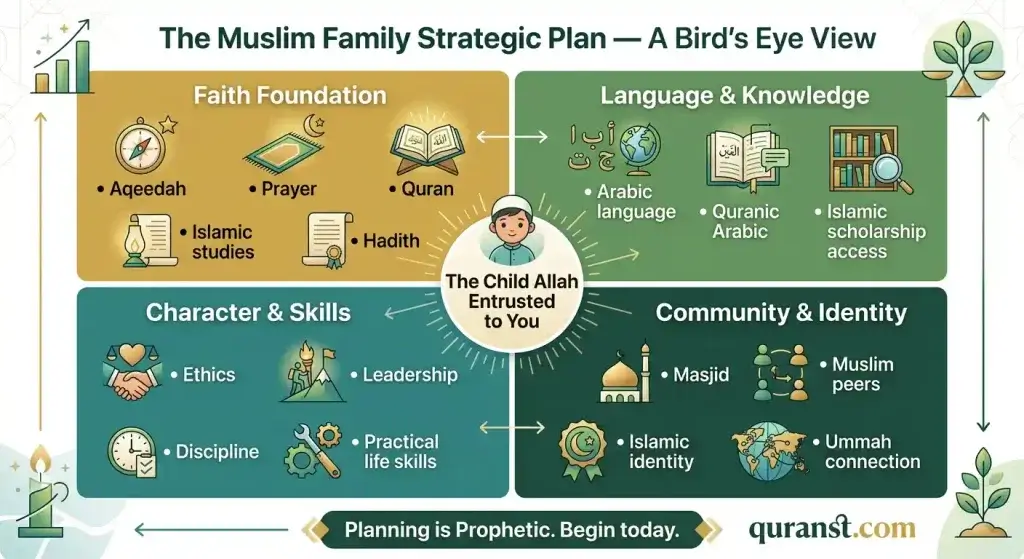
The Islamic Case for Strategic Planning
Before the practical framework, the theological motivation — because the Muslim parent who understands why planning is an Islamic virtue will plan with a quality of intention that cannot be manufactured through organizational tools alone.
Planning Is a Prophetic Practice
The Prophet Muhammad ﷺ emphasized: “If the Hour is about to be established and one of you has a sapling in his hand, let him plant it.” [Sahih, authenticated by al-Albani]. This hadith emphasizes taking proactive and meaningful action, even in the face of overwhelming circumstances. It encourages believers to always prepare and contribute positively, no matter how small the act may seem.
The planting of a sapling — when the world is ending — is not irrationality. It is the prophetic insistence that the future is always worth preparing for, that intentional action is always superior to paralysis, and that the believer’s orientation is always forward, always building, always acting as though the next generation matters.
The Prophet ﷺ also said:
“The intelligent person is the one who controls his desires and prepares for what comes after death.”
— Sunan al-Tirmidhi, Hadith 2459; classified as Hasan
And in the famous hadith of Ibn Abbas:
“Take advantage of five before five: your youth before your old age, your health before your illness, your wealth before your poverty, your free time before you become occupied, and your life before your death.”
— Musnad Ahmad, Hadith 458; authenticated by al-Albani, Sahih al-Jami’, 1077
This is a strategic planning framework in prophetic language: identify the windows of opportunity, plan for their use before they close, and act before circumstances remove the option.
The childhood years — particularly the first fifteen — are the most significant window of opportunity in the entire arc of a person’s life. They are the years when the brain is most plastic, when values are most easily encoded, when habits are most naturally formed, when the relationship between parent and child is most direct and most influential.
Planning for those years is not a Western management concept grafted onto Islamic tradition. It is Islamic tradition, articulated in prophetic language fourteen centuries ago.
The Parental Trust (Amanah)
The most important Islamic framework for parenting is the concept of amanah — trust. The child is not a possession. They are a trust given by Allah to the parent — with the expectation that the parent will fulfill the responsibilities of that trust.
يَا أَيُّهَا الَّذِينَ آمَنُوا قُوا أَنفُسَكُمْ وَأَهْلِيكُمْ نَارًا
“O you who have believed, protect yourselves and your families from a Fire.”
— Quran 66:6
The protection of the family from the Fire is not passive. It is active — it requires knowing what produces that protection (faith, knowledge, character, practice) and deliberately building it.
A parent who has a strategic plan for their child’s faith and skill development is not being overly ambitious. They are fulfilling the amanah with the seriousness it deserves.
Section 1: The Vision — What Are You Actually Raising?
Before milestones, timelines, and curriculum choices — a prior question that most family planning frameworks skip entirely:
What does success look like?
Not success by the world’s metrics. Not the highest-earning adult. Not the most academically decorated. Not the one who appears most Islamic on social media.
The Islamic definition of a successfully raised child is captured in one prophetic statement:
“When a person dies, all action is cut off except three: ongoing charity, knowledge that benefits, or a righteous child who prays for him.”
— Sahih Muslim, Hadith 1631
The righteous child who prays for their parent after their death. This is the Islamic success metric for parenting. And it has three dimensions:
1. Righteousness (Salah): the child is genuinely good — not merely compliant, but morally formed. Their honesty is real. Their compassion is real. Their relationship with Allah is personal, chosen, and sustained without parental enforcement.
2. Connection (they pray for their parent): the relationship between parent and child is warm enough — even after death — that the child still thinks of them, still loves them, still prays for them. This is not produced by authority. It is produced by love.
3. Knowledge (they can pray): the child knows how to make du’a, knows the words, knows the Islamic framework through which supplication is made. This requires Islamic education — Islamic studies, Hadith, Aqeedah, Fiqh, the Quran.
These three dimensions — righteousness, connection, and knowledge — are the three pillars of the Muslim family’s strategic vision. Every element of the plan below serves one or more of these three.
Section 2: The Four Pillars of Your Child’s Strategic Plan
The Muslim family’s strategic plan for a child’s development rests on four pillars — corresponding to the four dimensions of a complete human being in the Islamic framework:
Pillar 1: Faith Foundation (Al-Aqeedah wa al-‘Ibadah)
What it covers: The child’s beliefs, their relationship with Allah, their practice of worship, and their Islamic identity.
The milestones:
- Correct Islamic creed (Aqeedah) — who Allah is, what Islam is, why it is true
- The five pillars practiced correctly and understood deeply
- Quran relationship — recitation, memorization, and comprehension
- Daily adhkar and du’a — the child who prays to Allah regularly has a living relationship with their Creator
The enemies of this pillar: Distraction (screens, busyness), shame (Islam presented as restriction), disconnection (the parent who is not present), and ignorance (Aqeedah never explicitly taught).
Pillar 2: Knowledge and Language (Al-‘Ilm wa al-Lughah)
What it covers: Islamic studies, Quranic Arabic, Arabic language, and access to the Islamic scholarly tradition.
The milestones:
- Study Islam online through structured, qualified Islamic education
- Arabic for beginners through to functional classical Arabic literacy
- Learn Quran with Tajweed — correct recitation from a certified Online Quran teacher
- Quranic Arabic vocabulary — understanding what is recited in prayer
- Access to Hadith collections and Islamic scholarship in Arabic
The enemies of this pillar: Treating Islamic education as optional or supplementary, absence of Arabic language development, and Islamic studies programs that focus on information without understanding.
Pillar 3: Character and Ethics (Al-Akhlaq)
What it covers: The child’s honesty, compassion, justice, courage, self-discipline, and the other moral qualities that Islamic tradition considers the fruit of genuine faith.
The milestones:
- Truthfulness — demonstrated in difficult moments, not just easy ones
- Compassion — for family, friends, the broader community, and those in need
- Responsibility — age-appropriate tasks, consequences, and trust
- Self-discipline — the capacity to delay gratification, maintain commitments, and regulate behavior
The enemies of this pillar: Inconsistent correction, modeling that contradicts teaching, Islam presented as ritual without ethics, and the absence of genuine responsibility given to the child.
Pillar 4: Community and Identity (Al-Huwiyyah wa al-Intima’)
What it covers: The child’s sense of belonging to the Muslim ummah, their pride in Islamic civilization, their integration into a Muslim community, and their ability to navigate the world as a confident Muslim.
The milestones:
- Active masjid participation — not just attendance but belonging
- Muslim peer network — friends who share their values and their challenges
- Knowledge of Islamic history and civilization — the intellectual inheritance they carry
- Confidence in their Islamic identity in non-Muslim environments
The enemies of this pillar: Isolation from Muslim community, shame about Islamic identity, absence of Muslim peers, and disconnection from Islamic history and civilization.
Section 3: The Faith Development Roadmap — Ages and Milestones
Ages 0–3: The Foundation of Sound and Love
At this stage, the child cannot be taught Islam intellectually. But they can receive the sounds and the feelings that will shape their relationship with Islam for life.
Faith milestones for this period:
- Hears the adhan at birth (Sunnah of the Prophet ﷺ)
- Grows up hearing Quranic recitation as the sound of home
- Hears Bismillah before every meal, Alhamdulillah after, SubhanAllah when something beautiful is observed
- Experiences the warmth of parents who visibly love their religion
The investment: At this age, the investment is entirely in the parent’s own practice. The child who sees a parent stop everything for Salah, who hears Quran in the home, who feels the warmth of a family that loves Allah — that child enters age three with an emotional foundation for Islam that no classroom can produce.
Ages 3–7: Words, Stories, and First Practices
Faith milestones for this period:
- Knows “Allahu Ahad” — the simplest statement of Tawhid — by heart and by understanding
- Can recite Al-Fatiha with basic understanding of its meaning
- Knows the first pillar: “La ilaha illa Allah, Muhammadun Rasul Allah” — and knows what it means
- Prays with the family — not as obligation but as joy
- Knows the stories of the prophets as living narratives, not historical facts
The quranst investment at this stage:
- Online Quran classes for correct letter pronunciation and early Quran reading
- Quranic Arabic — the first 50 high-frequency words, connected to the surahs being memorized
- Islamic studies — Aqeedah for young children, prophet stories, basic du’as
Ages 7–12: Structure, Knowledge, and Deepening Practice
This is the stage when the child moves from feeling Islam to knowing Islam. The Prophet ﷺ commanded that children be instructed to pray at seven — and this is the age when Islamic education becomes explicit and structured.
Faith milestones for this period:
- Full, correct prayer with understanding of every word recited
- Completion of Juz’ ‘Amma memorization (minimum) with Tajweed
- Basic Aqeedah — the six pillars of Iman and their implications
- Basic Fiqh — the jurisprudence of worship: the conditions, pillars, and invalidators of prayer, Wudu, fasting
- Familiarity with the major stories of the Seerah — not just facts but character lessons
- Hadith collection — ten to twenty foundational hadith memorized with understanding
The quranst investment at this stage:
- Quran memorization (Hifz) — structured, daily, with a certified Online Quran teacher
- Tajweed — all major rules applied and practiced in recitation
- Islamic studies — Aqeedah, Fiqh, Seerah, Hadith — through our structured Islamic education curriculum
- Arabic language — functional Quranic Arabic, the 200 most frequent Quranic words
- Study Islam online — through live, one-on-one sessions that accommodate the school schedule
Ages 12–18: Understanding, Conviction, and Ownership
This is the stage that determines whether the faith the family built survives the pressures of adolescence and young adulthood. The goal shifts from instruction to conviction — the child must now own their faith, not merely inherit it.
Faith milestones for this period:
- Can explain and defend Islamic beliefs intellectually — knows why Islam is true
- Understands the wisdom behind Islamic rulings — not just compliance but comprehension
- Has their own practice of voluntary worship (Tahajjud, Sunnah prayers, dhikr)
- Can read Quranic Arabic with comprehension — understands the Quran they recite
- Has engaged with classical Islamic scholarship — at least in translation, with Arabic access developing
- Knows Islamic history and civilization — and feels pride in this heritage
The quranst investment at this stage:
- Advanced Quranic Arabic — classical Arabic grammar (Nahw) that opens the Quran
- Advanced Islamic studies — engagement with scholarly tradition, contemporary Islamic thought
- Quran completion — completing or significantly advancing Hifz
- Online Arabic tutor — conversational Arabic fluency for full access to the Arabic-speaking ummah
Section 4: The Skills Development Roadmap
The Muslim family’s strategic plan covers not only faith but the full range of skills that equip the child for life as a confident, competent Muslim adult.
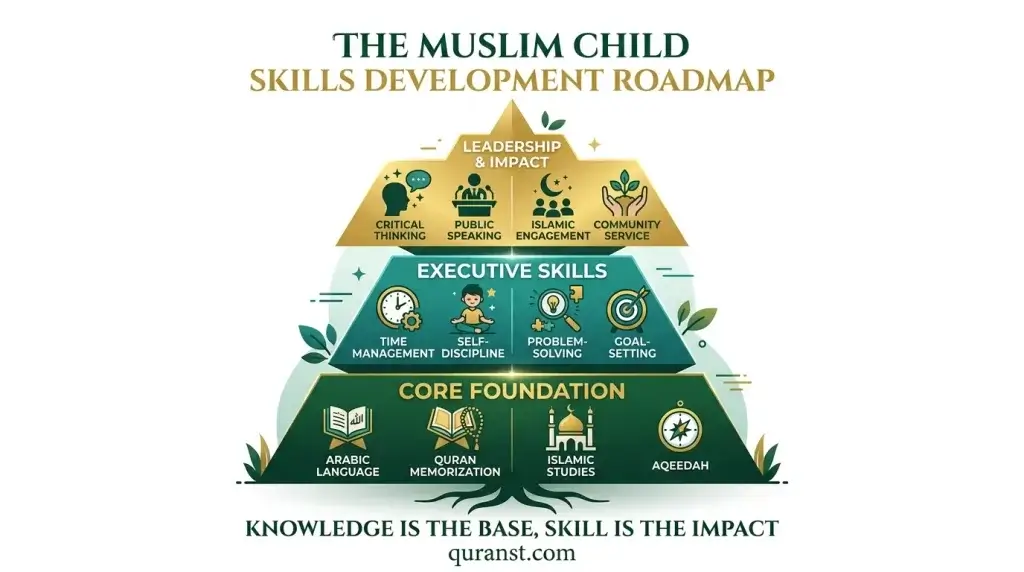
The Skill Pyramid
              LEADERSHIP
           Public speaking
        Critical thinking + debate
      Islamic intellectual engagement
    Problem-solving + project management
  Time management + self-discipline
Arabic language + Quran + Islamic studies
The base: Arabic language, Quran, and Islamic studies — the foundation on which everything Islamic builds.
The middle: Self-discipline, time management, and problem-solving — the executive function skills that determine whether the child can execute on their faith and their ambitions.
The upper levels: Critical thinking, public speaking, debate, and leadership — the skills that allow the Muslim young adult to contribute to their community and the world.
Skills by Age
| Age Range | Priority Skills | How to Build Them |
|---|---|---|
| 3–7 | Listening, following instructions, basic responsibility | Age-appropriate chores, clear expectations, consistent boundaries |
| 7–12 | Reading, memorization, study habits, basic time management | Hifz discipline, school support, structured daily schedule |
| 12–15 | Critical thinking, research, public speaking | Islamic debating, Quran tafsir discussions, school presentations |
| 15–18 | Leadership, independent learning, career exploration | Community volunteer roles, Islamic projects, mentorship |
Section 5: quranst as Your Strategic Education Partner
The family strategic plan described in this guide requires structured educational support that most families cannot provide entirely from within the home.
This is precisely where quranst serves as your long-term Islamic education partner — not a one-off tutoring service, but a structured curriculum partner that delivers specific, measurable milestones across the faith and language pillars of your child’s strategic plan.
What quranst Delivers in Your Child’s Strategic Plan
Faith Pillar — Quran Track:
- Learn Quran from the alphabet through complete Hifz, with a certified Online Quran teacher
- Online Quran classes — live, one-on-one, real-time Tajweed correction
- Quran memorization — the three-part daily structure (Sabaq/Sabqi/Manzil) managed professionally
- Quran lessons customized to your child’s current level and pace
Knowledge Pillar — Islamic Studies Track:
- Islamic studies — structured curriculum covering Aqeedah, Fiqh, Seerah, Hadith, and Tafsir
- Study Islam online — sessions scheduled around your family’s existing commitments
- Age-appropriate Islamic education from ages 5 through 18
- Teachers trained in Islamic scholarship who understand the Western Muslim experience
Language Pillar — Arabic Language Track:
- Learn Arabic — from Arabic for beginners through classical Arabic grammar
- Quranic Arabic — vocabulary and grammar connected to the Quran being memorized
- Online Arabic tutor — live, one-on-one, native-speaking instructors
- Speak Arabic fluently — conversational Arabic development alongside classical study
- Arabic language — classical Arabic and Modern Standard Arabic, built systematically
The quranst Curriculum Map in Your Strategic Plan
| Child’s Age | quranst Focus | Strategic Goal Served |
|---|---|---|
| 5–7 | Quran reading + first 50 Quranic words | Faith foundation + language basics |
| 7–10 | Tajweed + Juz’ ‘Amma Hifz + Aqeedah | Faith structure + knowledge pillar |
| 10–13 | Hifz continuation + Islamic studies + Arabic grammar | Faith depth + language access |
| 13–16 | Quranic Arabic + advanced Islamic studies + Seerah | Intellectual conviction + identity |
| 16–18 | Classical Arabic + Quran completion + scholarly access | Independent Islamic learning |
Structured Curriculum Framework
Every quranst enrollment includes a placement assessment, a personalized learning plan, and regular progress reports — so your child’s quranst education fits precisely into your family’s strategic plan.
Book your free 2-session trial →Section 6: The Annual Family Review — How to Track, Adjust, and Celebrate
A strategic plan without a review process is a wish list. The family that builds a plan and reviews it annually is the family that actually reaches their milestones.
The Annual Family Muhasabah (Self-Examination)
The Islamic concept of muhasabah — self-examination and accountability — is the theological framework for the annual family review.
“O you who have believed, fear Allah. And let every soul look to what it has put forward for tomorrow — and fear Allah.”
— Quran 59:18
The phrase “let every soul look to what it has put forward for tomorrow” — wa-ltanzur nafsun ma qaddamat li-ghad — is the Quranic instruction for strategic review: look back at what was done, assess it honestly, and plan the next period with clarity.
The Four Annual Review Questions
Set aside two hours, once a year — ideally at the beginning of the Hijri new year or at the beginning of the school year — to address these four questions as a family:
1. Faith Assessment: Where is each child in their relationship with Allah? Are they praying consistently? Do they understand what they are reciting? Are they connected to the Quran? Is their Aqeedah clear and owned?
2. Knowledge Assessment: What has each child learned about Islam this year? Which Islamic studies milestones were reached? What Arabic language progress was made? What Quran was memorized?
3. Character Assessment: What character qualities did each child demonstrate growth in? Where were the gaps? What specific situations revealed their strengths and their weaknesses?
4. Community Assessment: Is each child genuinely connected to a Muslim community? Do they have Muslim friends? Are they comfortable in Islamic spaces? Do they feel proud of their Islamic identity?
The Annual Goal-Setting Session
After the review, set three to five specific goals for each child for the coming year — one from each pillar, concrete and measurable:
Sample annual goals:
| Pillar | Concrete Goal |
|---|---|
| Faith | Complete memorization of Juz’ 29 with correct Tajweed |
| Knowledge | Learn 200 Quranic Arabic vocabulary words |
| Character | Complete one community service project independently |
| Community | Attend Islamic studies class consistently and build two Muslim friendships |
Celebrating Milestones
The annual plan only sustains momentum if milestones are celebrated when reached — specifically, warmly, and in the presence of the people the child loves.
Muslim parents can discuss and record reflections on lessons learned with older children to increase clarity. The exploration of Islamic knowledge can expand their comprehension and helps older children admire the universal nature of their Islamic faith.
A celebration does not require expense. It requires specificity: “You memorized Surah Al-Mulk this year. Every night you recite it, the Prophet ﷺ said it intercedes for the one who memorizes it in the grave. You have given yourself a companion for your grave. That is extraordinary. We are so proud of you.”
The child who hears their achievement named specifically — connected to its Islamic significance — has been given something that no trophy provides.
Section 7: Building the Plan — Step-by-Step Practical Guide
Here is the complete, actionable process for building your family’s strategic plan this month:
Step 1: The Family Vision Conversation (Week 1)
Sit with your spouse — or alone if necessary — and answer three questions:
- What kind of adult do I want my child to be at 25? (Not their career — their character, their faith, their relationships)
- What do I most fear my child will not have if I do not deliberately build it?
- What is one thing I know I should be doing for my child’s Islamic development that I am currently not doing?
Write the answers. Keep them. Return to them every year.
Step 2: The Current State Assessment (Week 1–2)
For each child, honestly assess:
- Quran: What is their current level? Can they read independently? How much have they memorized? Is their Tajweed correct?
- Arabic: Can they understand any Quranic Arabic? Can they speak any Arabic? What is their exposure level?
- Islamic studies: What do they know about Aqeedah, Fiqh, Seerah, Hadith? What are the gaps?
- Character: What are their genuine strengths? What are their genuine challenges?
- Community: Are they genuinely connected to a Muslim community?
Be honest. The accurate starting point is the prerequisite for a useful plan.
Step 3: Choose Three Annual Priorities Per Child (Week 2)
Based on the assessment, choose three specific priorities for each child for the coming twelve months. Not fifteen. Three. The family that chooses three and achieves them is ahead of the family that chooses fifteen and achieves none.
Write them down. Assign a specific, measurable completion criteria to each:
Not: “Improve Quran” But: “Complete memorization of the last three surahs of Juz’ ‘Amma with correct Tajweed“
Step 4: Identify the Resources Required (Week 3)
For each priority, identify what is needed:
- Time: When specifically, in the weekly schedule, will this happen? Which existing activity will it replace or share time with?
- Instruction: Does this require a qualified teacher? (Quran and Arabic almost always do — self-directed learning rarely produces correct results in either)
- Community: Does this require involvement in a specific community program?
- Materials: What books, courses, or resources are needed?
For faith and language development specifically — enroll in structured, live instruction. The family plan that includes online Quran classes, online Islamic studies, and an online Arabic tutor has professional expertise incorporated into the plan rather than relying entirely on parental knowledge.
Step 5: Build the Weekly Schedule (Week 3–4)
Map the priorities into the weekly schedule — specifically:
| Day | Morning | After School | Evening |
|---|---|---|---|
| Monday | Quran review (15 min) | — | Islamic studies session (quranst) |
| Tuesday | Quran review (15 min) | Arabic class (quranst) | — |
| Wednesday | Quran review (15 min) | — | Family Quran time (30 min) |
| Thursday | Quran review (15 min) | — | Hifz session (quranst) |
| Friday | Jumu’ah + family Islamic discussion | — | — |
| Saturday | New Hifz lesson + weekly review | — | — |
| Sunday | Arabic practice | — | Monthly family muhasabah |
This is illustrative — adapt it to your family’s specific schedule and your child’s age and level. The principle: Islamic education is scheduled, not hoped for.
Step 6: Enroll and Begin (Week 4)
The strategic plan that is built but not begun is worth nothing. The quranst enrollment process takes less than ten minutes — and within a week, your child can be in their first session with a qualified Online Quran teacher or Islamic studies instructor.
The placement assessment in the first session will:
- Identify your child’s exact current level across Quran reading, Tajweed, and Arabic
- Map their current knowledge against the milestones in this guide
- Produce a personalized learning plan that fits into your family’s strategic framework
Conclusion: The Best Investment You Will Ever Make
Financial advisors talk about compound interest — the principle that small, consistent investments accumulate into extraordinary outcomes over time.
There is compound interest in Islamic parenting.
The daily five minutes of Quran review compounds into a hafiz by age fifteen. The weekly Islamic studies session compounds into a young adult who can engage with any theological question with confidence. The consistent Arabic vocabulary — five words a week across ten years — compounds into a teenager who understands the Quran directly. The family dinner conversation about the day’s lessons compounds into an adult who finds it natural to process their life through an Islamic lens.
None of these outcomes require a perfect family. They require a planned family — one that has decided, deliberately, what they are building, and then builds it one day at a time.
The Prophet ﷺ said: “The most beloved deeds to Allah are those that are most consistent, even if they are small.” This is the foundation of the family strategic plan: not perfection, not intensity, but consistency over years.
Your child will stand before Allah one day. The question of that standing — what they know, what they have memorized, what character they carry, what they believed, how they prayed — will have been shaped more by the decisions you made in their childhood than by almost any other factor in their life.
That is not a weight. It is an invitation.
The strategic plan is how you accept it.
يَا أَيُّهَا الَّذِينَ آمَنُوا قُوا أَنفُسَكُمْ وَأَهْلِيكُمْ نَارًا وَقُودُهَا النَّاسُ وَالْحِجَارَةُ
“O you who have believed, protect yourselves and your families from a Fire whose fuel is people and stones.”
— Quran 66:6
🟢 Make quranst Part of Your Family Strategic Plan
The family strategic plan you have built in this guide needs a professional partner for its most important pillar: Islamic education and Arabic language development.
quranst delivers every component of the faith and knowledge pillars — in a format that fits into your family’s schedule and tracks against your specific milestones.
What Your Enrollment Includes
Quran Track — Faith Pillar:
- Learn Quran from the alphabet through complete Hifz
- Online Quran classes — live, one-on-one with certified instructors
- Quran memorization — professionally managed with the three-part structure
- Tajweed — all rules taught, applied, and reviewed in real recitation
- Online Quran teacher — certified, trained, and dedicated to your child
Islamic Studies Track — Knowledge Pillar:
- Islamic studies — Aqeedah, Fiqh, Seerah, Hadith, and Tafsir
- Study Islam online — flexible scheduling around your family’s week
- Islamic education for ages 5–18 — age-appropriate, scholar-supervised
- Hadith — foundational collections memorized with context and understanding
Arabic Language Track — Language Pillar:
- Learn Arabic — structured, progressive, from Arabic for beginners
- Quranic Arabic — grammar and vocabulary connected to the Quran
- Online Arabic tutor — native-speaking, live sessions
- Arabic language — classical and modern, serving both Quran access and communication
- Classical Arabic — the gateway to fourteen centuries of Islamic scholarship
Smart Parenting Track — For Parents:
- Coaching sessions to support your family strategic plan implementation
- Child behavior management tools grounded in the Prophetic model
- Annual review frameworks and milestone celebration guidance
- Islamic parenting strategies for every developmental stage
👇 Begin the Plan — Two Free Sessions
Two Ways to Begin
“When a person dies, all action is cut off except three: ongoing charity, knowledge that benefits, or a righteous child who prays for him.”
— Sahih Muslim, Hadith 1631
Plan for the child who will pray for you.
بِسْمِ اللَّهِ — Begin.
References and Sources
Quranic References
- Quran 59:18 — “Let every soul look to what it has put forward for tomorrow”
- Quran 66:6 — “Protect yourselves and your families from a Fire”
Hadith References
- Sahih Muslim, Hadith 1631 — Righteous child who prays for the parent after death
- Sunan al-Tirmidhi, Hadith 2459 — “The intelligent person controls his desires and prepares for the afterlife” (Hasan)
- Musnad Ahmad, Hadith 458 — “Take advantage of five before five” (authenticated by al-Albani, Sahih al-Jami’, 1077)
Islamic Sources
- Zuberi, Hena. “Inspired By The Prophet: Building Your Personal And Family Plan For 2025.” MuslimMatters.org, January 2025. Key quotes: Strategic planning framework for Muslim families; planting sapling hadith as prophetic precedent for planning; consistency as the foundation.
- SoundVision.com. “Setting Family Goals for Strengthening Faith in the New Year.” soundvision.com. Key finding: Annual discussion and reflection with children increases clarity and Islamic comprehension; masjid diversity exploration strengthens Islamic identity.
- (Muslim Family Initiative. “2024–2025 Goals.” muslimfamilyinitiative.org. Supporting Muslim families and empowering communities through structured educational and parenting support.
- Crescent Moon Store. “7 New Year Resolutions to Make with Your Muslim Family in 2024.” crescentmoonstore.com, December 2023. Key finding: Working toward realistic Islamic family goals is an essential life skill; goal-setting opens crucial conversations about Qadr and faith.
Frequently Asked Questions
Why is strategic long-term planning essential for a Muslim family?
What are the four core pillars of the Muslim Family Strategic Plan?
- Faith Foundation (Al-Aqeedah wa al-‘Ibadah): Aqeedah, prayer, Quran relationship, and daily adhkar[cite: 1].
- Knowledge and Language (Al-‘Ilm wa al-Lughah): Islamic studies, Tajweed, Quranic Arabic, and classical scholarship access[cite: 1].
- Character and Ethics (Al-Akhlaq): Truthfulness, compassion, self-discipline, and moral integrity[cite: 1].
- Community and Identity (Al-Huwiyyah wa al-Intima’): Masjid engagement, Muslim peer networks, and Islamic civilization awareness[cite: 1].
How do faith and skill development goals evolve across different childhood stages?
- Ages 0–3: Exposure to Quranic recitation, adhan, and parental practice[cite: 1].
- Ages 3–7: Basic Tawhid, Surah Al-Fatiha, prophet stories, and early listening/habit formation[cite: 1].
- Ages 7–12: Complete prayer, Juz’ ‘Amma Hifz with Tajweed, core Fiqh, Aqeedah, and structured study habits[cite: 1].
- Ages 12–18: Intellectual conviction, classical Quranic Arabic grammar, advanced Islamic studies, and leadership skills[cite: 1].

Pingback: The Quran and Character Building: How Hifz Transforms Academic Achievement & Intelligence