

Introduction: Why Your Child Dreads Arabic Class — And How to Change That Tonight
You know the look.
The sigh. The slow walk to the table. The pencil held with approximately the same enthusiasm as a visit to the dentist. The Arabic workbook opened with the careful reluctance of someone defusing a bomb.
And you, sitting across the table, wondering where the child who used to be curious about everything went — and whether forcing them through another page of letter tracing is actually building the connection to Arabic you were hoping for.
Here is the truth that the research confirms and that every effective Arabic teacher already knows:
For children, learning and playing are the same activity. The moment you separate them — the moment Arabic becomes a formal obligation rather than an enjoyable activity — you are working against the most powerful language acquisition mechanism available to a young brain.
Research confirms that learning Arabic through gamified methods is particularly beneficial for beginners. Gamification provides an enjoyable and challenging experience for learners, motivating them to become committed and participate actively. Students develop a more competitive spirit and anticipate their chances of achieving high scores, while game elements such as feedback and audio pronunciations assist engagement with teachers and other learners.
This guide is about reclaiming Arabic time — for your child and for you. It is grounded in research on gamification and language acquisition, rooted in the Quranic principle that the acquisition of knowledge should be a joyful pursuit, and built around quranst’s own library of free interactive Arabic games designed specifically for Muslim children.
By the end, you will have:
- Understood why games work better than traditional drills for language acquisition
- Explored quranst’s complete library of free Arabic games
- Learned ten practical game strategies you can use at home tonight
- Seen how games connect to structured Arabic and Quran learning
Let’s make Arabic the hour your child runs to, not away from.
The Science: Why Games Work Better Than Lessons
Before the games, the research — because the Muslim parent who understands why games work will use them with intention, not just as entertainment.
Engagement Drives Acquisition
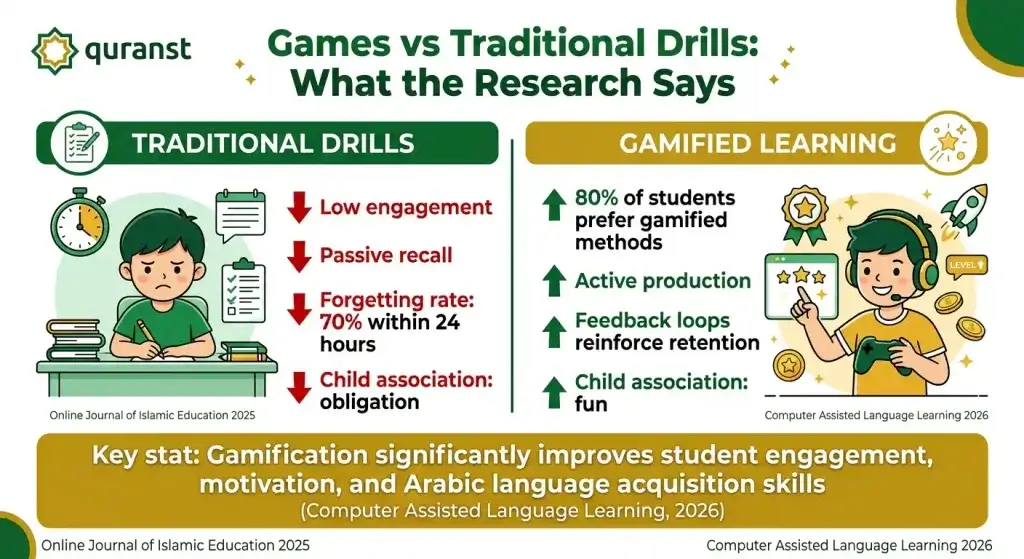
Research published in the Online Journal of Islamic Education (December 2025) found that studies demonstrate the potential of digital games to enhance foreign language teaching and learning, with significant improvements in engagement, participation, and academic performance. Research highlights that gamification in language education produces improved student engagement, motivation, and language acquisition skills.
The mechanism is neurological: engaged learners produce higher levels of dopamine and norepinephrine — the neurotransmitters associated with attention, motivation, and memory consolidation. A child who is genuinely engaged in a game is in an optimal neurological state for language acquisition.
Games Create the Conditions for Natural Language Learning
A 2026 study published in Computer Assisted Language Learning (Taylor & Francis) on gamified approaches to Arabic language learning for young learners found significant improvements in Arabic language skills, motivation, and engagement compared to conventional technology-based learning approaches. The gamified group showed measurably better outcomes across all measured dimensions of language acquisition.
Natural language acquisition — the way children learn their first language — happens through meaningful, emotionally engaged interaction, not through formal instruction. Games recreate this natural acquisition environment in a structured, intentional way: the child is using the language to accomplish something they care about, which is precisely the condition under which language is best acquired.
Competition and Challenge Are Motivators
Game elements such as competitive scoring, level progression, and immediate audio feedback assist in user engagement and motivate learners to commit to repeated practice. Students develop a more competitive spirit and anticipate their chances of achieving high scores.
The child who has given up on Arabic worksheets will spend hours on a game that challenges them to beat their previous score. This is not because children are lazy — it is because games offer what worksheets do not: immediate feedback, visible progress, a clear challenge, and the satisfaction of accomplishment.
The Islamic Framework for Joyful Learning
The Quran does not present the acquisition of knowledge as a burden. It presents it as a gift:
يَرْفَعِ اللَّهُ الَّذِينَ آمَنُوا مِنكُمْ وَالَّذِينَ أُوتُوا الْعِلْمَ دَرَجَاتٍ
“Allah will raise those who have believed among you and those who were given knowledge by degrees.”
— Quran 58:11
And the Prophet ﷺ said:
“The best of you are those who learn the Quran and teach it.”
— Sahih al-Bukhari, Hadith 5027
Teaching the Quran and Arabic with joy — with games, with laughter, with celebration of every small achievement — is not a compromise of Islamic educational seriousness. It is its most authentic expression.
Structured Curriculum Framework
Not sure where to start? The placement test takes 15 minutes and tells you exactly where your child stands — and the free trial lets you experience live, one-on-one Arabic instruction before any commitment.
The placement test →Section 1: quranst’s Free Interactive Arabic Games — Play Your Way to Fluency
quranst has built a dedicated library of free, interactive Arabic games specifically designed for Muslim children learning Arabic as a heritage or second language. These are not generic educational games with Arabic labels — they are purpose-built for the specific vocabulary, phonetics, and cultural context of Muslim children’s Arabic education.
Visit the complete free games library →
🎮 Game 1: Adventures of Noor Al-Bayan
Play Adventures of Noor Al-Bayan →
This narrative adventure game takes children through an immersive Arabic-language story — building vocabulary and comprehension through a plot-driven experience that makes stopping difficult.
Why it works: Narrative engagement is one of the most powerful vehicles for language acquisition. The child who wants to know what happens next will read — and read — and read — accumulating vocabulary without realizing they are “studying.”
Best for: Ages 7–12 | Intermediate beginners | Vocabulary and reading comprehension
How to use it: Play together as a family and pause at key vocabulary moments. Ask: “What do you think that word means? Look at the picture — what’s happening?” Then check together. The guessing process itself is a vocabulary acquisition activity.
🌸 Game 2: Interactive Arabic Alphabet Garden
Explore the Arabic Alphabet Garden →
A visual, interactive exploration of the Arabic alphabet — each letter brings its garden element to life with audio pronunciation, example words, and visual reinforcement.
Why it works: Research shows that gamification helps maintain learning focus, provides automatic error detection, and enables monitoring of learning progress — particularly for letter recognition tasks with young learners. The multi-sensory approach (visual + audio + interactive) encodes letter recognition more deeply than drill-based methods.
Best for: Ages 4–8 | Absolute beginners | Alphabet recognition and phonetics
How to use it: Before the session, hide objects around the room whose Arabic names start with the letter being explored. After playing the game, send the child on a “letter hunt” to find the hidden objects.
🎯 Game 3: Language Game
A versatile Arabic vocabulary and comprehension challenge — built around active production (the child must use the language, not just recognize it).
Why it works: Passive recognition and active production use different memory systems. The child who can recognize a word when they hear it but cannot produce it independently has only half the linguistic skill. This game requires active production — building the stronger form of vocabulary retention.
Best for: Ages 8–14 | All levels | Active vocabulary production
How to use it: After playing, ask the child to use three words from the game in original sentences about their own life. “Use the word ‘bayt’ in a sentence about our house.” The personalization anchors the vocabulary in long-term memory.
🏃 Game 4: Reading Race Game
A reading fluency challenge that builds speed and accuracy in Arabic text recognition — essential for the child transitioning from letter recognition to connected reading.
Why it works: Reading fluency in Arabic is a specific skill distinct from letter knowledge — it requires the brain to recognize letter combinations rapidly without processing each letter individually. Timed, gamified practice is the most effective method for building this automaticity.
Best for: Ages 8–12 | Post-alphabet stage | Reading fluency and speed
How to use it: Track your child’s score across sessions and celebrate visible improvement. “Last week you got 12 words. This week you got 18! You are getting faster every time.” Visible progress is one of the most powerful motivators in language learning.
📦 Game 5: Memory Boxes — Quran and Hadith Game
This is quranst’s most distinctive game — connecting Arabic language learning directly to Quran and Hadith memorization through a memory-match format.
Why it works: The memory match format (connecting Arabic terms to their meanings, or Quranic phrases to their translations) uses the same cognitive mechanism as flashcard learning — but with the engagement level of a game. The competitive element (beat your previous score, or play against a sibling) makes repeated practice feel like fun rather than drill.
Best for: Ages 6–14 | All levels | Quranic vocabulary and Hadith reinforcement
How to use it: After the game, identify the Arabic-Quran connection the child found hardest and spend three minutes on that specific connection. Write it on a sticky note and put it somewhere visible for the week. Return to it the following week and test recall.
The Islamic advantage of this game: Learning Arabic vocabulary through Quranic and Hadith content means every word learned has immediate application in the child’s prayer and daily remembrance. This is not just language learning — it is Quran comprehension building.
🌙 Game 6: Ramadan Heroes Challenge
Accept the Ramadan Heroes Challenge →
A seasonally focused Arabic challenge that connects language learning to the Islamic calendar — building vocabulary and cultural knowledge through the framework of Ramadan.
Why it works: Cultural and religious contextualisation is one of the strongest motivators in heritage language learning. The child who is learning Arabic in the context of something they already love and celebrate — Ramadan, the masjid, Islamic community life — has an emotional investment in the vocabulary that abstract language learning cannot provide.
Best for: Ages 6–12 | All levels | Seasonal Islamic vocabulary and cultural connection
How to use it: Use this game as an annual Ramadan tradition — starting the challenge at the beginning of Ramadan and completing it by Eid. The seasonal repetition creates a reliable return to focused Arabic vocabulary every year.
💡 Pro Tip: Visit quranst.com/free-games to access all games in one place. Bookmark the page and set a consistent “game time” in your weekly schedule — three sessions of 15 minutes each is more effective than one hour-long session.
Section 2: Ten Language Game Strategies for Home Arabic Sessions
Beyond quranst’s digital games, these offline strategies transform any Arabic learning moment into an engaging, game-like experience:
Strategy 1: The Arabic Treasure Hunt
Hide objects around the home. Write their Arabic names on clue cards. The child reads the clue, finds the object, and places it in the correct room (also labeled in Arabic).
Vocabulary built: Household objects, rooms, prepositions of place Age range: 5–10 Why it works: Physical movement + problem-solving + Arabic reading combined
Strategy 2: The Two-Minute Arabic Challenge
Set a timer for two minutes. Challenge the child to name as many objects in a specific category (colors, animals, foods, Quranic words) in Arabic as possible. Count and record the score. Beat it next week.
Vocabulary built: Category-specific vocabulary Age range: 6–14 Why it works: Competitive self-improvement + timed pressure activates focused recall
Strategy 3: Arabic Storytelling Dice
Create six simple dice (cardboard cubes) — each face showing a picture of a character, place, object, or Quranic figure. Roll and build a story together in Arabic, using the rolled elements. Start simple: “There was a [character] who went to [place]…”
Vocabulary built: Narrative vocabulary, verb forms, character descriptions Age range: 7–13 Why it works: Creative production in Arabic; the child uses language rather than just receiving it
Strategy 4: The Arabic Word Ladder
Begin with a simple Arabic word. The child changes one letter to make a new word — and so on. (Similar to the English word game “CAT → CAR → BAR → BAT”). In Arabic, this naturally develops morphological awareness — the understanding of how root letters combine.
Vocabulary built: Root-word awareness, phonological processing Age range: 9–14 Why it works: Deepens morphological awareness; each “step” is genuinely puzzling and engaging
Strategy 5: Arabic Bingo
Create bingo cards with Arabic words or letters instead of numbers. Call out words (or their meanings in English, or a picture of what they represent). The first to complete a row wins.
Vocabulary built: Any target vocabulary Age range: 5–12 Why it works: Multiple repetitions of each word in a single game; competitive element; group-friendly
Strategy 6: The Quranic Word Spot
Open the Quran to a familiar surah and give the child three Arabic words to spot within a two-minute period. Each correctly identified word earns a point.
Vocabulary built: Quranic vocabulary recognition Age range: 8–14 Why it works: Directly connects Arabic learning to Quran; children feel the immediate relevance of what they are learning
Strategy 7: Arabic Simon Says (السيمون قال)
Classic Simon Says — but all commands are given in Arabic. “السيمون قال: قِفْ” (Simon says: Stand). “السيمون قال: اجلسْ” (Simon says: Sit).
Vocabulary built: Action verbs, body parts, spatial directions Age range: 4–9 Why it works: Total Physical Response (TPR) — connecting movement to language builds bodily memory
Strategy 8: The Arabic Market
Set up a pretend market with household objects priced in Arabic numbers. The child “buys” items by asking for them in Arabic and paying the correct “price.” Give them a budget and a shopping list written in Arabic.
Vocabulary built: Numbers, money, shopping vocabulary, object names Age range: 6–12 Why it works: Real-world simulation makes the language feel useful and alive
Strategy 9: Arabic Trivia Race
Prepare twenty Arabic vocabulary questions (or use Arabic flashcards). Two players race to answer. Correct answer = one step forward on a simple board. First to the finish line wins.
Vocabulary built: Any vocabulary set Age range: 7–14 Why it works: Competition, peer learning, repeated exposure to the same vocabulary
Strategy 10: The Daily Arabic Word Dare
Each day, introduce one new Arabic word at breakfast. Whoever uses it correctly in a sentence first (before dinner) earns a point. Weekly winner gets to choose the weekend family activity.
Vocabulary built: One word per day = 365 words per year Age range: 5–14 Why it works: Daily exposure + family competition + natural sentence use = strong retention
Section 3: Games by Age and Level {#by-age}
| Age | Best Games | Focus |
|---|---|---|
| 4–6 | Alphabet Garden · Simon Says · Bingo | Letter recognition, basic vocabulary |
| 7–9 | Noor Al-Bayan · Memory Boxes · Treasure Hunt | Vocabulary, reading basics, Quran connection |
| 10–12 | Reading Race · Language Game · Word Ladder | Reading fluency, grammar awareness, Quranic vocabulary |
| 13+ | Language Game · Arabic Trivia · Ramadan Heroes | Advanced vocabulary, conversation, Islamic content |
Not sure which level your child is at? Take the free placement assessment at quranst.com/islamic-arabic-placement-tests — a structured evaluation that identifies your child’s exact Arabic level and recommends the right starting point for their learning journey.
Section 4: Connecting Games to the Quran — The Ultimate Motivation
The most powerful motivator for Arabic learning in Muslim families is one that no generic language game can provide: the direct connection between the Arabic being learned and the Quran being recited in prayer.
When a child recognizes the word رَبّ (Rabb — Lord) from the game they played this morning in “الحمد لله رب العالمين” during Maghrib prayer — something happens that no academic research fully captures. A door opens between the language they are learning and the book they already love.
This is why the Memory Boxes: Quran and Hadith Game — play it here — is the most distinctive game in the quranst library. It makes this connection explicit and repeated.
The Quranic Arabic Game: A Home Version
After any Arabic game session, take five minutes to find three words from the session in the Quran. Use a mushaf (Quran) or a Quranic vocabulary tool:
- Did you learn the word “samaa'” (سماء — sky)? Find it in: “الَّذِي خَلَقَ السَّمَاوَاتِ وَالْأَرْضَ” (Who created the heavens and the earth) — Quran 6:1
- Did you learn the word “nur” (نور — light)? Find it in: “اللَّهُ نُورُ السَّمَاوَاتِ وَالْأَرْضِ” (Allah is the Light of the heavens and the earth) — Quran 24:35
- Did you learn the word “kitab” (كتاب — book)? Find it in: “ذَٰلِكَ الْكِتَابُ لَا رَيْبَ فِيهِ” (This is the Book about which there is no doubt) — Quran 2:2
The child who plays this game for one year will end the year with a Quranic Arabic vocabulary that transforms their experience of prayer from phonetic recitation into genuine comprehension.
For structured Quranic Arabic learning alongside games, explore quranst’s Quranic courses →
Section 5: Building the Gamified Arabic Home Environment
Games are most effective when they exist within an environment that makes Arabic feel normal, valuable, and fun — rather than a school subject that has invaded the home.
The Physical Environment
Label everything in Arabic — sticky notes on the refrigerator (ثلاجة), the window (نافذة), the door (باب), the table (طاولة). Change the labels weekly as words are learned.
Arabic visual displays — a colorful Arabic alphabet chart in a visible location; the 99 names of Allah (with meanings) displayed beautifully; a Quranic verse selected monthly and placed where the family gathers.
The Arabic bookshelf — even three to five age-appropriate Arabic books creates a physical presence of Arabic as a reading language. Explore quranst’s library → for recommended materials.
The Audio Environment
Arabic audio as background — Quranic recitation during breakfast; Arabic nasheeds during car rides; Arabic cartoons as one of the permitted screen time options. Exposure to Arabic sounds — even without focused attention — builds phonological familiarity over time.
The weekly Arabic song — introduce one new Arabic nasheed per week. By the end of the year, the child’s Arabic listening vocabulary has expanded through forty-plus songs they genuinely enjoy.
The family Arabic challenge — one Arabic word per day, used by everyone, tracked on a visible chart. The parent who participates in the challenge is the parent whose child takes it seriously.
Arabic with grandparents — if grandparents speak Arabic, make video calls a weekly Arabic immersion session. The child who has a person they love to speak Arabic with has the most powerful motivator available.
The quranst community — in live sessions with a quranst online Arabic tutor, your child connects with other Muslim learners and a native-speaking teacher who makes Arabic genuinely engaging. Find a tutor →
Section 6: From Games to Structured Learning — The Complete quranst Path
Games are the on-ramp. They build motivation, basic vocabulary, and the positive association with Arabic that makes structured learning possible. But fluency — genuine Arabic fluency — requires structured, progressive instruction alongside the games.
quranst provides the complete path: from the first game to the full Arabic curriculum.
Step 1: Start with the Free Games
quranst.com/free-games — begin here. No commitment required. Let your child explore the games and find the ones they gravitate toward. Their preference is information: it tells you where their vocabulary gaps are and what learning style works best for them.
Step 2: Access Free Sample Lessons
Before enrolling in a paid course, sample structured Arabic instruction for free:
- Free Lessons → — structured Arabic and Islamic content, no registration required
- Free PowerPoint Lessons → — visual, organized, downloadable lessons for home use
Step 3: Take the Placement Assessment
Islamic and Arabic Placement Tests →
The placement assessment identifies your child’s exact level across:
- Arabic letter recognition and reading
- Quranic vocabulary and comprehension
- Grammar awareness and application
This takes the guesswork out of “where do we start?” and ensures your child begins at the right level — neither frustrated by content that is too hard nor bored by content that is too easy.
Step 4: Choose Your Courses
Arabic Courses → — from Arabic for beginners through classical Arabic grammar and Quranic Arabic comprehension
Quranic Courses → — Quran reading, Tajweed, Hifz (memorization), and Quranic Arabic
Islamic Studies Courses → — Aqeedah, Fiqh, Seerah, Hadith, and more
Smart Parenting & Behavior Courses → — for parents navigating Islamic parenting challenges in the modern West
Step 5: Review Pricing and Begin Your Free Trial
Fees and Plans → — transparent pricing for all tracks and age groups
Start Your Free Trial → — two free sessions, no commitment required. Your child will be placed, assessed, and matched with the right teacher before spending a single dirham or dollar.
Step 6: Read What Other Families Say
Before enrolling, hear from the Muslim families across 12+ countries who have used quranst for their children’s Arabic and Islamic education:
Structured Curriculum Framework
Not sure where to start? The placement test takes 15 minutes and tells you exactly where your child stands — and the free trial lets you experience live, one-on-one Arabic instruction before any commitment.
The placement test →Have a Question? Ask the Scholars
Arabic is the language of Islamic scholarship — and sometimes learning Arabic raises questions about the language of prayer, the correct recitation of Quran, or the meaning of specific Quranic terms.
For any question — linguistic, religious, jurisprudential — quranst’s scholars and educators are available:
And to learn more about quranst’s mission, team, and approach to Islamic education:
Blog: More Resources for Your Family’s Arabic Journey
quranst Blog → — articles, guides, and resources for Muslim families navigating Arabic learning, Quran education, and Islamic parenting in the modern world.
Conclusion: The Child Who Can’t Wait for Arabic Class
The child sitting across from you right now — the one who sighs when you open the Arabic workbook — is not lazy. They are not resistant to Arabic. They are resistant to boredom.
Give them a game instead of a drill. Give them a challenge instead of a worksheet. Give them a character to root for, a score to beat, a word hunt to complete, a sibling to outsmart in a vocabulary race.
And then — when the Arabic session is over — they will ask:
“Can we do it again tomorrow?”
That is the moment every Muslim parent raising Arabic-learning children is working toward. Not the child who tolerates Arabic. The child who requests it.
The research confirms what every effective language teacher already knows: gamification provides an enjoyable and challenging experience for learners, motivating them to become committed and participate in learning. Students develop a more competitive spirit and anticipate their chances of achieving high scores. Games make language learning stick because they make it feel like play.
And the child who plays with Arabic — who laughs in Arabic, competes in Arabic, discovers in Arabic, wins in Arabic — is the child who eventually thinks in Arabic.
And the child who thinks in Arabic can read the Quran the way the Prophet ﷺ received it: not as sounds to be reproduced, but as words to be understood — and lived.
Start with a game tonight.
وَقُل رَّبِّ زِدْنِي عِلْمًا
“And say: My Lord, increase me in knowledge.”
— Quran 20:114
🟢 The Complete quranst Arabic Learning Path
| Step | Resource | Link |
|---|---|---|
| Play first | Free interactive Arabic games | quranst.com/free-games |
| Adventures of Noor | Narrative Arabic game | quranst.com/adventures-of-noor-al-bayan |
| Alphabet Garden | Interactive alphabet | quranst.com/interactive-arabic-alphabet-garden |
| Language Game | Vocabulary production | quranst.com/language-game |
| Reading Race | Fluency building | quranst.com/reading-race-game |
| Memory Boxes | Quran + Hadith vocab | quranst.com/memory-boxes-quran-hadith-game |
| Ramadan Heroes | Seasonal Arabic | quranst.com/ramadan-heroes-challenge |
| Sample first | Free lessons | quranst.com/free-lessons |
| Know your level | Placement test | quranst.com/islamic-arabic-placement-tests |
| Choose a course | Arabic courses | quranst.com/arabic-courses |
| Add Quran | Quranic courses | quranst.com/quranic-courses |
| Find a teacher | Teacher directory | quranst.com/find-tutor |
| See pricing | Fees and plans | quranst.com/fee-and-plans |
| Start free | Free trial | quranst.com/free-trial |
| Read reviews | Testimonials | quranst.com/testimonial |
| Ask questions | Contact scholars | quranst.com/contacts |
| Learn more | About quranst | quranst.com/discover-quranst |
| More resources | Blog | quranst.com/blog |
Two Ways to Begin
References and Sources
Quranic References
- Quran 20:114 — “My Lord, increase me in knowledge”
- Quran 58:11 — “Allah will raise those who have believed and those given knowledge”
Hadith References
- Sahih al-Bukhari, Hadith 5027 — “The best of you are those who learn the Quran and teach it”
Peer-Reviewed Academic Sources
- Online Journal of Islamic Education, Vol. 13, Issue 2 (December 2025). “Enhancing Arabic Language Learning: Usability Study.” Key findings: Digital games enhance foreign language teaching with significant improvements in engagement, participation, and academic performance; gamification improves student engagement, motivation, and language acquisition skills.
- Computer Assisted Language Learning, Taylor & Francis (2026). Afrizal, Meitia Chairany, and Jie Chi Yang. “A gamified analytical thinking skills learning approach for young learners’ Arabic language learning: effects on performance, motivation, engagement, and gender-based perceptions.” Published online May 2026. DOI: 10.1080/09588221.2026.2673874. Key findings: Gamified approach produces significantly better Arabic language skills, motivation, and engagement vs conventional approaches.
- HuRuf Journal: International Journal of Arabic Applied Linguistics (June 2026). “Classroom-Based Gamification to Improve Students’ Arabic Speaking Skills.” References: Jaafar & Nik Yusoff (2022) — experimental study confirming gamification module effectiveness for Arabic in primary school.
- Journal International of Lingua and Technology (April 2026). “The Impact of Gamification on Student Engagement and Arabic Language Proficiency.” Mixed-methods study of 60 students. Key finding: Significant improvements in Arabic proficiency and engagement in gamified vs traditional learning groups.
- Systematic Literature Review: Gamification for Teaching Arabic to Non-Native Speakers. Key findings: Gamification beneficial for Arabic beginners; enjoyable and challenging experience; students develop competitive spirit; audio feedback assists user engagement.
- arXiv (2026). “Gamification-Based Learning Method for Hijaiyah Letters.” Key findings: Gamification helps maintain learning focus; provides automatic error detection; enables monitoring of learning progress without continuous manual supervision.
Frequently Asked Questions
Why is gamification more effective than traditional drills for teaching Arabic?
What free interactive games does quranst offer for children?
- Adventures of Noor Al-Bayan: A plot-driven story game for vocabulary and reading comprehension.
- Interactive Arabic Alphabet Garden: Multi-sensory letter recognition with audio and visual feedback.
- Language Game & Reading Race: Challenges focused on active vocabulary production and reading speed.
- Memory Boxes & Ramadan Heroes: Games directly linking Arabic learning to Quranic vocabulary, Hadith, and Islamic cultural heritage.
How do educational games connect Arabic learning directly to the Quran?
How can parents build a gamified Arabic environment at home?
- Home Games: Use Treasure Hunts, Word Ladders, Arabic Bingo, or “Simon Says” (السيمون قال) in Arabic.
- Physical Environment: Label household items with Arabic sticky notes and display visual charts.
- Daily Habits: Try the “Daily Arabic Word Dare” or stream background Arabic audio and nasheeds.
