

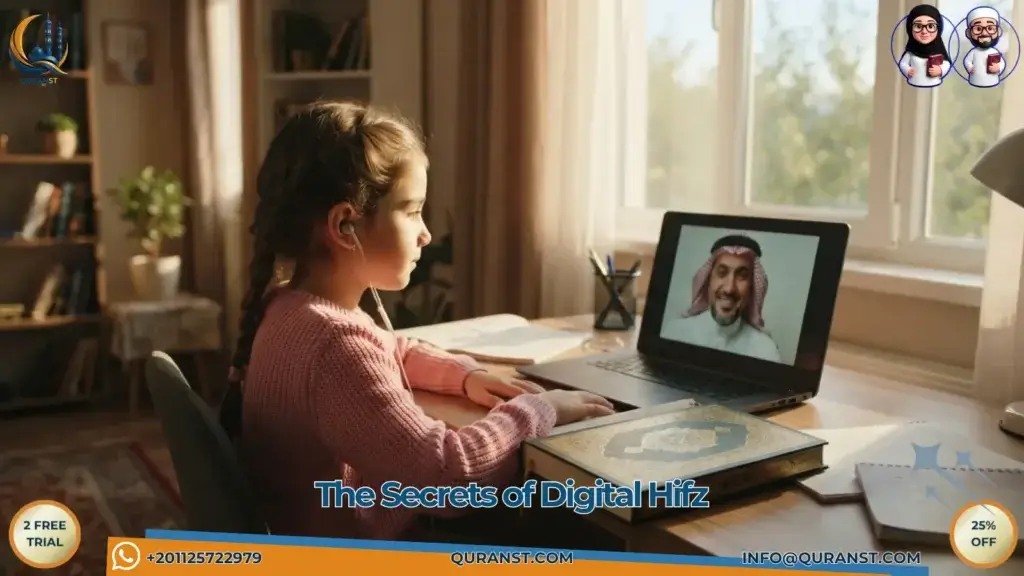
Introduction: The Hafiz in the Living Room
It is 7:15 AM on a Tuesday in suburban Toronto.
The school bus does not come for another hour. The household is quiet. And a twelve-year-old sits at a desk in her bedroom, earphones in, Quran open — watching the face of a sheikh in Cairo on her laptop screen as he listens to her recite the last page of Juz’ 20.
She makes an error in the middle of a verse. He stops her immediately. Walks her back three words. Models the correct pronunciation — slowly, precisely, with the thick emphasis on the dhad that she has been working to master for six weeks.
She repeats it. He nods. She continues.
By 7:45, she has memorized twelve new lines, reviewed thirty from the previous week, and received real-time correction on three phonetic habits that, left uncorrected, would have permanently embedded themselves into her recitation.
By 8:00, she has had breakfast and is waiting for the bus.
This scene — playing out every morning in homes across America, Canada, Britain, Australia, and the Gulf — represents one of the most significant shifts in Quran education since the printing press: the democratization of live, expert-led Hifz instruction through digital transmission.
And the results, as the research is now confirming, are extraordinary.
Structured Curriculum Framework
quranst’s Hifz track provides exactly this: live, one-on-one Quran memorization sessions with certified Online Quran teachers — scheduled around your family’s life, serving students across 12+ countries.
Book your free 2-session trial →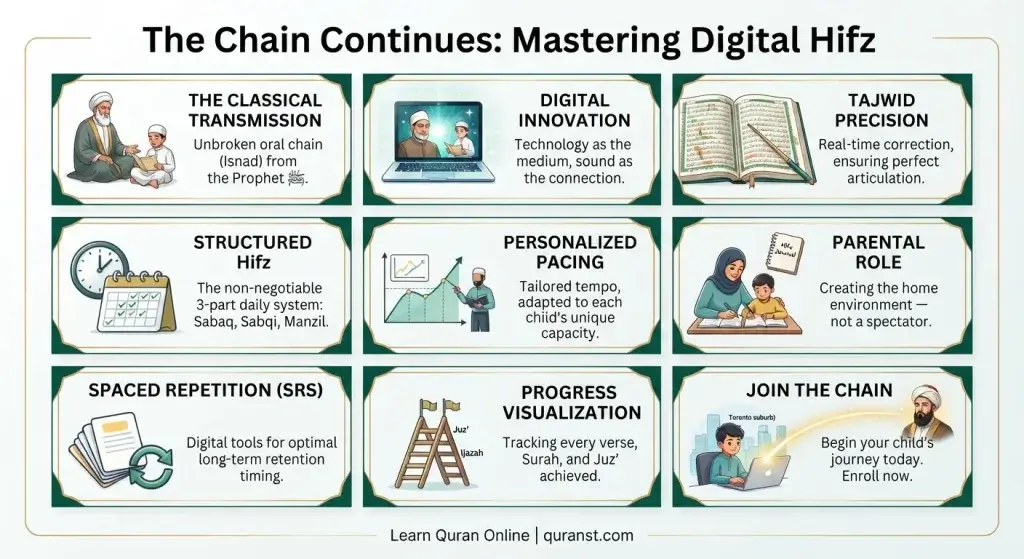
The Classical Tradition of Transmitted Knowledge
Before examining what makes digital Hifz effective, it is essential to understand what digital Hifz is continuing — because the innovation is not in the what, but in the how.
The Quran has always been transmitted orally, person to person, in an unbroken chain from the Prophet ﷺ through Jibril to Allah’s own words. This chain — the isnad of Quran recitation — is one of the most remarkable features of the Islamic intellectual tradition. Every certified hafiz can trace their recitation back, teacher by teacher, to the Prophet ﷺ himself.
“The one who is proficient in the Quran will be with the noble, righteous angels; and the one who recites the Quran with difficulty, struggling with it, will have a double reward.”
— Sahih al-Bukhari, Hadith 4937; Sahih Muslim, Hadith 798
And:
“The best of you are those who learn the Quran and teach it.”
— Sahih al-Bukhari, Hadith 5027
The classical talaqqi system — the direct transmission of Quran from teacher to student, with the teacher listening and the student reciting — is what every traditional Hifz institution has practiced for fourteen centuries. The student sits before the sheikh. The sheikh listens. The student recites. The sheikh corrects.
Digital Hifz does not replace this system. It extends it — making it available to a twelve-year-old in Toronto at 7:15 AM, to a mother in Melbourne after her children leave for school, to a convert in rural Scotland with no local Islamic center within fifty miles.
The chain of transmission continues. The screen is simply the medium through which the sound travels.
Section 1: Why Remote Hifz Works — The Research
The effectiveness of online Quran memorization is no longer a matter of theoretical promise. It is documented in research and in the lived experience of hundreds of thousands of students across the globe.
Structured Programs Produce Measurable Outcomes
Research and platform data from 2025 confirms that online Quran memorization programs have demonstrated positive outcomes for students, including improved focus, memory, and academic performance. The structured approach of online platforms — using goal-setting, regular practice, and progress tracking — helps students develop discipline and confidence.
Research published in Edu Spectrum: Journal of Multidimensional Education (2024) examining traditional and modern Quran memorization techniques found that analysis of effectiveness in distance learning for Tahfiz lessons demonstrated positive outcomes when structured systematically — with consistent teacher contact, daily review scheduling, and progress monitoring.
Digital Tools Amplify the Traditional Method
Digital tools speed up learning, support long-term retention through spaced repetition, and provide flexible access to recitations and corrective feedback. They work best when combined with a qualified teacher and consistent daily effort. Structured memorization plans and study schedules for daily revision, combined with audio recitations from multiple qualified reciters to perfect pronunciation and Tajweed rules, provide the technical scaffolding that amplifies what a teacher provides.
Technology Removes the Barriers — Without Removing the Standard
Online Quran education has seen remarkable growth in 2025, driven by the increasing demand among Muslim families for flexible, high-quality Quran learning. This digital transformation bridges gaps in accessibility, especially for families in areas with limited local Islamic centers.
The Muslim family in rural Ontario, the revert in a non-Muslim majority town in Germany, the Pakistani-American family in a suburb with no qualified Tajweed teacher for fifty miles — these families now have access to the same quality of Hifz instruction that was previously only available to those living in proximity to traditional Islamic institutions.
The standard has not been lowered to achieve this access. It has been maintained — and in some measurable ways, enhanced.
Section 2: The Five Secrets of Successful Digital Hifz
Not all online Hifz programs produce the same results. The families that produce precise, retained hafiz graduates through digital learning share five characteristics that distinguish their approach:
Secret 1: The Teacher-Student Relationship Is the Foundation — Not the Technology
The single most important variable in online Hifz is not the platform, the app, the scheduling software, or the curriculum design. It is the quality of the relationship between the teacher and the student.
The best online Hifz teachers are not just teachers — they are mentors, encouragers, and sometimes stand-in grandparents. One teacher described working with a student with severe anxiety: “We started lessons with du’as, not recitations. Once he felt safe, he memorized an entire Juz in six months. That’s the power of trust.”
A student who loves their teacher will practice between sessions. A student who fears or resents their teacher will do the minimum to avoid correction.
The online medium — contrary to initial skepticism — does not prevent the formation of this relationship. It accommodates it. The one-on-one nature of live online Hifz sessions (as opposed to the twenty-student classroom of the traditional masjid halaqa) actually creates more direct, personal teacher-student engagement than many in-person alternatives.
What to look for: A teacher who asks questions about the student’s life before asking them to recite. A teacher who celebrates small wins. A teacher who communicates with parents regularly — not with dry progress reports but with genuine observations about the child’s developing relationship with the Quran.
Secret 2: The Three-Part Daily Structure — Without Exception
The structured approach of successful online Hifz programs uses the high-efficiency revision system — Sabaq, Sabqi, Manzil — to handle both new memorization and comprehensive long-term retention. This system, combined with consistent teacher contact, prevents the most common failure mode of Hifz: adding new material faster than old material can be retained.
Sabaq (New Lesson): Today’s new memorization — the specific verses being added to the hafiz’s chest for the first time.
Sabqi (Recent Review): Review of the material memorized in the last seven to ten days — the window during which memory is most vulnerable to loss.
Manzil (Old Lesson): Review of previously solidified material — ensuring that what was memorized months or years ago remains accessible.
The families who produce graduates from online Hifz programs are, without exception, the families who maintain this three-part structure daily — not when it is convenient, not when the school schedule permits, but as the non-negotiable foundation of the day.
The digital advantage: Online platforms can track which portions of the Manzil have been reviewed most recently and schedule review sessions accordingly — something a traditional teacher managing thirty students cannot do but a dedicated online teacher managing six to eight students can do with precision.
Secret 3: Precision Tajweed From the First Word
The most common mistake in Hifz — in both traditional and digital settings — is beginning memorization before Tajweed is solid. The student who memorizes Surah Al-Mulk with incorrect pronunciation has not memorized Surah Al-Mulk. They have memorized a phonetically imprecise version of it that will require complete re-memorization to correct.
The risk of online Quran memorization without rigorous Tajweed correction: incorrect pronunciation becomes a habit that is far harder to correct than it would have been to prevent. For this reason, leading online Hifz programs assess Tajweed before beginning memorization and maintain real-time Tajweed correction throughout every session.
The digital medium, when used correctly, is superior to the traditional classroom for Tajweed correction — because the one-on-one format means every phonetic error is caught immediately by a teacher whose entire attention is on this one student. In a classroom of twenty, errors routinely pass uncorrected for months.
The quranst standard: Every Hifz session begins with Tajweed assessment of the previous lesson before new material is introduced. No verse is advanced until it is recited correctly.
Secret 4: Personalized Pacing — The Anti-Assembly-Line Approach
Successful online Quran memorization programs provide personalized instruction, with teachers who evaluate each student’s current level, learning style, and goals before building a custom schedule. One teacher created color-coded Quran pages for a visual learner — green for easy verses, yellow for challenging ones. This kind of individualization is simply not possible in a group setting.
The traditional masjid halaqa moves at the pace of the group — which means the fastest learner is bored and the slowest is overwhelmed. Online Hifz moves at the pace of the individual student — which means every session is maximally productive for every student.
Personalized pacing also means personalized methodology. Some children memorize best through rhythmic repetition. Others through visual association — connecting a verse to an image or a personal memory. Others through understanding the meaning first and then encoding the Arabic. A skilled online teacher identifies the child’s dominant memorization modality and deploys it consistently.
Secret 5: The Parent as the Home Environment — Not a Spectator
The families who produce successful hafiz graduates through online Hifz are families in which the parent is not a passive consumer of the service — dropping their child in front of a screen and expecting results.
They are families in which:
- The parent knows which portion is being memorized this week
- Morning and evening review happens at home between sessions
- The Quran is the sound of the household — recited at mealtimes, played during background time, referenced in conversation
- The parent’s own practice of Quran recitation provides a model the child can see and hear daily
Parent testimonial: “We keep a Hifz Journal where my daughter draws pictures of the verses she learns. It’s her pride and joy.”
The online teacher provides the instruction. The parent provides the environment. Together, they produce the hafiz.
Section 3: The Digital Tools That Amplify Memorization
Beyond live sessions with a teacher, a specific set of digital tools — when selected and used deliberately — significantly accelerate Hifz progress and retention:
Spaced Repetition Systems (SRS)
Spaced repetition systems schedule reviews at optimal intervals to increase long-term retention. Platforms with built-in SRS or tools like Anki with Quran decks allow students to review Quranic material at precisely the moment when memory decay is about to begin — maximizing retention with minimum review time.
The science behind SRS is well-established: memory retention increases dramatically when review is timed to occur just before the point of forgetting. A verse reviewed at the right interval stays in memory far longer than the same verse reviewed the same number of times at random intervals.
Multi-Reciter Audio Libraries
Audio-focused tools provide multi-reciter libraries, slow playback, and loop features for perfecting pronunciation. These tools are essential for learners practicing Tajweed and phonetics, allowing them to hear the correct pronunciation from multiple qualified reciters before and after each session.
The student who listens to Sheikh Mahmoud Khalil Al-Husary reciting the verses they are memorizing — at normal speed, then at half speed, focusing on the specific letters they are working to master — arrives at their online session having already heard the correct model dozens of times.
Progress Tracking and Milestone Visualization
Research published in the Journal of Electrical Systems (2024) found that digital tools that provide progress tracking features significantly improve students’ memorization efficiency and engagement, fostering a more effective and enjoyable learning environment. The ability to see visible progress — verses memorized, Surahs completed, Juz’ finished — is a consistent motivator that maintains long-term commitment.
The Hifz journey is long — often three to five years for a student memorizing consistently around school. Visible, quantified progress — 47 Surahs completed, 14 Juz memorized, 850 days of consecutive daily review — makes the long-term nature of the commitment feel manageable and the achievements feel real.
Video Session Recording
One of the underappreciated advantages of online Hifz over traditional settings: sessions can be recorded. Parents can review what was corrected. Students can watch their own recitation and notice errors their ears missed in the moment. Progress over time is visible — the recording from six months ago versus today is documentary evidence of development.
Section 4: The Challenges Are Real — And So Are the Solutions
Honest engagement with online Hifz requires acknowledging its genuine challenges — and the specific responses that address them:
Challenge 1: Screen Fatigue and Attention Limits
A child who has spent six hours in a school that is increasingly screen-based returns home to an online Hifz session on another screen. This is a genuine tension.
The solution: Keep online Hifz sessions short and focused — 20 to 30 minutes for children under ten; 30 to 45 minutes for older students. Quality of attention in a focused short session significantly outperforms quantity of unfocused long sessions. The three-part structure (Sabaq/Sabqi/Manzil) can be completed in 25 minutes when well-prepared.
Challenge 2: The Absence of Physical Community
The traditional Hifz school offers something digital instruction cannot directly replicate: the experience of memorizing alongside peers — the competitive energy, the mutual encouragement, the shared pride in collective achievement.
The solution: Build community around the digital learning. Arrange Quran circles with local Muslim families. Participate in Hifz competitions at the local masjid. Find other online Hifz students through Islamic community networks. The online teacher can also facilitate peer connections — introducing students of similar levels who can review together.
Challenge 3: Technical Disruptions and Schedule Consistency
Internet failures, device problems, and the logistical complexity of scheduling across time zones can disrupt the consistency that Hifz requires.
The solution: Build redundancy into the system. Always have a backup device. Have the emergency contact information for the teacher’s WhatsApp for rescheduling. And establish a rule: when a session is missed for any reason, the home review still happens — even without the teacher, the Sabqi and Manzil review is done.
Challenge 4: Parental Overwhelm in Monitoring Progress
Parents who are not themselves hafiz often feel unable to evaluate whether their child’s recitation is correct between sessions.
The solution: Record all recitation practice. Send the recording to the teacher for feedback between sessions. Use the multi-reciter audio tools to compare the child’s recitation against the model. And — most importantly — establish with the teacher a specific list of what the parent should listen for this week. “This week, focus on whether she is elongating the Madd in verse 3. Don’t worry about anything else. We will cover the other elements in Friday’s session.”
Section 5: What Makes a Great Online Quran Teacher for Hifz
Not all online Quran teachers are equal in their suitability for Hifz instruction specifically. Here are the qualities that distinguish the teachers who produce graduates:
Al-Azhar or Equivalent Certification
Among the key quality markers for effective online Quran programs: certified Al-Azhar tutors, personalized 1-on-1 and group classes, flexible scheduling, family packages, and completion certificates.
The teacher who has been certified by Al-Azhar University or an equivalent institution of Islamic learning has had their recitation verified by qualified scholars through the traditional isnad chain. When they correct your child’s pronunciation, they are correcting it against a standard that traces back to the Prophet ﷺ.
Hifz Experience Specifically — Not Just Tajweed
A teacher who is excellent at Tajweed instruction is not automatically excellent at Hifz instruction. Hifz teaching requires:
- Knowledge of memorization pedagogy — what methods work for what learning styles at what ages
- Understanding of the three-part review system and how to manage it across dozens of students
- Experience identifying and addressing specific retention problems (forgetting patterns, confusion between similar verses, etc.)
- Patience calibrated for the long arc of Hifz — a three-year journey requires different emotional resources than a three-month Tajweed course
Communication with Parents
The online Hifz teacher who does not communicate regularly and specifically with parents is a teacher whose students are more likely to plateau, lose motivation, and eventually disengage.
Look for:
- Weekly progress updates that go beyond “lesson completed”
- Specific identification of the current challenge and the strategy being used to address it
- Clear guidance on what to review at home between sessions
- Genuine interest in the child’s relationship with the Quran — not just their memorization statistics
Section 6: A Complete Digital Hifz System for Your Family
Here is a complete, practical system for successful online Hifz — integrating live teacher sessions with home practice and digital tools:
The Weekly Structure
| Day | Morning (15 min) | Evening (15 min) | Session Day |
|---|---|---|---|
| Monday | Sabqi review | Manzil review | — |
| Tuesday | Sabqi review | Manzil review | Hifz session (30 min) |
| Wednesday | Sabqi review | New material practice | — |
| Thursday | Sabqi review | Manzil review | Hifz session (30 min) |
| Friday | Full Juz review | Family Quran time | — |
| Saturday | Sabqi review | New material practice | Hifz session (45 min) |
| Sunday | Weekly Manzil review | Rest | — |
Three sessions per week, with daily home review, produces consistent progress without overwhelming school-age children.
The Daily Home Review Checklist
Before each session with the teacher:
- Yesterday’s new verses recited three times from memory
- Last week’s material recited once through
- One Manzil portion reviewed
- Specific Tajweed challenge from last session practiced with audio reference
The Milestone Celebration Calendar
Plan specific celebrations at specific milestones:
- Completion of Juz’ 30: family dinner, child’s choice
- Completion of ten Juz: gather the Muslim community; the child recites from their memorization
- Completion of full Quran: the event of a generation in your family’s history
Research tip on optimal review timing: the best time to review verses is within one hour after Fajr or before sleep — when the brain’s memory consolidation processes are most active.
Structured Curriculum Framework
quranst’s Hifz program provides certified Online Quran teachers, the three-part daily structure, Tajweed correction from the first session, parent communication weekly, and milestone celebrations built into the curriculum. Serving Muslim families across 12+ countries.
Book your free 2-session trial →Conclusion: The Chain Continues
Fourteen centuries ago, Jibril recited the Quran to Muhammad ﷺ in the Cave of Hira. The Prophet ﷺ recited it to his Companions. They recited it to the Tabi’un. The Tabi’un to the Tabi’ al-Tabi’in. And so the chain continued — teacher to student, mouth to ear, generation to generation — across every century, every continent, every civilization that Islam touched.
That chain did not stop when the internet arrived.
It passed through it.
The twelve-year-old in suburban Toronto, reciting to her sheikh in Cairo at 7:15 in the morning, is not receiving a digital approximation of the classical tradition. She is living it — in its most direct, most personalized, most precisely corrected form.
The tool has changed. The transmission has not.
And when she completes her Hifz — when the last verse of Surah Al-Baqarah passes her lips with correct Tajweed and complete retention, and her sheikh says “Khatamtil-Quran” — you have completed the Quran — she will take her place in a chain of transmission that began in a cave on a mountain in Arabia fourteen centuries before her birth.
The chain continues. And it needs your child in it.
“Whoever reads the Quran, memorizes it, and acts upon it — on the Day of Judgment his parents will be crowned with a crown of light.”
— Sunan Abu Dawud, Hadith 1453; authenticated by al-Albani
Begin the memorization. Join the chain.
وَرَتِّلِ الْقُرْآنَ تَرْتِيلًا
“And recite the Quran with measured, precise recitation.”
— Quran 73:4
🟢 Begin Your Child’s Digital Hifz Journey
The child in the living room who could be a hafiz by fifteen is waiting for one decision: enrollment.
quranst’s Quran memorization track provides:
- Certified Online Quran teachers — trained in Hifz pedagogy, with Al-Azhar equivalent certification
- Live, one-on-one online Quran classes — real-time Tajweed correction from the first session
- The three-part system (Sabaq/Sabqi/Manzil) managed by the teacher with digital tracking
- Personalized pacing — your child’s learning style, pace, and schedule, not a generic curriculum
- Weekly parent communication — specific progress, specific challenges, specific home practice guidance
- Milestone celebrations built into the program
- Flexible scheduling across all time zones — serving the USA, Canada, UK, Australia, and Gulf
👇 Begin with Two Free Quran Lessons
Two Ways to Begin
“The best of you are those who learn the Quran and teach it.”
— Sahih al-Bukhari, Hadith 5027
Learn it. Memorize it. Pass it on.
بِسْمِ اللَّهِ — Begin.
References and Sources
Quranic References
- Quran 73:4 — “Recite the Quran with measured, precise recitation”
Hadith References
- Sahih al-Bukhari, Hadith 4937; Sahih Muslim, Hadith 798 — Proficiency and struggle in Quran recitation
- Sahih al-Bukhari, Hadith 5027 — “The best of you are those who learn the Quran and teach it”
- Sunan Abu Dawud, Hadith 1453 — Crown of light for parents of hafiz (authenticated by al-Albani)
Frequently Asked Questions
Why is strategic long-term planning essential for a Muslim family?
What are the four core pillars of the Muslim Family Strategic Plan?
- Faith Foundation (Al-Aqeedah wa al-‘Ibadah): Aqeedah, prayer, Quran relationship, and daily adhkar[cite: 1].
- Knowledge and Language (Al-‘Ilm wa al-Lughah): Islamic studies, Tajweed, Quranic Arabic, and classical scholarship access[cite: 1].
- Character and Ethics (Al-Akhlaq): Truthfulness, compassion, self-discipline, and moral integrity[cite: 1].
- Community and Identity (Al-Huwiyyah wa al-Intima’): Masjid engagement, Muslim peer networks, and Islamic civilization awareness[cite: 1].
How do faith and skill development goals evolve across different childhood stages?
- Ages 0–3: Exposure to Quranic recitation, adhan, and parental practice[cite: 1].
- Ages 3–7: Basic Tawhid, Surah Al-Fatiha, prophet stories, and early listening/habit formation[cite: 1].
- Ages 7–12: Complete prayer, Juz’ ‘Amma Hifz with Tajweed, core Fiqh, Aqeedah, and structured study habits[cite: 1].
- Ages 12–18: Intellectual conviction, classical Quranic Arabic grammar, advanced Islamic studies, and leadership skills[cite: 1].

Pingback: The Quran and Character Building: How Hifz Transforms Academic Achievement & Intelligence