
Introduction: The Question Every Muslim Parent Is Asking
When a parent holds their newborn child for the first time, a profound question quietly takes root: How do I raise this child to know who they are, where they come from, and why it matters?
For Muslim families around the world — whether living in Chicago, Toronto, London, Sydney, or Dubai — this question carries extra weight. In a world saturated with competing ideologies, digital distractions, and cultural pressures, raising a child with a grounded Islamic identity is no longer something that “just happens.” It requires intention, structure, and a clear roadmap.
This guide is built for that purpose. Drawing on Quranic guidance, authentic Prophetic tradition, classical Islamic scholarship, and modern pedagogy, we lay out a comprehensive, age-appropriate Islamic studies curriculum for Muslim children between the ages of 5 and 15. Whether you are a parent in a Muslim-majority country or raising your children as a minority in the West, this roadmap applies to your family.
What makes this guide different: Most Islamic education resources focus on what to teach. This guide focuses on when, how, and why — mapping Islamic content to the psychological and spiritual development stages of the child, informed by classical scholars and contemporary research alike.
Section 1: Why a Structured Curriculum Matters — Beyond Random Religious Exposure
Many well-meaning Muslim families rely on what might be called “ambient Islamic exposure”: the adhan playing at home, occasional mosque visits, some Quranic verses memorized here and there. This approach may have worked in tight-knit Muslim communities of previous generations. Today, it is insufficient.
وَكُونُوا مَعَ الصَّادِقِينَ
“O you who have believed, fear Allah and be with those who are truthful.”
— Quran 9:119
The Quranic command to be with the truthful — interpreted by scholars like Imam al-Qurtubi as encompassing the company, environment, and structure a believer surrounds themselves with — points toward the necessity of intentional design in religious upbringing, not passive exposure.
The Three Pillars of Structured Islamic Education
1. Logical Sequencing Knowledge must build layer upon layer. A child cannot fully grasp the deeper meanings of Salah without first understanding tawakkul (reliance on Allah). Islamic jurisprudence cannot be absorbed before the heart is attached to the One Who legislates it.
2. Developmental Appropriateness What resonates with a five-year-old differs radically from what challenges a fifteen-year-old. Effective Islamic education speaks each age’s language — using emotion, play, and wonder for young children, and intellectual engagement and identity-building for teenagers.
3. Measurable Outcomes A structured curriculum gives parents and educators benchmarks: by age ten, a child should be able to do X; by age thirteen, they should understand Y. This allows for early correction and confident parenting.
“The most important period of life is not the age of university studies, but the first one — the period from birth to the age of six.”
— Ibn al-Qayyim al-Jawziyyah, Tuhfat al-Mawdud bi-Ahkam al-Mawlud (14th century)
Ibn al-Qayyim’s insight, written seven centuries ago, anticipates what modern developmental psychology would later confirm: the earliest years are the most neurologically formative. This is the window where Islamic tarbiyah (upbringing) must be most intentional.
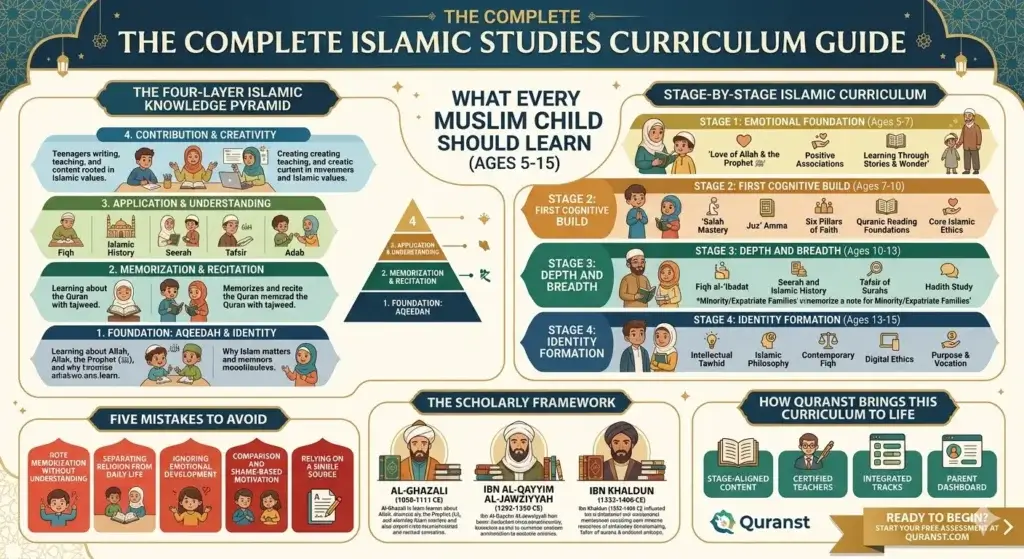
Section 2: The Four-Layer Islamic Knowledge Pyramid
Before mapping content to ages, we need a structural model of Islamic knowledge itself. Classical scholars organized Islamic learning in a hierarchy. For children and youth, this can be represented as a four-layer pyramid:
| Layer | Title | Description |
|---|---|---|
| Layer 4 | Contribution & Creativity | The child contributes: writes, teaches others, reflects, creates content rooted in Islamic values |
| Layer 3 | Application & Understanding | Fiqh, Islamic History, Seerah, Tafsir, Adab — turning knowledge into behavior |
| Layer 2 | Memorization & Recitation | The Quran: letter-perfect recitation, tajweed, hifz (memorization) |
| Layer 1 — Foundation | Aqeedah & Identity | The non-negotiable base: Who is Allah? Who am I? Why does Islam matter? |
No upper layer can withstand structural stress without the layers beneath it being solid. A child who memorizes the Quran without aqeedah (sound belief) becomes spiritually vulnerable at the first philosophical challenge. A child who knows Islamic jurisprudence without an emotional connection to Allah performs rituals mechanically, without sincerity.
“Teach your children the love of the Prophet and the love of his family, and the recitation of the Quran, for verily the Quran-bearers are in the shade of Allah on the day when there is no shade but His.”
— Reported by al-Tabarani in al-Mu’jam al-Awsat; cited in Kanz al-Ummal, Hadith 45396
Section 3: Stage-by-Stage Islamic Curriculum — Ages 5 to 15
The Prophet Muhammad ﷺ himself outlined developmental stages for children. Ibn al-Qayyim, in Tuhfat al-Mawdud, systematically described the spiritual and educational responsibilities of parents at each stage. What follows integrates this classical framework with modern developmental science.
Join our global community of 500+ families at Quranst Institute
Where we don’t just teach the Quran—we teach the lifestyle of the Prophets.
🚀 Start Your Smart Learning Journey TodayStage 1: Emotional Foundation — Ages 5 to 7
A child at this stage does not yet think in abstractions. They learn through the senses, through story, through emotion, and above all through what they see their parents do. This is not the stage for formal lessons — it is the stage for creating a beautiful, safe, love-filled association with Islam.
الْوَلَدُ سَيِّدٌ سَبْعَ سِنِينَ
“The child is a master for seven years [and is given freedom to explore and experience].”
— Prophet Muhammad ﷺ — Narrated in various forms; referenced in al-Suyuti’s al-Jami’ al-Saghir and Ibn al-Qayyim’s Tuhfat al-Mawdud
The hadith describes this phase as one of freedom, wonder, and foundational emotional imprinting. The educational mandate here is simple but profound: make the child love Allah, love the Prophet ﷺ, and love the Quran — before any obligation is placed on their shoulders.
Core Learning Goals for Ages 5–7
- Build a positive, loving image of Allah as the Most Merciful, the Sustainer — not primarily as a Judge.
- Introduce the Prophet Muhammad ﷺ through vivid, emotionally engaging stories of his kindness, humor, and love for children.
- Create a Quranic home environment: recitation heard daily, treated as a source of calm and beauty.
- Simple duas (supplications) for daily activities: waking, eating, entering the bathroom, sleeping.
- Basic pillars of Islam introduced through play, song, and imitation — never through compulsion.
إِنَّ اللَّهَ رَفِيقٌ يُحِبُّ الرِّفْقَ
“Indeed Allah is gentle and loves gentleness.”
— Sahih al-Bukhari, Hadith 6927; Sahih Muslim, Hadith 2593
⚠️ A Critical Parenting Note: At this stage, for every boundary you set (“don’t do this”), plant five positive associations (“let’s do this instead”). Islam for the young child should feel like a garden, not a fence. Research in developmental psychology confirms that fear-based religious instruction before age 7 correlates with adult religious disengagement — a finding that echoes what Islamic scholars warned about centuries ago.
Stage 2: First Cognitive Build — Ages 7 to 10
This is arguably the most important phase in Islamic education. The child’s memory is at peak capacity, logical thinking is beginning to develop, and the heart — not yet hardened by adolescent peer pressure or existential doubt — is still supple and receptive.
مُرُوا أَوْلَادَكُمْ بِالصَّلَاةِ وَهُمْ أَبْنَاءُ سَبْعِ سِنِينَ
“Command your children to pray when they reach seven years of age.”
— Sunan Abu Dawud, Hadith 495; authenticated and classified as Hasan by al-Albani
This hadith is not merely an instruction about prayer mechanics. It is a developmental milestone marker: at seven, the child enters a new educational phase where structured religious obligations begin — gently, with encouragement, not compulsion.
Core Learning Goals for Ages 7–10
- Complete mastery of Salah — all postures, supplications, and the spirit of khushu’ (presence).
- Memorization of Juz’ Amma (30th section) and Juz’ Tabarak (29th section) with correct tajweed.
- The 99 Names of Allah (Asma’ al-Husna) — meanings understood, not just sounds memorized.
- The Six Pillars of Faith (Arkan al-Iman): belief in Allah, angels, revealed books, prophets, the Last Day, and divine decree.
- Stories of the major prophets: Adam, Ibrahim, Musa, ‘Isa, and Muhammad ﷺ — told vividly, with moral takeaways.
- Core Islamic ethics: sidq (honesty), amanah (trustworthiness), birr al-walidayn (honoring parents), mercy toward animals.
- Introduction to Arabic letters and Quranic reading foundations (Qa’idah Noorania or equivalent).
“Memorization in childhood is like engraving on stone.”
— Arab classical proverb, widely cited in Islamic pedagogical literature including al-Ghazali’s Ihya’ Ulum al-Din
Al-Ghazali, in his foundational work Ihya’ Ulum al-Din (The Revival of the Religious Sciences), dedicated an entire chapter to the education of children, stating that the young child’s heart is like a blank canvas — whatever is inscribed on it becomes permanent. This is the window that structured Islamic education must not miss.
Deepen Your Knowledge of Islamic Studies
Embark on a comprehensive journey through Fiqh, Aqeedah, Seerah, and Hadith. Join our expert tutors and expand your understanding of Islam.
Book Your Free Class NowStage 3: Depth and Breadth — Ages 10 to 13
At this stage, the child begins asking real questions: Why? How do we know? Is this logical? These questions are not rebellion — they are intellectual growth. A well-designed curriculum welcomes them as opportunities, not threats.
طَلَبُ الْعِلْمِ فَرِيضَةٌ عَلَى كُلِّ مُسْلِمٍ
“Seeking knowledge is an obligation upon every Muslim.”
— Sunan Ibn Majah, Hadith 224; classified as Sahih by al-Albani
Core Learning Goals for Ages 10–13
- Fiqh al-‘Ibadat (jurisprudence of worship) in depth: conditions, pillars, and invalidators of prayer; fasting; purification; basics of zakat.
- The Seerah (prophetic biography) in detail: Mecca period, Hijra, Medina period, major battles, final years, and death of the Prophet ﷺ.
- Islamic history: the Rightly Guided Caliphs (Khulafa’ al-Rashidun), the golden age of Islamic civilization, Muslim scientists and their contributions.
- Tafsir (Quranic interpretation) of memorized surahs — connecting the words they know to living meaning.
- Introduction to hadith collections: understanding Sahih al-Bukhari and Sahih Muslim, the concept of isnad (chain of narrators), and what makes a hadith authentic.
- Islamic social ethics: justice, community service, environmental stewardship as khalifah (vicegerent) on earth.
“The curriculum content should follow a logical sequence and gradation — moving from simple to more complex elements, from easy to more difficult — according to the learner’s ability.”
— Ibn Khaldun, Muqaddimah, Chapter 6 — translated by Franz Rosenthal (Princeton University Press, 1989), p. 721
Ibn Khaldun’s pedagogical principle — written in 1377 CE — anticipates scaffolded learning theory by six centuries. He explicitly warned against overwhelming students with too many subjects simultaneously, cautioning that it produces confusion rather than mastery. For Muslim children in this age group, depth over breadth is the winning strategy.
📌 Special Note for Expatriate and Minority Families: Children ages 10–13 in Western schools are frequently confronted with questions that challenge their faith — from classmates, teachers, and online content. The curriculum at this stage must specifically address: How do we know God exists? How does Islam relate to science? What does Islam say about human rights? Answering these with intellectual confidence, not defensive deflection, is the goal.
Stage 4: Identity Formation — Ages 13 to 15
These three years, spanning early adolescence, are perhaps the most critical for Islamic identity. The teenager is no longer asking “What is Islam?” — they are asking “Who am I, and where does Islam fit into my identity?” The educational approach must shift accordingly: from instruction to dialogue, from answers to guided inquiry.
يَا أَيُّهَا الَّذِينَ آمَنُوا قُوا أَنفُسَكُمْ وَأَهْلِيكُمْ نَارًا
“O you who have believed, protect yourselves and your families from a Fire.”
— Quran 66:6
Imam al-Tabari, in his Tafsir (commentary), explains this verse as a comprehensive educational mandate to parents — encompassing not just knowledge transfer but the formation of character, values, and resilience. By ages 13–15, this resilience is existentially urgent.
Core Learning Goals for Ages 13–15
- Intellectual Tawhid: rational arguments for the existence of God, the authenticity of the Quran, and the prophethood of Muhammad ﷺ using cosmological, teleological, and linguistic evidence.
- Islamic philosophy: engaging with classical thinkers — al-Ghazali (Tahafut al-Falasifah), Ibn Rushd, Ibn Taymiyyah — ideas, not biographies.
- Muslim identity in pluralistic societies: navigating dual identities, engaging respectfully with other faiths, combating Islamophobia with knowledge and composure.
- Digital Islamic ethics: privacy, online relationships, social media use, content consumption — all examined through an Islamic lens.
- Fiqh of contemporary issues: music, mixed-gender interactions, halal/haram in food and finance — with reasoning, not just rulings.
- Purpose and vocation: the concept of khilafah (stewardship), career planning from an Islamic value framework, contribution to society.
“Do not restrict your children to your own learning, for they were born in a time other than yours.”
— Attributed to ‘Ali ibn Abi Talib (raḍiAllahu ‘anh) — cited in Ibn ‘Asakir’s Tarikh Dimashq and widely reported in Islamic educational literature
This oft-quoted statement encapsulates the entire philosophy of age-appropriate Islamic education: the content and delivery must evolve with the times and the child, while the values remain eternal.
Section 4: The Integrated Curriculum Overview Table
The following table summarizes the four stages and can be used as a practical checklist by parents and educators:
| Age Range | Main Focus | Core Subjects | Success Indicator |
|---|---|---|---|
| Ages 5–7 | Emotional Foundation | Love of Allah & the Prophet ﷺ; short surahs; daily duas; Islamic manners | Child looks forward to prayer time and Quran recitation |
| Ages 7–10 | First Cognitive Build | Salah mastery; Juz’ Amma; 6 Pillars of Faith; Seerah stories; Quranic reading | Prays consistently; recites with tajweed; answers basic aqeedah questions |
| Ages 10–13 | Depth & Breadth | Fiqh; detailed Seerah; Islamic history; hadith study; tafsir; social ethics | Explains ‘why’ behind Islamic practices; handles academic challenges to faith |
| Ages 13–15 | Identity Formation | Intellectual Tawhid; Islamic philosophy; identity in pluralism; digital ethics; vocation | Articulates Islamic identity confidently; defends faith calmly and intelligently |
Section 5: Five Mistakes That Undermine Islamic Education
Knowing what to teach is only half the equation. Knowing what to avoid is equally important. The following five mistakes are among the most common — and most damaging — in Muslim family education practices today.
Mistake 1: Rote Memorization Without Understanding
When Islamic education becomes a factory of sounds without meaning — hundreds of Quranic verses memorized but not understood, rules drilled but not reasoned — the child grows up seeing Islam as a burden. Ibn Khaldun explicitly criticized pedagogical harshness and rote-only approaches in the Muqaddimah, arguing they destroy the student’s enthusiasm and intellectual formation.
Mistake 2: Separating Religion from Daily Life
“Islamic time” is 20 minutes after Maghrib. Everything else is “regular life.” This false compartmentalization is perhaps the most insidious mistake. The Prophet ﷺ modeled Islam as a total way of life — in eating, sleeping, business, travel, and family — and this integration must be modeled to children, not just preached.
وَذَكِّرْ فَإِنَّ الذِّكْرَىٰ تَنفَعُ الْمُؤْمِنِينَ
“And remind, for indeed, the reminder benefits the believers.”
— Quran 51:55
Mistake 3: Ignoring Emotional Development
Information without emotion reaches the mind but not the heart. The Quran itself is arguably the most emotionally intelligent text ever revealed: its stories create empathy, its descriptions evoke awe, its promises inspire hope. Islamic education that bypasses emotion produces scholars without hearts — memorizers without conviction.
Mistake 4: Comparison and Shame-Based Motivation
“Look at your cousin — he has memorized three juz already!” This sentence has damaged more children’s relationships with the Quran than almost any other. Every child has their own path. The Prophet ﷺ said: “Make things easy and do not make them difficult; give glad tidings and do not repel.” (Sahih al-Bukhari, Hadith 69). The Islamic approach to motivation is encouragement, milestones, and celebration — never shame.
Mistake 5: Relying on a Single Source
A child needs an ecosystem, not a single teacher. The home environment, the mosque, the school, and — especially for expatriate families — a reliable online Islamic education platform all play distinct and complementary roles. quranst was designed precisely to serve the gap that no single source can fill on its own: consistent, expert-led, curriculum-driven Islamic and Quranic education accessible anywhere in the world.
Section 6: The Scholarly Framework — From Classical Educators to Contemporary Practice
This curriculum is not invented from scratch. It stands on the shoulders of Islamic civilization’s greatest educational thinkers.
Al-Ghazali (1058–1111 CE) — Ihya’ Ulum al-Din
Abu Hamid al-Ghazali, in the chapter “On the Education of Children” in his masterwork Ihya’ Ulum al-Din (The Revival of the Religious Sciences), described the child’s heart as a precious gem that, without proper polishing, deteriorates into base material. He emphasized the primacy of akhlaq (character) before any formal knowledge, arguing that moral formation precedes intellectual formation.
“Know that the method of training children is one of the most important matters. The child is a trust in the care of his parents; his pure heart is a precious gem, simple and free of any form or engraving.”
— Al-Ghazali, Ihya’ Ulum al-Din, Vol. 3, Chapter on the Education of Children (Dar al-Ma’rifah, Beirut)
Ibn Khaldun (1332–1406 CE) — Al-Muqaddimah
Writing in 1377 CE, Ibn Khaldun laid down educational principles that remain startlingly modern. He warned against:
- Teaching too many subjects simultaneously (cognitive overload)
- Pedagogical harshness that breaks students’ confidence
- Rote memorization without conceptual grounding
His principle of graduated learning — from concrete to abstract, from simple to complex — underpins every well-designed curriculum today, Islamic or otherwise.
Ibn al-Qayyim al-Jawziyyah (1292–1350 CE) — Tuhfat al-Mawdud
In his dedicated treatise on child-rearing, Tuhfat al-Mawdud bi-Ahkam al-Mawlud (The Precious Gift: Rulings on the Newborn), Ibn al-Qayyim provided the most detailed classical account of Islamic developmental education. He described how different stages of childhood require different emphases, and how failure to educate children properly is a form of injustice against them.
“Whoever neglects the education of his child when he can provide it has done him a great injustice. For most of the corruption of children comes from their parents, who neglect them and leave them untaught.”
— Ibn al-Qayyim al-Jawziyyah, Tuhfat al-Mawdud bi-Ahkam al-Mawlud (Dar Ibn Hazm, Beirut), p. 242
Contemporary Scholars
Contemporary scholars including Shaykh Yasir Qadhi, Dr. Tariq Ramadan, and Dr. Umar Faruq Abd-Allah have written and spoken extensively about the unique challenges of raising Muslim children in Western minority contexts. Their work converges on the same conclusion: the solution is not cultural retreat or total assimilation, but confident, intellectually grounded Islamic identity — rooted in classical tradition and fluent in the contemporary world.
Section 7: How quranst Brings This Curriculum to Life
quranst was not built to be one more online Islamic content site. It was built to solve a specific, urgent problem: how do Muslim children in Toronto, London, Melbourne, Houston, or Dubai receive the same quality of structured Islamic and Quranic education that children in well-resourced traditional learning environments receive?
The quranst Curriculum Difference
| Feature | What It Means for Your Child |
|---|---|
| Stage-aligned content | Every course is mapped to the developmental framework in this guide — not one-size-fits-all |
| Certified teachers | All instructors are qualified in Islamic sciences and trained for diaspora children specifically |
| Integrated tracks | Islamic Studies, Quran (hifz), Tajweed, and Arabic Language form one connected curriculum |
| Parent dashboard | Regular progress reports against developmental benchmarks, not just lesson completion |
| Live + recorded sessions | Flexible scheduling for busy families across all time zones |
✦ Start Your Child’s Islamic Education Journey Today
quranst offers a free placement assessment for new students — a short, non-stressful evaluation that identifies your child’s current level and the ideal starting point in our curriculum. No commitment required.
Deepen Your Knowledge of Islamic Studies
Embark on a comprehensive journey through Fiqh, Aqeedah, Seerah, and Hadith. Join our expert tutors and expand your understanding of Islam.
Book Your Free Class NowSection 8: A Practical 90-Day Starter Plan for Parents
You do not need to have everything figured out before you begin. Here is a simple, actionable three-month plan to start implementing structured Islamic education for your child, regardless of where you live.
Week 1 — Honest Assessment Sit with your child in a relaxed, pressure-free setting. Ask gentle questions: What do you know about Allah? What surahs do you know? How do you feel about prayer? Do not correct or evaluate out loud. Listen. Note where they are — not where you wish they were.
Month 1 — One Anchor, One Habit Choose one Islamic habit to anchor daily: praying Maghrib together as a family, reading one short surah before bed, or learning one dua per week. Research in habit formation confirms that single-habit anchoring is more effective than multi-front reform. The Prophet ﷺ said: “The most beloved deeds to Allah are those that are most consistent, even if they are small.” (Sahih al-Bukhari, Hadith 6465).
Month 2 — Add Structure Enroll in a structured learning program — quranst or equivalent. Let curriculum professionals carry the educational load while you focus on reinforcing the learning at home through conversation, stories, and lived example.
Month 3 — Celebrate and Recalibrate After 90 days, sit with your child again. What has changed? Celebrate every milestone — verbally, with small rewards, with community recognition. Celebration is not indulgence; it is prophetic pedagogy. The Prophet ﷺ expressed genuine delight when his companions achieved religious milestones.
Conclusion: Your Child Is Not a Project — They Are a Trust
When we speak of Islamic education in terms of curricula, milestones, benchmarks, and outcomes, we risk forgetting something essential: these are souls. Souls entrusted to us by the Most High. Souls that will one day stand before Allah and account for what they were given.
كُلُّكُمْ رَاعٍ وَكُلُّكُمْ مَسْؤُولٌ عَنْ رَعِيَّتِهِ
“Every one of you is a shepherd, and every one of you is responsible for their flock.”
— Sahih al-Bukhari, Hadith 893; Sahih Muslim, Hadith 1829
The Islamic education we give our children is not a transaction — it is a covenant. It is not about producing children who perform Islam correctly; it is about nurturing human beings who experience Islam as the fullest expression of who they are and who they are meant to become.
quranst exists as a partner in that covenant. Not a replacement for parental love and example. Not a substitute for community and mosque. But a structured, expert, compassionate scaffold that helps Muslim families around the world deliver on that most ancient and most urgent of parental promises: to raise a child who knows their Lord.
References & Sources
Quranic References
- Quran 9:119 (Surah al-Tawbah) — on being with the truthful
- Quran 66:6 (Surah al-Tahrim) — on protecting family from hellfire
- Quran 51:55 (Surah al-Dhariyat) — on the benefit of reminder
Hadith References
- Sunan Abu Dawud, Hadith 495 — command to pray at age seven (authenticated by al-Albani)
- Sahih al-Bukhari, Hadith 6927; Sahih Muslim, Hadith 2593 — Allah loves gentleness
- Sahih al-Bukhari, Hadith 69 — make things easy, give glad tidings
- Sahih al-Bukhari, Hadith 893; Sahih Muslim, Hadith 1829 — every person is a shepherd
- Sahih al-Bukhari, Hadith 6465 — most beloved deeds are consistent ones
- Sunan Ibn Majah, Hadith 224 — seeking knowledge is an obligation (authenticated by al-Albani)
- Al-Tabarani, al-Mu’jam al-Awsat; cited in Kanz al-Ummal, Hadith 45396 — love of the Prophet and Quran
Classical Scholarly Works
- Al-Ghazali, Abu Hamid. Ihya’ Ulum al-Din (The Revival of the Religious Sciences). Vol. 3, Chapter on Child Education. Dar al-Ma’rifah, Beirut.
- Ibn al-Qayyim al-Jawziyyah. Tuhfat al-Mawdud bi-Ahkam al-Mawlud (The Precious Gift). Dar Ibn Hazm, Beirut, p. 242.
- Ibn Khaldun. Al-Muqaddimah (An Introduction to History). Translated by Franz Rosenthal. Princeton University Press, 1989. Chapter 6, p. 721.
- Al-Tabari, Muhammad ibn Jarir. Tafsir al-Tabari (Jami’ al-Bayan fi Ta’wil al-Quran). Commentary on Quran 66:6. Dar al-Hadith, Cairo.

