

Introduction: The Child Who Recites Without Seeing
She recites Surah Al-Ghashiyah perfectly.
Every letter correct, every Tajweed rule applied, the melody precise. Her teacher has praised her. Her parents are proud. At the Friday gathering, she recites it for the extended family and they applaud.
She does not know that Al-Ghashiyah describes faces on the Day of Judgment — some downcast and exhausted, laboring in the Fire, drinking from a boiling spring. Others radiant, pleased, in a lofted garden where they hear no ill speech, where there is a flowing spring, raised couches, arranged cups, cushions in rows, and carpets spread.
She does not know that when she recites “Wujuhun yawma’idhin khashi’ah” — “Faces that Day will be downcast” — she is reciting a verse that paints one of the most vivid scenes in the entire Quran.
She is reciting sounds. She is not yet reading a picture.
This is the gap that visual Tafsir — the interpretation of Quranic verses through drawing, coloring, and illustration — is uniquely positioned to close. Not as a replacement for correct recitation and memorization. Not as a shortcut past Tajweed. But as the bridge between the phonetically perfect recitation of a surah and the moment the child sees what the surah is describing — and the memory becomes not just phonetic but visual, emotional, and genuinely comprehended.
Research on Quranic pedagogical methods identifies four core educational approaches in the Quran itself: exemplary conduct (uswah hasanah), wise counsel (maw’izhah hasanah), constructive dialogue (mujadalah), and measured discipline. The Quran teaches through story, image, comparison, and dialogue — not through abstract proposition. Visual interpretation of Quranic content is therefore not an innovation but a development of the Quran’s own pedagogical methodology.
Structured Curriculum Framework
quranst’s Quranic courses connect Quran memorization to comprehension — with Quranic Arabic, Tafsir-grounded lessons, and creative engagement methods that make the Quran genuinely understood, not just recited.
Book your free 2-session trial →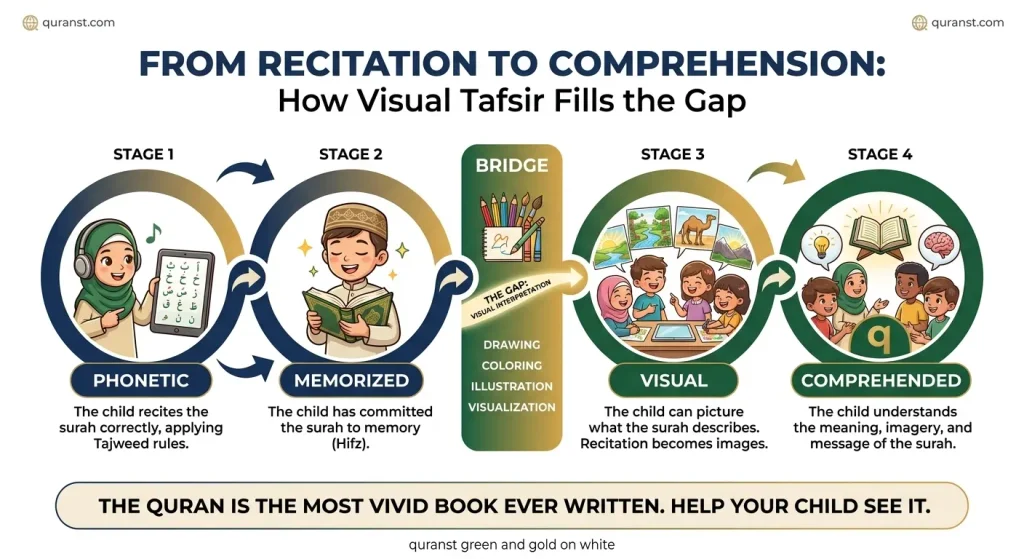
The Quranic Invitation to Observe and Reflect
The Quran is — among all the things it is — the most visually evocative text in the history of human language.
It describes Paradise with specific, sensory detail: flowing rivers, raised couches, cool shade, sweet fruits, the faces of the blessed radiant with light. It describes the mountains moving like clouds on the Day of Judgment. The sea set on fire. The pregnant camel abandoned. The blind man arriving at an important meeting. The spider building its house.
These are not theological abstractions. They are images — deliberately chosen by Allah to make His message accessible to the full range of human perception, including the visual imagination.
أَفَلَا يَنظُرُونَ إِلَى الْإِبِلِ كَيْفَ خُلِقَتْ ﴿١٧﴾ وَإِلَى السَّمَاءِ كَيْفَ رُفِعَتْ ﴿١٨﴾ وَإِلَى الْجِبَالِ كَيْفَ نُصِبَتْ ﴿١٩﴾ وَإِلَى الْأَرْضِ كَيْفَ سُطِحَتْ
“Do they not look at the camels — how they are created? And at the sky — how it is raised? And at the mountains — how they are erected? And at the earth — how it is spread out?”
— Quran 88:17–20
These four verses — from Surah Al-Ghashiyah itself — are a direct invitation to look. To observe. To see. And the child who draws a camel after reciting these verses has done precisely what Allah invited: they have looked.
وَفِي الْأَرْضِ آيَاتٌ لِّلْمُوقِنِينَ ﴿٢٠﴾ وَفِي أَنفُسِكُمْ ۚ أَفَلَا تُبْصِرُونَ
“And on the earth are signs for those of certain faith. And in yourselves — will you not then see?”
— Quran 51:20–21
“Will you not then see?” — Allah’s direct question to the reader. The visual engagement with Quranic content is not a pedagogical innovation. It is a divine invitation that has been waiting fourteen centuries to be taken seriously in children’s Islamic education.
The Research: Why Visual Learning Deepens Quranic Comprehension
The case for visual Tafsir is not only theological. It is supported by converging evidence from educational psychology, neuroscience, and Islamic pedagogy research.
Research published in the International Journal of Educational Research (Volume 7, September 2025) on innovative Quranic technologies in early childhood education found a consistent rise in scholarly output between 2020 and 2024, with 2024 marking the peak in publication frequency. The research confirms that multi-modal approaches to Quranic education — combining auditory, visual, and kinesthetic elements — significantly improve comprehension and retention compared to auditory-only methods.
The Dual Coding Theory
Educational psychologist Allan Paivio’s Dual Coding Theory (1971, extensively validated since) demonstrates that information encoded through both verbal and visual channels is retained significantly more strongly than information encoded through either channel alone. When a child recites Surah Al-Ghashiyah and draws the images it describes, they are encoding the surah in two separate memory systems — and the combination is exponentially more durable than either alone.
The child who has drawn the garden of Paradise described in Al-Ghashiyah — the flowing spring, the raised couches, the cushions in rows — will never recite those verses without seeing what they describe. The visual memory activates the verbal memory, and vice versa, creating a reinforcing loop that traditional memorization-only approaches cannot replicate.
Art as Comprehension Evidence
When a child draws what they understand a Quranic verse to mean, the drawing is simultaneously a creative act and a comprehension assessment. The teacher or parent who sees the drawing knows immediately — without a formal test — exactly what the child understood, what they missed, and what requires further explanation.
Research on creative engagement with Quranic themes confirms that when children paint their interpretations of Quranic descriptions — Jannah, the signs of Allah in creation, the scenes of the Day of Judgment — and then hold a discussion about the rewards of good deeds and the importance of striving, the activity helps children reflect on their actions and connect the Quranic imagery to their daily lives in ways that verbal instruction alone cannot achieve.
The Emotional Encoding Effect
Emotions significantly enhance memory formation — a finding so robust in neuroscience that it is considered one of the most reliable principles in all of learning research. When a child feels something while learning — curiosity, wonder, delight, a sense of discovery — the memory of what they were learning is encoded more deeply.
A child who draws the scene of the Day of Judgment — the mountains moving, the seas set on fire, the faces downcast — experiences a genuine emotional response to what they are drawing. That emotional experience encodes the Quranic content at a neurological depth that recitation without visual engagement cannot match.
Section 1: The Four Levels of Quranic Engagement — Where Art Enters
Understanding where visual Tafsir fits in the complete arc of Quranic engagement helps parents deploy it correctly — not as a replacement for other elements but as a bridge between them.
Level 1: Phonetic Engagement (Recitation)
The child can produce the sounds correctly. This is the work of Tajweed and Quran reading — essential, non-negotiable, but not sufficient alone.
Level 2: Memorial Engagement (Memorization/Hifz)
The child has committed the surah to memory. This is the work of Hifz — also essential, also not sufficient alone for genuine comprehension.
Level 3: Visual Engagement (Imagination/Tafsir)
This is where drawing and coloring enter. The child can picture what the surah describes — they have moved from phonetic and memorial engagement to genuine imagistic comprehension.
Level 4: Personal Engagement (Application)
The child understands the surah’s message and can connect it to their own life, their choices, their relationship with Allah.
Visual art is the bridge from Level 2 to Level 3 — the specific tool for transforming a memorized sound into a comprehended image that eventually becomes a personally meaningful message.
Section 2: Twelve Surahs, Twelve Visual Worlds
Each surah below includes:
- Its primary visual content (what the child can draw)
- The specific Quranic imagery to engage
- An age-appropriate drawing prompt
- The comprehension question that follows
1. Surah Al-Fatiha — The Journey and the Path
The visual world: A path dividing into three roads — the straight path, the path of those who received blessings, and the diverging paths of those who went astray. At the end of the straight path: light.
Drawing prompt: “Draw the path of someone who is guided to Allah. What does the road look like? What is at the end? Who else is on the road with them?”
Quranic imagery:
اهْدِنَا الصِّرَاطَ الْمُسْتَقِيمَ “Guide us to the straight path.” — Quran 1:6
Comprehension question: “What do you think it feels like to be on the straight path? What helps you stay on it?”
2. Surah Al-Ghashiyah — Two Kinds of Faces, Two Kinds of Gardens
The visual world: Two contrasting worlds. On one side: exhausted, downcast faces near a burning spring, eating bitter food. On the other: radiant, pleased faces in a lofted garden with flowing springs, silk couches, cushions in rows.
Drawing prompt: “Draw the garden of Al-Ghashiyah. What does the flowing spring look like? What are the raised couches made of? What do the faces of the people look like?”
Quranic imagery:
وُجُوهٌ يَوْمَئِذٍ نَّاعِمَةٌ ﴿٨﴾ لِّسَعْيِهَا رَاضِيَةٌ ﴿٩﴾ فِي جَنَّةٍ عَالِيَةٍ “Faces that Day will be joyful, satisfied with their effort, in an elevated garden.” — Quran 88:8–10
Comprehension question: “What do you think the people in the garden did in their lives to end up there?”
3. Surah Al-Zilzalah — The Earth Shaking and Speaking
The visual world: The earth shaking violently, throwing up everything inside it, then speaking — telling what it saw of every deed done upon it. People emerging scattered, going to see their actions.
Drawing prompt: “Draw the earth on the Day of Judgment. What is coming out of it? What is the earth saying? Draw the people’s faces as they hear what the earth says about them.”
Quranic imagery:
يَوْمَئِذٍ تُحَدِّثُ أَخْبَارَهَا “That Day it will report its news.” — Quran 99:4
Comprehension question: “If the ground outside our home could speak, what would it say about what happened there today?”
4. Surah Al-Fil — The Army of Elephants and the Birds
The visual world: An enormous army with elephants advancing on the Kaaba. Then a flock of small birds arriving from the sky, each carrying three stones — one in the beak, two in the claws — and dropping them on the army until they are like “eaten straw.”
Drawing prompt: “Draw the army of Abraha marching toward the Kaaba. Then draw the birds arriving. Show what happens when the stones fall. What does the army look like afterward?”
Quranic imagery:
وَأَرْسَلَ عَلَيْهِمْ طَيْرًا أَبَابِيلَ ﴿٣﴾ تَرْمِيهِم بِحِجَارَةٍ مِّن سِجِّيلٍ “And He sent against them birds in flocks, striking them with stones of hard clay.” — Quran 105:3–4
Comprehension question: “Allah used small birds to defeat a huge army. What does that tell you about how Allah protects what is sacred?”
5. Surah Al-Kawthar — The River of Abundance
The visual world: A magnificent river in Paradise — the Prophet ﷺ described Al-Kawthar as a river whose banks are made of gold, whose bed is rubies and pearls, whose water is whiter than milk and sweeter than honey.
Drawing prompt: “Draw the river of Al-Kawthar. What are the banks made of? What color is the water? What do the people drinking from it look like?”
Quranic imagery:
إِنَّا أَعْطَيْنَاكَ الْكَوْثَرَ “Indeed, We have granted you Al-Kawthar.” — Quran 108:1
The Prophet ﷺ described it:
“Al-Kawthar is a river in Paradise. Its banks are of gold, its bed of pearls and rubies. Its water is whiter than snow and sweeter than honey.” — Sahih al-Tirmidhi, Hadith 2542; classified as Sahih
Comprehension question: “This river was given to the Prophet ﷺ as a gift from Allah. What do you think it means that those who love and follow the Prophet ﷺ will drink from it?”
6. Surah Al-Falaq — The Evils of Darkness
The visual world: Dawn breaking — light pushing through darkness. In the darkness before dawn: the mischief of created things, the darkness when it settles, the harm of those who blow on knots.
Drawing prompt: “Draw the moment just before dawn — the sky is dark but the first light is beginning. What dangers might be in the darkness? Draw the light of Al-Falaq arriving and what it does to those dangers.”
Quranic imagery:
قُلْ أَعُوذُ بِرَبِّ الْفَلَقِ ﴿١﴾ مِن شَرِّ مَا خَلَقَ “Say: I seek refuge with the Lord of the dawn — from the evil of what He created.” — Quran 113:1–2
Comprehension question: “Why do you think we seek refuge with the ‘Lord of the dawn’? What does dawn do to darkness?”
7. Surah Al-Nas — The Whisperer Who Retreats
The visual world: An invisible whisperer hiding in the chest of a person, whispering bad thoughts. Then the person remembers Allah and the whisperer retreats — becomes smaller, quieter, less powerful.
Drawing prompt: “Draw a person with the whisperer inside their chest. Then draw what happens when the person says ‘A’udhu billahi min al-Shaytan al-Rajim.’ What does the whisperer look like when it retreats?”
Comprehension question: “The surah says the Shaytan ‘whispers and then retreats.’ Why do you think he retreats when we remember Allah?”
8. Surah Al-Duha — Morning Light and Divine Care
The visual world: The brightness of morning (Al-Duha) contrasted with the quiet stillness of night (Al-Layl). Light, warmth, gradual brightening — Allah’s care for the Prophet ﷺ described through the metaphor of dawn.
Drawing prompt: “Draw the morning light of Al-Duha — the sun rising, the sky going from dark to bright. In one corner, draw a person sleeping peacefully (the night). In another, draw the same person awake and active in the morning light. Color the morning scene in warm colors that feel like care and safety.”
Quranic imagery:
وَالضُّحَىٰ ﴿١﴾ وَاللَّيْلِ إِذَا سَجَىٰ ﴿٢﴾ مَا وَدَّعَكَ رَبُّكَ وَمَا قَلَىٰ “By the morning brightness. And by the night when it covers with darkness. Your Lord has not taken leave of you, nor has He detested you.” — Quran 93:1–3
Comprehension question: “Allah compares His care for the Prophet ﷺ to the morning light. If Allah’s love were a color, what color would you choose? Why?”
9. Surah Al-A’la — The Growing Green and the Spreading Gray
The visual world: Lush green pasture being watered and growing, then turning to gray-brown dried grass after its moisture is gone. The cycle of growth, abundance, withering — used to describe the transience of this world.
Drawing prompt: “Draw two scenes side by side. Scene 1: Lush green grass and water (the world in its abundance). Scene 2: The same grass dried and gray (the world after its moment passes). Which scene looks more beautiful? Which do you think is more real?”
Quranic imagery:
وَالَّذِي أَخْرَجَ الْمَرْعَىٰ ﴿٤﴾ فَجَعَلَهُ غُثَاءً أَحْوَىٰ “And who brings out the pasture — and then makes it black stubble.” — Quran 87:4–5
Comprehension question: “The surah compares this world to the green grass that dries up. If you had to draw your own life as a plant, what stage would it be in right now? What are you growing toward?”
10. Surah Al-Tin — The Two Sacred Trees and the Balanced Human
The visual world: The fig tree and the olive tree — both ancient, both sacred, both producing fruit that nourishes. And Allah’s declaration that He created the human being in the “best of forms” (ahsan al-taqwim).
Drawing prompt: “Draw a fig tree and an olive tree standing side by side — strong, rooted, bearing fruit. Between them, draw a human being standing upright — in the ‘best of forms.’ What does the best form of a human being look like? What makes a person truly beautiful?”
Quranic imagery:
لَقَدْ خَلَقْنَا الْإِنسَانَ فِي أَحْسَنِ تَقْوِيمٍ “We have certainly created the human in the best of forms.” — Quran 95:4
Comprehension question: “Allah says He created you in the best of forms. What do you think that means — just physically, or something more? What does it feel like to be made by Allah as a best form?”
11. Surah Al-Shams — The Sun, the Moon, and the Soul
The visual world: The sun blazing in the sky. The moon following, reflecting its light. The day revealing. The night covering. The sky and what built it. The earth and what spread it. And then — the soul, and its inspiring — the one who purifies it succeeds.
Drawing prompt: “Draw the sun, the moon, the day, and the night — all in one picture. Then, in the center of the picture, draw a human soul. What color is a purified soul? What does the soul that has been corrupted look like? How are the sun and the soul similar?”
Quranic imagery:
قَدْ أَفْلَحَ مَن زَكَّاهَا ﴿٩﴾ وَقَدْ خَابَ مَن دَسَّاهَا “Successful is the one who purifies it. Losing is the one who corrupts it.” — Quran 91:9–10
Comprehension question: “The surah talks about the sun giving light and then about the soul. Why do you think Allah compares the soul to the sun?”
12. Surah Al-Ikhlas — The Absolute Uniqueness of Allah
The visual world: A unique conceptual challenge — how do you draw the undrawable? Al-Ikhlas is deliberately abstract. And this becomes the most powerful visual activity of all.
Drawing prompt: “Surah Al-Ikhlas says that Allah is Ahad (One and Unique) and Al-Samad (Eternal and Self-sufficient). It says He was not born and has no child and there is nothing like Him. This is the hardest drawing challenge: How would you show that something is completely unique — unlike anything that has ever existed? Draw whatever feels right to you. You cannot draw Allah — but can you draw the feeling of His uniqueness?”
Comprehension question: “What did you draw? Why did you choose that? What is the hardest part of understanding that Allah is unlike anything we have ever seen?”
Section 3: The Practical Method — How to Run a Quranic Art Session at Home
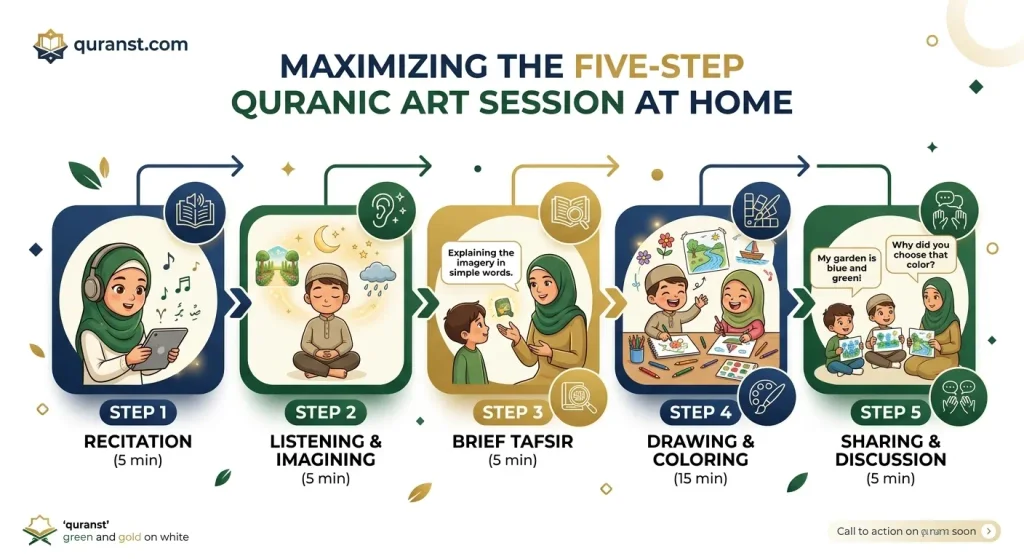
The Five-Step Session Structure
Step 1 — Recitation (5 minutes) Begin with the child reciting the surah — correctly, with Tajweed. If they are still learning, recite together. The phonetic engagement comes first; the visual engagement builds on it.
Step 2 — Listening and Imagining (5 minutes) Recite the surah again — slowly, expressively. Ask the child to close their eyes and listen. Not to repeat. Not to memorize. Just to listen and let the words create pictures in their mind. “What do you see when you hear this surah?”
Step 3 — Brief Tafsir (5 minutes) Give a simple, age-appropriate explanation of the surah’s imagery — what the key words mean, what scene is being described. Keep it to three to five sentences. You are not delivering a lecture; you are giving the child enough context to draw intelligently.
Step 4 — Drawing (15–20 minutes) Provide blank paper, colored pencils or crayons, and let the child draw what they understood. No wrong answers. No critique of artistic quality. The drawing is a comprehension tool, not an art competition. During the drawing, do not explain or instruct. Observe. Ask occasional open questions: “What’s that? Tell me about that part.”
Step 5 — Sharing and Discussion (5 minutes) After the drawing is complete: “Tell me about your picture. What’s happening here? Why did you choose this color?” Then one comprehension question that connects the surah’s imagery to the child’s life (see examples in Section 2).
Age Adaptations
| Age | Drawing Approach | Tafsir Depth | Engagement Style |
|---|---|---|---|
| 3–6 | Free drawing with basic prompts | One image, one sentence | Parent draws alongside; narrate while drawing |
| 7–10 | Scene-based drawing with character and setting | Three to five sentences of context | Some independence; parent asks questions |
| 11+ | Conceptual and metaphorical drawing | Full Tafsir context with scholarly perspective | Independent; discussion after is the focus |
Section 4: Beyond Coloring — Advanced Visual Tafsir Techniques
The Surah Map
For older children (ages 10+): after multiple Quranic art sessions on the same surah, create a Surah Map — a visual overview of the entire surah that captures its structure, its key images, and its overall message in a single illustration.
The Surah Map for Al-Ghashiyah, for example, might be divided into three sections:
- The Day of Judgment (the overwhelming event)
- The two groups of people (their faces, their situations)
- The call to reflect on creation (the camel, the sky, the mountains, the earth)
Creating this map requires the child to understand not just individual verses but the surah as a unified whole — a significantly deeper engagement than individual verse illustration.
The Before-and-After Illustration
For surahs that describe transformation — Al-Shams (pure soul vs. corrupted soul), Al-Tin (the human in best form vs. the human reduced to lowest of the low), Al-A’la (green pasture vs. gray stubble) — draw the before and after side by side.
The comparison reveals the Quranic moral argument visually: here is what we were created to be; here is what we become when we abandon that path. The child who has drawn both sides carries an embodied understanding of the surah’s message that abstract instruction cannot produce.
The Quranic Story Scroll
For narrative surahs (Al-Fil, Al-Buruj, Al-Fajr), create a Story Scroll — a long strip of paper on which the child illustrates the surah’s narrative in sequential panels, like a comic strip.
Creative Islamic art projects — including Arabic calligraphy combined with illustrated Islamic content — encourage children to appreciate the artistic traditions of Islamic culture while learning about the importance of conveying Quranic verses and messages. The integration of visual and textual elements creates multi-modal memory that significantly outperforms single-channel instruction.
Section 5: Islamic Calligraphy as Quranic Connection
The most direct visual engagement with the Quran — the most ancient, the most traditionally Islamic — is calligraphy. And for children learning Quranic Arabic, calligraphy is simultaneously:
- A visual art activity that engages the creative brain
- An Arabic letter practice that reinforces Learn Arabic goals
- A direct encounter with the specific letters of the Quran they are memorizing
- A connection to 1,400 years of Islamic civilization’s most distinctive art form
Guide children to draw important symbols in Islam and the word “Allah” in decorative calligraphy. These activities not only nurture artistic skills but also provide opportunities for children to learn about Islamic history, values, and cultural traditions through their creative expressions.
Calligraphy Activities by Level
Ages 4–7: Tracing large, printed Arabic letters with thick markers. Coloring them in patterns. The physical trace of the letter Alif, Baa, Meem in the context of a Quranic word connects the child’s body to the text.
Ages 7–12: Writing specific Quranic words or short phrases in stylized form — Bismillah, Alhamdulillah, Subhanallah. Decorating them with geometric patterns, natural imagery, or color gradients.
Ages 12+: Simple Naskh or Ruq’ah script practice with specific Quranic verses. The child who can write “Wa-inna ilayhi raji’un” in careful script has engaged with that verse at a depth that recitation alone cannot produce.
Section 6: From Visual to Verbal — Completing the Comprehension Circle
Visual Tafsir is the bridge. The destination is not the picture — it is the understanding that the picture represents. The complete Quranic comprehension circle moves:
Phonetic → Visual → Verbal → Personal
After the drawing session, the verbal stage is essential: the child explains their drawing. Not just what they drew but why — what they understood, what confused them, what surprised them.
This verbal explanation after visual engagement is one of the most powerful comprehension assessment tools available in any subject area. The child who can explain “I drew the birds small because I wanted to show they shouldn’t have been able to defeat the army — but they did because Allah sent them” has understood the theological message of Surah Al-Fil.
The personal stage — “What does this surah mean for my life?” — is the ultimate destination of Islamic education. The surah about the path (Al-Fatiha) becomes a question about the child’s own direction. The surah about two kinds of faces (Al-Ghashiyah) becomes a question about which kind of face they are working toward. The surah about the purified soul (Al-Shams) becomes a question about what purification looks like in their specific daily life.
Quranic education’s goal — rooted in Surah Luqman and the Quranic pedagogical framework — is to develop the whole person: guiding learners through key aspects of Islamic knowledge including Iman and Tazkiyah, Quran and Tafsir, Fiqh, Adab and Akhlaq. The visual interpretation of Quranic content serves this holistic development when it moves from image to understanding to personal application.
Structured Curriculum Framework
quranst’s online Quran classes connect Tajweed and Hifz to genuine Tafsir comprehension — helping children understand not just how to recite the Quran but what they are reciting and why it matters.
Book your free 2-session trial →Conclusion: The Surah That Became a Picture That Became a Memory
Years from now, your child will stand in prayer and recite Surah Al-Ghashiyah.
They will say “Fi jannatin ‘aliyah” — “In a lofted garden” — and somewhere in their memory, a picture will appear. A garden they drew when they were eight years old, with a flowing spring they colored blue-green and raised couches they colored gold and a face they drew smiling because it was pleased with its effort.
They will not remember where the picture came from. They will not remember the afternoon session at the kitchen table, the colored pencils, the question their parent asked afterward.
They will simply see the garden when they recite the verse. And the seeing will deepen the recitation. And the recitation will carry the memory. And the memory will carry the meaning through their life.
This is what visual Tafsir does.
It does not compete with Tajweed. It does not replace Hifz. It does not shortcut the serious work of Quranic education.
It completes it — filling the gap between the perfectly recited sound and the genuinely comprehended message, between the verse stored in the memory and the image that lives in the imagination, between the child who recites the Quran and the adult who is shaped by it.
كِتَابٌ أَنزَلْنَاهُ إِلَيْكَ مُبَارَكٌ لِّيَدَّبَّرُوا آيَاتِهِ وَلِيَتَذَكَّرَ أُوْلُوا الأَلْبَابِ
“This is a blessed Book which We have revealed to you, so that they might reflect upon its verses and that those of understanding would be reminded.”
— Quran 38:29
Give your child a pencil. Open the Quran. Let them see what they recite.
🟢 Connect Quran Recitation to Deep Comprehension
The coloring and drawing activities in this guide build the visual comprehension bridge. The structured curriculum that provides the Tafsir context, the Quranic Arabic vocabulary, and the comprehension framework that makes those pictures genuinely meaningful is what quranst delivers.
quranst’s Quranic curriculum provides:
Quran Reading and Tajweed:
- Learn Quran from correct pronunciation through fluent independent reading
- Tajweed — all rules taught with immediate application in recitation
- Online Quran teacher — certified, live, one-on-one correction
Hifz (Memorization) with Comprehension:
- Quran memorization — the three-part structure with daily review
- Online Quran classes — connecting memorization to meaning from the first session
- Quranic Arabic — the vocabulary that unlocks the imagery the child is drawing
Tafsir and Islamic Studies:
- Quranic Arabic grammar — understanding how the language creates its imagery
- Islamic studies — connecting Tafsir to Aqeedah, Hadith, and Seerah
- Study Islam online — flexible scheduling for Muslim families in the West
👇 Begin with Two Free Quran Lessons
Two Ways to Begin
“The Quran was revealed with imagery, story, comparison, and dialogue — not abstract proposition. Visual engagement with Quranic content is not innovation; it is a development of the Quran’s own pedagogical methodology.”
— Based on Qur’anic Pedagogical Methods research, etflin 2025
Recite it. See it. Understand it. Live it.
بِسْمِ اللَّهِ — Begin.
References and Sources
Quranic References
- Quran 1:6 — “Guide us to the straight path”
- Quran 38:29 — “A blessed Book revealed so they might reflect upon its verses”
- Quran 51:20–21 — “On the earth are signs — will you not then see?”
- Quran 87:4–5 — “Who brings out the pasture and then makes it black stubble”
- Quran 88:8–10 — “Faces that Day will be joyful — in an elevated garden”
- Quran 88:17–20 — “Do they not look at the camels, the sky, the mountains, the earth?”
- Quran 91:9–10 — “Successful is the one who purifies their soul”
- Quran 93:1–3 — “By the morning brightness — Your Lord has not taken leave of you”
- Quran 95:4 — “We have certainly created the human in the best of forms”
- Quran 105:3–4 — “Birds in flocks, striking them with stones of hard clay”
- Quran 108:1 — “Indeed, We have granted you Al-Kawthar”
- Quran 113:1–2 — “Say: I seek refuge with the Lord of the dawn”
Hadith References
- Sunan al-Tirmidhi, Hadith 2542 — Description of the river Al-Kawthar (classified Sahih)
Academic Research Sources
- ResearchGate / International Journal of Educational Research, Volume 7, Issue 26 (September 2025). “Exploring Innovative Quranic Technologies in Early Childhood Education: Trends Analysis.” Key findings: Consistent rise in multi-modal Quranic education research 2020–2024; multi-modal approaches combining auditory, visual, and kinesthetic elements improve comprehension and retention.
- Etflin / Journal of Islamic Education Studies (November 2025). “Qur’anic Pedagogical Methods in Islamic Child Education.” Research on Surah Al-Ahzab and Surah Luqman. Key findings: Four core Quranic pedagogical methods — uswah hasanah, maw’izhah hasanah, mujadalah, al-‘iqab; Quran teaches through story, image, comparison, and dialogue; holistic child development including Iman, Quran and Tafsir, Fiqh, Adab and Akhlaq.
Frequently Asked Questions
Why is visual drawing and coloring effective for teaching Quranic Tafsir?
Does visual Tafsir replace traditional Hifz and Tajweed rules?
How can parents implement a Quranic art session at home?
- Recitation (5 mins): Recite the surah together with proper pronunciation.
- Listening (5 mins): Listen again while encouraging the child to visualize the imagery.
- Brief Tafsir (5 mins): Explain the verse’s context in 3 to 5 simple sentences.
- Drawing (15 mins): Let the child freely illustrate what they understood.
- Discussion (5 mins): Ask open-ended questions about their drawing and how it applies to their daily lives.
