

Introduction: The Parent Who Downloaded Twenty Apps and Is Still Confused
The notification arrives at 11:23 PM.
“Your child has maintained a 47-day streak on Arabic learning! 🔥”
You check the app. Your child has indeed maintained a forty-seven-day streak. They have completed thirty-two levels. They have earned 2,400 points and unlocked three achievement badges. Their “Arabic progress” is represented by a cheerful animated percentage bar.
You ask them to read a sentence from the Quran they are memorizing. They look at you blankly.
Forty-seven days of daily app engagement. Zero increase in Quranic comprehension.
This is the most common outcome of the “Arabic app approach” to language learning — and it has nothing to do with the app’s quality and everything to do with a misunderstanding of what AI tools can and cannot do for Arabic learners.
Research published in 2025 on AI in Arabic language education found that AI significantly enhances engagement by providing adaptive, personalized learning experiences, specifically improving speaking proficiency and summarization accuracy through audio-lingual tools. However, the same research identified that although AI provides significant benefits in technical aspects, there are major challenges related to the limitations of this technology in providing deeper cultural context related to the Arabic language.
The Muslim parent navigating the landscape of AI tools, language apps, speech recognition software, and generative AI chatbots for their child’s Arabic learning is navigating something genuinely complex. The tools are real. The benefits are real. The limitations are also real — and they are the specific limitations that matter most for the Muslim family whose Arabic learning is Quran-anchored.
This guide cuts through the noise: what AI tools genuinely help, what they genuinely cannot do, which tools are worth using, and how to integrate them intelligently with the live, teacher-led instruction that produces actual Arabic fluency.
Structured Curriculum Framework
quranst’s live, one-on-one Arabic instruction — delivered by native-speaking certified instructors — provides what no AI tool can: genuine cultural context, real-time pronunciation feedback, and the Quran-anchored curriculum that turns Arabic vocabulary into Quranic comprehension.
Book your free 2-session trial →The Research: What AI Actually Does for Arabic Learners
Before the tool recommendations, the intellectual framework — because the parent who understands what the research says about AI and Arabic learning will deploy tools intentionally rather than experimentally.
Research from ACOpen/UMSIDA (2025) on AI implementation in Arabic language learning found: AI-based platforms provide significant improvement in vocabulary acquisition and language skills. However, challenges related to cultural limitations can only be explained through direct interaction with teachers. The research concluded that AI tools increase interactivity and flexibility in learning, while direct human instruction remains irreplaceable for cultural depth and authentic communicative context.
A 2025 qualitative study examining Arabic language learning with generative AI tools found that learners consistently reported transformation of their Arabic studies through improved fluency, pronunciation, and confidence. However, participants highlighted key limitations in AI personalization and raised concerns about overreliance on AI tools for routine language tasks — recommending that instructors emphasize the learning process and create authentic assessment methods that AI cannot replicate.
The most comprehensive recent study — a ResearchGate publication on AI in Arabic language education (2025) — found that AI significantly reshapes Arabic language curricula by promoting personalized learning pathways, adaptive assessment, and immersive interactive media. Specifically, AI tools such as speech recognition apps and conversational agents improve speaking skills. However, the research identifies morphological complexity and scarcity of authentic language practice environments as persistent limitations — areas where AI performs significantly below human instruction.
The Pattern Across All Research
Every peer-reviewed study on AI and Arabic learning shows the same pattern:
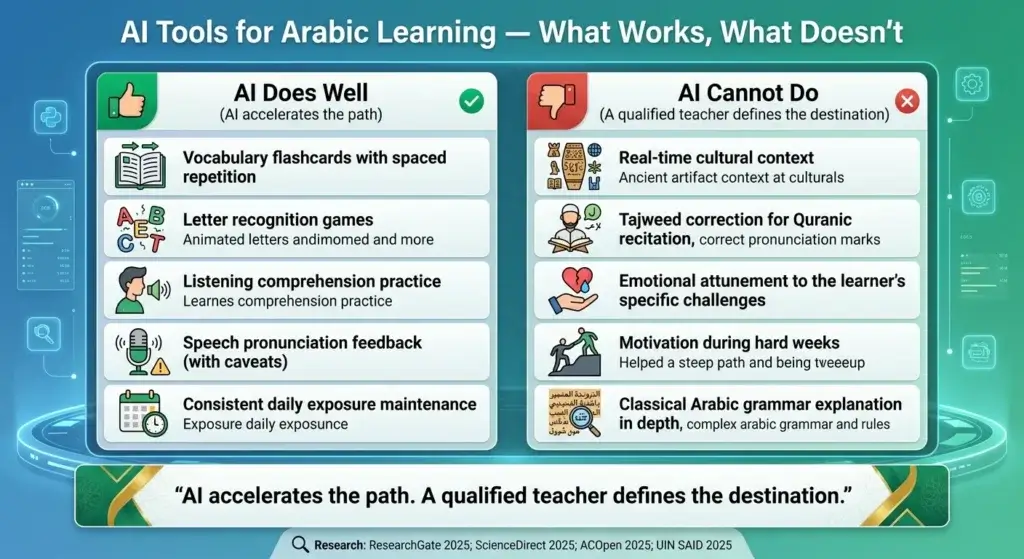
AI accelerates: Vocabulary acquisition, pronunciation practice, reading fluency, basic comprehension, and consistent daily engagement are all enhanced by well-designed AI tools.
AI cannot replace: Cultural context, emotional attunement, real-time correction of complex Tajweed errors, Quranic meaning integration, and the motivational relationship between teacher and student — all remain uniquely human.
For the Muslim family whose Arabic learning is Quran-anchored, the second list contains the things that matter most. This does not mean AI tools are useless — it means they are supplements, not replacements.
Section 1: The Five Things AI Does Well in Arabic Learning
1. Spaced Repetition for Vocabulary — The Flashcard That Never Forgets
The most evidence-supported application of AI in language learning is spaced repetition vocabulary review. Digital flashcard systems that schedule each word’s review at the optimal interval before forgetting occurs produce dramatically better long-term retention than manual flashcard practice.
For Quranic Arabic specifically — where the goal is mastering 300–500 high-frequency words — a well-designed spaced repetition system can compress what would take years of passive exposure into months of deliberate review.
What it does: Tracks every word the learner knows, every word they are shaky on, every word they have forgotten — and serves each one at the precise moment when reviewing it will produce the maximum retention benefit.
The limitation: Spaced repetition systems review vocabulary in isolation. The Quran uses vocabulary in complex grammatical contexts that a flashcard cannot fully capture. The student who recognizes sabr on a flashcard is not the same as the student who can parse “inna Allaha ma’a al-sabirin” grammatically and theologically. The flashcard is the beginning; the grammar lesson is the necessary continuation.
2. Arabic Script Letter Recognition — Games That Work
Research on AI tools for Arabic alphabets classification in children’s education confirms that AI-powered letter recognition games significantly accelerate the acquisition of Arabic script reading — a particularly challenging initial barrier for non-Arabic-speaking learners. Interactive letter recognition tools with immediate feedback produce measurable improvement in reading fluency when used consistently as a supplement to instruction.
For the young child learning Arabic for beginners — specifically, learning the Arabic alphabet — gamified letter recognition tools provide the repetitive practice that human instructors cannot efficiently provide within a session. The thirty minutes a child spends on a well-designed Arabic letter recognition game could require several hours of teacher-directed drill for the same outcome.
The limitation: Letter recognition is the prerequisite for reading, not reading itself. A child who can identify letters in isolation but cannot read connected Arabic script has not learned to read. The transition from letter recognition to reading requires instruction that AI tools currently handle poorly.
3. Listening Comprehension — Authentic Arabic Audio at Scale
AI-curated Arabic audio content — graded by difficulty, filtered for clarity, matched to the learner’s current vocabulary level — provides listening input at a scale that no individual human teacher can replicate.
For Quranic Arabic specifically: AI-curated listening tools can expose the learner to hours of high-quality Quranic recitation from certified reciters, with features like adjustable playback speed, automatic highlighting of the verse being recited, and vocabulary lookup on tap.
The learner who combines their quranst live sessions with daily AI-curated Quranic listening exposure has dramatically more total Arabic input than the one who relies on sessions alone.
4. Pronunciation Practice Between Sessions
AI tools such as speech recognition apps and conversational agents were shown to improve speaking skills, improving fluency, pronunciation, and confidence. The availability of immediate feedback — rather than waiting for a correction from a teacher in the next session — accelerates pronunciation improvement for basic Arabic sounds.
For the Arabic learner practicing between quranst sessions, AI speech recognition tools provide a form of pronunciation feedback that would otherwise be unavailable until the next scheduled session. The child who practices their Arabic pronunciation with an AI tool five times before their weekly session arrives with significantly better pronunciation than one who practiced only in their own head.
The critical limitation for Tajweed: Current AI speech recognition cannot reliably correct Tajweed errors — the specific phonological rules of Quranic recitation that require a trained human ear to evaluate. The ‘Ain (ع) that is produced from the wrong pharyngeal position, the Dad (ض) that is missing its characteristic lateral articulation — these errors require a certified Tajweed instructor to detect and correct. AI speech tools will confirm the pronunciation as “close enough” when it is not, precisely because Arabic children’s speech and Tajweed nuance remain areas of significant AI limitation.
5. Consistent Daily Exposure — Maintaining the Habit Between Sessions
The most underrated application of AI tools in Arabic learning is the simplest: maintaining daily Arabic contact between live instruction sessions.
The child who has three quranst sessions per week has 21 opportunities per week to maintain Arabic exposure. Three of them are filled by quranst. The remaining 18 are where AI tools earn their place — not as instruction, but as daily contact maintenance:
- Five minutes of Arabic spaced repetition vocabulary review in the morning
- Ten minutes of Quranic audio listening during a meal
- A five-minute Arabic letter game before sleep
This is not instruction. It is the ambient Arabic exposure that prevents the forgetting that occurs in the gaps between sessions.
Section 2: The Four Things AI Cannot Do
These are not limitations that future AI development will eliminate within the next few years. They are structural limitations rooted in the nature of what language learning — and specifically Quranic Arabic learning — actually requires.
1. Providing Cultural and Islamic Context
Challenges related to cultural limitations of AI in Arabic learning can only be explained through direct interaction with teachers. AI provides significant benefits in technical aspects but lacks the cultural depth that Arabic, as a living language embedded in Islamic civilization, requires.
When a child encounters the word Taqwa in the Quran, an AI tool can provide a translation: “fear of God” or “God-consciousness.” It cannot explain why classical scholars have written volumes on the distinction between khawf (fear) and Taqwa (God-consciousness-that-produces-action), why the Quran uses Taqwa in contexts of both warning and encouragement, how the word’s root connects to wiqaya (protection), and why Imam Al-Ghazali considered Taqwa the foundational quality of the entire Islamic spiritual path.
This cultural, theological, and civilizational depth is what transforms Arabic vocabulary acquisition into Islamic education. It requires a teacher. It cannot be generated by an AI.
2. Motivating a Child Through Hard Weeks
The weeks when the child does not want to practice Arabic — when school is hard, when the social pressures are high, when the novelty of Arabic has worn off and the commitment is what remains — are the weeks where the teacher-student relationship is the most important variable in whether the learning continues.
No AI tool has the capacity to sit with a child who is discouraged and say: “I know this week was hard. I noticed you struggled with these three words. Let me tell you something — I worked with a student last year who had the same challenge, and here is what helped them.” The personal relationship, the emotional attunement, the specific encouragement based on knowledge of this individual child’s history — this is irreplaceable.
3. Correcting Tajweed with Genuine Accuracy
Questions still exist about how accurate AI tools are in terms of Arabic language rules — particularly for Quranic recitation. The morphological complexity of Arabic and the specific phonological requirements of Tajweed represent areas where current AI performs significantly below human expert instruction. A certified Tajweed instructor who has memorized the Quran and received an authenticated chain of transmission can hear a Dad (ض) produced from the wrong position immediately — AI speech recognition tools routinely pass incorrect Tajweed as acceptable.
For the Muslim family whose Arabic learning is Quran-anchored, Tajweed correction is non-negotiable. And it requires a human ear.
4. Adapting in Real Time to the Individual Learner
A trained Arabic instructor in a quranst session notices things that no AI tool tracks: the specific pattern of errors that suggests a foundational misunderstanding rather than a surface mistake; the moment when a child’s attention shifts because they are confused rather than bored; the connection between this week’s vocabulary struggle and a grammar point that was introduced three months ago; the specific Quranic verse that will make this abstract grammar rule suddenly click for this particular child.
This real-time, relationship-based adaptation is the core of effective language instruction. It is what “personalized learning” means in practice — not an algorithm that adjusts the difficulty level, but a teacher who knows the learner.
Section 3: The Best AI and Digital Tools for Arabic — Evaluated Honestly
These tools are evaluated against the specific needs of the Muslim family pursuing Quran-anchored Arabic learning:
Tool Category 1: Vocabulary Spaced Repetition
Anki with Quranic Arabic Decks
What it is: An open-source spaced repetition system — highly configurable, community-supported with Quranic Arabic vocabulary decks.
Best for: The high-frequency Quranic word list (300–500 words). Download the “Quranic Vocabulary” community deck — filtered for the most frequent Quranic words with root information and verse citations.
The right use: 5 minutes per day. Review-only — not for initial learning. New words are introduced in quranst sessions; Anki maintains them between sessions.
The limitation: Requires some technical setup. The deck quality varies — curate carefully or use a specifically vetted Quranic vocabulary deck.
Quizlet with custom Quranic Vocabulary Sets
What it is: Accessible, visually appealing flashcard platform with multiple game modes.
Best for: Ages 8–14. More engaging than Anki for children. Parent can create custom sets using the weekly vocabulary from quranst sessions.
The right use: The child’s quranst instructor provides five new words each session. Parent creates a Quizlet set. Child reviews daily using the “Learn” and “Match” modes.
The limitation: No Arabic root system integration. Works best alongside a Quranic Arabic course that provides the root context.
Tool Category 2: Quranic Listening and Reading
Quran.com with Audio and Translation
What it is: The most comprehensive free Quran platform — every verse with audio from multiple reciters, word-by-word translation, and morphological analysis.
Best for: All ages, all levels. The word-by-word translation feature is particularly powerful for Quranic Arabic learners — click any word in any verse and see its root, meaning, and grammatical function.
The right use: After each quranst Arabic session, spend five minutes on Quran.com looking up the vocabulary words learned that day in the verses where they appear in the Quran.
What it is: AI-powered Quran recitation app with real-time error detection during recitation.
Best for: Ages 10+ who have basic Tajweed instruction and want to practice between sessions. The AI catches common errors in familiar surahs.
The important caveat: Tarteel.ai is a useful supplement but not a Tajweed teacher. It identifies errors in well-recognized patterns but misses subtle Tajweed nuances. Use it to practice familiar material between sessions — not to learn Tajweed initially, and not as a replacement for instructor feedback.
Tool Category 3: Arabic Writing and Reading Practice
Arabic Writing Practice Apps (Harf, Huruf, similar)
What it is: Gamified Arabic letter tracing and writing practice apps, designed for young learners.
Best for: Ages 4–8 learning the Arabic alphabet. The gamification produces the repetitive practice that letter writing requires without the tedium.
The right use: 10 minutes per day, alongside (not instead of) initial Arabic instruction. The motor skill of handwriting Arabic letters consolidates the visual recognition in ways that screen-based recognition games cannot.
Tool Category 4: Generative AI (ChatGPT, Claude, and similar)
What research says: Studies examining generative AI tools in Arabic language education found that students reported transformation of their Arabic studies through AI — particularly for text comprehension and understanding grammar rules. However, the same studies raised significant concerns: accuracy limitations in Arabic specifically, overreliance risks, academic integrity issues, and reduced critical engagement. The research specifically noted that using AI to translate assignments from other languages into Arabic “did not show students’ real Arabic language skills.”
The honest assessment for Quranic Arabic learners:
Generative AI (ChatGPT, Claude, Gemini) can be genuinely useful for:
- Explaining Arabic grammar rules in plain English
- Providing example sentences using vocabulary words being studied
- Answering questions about Arabic root systems
- Generating simple Arabic reading passages at a specified level
It is unreliable for:
- Translating Quranic Arabic (classical Arabic nuances are frequently missed)
- Explaining Tafsir (Islamic scholarly interpretation requires authenticated human scholarship)
- Correcting pronunciation (generative AI does not hear)
- Replacing the teacher in any instructional capacity
The right use: A parent can use generative AI to understand an Arabic grammar concept before helping their child with homework. A child can use it to look up a vocabulary word. It should not be used to generate Arabic that the child then passes off as their own, or to replace any component of structured Arabic instruction.
Section 4: The quranst + AI Integration System
The maximum benefit from AI tools comes when they are integrated into a structured learning system led by a qualified human instructor — not deployed independently as the primary learning mechanism.
Here is how the quranst curriculum integrates with AI tools:
The Weekly Integration System
Monday — quranst Session (30-45 minutes): Live instructor introduces 5 new vocabulary words, one grammar structure, and one Quranic application. The instructor corrects pronunciation in real time, explains cultural context, makes the Quran connection.
Monday–Wednesday — AI Reinforcement:
- Morning (5 min): Anki/Quizlet review of the week’s 5 new words + previous words
- Evening (5 min): Quran.com — find the week’s vocabulary words in Quranic verses
- Before sleep (5 min): Tarteel.ai — recite the Quranic verses containing the week’s words
Wednesday — quranst Session (30-45 minutes): Instructor reviews previous session’s vocabulary and grammar. Introduces the week’s second vocabulary set and grammar application. Adjusts based on the student’s performance from the AI-reinforced home practice.
Thursday–Saturday — AI Reinforcement:
- Same pattern as Monday–Wednesday with the new content
Saturday — quranst Session (30-45 minutes): Weekly review and consolidation. The instructor assesses what was genuinely retained versus what was superficially familiar. Plans the following week based on actual retention data.
Sunday — Family Quran Time: The week’s vocabulary is applied in the family Quran session — the child reads Quranic verses containing the week’s words, explains what they mean to the family. The live application of what was learned through quranst + AI reinforcement.
The Total Weekly Arabic Contact
| Source | Time Per Week |
|---|---|
| quranst live sessions (3×) | 90–135 minutes |
| AI vocabulary review (7×) | 35 minutes |
| Quranic listening/Quran.com (7×) | 35 minutes |
| Tarteel recitation practice (5×) | 25 minutes |
| Family Quran application (1×) | 30 minutes |
| Total weekly Arabic contact | 215–260 minutes |
This is 3.5–4.5 hours of Arabic contact per week — without any single session exceeding 45 minutes. The distribution maintains daily contact without creating the fatigue that long sessions produce.
Section 5: Age-by-Age AI Tool Guide for Muslim Families
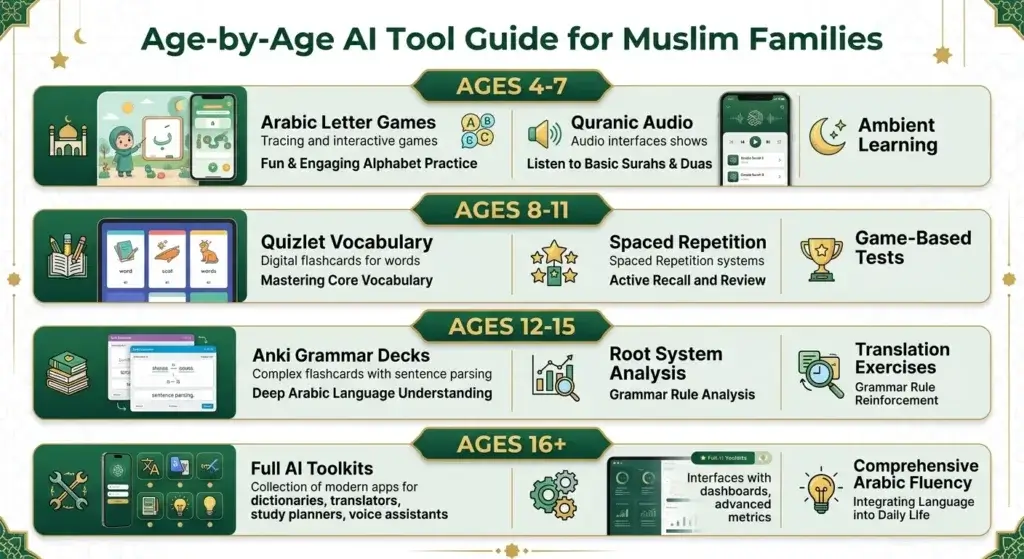
| Age | Primary AI Tools | Best Use | Avoid |
|---|---|---|---|
| 4–7 | Arabic letter games (Harf, Huruf) · Quranic audio (Quran.com) | Letter recognition (10 min/day) · Ambient Quran listening | Vocabulary apps (premature) · Generative AI |
| 8–11 | Quizlet · Quran.com word-by-word · Tarteel.ai | Daily vocabulary review · Quranic verse exploration · Recitation practice | Unsupervised generative AI use |
| 12–15 | Anki · Tarteel.ai · Quran.com · Supervised ChatGPT/Claude | Systematic spaced repetition · Advanced grammar questions | AI-generated Arabic homework |
| 16+ | Full toolkit · Anki advanced decks · Quran.com deep analysis | Self-directed reinforcement between sessions | AI replacing teacher-guided learning |
Section 6: The Dangers of AI Dependency — What the Research Warns
The research on AI in language learning is consistent in identifying one primary risk: overreliance.
Students respond positively to AI because it facilitates text comprehension and supports understanding of nahwu-sarf rules, enriches vocabulary, and improves learning efficiency. However, this acceptance is accompanied by concerns regarding dependency, accuracy limitations, and shifts toward more instant learning strategies. The research underscores the importance of integrating AI proportionally to support Arabic language learning while maintaining students’ academic autonomy and learning quality.
The specific overreliance patterns to watch for in children:
Pattern 1: Translating instead of understanding. The child who uses a translation app to complete their Arabic assignment has not practiced Arabic — they have practiced using a translation tool. The quranst approach: assignments include oral recitation and explanation that cannot be AI-translated.
Pattern 2: App streaks as a proxy for learning. The forty-seven-day streak that opened this article is the most visible manifestation of this pattern. Streak maintenance becomes the goal; Arabic learning is the means — and then, gradually, the means replaces the end. Monitor what is actually being retained, not what is being streaked.
Pattern 3: AI correction replacing instructor correction. The child who relies primarily on Tarteel.ai or a speech recognition app for Tajweed feedback is receiving feedback that is, for Quranic recitation specifically, unreliable. A teacher who catches a ‘Ain (ع) produced incorrectly is catching something that will affect every verse the child recites for the rest of their life. An AI that passes it is embedding that error permanently.
The research specifically warns that AI-generated Arabic and AI-based assessment tools “did not show students’ real Arabic language skills.” The authentic assessment of Arabic ability requires human evaluation — reading aloud to a teacher, explaining a grammar rule, translating a novel sentence — that AI cannot replicate.
Section 7: Building the Smart Arabic Learning Stack
The Arabic learning stack that produces results for the Muslim family in the 2020s combines:
The Foundation (Non-Negotiable): → Live, one-on-one Arabic instruction with a qualified, Quran-anchored instructor (quranst)
The Reinforcement Layer (High Value): → Spaced repetition vocabulary review (Anki or Quizlet) — daily, 5 minutes → Quranic audio and word-by-word exploration (Quran.com) — daily, 5-10 minutes
The Practice Layer (Valuable Supplement): → Arabic letter and writing practice apps (for beginners, ages 4-9) → Tajweed recitation practice (Tarteel.ai) — between sessions, for familiar material
The Context Layer (Used Wisely): → Generative AI (ChatGPT/Claude) — for grammar questions, vocabulary exploration, parent support. Supervised. Never for generating Arabic content.
The Social Layer (Most Underused): → Family Quran application sessions — the child explains what they learned → Grandparent/extended family Arabic conversations — real human interaction in Arabic
The stack works because each layer addresses what the others cannot. The live instructor provides instruction, correction, cultural context, and motivation. The AI tools provide scale, repetition, and daily contact. The social layer provides the authentic communicative purpose that makes all the vocabulary and grammar mean something.
Structured Curriculum Framework
quranst’s Arabic Language track is designed to be the live-instruction core of exactly this integrated stack — with Quranic Arabic focus, native-speaking certified instructors, and a curriculum that makes every AI-reinforced vocabulary word come alive in a Quranic verse.
Book your free 2-session trial →Conclusion: The Tool Serves the Learning. Not the Other Way Around
The Islamic tradition has always been innovative in its educational tools. The pen. The ink. The paper. The printing press. The audio cassette of the Quran recitation that a generation of Muslim children grew up listening to in their parents’ cars.
Each tool, in its era, amplified the transmission of knowledge. None of them replaced the scholar. None of them replaced the teacher-student relationship. None of them replaced the isnad — the living human chain of transmission through which authentic knowledge travels.
AI tools are the latest in this line. They are genuinely useful. They genuinely accelerate Arabic learning when deployed intelligently. They are genuinely dangerous when deployed as replacements for the human instruction they are designed to supplement.
The child who uses Anki to maintain their vocabulary between quranst sessions and arrives at each session with five words firmly in memory is learning Arabic more efficiently than the generation before them. The child who uses Anki instead of quranst and arrives nowhere in particular with five words that exist nowhere except on a flashcard is not learning Arabic at all.
The tool serves the learning. Not the other way around.
وَقُل رَّبِّ زِدْنِي عِلْمًا
“And say: My Lord, increase me in knowledge.”
— Quran 20:114
Increase through every means available. Use every tool wisely. Begin with the foundation.
🟢 The Foundation That Makes Every Tool Work
The AI tools in this guide amplify learning. But they amplify what is already there — not create it from nothing. The live, qualified, Quran-anchored Arabic instruction that quranst provides is what the AI tools are amplifying.
quranst’s Arabic Language track provides:
The Live Instruction Foundation:
- Learn Arabic — from Arabic for beginners through classical Arabic, Quran-anchored throughout
- Online Arabic tutor — native-speaking, certified instructor, live and one-on-one
- Arabic grammar — Nahw and Sarf taught through Quranic sentences
- Arabic for beginners — from the alphabet through the first 100 high-frequency Quranic words
The Quranic Integration:
- Quranic Arabic — every vocabulary lesson connected to the Quran the student already recites
- Learn Quran — Arabic and Quran learning in coordinated, integrated sessions
- Classical Arabic — the gateway to fourteen centuries of Islamic scholarship
The Instruction That AI Cannot Replace:
- Tajweed correction in real time — the certified ear that catches what algorithms miss
- Cultural and Islamic context — what the word means in the civilization that produced it
- Relationship-based motivation — the teacher who knows this student’s specific journey
- Authentic assessment — the child explains the grammar rule out loud, not to an algorithm
👇 Begin the Foundation — Two Free Arabic Sessions
Two Ways to Begin
“The best of teachers are those who, when you are with them, make you want to return.”
— Classical Arabic educational maxim
Let the AI reinforce. Let the teacher inspire. Begin with the teacher.
بِسْمِ اللَّهِ — Begin.
References and Sources
Quranic References
- Quran 20:114 — “My Lord, increase me in knowledge”
Peer-Reviewed Research Sources
- ResearchGate (2025). “Artificial Intelligence in Arabic Language Education: Applications, Perceptions, and Pedagogical Integration.” Key findings: AI significantly enhances engagement through adaptive, personalized learning; AI tools (speech recognition, conversational agents) improve speaking proficiency; major challenges relate to cultural context limitations that require direct teacher interaction; morphological complexity and scarcity of authentic practice environments as persistent AI limitations.
- UIN SAID Journal (2025). “Artificial Intelligence and the Transformation of Learning Practices in Arabic Language Education.” Key findings: Students respond positively to AI for text comprehension, grammar support (nahwu-sarf), vocabulary enrichment; concerns include dependency, accuracy limitations, and shift to instant learning; emphasizes integrating AI proportionally while maintaining academic autonomy.
- ResearchGate (2025). “From Vocabulary to Voice: How Generative AI Shapes Arabic Learning for Non-Native Speakers.” Key findings: Learners report transformation of Arabic studies through AI; improvements in fluency, pronunciation, confidence; limitations in personalization; concerns about overreliance on AI for routine language tasks; recommendation for authentic assessment that AI cannot replicate.
- ACOpen / UMSIDA (2025). “Exploring the Application of Artificial Intelligence in Arabic Language Learning: Perspectives of Students and Teachers.” Key findings: AI platforms provide significant vocabulary and language skills improvement; cultural limitations can only be explained through direct teacher interaction; AI increases interactivity and flexibility; human instruction irreplaceable for cultural depth.
- ResearchGate (2025). “Artificial Intelligence in Arabic Language Education.” Key findings: AI reshapes curricula through personalized pathways and adaptive assessment; speech recognition apps and conversational agents improve speaking skills; morphological complexity and scarcity of authentic practice environments are persistent limitations.
- ScienceDirect (2025). “Generative AI Implementation and Assessment in Arabic Language Teaching.” Key findings: Students used AI to translate assignments — did not show real Arabic skills; accuracy questions regarding Arabic language rules remain; teaching AI awareness skills recommended as part of Arabic language courses; authentic assessment methods essential.
- AI in Arab University English Classrooms Review (arXiv 2025). Key findings: Findings reveal overwhelmingly positive perceptions of AI-assisted language acquisition; ChatGPT and generative AI raise issues of accuracy, overreliance, academic integrity, and reduced critical engagement; researchers advocate integrating AI while developing critical thinking and responsible AI-use practices.
- arXiv (2025). “Abjad-Kids: An Arabic Speech Classification Dataset for Primary Education.” Key findings: AI is beginning to change the landscape for Arabic children’s learning; interactive tools improve retention by mimicking social dialogue; Arabic children’s speech presents specific AI classification challenges due to high intra-class similarity of letters and limited annotated datasets.
Frequently Asked Questions
Can AI tools completely replace an online Arabic tutor for children?
How can digital tools help children learning Arabic for beginners?
- Spaced Repetition: Long-term vocabulary retention through optimized flashcard scheduling.
- Letter Recognition: Gamified apps that accelerate Arabic script reading.
- Daily Exposure: Maintaining consistent contact with the Arabic language between live classes.
What is the role of AI in mastering classical Arabic and Quranic Arabic?
How can parents build a smart learning stack combining AI and live classes?
- The Foundation: Live, one-on-one sessions with a certified Online Quran teacher.
- The Reinforcement: 5 to 10 minutes of daily AI-powered vocabulary review or listening practice.
- The Application: Practicing to speak Arabic fluently through real-life family discussions and guided reading.
