
Introduction: The Philosophy of Language in Islamic Education
In the journey of Smart Parenting and spiritual growth, the Arabic language serves as more than just a medium of communication; it is the very vessel of Divine Revelation. For parents striving to provide a balanced Islamic upbringing, understanding the mechanics of the Quranic text is a fundamental pillar. Linguistic literacy is often considered a gateway to deeper comprehension, as it allows the reader to engage directly with the Word of Allah while appreciating the depth and precision of the original Arabic structure, beyond simplified translations that may not capture all linguistic nuances.
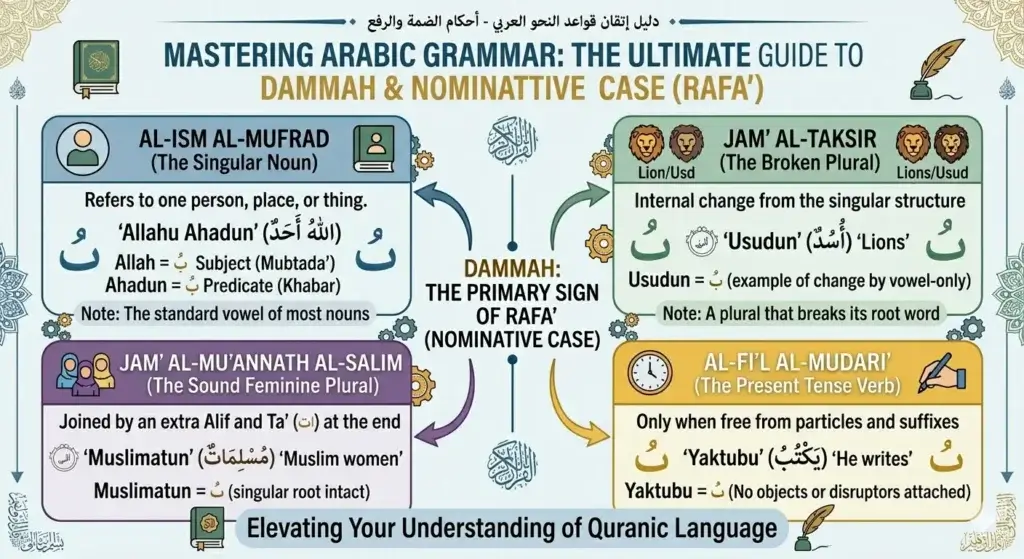
The study of Nahw (Arabic Grammar) has been preserved for centuries through classical texts, most notably the Al-Ajrumiyyah, a foundational primer that provides a structured roadmap for students of Arabic. In this comprehensive guide, we focus on the “Dammah” ( ُ )—the primary sign of the Nominative Case (Rafa’). Understanding where and why the Dammah appears is essential for anyone enrolled in Arabic Courses or Quranic Tracks, as it indicates the grammatical state of elevation (Rafa’) in nouns and verbs according to classical Arabic grammar. By mastering these four positions, the learner moves from surface-level reading to a deeper structural understanding of Arabic sentence formation.
Module 1: The Architecture of Arabic Inflection (I’rab)
To truly appreciate the role of the Dammah, one must first understand the broader system of Arabic inflection known as I’rab. Arabic is an inflected language in which the ending of a word reflects its grammatical state and syntactic function within the sentence. This system is built upon four primary grammatical states recognized by classical grammarians:
Rafa’ (The Nominative Case)
Its original and most common sign is the Dammah. It indicates the state of grammatical elevation and appears in subjects, predicates, active agents (fa’il), and other raised components of the sentence.
Nasb (The Accusative Case)
Its original sign is the Fathah. It generally appears in objects, circumstantial elements, and other syntactic components that require the accusative state.
Khafd/Jarr (The Genitive Case)
Its original sign is the Kasrah. This state is exclusive to nouns and appears after prepositions and in genitive constructions (Idafah).
Jazm (The Jussive Case)
Its original sign is the Sukun. This state is exclusive to verbs and appears in specific grammatical contexts, particularly after jussive particles.
The Shared Territory of Nouns and Verbs
One of the defining features of Arabic grammar is the interaction between nouns and verbs within the system of I’rab. Both nouns and verbs share the grammatical states of Rafa’ and Nasb, meaning that both can appear in elevated and accusative positions depending on their syntactic environment.
However, they diverge in the remaining two states:
A noun can enter the state of Jarr, but a verb cannot.
A verb can enter the state of Jazm, but a noun cannot.
Within the territory of Rafa’, the Dammah is considered the original sign of elevation, while other signs such as the Waw (in the sound masculine plural and the five nouns) or the Alif (in the dual) are regarded as secondary or substitute signs according to classical grammatical theory. The Dammah therefore occupies a central role in identifying the nominative state in Arabic structure, especially in foundational grammatical texts studied in Arabic and Quranic courses.
Module 2: The Singular Noun – Beyond the Basics
The first and most frequent position of the Dammah is Al-Ism Al-Mufrad (The Singular Noun). In classical Arabic grammar, the singular noun is defined as any noun that is neither dual, nor plural (of any type), nor one of the Five Nouns when they fulfill their special grammatical conditions.
The Technical Boundaries of Singularity
In structured Arabic learning programs, the singular noun is considered the foundational form of the Arabic word, as it follows the original grammatical rule of raising by Dammah in the nominative state. For a noun to be raised with a Dammah, it must remain in its basic morphological form and not fall under categories that require secondary signs.
Examples from the Quran illustrate this clearly:
Allahu Ahadun
اللهُ → مبتدأ مرفوع وعلامة رفعه الضمة
أحدٌ → خبر مرفوع وعلامة رفعه الضمة
Both words are singular nouns raised by the original sign of Rafa’, which is the Dammah, demonstrating the core grammatical structure of nominal sentences in Arabic.
The Case of the Five Nouns and the Speaker’s “Ya’”
A critical distinction must be made to avoid common grammatical misunderstandings. The Five Nouns (Asma’ al-Khamsah) — such as:
Abu (father)
Akhu (brother)
Hamu (father-in-law)
Fu (mouth)
Dhu (possessor)
are normally raised by Waw, not Dammah, but only under specific grammatical conditions:
They must be singular
They must be in an Idafah construction
They must not be attached to Ya’ al-Mutakallim
They must not be in a diminished or altered form
If these conditions are not met, they return to the original rule of singular nouns and are raised by Dammah or a hidden Dammah.
Example
Hadha abun
هذا أبٌ
The noun here is not in an Idafah construction, so it follows the original rule and is raised with Dammah.
Example
Akhi
أخي
Here the noun is attached to Ya’ al-Mutakallim, so the Dammah becomes estimated (muqaddarah) due to the phonetic constraint of the Ya’.
This distinction highlights the precision of Arabic grammar, where the Dammah remains the foundational sign of elevation even when it is not visibly pronounced.
Module 3: The Broken Plural (Jam’ Al-Taksir) – The Art of Structural Change
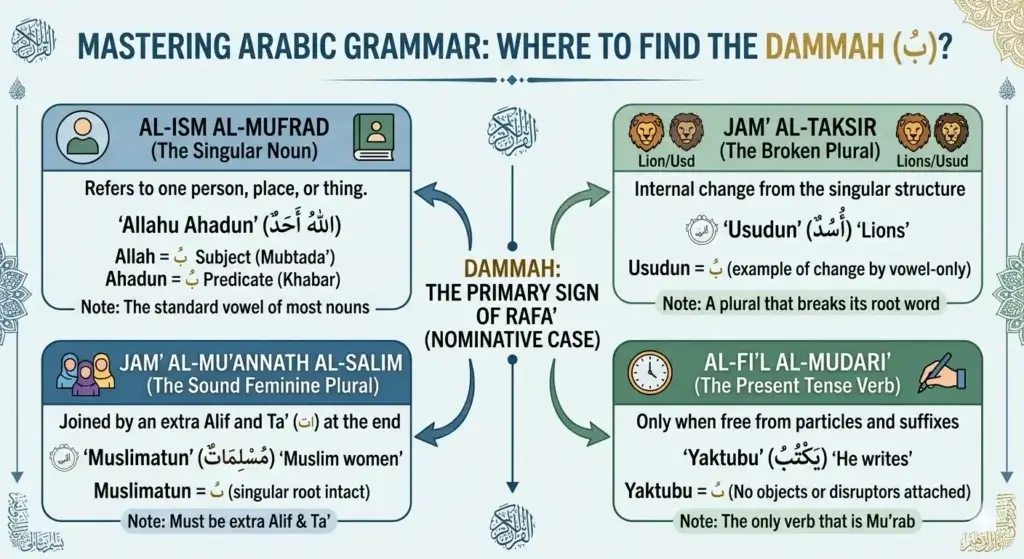
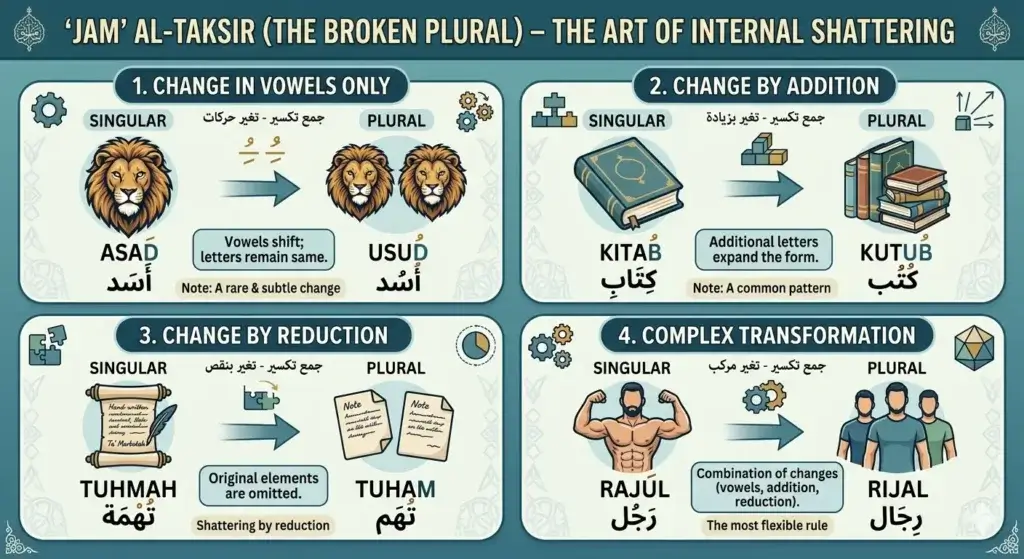
In the world of Arabic morphology, the Broken Plural (Jam’ Al-Taksir) represents one of the most distinctive features of the language. Unlike the Sound Plural in English, where an “-s” is added to form plurality, the Broken Plural in Arabic involves a structural change in the internal pattern of the singular noun. This category forms the second major position in which the Dammah ( ُ ) appears as a sign of Rafa’, according to classical Arabic grammar.
The Structural Patterns of Change
The transformation from singular to broken plural is not random; rather, it follows recognized morphological patterns that were documented by classical grammarians and studied extensively in Arabic linguistic traditions. These changes typically occur in structured forms that preserve the root while modifying the word pattern.
Change in Vowels
The letters of the root remain the same, but the internal vowel pattern shifts.
Example:
Asad (lion) becomes Usud (lions)
Here, the root letters remain intact while the vowel structure changes, producing a recognized broken plural pattern.
Change by Addition
Letters may be added to expand the structure of the word.
Example:
Kitab (book) becomes Kutub (books)
The internal structure changes while maintaining the root meaning, forming a standard broken plural.
Change by Reduction
Certain elements of the singular form may be reduced or removed.
Example:
Tuhmah (accusation) becomes Tuham (accusations)
The Ta’ Marbutah is removed and the vowel pattern shifts to create a broken plural form.
Complex Structural Transformation
Often, broken plurals involve a combination of vowel shifts, additions, or reductions.
Example:
Rajul (man) becomes Rijal (men)
This represents a well-known Quranic broken plural pattern used in multiple verses, illustrating the structural transformation typical of Jam’ al-Taksir.
The Grammatical Significance
The importance of recognizing broken plurals lies in their grammatical behavior. A broken plural behaves like a singular noun in terms of case marking, meaning that when it appears in the nominative case, it is raised by Dammah.
Examples:
Masajidu (mosques)
Kutubu (books)
Rijalu (men)
Each of these takes Dammah in the state of Rafa’, demonstrating the classical grammatical rule that broken plurals follow the original signs of singular nouns in case marking.
For students enrolled in Arabic or Quranic learning tracks, identifying broken plurals allows accurate recognition of subjects, predicates, and raised elements in Quranic verses, strengthening both grammatical understanding and reading precision.
Join our global community of 500+ families at Quranst Institute
Where we don’t just teach the Quran—we teach the lifestyle of the Prophets.
🚀 Start Your Smart Learning Journey TodayModule 4: The Sound Feminine Plural – Common Pitfalls
The third domain of the Dammah is Al-Jam’ al-Mu’annath al-Salim (The Sound Feminine Plural). Classical grammarians define this plural as a noun that indicates more than two feminine entities through the addition of Alif and Ta’ (ات) while preserving the original structure of the singular word.
The Sound vs Broken Distinction
The term “Sound” (Salim) indicates that the original root and structure of the singular noun remain intact without internal structural change.
Example:
Mu’minah (believer) becomes Mu’minat (believing women)
Muslimah (Muslim woman) becomes Muslimat (Muslim women)
The singular structure remains preserved while the plural suffix is added, distinguishing it clearly from broken plurals.
When these nouns appear in the nominative case, they are raised with Dammah.
Example:
Al-Muslimatu hadirun
المسلماتُ حاضرون
Here:
المسلماتُ is a sound feminine plural raised with Dammah as the original sign of Rafa’.
The “Alif and Ta’” Misconception
A common mistake among students is assuming that every noun ending in (ات) is automatically a sound feminine plural. Classical grammar clarifies that this is not always the case.
A word is considered a sound feminine plural only if:
the singular exists
the plural is formed by adding Alif and Ta’
the internal structure of the word remains unchanged
If the structure changes internally, the word becomes a broken plural instead.
Example:
Bayt → Buyut (broken plural)
This is not a sound feminine plural because the internal structure changed.
The Case of Original Ta’
Another important clarification concerns words whose original root already contains Ta’. The presence of Ta’ in the root does not make the word a sound feminine plural unless the plural is formed by adding Alif and Ta’.
Example:
Amwat (dead people)
This is a broken plural, not a sound feminine plural, because it follows a structural pattern change rather than suffix addition.
Linguistic Precision in Quranic Usage
Arabic grammar emphasizes structural accuracy in identifying plural forms, especially in Quranic language. Words like:
Muslimat
Qanitat
Sajidat
retain their original structure and follow the rule of sound feminine plural formation, and when raised in the nominative state, they take Dammah as the primary sign of Rafa’.
Recognizing this distinction allows students to correctly analyze grammatical structures in Quranic verses and classical Arabic texts, ensuring precise linguistic understanding and avoiding common grammatical confusion.
Module 5: The Present Tense Verb – The Dynamic Pillar
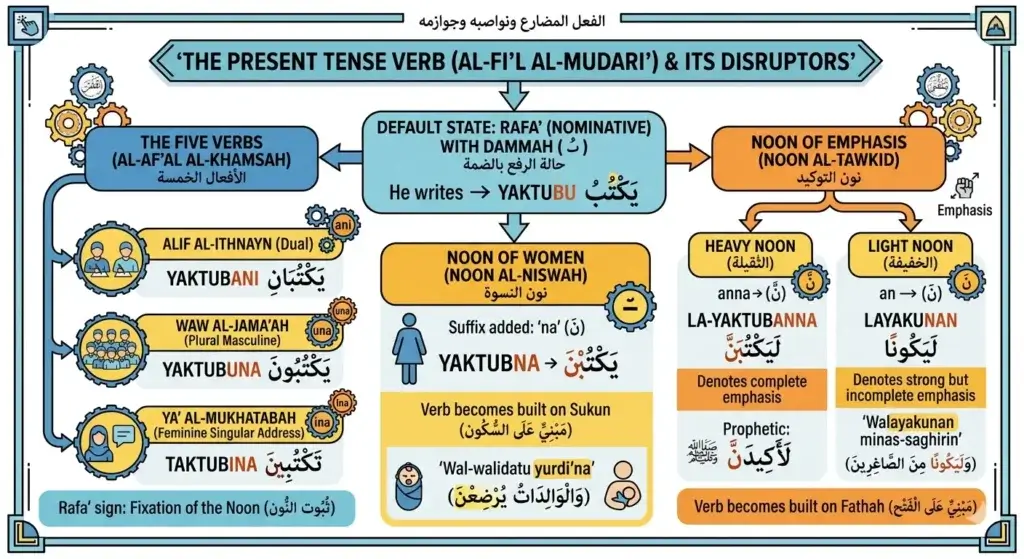
The fourth and final domain of the Dammah ( ُ ) is Al-Fi’l Al-Mudari’ (The Present Tense Verb). In classical Arabic grammar, the present tense verb occupies a unique position because it is Mu’rab (declinable), meaning that its ending changes according to grammatical context. For it to carry Dammah as a sign of Rafa’, one essential condition must be met: the verb must be free from any particle of Nasb or Jazm and must not be attached to suffixes that transfer it from the basic singular form of the present tense.
The Concept of Al-Tajarrud (Grammatical Freedom)
A present tense verb such as:
Yaktubu (he writes)
Ya’kulu (he eats)
Yadrusu (he studies)
is considered to be in its default grammatical state. Because it is not preceded by a particle of Nasb (such as lan or an) and not preceded by a particle of Jazm (such as lam or lamma), it remains in the state of Rafa’ and therefore carries Dammah as the original sign of elevation.
This rule is clearly stated in classical grammar: the present tense verb is raised when it is free from nasb and jazm particles.
The Five Verbs (Al-Af’al al-Khamsah)
A major grammatical transformation occurs when the present tense verb is attached to:
Alif al-Ithnayn (dual)
Waw al-Jama’ah (plural masculine)
Ya’ al-Mukhatabah (feminine singular)
In this case, the verb becomes part of Al-Af’al al-Khamsah (The Five Verbs).
Examples:
Yaktubani (they two write)
Yaktubuna (they write)
Taktubina (you write)
Here, the Dammah is replaced by Thubut al-Noon (the fixation of Noon) as the sign of Rafa’.
This does not eliminate Rafa’; rather, it changes the sign of Rafa’ from Dammah to the stability of Noon, which is recognized by classical grammarians as a secondary sign.
Noon al-Niswah (The Feminine Plural Suffix)
When the present tense verb attaches to Noon al-Niswah, a different grammatical transformation occurs.
Example:
Yaktubna (they feminine write)
In this case:
the verb becomes Mabni (built)
it is built on Sukun
it no longer carries Dammah
This rule is confirmed in classical Arabic grammar, where verbs attached to Noon al-Niswah are considered built and not declinable.
Example from the Quran:
Wal-walidatu yurdi’na awladahunna
The verb yurdi’na is built on Sukun because of Noon al-Niswah.
Noon of Emphasis (Noon al-Tawkid)
Another important grammatical feature appears when the present tense verb is attached to Noon al-Tawkid.
Example:
La-aktubanna
La-yakunan
In this case:
the verb becomes Mabni
it is built on Fathah
it leaves the state of I’rab
Classical grammar distinguishes between:
Heavy Noon (Noon al-Tawkid al-Thaqilah)
Light Noon (Noon al-Tawkid al-Khafifah)
Both forms transform the verb from Mu’rab to Mabni, which removes the Dammah as a sign of Rafa’ and replaces it with a fixed grammatical ending.
This transformation reflects the structured nature of Arabic grammar, where suffixes directly influence the grammatical behavior of the verb.
Deepen Your Knowledge of Islamic Studies
Embark on a comprehensive journey through Fiqh, Aqeedah, Seerah, and Hadith. Join our expert tutors and expand your understanding of Islam.
Book Your Free Class NowModule 6: Smart Parenting – Teaching Grammar as a Life Skill
Within structured Islamic education, grammar is often viewed not merely as a linguistic discipline but as a foundational intellectual skill that strengthens analytical thinking and language comprehension. Teaching the rules of Dammah and Rafa’ to children or students is therefore not limited to memorizing grammatical rules; rather, it involves developing a systematic understanding of language structure and meaning.
Grammar as a Gateway to Understanding
Arabic grammar enables learners to recognize how words function within sentences, which contributes to accurate reading and interpretation of classical texts, including the Quran and Hadith literature. Educational research in language acquisition confirms that structured grammar instruction improves reading comprehension, linguistic awareness, and analytical reasoning, particularly in inflected languages.
When a learner understands why a word ends with Dammah, they begin to connect grammatical signs with syntactic roles such as subject, predicate, and agent, creating a structured cognitive framework for language analysis.
The Analytical Child
Teaching grammar to children contributes to:
structured thinking
pattern recognition
logical sequencing
linguistic accuracy
Studies in language education show that early exposure to structured grammar supports cognitive development and enhances comprehension skills, especially in languages with complex morphological systems such as Arabic.
By learning the difference between singular nouns, broken plurals, sound plurals, and present tense verbs, the learner develops the ability to analyze language systematically rather than memorizing isolated vocabulary.
The Spiritual and Educational Dimension
In Quranic education environments, grammar serves as a tool for precise understanding of religious texts. Understanding grammatical structures helps learners correctly identify subjects, verbs, and objects in Quranic verses, which supports accurate interpretation and avoids misreading.
This approach integrates:
Arabic Language
Quranic Reading
Islamic Studies
into a unified educational framework that emphasizes clarity, structure, and linguistic precision.
The Balanced Curriculum
A balanced curriculum in Arabic education typically includes:
Nahw (Grammar)
Sarf (Morphology)
Quranic Reading
Language Practice
This integrated approach ensures that learners develop both theoretical knowledge and practical reading ability.
By combining structured grammar instruction with guided reading, educational institutions and learning programs help students build a strong linguistic foundation that supports long-term mastery of Arabic and deeper engagement with classical Islamic texts.
Module 7: Linguistic Application – The Dammah in Quranic Context
The true depth of Arabic grammar appears most clearly in its practical application within Quranic language. In structured Arabic and Quranic learning, grammatical rules are not studied in isolation but are applied directly to Quranic verses and classical Arabic texts. The Dammah ( ُ ) functions as a clear grammatical indicator of Rafa’, allowing the reader to identify elevated nouns and verbs and understand their syntactic roles in the sentence.
Case Study: Surah Al-Ikhlas
Consider the opening verse:
Qul huwa Allahu ahad
قل هو الله أحد
Allahu
اللهُ → خبر مرفوع وعلامة رفعه الضمة
Ahadun
أحدٌ → خبر ثانٍ أو بدل أو نعت مرفوع وعلامة رفعه الضمة
In this structure:
هو → مبتدأ
الله → خبر
أحد → خبر ثانٍ أو صفة
Both nouns are singular and raised with Dammah, illustrating the grammatical rule that singular nouns take Dammah as the original sign of Rafa’.
Through structured Quranic learning, students learn to recognize these grammatical patterns and apply classical rules of I’rab while reading the Mushaf, which strengthens linguistic accuracy and enhances comprehension.
Broken and Sound Plurals in Quranic Language
The Quran uses both broken plurals and sound plurals according to established Arabic grammatical rules. Recognizing these forms allows the learner to identify grammatical roles and syntactic relationships within verses.
Examples:
Rijalu
رجالُ → جمع تكسير مرفوع بالضمة
Muslimatu
مسلماتُ → جمع مؤنث سالم مرفوع بالضمة
Kutubu
كتبُ → جمع تكسير مرفوع بالضمة
In each of these cases, the Dammah marks the nominative state and helps determine the grammatical function of the word in the sentence.
This application-based approach ensures that grammar is not treated as theoretical knowledge but as a practical analytical tool used to interpret Arabic texts with precision and clarity.
Structural Awareness in Quranic Reading
When students consistently apply grammatical rules such as Rafa’, Nasb, and Jarr during Quranic reading, they develop structural awareness of sentence formation. This awareness helps them:
identify subjects and predicates
distinguish between verbs and nouns
recognize plural forms
analyze sentence structure accurately
As a result, grammar becomes a functional instrument for reading and understanding rather than a purely memorized system of rules. This practical approach aligns with traditional Arabic learning methods, where grammar is studied alongside real textual application.
Deepen Your Knowledge of Islamic Studies
Embark on a comprehensive journey through Fiqh, Aqeedah, Seerah, and Hadith. Join our expert tutors and expand your understanding of Islam.
Book Your Free Class NowModule 8: Conclusion – Your Path to Linguistic Mastery
Arabic grammar represents one of the foundational tools for mastering classical Arabic and understanding structured linguistic systems. The study of Dammah and Rafa’ provides learners with a clear entry point into the broader system of I’rab, allowing them to identify grammatical patterns and analyze Arabic sentences with confidence.
From Knowledge to Structured Learning
Mastering the four primary positions of Dammah:
Singular Noun
Broken Plural
Sound Feminine Plural
Present Tense Verb
builds a solid grammatical foundation that supports further study in Arabic language and classical Islamic texts. This structured progression reflects the traditional sequence followed in Arabic education, where students begin with foundational grammar before advancing to deeper linguistic analysis.
By moving from theoretical understanding to guided practice, learners gradually develop fluency in reading and analyzing Arabic sentences, enabling them to engage with classical texts more accurately and confidently.
Educational Priority Framework
A structured Arabic learning pathway often follows a logical educational order:
Priority 1: Language Awareness and Structured Learning
Priority 2: Classical Arabic Grammar and Morphology
Priority 3: Quranic and Textual Application
This sequence ensures that learners build their knowledge gradually, moving from foundational linguistic understanding to applied reading and interpretation.
Such an approach reflects established Arabic educational methodologies, where grammar serves as a foundation for language mastery and textual comprehension.
Final Call to Action
The Arabic language is a vast and structured linguistic system, and mastering the Dammah is only the beginning of the journey. Understanding grammatical elevation, plural structures, and verb behavior opens the door to deeper engagement with Arabic texts and Quranic language.
Students and parents who seek structured Arabic education are encouraged to move beyond theoretical reading and engage in guided learning programs that combine grammar, morphology, and Quranic application. Through consistent study and structured instruction, learners can develop strong linguistic skills and build a lasting connection with classical Arabic.
The journey toward linguistic mastery begins with foundational grammar, and continued structured learning transforms knowledge into practical fluency and confident understanding of Arabic language and Quranic text.
References
- Al-Ajrumiyyah – Ibn Ajurrum
Classical foundational text on Arabic grammar explaining signs of Rafa’, Nasb, Jarr, and Jazm and the four positions of Dammah. - Tuhfat al-Saniyyah bi Sharh al-Ajrumiyyah – Muhammad Muhyi al-Din Abd al-Hamid
Detailed explanation of nominative signs including singular noun, broken plural, sound feminine plural, and present tense verb. - Sharh Ibn Aqil – Ibn Aqil
Comprehensive reference for Arabic grammar rules, plural structures, verbs, and I’rab. - Qatr al-Nada wa Ball al-Sada – Ibn Hisham al-Ansari
Authoritative classical reference on grammatical cases and verb structures. - Al-Nahw al-Wafi – Abbas Hasan
Modern academic reference covering grammatical structures and case marking in Arabic. - Al Jazeera Learning Arabic
https://learning.aljazeera.net
Educational resource explaining Arabic grammatical signs and structures.
Frequently Asked Questions (FAQ)
What are the four positions where Dammah is the sign of Rafa’?
According to classical Arabic grammar (Al-Ajrumiyyah), the Dammah is the original sign of the nominative case (Rafa’) in four specific instances:
1. The Singular Noun (Al-Ism Al-Mufrad).
2. The Broken Plural (Jam’ Al-Taksir).
3. The Sound Feminine Plural (Jam’ Al-Mu’annath Al-Salim).
4. The Present Tense Verb (Al-Fi’l Al-Mudari’) when no suffixes are attached to its end.
Why is the Broken Plural called “Broken” (Taksir)?
It is called Broken (Jam’ Al-Taksir) because the internal structure of the singular noun is “shattered” or changed to form the plural. This change can occur through vowel shifts, adding letters, or removing letters, unlike the “Sound” plural where the singular form remains intact.
Can a verb take a Dammah if it is connected to Noon of Women?
No. When a present tense verb is attached to the Noon of Women (Noon al-Niswah), it becomes “Mabni” (built) on a Sukun. The Dammah disappears because the verb is no longer in a declinable (Mu’rab) state in that specific form.
Are all words ending in “At” (ات) considered Sound Feminine Plurals?
Not necessarily. For a word to be a Sound Feminine Plural, the “Alif and Ta’” must be extra additions to the singular root. If the “Ta’” is part of the original singular root (like in the word Amwat/Dead), it is actually classified as a Broken Plural.
How does learning Nahw help in Smart Parenting?
Mastering Nahw (Arabic Grammar) allows parents to teach their children the Quran with structural precision. This builds a logical mind in the child, where they understand the “cause and effect” of language, leading to a deeper, more balanced connection with Islamic values and behavior.
