

What Is the Best Way to Raise a Confident Muslim Child?
The best way to raise a confident Muslim child is to build four interconnected foundations simultaneously:
- A strong Islamic identity rooted in Allah — not in peer approval, performance, or social status. The Quran states: “To Allah belongs all honor, and to His Messenger, and to the believers” (63:8). A child whose self-worth is anchored in their relationship with Allah is not dependent on classmates to feel valued.
- Deep understanding of their faith — not just practice. A child who knows why they pray, why they fast, and why Islam matters is equipped to defend and own their identity. Knowledge produces confidence; absence of knowledge produces shame.
- A genuine sense of belonging to the Muslim community — through the masjid, Muslim peers, and connection to the global ummah. Research confirms that Muslim teens with strong religious identity show higher self-esteem and lower anxiety (ISPU American Muslim Poll 2022; Yaqeen Institute 2024).
- Emotional security through a strong parent-child connection — built on warmth, dignified correction, active listening, and a home where questions are never punished.
In short: Confident Muslim children are not born — they are built, one intentional interaction at a time.
This guide covers all four foundations in practical, actionable detail.
Introduction: The Fear That Keeps Muslim Parents Up at Night
It is 11 PM in suburban Toronto.
A mother sits at the edge of her twelve-year-old son’s bed, watching him sleep. He came home from school that afternoon quiet — too quiet. At dinner, he barely spoke. She had noticed, in recent months, that he no longer volunteered to lead the family in du’a. That the prayer mat she laid out for him in the mornings was often left untouched.
Is he losing his connection to Islam? Is he ashamed of who he is? What did I miss?
This scene plays out in homes from Dearborn to Vancouver, from Houston to Calgary, from Fremont to Ottawa. Indeed, it is the quiet crisis of Muslim parents raising children in the West.
The question is always the same:
How do I raise a child who is grounded in their faith and confident in their identity — not just surviving the pressures of school, social media, and secular culture, but thriving through them?
This guide is for every parent who has asked that question. It draws on the Quran, authentic Sunnah, classical Islamic scholarship, and verified contemporary research. And it is written specifically for the realities of Muslim family life in North America.
📌 About quranst: quranst has helped families across 12+ countries — in the USA, Canada, UK, Australia, and the Gulf — build structured, expert-led Islamic education for their children. Our curriculum is built around exactly the framework in this guide: Islamic identity, Quran, Arabic, and real tarbiyah — not just recitation. Everything in this article is drawn from what actually works with real children in real Western classrooms and homes.
⚡ If You Only Do ONE Thing After Reading This Guide
Before we go deep — here is the single most impactful change you can make starting tonight:
Ask your child this question at dinner:
“What’s the hardest thing about being Muslim at your school?”
Then: listen completely. Do not correct. Do not defend Islam. Do not launch into advice. Simply listen — and say: “Thank you for telling me that.”
This one act does three things simultaneously:
- It signals that Islam is a safe topic in your home — not a source of shame or defensiveness
- It gives you real intelligence about what your child is actually facing
- It begins rebuilding or reinforcing the emotional bridge through which all future Islamic education will flow
Everything else in this guide builds on that bridge.
Section 1: Challenges Facing Muslim Children in the West — What Every Parent Must Understand
Before we talk about solutions, we need to be honest about the problem.
Muslim children in the USA and Canada face a specific set of pressures that no previous generation of Muslim parents navigated in quite the same way. As a result, understanding these pressures is the first step to addressing them strategically.
The Statistics — Verified and Sourced
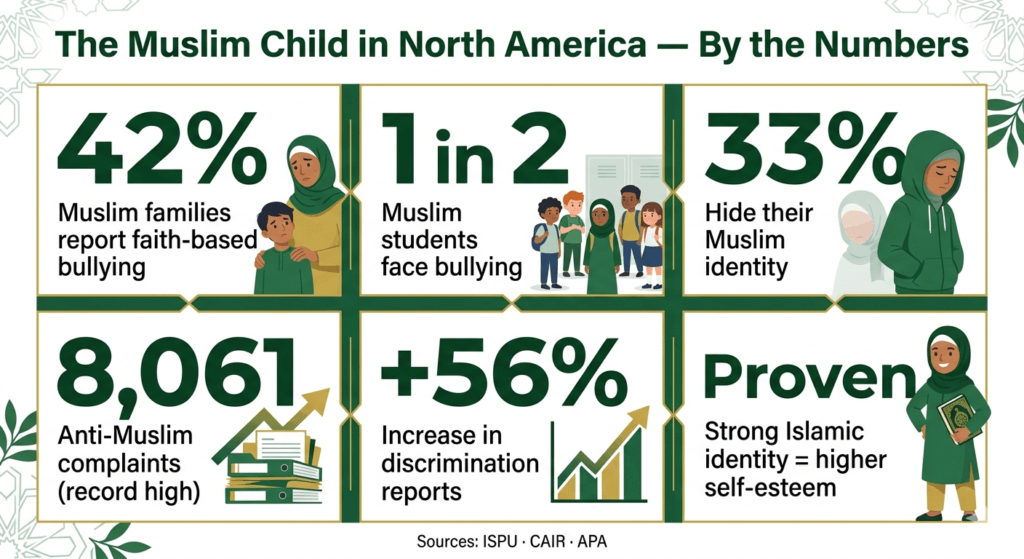
The American Psychiatric Association (APA) cites data from the Institute for Social Policy and Understanding (ISPU) showing that 42% of Muslims with children in K–12 schools report bullying of their children because of their faith. The ING (Islamic Networks Group), drawing on ISPU’s more recent research, states that “nearly 1 in 2 Muslim students face bullying” — with reports indicating significant increases in authority-figure involvement in recent years.
Additionally, ISPU data shows that 33% of Muslim students have altered their appearance, names, or behavior to hide that they are Muslim — a striking indicator of the identity pressure these children experience daily (World Hijab Day Report, citing ISPU American Muslim Poll 2020).
The Council on American-Islamic Relations (CAIR) received 8,061 complaints in 2023 — the highest in its 30-year history, representing a 56% increase over 2022 (CAIR 2024 Civil Rights Report: “FATAL: The Resurgence of Anti-Muslim Hate”).
Yet here is the crucial counterpoint that changes everything:
“Research consistently finds that strong religiosity in Muslim teens is associated with positive well-being, high self-esteem, and low anxiety.”
— ISPU American Muslim Poll 2022; Yaqeen Institute for Islamic Research, 2024
A strong Islamic identity is not a liability in the West. On the contrary, it is a documented protective factor. But only when it is deliberately built — which is exactly what this guide is about.
📎 Related: Help Your Child Love Prayer
The Three Fault Lines Every Muslim Parent Must Know
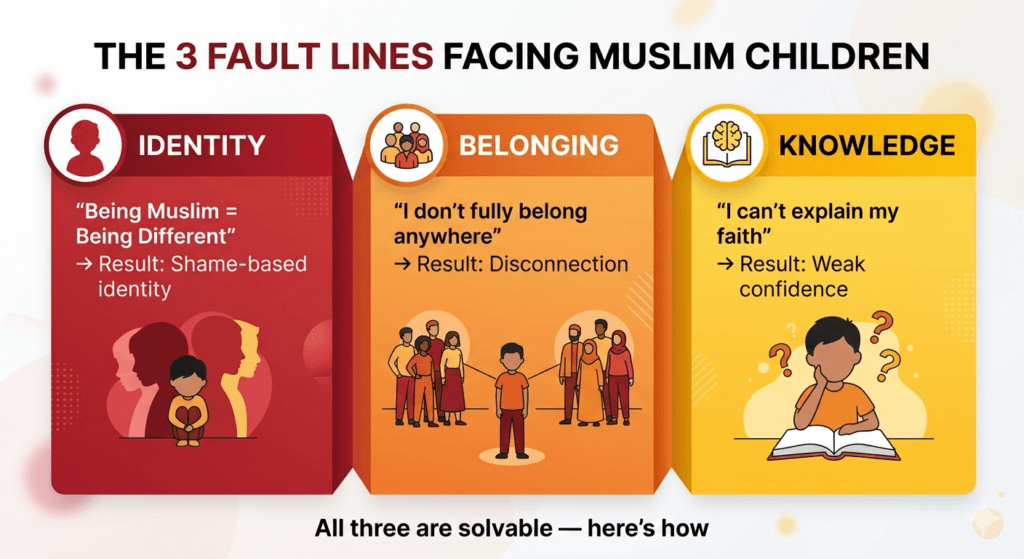
① The Identity Fault Line At school, in media, and online, Muslim identity is often filtered through suspicion, exoticism, or controversy. As a result, the child who hasn’t been given a confident Islamic identity from home constructs one in the middle of that noise — with predictably fragile results.
② The Belonging Fault Line Furthermore, the child caught between two worlds — neither fully “Muslim enough” nor fully “Western enough” — is the most vulnerable to identity crisis, faith disengagement, and in some cases, extreme responses in either direction.
③ The Knowledge Fault Line Finally, a Muslim child who cannot explain why they pray, what they believe, or why Islam matters is spiritually disarmed. Knowledge produces confidence. By contrast, absence of knowledge produces shame and avoidance.
📋 Section 1 Summary:
- 42% of Muslim K–12 families report faith-based bullying (ISPU / APA, psychiatry.org)
- “Nearly 1 in 2 Muslim students face bullying” (ING 2025, citing ISPU)
- 33% of Muslim students hide their Muslim identity at school (ISPU American Muslim Poll 2020)
- 8,061 CAIR complaints in 2023 — a 30-year record (CAIR 2024 Civil Rights Report)
- Strong Islamic identity is a documented protective factor — not a liability
- The three fault lines: Identity, Belonging, Knowledge — all three are solvable
Section 2: What Does a Confident Muslim Child Actually Look Like? The Islamic Framework
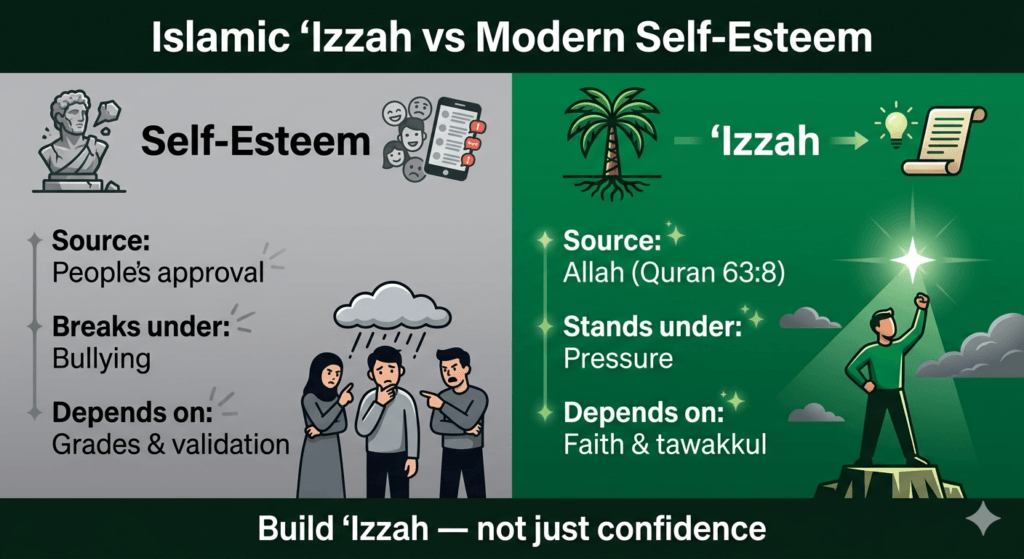
Western psychology defines confidence as self-efficacy — belief in one’s ability to accomplish tasks. However, Islamic tradition takes this further, embedding it in something deeper and more durable.
Islamic confidence = certainty about one’s identity before Allah.
📎 Related: Building Islamic Identity in Muslim Children: A Stage-by-Stage Guide
وَلِلَّهِ الْعِزَّةُ وَلِرَسُولِهِ وَلِلْمُؤْمِنِينَ
“And to Allah belongs [all] honor, and to His Messenger, and to the believers.”
— Quran 63:8
This verse is foundational. It locates the source of a believer’s dignity not in social approval, grades, or peer acceptance — but in Allah Himself.
Furthermore, Ibn al-Qayyim al-Jawziyyah, in Madarij al-Salikin (Stations of the Wayfarers), describes ‘izzah (dignity, self-worth) as one of the fruits of genuine tawakkul — trust in Allah. The child who truly believes Allah is their guardian and the source of their honor carries within them a confidence structurally immune to the fluctuations of social opinion.
“I swear by the One in Whose Hand is the soul of Muhammad: the sanctity of a believer is greater in the sight of Allah than your sanctity.”
— The Prophet ﷺ, speaking at the Ka’bah. Narrated by ‘Abdullah ibn ‘Umar; Sunan Ibn Majah, Hadith 3932
📋 Section 2 Summary:
- Western confidence depends on external validation — Islamic ‘izzah does not
- Quran 63:8 anchors a believer’s honor directly to Allah — not to society
- Ibn al-Qayyim: true tawakkul produces unshakeable self-worth (Madarij al-Salikin)
- Practical implication: teach children where their worth comes from before what to perform
7 Pillars to Raise a Confident Muslim Child in America and Canada
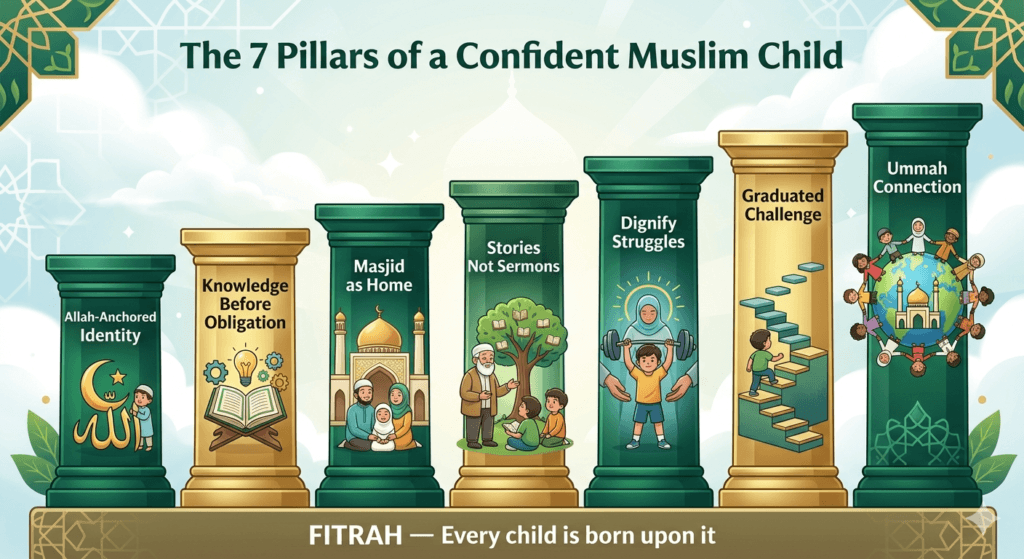
These are not abstract principles. Each is drawn from Prophetic example, classical scholarship, and the lived experience of Muslim families navigating North American life.
Pillar 1: Attach Their Identity to Allah — Not to Performance
The most common parenting trap: tying a child’s worth to achievement — grades, Quran memorization, public behavior. While excellence matters deeply in Islam, tying self-worth to performance creates a child who feels valuable only when they succeed — and worthless when they fail.
يَا غُلَامُ، إِنِّي أُعَلِّمُكَ كَلِمَاتٍ: احْفَظِ اللَّهَ يَحْفَظْكَ
“O young boy, I will teach you something: Be mindful of Allah and Allah will protect you.”
— The Prophet ﷺ to a young Ibn ‘Abbas. Sunan al-Tirmidhi, Hadith 2516; classified as Sahih
The anchor was not performance — it was the child’s relationship with Allah. When you notice something good in your child, connect it back to Allah: “Isn’t it wonderful that Allah blessed you with such patience? That’s a quality He loves.”
Pillar 2: Build Knowledge Before Building Obligations
A child who doesn’t know why they pray will eventually stop praying when no one is watching. Therefore, before you expect compliance, build understanding.
“Seeking knowledge is an obligation upon every Muslim.” — Sunan Ibn Majah, Hadith 224; classified as Sahih by al-Albani
“Faith prep” evenings: Before each school year, practice the questions your child will face: “Why do you fast?” · “What do Muslims believe about Jesus?” · “Why do you pray five times?” In short: knowledge is armor. Preparation is training.
Pillar 3: Make the Masjid Their Second Home
Children with strong Islamic identity share one thread: their parents brought them to the masjid regularly. Indeed, the masjid provides three irreplaceable things:
- A community of Muslim peers raised similarly
- Physical proof that Muslims are a civilization, not just a household custom
- A space where the child is known, welcomed, and celebrated beyond home
Practical note: Two consistent weekly commitments build deeper belonging than sporadic intensive attendance.
Pillar 4: Use Stories, Not Sermons
نَحْنُ نَقُصُّ عَلَيْكَ أَحْسَنَ الْقَصَصِ
“We relate to you the best of stories.”
— Quran 12:3
When your child shows courage: “When you stood up for that kid today — that reminded me of Musa standing in front of Pharaoh, alone, but certain of the truth.” Stories build the moral frameworks that carry children through their own hard moments.
Pillar 5: Dignify Their Struggles — Never Dismiss Them
The most damaging phrase in Muslim households: “You’re fine. People have real problems.”
“The Prophet ﷺ used to visit Umm Sulaym. When her son Anas was sad because his small bird had died, the Prophet ﷺ sat with him and said: ‘O Abu ‘Umayr — what happened to the little nightingale?'”
— Sahih al-Bukhari, Hadith 6129
He dignified the child’s grief with his presence and his question. No lecture. No comparison. Just attention. Above all, listen first. The religious conversation has a far better chance when the relationship is warm.
Pillar 6: Build Resilience Through Graduated Challenge
“The strong believer is more beloved to Allah and better than the weak believer, though there is good in both.”
— Sahih Muslim, Hadith 2664
Allow age-appropriate decision-making: choosing study schedules, deciding which surah to reflect on, planning a family act of charity. As a result, children develop the evidence-based belief: I can handle difficult things. For Muslim children who will face difficult things — this belief is not optional.
Pillar 7: Connect Them to the Ummah — Locally and Globally
إِنَّمَا الْمُؤْمِنُونَ إِخْوَةٌ
“The believers are but brothers.”
— Quran 49:10
For example, tell your child: Algebra was developed by al-Khwarizmi. The world’s first university was founded by a Muslim woman — Fatima al-Fihri — in 859 CE. Moreover, Ibn Sina’s medical encyclopedia was used in European universities until the 17th century. Let them carry that history into every classroom.
📋 Section 3 — The 7 Pillars at a Glance:
# Pillar One Action This Week 1 Allah-Anchored Identity Praise your child through Allah, not just to them 2 Knowledge Before Obligation Run a “faith prep” session before school 3 Masjid as Home Commit to two consistent weekly masjid visits 4 Stories Not Sermons Connect one moment today to a Prophetic story 5 Dignify Struggles Tonight: listen fully before responding 6 Graduated Challenge Give your child one real responsibility this week 7 Ummah Connection Share one Muslim civilization fact at dinner
🌱 Want to know exactly where your child stands — across all 7 pillars?
quranst will assess your child’s current level in Quran, Arabic, Islamic Studies, and Islamic identity — in a free 20-minute placement session. You’ll leave knowing exactly where to start and what to focus on.
Trusted by Muslim families in 40+ countries. ⏳ Limited weekly spots.
Section 4: How to Help Your Muslim Child Deal With Islamophobia and Bullying at School
We cannot write a guide for Muslim parents in America and Canada without addressing Islamophobia directly. Indeed, it is documented, measurable, and affects children as young as six.
The American Psychiatric Association notes, citing ISPU data: “Muslim children are more likely to be bullied in school than children of other faiths.” Moreover, reports indicate significant and growing involvement of authority figures — teachers, school administrators — in these incidents.
Meanwhile, the Council on American-Islamic Relations (CAIR) documented 8,061 complaints in 2023 — a 56% increase over 2022, the highest in the organization’s 30-year history.
The response is not to hide Islam. The response is to build a child so thoroughly grounded that Islamophobic attacks hit a wall — not an open wound.
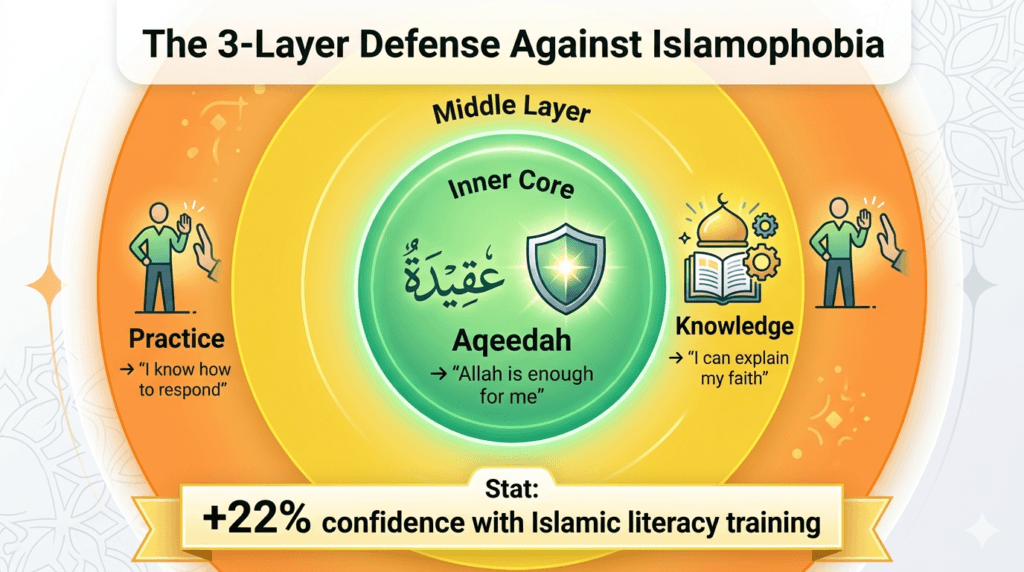
The Three-Layer Defense Framework
🛡️ Layer 1 — Inner Armor (Aqeedah)
حَسْبُنَا اللَّهُ وَنِعْمَ الْوَكِيلُ
“Allah is sufficient for us, and He is the best Disposer of affairs.”
— Quran 3:173 — recited by the Prophet ﷺ and his Companions when facing overwhelming threat
Teach this du’a as a posture — the posture of someone whose security does not rest in human approval. This is the inner fortress. When it is solid, external attacks cannot reach the core.
🛡️ Layer 2 — Intellectual Armor (Knowledge)
Moreover, students who participated in structured Islamic literacy workshops with ING reported a 22% increase in confidence when presenting about Islam in class. Clearly, knowledge is armor. The child who can calmly explain what Islam actually teaches about peace, about women, about other faiths — cannot be silenced by a hostile question.
🛡️ Layer 3 — Practical Armor (Rehearsed Responses)
Beyond knowledge, however, practical rehearsal matters equally. Practice these scenarios with your child at home — calmly, confidently, respectfully:
- “Why do you fast — isn’t that unhealthy?”
- “Do Muslims hate Christians and Jews?”
- “Are you going to be a terrorist?”
Consequently, the child who has rehearsed these ten times at home will not freeze when they face them in the cafeteria.
📋 Section 4 Summary:
- 42–48% of Muslim families report faith-based school bullying (ISPU 2020–2022 / APA)
- “Nearly 1 in 2 Muslim students face bullying” — including from authority figures (ING 2025, citing ISPU)
- Source attribution: American Psychiatric Association psychiatry.org; ING ing.org; CAIR 2024 Civil Rights Report
- The answer is more grounded Islam — not less visible identity
- Build the three layers: inner aqeedah → intellectual knowledge → rehearsed social responses
Section 5: Islamic Parenting Strategies from the Prophet ﷺ — 5 Sunnah Practices That Build Confidence
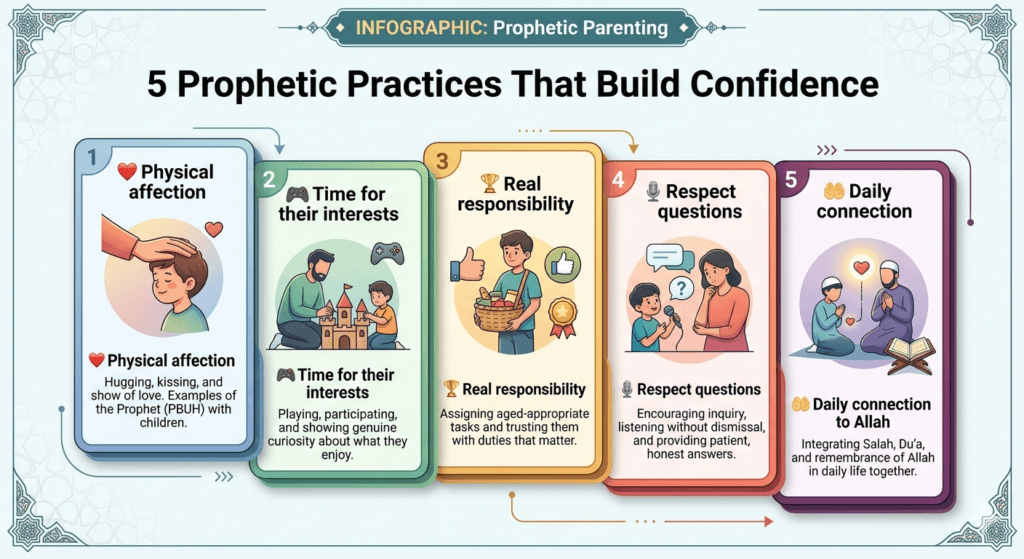
The Prophet Muhammad ﷺ is the greatest educator in human history. Indeed, his interactions with children are a masterclass in building grounded, confident, purposeful young people.
Practice 1: Physical Affection and Expressed Love
“The Prophet ﷺ kissed al-Hasan ibn ‘Ali while al-Aqra’ ibn Habis was sitting with him. Al-Aqra’ said: ‘I have ten children and I have never kissed any of them.’ The Prophet ﷺ looked at him and said: ‘Whoever does not show mercy will not be shown mercy.'”
— Sahih al-Bukhari, Hadith 5997; Sahih Muslim, Hadith 2318
Physical affection — hugging, kissing, expressed verbal love — is not a Western concept imported into Islam. On the contrary, it is Sunnah. Research in developmental psychology confirms that physically affectionate parenting produces children with higher self-esteem, lower anxiety, and stronger social competence. Remarkably, the Prophet ﷺ demonstrated this fourteen centuries ago.
Practice 2: Make Time for What They Love
“The Prophet ﷺ would visit Umm Sulaym, and she had a son called Anas. The Prophet ﷺ would play with him and joke with him.”
— Sahih al-Bukhari, Hadith 6129
The Prophet ﷺ was the busiest man in Madinah. Yet he still made time to play with children, race with ‘A’isha, and ask Anas about his pet bird. Ultimately, your child needs you — present, engaged, genuinely interested in what they love. This is where Islamic education actually begins.
Practice 3: Give Age-Appropriate Responsibility
The Prophet ﷺ sent Mu’adh ibn Jabal to Yemen as a teacher and judge while he was still in his twenties. At seventeen, ‘Usamah ibn Zayd was trusted with command of an entire army. Both examples point to the same truth: real responsibility produces real confidence. In fact, a child entrusted with meaningful tasks quickly develops an evidence-based belief in their own capability — and that belief is exactly what carries them through hard moments.
Practice 4: Answer Questions With Patience and Dignity
“A Bedouin stood up and urinated in the mosque. The people rushed to stop him, but the Prophet ﷺ said: ‘Leave him; do not interrupt him.’ After he finished, the Prophet ﷺ called him and explained kindly.”
— Sahih al-Bukhari, Hadith 6025
If the Prophet ﷺ treated the ignorance of a grown man with this patience, how much more patient should we be with our children’s questions and mistakes? Consequently, a child who knows they will never be shamed for asking a question will keep coming with the hard ones — including doubts about faith, identity, and belonging.
Practice 5: Connect Daily Life to Allah
فَاذْكُرُونِي أَذْكُرْكُمْ
“So remember Me; I will remember you.”
— Quran 2:152
The child who says bismillah before eating, alhamdulillah after, subhanallah when they see something beautiful, and astaghfirullah when they make a mistake lives in a constant conversation with Allah. Ultimately, that conversation is the deepest root of their confidence.
📋 Section 5 — Sunnah Actions for This Week:
Practice Do This Today Physical affection Hug your child every morning before school — non-negotiable Time for their interests Ask one question about what they love — and truly listen Give responsibility Let them lead the family du’a tonight Answer with patience Sit down before responding to the next “hard question” Daily Allah-connection Teach one new contextual du’a — meaning first, words second
📖 A curriculum built on exactly this model
quranst teachers are trained in the Prophetic approach to education: age-appropriate, emotionally intelligent, identity-focused. See exactly where your child stands — in Quran, Arabic, Islamic Studies, and Islamic identity — in a free 20-minute assessment.
⏳ New student slots open weekly — limited availability.
Section 6: Islamic Parenting Mistakes That Undermine Your Child’s Muslim Identity
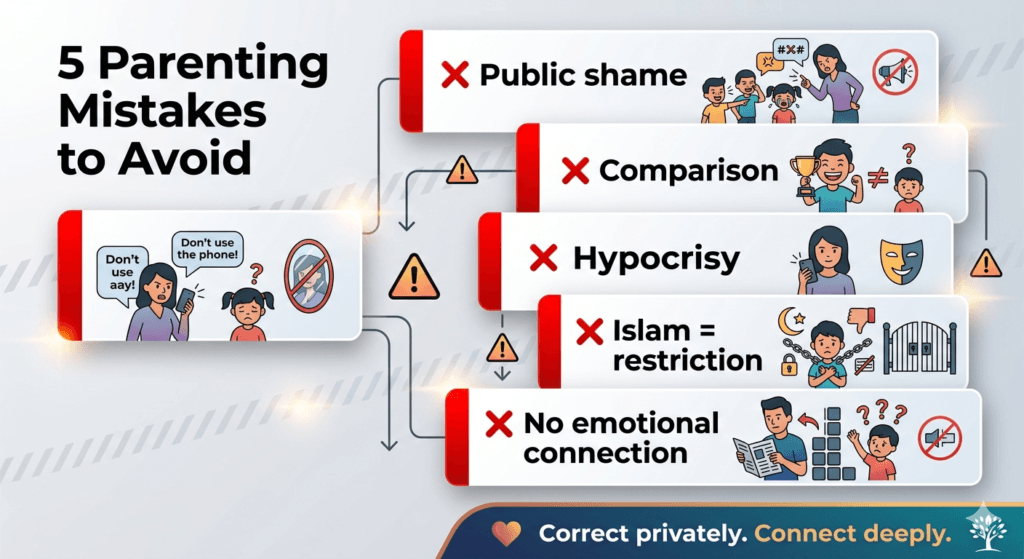
Even well-intentioned Muslim parents can fall into patterns that erode rather than build their child’s Islamic confidence.
⚠️ Mistake 1: The Public Shame Correction
“Why didn’t you pray? You were supposed to pray an hour ago!” — delivered in front of guests.
As a result, this teaches the child that Islam is associated with humiliation. Notably, the Prophet ﷺ consistently corrected people in private. Preserve your child’s dignity, and they will, in turn, preserve their relationship with their faith.
✅ Better: Pull them aside privately. Correct once, calmly, and move on.
⚠️ Mistake 2: The Comparison Trap
“Your cousin memorized 5 juz by his age.”
Above all, remember: every child is a unique creation of Allah. After all, the Quran itself was revealed over 23 years — meeting the varying needs of a real community. Meet your child where they are.
✅ Better: Celebrate their progress compared only to their own past self.
⚠️ Mistake 3: The Dual Standard Home
Children are exquisitely sensitive to hypocrisy. Consider the father who demands modesty from his children while consuming immodest content privately. Or the mother who teaches honesty, then quietly lies about a child’s age for a discount. Both scenarios share the same outcome: these inconsistencies go unspoken — and quietly hollow out the child’s trust in Islam as a lived reality.
يَا أَيُّهَا الَّذِينَ آمَنُوا لِمَ تَقُولُونَ مَا لَا تَفْعَلُونَ
“O you who have believed, why do you say what you do not do?”
— Quran 61:2
✅ Better: Model what you teach — in private as much as in public.
⚠️ Mistake 4: The “Islam as Restriction” Frame
When Islam is communicated primarily as a list of prohibitions, the religion is experienced as a cage. In reality, Islam is, in the words of the Quran, a Rahma — a mercy.
✅ Better: For every “we don’t do that,” share what Islam gives instead. For every boundary, name the freedom it creates.
⚠️ Mistake 5: Religious Education Without Relationship
Enrolling a child in every Islamic class while being emotionally absent at home produces religious burnout — not confidence. Ultimately, the most important Islamic education your child receives is watching you.
✅ Better: Be present. Be curious. Be consistent. Your example is the curriculum.
📋 Section 6 — Parent Self-Check:
- Do I correct my child privately, or in front of others?
- Do I compare my child to others to motivate them?
- Is my private behavior consistent with what I teach?
- Do I present Islam as a gift, or primarily as a restriction?
- Am I emotionally present — or just educationally providing?
Section 7: Why Most Parents Fail at Islamic Parenting — and How to Avoid It
The Real Obstacles — and Why They Are Not Your Fault
You may be reading this guide with a quiet, uncomfortable thought:
“I’ve tried before. It didn’t work.” “My child doesn’t even care anymore.” “I don’t have time for all of this.”
These are not excuses — they are real obstacles. And, as such, they deserve real answers.
Objection 1: “My Child Doesn’t Care About Islam Anymore”
This is the most common fear — and it is almost always a symptom of disconnection in relationship, not rejection of Islam itself.
In fact, research on adolescent religious disengagement consistently finds that teens who withdraw from religion are predominantly reacting to how religion was presented to them — not to the religion itself. Consequently, a child who experiences Islam as joyful, dignified, and relevant does not disengage. By contrast, a child who experiences it as shame, compulsion, and irrelevance eventually will.
The action: Don’t start with religion. Start with connection. Ask them what they’re struggling with. Watch what they watch. Be genuinely present. Religious conversation flows naturally through a warm, open relationship — and rarely through a closed, defensive one.
Objection 2: “I Don’t Have Time for All of This”
This objection is honest — North American Muslim parents are genuinely time-poor. Between long commutes, demanding work, community obligations, and the relentless logistics of modern family life, time is the scarcest resource.
Fortunately, the Prophetic answer is elegant:
“The most beloved deeds to Allah are those that are most consistent, even if they are small.”
— Sahih al-Bukhari, Hadith 6465
One consistent small act beats ten sporadic grand efforts. One family du’a. One bedtime Seerah story. One genuine conversation per week. Start there. Moreover, for structured education — this is exactly what quranst exists to solve. You don’t need to be the Islamic curriculum expert. Instead, let qualified teachers handle the formal education while you focus on being the warm, present, modeling parent.
Objection 3: “I’ve Tried Programs Before — They Didn’t Work”
Most Islamic education programs for children in the West fail for the same underlying reason: they treat the child as a vessel to fill — not a person to form. As a result, the emphasis falls on memorization over meaning, recitation over relationship, and compliance over conviction.
Before enrolling in any program, therefore, ask:
- Does the curriculum address identity, not just knowledge?
- Are teachers trained to work with diaspora children specifically?
- Is there a parent component — or does the program work in isolation from the home?
- Does the child look forward to it — or merely tolerate it?
A program your child wants to attend is worth more than one they endure.
📋 Section 7 — Objection Resolution:
Objection Root Cause Solution “My child doesn’t care” Relationship gap, not faith rejection Rebuild connection first “I don’t have time” Pursuing perfection over consistency One small daily act “Programs didn’t work before” Wrong program design Ask the right questions before enrolling
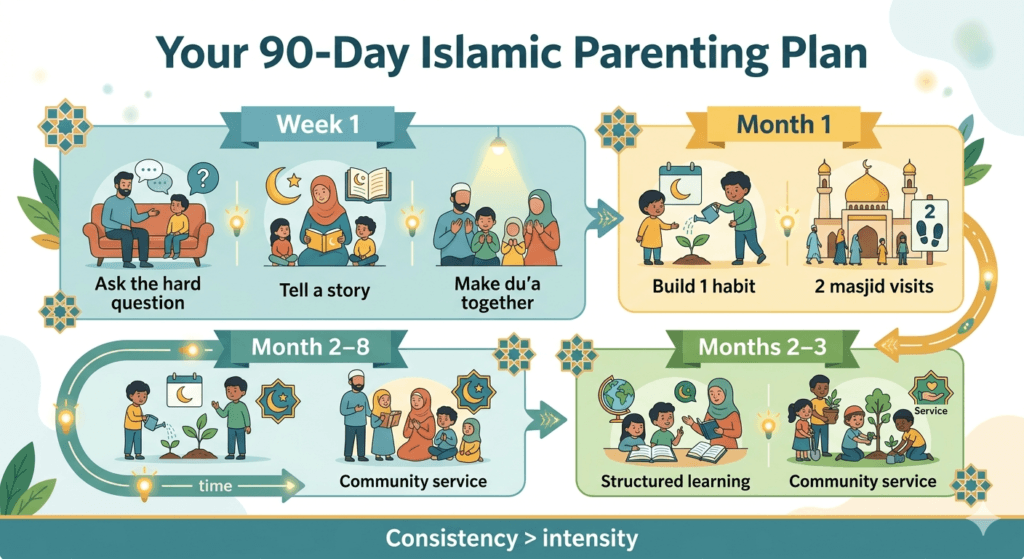
Section 8: A 90-Day Islamic Parenting Action Plan for Muslim Families in the USA and Canada
You do not need everything figured out before you begin. Here is a simple, actionable plan.
This Week — 5 Daily Actions
| Day | Action |
|---|---|
| Day 1 | Ask at dinner: “What’s the hardest thing about being Muslim at your school?” — Listen only. Don’t fix. |
| Day 2 | Find a Seerah story connecting to something your child faces now. Tell it as a story, not a lesson. |
| Day 3 | Express one specific Allah-connected praise: “I noticed your patience today — that’s hilm, and Allah loves it.” |
| Day 4 | Make family du’a out loud together, including your children by name. |
| Day 5 | Ask: “If a classmate asked you why you’re Muslim, what would you say?” Then help them build a stronger answer. |
Month 1 — One Anchor, One Habit
- First, anchor one daily Islamic habit. Consistency on one habit beats scattered effort on ten.
- Next, identify one Muslim role model connected to your child’s interests: scientist, athlete, scholar, artist.
- Finally, establish two consistent masjid commitments per week.
As the Prophet ﷺ said: “The most beloved deeds to Allah are those most consistent, even if they are small.” (Sahih al-Bukhari, Hadith 6465).
Months 2–3 — Structure and Celebration
- Enroll in structured Islamic education. quranst is designed specifically for Muslim children in North America who need a curriculum that prepares them to live their faith with confidence — not merely recite it.
- In addition, plan one family community service activity — giving back builds both belonging and shared purpose.
- Finally, begin a monthly “faith conversation” — informal, judgment-free, and genuinely curious.
📥 Download Free:
“The 7 Pillars of a Confident Muslim Child — Weekly Checklist for Parents”
A printable one-page PDF tracker. Built for busy Muslim parents in the USA and Canada. Use it alongside this guide.
Section 9: What Classical Islamic Scholars Say About Raising Confident Muslim Children
The concern for raising psychologically confident children is not a modern Western import into Islamic thought. Rather, it is deeply embedded in the classical tradition — centuries before modern psychology named these concepts.
Imam al-Ghazali (1058–1111 CE) — Ihya’ Ulum al-Din, Vol. 3
Al-Ghazali explicitly warns against shame as a disciplinary tool. Specifically, he states that excessive scolding and public humiliation cause the child to cease to care about their own dignity — and the child who no longer cares about their dignity has lost something essential to moral and spiritual functioning.
“The child is a trust in the care of his parents; his pure heart is a precious gem, simple and free of any form or engraving.”
— Al-Ghazali, Ihya’ Ulum al-Din, Vol. 3, Chapter on Child Education (Dar al-Ma’rifah, Beirut)
Ibn al-Qayyim al-Jawziyyah (1292–1350 CE) — Tuhfat al-Mawdud, p. 242
“Whoever neglects the education of his child when he can provide it has done him a great injustice. For most of the corruption of children comes from their parents, who neglect them and leave them untaught.”
— Ibn al-Qayyim, Tuhfat al-Mawdud bi-Ahkam al-Mawlud (Dar Ibn Hazm, Beirut), p. 242
Moreover, Ibn al-Qayyim also wrote that the child is born upon the fitrah — pure, upright, already oriented toward Allah. Therefore, your role is not to install something foreign. It is to protect and cultivate what is already there.
Ibn Khaldun (1332–1406 CE) — Al-Muqaddimah, Chapter 6, p. 721
Similarly, Ibn Khaldun observed that students treated with harshness and rigid control develop a psychology of servility — unable to think independently or act with conviction. In his view, the goal of education is not submission to the teacher but the formation of a capable, self-directed human being.
📋 Section 9 — Scholarly Consensus:
- Al-Ghazali: Shame destroys dignity — avoid it completely (Ihya’ Vol. 3, Dar al-Ma’rifah)
- Ibn al-Qayyim: The child is born upon fitrah — protect it, don’t install it (Tuhfat, p. 159, 242)
- Ibn Khaldun: Harshness produces servility — graduated freedom builds confidence (Muqaddimah, Ch. 6, p. 721)
- All three: The parent carries a trust — and will be asked about it
Conclusion: Back to the Child in the Bed
Do you remember the mother at the beginning of this guide?
It is 11 PM in suburban Toronto. She is sitting at the edge of her twelve-year-old son’s bed, watching him sleep. The prayer mat left untouched. The du’a no longer offered at the dinner table.
What if she had this guide a year ago?
What if, instead of waiting for the drift to become a departure, she had asked him that one dinner question: “What’s the hardest thing about being Muslim at your school?” And what if she had listened — fully, without fixing — while he told her about the cafeteria comment that made him feel like an outsider? And instead of defending Islam immediately, she had simply said: “Thank you for telling me that.”
What if, that same week, she had shared the story of Bilal — a man who was tortured for saying Ahad, Ahad while his torturers tried to make him deny it, and who became one of the most beloved companions of the Prophet ﷺ? Not as a lecture. Simply as a story, at bedtime.
What if, then, month by month — small and consistent — one habit, one masjid visit, one genuine conversation, one teacher who actually understood diaspora children — she had built around him a fortress that Islamophobia couldn’t penetrate, because he already knew, at his core, exactly who he was and Whose he was?
That child does not have a drifting prayer mat. Instead, that child walks into school the next morning with something quiet and unshakeable — the ‘izzah of a believer.
The Choice That Builds That Child
رَبِّ هَبْ لِي مِنَ الصَّالِحِينَ
“My Lord, grant me [a child] from among the righteous.”
— Quran 37:100 — the du’a of Ibrahim (peace be upon him)
This was Ibrahim’s prayer. It is, furthermore, the prayer of every Muslim parent reading this right now. And the answer to that prayer is not a miracle dropped from the sky. Rather, it is a choice — made every morning, in every interaction, in every small moment of attention and intention.
quranst is here to walk that path with you. Not as a replacement for your love, your example, or your du’a — but as a structured, expert partner, trusted by Muslim families in 12+ countries, in building the knowledge, the Quran, and the Islamic identity that will carry your child through whatever this world brings.
✦ Take the First Step — Before the Week Ends
See exactly where your child stands in Quran, Arabic, and Islamic identity — in a free 20-minute assessment.
quranst opens a limited number of new student spots each week to ensure every child receives genuine personal attention.
Built for Muslim families in the USA, Canada, UK, Australia, and beyond.
References & Sources
Quranic References
- Quran 2:152 — “Remember Me; I will remember you”
- Quran 3:173 — “Allah is sufficient for us, and He is the best Disposer of affairs”
- Quran 12:3 — “We relate to you the best of stories”
- Quran 17:24 — “Lower to them the wing of humility out of mercy”
- Quran 37:100 — Du’a of Ibrahim for righteous offspring
- Quran 49:10 — “The believers are but brothers”
- Quran 61:2 — “Why do you say what you do not do?”
- Quran 63:8 — “To Allah belongs all honor, and to His Messenger, and to the believers”
Hadith References
- Sahih al-Bukhari, Hadith 5997; Sahih Muslim, Hadith 2318 — Prophet’s mercy toward children; kissing al-Hasan
- Sahih al-Bukhari, Hadith 6025 — Patient correction of the Bedouin in the mosque
- Sahih al-Bukhari, Hadith 6129 — Prophet with Anas about his bird; dignity of a child’s grief
- Sahih al-Bukhari, Hadith 6465 — Most beloved deeds are consistent ones
- Sahih Muslim, Hadith 2664 — The strong believer is more beloved to Allah
- Sunan al-Tirmidhi, Hadith 2516 (Sahih) — “O young boy, be mindful of Allah” — to Ibn ‘Abbas
- Sunan Ibn Majah, Hadith 224 — Seeking knowledge is an obligation (authenticated by al-Albani)
- Sunan Ibn Majah, Hadith 3932 — The sanctity of a believer, at the Ka’bah
Classical Scholarly Works
- Al-Ghazali, Abu Hamid. Ihya’ Ulum al-Din (The Revival of the Religious Sciences). Vol. 3, Chapter on Child Education. Dar al-Ma’rifah, Beirut.
- Ibn al-Qayyim al-Jawziyyah. Tuhfat al-Mawdud bi-Ahkam al-Mawlud. Dar Ibn Hazm, Beirut. pp. 159, 242.
- Ibn al-Qayyim al-Jawziyyah. Madarij al-Salikin. Dar al-Kitab al-‘Arabi, Beirut.
- Ibn Khaldun. Al-Muqaddimah. Translated by Franz Rosenthal. Princeton University Press, 1989. Chapter 6, p. 721.
Verified Research Sources
Bullying & Discrimination — Primary Sources:
- American Psychiatric Association (APA). “Stress and Trauma — Muslims.” psychiatry.org. Cites ISPU: “42% of Muslims with children in K–12 schools report bullying of their children because of their faith.” URL: psychiatry.org/psychiatrists/diversity/education/stress-and-trauma/muslims
- Islamic Networks Group (ING). “Safeguarding Religious Freedom: Addressing the Challenges Facing Muslim Americans Today.” ing.org, May 29, 2025. Direct quote: “According to the Institute for Social Policy and Understanding (ISPU), nearly 1 in 2 Muslim students face bullying.” URL: ing.org/safeguarding-religious-freedom
- Institute for Social Policy and Understanding (ISPU). American Muslim Poll 2022. ispu.org/poll/american-muslim-poll-2022
- Institute for Social Policy and Understanding (ISPU). American Muslim Poll 2025. ispu.org/public-policy/american-muslim-poll-2025
- World Hijab Day Organization / ISPU American Muslim Poll 2020. “33% of Muslim students reported that they have altered their appearance, names, etc. to hide that they are Muslim.” worldhijabday.com/hijab30
- Council on American-Islamic Relations (CAIR). 2024 Civil Rights Report: “FATAL: The Resurgence of Anti-Muslim Hate.” 8,061 complaints in 2023 — highest in 30-year history; 56% increase over 2022. URL: bridge.georgetown.edu/research/2024-civil-rights-report
- ING (Islamic Networks Group). “22% increase in student confidence after Islamic literacy workshops.” ing.org
Religion & Demographics:
- Pew Research Center. “Islam Was the World’s Fastest-Growing Religion from 2010 to 2020.” June 10, 2025. pewresearch.org/short-reads/2025/06/10
- U.S. Religion Census 2020. 4.5 million Muslims in the United States. thearda.com/data-archive
Muslim Identity & Well-Being:
- MDPI Religions. “An Overview of Muslim Spiritual Parenting.” Vol. 12, No. 12 (2021). DOI: 10.3390/rel12121130
- SNMC Newsletter. “Goals of Canadian Muslim Families in Raising Their Children.” newsletter.snmc.ca, June 2021.
© quranst.com — All Rights Reserved | www.quranst.com
