

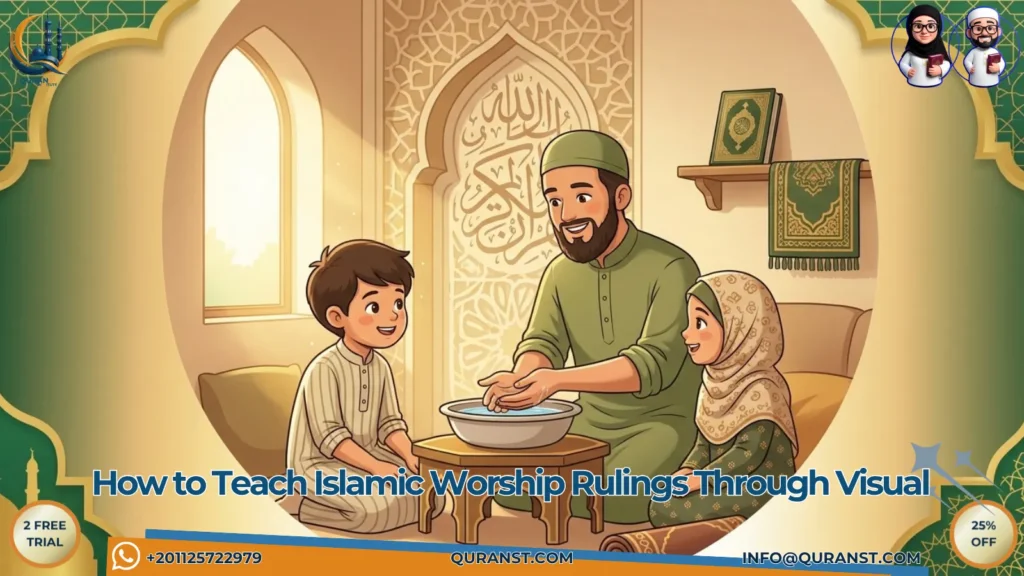
Introduction: The Child Who Prays Without Knowing What They Are Saying
He performs Wudu correctly. Every step in the right order. Hands, face, arms, head, feet. He has done it hundreds of times.
He does not know that the Prophet ﷺ said that as the water runs off each limb, the sins of that limb run off with it. He does not know that the angels who witness his Wudu are recording an act of purification that is simultaneously physical and spiritual. He does not know that the du’a he says after Wudu — “Ashhadu an la ilaha illa Allah…” — the Prophet ﷺ promised would open for him any of the eight gates of Paradise.
He knows the procedure. He does not know the Fiqh.
This is the gap that exists in most children’s Islamic education — and it is a significant one. Fiqh al-Ibadah (the jurisprudence of worship) is not primarily a body of rules to be memorized. It is a system of meaning — a divinely designed architecture that connects every physical act of worship to a theological truth, every step of Wudu to a spiritual reality, every unit of Salah to a specific station in the relationship between the servant and Allah.
The child who knows only the procedure has learned the shell. The child who knows the Fiqh has learned the pearl inside it.
Research confirms that a child who knows why they perform Wudu is far more likely to do it consistently than one who was just told to do it. The goal of Fiqh education is not memorization alone — it is understanding. When children understand the purpose and meaning behind Islamic worship, they develop intrinsic motivation that external instruction alone cannot produce.
This guide is the complete system for teaching Fiqh al-Ibadah to Muslim children — not through abstract rule recitation, but through visual demonstration, interactive practice, story-based illustration, and the kind of meaning-anchored explanation that transforms procedure into devotion.
Structured Curriculum Framework
quranst’s Islamic Studies track teaches Fiqh al-Ibadah as a structured, meaning-rich curriculum — connecting every worship ruling to its Quranic foundation, Hadith source, and practical daily application. Live, one-on-one sessions with certified instructors.
Book your free 2-session trial →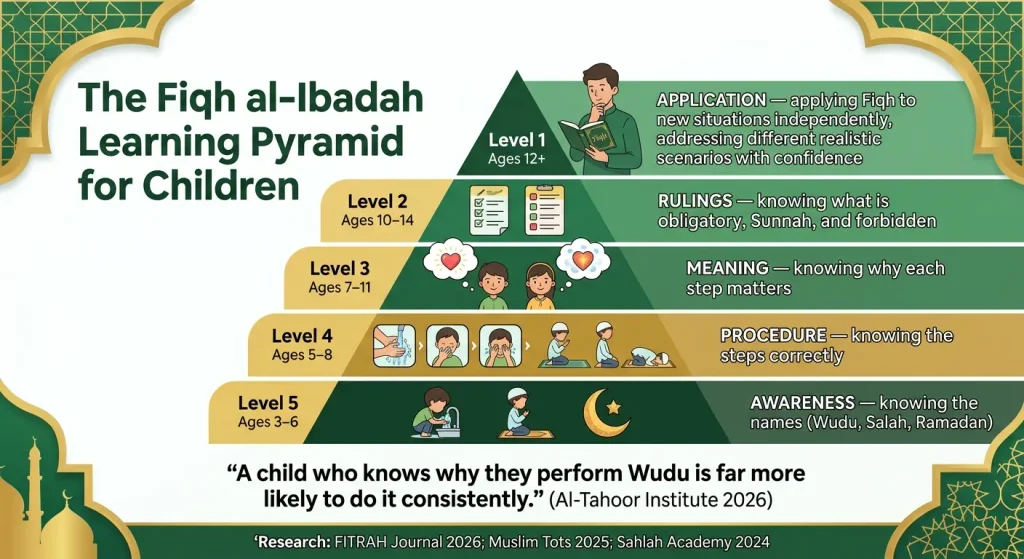
The Quranic Foundation: Why Understanding Worship Matters
The Quran does not present worship as a list of procedures to be executed correctly. It presents worship as a living relationship — between the servant who approaches and the Lord who receives.
إِنَّ الصَّلَاةَ تَنْهَىٰ عَنِ الْفَحْشَاءِ وَالْمُنكَرِ
“Indeed, prayer prohibits immorality and wrongdoing.”
— Quran 29:45
The prayer that is performed correctly in procedure but not in consciousness does not carry this promise. The Quran’s description of the prayer that “prohibits immorality” is a prayer that is performed with awareness — the Salah of a child who knows they are standing before Allah, who knows what Al-Hamdulillah means and feels gratitude when they say it, who knows what Allahu Akbar means and feels the magnification of Allah when they say it.
يَا أَيُّهَا الَّذِينَ آمَنُوا كُتِبَ عَلَيْكُمُ الصِّيَامُ كَمَا كُتِبَ عَلَى الَّذِينَ مِن قَبْلِكُمْ لَعَلَّكُمْ تَتَّقُونَ
“O you who have believed, decreed upon you is fasting as it was decreed upon those before you — that you may become righteous (Taqwa).”
— Quran 2:183
The purpose of fasting is Taqwa — God-consciousness. The child who fasts without knowing this has performed the procedure. The child who fasts for Taqwa has performed the Fiqh.
The Prophet ﷺ established this meaning-centered approach to worship in one of the most important pedagogical statements in the Hadith:
“Pray as you have seen me pray.“
— Sahih al-Bukhari, Hadith 631
See me pray. Not: read the rules of prayer. Not: memorize the steps of prayer. Watch me. The primary transmission of Fiqh in the Prophetic model was visual — the Companions watched, imitated, asked, and understood.
The visual, interactive, story-based methods in this guide are not pedagogical innovations. They are the restoration of the Prophetic model of Fiqh transmission.
Section 1: The Research — Why Visual and Interactive Methods Work for Fiqh
Research published in the FITRAH Journal of Islamic Studies (June 2026) on the integration of e-modules in teaching Fiqh al-Ibadah at Pesantren Muhammad Natsir found that the use of visual e-modules significantly improves students’ understanding of worship procedures — particularly for Wudu, Tayammum, and prayer movements — through visual explanations and structured learning steps. The research confirms that visual and structured digital learning improves comprehension of Fiqh content significantly over text-based instruction alone.
Research confirms that children can comprehend Salah, Wudu, fasting, and charity far more effectively when the right tools are used: animated demonstrations, stories, and interactive practice. Early Fiqh learning linked to increased self-discipline and respect in all aspects of life — education and community service. Early initiation by parents facilitates the development of children into confident, committed Muslims.
Research from Sahlah Academy’s curriculum development confirms that hands-on activities — including creating visual aids and group discussions — significantly improve engagement and retention in Fiqh learning. Practical demonstrations of Salah, with emphasis on correct postures observed visually rather than described verbally, produce more accurate and more lasting learning outcomes.
The Four Learning Channels for Fiqh
Effective Fiqh education for children engages all four primary learning channels:
Visual: Diagrams, step-by-step visual sequences, illustrated story books, demonstration videos, body position charts Auditory: The teacher’s narration, the sounds of the worship act itself, Quranic verses recited in context Kinesthetic: Physical practice of the act — actually performing Wudu, actually performing each Salah position, actually making and distributing Zakat Narrative: Stories that embed Fiqh rulings in memorable human contexts — the Companion who asked about Wudu, the child who fasted their first Ramadan
Teachers who use practical demonstrations during live sessions — including showing correct Salah postures — produce children who learn by seeing rather than just hearing. The teacher who only describes Wudu leaves the child with an auditory memory; the teacher who demonstrates it alongside the child leaves them with a bodily memory that persists long after the lesson ends.
Section 2: The Five Pillars as a Learning Framework
The Fiqh al-Ibadah curriculum for children is naturally organized around the Five Pillars of Islam — the most fundamental framework of Islamic worship practice.
The Prophet ﷺ said:
“Islam is built upon five: the testimony that there is no god but Allah and that Muhammad is His Messenger, establishing prayer, paying Zakat, fasting Ramadan, and performing Hajj to the House for whoever is able.”
— Sahih al-Bukhari, Hadith 8; Sahih Muslim, Hadith 16
These five are not simply obligations. They are the architectural pillars of the Muslim’s life — the five points of connection between the servant and Allah that organize the day (Salah), the year (Sawm), the wealth (Zakat), and the lifetime (Hajj).
The Fiqh Curriculum Sequence by Age
| Pillar | When to Begin Teaching | What to Teach First | When to Add Rulings |
|---|---|---|---|
| Shahada | Birth — continuously | Meaning and love | Ages 5–7: conditions and implications |
| Wudu/Salah | Ages 4–5 (procedure) | The steps, observed visually | Ages 7–9: obligatory acts vs. Sunnah |
| Sawm | Ages 6–7 (partial fasts) | Why we fast; Ramadan spirit | Ages 10–11: full obligations |
| Zakat | Ages 6–8 (Sadaqah concept) | Giving as worship; generosity | Ages 12+: calculation and categories |
| Hajj | Ages 5+ (storytelling) | The journey and its meaning | Ages 10+: rituals and their wisdom |
Section 3: Wudu (Purification) — Twelve Visual Teaching Methods
Wudu is the first Fiqh a Muslim child learns in practice — and the most frequently performed act of Islamic jurisprudence in their daily life. A child who performs five prayers daily performs Wudu at minimum three times — more than a thousand times per year.
The quality of that practice — whether it is mechanical routine or conscious worship — depends entirely on whether the child has been taught the Fiqh alongside the procedure.
The Four Obligatory Acts and Their Meaning
From the Hanafi school (widely followed):
| Obligatory Act | Action | Meaning for the Child |
|---|---|---|
| Niyyah (intention) | Intending Wudu in the heart | “I am doing this for Allah, not just to get clean” |
| Face (once) | Washing the full face | “Every sin my eyes, mouth, or face committed is running off with this water” |
| Arms to elbows (once) | Both arms to elbow | “My hands’ sins — the things I grabbed, took, or hit — are being washed away” |
| Head (masah — wiping one quarter) | Wiping part of the head | “What my mind thought, what my ears heard — I am purifying all of it” |
| Feet to ankles (once) | Both feet | “The places my feet walked that they shouldn’t have — washed away” |
(Classical Fiqh source: Ibn Qudama, Al-Mughni; Al-Nawawi, Al-Majmu’)
The Twelve Visual Teaching Methods for Wudu
1. The Live Demonstration: The parent performs Wudu slowly, narrating each step aloud with its meaning. “I’m washing my face now. The Prophet ﷺ said every sin I committed with my face runs off with this water.” The child watches. Then does.
2. The Wudu Poster: A laminated, step-by-step visual chart posted near the bathroom sink. Each step illustrated with a simple image and the step name in Arabic + English.
3. The Wudu Song: For young children (ages 3–7), a simple melody that sequences the steps of Wudu. The rhythm creates procedural memory that persists even when the instruction is forgotten.
4. The Error Correction Game: The parent performs Wudu with two deliberate errors. The child watches and identifies the errors. This actively engages the child’s knowledge of the procedure rather than just having them passively observe.
5. The Sin-Washing Story: Tell the full narration of the Hadith in which the Prophet ﷺ describes the sins running off each limb during Wudu. (Sahih Muslim, Hadith 244) Then ask: “Which limb’s sins do you think need the most washing today?” This connects the physical act to the child’s own moral self-awareness.
6. The Wudu Conditions Chart: For older children (ages 8+), a visual flowchart that covers the conditions and invalidators of Wudu — presented as a decision tree. “Does [event] break Wudu? Yes/No → and what comes next.”
7. The After-Wudu Du’a Practice: The Prophet ﷺ promised that whoever says the Shahada after Wudu will have all eight gates of Paradise opened for them (Sahih Muslim, Hadith 234). Make the after-Wudu du’a a non-negotiable, meaning-anchored practice. “You just washed away your sins. Now you say these words, and the Prophet ﷺ said the gates of Paradise open for you. Say it with me.”
8. The Tayammum Introduction (for older children): When there is no water, or for illness — what does the Muslim do? The Tayammum lesson teaches the principle of Islamic jurisprudence that underlies the entire system: Islam removes hardship. The rule always has a valid alternative when the primary option is genuinely unavailable. Quran 4:43.
9. The Role-Play Scenarios: “You are about to pray but you just touched something that might break Wudu. What do you do?” The child works through realistic Fiqh scenarios — building the independent reasoning (ijtihad at the child’s level) that Fiqh education ultimately aims for.
10. The Wudu Competition: Which sibling can perform the most complete Wudu — not fastest, but most accurately, most consciously, with all steps in correct order and all du’as said? The parent judges on a simple rubric.
11. The Wudu Journal: For older children learning Fiqh formally, a weekly Wudu journal: “This week I performed Wudu [X] times. One time I did it especially consciously was… One thing I want to improve is…”
12. The Wudu and Salah Connection: Never teach Wudu in isolation. Always connect it to its purpose: “Wudu is the key to the prayer. The Prophet ﷺ said ‘The prayer of the one who does not have Wudu is not accepted.'” (Sunan Abu Dawud, Hadith 60; authenticated by al-Albani)
Section 4: Salah (Prayer) — Making the Most Complex Pillar Genuinely Understood
Salah is the most frequently performed — and most comprehensively structured — act of Islamic worship. Its seventeen daily units, its specific postures, its recited texts, its internal conditions (khushu’) — together they form the most complete act of worship in any religious tradition.
And yet, for most Muslim children, Salah is learned as a sequence of physical movements with recited Arabic sounds — without the understanding that transforms movement into conversation with Allah.
The Theological Frame
The Prophet ﷺ said:
“When any of you stands to pray, he is speaking privately with his Lord.”
— Sahih al-Bukhari, Hadith 405 (narrated from Abu Hurayrah in related narrations; the concept is documented in multiple authenticated traditions)
Speaking privately with his Lord. Not performing a ritual. Not executing a procedure. Conversing with Allah. This one reframe changes everything about how Salah is taught to children.
The child who knows they are in private conversation with Allah — who understands that “Alhamdulillahi rabb il-‘alamin” means “All praise belongs to Allah, the Lord of all the worlds” and feels the praise rising in them — is praying a different Salah from the child who is producing correct sounds in the correct order.
The Salah Teaching Sequence
At the beginner level, children learn the importance of the five daily prayers (Salah), including their steps and significance. As they advance, they learn more detailed aspects of prayer including its conditions, obligations, and the correct way to make up missed prayers. Emphasis is placed on practical demonstrations with visual aids and hands-on activities to encourage active participation.
Phase 1 — The Story of Salah (Ages 4–6)
Before the child learns the steps, teach the story: the Night of Isra and Mi’raj, when the Prophet ﷺ was taken through the heavens and received the gift of fifty prayers from Allah — then, through the intercession of Musa (peace be upon him), the number was reduced to five that count as fifty in reward.
The child who knows this story knows that the five daily prayers are a gift from Allah — the most precious gift ever given to a human being, delivered personally through the heavens. They approach prayer differently than the child for whom prayer is simply an obligation.
Phase 2 — The Meaning of Al-Fatiha (Ages 5–8)
Al-Fatiha is recited in every unit of every prayer — seventeen times daily. It is the most recited text in the life of a Muslim. And its meaning is both accessible and profound.
Teach it verse by verse, in the order it is recited:
| Verse | Arabic | Meaning | For the Child |
|---|---|---|---|
| 1 | بِسْمِ اللَّهِ الرَّحْمَٰنِ الرَّحِيمِ | “In the name of Allah, the Most Gracious, the Most Merciful” | “I begin this conversation in His name” |
| 2 | الْحَمْدُ لِلَّهِ رَبِّ الْعَالَمِينَ | “All praise is to Allah, the Lord of all worlds” | “Everything good comes from Him — I acknowledge that right now” |
| 3 | الرَّحْمَٰنِ الرَّحِيمِ | “The Most Gracious, the Most Merciful” | “He is merciful to everyone — and specifically merciful to me” |
| 4 | مَالِكِ يَوْمِ الدِّينِ | “Master of the Day of Judgment” | “There is a day when everything will be accounted for — He controls it” |
| 5 | إِيَّاكَ نَعْبُدُ وَإِيَّاكَ نَسْتَعِينُ | “It is You we worship and You we ask for help” | “Only You, Allah — not the teacher, not the popular kid, not my own power. You.” |
| 6 | اهْدِنَا الصِّرَاطَ الْمُسْتَقِيمَ | “Guide us to the straight path” | “I need guidance — every day. I am asking right now.” |
| 7 | صِرَاطَ الَّذِينَ أَنْعَمْتَ عَلَيْهِمْ… | “The path of those You have blessed — not of those who earned anger or went astray” | “Show me the people who got it right — and let me walk with them” |
The child who understands Al-Fatiha at this level is not reciting sounds. They are having a conversation.
Phase 3 — The Postures and Their Meanings (Ages 7–10)
Each posture of Salah embodies a theological truth:
- Qiyam (standing): The servant stands before the King — upright, present, attentive
- Ruku’ (bowing): The head bows — acknowledgment that Allah is above all human pride
- Sujood (prostration): The highest point of the body (the forehead) touches the lowest point (the ground) — the total submission that the Prophet ﷺ called the closest moment a servant can be to Allah (Sahih Muslim, Hadith 482)
- Juloos (sitting): Rest between the prostrations — the moment of asking (du’a in the sitting position is particularly blessed)
The child who understands why they bow — not just that they must bow — bows differently. Their Ruku’ carries a different quality of acknowledgment.
Phase 4 — The Conditions, Pillars, and Invalidators (Ages 9–13)
Only after the meaning is established do the formal Fiqh rules become genuinely useful — because the child who loves Salah wants to perform it correctly. The rules are the answer to “how do I do this right?” not a cage that surrounds an obligatory chore.
The conditions of Salah (taharah, facing Qibla, covering ‘awrah, entering the prayer time, niyyah) are taught as the prerequisites of the conversation: “If you were going to speak to the most important person in existence, you would prepare yourself. These are the preparations for speaking to Allah.”
The Khushu’ (Concentration) Curriculum
The goal of Fiqh education is not memorization alone — it is understanding. Teachers use practical demonstrations during live sessions, including showing correct Salah postures, so children learn by seeing, not just hearing.
Khushu’ — the quality of concentrated presence in prayer — is both the most important and the most neglected dimension of Salah education for children. The child can perform every physical element correctly and still be absent from the prayer in the most important sense.
Teaching khushu’ to children:
The Conversation Reminder: Before each prayer, briefly: “We’re about to speak directly to Allah. He is listening. He sees you. He knows what you’re asking before you ask it. Be present.”
The One-Verse Focus: Choose one verse from Al-Fatiha and focus on its meaning for this one prayer. “In today’s prayer, when we reach ‘Iyyaka na’budu’ — think about what it means that we say ‘only You’ right now.”
The Concentration Check: After Salah, occasionally ask: “Was your mind in the prayer? Which part did you feel most present in?” This builds metacognitive awareness of their own attention without creating performance anxiety.
Section 5: Sawm (Fasting) — Teaching the Inner Dimension to Children
The Theological Frame
Allah said about fasting — uniquely, in the Hadith Qudsi:
“Every act of the son of Adam is for himself — except fasting. It is for Me, and I will reward it.”
— Sahih al-Bukhari, Hadith 1904; Sahih Muslim, Hadith 1151
Fasting is the only act of worship that is invisible to others — only Allah knows if someone is genuinely fasting. This makes it the purest test of Taqwa: the child who fasts when no one is watching has demonstrated that their worship is truly for Allah, not for social approval.
This theological reality — taught in language accessible to children — transforms the experience of fasting from physical deprivation into the most personal act of worship available to a Muslim.
The Fasting Teaching Sequence
Ages 5–7 — Half-Day Fasting and Ramadan Awareness: Begin with partial fasts — from Fajr to Dhuhr, or from Suhoor to the early afternoon. The goal is not to build physical endurance but to introduce the experience and its meaning.
“Today you are fasting. No eating or drinking until we break your fast together. This is what Muslims do in Ramadan — and Allah loves it so much that He keeps the reward of fasting as a special gift He gives directly.”
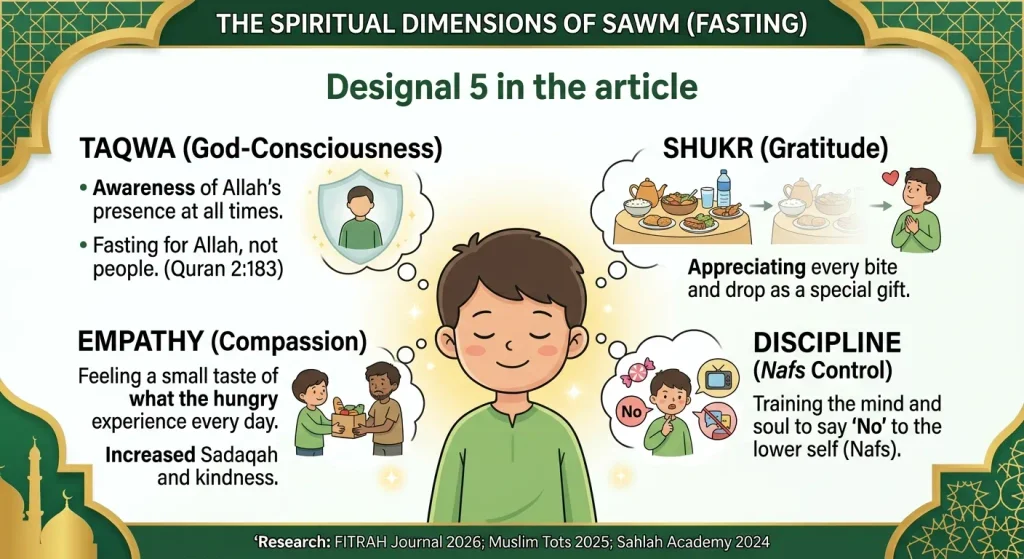
Ages 8–10 — Full Fasting and the Five Purposes: Introduce the five objectives of fasting:
- Taqwa — God-consciousness (Quran 2:183)
- Shukr — Gratitude for food, water, and every blessing normally taken for granted
- Empathy — A genuine taste of what the hungry feel, every day
- Discipline — Controlling the nafs (desires) in the most basic way
- Community — The entire ummah fasting together, breaking fast together
Ages 11+ — Fasting Rulings: The conditions that invalidate the fast, the categories of those exempt, the Kaffarah (expiation) for breaking the fast deliberately — taught as the Fiqh structure that protects and clarifies the worship.
The Visual Teaching Methods for Sawm
The Ramadan Countdown Chart: A visual daily tracker for the child’s own fasting progress — not just dates but notes on what they noticed, what they were grateful for, what was hard.
The Suhoor-to-Iftar Visual Timeline: A clock diagram showing the duration of the fast, the times of the recommended acts (Suhoor, Fajr prayer, reading Quran, Dhuhr and Asr prayer, the hours of hunger that connect to empathy for the poor), and the Iftar moment.
The Fasting Feelings Journal: At Iftar each day: “What were you grateful for today that you don’t usually notice? What did the hunger feel like?” This builds the inner Taqwa dimension that is the purpose of fasting.
Section 6: Zakat and Sadaqah — Generosity as Practiced Jurisprudence
The Teaching Sequence
The Prophet ﷺ said:
“The upper hand (giving) is better than the lower hand (receiving).”
— Sahih al-Bukhari, Hadith 1427
For children, the Fiqh of Zakat begins not with nisab calculations but with Sadaqah — voluntary giving that children can practice at any age, at any wealth level.
Children learn about the concept of Zakat (charity) and its significance in strengthening one’s connection with Allah and the community. The curriculum guides them from the basic concept of giving to the more detailed rules of calculation as they advance in age and understanding.
Ages 5–8: The Sadaqah Jar — a visible container where the child deposits a portion of any money they receive, for periodic donation to a chosen cause.
Ages 8–12: Introduction to Zakat as obligatory giving — who must pay, the threshold (nisab), the categories of recipients. Taught through a visual flowchart: “Do I have this much saved for a year? → Then this percentage goes to…”
Ages 12+: The full Fiqh of Zakat — calculation methods, valid recipients, intention, and the theological foundation: that wealth is a trust from Allah, and Zakat is the portion that was never truly theirs to keep.
Section 7: Hajj — The Pilgrimage Your Child Can Understand Before They Go
The Story Before the Rulings
The Fiqh of Hajj begins with Ibrahim (peace be upon him) and the founding of the Kaaba — the story that gives every ritual its meaning.
The child who knows why pilgrims walk between Al-Safa and Al-Marwa — because Hajar ran between them searching for water for her son Ismail, and her trust in Allah produced the well of Zamzam — performs that ritual differently from the child who only knows that walking between them is required.
Each ritual of Hajj has a story:
- The Ka’bah: Built by Ibrahim and Ismail, established as the first house of worship on earth
- Tawaf (circumambulation): The angels circle the Bayt al-Ma’mur in heaven — the pilgrims mirror the heavenly worship
- Sa’i (Safa-Marwa): Hajar’s trust in Allah producing the miracle of Zamzam
- Arafat: The gathering that mirrors the Day of Judgment — the ultimate rehearsal
- The Jamarat (stoning): Ibrahim’s rejection of Shaytan — the pilgrim reenacts the rejection of evil
The Home Hajj Experience: For children who have not yet performed Hajj, recreate the experience at home — a Ramadan or Dhul-Hijja activity where the family learns the rituals in sequence, enacting them in simplified form while discussing their meaning.
Section 8: Age-by-Age Fiqh Learning Framework
Early Fiqh learning — beginning before age 10 — is linked to increased self-discipline and respect in all aspects of life, including education and community service. Children who grow up understanding the why behind Islamic worship naturally grow as followers of Islam rather than experiencing religion as an external imposition.
| Age Range | Fiqh Content | Teaching Method | Goal |
|---|---|---|---|
| 3–5 | Names and basic awareness (Wudu, Salah, Ramadan) | Observation, songs, simple stories | Familiarity and love |
| 5–7 | Wudu steps, Salah postures, Ramadan awareness | Live demonstration, visual aids, family modeling | Correct procedure |
| 7–10 | Full Wudu Fiqh, Al-Fatiha meaning, Salah conditions, Sawm basics | Interactive practice, story-based learning, visual charts | Meaning alongside procedure |
| 10–13 | Salah pillars and invalidators, Sawm rulings, Zakat introduction, Hajj rituals | Role-play scenarios, Fiqh flowcharts, discussion | Ruling-level understanding |
| 13+ | Full Fiqh with scholarly references, comparative perspectives, application to new situations | Study Islam online with certified instructor, independent reading, Fiqh case studies | Independent application |
The Critical Ages 7–12
Children learn fastest between the ages of 4 and 12. This is the window in which Fiqh that is taught correctly, with meaning and visual engagement, becomes genuinely internalized — not rules imposed from outside but understanding that the child has made their own.
For these years, the combination of:
- Live demonstration by a parent or teacher
- Visual aids (posters, charts, illustrated guides)
- Story-based illustration (the Hadith stories behind each ruling)
- Interactive practice (role-play, competitions, journaling)
- Consistent daily application (the actual performance of the worship)
…produces a Fiqh literacy that lasts a lifetime.
Structured Curriculum Framework
quranst’s Islamic Studies track delivers structured, visual, story-based Fiqh al-Ibadah education — connecting every ruling to its Quranic foundation, Hadith source, and practical meaning. Certified instructors, live sessions, ages 5–18.
Book your free 2-session trial →Conclusion: The Child Who Understands Why They Worship
There is a quality that the classical scholars called ‘ilm nafi’ — beneficial knowledge. Knowledge that changes the one who holds it. Knowledge that shows up not just in what they can recite but in how they live.
The child who has learned the Fiqh of Wudu with its meaning washes their hands differently. The child who knows that they are speaking privately with Allah during Salah stands differently when they pray. The child who understands that their fast is the one act of worship kept secret between them and Allah fasts with a different quality of sincerity.
This is the difference between Fiqh as a list of rules and Fiqh as a lived understanding of worship.
And the path to that understanding — for children — runs through visual demonstration, through story, through interaction, through seeing and doing and asking and experiencing — the same path by which the Prophet ﷺ taught it to his Companions fourteen centuries ago.
“Pray as you have seen me pray.”
They saw him. They learned. They became the generation that carried Islam to the world.
Your child can see. They can learn. They can become.
إِنَّ الصَّلَاةَ كَانَتْ عَلَى الْمُؤْمِنِينَ كِتَابًا مَّوْقُوتًا
“Indeed, prayer has been decreed upon the believers at specified times.”
— Quran 4:103
Teach the prayer. Teach the times. Teach the meaning. Together.
🟢 Give Your Child Fiqh That They Actually Understand
The Fiqh education that produces children who understand why they worship — not just how — requires structured, expert-led instruction alongside home learning.
quranst’s Islamic Studies track delivers comprehensive Fiqh al-Ibadah:
Taharah and Salah:
- Wudu — the four obligatory acts, the Sunnah acts, the du’as, and their meanings
- Salah — postures, recitations, conditions, pillars, invalidators, and the inner dimension of khushu’
- Study Islam online through live, one-on-one sessions with certified instructors
The Five Pillars Complete:
- Shahada — meaning, conditions, and what it demands of daily life
- Sawm — the obligations, the exemptions, and the inner Taqwa dimension
- Zakat — from Sadaqah for young children to full calculation for teenagers
- Hajj — story-based ritual understanding before the pilgrimage and formal Fiqh for older students
Aqeedah Foundation:
- Tawheed as the root of all worship — taught alongside the Fiqh
- The connection between belief and practice that makes Fiqh genuinely Islamic
Hadith and Seerah:
- The Hadith sources of each ruling, taught with their stories
- The Prophet’s ﷺ model of worship as the living example of every Fiqh rule
👇 Begin with Two Free Sessions
Two Ways to Begin
“Pray as you have seen me pray.”
— Sahih al-Bukhari, Hadith 631
See it. Learn it. Understand it. Live it.
بِسْمِ اللَّهِ — Begin.
References and Sources
Quranic References
- Quran 2:183 — “Decreed upon you is fasting — that you may become righteous”
- Quran 4:43 — Tayammum (dry ablution) when water is unavailable
- Quran 4:103 — “Prayer has been decreed upon the believers at specified times”
- Quran 29:45 — “Indeed, prayer prohibits immorality and wrongdoing”
Hadith References
- Sahih al-Bukhari, Hadith 8; Sahih Muslim, Hadith 16 — The Five Pillars of Islam
- Sahih al-Bukhari, Hadith 405 — “When any of you stands to pray, he is speaking privately with his Lord”
- Sahih al-Bukhari, Hadith 631 — “Pray as you have seen me pray”
- Sahih al-Bukhari, Hadith 1427 — “The upper hand (giving) is better than the lower hand”
- Sahih al-Bukhari, Hadith 1904; Sahih Muslim, Hadith 1151 — “Fasting is for Me and I will reward it” (Hadith Qudsi)
- Sahih Muslim, Hadith 234 — After-Wudu du’a: gates of Paradise opened
- Sahih Muslim, Hadith 244 — Sins running off limbs during Wudu
- Sahih Muslim, Hadith 482 — Sujood as the closest moment to Allah
- Sunan Abu Dawud, Hadith 60 — “The prayer of the one without Wudu is not accepted” (authenticated by al-Albani)
Classical Fiqh Sources
- Ibn Qudama: Al-Mughni. (Hanbal school Fiqh reference — Wudu obligations)
- Al-Nawawi: Al-Majmu’ Sharh al-Muhadhdhab. (Shafi’i school Fiqh reference — comprehensive)
Research Sources
- FITRAH: Jurnal Kajian Ilmu-ilmu Keislaman (June 2026). “Enhancing Fiqh al-Ibadah Learning Through Humanistic E-Modules at Pesantren Muhammad Natsir.” Key findings: Visual e-modules significantly improve understanding of Wudu, Tayammum, and prayer movements through structured visual steps; digital modules improve comprehension over text-based instruction.
- Sahlah Academy (June 2024). “Islamic Studies Lessons for Kids: Quran, Arabic, Fiqh, Seerah, Islamic Manners.” Key findings: Practical demonstrations of Salah with visual aids produce better retention; beginner through advanced Fiqh curriculum progression; hands-on activities significantly improve engagement.
- Muslim Tots (September 2025). “Learn Fiqh Online for Kids.” Key findings: Children comprehend Salah, Wudu, fasting with animated demonstrations and interactive games; early Fiqh learning linked to increased self-discipline and respect; early initiation facilitates confident Muslim development.
- Sahlah Academy (June 2024). “Islamic Studies Lessons for Kids.” Key findings: Hands-on activities including visual aids and group discussions improve engagement and retention; practical demonstrations of correct Salah postures produce more accurate learning outcomes.
- Al-Tahoor Quran Institute (May 2026). “Islamic Studies For Kids Online.” Key findings: Children learn fastest between ages 4 and 12; teachers using practical demonstrations in live sessions produce children who learn by seeing; understanding why Wudu is performed produces more consistent practice.
- 121 Islam for Kids (February 2024). “Islamic Online Education: Fiqh Curriculum for Ages 8–10.” Key findings: Objective to introduce children to Fiqh principles and guide application to daily life; teach significance of Five Pillars including prayer, purification, fasting, Zakat, and Hajj.
Frequently Asked Questions
At what age should children start learning Fiqh al-Ibadah?
Why is visual and interactive learning essential for teaching Fiqh to children?
How can parents help their children develop Khushu’ (focus) in Salah?
- Explain the Meaning: Teach the translation of Surah Al-Fatiha and daily Zikr verse by verse.
- Remind of the Conversation: Before starting, remind the child that they are speaking directly with Allah.
- Explain Posture Wisdom: Help them understand why we bow (Ruku’) and prostrate (Sujood) as acts of humility and closeness to Allah.
